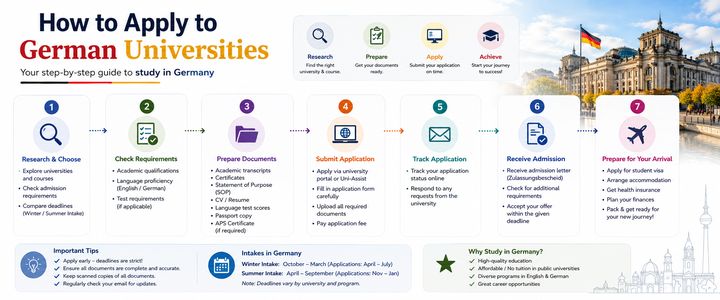

Germany primarily has two university admission intakes:
Winter Semester
Summer Semester
For international students, choosing between the two can affect the number of universities available, course selection, application deadlines, visa preparation, accommodation, and overall admission strategy.
The Winter Semester is the main intake in Germany. Most universities and degree programs admit new students during this period, making it the best option for students who want the widest possible choice.
The Summer Semester is a smaller secondary intake. Fewer programs begin in summer, but it can still be an excellent choice for students whose preferred course is available and who do not want to wait until the following winter.
The right intake is therefore not simply the one with “easier admission.”
It depends on:
Your preferred university
Course availability
Degree level
Academic eligibility
Application readiness
Language-test results
APS status
Visa preparation
Personal timeline
This guide compares the Winter and Summer intakes in Germany in detail and explains which intake may be better for international and Indian students.
Germany Intakes at a Glance
| Category | Winter Intake | Summer Intake |
|---|---|---|
| German Name | Wintersemester | Sommersemester |
| Abbreviation | WiSe / WS | SoSe / SS |
| Main Semester Period | October–March | April–September |
| Classes Commonly Begin | September/October | March/April |
| Common Application Deadline | Around 15 July | Around 15 January |
| Program Availability | Highest | Lower |
| Bachelor’s Options | Very High | Limited |
| Master’s Options | Very High | Moderate |
| Competition | Usually higher applicant volume | Applicant volume may be lower |
| Scholarships | Wide availability | Available, but program dependent |
| Accommodation Pressure | Generally higher | Can be somewhat lower |
| Best For | Maximum choice | Students with eligible summer-start programs |
What Is the Winter Intake in Germany?
The Winter Semester is the primary academic intake at German universities.
At most universities, the official semester generally runs from:
1 October to 31 March
However, universities of applied sciences and individual institutions may use somewhat different calendars.
Lectures commonly begin around September or October.
The Winter Semester is the most important intake because the majority of German degree programs allow students to begin during this period.
Students can find Winter admission for:
Bachelor’s degrees
Master’s degrees
Engineering
Computer Science
Artificial Intelligence
Business
Economics
Medicine
Natural Sciences
Humanities
Social Sciences
Architecture
Design
Studienkolleg
Selected dual-study programs
For students who want the greatest number of choices, Winter is usually the better intake.
What Is the Summer Intake in Germany?
The Summer Semester is Germany’s secondary university intake.
At most universities, it generally runs from:
1 April to 30 September
Classes commonly begin around March or April.
Unlike Winter, not every degree accepts first-semester students during the Summer Semester.
Some universities may allow:
Master’s admission
Higher-semester admission
Selected Bachelor’s programs
Exchange students
while keeping many first-semester Bachelor’s programs available only in Winter.
This is why students must check the intake for the specific program, rather than assuming the whole university accepts Summer applications.
Winter vs Summer Intake: Main Difference
The biggest difference is course availability.
Winter has substantially more programs.
Summer has fewer choices.
This does not necessarily mean Summer programs are academically weaker or less valuable.
A student joining a degree in Summer receives the same degree as a student joining the same program in Winter.
The intake itself does not appear as a different qualification.
Winter Intake Application Timeline
For many universities, Winter applications follow approximately this pattern:
October–December of Previous Year
Start:
University research
Course shortlisting
Academic eligibility checks
German preparation
IELTS or TOEFL preparation
January–March
Complete:
Language tests
APS preparation
Academic documentation
CV
Motivation letter
Recommendation letters
March–May
Applications may begin opening.
Some Master’s programs already have deadlines during this period.
May–July
This is an important application period for many universities.
A common deadline is:
15 July
However, this is not universal.
August–September
Students may receive:
Admission decisions
Enrollment instructions
Visa-related documentation
Students should simultaneously arrange:
Financial proof
Health insurance
Accommodation
Visa
September–October
Travel and semester beginning.
Summer Intake Application Timeline
Summer applicants should begin much earlier than many students expect.
May–July of Previous Year
Research:
Universities
Summer-start courses
Eligibility
Language requirements
July–September
Complete:
APS
IELTS/TOEFL
German-language examinations
Academic documentation
September–November
Prepare:
CV
Motivation letter
Recommendations
uni-assist documents
VPD where required
Some Summer applications may begin opening during this period.
December–January
A common Summer application deadline is:
15 January
Some programs close earlier.
February–March
Admission decisions, visa preparation, housing, and enrollment.
March–April
Travel and semester beginning.
Which Intake Has More Courses?
Winter.
This is the most important advantage of Winter admission.
Many programs, particularly Bachelor’s degrees, admit new students only once per year.
That entry point is frequently the Winter Semester.
Winter provides more options in:
Engineering
Computer Science
Natural Sciences
Business
Economics
Humanities
Social Sciences
Medicine
Psychology
Architecture
Summer course availability depends heavily on the university and subject.
Bachelor’s Intake in Germany
For Bachelor’s students, Winter is generally the better choice.
Many German Bachelor’s degrees:
Begin only in Winter
Follow a curriculum designed around an October start
Offer first-semester core modules only once per academic year
Summer Bachelor’s admission exists, but the choice is considerably smaller.
Students who want maximum flexibility should plan for Winter.
Master’s Intake in Germany
Master’s students have more flexibility.
Many German universities offer Master’s programs in:
Winter only
Winter and Summer
Occasionally Summer only
English-taught Master’s degrees are available in both intakes.
Popular areas include:
Computer Science
Artificial Intelligence
Data Science
Mechanical Engineering
Electrical Engineering
Renewable Energy
Physics
Mathematics
Biotechnology
Economics
Business
Environmental Science
Students should check each program individually.
Which Intake Is Better for Engineering?
Winter generally provides the widest choice.
Engineering fields can include:
Mechanical Engineering
Electrical Engineering
Automotive Engineering
Civil Engineering
Chemical Engineering
Mechatronics
Aerospace
Materials Science
Industrial Engineering
Summer admission is still available in selected programs.
For Master’s students, it is worth checking both intakes.
Which Intake Is Better for Computer Science?
Computer Science and related areas often have good availability across German universities.
Winter still provides more options overall.
Students may find Summer-start programs in:
Computer Science
Data Science
Artificial Intelligence
Software Engineering
Cybersecurity
Information Systems
Applicants should pay close attention to prerequisite-credit requirements.
Which Intake Is Better for Business?
Both intakes may offer business-related Master’s programs.
Possible subjects include:
Management
Finance
Economics
International Business
Business Analytics
Entrepreneurship
Supply Chain Management
Private universities sometimes provide additional intakes beyond the standard Winter and Summer model.
Winter Intake Advantages
Maximum University Choice
Winter provides access to the largest number of programs.
More Bachelor’s Programs
Students applying immediately after school will generally find significantly more choices.
Greater Course Variety
More specializations and electives may begin in Winter.
Larger Incoming Student Community
Universities usually receive their largest new cohort during the Winter Semester.
This can make orientation and social integration easier.
More University Activities
Welcome events, clubs, and orientation programs are often designed around the main Winter intake.
Winter Intake Disadvantages
Larger Applicant Volume
Because Winter is the main intake, a large number of international and domestic students apply.
This does not mean every program is harder to enter, because admission depends on the number of seats and selection method.
Housing Pressure
Large numbers of new students arrive around September and October.
Finding:
Student housing
Shared apartments
Private rooms
can be difficult in popular cities.
Visa Pressure
Embassies and consulates may receive large numbers of student visa applications before the Winter Semester.
Early preparation is important.
Summer Intake Advantages
Earlier Start Instead of Waiting
Students who miss Winter admission may be able to begin in March or April instead of waiting until the next October.
Potentially Smaller Incoming Cohort
Some Summer programs have smaller numbers of new students.
Housing May Be Slightly Easier
Because fewer new university students begin during Summer, housing pressure may sometimes be lower than during the major autumn arrival period.
This varies significantly by city.
Useful for Master’s Students
Summer is particularly valuable for Master’s applicants because many graduate programs offer both entry periods.
Summer Intake Disadvantages
Fewer Programs
This is the biggest disadvantage.
Students may find their preferred program is simply unavailable.
Limited Bachelor’s Choice
Many Bachelor’s degrees accept first-semester students only in Winter.
Fewer Alternatives
If one or two Summer applications are rejected, students may have fewer backup programs available.
This makes proper shortlisting especially important.
Is Summer Intake Easier to Get Into?
Not necessarily.
This is a common misconception.
A Summer intake may receive fewer applications, but it can also have fewer available places.
Admission depends on:
Number of seats
Number of applicants
Academic requirements
GPA
Previous subject credits
Language score
NC restrictions
Aptitude tests
Students should not choose Summer only because they assume admission will be easier.
Does Intake Affect Degree Value?
No.
A student who begins the same Master’s program in April and another who begins in October receive the same academic qualification.
Employers normally care about:
Degree
University
Skills
Experience
Grades
Internships
Projects
German proficiency
rather than whether the student joined in Winter or Summer.
Does Intake Affect Tuition Fees?
Normally, the intake itself does not determine tuition.
Students pay according to:
University
Degree
Nationality
State
Program fee structure
For most public universities, regular programs may have no general tuition, although students pay semester contributions.
Exceptions can include:
Baden-Württemberg tuition for many non-EU students
TUM tuition for many non-EU students
Professional Master’s programs
Continuing-education programs
Private universities
Does Intake Affect Scholarships?
Some scholarships accept applications annually rather than by academic intake.
Others are linked to:
University admission
Degree program
Scholarship cycle
Winter applicants may sometimes encounter more opportunities simply because more programs start during Winter.
However, students should search by scholarship deadline rather than assuming it follows the university deadline.
Winter vs Summer for International Students
For most international students:
Winter = better overall choice
because it offers:
More universities
More courses
More Bachelor’s degrees
More alternatives
Summer can still be strategically excellent when:
Your exact program is offered
You missed Winter
You complete your previous degree late
Your APS or language test takes longer
You want to avoid delaying your studies for a full year
Which Intake Is Better for Indian Students?
For most Indian students, Winter is usually the preferred intake.
The reason is course availability rather than nationality.
Winter works well with students completing:
Class 12
Bachelor’s degrees
Final university examinations
However, Indian students should plan for additional processes such as:
APS
IELTS or TOEFL
German-language tests
uni-assist
VPD
Visa processing
Selected Master’s applicants in affected academic fields should also check current dMAT requirements for upcoming admission cycles.
APS Timeline and Intake Choice
Indian students should not leave APS until the final application stage.
For Winter admission, begin preparing APS months before major university deadlines.
For Summer admission, start APS preparation during the previous year.
Delays can affect:
Application
Visa
Enrollment
depending on the university and applicant situation.
Winter Intake for Indian Bachelor’s Students
Students applying after Class 12 generally benefit from Winter because more undergraduate programs start then.
Students should first determine whether they qualify for:
Direct admission
Subject-restricted direct admission
Studienkolleg
Eligibility should be checked before university shortlisting.
Summer Intake for Indian Bachelor’s Students
Summer Bachelor’s options are limited.
Applicants should search specifically for:
“Studienbeginn: Sommersemester”
rather than assuming a course accepts Summer applications.
Winter Intake for Indian Master’s Students
This is usually the largest admission cycle.
Students can find substantial choice across:
Engineering
Computer Science
AI
Data Science
Business
Economics
Natural Sciences
Because competition and application volume can be high, students should prepare multiple universities.
Summer Intake for Indian Master’s Students
Summer can be an excellent second route.
It is particularly useful for students who:
Missed a Winter deadline
Graduated later
Needed additional time for IELTS
Needed additional time for APS
Want to improve their profile
Found their desired program in Summer
Winter Intake Application Documents
Typical documents include:
Passport
Academic certificates
Academic transcripts
Class 10 and 12 documents
Bachelor’s documents for Master’s applicants
APS certificate for applicable Indian applicants
IELTS/TOEFL
German-language certificate
CV
Motivation letter
Recommendation letters
Module descriptions
VPD where required
Portfolio for relevant courses
The same broad document categories usually apply to Summer.
uni-assist Deadlines
Students applying through uni-assist should not wait until the university deadline.
Processing can take several weeks.
A safer strategy is to submit the application approximately eight weeks before the final deadline whenever possible.
Students requiring a VPD should allow even more time because:
uni-assist must evaluate the documents.
The VPD must be issued.
The student must then apply separately to the university.
What Happens If You Miss the Winter Deadline?
You have several options.
Option 1: Find Summer Programs
Check whether the same or a similar degree begins in Summer.
Option 2: Find Universities with Later Deadlines
Application deadlines vary.
Some universities continue accepting applications after common national dates.
Option 3: Prepare for the Next Winter
Use the extra time to improve:
German
IELTS
Research
Internships
Projects
Work experience
A six-month or one-year delay can be useful if it significantly strengthens the application.
What Happens If You Miss the Summer Deadline?
Because Winter follows several months later and offers many more programs, missing Summer is generally easier to manage.
Students can prepare for the next Winter intake.
Which Intake Is Better for Studienkolleg?
Availability varies by Studienkolleg.
Some have:
Winter admission
Summer admission
Both
Deadlines can be significantly earlier than regular university deadlines.
Students should separately check:
Studienkolleg deadline
Entrance-test date
German requirement
FSP subjects
Which Intake Is Better for Medicine?
Medicine is highly competitive and subject to specific admission procedures.
Program availability should be checked carefully.
Winter generally offers broader first-semester availability.
International applicants should not rely on the general Winter/Summer deadlines used for ordinary unrestricted degrees.
Which Intake Is Better for PhD?
PhD admission works differently.
Doctoral candidates may begin based on:
Research project availability
Supervisor agreement
Employment contract
Graduate-school schedule
Many PhD positions are advertised throughout the year.
Therefore, the Winter-vs-Summer distinction is less important for doctoral research than it is for Bachelor’s and Master’s study.
Which Intake Has More English-Taught Programs?
Winter generally has more English-taught programs because it has more programs overall.
However, a substantial number of English-taught Master’s degrees also accept Summer students.
Students searching for an English Master’s should examine both intakes.
Admission Competition: Winter vs Summer
It is misleading to say:
“Summer is easy.”
or:
“Winter is difficult.”
Competition is program-specific.
Imagine:
Winter: 1,000 applicants for 200 seats
Summer: 400 applicants for 50 seats
The Summer intake receives fewer applications but can still be more competitive proportionally.
Focus on academic fit instead.
Accommodation: Winter vs Summer
Winter
Housing can be difficult because large numbers of students arrive at the same time.
Popular cities include:
Munich
Berlin
Hamburg
Frankfurt
Stuttgart
Cologne
Summer
Housing demand can sometimes be slightly less intense, although affordable rooms remain competitive in major cities.
Regardless of intake, apply for student housing as early as possible.
Weather When You Arrive
This is a small but practical difference.
Winter Intake
Students arriving in September or October experience:
Autumn
Shortening daylight
Colder weather soon after arrival
Winter within a few months
Summer Intake
Students arriving in March or April experience:
Spring
Longer days
Warmer weather ahead
Easier outdoor exploration
For students moving abroad for the first time, Summer arrival can sometimes make the initial adjustment more comfortable.
Student Life
Winter usually brings:
Larger orientation events
More new students
More club recruitment
Bigger welcome programs
Summer students still receive university support, but new-student activities may involve smaller groups.
Part-Time Jobs
Both Winter and Summer students can seek student employment subject to the applicable immigration and employment rules.
Employment availability depends more on:
City
German skills
Field of study
Experience
Semester workload
than on intake.
Internships
The intake does not fundamentally change internship eligibility.
However, semester sequencing can affect when students become available for:
Summer internships
Working-student positions
Research assistantships
Students should examine the curriculum structure.
Can You Switch from Winter to Summer?
You normally cannot simply change the intake after being admitted unless the university allows:
Deferral
Reapplication
Enrollment in a later semester
Some universities do not permit deferral.
Students who cannot join their admitted semester may need to apply again.
Can You Apply for Both Intakes?
Yes.
A student who is unsuccessful in Winter can apply again for Summer when the course is offered.
Similarly, a student rejected for Summer can apply for the next Winter.
Each semester normally requires a separate application.
Winter Intake vs Summer Intake Comparison
| Factor | Winter | Summer |
|---|---|---|
| Course Availability | Excellent | Limited |
| Bachelor’s Programs | Excellent | Limited |
| Master’s Programs | Excellent | Good in selected fields |
| English Programs | More | Fewer |
| Number of Applicants | Higher | Generally lower |
| Admission Difficulty | Program dependent | Program dependent |
| Housing Competition | High | Sometimes lower |
| Student Orientation | Larger | Smaller |
| Weather on Arrival | Autumn | Spring |
| Backup Universities | More | Fewer |
| Best Overall Choice | Yes | Strong alternative |
Who Should Choose Winter Intake?
Winter is best for students who:
Want maximum program choice
Are applying for a Bachelor’s
Want several backup universities
Are applying to competitive fields
Want access to the main university admission cycle
Have enough time to complete documentation
Who Should Choose Summer Intake?
Summer is best for students who:
Have found the exact course they want
Missed Winter deadlines
Completed their previous degree later
Need additional APS or language-test preparation
Do not want to wait an entire year
Are applying mainly for Master’s study
Recommended Strategy
Do not begin by deciding:
“I want Winter.”
Instead:
Choose the subject.
Find suitable universities.
Check academic eligibility.
Check which intakes each course offers.
Compare the programs.
Choose the intake.
The program should decide the intake, not the other way around.
Common Mistakes
Assuming every program has two intakes
Waiting until July to start Winter preparation
Waiting until January to start Summer preparation
Applying only to famous universities
Assuming Summer admission is easier
Ignoring university-specific deadlines
Treating 15 July as a universal deadline
Treating 15 January as a universal deadline
Applying for VPD too late
Starting APS too late
Ignoring visa-processing time
Assuming admission can automatically be deferred
Choosing Summer without checking course availability
Missing earlier Master’s deadlines
Ignoring Studienkolleg-specific deadlines
Frequently Asked Questions
How many intakes are there in Germany?
Germany primarily has two university intakes: Winter and Summer.
Which is the main intake?
Winter is the main intake.
When does the Winter Semester start?
At most universities, the semester begins in October, although classes and university activities can begin around September or October.
When does the Summer Semester start?
At most universities, the semester begins in April, with some academic activities beginning in March.
What is the Winter application deadline?
Many universities use 15 July, but the exact deadline depends on the course and university.
What is the Summer deadline?
Many programs use 15 January, although individual deadlines can be earlier or later.
Which intake has more courses?
Winter.
Is Summer intake easier?
Not necessarily. Competition depends on applications, seats, and admission criteria.
Is Winter better for Bachelor’s?
Generally yes because considerably more Bachelor’s programs begin during Winter.
Is Summer good for Master’s?
Yes. Many Master’s programs accept Summer applications.
Is the degree different?
No. Students receive the same qualification for the same program regardless of intake.
Does Summer intake have fewer scholarships?
Scholarship availability depends on the funding program rather than simply on the intake.
Can Indian students apply for Summer intake?
Yes, provided the chosen program accepts Summer admission and all academic, APS, language, and other requirements are met.
Can I apply to Winter after being rejected for Summer?
Yes.
Can I apply to Summer after missing Winter?
Yes, provided your chosen course accepts Summer entry.
When should I start preparing?
Ideally eight to twelve months before the intended semester.
Final Verdict: Winter or Summer?
For most international students, Winter is the better default choice.
It provides:
More universities
More courses
More Bachelor’s options
More English-taught programs
More backup choices
However, Summer should not be considered an inferior intake.
It can be an excellent option when:
Your preferred course is available
Your academic profile is ready
You missed Winter
You want to begin sooner rather than wait another year
For Bachelor’s applicants:
Winter is generally preferable.
For Master’s applicants:
Check both Winter and Summer.
For PhD applicants:
Focus on research positions and supervisors rather than intake.
The smartest strategy is therefore not to choose Winter or Summer first.
Start with the program you want, check its available start semester, confirm the deadline, and build your application timeline backward from that date.