
Germany is one of the few major international study destinations where students can earn a recognized university degree without paying high tuition fees.
Most public universities do not charge general tuition for regular bachelor’s degrees and many consecutive master’s programs. This policy usually applies to German, EU, and non-EU students.
However, studying in Germany is not completely free.
Even at a tuition-free university, students must normally pay for:
Semester contributions
Accommodation
Health insurance
Food
Visa expenses
Study materials
Transportation not covered by the semester ticket
Academic document verification
Personal expenses
Housing deposits
Residence-permit charges
The realistic goal is therefore not always to study at zero cost. It is to reduce tuition to zero or close to zero and cover remaining expenses through scholarships, affordable housing, careful budgeting, and permitted student employment.
This guide explains how international students can study in Germany for free or at the lowest possible cost.
Can International Students Really Study in Germany for Free?
Yes, international students can study tuition-free at many public universities in Germany.
As a general rule, state-funded universities do not charge tuition for regular bachelor’s programs and many consecutive master’s degrees. Students instead pay a semester contribution, which supports administration, student services, student representation, and sometimes public transportation.
Tuition-free does not mean cost-free.
A student may avoid €10,000, €20,000, or more in annual tuition but still need approximately €900 to €1,200 per month for living expenses. The final amount depends heavily on the city, accommodation, lifestyle, insurance, and personal spending.
What Does “Study for Free” Actually Mean?
There are three realistic ways to study in Germany at little or no personal cost.
Route 1: Tuition-Free Public University
The student attends a public university that does not charge general tuition and pays only:
Semester contribution
Living expenses
Insurance
Administrative costs
This is the most common route.
Route 2: Tuition-Free University Plus Scholarship
The student attends a tuition-free public university and receives a scholarship that helps cover:
Monthly living costs
Health insurance
Travel
Study materials
Research expenses
Family allowance in selected cases
This can reduce the student’s personal expenses substantially.
Route 3: Fully Funded Scholarship
A full scholarship may cover most or all major expenses, including:
Tuition where applicable
Monthly stipend
Insurance
Travel allowance
Study and research allowance
German-language course
Accommodation support in selected programs
Fully funded scholarships are highly competitive and are more common for master’s, doctoral, research, and development-related programs than for regular bachelor’s degrees.
Public Universities with No General Tuition
Many public universities offer regular programs without general tuition.
Examples include:
Ludwig Maximilian University of Munich
Humboldt University of Berlin
Freie Universität Berlin
Technical University of Berlin
University of Hamburg
University of Cologne
University of Bonn
University of Göttingen
TU Dresden
Leipzig University
University of Bremen
Saarland University
University of Bayreuth
Otto von Guericke University Magdeburg
Martin Luther University Halle-Wittenberg
University of Jena
TU Chemnitz
University of Siegen
Students must check the exact course rather than relying only on the university’s general fee policy.
A university may be tuition-free for most degrees but charge tuition for:
MBA programs
Executive degrees
Continuing-education master’s programs
Distance-learning courses
Second degrees
Professional programs
Selected international degrees
Long-term study
Important Tuition Exceptions
Students should not assume that every German public university is free.
Baden-Württemberg
Most students from outside the EU and EEA studying at public universities in Baden-Württemberg generally pay €1,500 per semester unless they qualify for an exemption.
Universities affected include:
Heidelberg University
University of Freiburg
University of Tübingen
University of Stuttgart
Karlsruhe Institute of Technology
University of Mannheim
University of Ulm
University of Hohenheim
University of Konstanz
These institutions remain considerably cheaper than many universities in the United States, United Kingdom, Australia, or Canada, but they are not tuition-free for most non-EU students.
Technical University of Munich
Many students from outside the EU and EEA pay program-specific tuition at TUM.
Typical fees are:
€2,000 or €3,000 per semester for many bachelor’s programs
€4,000 or €6,000 per semester for many master’s programs
Semester contributions and living expenses are additional.
Scholarships and tuition waivers may be available for eligible students. A waiver is normally awarded for a limited period and may need to be renewed.
Private Universities
Private universities generally charge tuition.
Fees can range from:
Several hundred euros per month
€5,000–€10,000 per semester
€25,000–€40,000 for a complete master’s degree
€40,000–€50,000 for a premium MBA
Students seeking the lowest-cost route should normally prioritize public universities.
How Much Is the Semester Contribution?
Students at tuition-free universities usually pay a mandatory semester contribution.
It commonly ranges from approximately €150 to more than €450 per semester.
The payment may include:
Student services
Student union
Administrative charges
Student representation
Campus facilities
Public transportation
Cultural benefits
Subsidized dining services
The semester contribution is not tuition.
In some cities, the included transportation ticket can save students a significant amount of money during the semester.
Best Tuition-Free Universities by Subject
Computer Science and Artificial Intelligence
Affordable public options include:
Saarland University
TU Berlin
TU Dresden
TU Darmstadt
RWTH Aachen University
University of Bonn
TU Chemnitz
Otto von Guericke University Magdeburg
University of Freiburg, subject to non-EU tuition
University of Tübingen, subject to non-EU tuition
Engineering
Strong options include:
RWTH Aachen University
TU Berlin
TU Dresden
TU Darmstadt
Hamburg University of Technology
Leibniz University Hannover
TU Braunschweig
TU Chemnitz
Otto von Guericke University Magdeburg
University of Siegen
Business and Economics
Affordable choices include:
University of Cologne
Goethe University Frankfurt
LMU Munich
University of Bayreuth
Leipzig University
University of Jena
Otto von Guericke University Magdeburg
Saarland University
Natural Sciences
Students may consider:
University of Bonn
University of Göttingen
LMU Munich
University of Hamburg
University of Cologne
University of Jena
Leipzig University
TU Dresden
University of Bayreuth
Medicine
Most public medical universities charge no general tuition outside the main fee exceptions.
Examples include:
Charité – Universitätsmedizin Berlin
LMU Munich
University of Hamburg
University of Bonn
University of Göttingen
University of Cologne
University of Münster
Leipzig University
Medicine is usually taught in German, is extremely competitive, and leads to the German Medical State Examination.
Humanities and Social Sciences
Strong tuition-free options include:
Humboldt University of Berlin
Freie Universität Berlin
University of Cologne
University of Hamburg
Leipzig University
University of Göttingen
University of Bonn
LMU Munich
Step 1: Choose a Tuition-Free Program
Begin by searching for public universities and filtering programs by:
Subject
Degree level
Teaching language
Tuition
City
Admission restrictions
Academic prerequisites
Application deadline
Germany offers many internationally oriented programs, particularly at the master’s level. Students can search by degree type, language, tuition level, subject, institution, and location.
Check the Exact Fee Page
Before applying, verify:
General tuition
Non-EU tuition
Semester contribution
Application fee
Program-specific fee
Examination fee
Study-material costs
Required excursions
Internship expenses
Do not rely on third-party statements claiming that an entire university is free.
Step 2: Confirm Academic Eligibility
Bachelor’s Applicants
Students need a recognized university entrance qualification.
A foreign school-leaving certificate may provide:
Direct admission
Subject-restricted admission
Eligibility after completing additional university study
Eligibility only after Studienkolleg
No immediate eligibility
Students whose school qualification is not equivalent to the German university entrance qualification may need to complete a Studienkolleg before starting the degree.
Master’s Applicants
Applicants usually need:
Recognized bachelor’s degree
Relevant academic background
Required subject credits
Competitive grades
Language proficiency
Complete transcripts
Module descriptions
Curriculum vitae
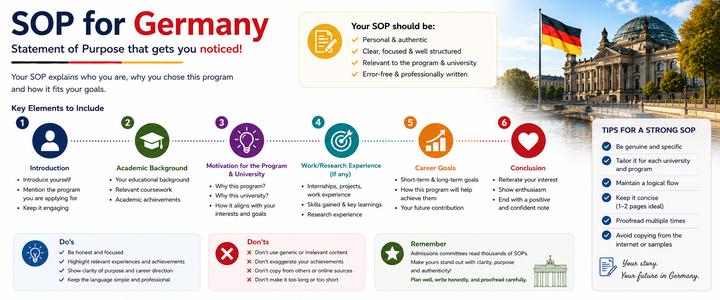
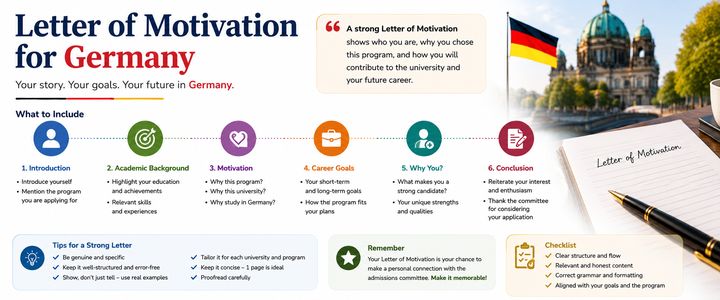
Motivation letter
Recommendation letters for selected courses
Work experience for professional programs
German universities often evaluate the content of the previous degree, not only its title.
A student with a bachelor’s degree in electronics may not automatically qualify for every computer-science master’s program unless the required programming, algorithms, mathematics, and theoretical-computing credits are present.
Step 3: Choose Between German- and English-Taught Programs
German-Taught Programs
German-taught degrees provide the widest selection, especially at the bachelor’s level.
Common language requirements include:
B2 German
C1 German
DSH-2
TestDaF with the required score
Accepted equivalent certificate
Medicine, law, teaching, psychology, social work, and many undergraduate programs require advanced German.
English-Taught Programs
English-taught degrees are widely available at the master’s level.
Common requirements include:
IELTS
TOEFL
Cambridge English
Previous degree taught in English, when accepted
Another university-approved certificate
English programs are available in:
Engineering
Computer Science
Artificial Intelligence
Data Science
Natural Sciences
Business
Economics
Environmental Science
Public Health
International Relations
Development Studies
Studying in English does not remove the practical value of learning German.
German improves access to:
Part-time jobs
Internships
Housing
Local employers
University administration
Healthcare
Graduate employment
Social integration
Step 4: Apply for Scholarships
Scholarships can transform a tuition-free degree into a nearly fully funded education.
Germany has scholarship opportunities from academic organizations, universities, foundations, religious organizations, companies, political foundations, and research institutions. Students can search scholarship databases by nationality, study level, subject, and funding purpose.
Major Scholarship Categories
Academic Exchange Scholarships
These scholarships may support:
Master’s study
Doctoral research
Development-related postgraduate programs
University summer courses
Research visits
Language study
Academic exchange
Deutschlandstipendium
Selected students may receive merit-based support funded jointly by public and private contributors.
Selection may consider:
Academic achievement
Social commitment
Personal circumstances
Leadership
Extracurricular activity
Availability and selection rules depend on the university.
Political and Social Foundations
Scholarships may be available through foundations connected with:
Social democracy
Christian democracy
Liberal politics
Environmental movements
Labor and social participation
Academic excellence
Civic engagement
Applicants are often expected to demonstrate:
Strong academics
Social engagement
Alignment with the foundation’s values
German proficiency
Long-term commitment
University Scholarships
Individual universities may offer:
Merit awards
Completion grants
Emergency funding
Research scholarships
Tuition waivers
International-student support
Departmental scholarships
Women-in-STEM funding
Research and Assistant Positions
Master’s and doctoral students may obtain paid positions as:
Research assistants
Teaching assistants
Laboratory assistants
Departmental student employees
Project staff
These positions may reduce living expenses while providing valuable academic experience.
How to Improve Your Scholarship Application
A strong scholarship application should demonstrate more than financial need.
Build a Clear Academic Story
Explain:
What you have studied
Why the German program fits your background
What problem you want to solve
Why the scholarship is necessary
How the degree supports your career
How your work will benefit others
Show Measurable Achievement
Include evidence such as:
Academic rank
Research
Publications
Projects
Internships
Competitions
Leadership
Community work
Professional achievements
Avoid Generic Motivation Letters
Do not write only:
Germany has excellent education
The university is highly ranked
I want international exposure
I am passionate about the subject
Use specific details about:
Curriculum
Research themes
Faculty expertise
Laboratories
Professional goals
Relevant experience
Apply Early
Scholarship deadlines may be earlier than university deadlines.
Some programs require students to apply almost a year before the intended start date.
Step 5: Choose an Affordable City
A tuition-free degree can still become expensive if the university is located in Munich, Frankfurt, Hamburg, or central Berlin.
Affordable cities may include:
Chemnitz
Magdeburg
Halle
Saarbrücken
Jena
Dresden
Leipzig
Siegen
Kaiserslautern
Cottbus
Clausthal-Zellerfeld
Ilmenau
Expensive Cities
Students should prepare a larger budget for:
Munich
Frankfurt
Hamburg
Stuttgart
Berlin
Cologne
Düsseldorf
Compare Total Cost, Not Only Tuition
A university with a €350 semester contribution in Magdeburg may be cheaper overall than a university charging only €100 in Munich because rent can differ by several hundred euros per month.
Step 6: Reduce Accommodation Costs
Accommodation is usually the largest monthly expense.
Affordable alternatives to renting a private apartment include student residences and shared apartments. Students normally arrange their own accommodation, and low-cost housing can be highly competitive.
Student Residence
Advantages include:
Lower rent
Student community
Furnished rooms
Manageable utilities
Campus access
International environment
Apply as soon as the university application or admission process permits.
Shared Apartment
A shared apartment can reduce:
Rent
Heating
Internet
Electricity
Broadcasting contribution
Household expenses
Live Outside the City Center
Students can save money by choosing:
Suburban housing
Nearby towns
Longer commuting routes
Campuses outside expensive centers
Check whether transportation is included in the semester contribution before committing to a long commute.
Step 7: Prepare for Living Expenses
Students commonly need approximately €900 to €1,200 per month, depending on the city and lifestyle.
Typical Monthly Expenses
| Expense | Approximate Monthly Range |
|---|---|
| Accommodation | €300–€900+ |
| Health Insurance | €130–€150 |
| Food | €200–€350 |
| Phone and Internet | €20–€50 |
| Study Materials | €20–€60 |
| Personal Expenses | €80–€200 |
| Transportation | Often partly covered by semester contribution |
These figures are planning estimates, not fixed charges.
Initial One-Time Expenses
Students should also prepare for:
Housing deposit
First rent
Temporary accommodation
Travel
Visa fee
Residence permit
Academic document evaluation
Certified translations
Bedding
Kitchen items
Winter clothing
Laptop or study equipment
The first month can cost substantially more than an average month.
Step 8: Arrange Proof of Financial Resources
Receiving admission from a tuition-free university does not eliminate the financial requirement for a student visa.
In most cases, students applying for a German study visa must show access to €11,904 for one year in 2026. Accepted methods may include a blocked account, recognized scholarship, declaration of commitment, parental financial evidence where accepted, or another approved form of proof.
The required amount can change.
Students should verify the applicable figure with the responsible German mission before transferring funds.
Important Difference
The blocked account is not a tuition payment.
The money remains the student’s own living-expense funding and is released in limited monthly amounts after arrival.
Scholarship as Financial Proof
A recognized scholarship award may serve as proof of funding when it confirms sufficient financial support.
The scholarship letter should clearly state:
Monthly amount
Duration
Funding organization
Covered expenses
Student identity
Program details
Step 9: Work Part-Time Legally
Part-time employment can help students reduce living expenses.
Students from third countries may generally work:
Up to 140 full days per year
Up to 280 half-days per year
Or up to 20 hours per week under the alternative working-time arrangement
A working period of up to four hours may count as a half-day.
Common Student Jobs
Students may work as:
Research assistants
Teaching assistants
Software developers
Tutors
Laboratory assistants
Office assistants
Retail employees
Restaurant workers
Warehouse staff
Working students
Marketing assistants
Customer-support employees
Best Jobs for Long-Term Value
Students should prioritize work connected with their degree, such as:
Software development
Engineering
Data analysis
Laboratory research
Accounting
Marketing
Logistics
University research
Academic tutoring
Subject-related work supports both finances and future employment.
Do Not Depend Entirely on Employment
Part-time work should supplement a financial plan, not replace it.
Finding a job can take time, and international students may face:
Language barriers
Limited local vacancies
Academic workload
Exam pressure
Work-hour restrictions
Competition from other students
Student employment alone is rarely a secure method for funding the entire degree.
Step 10: Use Student Benefits
Enrolled students may receive discounts on:
Public transportation
Museums
Cultural events
Sports
Software
Newspapers
Mobile plans
Banking
University cafeterias
Theater
Cinema
Local services
Students can also save by:
Cooking at home
Using subsidized cafeterias
Buying secondhand furniture
Borrowing books from libraries
Sharing household expenses
Using student transportation
Avoiding unnecessary private insurance
Shopping at lower-cost supermarkets
Using university sports facilities
Can You Study for Free at the Bachelor’s Level?
Yes, but tuition-free English bachelor’s programs are less common than English master’s programs.
Students have three main choices:
German-Taught Public Bachelor’s Degree
This offers the largest number of tuition-free options.
Students commonly need B2 or C1 German.
English-Taught Public Bachelor’s Degree
These programs exist in fields such as:
Computer Science
Cybersecurity
Engineering
International Business
Liberal Arts
Natural Sciences
The number of places may be limited.
Scholarship-Funded Private Bachelor’s Degree
A student may attend a private university at reduced cost through:
Full scholarship
Partial scholarship
Income-linked payment
Employer sponsorship
Education fund
This route is less predictable than tuition-free public study.
Can You Study for Free at the Master’s Level?
The master’s level offers the largest range of English-taught tuition-free opportunities.
Students can find public programs in:
Computer Science
Data Science
Artificial Intelligence
Engineering
Physics
Chemistry
Mathematics
Biotechnology
Environmental Science
Economics
International Relations
Development Studies
Public Health
Renewable Energy
Logistics
Sustainability
Consecutive master’s programs are more likely to be tuition-free than professional, executive, or continuing-education programs.
Can You Complete a PhD for Free?
Doctoral study at German public universities generally does not involve conventional tuition.
Doctoral candidates may receive funding through:
Research employment
University scholarships
Research institutes
Structured graduate schools
Academic exchange funding
Foundation scholarships
Supervisor-funded projects
Industry partnerships
A funded PhD may include:
Monthly salary or scholarship
Health-insurance support
Research expenses
Conference travel
Training
Teaching experience
Students should distinguish between an employment contract and a scholarship because taxes, social insurance, and employment rights differ.
Requirements for Indian Students
Indian applicants may need:
Class 10 certificate
Class 12 certificate
Bachelor’s degree documents
Semester-wise transcripts
Grading scale
Passport
Language certificate
Curriculum vitae
Motivation letter
Recommendation letters
Module descriptions
APS certificate
Financial proof
University application documents
Bachelor’s Applicants from India
Direct admission depends on:
School board
Academic results
Entrance-examination history
Previous university study
Intended subject
Current German equivalency rules
Some applicants may need:
One year of relevant university study
Studienkolleg
A qualifying entrance route
German proficiency
Master’s Applicants from India
Students should ensure that their bachelor’s degree provides:
Required academic credits
Relevant subject background
Adequate mathematics
Required laboratory work
Sufficient degree duration
Recognized institutional status
APS documentation should be started early because it may affect both admission and visa processing.
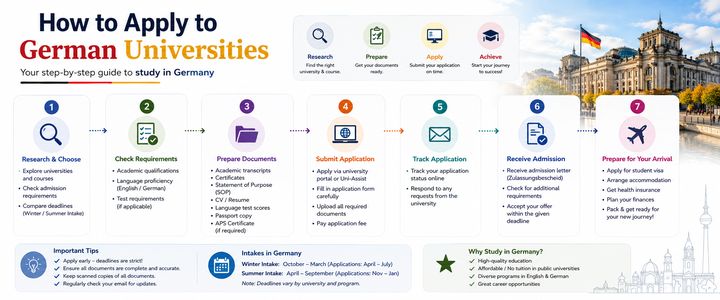
Recommended Application Timeline
12–15 Months Before Intake
Select subject and degree level
Review academic eligibility
Begin German or English preparation
Identify tuition-free programs
Research scholarships
Prepare passport and academic records
9–12 Months Before Intake
Take language tests
Begin APS processing where required
Request recommendation letters
Prepare curriculum vitae
Draft motivation letter
Collect module descriptions
Shortlist universities
6–9 Months Before Intake
Submit scholarship applications
Submit university applications
Arrange certified translations
Pay application-processing charges
Track missing documents
3–6 Months Before Intake
Accept the admission offer
Arrange financial proof
Apply for student housing
Obtain health-insurance documentation
Begin the visa process
Prepare travel funds
1–3 Months Before Intake
Secure accommodation
Enroll at the university
Pay the semester contribution
Book travel
Prepare original documents
Plan city registration and residence permit
Sample Low-Cost Annual Budget
The following example shows how a student might reduce costs in an affordable German city.
| Expense | Estimated Annual Cost |
|---|---|
| Tuition | €0 |
| Semester Contributions | €600 |
| Rent | €4,200 |
| Health Insurance | €1,680 |
| Food | €2,640 |
| Phone and Internet | €360 |
| Study and Personal Expenses | €900 |
| Approximate Total | €10,380 |
This is only an example.
A student in Munich, Frankfurt, Hamburg, or Berlin may spend substantially more.
A scholarship, residence-hall room, or student job could reduce the amount paid from personal savings.
Common Mistakes
Believing tuition-free means no money is required
Applying only to famous universities
Ignoring semester contributions
Missing Baden-Württemberg tuition
Assuming TUM is free for all non-EU students
Choosing an expensive city without checking rent
Applying to a fee-based professional master’s program
Depending entirely on part-time employment
Waiting too long to apply for housing
Missing scholarship deadlines
Submitting a generic motivation letter
Applying without checking subject-credit requirements
Ignoring Studienkolleg eligibility
Starting APS late
Confusing English-taught biomedical study with medical qualification
Using outdated visa-funding figures
Accepting a private-university offer without checking recognition
Applying to too few universities
Frequently Asked Questions
Can international students study in Germany for free?
Yes. Most regular programs at public universities charge no general tuition, although semester contributions and living expenses remain payable.
Is education completely free in Germany?
No. Students must pay for accommodation, insurance, food, semester charges, visas, and personal expenses.
Which German universities are tuition-free?
Many public universities are tuition-free for regular programs, including universities in Berlin, Hamburg, Cologne, Bonn, Dresden, Leipzig, Bremen, Magdeburg, Halle, Jena, and Saarbrücken.
Do Indian students pay tuition in Germany?
Indian students can study tuition-free at many public universities. They generally pay non-EU tuition in Baden-Württemberg and at TUM where program-specific fees apply.
Can I study in Germany without IELTS?
Some universities accept another English certificate or proof that the previous degree was taught in English. Requirements vary by program.
Can I study in Germany without German?
Yes, through an English-taught degree. However, German improves employment, housing, administration, and everyday life.
How much money is needed for a German student visa?
In most cases, students need to demonstrate access to €11,904 for one year in 2026. The required figure may change.
Can a scholarship replace the blocked account?
A recognized scholarship may serve as financial proof when it provides sufficient confirmed funding.
Can I pay living costs through part-time work?
Part-time work can help, but students should not depend on it to cover all expenses.
Are English-taught public programs free?
Many English-taught public master’s programs charge no general tuition. Students must check the specific program.
Is a bachelor’s degree free?
Many public bachelor’s programs are tuition-free, but most are taught in German.
Is a master’s degree free?
Many consecutive public master’s programs are tuition-free. MBA, executive, and continuing-education programs often charge fees.
Is a PhD free?
Doctoral candidates generally do not pay conventional tuition at public universities and may receive employment or scholarship funding.
Which cities are cheapest?
Chemnitz, Magdeburg, Halle, Saarbrücken, and several smaller eastern German cities are generally more affordable than Munich, Frankfurt, or Hamburg.
Is medicine free in Germany?
Most public medical programs do not charge general tuition outside major fee exceptions. Admission is highly competitive, and programs are taught in German.
Can I receive a full scholarship?
Yes, but full scholarships are limited and competitive. They are more common for graduate and doctoral study.
Final Verdict
Studying in Germany for free is possible when students understand what “free” actually means.
The most practical strategy is:
Choose a tuition-free public university.
Avoid major non-EU tuition exceptions.
Select an affordable city.
Apply for scholarships early.
Secure low-cost student housing.
Prepare the required visa funding.
Work part-time within the legal limits.
Learn German to improve employment opportunities.
Use student discounts and university services.
Build an emergency fund for unexpected expenses.
The strongest low-cost route combines:
Zero general tuition
Affordable accommodation
Scholarship support
Careful budgeting
A legal student job
A program with strong career outcomes
Germany can make an international degree significantly more affordable, but successful students plan for the complete cost rather than focusing only on tuition.