
Benefits of Studying in Germany: Top Reasons International Students Choose Germany
Germany has grown from a country that was known mainly for its engineering and research to one of the most popular destinations for international students to pursue higher education. Affordable public universities, internationally recognized degrees, hands-on learning, research opportunities, a large economy and clear post-study career options have combined to create a study environment that appeals to students from all over the world.
But the real benefits of studying in Germany go far beyond the phrase “low tuition fees.
For those who choose it, Germany’s education system is marked by academic freedom, subject expertise, research and practical problem solving. Depending on the institution and degree, students may study at traditional research universities, universities of applied sciences or specialized institutions for art, film and music. This gives students a choice of an academic route that is compatible with their career goals, rather than choosing a university just on its overall ranking.
Germany is especially attractive to students who are interested in studying engineering, computer science, artificial intelligence, data science, business, renewable energy, manufacturing, biotechnology and other research intensive or technical fields. But the country also has programs in social sciences, economics, design, humanities, health-related disciplines and creative subjects.
So why should Germany be on your radar?
Here are the key benefits of studying in Germany and practical reasons why international students continue to add the country to their study abroad plans.
Quick Overview: Why Study in Germany?
|
Benefit |
Why It Matters |
|
Affordable public education |
Many state higher education institutions do not charge tuition for bachelor's and many master's programs |
|
Internationally recognized degrees |
German qualifications are widely recognized by universities and employers |
|
Different university types |
Students can choose research-focused or practical, applied education |
|
English-taught programs |
International programs are available across multiple study areas |
|
Strong technical education |
Germany has a well-established engineering, science, and technology ecosystem |
|
Research opportunities |
Students can study in a country known for scientific and industrial research |
|
Part-time work options |
Eligible international students can work while studying under applicable rules |
|
Practical learning |
Universities of applied sciences have a particularly strong practice-oriented approach |
|
European location |
Students can experience life in the center of Europe |
|
Post-study career options |
Eligible graduates can remain in Germany to search for qualified employment |
1. Affordable Education at Many Public Universities
The cost of attending a university abroad is usually the first concern for both students and parents. In countries where annual tuition can be a significant financial commitment, students may need large education loans before they even work out accommodation and living expenses.
Germany is different.
Typically, public institutions of higher education do not charge tuition fees for bachelor’s programs and for many master’s programs. Instead, students usually pay a semester contribution. The amount and what it covers differs by institution.
It does not mean that every university and every course in Germany is completely free.
There are important exceptions. Private universities charge tuition fees and some master’s programs have separate fees. In many state institutions in Baden-Württemberg, non-EU students typically pay €1,500 per semester.
The key benefit is choice.
International students are able to explore a wide variety of public institutions and compare programs without being automatically subjected to the very high tuition costs of some other international education systems.
Lower tuition can also affect how students plan their careers. A graduate with a smaller education loan might have more opportunity to take an entry-level research position, join a startup, pursue doctoral study, or otherwise accept a job based on long-term career potential rather than immediately prioritizing the highest available salary.
2. High Academic Standards
German higher education is recognized for its academic profundity.
Students are generally expected to grasp concepts rather than just memorize facts for exams. The course may consist of lectures, seminars, lab sessions, research assignments, presentations, projects and independent study depending on the subject.
This system may seem challenging for international students at first.
The professor does not always remind the students for each task. At university, students are expected to read course information, understand the examination regulations, keep track of deadlines and take responsibility for their academic progress.
One of the major benefits of studying in Germany is that independence.
Over time students build skills such as:
· Research independent
· Critical thinking
· Managing time
· Writing for academia
· Technical problem solving
· Statistical analysis
· Presentation skills
· Collaborate with team
These skills can be useful long after you graduate.
3. Degrees with Global Value
Studying abroad is a big investment, so the long-term value of the qualification counts.
German universities are part of a highly structured higher education system. There are state and private institutions, universities, universities of applied sciences and specialized institutions for art, film and music, which students can choose from.
Students who want to work in another country or study in another country can find a degree from Germany useful.
But students should also do their homework on the particular institution and program.
“Study in Germany” should never replace proper university research.
Applicants must check the institution, course structure, medium of instruction, accreditation or recognition if any, admission requirements and relevance to career before applying.
The best decision is not just to choose Germany. It's about finding the right German institution and the right program.
4. Excellent Engineering Education
Germany’s engineering reputation is one of the country’s biggest draws.
For many decades the German industry was a synonym for manufacturing, automotive tech, machinery, industrial systems and technical innovation.
Students may study areas including:
· Mech. Engr.
· Auto Engineering
· Electronic Engineering
· Civil Engineering
· Engineering Industrial
· Mechatronic
· Aerospace Engineering
· Chemical Engineering
· Production Engineering
· Robotics
· Automation
· Energy Engineering
But it is not only the availability of engineering degrees that benefits you.
Students study in an environment where technical industries are a large part of the economy. This can provide opportunities to explore the application of engineering concepts in manufacturing, product development, automation, energy systems, and industrial processes.
For an engineering student, the industrial ecosystem surrounding him/her can be as important as the classroom.
5. Strong Prospects in Computer Science & AI
Germany is also becoming a more attractive destination for tech students.
Universities provide programs and specializations in:
· CS
· AI
· Machine Learning
· Data Science
· Cyber Security
· Software Engineering
· Robotics
· Embedded System
· Computational Science
· HCI: Human Computer Interaction
· Business Analytics
One of the big perks of studying technology in Germany is the ability to explore applications outside of traditional software companies.
AI and data technologies are becoming ever more intertwined with manufacturing, automotive systems, logistics, health care, energy, and industrial automation.
For example, a student interested in machine learning may have opportunities to work on computer vision, autonomous systems, predictive maintenance, industrial data or intelligent mobility.
This interdisciplinary environment can help students build more specialized career profiles.
6. Research and Innovation Opportunities
Students who are interested in research tend to look to Germany due to its larger scientific ecosystem.
Universities and specialized research organizations carry out research, in cooperation with industry and public institutions.
Depending on the course and university participation may include:
· Research in laboratory
· Research assistantships
· Master thesis projects:
· Industry sponsored research
· Scholarly conferences
· PhD prep
· Research groups across disciplines
For master’s students the thesis can be an important career tool.
In addition to satisfying a graduation requirement, students now have the option of selecting a research topic that relates to the career they wish to pursue. A strong thesis can be helpful in showing your expertise when applying for jobs, or it can help support your application to do doctoral work.
Students who are interested in research should check out faculty profiles and research groups before applying to university. The university with the highest overall ranking might not have the best research group for the specific interest of a student.
7. Universities of Applied Sciences Provide Practical Education
Not every student wants a highly theoretical or research-oriented degree.
German universities of applied sciences are especially attractive to students who are interested in a practical and professional education.
These institutions tend to focus on applied learning more.
Depending on the program, students may face:
· Practical projects
· Case studies from the industry
· Laboratory work
· Internships
· Partnerships with companies
· Application-oriented assignments
This model may be suitable for students who want to get into professional employment after graduation.
For example, a student interested in industrial automation might want a program with lab training and company projects. Another business analytics student might prefer a course with real data sets and applied consulting assignments.
Your learning style and career goals should dictate whether you choose a traditional university or a university of applied sciences.
8. More International Study Programs to Choose From
German is important in Germany but students should not think that every degree is taught in German only.
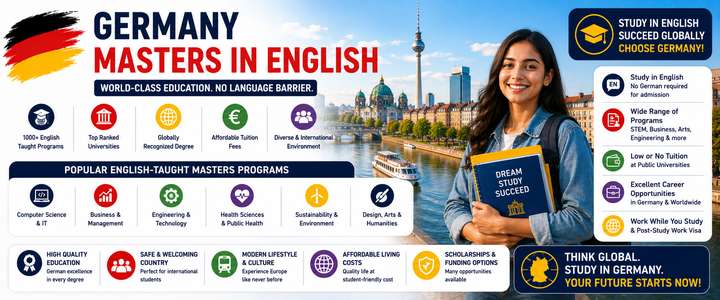
A selection of subjects are available for international study programs. English tends to be the language of choice for Master’s level programs.
This is to the advantage of students who wish to commence an international degree without first having reached advanced academic German.
But English education should not be confused with English-only life.
A student may attend lectures in English and yet find German when:
· Looking for a place to stay
· Going to local offices
· Shopping
· Accessing healthcare services
· Apply for part time jobs
· Contact with neighbors
· Search for internships
So one of the smartest strategies is to pick an English-taught degree and pick up German slowly.
International degree + German could be worth a lot more than just English.
9. Students Can Study While Working
Another important advantage is the chance to get work experience while still at university.
Third country students who are eligible can normally work up to 140 full days or 280 half days a year. There is an alternative framework with rules to work up to 20 hours a week during the lecture period.
Students could find opportunities as:
· Research Assistant
· University student assistants
· Students who work
· Software engineers
· Technical assistance
· Teachers
· Retail workers
· Restaurant staff.
· Warehouse workers
· Administrative aides
The biggest advantage of student employment is not always the money.
A job related to a student’s degree can provide German work experience, professional contacts and practical skills.
For example, a computer science student employed as a student developer may graduate with both a master’s degree and local technical experience. An engineering student who works with a manufacturing company might already know what to expect from German workplaces before applying for full-time jobs.
Students should still arrange to have enough money before they arrive. A part-time job should be seen as a way to get experience and earn some extra money, not as a surefire way to pay for all your college costs.
10. Opportunities for Industry Experience Before Graduation
The industrial setting of Germany can help students to connect their academic learning with professional work.
Depending on the field students may take:
· Internship
· Work-study student
· Practice semesters
· Company projects
· Theses with an industry focus
A student working position can be especially useful, helping a student to get relevant experience while completing a degree.
Students who begin to plan their careers in the early semesters may be at a significant advantage over those who wait until their final year.
Often the best strategy is to gradually build up skills, improve your German, build up a professional network and gain relevant experience.
11. Career Opportunities After Study
For many international students, a degree is just one piece of the study abroad puzzle.
The ability to build a career after graduation is just as important.
Generally, eligible international graduates can apply for a residence permit for up to 18 months after their studies to continue their search for qualified employment.
Graduates are given time to find opportunities related to their qualifications.
Once suitable employment is found graduates may be able to move to an appropriate employment residence permit or, where the requirements are met, an EU Blue Card.
This does not ensure a job.
But students still need the right skills, a strong application and knowledge of the job market. Many positions can also be important ability to speak German language.
The benefit is that graduates have a clear path to seek qualified jobs instead of having to leave immediately after completing their degree.
12. The Heart of Europe is Germany.
Another advantage that students sometimes don’t realize is geography.
Germany is bordered by several European countries and has good rail, road and air connections.
Students may have chances to visit countries including:
· France
· Austria
· Switzerland
· Holland
· Belgium
· Denmark
· Czech Republic
Travel is not merely about tourism.
Living in Europe exposes students to diverse cultures, languages, business environments, and professional networks.
Opportunities also exist for international students to attend conferences, visit friends studying in a neighboring country, participate in academic exchanges or simply see different parts of Europe during university breaks.
13. Public Transportation Simplifies Students' Lives
Germany has a very extensive public transport system.
Depending on the city, students may be able to take advantage of:
· Intercity train
· S-Bahn
· U-Bahn
· Tramways
· Bus
Some student arrangements or semester contributions may include transportation benefits, but this is dependent on the university and the region.
Having good public transportation can mean not having to buy a car.
This can really make life a lot easier on a daily basis for international students.
A student can live kilometers away from campus and still commute by public transportation. It can also help people access part-time jobs and internships across a city.
14. Students Find a Different Academic Culture
Studying in Germany can mean a big adjustment.
That adjustment can be a benefit in itself.
Students learn how to give:
· Academic independence
· Money management
· House work
· Administration procedures
· Cross-cultural communication
· Professional networking
Such experiences may accelerate personal growth for students who are moving abroad for the first time.
The student who arrives in Germany may be a very different person from the graduate who leaves university some years later.
International education is more than just a qualification. It can also teach students how to be independent, solve problems, and adapt in new environments.
15. Learning German can be a career asset
German is one of the major languages of Europe.
Students who learn German during their studies may improve their professional profile with an important skill.
Knowledge of German may be useful for:
· Work part time
· Work internships
· Employment of graduates
· Client centric roles
· Networking (career)
· Communication on a daily basis
Required level depends on the career.
Some international tech teams work nearly exclusively in English. Other positions require good German language skills, as the employees are in contact with customers, patients, authorities or local business partners.
Students don’t have to be fluent immediately.
It is realistic to pick up basic German before arrival and gradually improve during university.
16. An International Student Body from All Over
Many German universities have students from many countries.
This enables students to make friends and professional contacts across cultures.
A group project may involve students from Europe, Asia, Africa and the Americas. Classroom discussions may include various professional, cultural and academic perspectives.
These experiences are particularly useful for students intending to work for multinational organizations.
Being able to communicate with people from different backgrounds is a practical professional skill.
International friendships can build a worldwide network that carries on beyond graduation.
17. Multiple Cities, Varied Student Experiences
Studying in Germany is not about choosing a type of lifestyle.
Berlin offers a big international environment with a strong startup and creative culture.
Munich has strong links with large tech, engineering and corporate employers but is known for a higher cost of living.
Aachen is a very technical and student city.
Hamburg is famous for logistics, media, commerce and international business.
Stuttgart is very much associated with manufacturing and automotive industries.
Leipzig and Dresden can give students a different cost of living and lifestyle.
The plus side is that students can pick a city for reasons other than university rankings.
They can think about:
· Line of work
· Costs for the hotel
· Size of city
· Transport
· Student body
· Language option
· Internship openings
The right city can make a huge difference to the overall experience of studying.
18. Best Value for the Cost of Education
It is not easy to measure the return on investment of tuition fees.
Students should consider the big picture:
· School Fees
· Semester fees
· Cost of living
· Quality of degree
· Job opportunities
· Job experience
· Educational debt burden
Germany provides good value, with students able to access respected public higher education without the tuition levels of many international institutions elsewhere.
But there are still day-to-day expenses. According to official German study guides, students need an average of 900 to 1,200 euros a month depending on location and lifestyle.
Students must therefore be aware of the misconception that studying in Germany is “free”.
A more accurate description is that Germany can provide relatively affordable higher education, especially at many of the state institutions.
19. Personal and professional opportunities for autonomy
Students in Germany often have to make their own decisions.
· What courses should I take?
· When should you start your thesis?
· How are you going to manage your monthly budget?
· Do you need to learn German?
· When should I start applying for internships?
First there are so many things to decide.
But students learn responsibilities for their educational and professional growth over time.
One of the most precious outcomes of studying abroad could be this independence.
20. Germany Can Be a Good Choice for Long-Term Career Planning
Germany isn't the country you choose just because the tuition at public universities is cheap.
The country is most helpful for students with a clear academic and career strategy.
A student who wants to study automotive engineering can choose a university located near an industrial cluster.
Data science students should consider cities with technology companies and research institutions.
A renewable energy student might research faculty research before selecting a master's program.
A business student may emphasize internships and German language skills.
The long-term value of studying in Germany can be significant, if the university, program, city and career plan are linked.
Are there any downsides to studying in Germany?
Sure. Every place to study has its downsides.
International students could face:
· Hard to find affordable accommodation
· Barriers in German language
· Education stress
· Expectations of self-directed learning
· Complicated administrative procedures
· Dark and cold winters
· Competition for jobs and graduate jobs
These are challenges that students should be aware of before applying.
Germany can be a great destination, but it does reward you for being prepared.
Students who do their university research, develop a realistic budget, apply for housing early and learn German are generally better prepared for the transition.
Who Should Move to Germany?
Germany could be a good option for students who:
· Want a good education for a reasonable price
· Interested in engineering, technology, science, research or business.
· Can learn independently
· Ready to transition to a new academic culture
· Looking for international experience
· An interest in European career opportunities
· Willing to learn basic German
Germany might not suit students who expect universities to provide them with constant academic supervision, or who are not willing to learn any German while living in the country.
The Bottom Line: Should You Go to School in Germany?
Sure, for many international students.
There are many significant advantages of studying in Germany such as relatively inexpensive public education, high academic standards, opportunities for research, practical study options, the chance to work part-time and career opportunities after graduation.
The real advantage of the country is the combination of these factors.
Affordable tuition doesn't make it a good place to study. Germany is a mix of education and research, industry, international exposure and access to one of the largest professional environments in Europe.
But students still need to choose wisely. Not every university, course and city will be right for every applicant.
Investigate the curriculum. Compare schools. Calculate the real cost of living. Check language requirements. Know the job market associated with your course.
If those factors align with your career goals, Germany can offer much more than an international degree. It can give the academic knowledge, professional experience and personal independence you need to build a global career.
FAQ
What are the key benefits of studying in Germany?
The main benefits are affordable public higher education, respected degrees, research opportunities, practical study options, part-time work opportunities and career pathways after study.
Is education in Germany free for international students?
Most public universities charge no tuition for undergraduate and many graduate programs. Exceptions apply and semester contributions and living costs still apply.
Are Germany good for engineering students?
Yes. Germany has a strong engineering and industrial ecosystem and is a popular destination for mechanical, automotive, electrical, industrial and related engineering disciplines.
Can I study in Germany in English?
Yes. International and English-taught programs are available, especially at master’s level. Applicants are advised to check the language of instruction of each individual course.
Can international students work in Germany?
Third-country students who meet the eligibility criteria are normally allowed to work 140 full days or 280 half days per year, or the corresponding 20 hours per week during the lecture period.
Should you learn German?
While you may not need it for a degree taught in English, German can be a game-changer in terms of everyday life, internship opportunities and jobs.
Is Germany costly for students?
Costs of living vary by city and lifestyle. Official German study guidance states students will need around €900 to €1,200 per month on average.
Can I stay in Germany after graduating?
Eligible international graduates are generally allowed to stay for up to 18 months to find suitable employment.
How does Germany stack up against other study abroad destinations?
The answer depends on the student’s budget, course, language choice and career goals. Germany is particularly attractive to students looking for low-cost public education, technical programs, research and European career opportunities.
What is the main advantage of studying in Germany?
For many students, the biggest plus is value: the chance to get a high-quality higher education and be in a strong educational and professional environment without paying the tuition fees that many other international study destinations charge