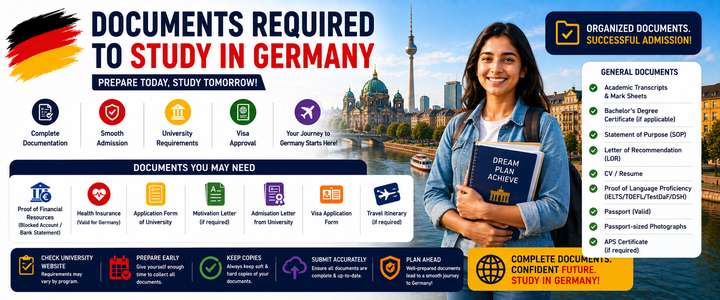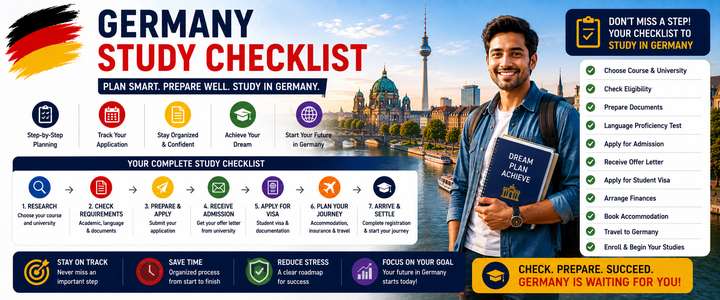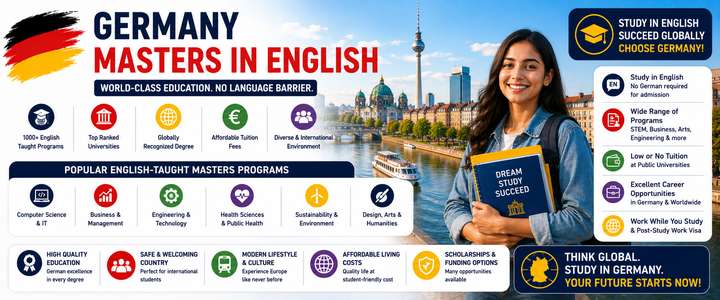

How to Study in Germany: The Complete Guide for International Students Germany has emerged as one of the most attractive study destinations for international students seeking respected qualifications, affordable education and strong career opportunities. German institutions offer thousands of programs across a broad spectrum of subjects from engineering and computer science to business, medicine, design and social sciences. The country is especially attractive as many public universities offer little or no tuition for regular degree programs. Students also enjoy the benefits of modern research facilities, links to global employers and the chance to stay in Germany after graduation to seek qualified employment. A recent survey by the German Academic Exchange Service found that about 420,000 international students and doctoral candidates were enrolled at German universities in the winter semester 2025–26. The guide includes information on the German education system, types of universities, eligibility criteria, application process, tuition fees, living costs, scholarships, visas, part-time jobs, and career opportunities after graduation. Reasons to Study in Germany Germany provides a mix of quality of education and affordability that is hard to beat in many other popular destinations. International students have many good reasons to choose Germany, such as: Low or no tuition at many state universities World-class undergraduate, graduate and doctoral degrees Increasing number of programs in English only Excellent opportunities for engineering, technology, science and business Access to research laboratories and projects based in industry Part-time job opportunities while studying 18-month post-study period to secure qualified employment Central European location with connections to the other European countries A safe, well-connected public transit system Scholarships from DAAD, universities and independent foundations Germany is especially useful for students who want practical education related to industry. Many universities cooperate with companies, research institutes and public organizations, providing students with the opportunity to do internships, applied projects and professional training. A Brief Look at the German Higher Education System There are a number of higher education institutions in Germany. Selecting the right type is as important as selecting a course. Higher Education Traditional universities are much more driven by theory and research. They offer degree programmes leading to the award of a Bachelor, Master, Doctorate or State Examination. These institutions are suitable for students who wish to do research, engage in advanced academic study or pursue careers that need a strong theoretical foundation. Fachhochschulen (Universities of Applied Sciences) Universities of Applied Sciences (Fachhochschulen or Hochschulen für angewandte Wissenschaften) focus on practical learning. Their programs often involve internships and industry projects, laboratory work, and direct collaboration with employers. They are popular for engineering, information technology, business, media, design and social works. Art, Film and Music Universities The institutions provide specialized programs in fields like fine arts, performing arts, music, filmmaking, architecture and design. Admission may be by portfolio, audition, artistic assessment or entrance examination. Public vs. Private Universities Most students in Germany go to public universities. They are mostly government funded and tend to charge lower tuition fees. Private schools may offer smaller classes, specialized courses and English-language programs, but tuition can be much higher. Before applying, students are urged to make sure that the private institution and the program they have chosen are officially recognized. Top Courses in Germany Germany is globally known for technical and research-based education but students have a far wider choice of subjects. Popular areas of study: Mech. Eng. Auto Engineering Electronic Engineering Engineering, Civil Information Technology AI (Artificial Intelligence) Data Science Cyber Security Automation and Robotics Green Electricity Biotechnologies Business Management Finance and Economy International Management Architecture Design Health care and Medicine Psychology. Social Studies Ecological “Students shouldn’t take a course just because it is popular. Better: Comparison of curriculum content, teaching language, internship opportunities, location, total cost and graduate employment prospects. Requirements for Eligibility Requirements vary by university, degree level and program. Check the official course page per student before applying. Requirements for a Bachelor’s Degree Applicants must as a rule have a school-leaving qualification which is recognised as equivalent to the German university entrance qualification. For some educational backgrounds of the applicant and in some countries, a school certificate alone may not be enough for direct entry. You may need to have studied at university before or taken a pre-university course. Students whose qualifications do not directly lead to university admission may be required to attend a Studienkolleg. This is a preparatory programme which normally ends with an assessment examination. Master’s Degree Requirements A master's applicant generally requires: An accredited bachelor's degree A relevant degree related to the intended subject of the master's Required academic credits in relevant subjects Transcripts of academic records Proof of language ability Motivation letter / Statement of purpose Letters of recommendation (if applicable) A curriculum vitae or résumé GRE or GMAT scores required for selected programs German universities may take into account the degree title, modules and credits obtained in your bachelor's programme. uni-assist says that applicants for a master’s program usually need to have completed undergraduate study in a comparable field. Requirements for the Doctoral Degree Usually, a relevant master’s degree and a good research proposal are necessary for PhD applicants. Depending on the program, the student may need to find a professor willing to supervise the research. Germany offers individual doctorates and structured doctoral programs. Language Skills The language needed depends on the teaching medium of the program Universities may accept tests such as: for English-taught programs IELTS (Academic) TOEFL iBT Cambridge English exams Prior education in English where specifically accepted Qualifications accepted for German-taught courses may include: TestDaF Digital Signal Processing Goethe-Zertifikat telc German C1 Hochschule Other German certificates recognized by the university Knowing some basic German will make everyday life, finding accommodation, internships and part-time work significantly easier, even if the course is taught in English. When to Apply and Which Intake to Choose Germany generally has two main admission periods. Wintersemester The winter semester generally starts in September or October. It has the broadest choice of courses and university places. Many programs have a July 15 application deadline, although individual universities may have earlier or later deadlines. Summer term The summer semester usually starts in March or April. Less programs intake students in this intake. The application deadline is usually January 15. But deadlines differ by university, by course and by applicant category. Ideally, international students should start looking into courses 10 to 12 months prior to the semester they wish to study in. Visa appointments, document checking, translations and financial arrangements can take a long time. Application process for German universities You can submit your applications directly to the university or via uni-assist. Uni-assist reviews applications from international students for about 180 German universities. It checks the educational documents for compliance with the formal requirements of the partner institutions. The application process usually consists of: 1. Choose the degree and specialization. 2. Verify if your academic qualification is approved. 3. Check the language of instruction and required test scores. 4. Please see the eligibility criteria for each subject. 5. Verify whether the application is direct or via uni-assist. 6. Get certified academic transcripts and translations. 7. Submit the application by the deadline. 8. Check the status of your application. 9. Submit any requested missing documents. 10. Receive admission offer and initiate visa process. Typical documents asked for are: Copy of passport School/university certificates Transcript of records Language test scores Abstract Letter of motivation Letters of recommendation Portfolio of creative programs Certificates of work experience, if applicable Form Application Proof of payment of fee Origin country academic verification documents. Students are required to upload high-quality, clearly scanned documents. An application can be delayed by missing pages, incorrect translations or incomplete academic records. Tuition Fee and Semester Dues Most public universities in Germany do not charge general tuition fees for regular bachelor’s and consecutive master’s degrees. Students pay a contribution each semester, which covers services such as student administration, student welfare and, at some institutions, local transport. The contribution depends on the institution and can be several hundred euros per semester. There are some important exceptions. In Baden-Württemberg, many degree programs cost non-EU students at public universities €1,500 per semester. Private universities, specialized master’s programs and some public institutions may also charge tuition. Public universities aren’t always entirely free, and students shouldn’t assume that they are. Check the official course and university pages for exact fee. What Is the Cost of Living in Germany? According to the DAAD, students will need around €900 to €1,200 per month depending mainly on the city and accommodation. Here’s how a monthly budget for a student could look like: Rent and Utilities Food & Groceries Medical insurance Domestic travel Internet, phone Study materials Clothing & personal expenses Broadcast section Travel and recreation Cities like Munich, Frankfurt and Hamburg can be more expensive, especially accommodation. Smaller cities have lower rents but fewer English speaking part-time jobs. Student housing is usually cheaper than private apartments but is in high demand. Students are encouraged to apply for housing as soon as they are admitted. Health insurance is required. Students younger than 30 years of age may be able to pay the statutory student health insurance rate, which is about €120 to €130 per month, but actual contributions vary, according to DAAD. International Students Scholarships Scholarships are available through: DAAD All German universities Political and social underpinnings Research institutes Faith based foundations Companies (private Funding programmes of the European Union Home country Government scholarship schemes for the student DAAD and selected external organizations offer funding. A list can be found in the DAAD scholarship database. Scholarships can pay for tuition, monthly living expenses, travel, insurance or research costs. However, fully-funded undergraduate scholarships are relatively scarce, so students should have a realistic financial backup plan. Applicants should carefully check eligibility, academic requirements, professional experience, nationality restrictions and application deadlines. Student Visa in Germany You will normally need an appropriate visa or residence permit if you are a student from outside the European Union or the European Economic Area. Common Types of Study-Related Visas include: Student visa for applicants who have a confirmed admission Student applicant visa for applicants completing admission steps Language-course visa if applicable Visa for preparatory study or Studienkolleg A valid passport Admission letter of university Visa application form completed Educational certificates Proof of financial means Health care insurance Proof of accommodation, if applicable Evidence of language abilities Letter of motivation Visa cost. Country specific supporting documents According to the official Make it in Germany portal, students can prove they have the necessary funds for 2026 by showing a blocked account with at least €11,904, a scholarship or a formal declaration of commitment. Financial requirements may change so applicants should check the relevant amount before applying for the visa. The German Federal Foreign Office also recognizes several methods to provide financial security such as parental finances, declaration of commitment, blocked account or an annual renewable bank guarantee. Students are advised to apply as early as possible, as processing times vary depending on country, season and individual case. International Student Experience Working in Germany International students may work during their studies, subject to immigration and residence rules. Students from third countries are generally allowed to work up to 140 full days or 280 half-days per year without further approval from the Federal Employment Agency. An alternative arrangement may permit work up to 20 hours per week during the lecture period. Typical student jobs include: University research assistant Teaching Assistantships Technical or software help Retail Worker Workers in restaurants or cafes Warehouse or manufacturing assistant Private teacher Student trainee in a company Interns Working part-time can be a good experience and also provide extra income, but students should not rely on employment to support themselves alone. It takes a while to get a job . It helps a lot to know the German language in terms of options for jobs . Post-Graduation Stay in Germany Germany offers international graduates an open way to seek employment. Third country nationals may be issued with a residence permit valid for a maximum period of 18 months to enable them to look for qualified employment. During this time they may take any job and look for a position related to their qualifications. Once working, graduates may be eligible to change to: Residence permit for qualified specialists EU Blue Card (if you are eligible) Another residence permit on the basis of work A license of self-employment in qualifying cases Long-term options depend on employment, qualifications, salary, German language ability, residence history and the immigration rules applicable at the time. Most Popular Cities for International Students Popular student cities in Germany are: Berlin: Known for its startups, technology, art and a highly international environment. Munich: Strong in engineering, automotive technology, finance and research, but expensive. Hamburg: Suitable for media, logistics, trade and engineering. Frankfurt: The center of finance, banking, consulting and international business. Aachen: Especially known for engineering and technical education. Dresden: Home to respected technical institutions and relatively easy costs of living. Leipzig: Known for its culture, student life and cheaper accommodation than some bigger cities. Stuttgart: Manufacturing and technology companies, closely linked to automotive engineering. Students should look beyond the university league tables. Availability of accommodation, internships, industry contacts and everyday costs can make a big difference to the overall experience of studying. Last checklist Students should be sure to have: before leaving for Germany Valid passport and a visa * Official letter of admission *Proof of financial means * Health insurance in force * Housing, temporary or permanent * Research papers that are original * Translations certified * Emergency savings * Digital and printed copies of documents * Travel plans * Prescriptions and medical history required * Basic german knowledge * Details of university registration * Information about local registration of residence Once students arrive they may have to register their address, register at the university, activate health insurance, open a local bank account and apply for a residence permit. FAQs Is it free to study in Germany for international students? Many public universities do not have a general tuition for standard programmes, but students typically pay a semester contribution. At some universities, at private universities and for some master’s degree programmes in Baden-Württemberg, tuition fees may be charged . Can I study in Germany without speaking German? Yes, it is possible to study in English taught programme. But it is highly recommended to learn German for your daily life, internships, networking and employment. Is IELTS mandatory for Germany? You don't need IELTS for all programs. Universities have their own language requirements and may accept TOEFL, Cambridge qualifications or other recognised evidence. Is Germany a good place for international students? Germany is a great choice for students looking for quality education, low tuition fees, research opportunities and access to the European job market. Usually students who prepare themselves for this financially, and learn some basic German, have a better experience. Can students remain after graduation? Graduates from outside the EU can apply for a residence permit of up to 18 months to search for qualified jobs. Do I have to open a blocked account? One common method of proving financial resources is a blocked account, but it is not the only way. In some cases, an established scholarship or pledge of commitment may also be accepted. Abstract Germany has so much more to offer than just an affordable degree. It can provide access to quality education, practical industry experience, international research and long-term career opportunities. The application process calls for careful planning. Students should compare the recognized universities, check the eligibility, prepare the correct documents, arrange for finances and start the visa process early. Learning German and applying for accommodation in advance can make the transition a lot easier. For students with realistic expectations and thorough preparation, Germany still remains one of the strongest international study destinations in Europe.
Gujarat Police Result 2026 Expected for SI Wireless and Technical Operator PostsFree Online Courses with Certificates: 2026 Updated ListTamil Nadu Special TET Results Still Pending: Court Stay and Cutoff Dispute Affect TeachersGK Quiz on BRICS Summit 2026: Test Your KnowledgePunjab School Holiday September 28, 2026: Check Monday School Closure UpdateGermany CGPA Requirements: Minimum GPA for Bachelor’s, Master’s, and Top UniversitiesTop 50 Free Online Courses with Certificates in IndiaBest Free Government Online Courses with Certificates in IndiaGermany Intake: Summer and Winter Admissions, Deadlines, Eligibility, APS, dMAT, Costs, and VisaNEET PG AIR 2: IAF Doctor Posted in Kanpur Secures Second Rank
Gujarat Police Result 2026 Expected for SI Wireless and Technical Operator PostsFree Online Courses with Certificates: 2026 Updated ListTamil Nadu Special TET Results Still Pending: Court Stay and Cutoff Dispute Affect TeachersGK Quiz on BRICS Summit 2026: Test Your KnowledgePunjab School Holiday September 28, 2026: Check Monday School Closure UpdateGermany CGPA Requirements: Minimum GPA for Bachelor’s, Master’s, and Top UniversitiesTop 50 Free Online Courses with Certificates in IndiaBest Free Government Online Courses with Certificates in IndiaGermany Intake: Summer and Winter Admissions, Deadlines, Eligibility, APS, dMAT, Costs, and VisaNEET PG AIR 2: IAF Doctor Posted in Kanpur Secures Second Rank