
A master’s degree in Germany can be one of the most valuable routes into advanced education, research, and the European employment market. The country offers a large selection of programs in engineering, computer science, data science, business, economics, biotechnology, environmental studies, social sciences, and many other disciplines.
The attraction is easy to understand. Many public universities charge little or no general tuition for consecutive master’s programs, Germany has a large industrial and research economy, and eligible international graduates can remain in the country for up to 18 months to search for qualified employment.
Yet many students approach Germany with the wrong strategy.
They begin by searching for the “top universities,” apply to programs with impressive names, and assume that a good undergraduate grade will be enough. German admissions often work differently. Universities may examine the exact subjects, credits, mathematics content, laboratory work, research methods, and technical modules completed during the bachelor’s degree.
In other words, Germany does not only ask:
How well did you perform?
It also asks:
Did your previous education prepare you for this exact master’s program?
This guide explains how to select a suitable master’s degree in Germany, understand eligibility, shortlist universities, prepare applications, manage costs, complete the visa process, and plan for employment after graduation.
Master’s Degree in Germany at a Glance
| Area | Typical Details |
|---|---|
| Program duration | Usually two to four semesters |
| Main intakes | Winter and summer, depending on the course |
| Teaching language | German, English, or a combination |
| University types | Research universities and universities of applied sciences |
| Tuition | Often no general tuition at many public universities, but exceptions apply |
| Semester payment | Semester contribution usually required |
| Academic requirement | Related undergraduate degree |
| Application route | Direct to university or through uni-assist |
| Work during study | Permitted under applicable international student rules |
| Post-study option | Up to 18 months to search for qualified employment |
| Popular subjects | Engineering, computer science, AI, data science, business, renewable energy and biotechnology |
Why Pursue a Master’s Degree in Germany?
Germany offers more than affordable education.
A strong master’s program can help students deepen subject knowledge, gain research or industrial experience, build a professional network, and reposition themselves for specialized employment.
The main advantages include:
Access to respected universities and research institutions
Comparatively affordable public education
A large selection of international programs
Strong technical and scientific infrastructure
Practical courses at universities of applied sciences
Research-based programs at traditional universities
Opportunities to work during study
Access to internships and working-student positions
A defined post-study employment-search route
Exposure to Germany and the wider European region
DAAD’s international program database currently lists more than 1,700 master’s programs intended for an international audience, illustrating the scale of available choice.
The large number of programs is helpful, but it creates a new problem: students may apply too broadly without properly evaluating course compatibility.
The best master’s program is not necessarily the one with the highest university ranking. It is the one that matches your previous education, preferred learning style, financial situation, language ability, and intended career.
The First Major Decision: Research University or University of Applied Sciences?
Germany has different types of higher education institutions. Understanding the distinction can prevent students from choosing a course that does not match their expectations.
Research Universities
Traditional universities generally emphasize theory, academic depth, independent analysis, and research.
A master’s program may include:
Advanced theoretical modules
Academic seminars
Research methodology
Laboratory research
Independent projects
A substantial master’s thesis
These programs can be suitable for students interested in:
Research and development
Doctoral study
Academic careers
Advanced technical specialization
Theoretical or scientific roles
A research university may be ideal for a student who enjoys academic reading, mathematical depth, experimentation, or independent investigation.
It may be less suitable for someone expecting constant practical projects and direct employer training.
Universities of Applied Sciences
Universities of applied sciences, often identified as Hochschulen or Fachhochschulen, usually place greater emphasis on practical and professional application.
Their courses may include:
Company projects
Practical case studies
Laboratory assignments
Internships
Application-focused teaching
Industry-linked thesis projects
These institutions can suit students who want to enter professional employment soon after graduation.
For example, a student studying embedded systems may prefer a course connected with industrial applications. A business analytics student may value working with company datasets. A renewable-energy student may prefer practical system design over highly theoretical research.
Neither university type is automatically better.
The correct choice depends on what you want the degree to accomplish.
Consecutive and Non-Consecutive Master’s Programs
German universities commonly distinguish between programs that continue directly from a related bachelor’s degree and professionally oriented or continuing-education programs.
Uni-assist explains that a master’s course generally follows completed undergraduate study and usually lasts between two and four semesters.
Consecutive Master’s Programs
A consecutive program builds on the academic content of a related undergraduate degree.
Examples include:
Bachelor’s in Mechanical Engineering to Master’s in Automotive Engineering
Bachelor’s in Computer Science to Master’s in Artificial Intelligence
Bachelor’s in Economics to Master’s in Applied Economics
Bachelor’s in Biotechnology to Master’s in Molecular Biotechnology
These programs often have strict subject and credit requirements.
Continuing-Education or Professional Programs
Some programs are intended for candidates with work experience and may charge tuition even when offered through a public university.
Examples can include:
MBA programs
Executive master’s degrees
Specialized professional management programs
Selected public-policy or continuing-education degrees
Applicants should not assume that every program at a public university is tuition-free.
The Most Important Admission Principle: Academic Fit
Many international students focus heavily on university rankings, GPA, IELTS scores, and the statement of purpose.
Those factors matter, but academic fit can be more important.
Uni-assist states that applicants generally need completed undergraduate study in a related subject to apply for a master’s course in Germany.
A university may evaluate whether the applicant has completed enough credits in areas such as:
Mathematics
Statistics
Programming
Algorithms
Mechanics
Thermodynamics
Economics
Accounting
Research methods
Laboratory science
Subject-specific theory
Consider two applicants applying to a data science program.
Applicant A has a high overall grade but limited mathematics and programming.
Applicant B has a slightly lower grade but has completed calculus, linear algebra, probability, statistics, Python, database systems, and machine learning.
Depending on the published requirements, Applicant B may be academically better prepared.
This is why students should compare their bachelor’s transcript with the master’s curriculum before applying.
Build a Module-Matching Sheet
Create a spreadsheet with the following columns:
| Master’s Requirement | Your Bachelor’s Module | Credits | Evidence |
|---|---|---|---|
| Calculus | Engineering Mathematics I | 5 | Transcript and syllabus |
| Statistics | Probability and Statistics | 4 | Transcript |
| Programming | Object-Oriented Programming | 5 | Transcript and module description |
| Research methods | Final-year research project | 8 | Project summary |
| Databases | Database Management Systems | 4 | Transcript |
This process helps identify:
Strongly matched programs
Programs requiring clarification
Programs where you are unlikely to qualify
Missing documents or module descriptions
Subjects that should be highlighted in the application
A thoughtful shortlist of eight compatible programs is usually stronger than thirty random applications.
Popular Master’s Degrees in Germany
Germany offers master’s programs across nearly every academic field, but certain subjects are especially attractive because of the country’s research and industrial environment.
Computer Science
Computer science is one of the most competitive application areas.
Specializations may include:
Software engineering
Distributed systems
Cybersecurity
Computer vision
Human-computer interaction
Cloud computing
Embedded systems
Scientific computing
Applicants should examine whether the course expects theoretical computer science, advanced mathematics, programming, or systems knowledge.
Artificial Intelligence and Machine Learning
AI programs can differ dramatically.
One course may be mathematics-heavy and research-oriented. Another may focus on applications in manufacturing, mobility, or business. A third may sit inside a broader computer science degree.
Students should review modules such as:
Linear algebra
Probability
Optimization
Machine learning
Deep learning
Computer vision
Natural language processing
Robotics
Responsible AI
A trendy program title does not guarantee a strong curriculum.
Data Science
Data science combines statistics, computing, modeling, and domain knowledge.
A good course should provide more than software-tool training. Look for depth in:
Statistical inference
Data engineering
Machine learning
Databases
Data visualization
Optimization
Experimental design
Ethics and governance
Students from engineering, mathematics, statistics, economics, or computer science may qualify, but the exact eligibility rules vary.
Mechanical and Automotive Engineering
Germany remains attractive for students interested in industrial systems and advanced engineering.
Possible specializations include:
Automotive engineering
Production technology
Mechatronics
Computational mechanics
Materials engineering
Robotics
Manufacturing systems
Energy systems
Candidates should examine laboratory access, research groups, local industry, and thesis opportunities rather than relying only on the university’s overall reputation.
Electrical Engineering and Embedded Systems
Programs may focus on:
Communications
Microelectronics
Control systems
Signal processing
Embedded systems
Power engineering
Automation
Semiconductor technology
Because these degrees can be highly specialized, a careful transcript comparison is essential.
Renewable Energy and Sustainability
Germany offers programs connected with:
Renewable-energy systems
Energy management
Environmental engineering
Sustainable mobility
Climate science
Circular economy
Green manufacturing
Students should distinguish between technical energy programs and policy or management programs. Their prerequisites and career outcomes may be very different.
Biotechnology and Life Sciences
Possible fields include:
Molecular biotechnology
Bioinformatics
Pharmaceutical biotechnology
Neuroscience
Molecular medicine
Food science
Environmental biotechnology
Some programs may require extensive laboratory credits or particular undergraduate subjects.
Business and Management
Germany offers both general management degrees and specialized programs in:
Finance
Economics
International business
Supply chain management
Business analytics
Marketing
Innovation management
Entrepreneurship
Students with limited work experience may find a Master in Management or specialized MSc more appropriate than an MBA.
Social Sciences and Public Policy
Programs may include:
International relations
Development studies
Public policy
Sociology
Political science
European studies
Governance
Applicants should review research-method requirements, writing expectations, and language demands carefully.
English-Taught vs German-Taught Master’s Degrees
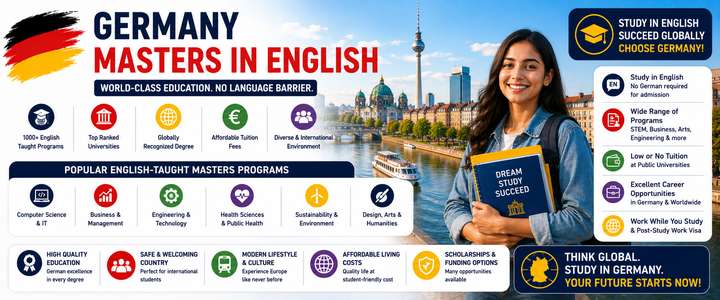
A master’s degree taught in English can make Germany accessible to students who do not yet have advanced German.
However, the teaching language affects more than classroom learning.
Advantages of English-Taught Programs
Easier academic transition for international applicants
Access to international cohorts
No immediate need for advanced academic German
Common availability in technical and scientific fields
Greater suitability for students targeting international careers
Limitations
Some fields offer fewer English options
Part-time jobs may still require German
Internships can be harder without local-language skills
Daily administration is not always available in English
Long-term employment options may be narrower
A strong strategy is to study in English while learning German consistently.
German proficiency can help with:
Accommodation
Local administration
Healthcare
Student employment
Internships
Professional networking
Graduate jobs
Students should not wait until the final semester to begin learning the language.
Admission Requirements for a Master’s Degree in Germany
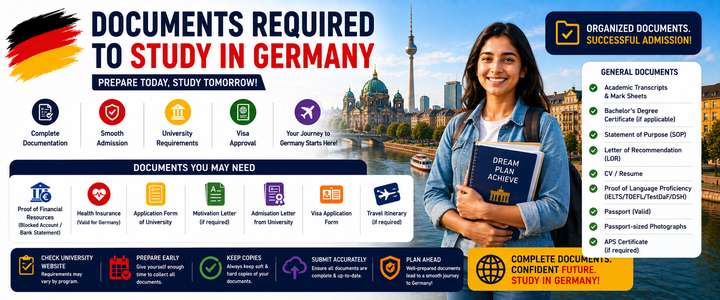
Requirements differ by institution and program, but applicants commonly need:
A recognized undergraduate degree
A degree in a related subject
Complete academic transcripts
Degree certificate or provisional completion evidence
Proof of English or German proficiency
Curriculum vitae
Statement of purpose or motivation letter
Recommendation letters where requested
Module descriptions or course syllabus
GRE or GMAT for selected programs
Portfolio for design or creative fields
Work experience for professional programs
APS documentation for relevant applicants
For master’s applications, uni-assist instructs applicants to submit their complete university certificates, including the diploma and full overview of subjects and grades. No pages should be omitted.
GPA and Grade Conversion
Germany uses a different grading system from many countries.
Universities may convert international grades into the German scale or evaluate them through their own procedures.
Students should avoid relying entirely on unofficial online grade calculators. A university may use:
Modified Bavarian formula
Country-specific evaluation
uni-assist assessment
Program-specific selection rules
Minimum grade plus subject requirements
Meeting the minimum grade does not guarantee admission.
ECTS and Credit Requirements
European programs commonly use the European Credit Transfer and Accumulation System.
An admissions page may require a minimum number of credits in specific areas.
For example:
20 credits in mathematics
15 credits in computer science
10 credits in statistics
30 credits in economics
A minimum number of laboratory credits
International students may need to provide detailed module descriptions so the university can understand the content of their undergraduate courses.
Language Requirements
English-taught programs may accept:
IELTS Academic
TOEFL iBT
Cambridge English qualifications
Previous English-medium education, only where explicitly accepted
German-taught programs may require:
TestDaF
DSH
Goethe qualifications
telc Deutsch C1 Hochschule
Another university-approved certificate
Never assume that a medium-of-instruction letter will replace IELTS or TOEFL. Some universities accept it; others do not.
APS Certificate for Indian Applicants
Indian applicants should plan for the APS process early.
APS India verifies academic qualifications issued by Indian institutions. The APS certificate is generally required as part of the German student visa documentation, although it does not replace the university’s admission decision or the visa decision.
Applicants must use the correct APS checklist and submit complete, formally correct documents. APS may request additional evidence during verification.
A 2026 APS clarification states that certificates are issued based on qualifications completed and documented when the application is processed. APS does not keep an application open while waiting for future examination results or additional semester marks.
This makes timing important for final-year students.
A Practical APS Strategy
Review the current APS category applicable to your profile.
Check whether your degree and marksheets are complete.
Apply early enough to avoid delaying the visa.
Keep university records and contact details accurate.
Do not assume APS guarantees admission.
Check current requirements directly before submission.
How to Find Master’s Programs in Germany
Students can search through:
DAAD’s international program database
Individual university websites
Hochschulkompass
uni-assist
Program-specific department pages
DAAD’s database is especially helpful for filtering by subject, degree type, language, tuition, and location.
However, databases should be used for discovery, not as the final authority.
The university’s official program page should be the main source for:
Eligibility
Deadlines
Curriculum
Language scores
Tuition
Required documents
Application route
How to Build a Smart University Shortlist
Do not divide universities only into “safe,” “moderate,” and “ambitious” based on rankings.
German admissions are often too requirement-driven for that model.
Instead, use four categories.
Strong Academic Match
You clearly satisfy:
Degree background
Subject credits
Grade requirement
Language requirement
Additional conditions
These should form the core of your applications.
Conditional Match
You satisfy most conditions, but one area requires interpretation.
Examples:
Your module title differs but content is similar.
Your credits may need conversion.
You are completing the final semester.
The course asks for a subject that may be covered inside another module.
Apply only after reviewing the wording carefully.
Competitive Match
You meet minimum requirements, but the program has limited seats or a highly selective process.
These applications are reasonable, but they should not make up your entire shortlist.
Weak Match
You lack major prerequisites.
Examples:
Applying to AI without mathematics or programming
Applying to finance without economics or quantitative credits
Applying to biotechnology without laboratory science
Applying to engineering after an unrelated degree
A polished SOP rarely compensates for a major academic mismatch.
Application Routes: Direct or Through uni-assist
German universities may receive applications:
Directly through their own portal
Through uni-assist
Through uni-assist for preliminary review followed by a university portal
Through a program-specific platform
Uni-assist evaluates international applications for approximately 180 German universities.
The standard My assist portal is used to create and submit applications for participating universities.
Current uni-assist handling fees are €75 for the first selected course in a semester and €30 for each additional selected course.
Students must still confirm whether their chosen course uses uni-assist.
Master’s Application Timeline
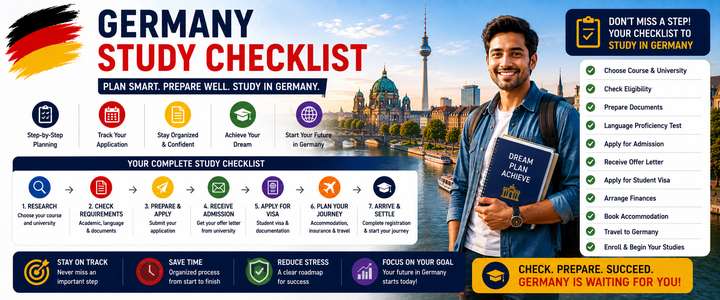
A good timeline begins approximately 10 to 12 months before enrollment.
Ten to Twelve Months Before
Define career and academic goals.
Research subjects and university types.
Review transcript compatibility.
Begin language-test preparation.
Investigate APS requirements.
Estimate finances.
Eight to Ten Months Before
Take IELTS, TOEFL, GRE, GMAT, or German tests where needed.
Collect transcripts and degree documents.
Request recommendation letters.
Prepare module descriptions.
Shortlist programs.
Six to Eight Months Before
Begin APS where applicable.
Draft motivation letters.
Create university portal accounts.
Check certification and translation rules.
Submit early-deadline applications.
Four to Six Months Before
Submit remaining applications.
Monitor portals and email.
Respond to document requests.
Compare offers.
Begin accommodation research.
Two to Four Months Before
Accept admission.
Arrange proof of funds.
Purchase appropriate insurance.
Apply for the visa.
Finalize accommodation and travel.
Application Deadlines
For many programs, common deadlines are:
July 15 for winter-semester entry
January 15 for summer-semester entry
However, uni-assist warns that universities may set different or earlier deadlines, especially for master’s programs.
Some courses close months earlier.
Students should build their schedule using each university’s exact deadline, not the general national pattern.
Writing a Strong Motivation Letter
A weak motivation letter says:
Germany has excellent education.
The university is prestigious.
The applicant is passionate.
The course will provide global exposure.
These statements are generic.
A stronger letter explains:
What academic problem or field interests you
How your bachelor’s degree prepared you
Why this particular curriculum is suitable
Which modules, laboratories, or research areas matter
What type of work you want to pursue
Why Germany supports that plan
What evidence demonstrates your readiness
Example of Stronger Positioning
Instead of:
“I want to study data science because data is the future.”
Write:
“My undergraduate work in statistics, Python, database systems, and predictive modeling led me toward industrial data applications. The program’s modules in statistical learning, data engineering, and optimization align with my goal of working on predictive maintenance and manufacturing analytics.”
Specificity makes the application credible.
Tuition Fees for a Master’s Degree in Germany
Many public universities charge no general tuition for consecutive master’s degrees, but students still pay semester contributions and other living expenses.
Exceptions include:
Private universities
Continuing-education programs
Selected specialized master’s degrees
Certain universities with international tuition policies
Many non-EU students studying at public institutions in Baden-Württemberg
DAAD notes that non-EU students at many higher education institutions in Baden-Württemberg pay €1,500 per semester.
Students must verify fees for the exact program.
Semester Contribution
The semester contribution may support:
Student administration
Student services
Student union activities
Transportation arrangements
Campus facilities
The amount differs by institution.
Cost of Living
DAAD reports average student expenses of €876 per month based on its cited social survey, while visa applicants must demonstrate the officially required level of financial resources. Current requirements should always be verified before applying.
Actual monthly expenses vary considerably.
Major Cost Categories
Rent and utilities
Food
Health insurance
Transportation
Phone and internet
Study materials
Broadcasting contribution
Clothing
Personal and leisure expenses
Accommodation is usually the largest expense.
Munich, Frankfurt, Hamburg, and some areas of Berlin can be expensive. Smaller university cities may offer lower rent, although housing availability can still be difficult.
Scholarships
Scholarships may be available through:
DAAD
Universities
Political foundations
Social and religious foundations
Research institutions
Erasmus-related programs
Home-country funding bodies
Students should understand that Germany’s low public tuition does not mean scholarships are easy to obtain.
Many scholarships focus on:
Academic performance
Research potential
Professional experience
Social engagement
Leadership
Country or subject priorities
Applications often require strong preparation well before university deadlines.
Student Visa and Financial Proof
Non-EU students generally need an appropriate visa or residence route for study.
Common requirements include:
Admission letter
Valid passport
Proof of finances
Health insurance
Academic documents
APS documentation where applicable
Visa forms and photographs
Motivation or study-plan documents
Language evidence where requested
Financial proof may be demonstrated through accepted methods such as a blocked account, scholarship, or formal sponsorship arrangement, depending on the applicable rules.
Because the required amount can change, applicants should verify the figure on the official German government or mission website before applying.
Working During a Master’s Degree
International students can work during their studies under applicable residence rules.
Germany’s official portal explains the available routes and regulations for employment alongside academic study.
Common opportunities include:
Research assistant
Teaching assistant
Working student
Software developer
Laboratory assistant
Data analyst
Retail or hospitality work
Tutoring
Administrative roles
Internships
The most valuable student job is often one related to the degree.
A working-student role can provide:
German work experience
Industry contacts
Technical skills
References
A possible route to graduate employment
Students should not rely on immediate part-time employment to fund their entire stay.
The Master’s Thesis as a Career Tool
Many students treat the thesis as the final academic obstacle.
A better approach is to use it strategically.
A thesis can help you:
Build expertise in a specialized area
Work with a research group
Collaborate with a company
Demonstrate practical problem-solving
Prepare for doctoral study
Create a strong interview discussion topic
When possible, choose a thesis that connects with your desired career.
Examples:
Computer vision for industrial quality control
Battery-management systems
Sustainable supply-chain optimization
Financial risk modeling
Renewable-energy forecasting
Biomedical image analysis
Human-centered AI governance
A well-chosen thesis can become part of your professional identity.
Career Opportunities After Graduation
Germany’s official immigration portal states that eligible third-country graduates can receive a residence permit for up to 18 months to search for qualified employment. During this period, they may take any type of job while searching.
Once qualified employment is secured, graduates may be eligible to move to:
A residence permit for qualified professionals
An EU Blue Card, where requirements are met
A research residence route
Another applicable employment permit
The degree alone does not guarantee employment.
Students can improve their prospects by developing:
German-language ability
Relevant student employment
Internships
Technical projects
Professional networking
A clear specialization
Strong application documents
Common Mistakes Students Make
Choosing by Ranking Alone
University reputation matters, but program fit, curriculum, and local industry may matter more.
Ignoring Subject-Credit Requirements
A high GPA cannot always replace missing prerequisite modules.
Applying Only to Famous Universities
Germany has many strong institutions beyond the most internationally recognized names.
Writing the Same SOP for Every Course
Each motivation letter should reflect the specific curriculum and academic fit.
Assuming Public Means Completely Free
Semester contributions and exceptions still apply.
Ignoring German Until Graduation
Language skills take time to develop and can influence internships and employment.
Depending Entirely on Part-Time Work
Students need a realistic financial plan before arrival.
Applying Too Late
APS, tests, document certification, visa appointments, and accommodation can all create delays.
A Better Way to Choose Your Master’s Degree
Before applying, answer these questions:
What exact subject do I want to study?
Which bachelor’s modules support that choice?
Do I prefer research or practical learning?
Which jobs should the degree prepare me for?
Which German regions have those employers?
Is the course taught in English or German?
What is the full cost?
Can I meet every formal requirement?
Does the curriculum provide real specialization?
Am I willing to learn German?
When those answers are clear, university selection becomes much easier.
Is a Master’s Degree in Germany Worth It?
A master’s degree in Germany can be an excellent investment for students who choose carefully.
It is particularly attractive for those who want:
Advanced technical or scientific education
Research experience
Comparatively affordable public study
Exposure to German industry
An international career
A possible route into European employment
It may be less suitable for students who choose a random course only because tuition appears low.
Germany rewards preparation.
Students who understand admission requirements, match their previous education with the curriculum, plan finances realistically, and begin career preparation early are more likely to benefit from the experience.
The real value of a German master’s degree is not simply the name of the university.
It is the combination of academic specialization, practical experience, language development, and professional direction built during the program.
Frequently Asked Questions
How long does a master’s degree take in Germany?
Most master’s programs take two to four semesters, depending on the course structure and credit requirements.
Is a master’s degree free in Germany?
Many consecutive master’s programs at public universities charge no general tuition, but semester contributions and living expenses apply. Private and continuing-education programs usually charge tuition, and other exceptions exist.
Can I study in English?
Yes. Germany offers many English-taught master’s programs, particularly in technical, scientific, and international subjects.
Is German required?
It may not be required for admission to an English-taught program, but it can significantly improve daily life and employment opportunities.
What GPA is required?
There is no single GPA requirement. Each university and program sets its own minimum grade and selection criteria.
Can I change my academic field?
Limited changes may be possible, but most consecutive master’s programs require a related bachelor’s degree and specific subject credits.
Is IELTS compulsory?
Not for every course. Universities may accept IELTS, TOEFL, other qualifications, or previous English-medium education where explicitly allowed.
Is the GRE required?
Only selected programs require or recommend the GRE. Applicants must check the official course page.
What is uni-assist?
Uni-assist evaluates international applications for participating German universities. Some universities use it, while others accept applications directly.
Do Indian students need APS?
The APS certificate is generally required for the German student visa procedure for applicants with Indian academic qualifications. Applicants should check the current rules and their applicable category.
Can students work while studying?
Yes, international students may work under the conditions attached to their residence status.
Can I stay after graduation?
Eligible third-country graduates may receive up to 18 months to search for qualified employment.
Which master’s degrees are popular in Germany?
Popular subjects include computer science, artificial intelligence, data science, mechanical engineering, automotive engineering, electrical engineering, renewable energy, biotechnology, finance, and business analytics.
Are universities of applied sciences good?
Yes. They can be especially suitable for students seeking practical, industry-oriented education.
When should I apply?
Begin planning 10 to 12 months before the intended intake. Exact deadlines vary, and some master’s programs close earlier than general university deadlines.