
Germany can be an excellent destination for students who want to begin their international education immediately after school. Its public universities, technical institutions, universities of applied sciences, research facilities, and industry connections make it particularly attractive for students interested in engineering, computer science, business, natural sciences, design, and related fields.
However, applying for a bachelor’s degree in Germany is more complicated than simply submitting a Class 12 certificate.
Germany evaluates whether an applicant’s school education is equivalent to the qualification held by German students entering university. This qualification is called the Hochschulzugangsberechtigung, usually shortened to HZB.
Depending on your country, school board, subjects, grades, entrance examinations, and any university education completed after school, you may receive:
Direct admission to all subjects
Direct admission limited to related subjects
Eligibility for a Studienkolleg
Eligibility only after completing additional university study
No immediate eligibility under your current qualifications
This means the first question is not:
Which German university should I apply to?
It is:
Which admission route does my academic background qualify for?
This guide explains bachelor’s degrees in Germany from that perspective. It covers direct admission, Studienkolleg, language requirements, course selection, public and private universities, tuition fees, applications, APS requirements, student visas, part-time work, and career planning.
Bachelor’s Degree in Germany at a Glance
| Category | Typical Details |
|---|---|
| Degree duration | Usually three to four years |
| Academic semesters | Commonly six to eight semesters |
| Main intake | Winter semester |
| Additional intake | Summer semester for selected programs |
| Teaching language | Mostly German, with some English-taught options |
| University types | Universities and universities of applied sciences |
| Main qualification | University entrance qualification or HZB |
| Alternative route | Studienkolleg followed by an assessment examination |
| Tuition at public universities | Often no general tuition, but exceptions apply |
| Additional payment | Semester contribution |
| Work while studying | Permitted under applicable residence rules |
| Post-study option | Eligible graduates may remain for up to 18 months to seek qualified work |
Why Study for a Bachelor’s Degree in Germany?
Germany offers a combination of academic quality, relatively affordable public education, practical learning, research opportunities, and access to a large European economy.
Students may benefit from:
Public universities with little or no general tuition
Strong engineering and technology programs
Practical education at universities of applied sciences
Modern laboratories and research facilities
Internships and company-linked projects
Internationally recognized qualifications
Part-time employment opportunities
The possibility of learning German
Access to European travel and professional networks
Post-study employment options
Germany is especially valuable for students who are prepared to become independent learners.
Universities generally expect students to manage their own schedules, understand examination rules, register for courses, complete assignments, and seek help when needed. Professors may provide academic guidance, but students are responsible for organizing their progress.
That independence can be challenging during the first year, but it also develops valuable professional habits.
Understanding the German University Entrance Qualification
To enter a German bachelor’s or state-examination program, applicants need a recognized university entrance qualification.
Uni-assist explains that this qualification is called the Hochschulzugangsberechtigung. It may be based on a school-leaving certificate, but applicants from some countries may also need previous university study or another qualification.
The result of your assessment may be:
General University Entrance Qualification
This allows you to apply across a wide selection of academic subjects, subject to each program’s admission rules.
Subject-Restricted University Entrance Qualification
This allows you to apply only to subjects related to your previous educational background.
For example, an applicant with a science-focused qualification may be limited to science or technical programs.
Studienkolleg Eligibility
Your school qualification may allow you to attend a preparatory course but not begin a bachelor’s degree directly.
No Current Eligibility
Some applicants may need to complete additional recognized education before they can qualify.
Students can use uni-assist’s official university-admission checker for an initial assessment. The tool is based on guidance from Germany’s Central Office for Foreign Education.
The result should be treated as an initial guide. The university or responsible application service makes the formal decision.
Direct Admission vs Studienkolleg
This is the most important distinction for international bachelor’s applicants.
Direct Admission
Direct admission means your previous education qualifies you to apply to a bachelor’s program without first completing a preparatory course.
Direct admission does not guarantee acceptance.
You must still meet:
Subject requirements
Grade requirements
Language requirements
Entrance-test conditions
Application deadlines
Portfolio or aptitude-test requirements where applicable
Admission may also be subject-restricted, meaning you can apply only within a particular academic area.
Studienkolleg
A Studienkolleg is a preparatory program for students whose school qualification is not fully equivalent to the German university entrance qualification.
The program usually prepares students for the Feststellungsprüfung, or university qualification assessment examination.
A Studienkolleg is not simply a German-language course. It combines language preparation with academic subjects related to the student’s intended degree.
Common tracks include:
| Studienkolleg Track | Typical Degree Areas |
|---|---|
| T-Kurs | Engineering, mathematics, computer science, natural sciences |
| M-Kurs | Medicine, biology, pharmacy and related sciences |
| W-Kurs | Business, economics and social sciences |
| G-Kurs | Humanities and German studies |
| S-Kurs | Languages and selected humanities subjects |
Track names and structures can vary by institution.
Passing the final assessment normally gives the student a subject-restricted university entrance qualification connected with the chosen preparatory track.
Is Studienkolleg a Disadvantage?
Not necessarily.
It adds time before the bachelor’s degree, but it can provide:
Academic German preparation
Familiarity with the German education system
Subject revision
Time to adapt to Germany
Better preparation for first-year university courses
A structured transition from school to independent university study
For a student arriving directly after Class 12, this transition period can be useful.
However, public Studienkollegs can be competitive, and entrance examinations may test German and academic subjects.
Bachelor’s Admission Routes for Indian Students
Indian applicants must evaluate their eligibility carefully because different academic profiles may lead to different admission categories.
APS India provides separate document checklists for:
Class 12 graduates
Applicants with JEE Main and Advanced
Undergraduate students with at least two completed bachelor’s semesters
Other applicable educational profiles
APS also states in its frequently asked questions that applicants for bachelor’s programs are generally required to submit a TestAS score. Applicants should check the latest APS instructions applicable to their exact category before registering for tests or submitting documents.
The possible pathways may include:
Route 1: Class 12 to Studienkolleg
Some school graduates may qualify for a preparatory course rather than direct bachelor’s admission.
They normally need:
A recognized Class 12 qualification
Required grades and subjects
German-language proficiency
APS documentation
TestAS or other required assessment
Admission to a Studienkolleg or university pathway
Successful completion of the Feststellungsprüfung
Route 2: JEE-Based Eligibility
Applicants with the required JEE qualifications may fall under a different evaluation route.
Students should not assume that simply appearing for JEE is sufficient. They must review the current APS checklist and German admission rules applying to their results.
Route 3: Previous University Study in India
Applicants who complete the required period of recognized bachelor’s study in India may become eligible for direct subject-restricted admission in Germany.
The German course generally needs to be connected with the previous field of study.
For example, a student who has completed recognized engineering education may qualify for a related engineering or technical bachelor’s program, but not automatically for an unrelated subject.
Important 2026 APS Changes
APS India published updated information in February 2026 concerning eligibility for Indian applicants seeking undergraduate admission in Germany. Because these rules can affect students applying for the winter 2026–27 cycle and later intakes, applicants must review the current APS announcement rather than relying on older consultancy articles or social-media summaries.
This is particularly important because the rules may distinguish between:
Studienkolleg eligibility
Direct subject-restricted admission
Completed school qualifications
Completed university semesters
Entrance examination results
Choosing the Right Type of German Institution
Germany has more than one kind of university.
The correct institution depends on whether you want theoretical research, practical professional preparation, creative training, or a specialized career.
Traditional Universities
Traditional universities emphasize:
Academic theory
Research
Scientific depth
Independent study
Advanced mathematics or methodology
Preparation for master’s and doctoral study
They can be suitable for students interested in:
Research careers
Academic study
Advanced technical development
Theoretical computer science
Natural sciences
Economics
Humanities
Doctoral education later
Universities of Applied Sciences
Universities of applied sciences generally focus more heavily on professional application.
Programs may include:
Laboratory assignments
Applied projects
Internships
Company partnerships
Practical semesters
Industry-oriented teaching
They can be attractive for students who want to enter employment after graduation.
A computer science program at a university of applied sciences may emphasize software development, systems, and company projects. A traditional university program may include more mathematics, algorithms, theory, and research.
Neither is automatically superior.
Art, Film, and Music Institutions
Specialized institutions offer programs in:
Fine arts
Music
Acting
Film
Animation
Design
Architecture
Performance
Admission may require:
Portfolio
Audition
Artistic aptitude test
Interview
Practical assignment
Academic grades may be only one part of the selection process.
Popular Bachelor’s Courses in Germany
Engineering
Germany is widely associated with engineering and industrial education.
Popular programs include:
Mechanical Engineering
Automotive Engineering
Electrical Engineering
Civil Engineering
Industrial Engineering
Mechatronics
Chemical Engineering
Aerospace Engineering
Production Engineering
Environmental Engineering
Engineering students should examine:
Mathematics requirements
Laboratory facilities
Industry partnerships
Internship structure
Teaching language
Local employers
Program accreditation where relevant
Computer Science
Bachelor’s programs may cover:
Programming
Algorithms
Databases
Computer architecture
Operating systems
Software engineering
Networks
Mathematics
Theoretical computer science
Students interested only in coding may underestimate the mathematical and theoretical content of a German computer science degree.
Artificial Intelligence and Data Science
Standalone bachelor’s programs in artificial intelligence and data science are increasingly available, but applicants should inspect the curriculum carefully.
A strong program should include foundations such as:
Calculus
Linear algebra
Probability
Statistics
Programming
Algorithms
Databases
Machine learning
Data ethics
A fashionable course name is not enough.
Business and Economics
Popular options include:
Business Administration
International Business
Economics
Finance
Business Informatics
Supply Chain Management
Management
Business Analytics
Business Informatics can be particularly interesting for students who want to combine information technology with business systems.
Natural Sciences
Germany offers research-oriented bachelor’s programs in:
Physics
Chemistry
Biology
Mathematics
Geosciences
Environmental Science
Materials Science
These degrees can provide pathways to research, laboratories, technical industries, or specialized master’s study.
Design and Architecture
Creative programs may include:
Product Design
Communication Design
Industrial Design
Architecture
Media Design
Interaction Design
Portfolios and aptitude tests are often central to admission.
Social Sciences and Humanities
Students can also explore:
Political Science
Sociology
Psychology
History
Philosophy
Linguistics
Cultural Studies
European Studies
English-taught choices may be more limited than in selected technical fields.
German-Taught vs English-Taught Bachelor’s Programs
This is one of the biggest practical differences between bachelor’s and master’s study in Germany.
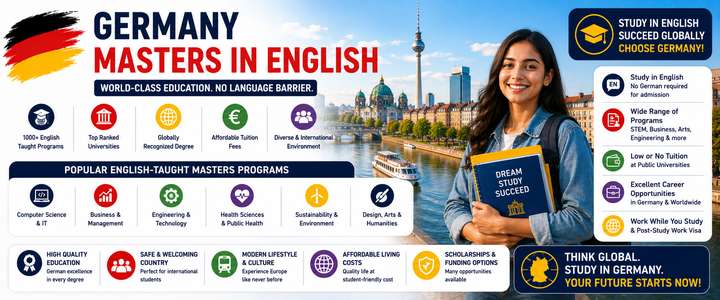
Most bachelor’s programs are taught in German.
The DAAD international-program database lists hundreds of internationally oriented bachelor’s options, but the number remains much smaller than the selection available at the master’s level.
German-Taught Programs
Advantages include:
Much wider course selection
Greater access to public universities
Better integration into student life
Easier access to part-time employment
Stronger long-term job prospects in Germany
Possible language certificates include:
TestDaF
DSH
Goethe-Zertifikat
telc Deutsch C1 Hochschule
Other university-approved evidence
The required certificate and level vary by institution.
English-Taught Programs
Advantages include:
Easier academic entry for students without advanced German
International classroom environment
Access to selected technology, science, and business programs
Limitations may include:
Smaller program selection
More private-university options with higher tuition
Competition for limited places
Continued need for German outside the classroom
Uni-assist notes that even some English-taught programs may still require proof of German proficiency. Applicants must check the exact university rules.
The Best Language Strategy
Students planning a full bachelor’s degree in Germany should take German seriously, even when the program is taught in English.
A bachelor’s student may spend three or four years in the country. During that time, German can help with:
Housing
Local administration
Healthcare
Friendships
University communication
Internships
Working-student positions
Graduate employment
Starting German before arrival is much easier than trying to learn it under pressure during the final year.
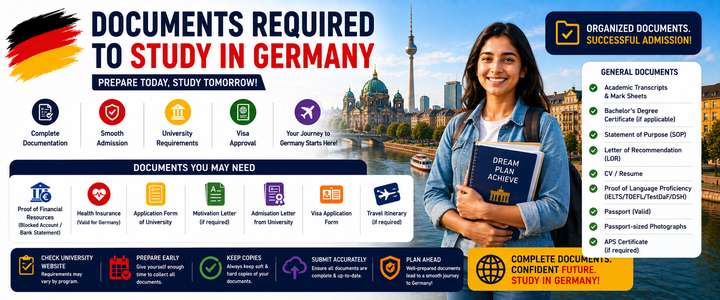
Admission Requirements
Requirements differ, but international bachelor’s applicants commonly need:
Recognized school-leaving qualification
University entrance qualification
Academic transcripts
Proof of subjects studied
University entrance examination evidence where applicable
Previous university transcripts where applicable
German or English language certificate
APS certificate for eligible Indian applicants
TestAS where required
Valid passport
Curriculum vitae
Motivation letter where requested
Portfolio or aptitude-test result for creative programs
Certified translations where required
Uni-assist lists school certificates, university entrance examinations, previous university records, and information about the grading system among the documents that may be needed for international applications.
Numerus Clausus Programs
Some bachelor’s programs have restricted admission because demand exceeds available places.
These may be described as having a Numerus Clausus, or NC.
Selection can depend on:
Academic grades
Waiting or selection rules
Aptitude tests
Interviews
Subject-specific criteria
Available seats
Medicine, psychology, and other high-demand fields can be particularly competitive.
Open-Admission Programs
Some programs admit all applicants who meet the published formal requirements.
However, “open admission” does not mean the course is academically easy. Students must still satisfy entrance, language, and documentation requirements.
How to Search for Bachelor’s Programs
Useful official search tools include:
DAAD International Programmes
Hochschulkompass
Individual university websites
uni-assist
State-level university portals
The DAAD international-program database includes internationally oriented bachelor’s programs and allows filtering by subject, language, location, and degree type.
Students should use databases to discover programs, then verify all information on the university’s current course page.
Always confirm:
Teaching language
Direct-admission requirements
Studienkolleg route
Required subjects
Language score
Tuition
Semester contribution
Application platform
Deadline
Entrance tests
Portfolio requirements
Application Routes
Applications may be submitted:
Directly to the university
Through uni-assist
Through a university portal after uni-assist verification
Through a state-level admissions platform
Through a foundation-course or Studienkolleg process
Uni-assist currently works with approximately 180 German universities.
When uni-assist is responsible, students apply through the My assist portal.
The standard processing fee is €75 for the first course selected in a semester and €30 for each additional course.
A university may use uni-assist for some programs but not others, so applicants should check the specific course instructions.
Bachelor’s Application Timeline
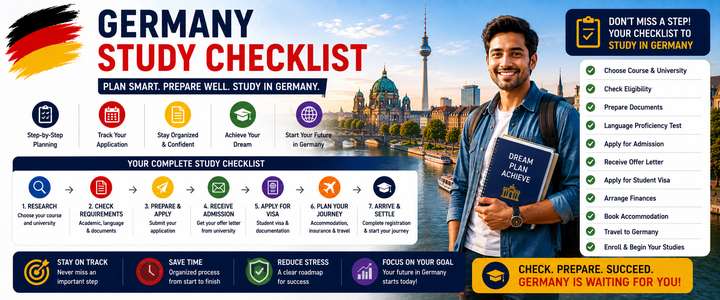
Students should begin preparing approximately 12 to 18 months before the intended intake.
Twelve to Eighteen Months Before
Decide the subject area.
Check admission eligibility.
Determine whether Studienkolleg is required.
Begin German-language preparation.
Review APS requirements.
Research TestAS or entrance examinations.
Estimate the total budget.
Nine to Twelve Months Before
Take required language tests.
Register for TestAS where applicable.
Collect school certificates and transcripts.
Prepare translations and certified copies.
Shortlist universities and Studienkollegs.
Check subject and grade requirements.
Six to Nine Months Before
Complete the APS process where required.
Submit early applications.
Prepare motivation letters.
Create uni-assist and university accounts.
Monitor entrance-examination dates.
Three to Six Months Before
Submit remaining applications.
Attend entrance tests or interviews.
Compare admission offers.
Arrange proof of funds.
Search for accommodation.
Begin visa preparation.
One to Three Months Before
Finalize enrollment.
Complete the visa process.
Arrange health insurance.
Confirm accommodation.
Prepare travel and arrival documents.
Application Deadlines
Many universities use:
July 15 for winter-semester applications
January 15 for summer-semester applications
However, these are not universal.
Studienkollegs, competitive programs, international courses, and programs with entrance tests may close earlier.
Students must follow the exact deadline published by the university.
Tuition Fees
Germany’s public education system is one of its biggest attractions.
DAAD states that most students at state-funded higher education institutions do not pay tuition fees.
However, public does not always mean completely free.
Students may need to pay:
Semester contribution
Administrative charges
Transportation-related fees
Student-service fees
Tuition in specific states or institutions
Program-specific fees
Examination or material costs
Baden-Württemberg
Non-EU students at many state institutions in Baden-Württemberg generally pay €1,500 per semester.
Other Possible Exceptions
Some universities in other German states have introduced or considered tuition policies for international students. Students should check the exact fee for their intended intake rather than relying on the broad statement that “Germany is free.”
Private Universities
Private-university bachelor’s programs may charge significant tuition.
They may offer:
More English-taught programs
Smaller classes
International support
Specialized curricula
Flexible admissions
Students should verify:
Institutional recognition
Program accreditation where relevant
Full tuition
Refund rules
Career outcomes
Employer reputation
Cost of Living
The total cost depends heavily on the city and accommodation.
Students should budget for:
Rent
Utilities
Food
Health insurance
Transportation
Phone and internet
Study materials
Broadcasting contribution
Clothing
Personal expenses
Travel
Munich, Frankfurt, Hamburg, and parts of Berlin can be expensive. Smaller cities may offer lower rent, although housing shortages can occur anywhere with a large student population.
Students should not select a university without comparing local accommodation costs.
Scholarships for Bachelor’s Students
Scholarships are available, but full undergraduate funding is more limited than many applicants expect.
Potential sources include:
Universities
German foundations
Political foundations
Religious or social organizations
Home-country scholarships
Private sponsors
Merit-based programs
Scholarships may consider:
Academic achievement
Leadership
Social involvement
Financial circumstances
Subject area
Nationality
Language ability
Students should not build their entire study plan around receiving a scholarship unless the funding has already been confirmed.
Student Visa and Proof of Funds
Non-EU students generally need an appropriate student visa or residence permit.
Common requirements may include:
Admission letter
Passport
Academic documents
APS certificate where applicable
Proof of finances
Health insurance
Visa application documents
Language evidence
Motivation or study plan
Accommodation details where requested
The required financial amount can change. Applicants should verify the current blocked-account or financial-proof requirement through the official German mission or government immigration portal before applying.
Working While Studying
Third-country students can generally work up to:
140 full days per year, or
280 half-days per year
An alternative framework allows work for up to 20 hours per week during the lecture period under the applicable rules.
Common student jobs include:
University assistant
Research support
Tutor
Software developer
Retail employee
Café or restaurant employee
Warehouse worker
Administrative assistant
Intern
Working student in a company
Students should not expect part-time work to finance the entire degree.
DAAD warns that it is generally unrealistic to cover all living expenses through student jobs.
The strongest part-time opportunity is usually one connected with the degree.
A working-student role can provide:
Professional experience
German workplace knowledge
References
Industry contacts
A possible route to full-time employment
Internships and Practical Experience
Bachelor’s students should begin career preparation early.
Depending on the degree, students may complete:
Mandatory internships
Voluntary internships
Practical semesters
Laboratory projects
Company-sponsored projects
Working-student positions
Industry-linked bachelor’s theses
Do not wait until the final semester to build a résumé.
A useful three-year strategy is:
First Year
Adapt academically.
Improve German.
Join student organizations.
Build foundational technical or business skills.
Second Year
Complete projects.
Attend career events.
Apply for internships.
Seek university or working-student positions.
Third Year
Specialize.
Complete an industry-relevant project.
Build professional contacts.
Choose a strategic thesis topic.
Apply for graduate jobs or master’s programs.
Career Options After Graduation
Eligible international graduates from third countries may receive a residence permit for up to 18 months to search for qualified employment. They may take any type of job during this search period.
After finding suitable qualified work, graduates may be able to move to:
A residence permit for qualified professionals
An EU Blue Card where requirements are met
A research or other employment route
A suitable self-employment pathway in eligible cases
Career opportunities depend on:
Degree subject
German-language ability
Internships
Technical skills
Location
Industry demand
Professional network
Work authorization requirements
A bachelor’s degree alone does not guarantee employment.
Bachelor’s Degree or Studienkolleg: Which Route Is Better?
This is not always a matter of preference. Your academic qualifications determine which route is available.
Choose direct admission when:
Your school and academic qualifications meet the HZB requirements.
You meet the program’s language and subject conditions.
You are ready for university-level independent study.
Complete Studienkolleg when:
Your qualification does not provide direct entry.
You need academic and language preparation.
You want a structured transition into German higher education.
Students should not treat Studienkolleg as a failure or unnecessary delay. It can prevent a much more serious problem: entering university without sufficient language or academic preparation.
Common Mistakes
Assuming Class 12 Automatically Gives Direct Admission
Eligibility depends on the country, board, qualifications, examinations, and current German evaluation rules.
Choosing Only English-Taught Courses
This greatly reduces the available public-university selection.
Starting German Too Late
Reaching university-level German can take substantial time.
Depending on Rankings
The course structure and admission route matter more than a general ranking.
Ignoring Studienkolleg Entrance Requirements
Public Studienkollegs can have competitive German and subject tests.
Believing Every Public University Is Free
State, institution, and program exceptions exist.
Applying Through the Wrong Portal
Some universities use uni-assist, while others use their own systems.
Depending Entirely on Part-Time Work
Employment is not guaranteed and should not replace a proper financial plan.
Failing to Verify APS Updates
Indian applicants must follow the latest official APS category and documentation rules.
Is a Bachelor’s Degree in Germany Worth It?
For the right student, yes.
Germany can offer:
High-quality education
Comparatively affordable public study
Strong technical and research environments
Practical learning
Access to internships
German-language development
International experience
Long-term career opportunities
However, a German bachelor’s degree requires more preparation than many students expect.
Applicants must understand their admission route, begin language preparation early, prepare finances, and select a course based on curriculum rather than marketing.
The students who benefit most are usually those who:
Are comfortable with independent learning
Research admission requirements carefully
Are willing to learn German
Build practical experience during the degree
Plan beyond admission
Choose a course linked to a realistic career goal
Germany should not be chosen only because tuition appears low.
It should be chosen because the academic program, language environment, cost, and career ecosystem fit the student’s long-term plan.
Frequently Asked Questions
Can international students pursue a bachelor’s degree in Germany?
Yes. International students can apply if their academic qualifications provide a recognized university entrance route.
Is Class 12 enough for direct admission?
Not always. Depending on the applicant’s educational background, Studienkolleg, an entrance examination, or previous university study may be required.
What is Studienkolleg?
Studienkolleg is a preparatory academic course for students whose school qualification does not provide direct university admission in Germany.
Is a bachelor’s degree free in Germany?
Many public universities charge no general tuition, but semester contributions and living expenses apply. Tuition exceptions also exist.
Are bachelor’s programs available in English?
Yes, but the number is more limited than German-taught bachelor’s programs.
Is German compulsory?
German is required for most bachelor’s programs. Even students in English-taught courses benefit significantly from learning it.
How long is a bachelor’s degree?
Most programs last six to eight semesters, or approximately three to four years.
Do Indian students need APS?
Indian applicants generally need APS verification according to the category applicable to their education and intended study route.
Is TestAS required?
APS states that bachelor’s applicants are generally required to submit a TestAS score. Students must check the latest rules for their category.
Can students work while studying?
Eligible third-country students can generally work up to 140 full days or 280 half-days annually, subject to applicable rules.
Can students stay after graduation?
Eligible graduates may receive up to 18 months to search for qualified employment.
Which bachelor’s courses are popular?
Popular options include engineering, computer science, business, economics, natural sciences, data science, design, and environmental studies.
Is a university of applied sciences good?
Yes. It may be particularly suitable for students seeking practical, professionally oriented education.
When should students start preparing?
Ideally, students should begin 12 to 18 months before the intended intake, particularly when German, Studienkolleg, APS, or TestAS preparation is required.
Is Germany good for Indian undergraduate students?
Germany can be a strong option for Indian students who understand the admission route, prepare German early, and want affordable, academically rigorous international education.