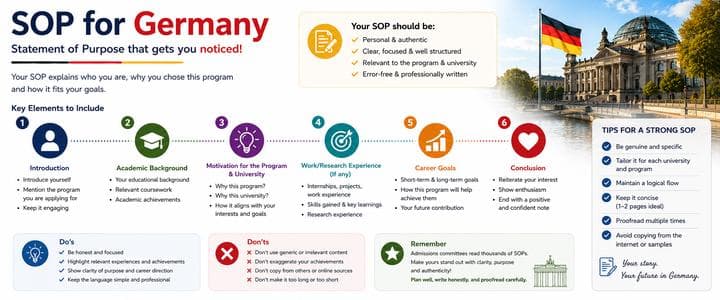
A Statement of Purpose (SOP) for Germany is an academic essay that explains your educational background, relevant experience, reasons for choosing a particular degree, and your future academic or professional goals.
For many German university applications, especially competitive Master’s programs, the SOP can help the admissions committee understand the person behind the transcript.
Your grades show how you performed.
Your CV shows what you have done.
Your SOP explains why those experiences matter and why the chosen program is the logical next step.
A strong SOP for Germany should demonstrate a clear connection between:
Previous education → Academic interests → Projects or experience → Chosen German program → Future goals
German universities generally value clarity and academic relevance more than dramatic storytelling. Your SOP should therefore be specific, factual, personalized, and closely connected to the curriculum you are applying for.
SOP for Germany at a Glance
| Factor | Recommended Approach |
|---|---|
| Typical Length | Around 1–2 pages unless specified |
| Common Word Range | Approximately 700–1,000 words when no limit is given |
| Tone | Professional, academic and personal |
| Main Focus | Academic fit and future goals |
| University Specific | Yes |
| Repeat CV | No |
| Mention Projects | Yes |
| Mention Work Experience | When relevant |
| Mention Germany | Briefly and academically |
| Mention Rankings | Usually unnecessary |
| Same SOP for Every University | Not recommended |
| AI-Generated Generic SOP | Avoid |
| Submit as PDF | When requested by the university |
What Is an SOP for Germany?
SOP stands for:
Statement of Purpose
It is a written explanation of your academic journey and reasons for applying to a particular university program.
The SOP usually helps answer questions such as:
What have you studied?
What areas interest you most?
What relevant projects have you completed?
What have you learned through internships or work?
Why do you want this particular degree?
Why have you selected this university?
Why does Germany fit your academic goals?
What do you plan to do after graduation?
A strong SOP should make the progression of your education and career easy to understand.
Is SOP Mandatory for German Universities?
Not every German university requires an SOP.
Some programs may ask for:
Statement of Purpose
Letter of Motivation
Motivation Letter
Personal Statement
Essay
Statement of Academic Interest
Other programs may not require any written statement.
Admission may instead depend largely on:
Previous degree
GPA
Required subject credits
Language proficiency
Entrance examination
Portfolio
Work experience
Always follow the exact requirement of the program.
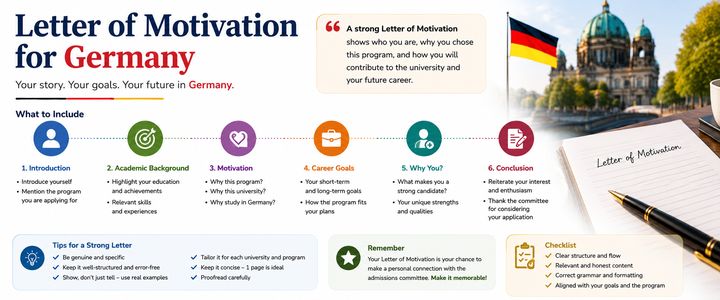
SOP vs Letter of Motivation for Germany
These documents are closely related and universities sometimes use the terms interchangeably.
However, there can be a slight difference.
| SOP | Letter of Motivation |
|---|---|
| More academic and career focused | Can be slightly more motivation focused |
| Explains academic progression | Explains why you want the opportunity |
| Often discusses projects/research | Often discusses personal and academic motivation |
| Strong emphasis on future goals | Strong emphasis on reasons for choosing the program |
| Common for postgraduate study | Common across several degree levels |
For German universities, the safest approach is to combine both qualities.
Your document should explain:
your academic preparation + your motivation + your program fit + your future direction
If the university specifically asks for a “Letter of Motivation,” use that title.
If it specifically asks for an “SOP,” follow the SOP instructions.
Ideal SOP Length for Germany
There is no universal word limit.
Universities may specify:
One page
Two pages
500 words
750 words
1,000 words
Character limits
Specific questions
The university's instructions always take priority.
When no length is specified, approximately 700–1,000 words or one to two pages is usually enough to explain your profile without unnecessary repetition.
Longer does not automatically mean better.
Recommended SOP Structure
A strong SOP can follow this structure:
Introduction and academic interest
Academic background
Relevant projects and research
Internship or professional experience
Why this program
Why this university
Why Germany
Career goals
Conclusion
These do not need to appear as headings in the final SOP.
The document should read as one connected academic narrative.
Paragraph 1: Start With Your Academic Direction
The first paragraph should immediately establish:
Your academic background
Your area of interest
What you want to study next
Avoid starting with childhood stories unless they genuinely explain your academic direction.
Weak Opening
“Since childhood, computers have always fascinated me.”
This has been used in thousands of SOPs.
Better Opening
“My undergraduate studies in Computer Engineering introduced me to the interaction between algorithms, software systems and data-driven decision-making. Through coursework and projects involving machine learning and distributed applications, I became particularly interested in building intelligent systems that remain efficient and reliable at scale.”
This immediately establishes academic purpose.
Paragraph 2: Explain Your Academic Background
Discuss your previous degree.
Focus on relevant subjects.
For an MSc Computer Science application, these might include:
Data Structures
Algorithms
Operating Systems
Databases
Computer Networks
Mathematics
Artificial Intelligence
For Mechanical Engineering:
Thermodynamics
Fluid Mechanics
Manufacturing
Machine Design
Materials
Control Systems
For Business Analytics:
Statistics
Economics
Finance
Operations
Programming
Quantitative Methods
Do not simply copy your transcript.
Explain what certain subjects helped you understand.
Create Academic Progression
Your SOP should demonstrate how one experience led to another.
For example:
Programming course → Data project → Internship → Machine-learning interest → MSc Data Science
or:
Mechanical Engineering → Manufacturing project → Automation internship → Interest in Industry 4.0 → MSc Production Engineering
This makes the decision to study the program appear logical rather than random.
Paragraph 3: Discuss Academic Projects
Projects can significantly strengthen an SOP.
Mention:
Final-year project
Thesis
Research assignment
Laboratory project
Technical competition
Independent project
A strong project description explains:
Problem → Your contribution → Method → Learning
Weak Example
“I completed a machine learning project in college.”
Better Example
“For my final-year project, I developed a predictive maintenance model using equipment sensor data. I was responsible for preprocessing the dataset, selecting relevant features, comparing classification algorithms and evaluating model performance. The project helped me understand how data quality and model assumptions directly influence the reliability of predictive systems.”
This demonstrates actual experience.
Do Not Turn Your SOP Into a Technical Report
You do not need to describe every algorithm or equation.
Use enough technical detail to establish credibility.
Then explain what the experience taught you and how it influenced your academic interests.
Paragraph 4: Work Experience and Internships
Relevant employment can strengthen your application.
Focus on:
Problems you worked on
Responsibilities that developed your skills
Technologies or methods you used
Lessons learned
How the experience influenced your decision to pursue further study
Weak Work Experience Section
“I worked as a software engineer where I was responsible for development, debugging and testing.”
Stronger Version
“Working as a software engineer exposed me to the challenges of developing applications that must remain reliable beyond controlled academic environments. Collaborating on backend services, testing and deployment strengthened my understanding of software architecture while also revealing areas such as distributed computing and system optimization that I wanted to study more deeply.”
The second version connects work experience to the Master's degree.
What If You Have No Work Experience?
That is not necessarily a weakness.
Many students enter German Master's programs immediately after completing a Bachelor's degree.
Focus on:
Coursework
Projects
Thesis
Research
Internships
Competitions
Certifications
Independent learning
Never invent work experience.
Paragraph 5: Why This Program?
This is one of the most important parts of your SOP.
Show that you have actually studied the curriculum.
Mention specific:
Modules
Specializations
Research areas
Laboratories
Thesis opportunities
Interdisciplinary options
Do not simply copy the university website.
Explain why those features matter to you.
Example
“The program’s combination of Advanced Machine Learning, Statistical Methods and Distributed Data Systems particularly interests me because it addresses both the analytical and computational aspects of modern data-driven applications. This combination aligns closely with my goal of developing systems that can apply intelligent models at scale.”
This is stronger than:
“The university offers excellent courses and world-class facilities.”
Paragraph 6: Why This University?
You do not need to flatter the institution.
Focus on academic fit.
Possible reasons include:
Curriculum
Research groups
Laboratories
Faculty expertise
Thesis opportunities
Interdisciplinary education
Industry collaboration
Applied research
Avoid relying entirely on rankings.
Should You Mention Professors?
Only when it adds genuine value.
Mention a professor or research group when:
Their work directly matches your interests
You have read about their research
Research matching is important to the program
Do not randomly insert faculty names.
Paragraph 7: Why Germany?
Keep this section relatively concise.
Good academic reasons may include:
Strong research ecosystem
Technical and industrial environment
Applied research
Collaboration between universities and companies
International research institutes
Engineering expertise
Innovation ecosystem
Avoid focusing on:
Tourism
Beautiful cities
Free education
Lifestyle
Nightlife
Weak Germany Explanation
“I chose Germany because education is free and Germany is a beautiful developed country.”
Better Germany Explanation
“Germany’s close integration of academic research with industrial application makes it particularly relevant to my interest in automation and intelligent manufacturing. Studying in this environment would allow me to strengthen my theoretical knowledge while understanding how advanced engineering research is applied in real production systems.”
Paragraph 8: Career Goals
Explain what you plan to do after graduation.
Your career plan should be:
Realistic
Specific
Connected to the degree
You do not need to know your exact job title ten years from now.
But you should demonstrate direction.
Short-Term Goals
Examples:
Develop specialization
Work in AI engineering
Join automotive R&D
Enter financial analytics
Work in renewable energy
Gain research experience
Long-Term Goals
Examples:
Lead advanced engineering projects
Become a specialist in cybersecurity
Conduct industrial research
Build technology products
Pursue doctoral research
Work on sustainable energy systems
Career Goal Example
“After completing the Master's degree, I intend to work in data engineering and machine-learning systems, particularly in roles involving large-scale analytical platforms. In the longer term, I aim to develop expertise in designing reliable AI infrastructure for industrial applications.”
Paragraph 9: Conclusion
Keep the conclusion concise.
Reinforce:
Your preparation
Your program fit
Your goals
Avoid pleading.
Weak Conclusion
“I kindly request you to give me this golden opportunity to prove myself.”
Better Conclusion
“My academic preparation in Computer Engineering, experience with data-oriented projects and growing interest in intelligent systems have prepared me well for advanced study in this field. I believe the program offers the theoretical depth and research environment required to develop my interests into specialized expertise.”
Best SOP Formula for Germany
Use this sequence:
Past → Development → Present Interest → Program → Future
Past
What did you study?
Development
Which courses, projects, research or professional experiences influenced you?
Present Interest
What do you now want to explore more deeply?
Program
Why does this particular program provide the right next step?
Future
How will you use the degree?
SOP for Master's in Germany
Most SOP-related searches for Germany concern Master's programs.
A strong Master's SOP should emphasize:
Bachelor's degree
Relevant modules
Subject prerequisites
Projects
Thesis
Research
Internships
Work experience
Master's curriculum
Career direction
German Master's admissions can be highly dependent on academic compatibility.
Your SOP should reinforce this compatibility.
Suggested Master's SOP Structure
Paragraph 1
Academic direction and reason for pursuing the Master's.
Paragraph 2
Relevant undergraduate coursework.
Paragraph 3
Project, thesis or research.
Paragraph 4
Internship or employment.
Paragraph 5
Specific program fit.
Paragraph 6
Germany, career goals and conclusion.
SOP for Bachelor's in Germany
Bachelor's applicants generally have less academic experience.
Focus on:
School subjects
Academic strengths
Relevant projects
Competitions
Clubs
Technical interests
Subject motivation
Future goals
A Bachelor's SOP should not try to imitate the research profile of a postgraduate applicant.
SOP for Computer Science in Germany
Good topics include:
Algorithms
Programming
Software Engineering
Operating Systems
Databases
Networks
AI
Cybersecurity
Research projects
Avoid simply listing languages such as:
“C, C++, Java, Python.”
Instead explain what you built or learned using them.
SOP for Data Science in Germany
Demonstrate preparation in:
Mathematics
Statistics
Probability
Programming
Machine Learning
Databases
Data analysis
Data Science programs often expect quantitative preparation.
Do not write an SOP entirely about being fascinated by artificial intelligence.
SOP for Mechanical Engineering in Germany
Relevant content may include:
Thermodynamics
Mechanics
Fluid Dynamics
CAD
Manufacturing
Automotive Engineering
Control Systems
Simulation
Materials
Discuss projects and internships that led you toward your intended specialization.
SOP for Electrical Engineering
Relevant areas can include:
Circuits
Electronics
Signal Processing
Embedded Systems
Control
Telecommunications
Power Systems
Automation
Explain the technical direction you intend to develop.
SOP for Civil Engineering
Possible areas include:
Structural Engineering
Construction Management
Geotechnical Engineering
Transportation
Environmental Engineering
Sustainable Infrastructure
Germany can be discussed in the context of engineering research, infrastructure, technology and sustainability.
SOP for Business and Management
Business-related SOPs should emphasize:
Academic preparation
Work experience
Leadership
Business challenges
Analytical skills
Career progression
Management goals
Avoid overly broad goals such as:
“I want to become a CEO.”
Explain the specific area of management that interests you.
SOP for MBA in Germany
MBA applicants should focus more heavily on:
Professional achievements
Leadership
Career progression
Management responsibilities
Business impact
Post-MBA goals
An MBA SOP is generally more career-focused than an academic MSc SOP.
SOP for Engineering Management
Show the connection between:
Technical background + Business/management need
For example:
An engineer who has worked on industrial projects may explain how experience revealed the importance of:
Project management
Operations
Finance
Leadership
Strategy
This creates a logical transition.
SOP for Renewable Energy
Relevant content can include:
Electrical Engineering
Mechanical Engineering
Energy Systems
Sustainability
Power Electronics
Solar
Wind
Energy Storage
Smart Grids
Avoid writing only about climate change.
Demonstrate technical preparation.
SOP for Artificial Intelligence
Strong AI SOPs should discuss foundations such as:
Mathematics
Probability
Algorithms
Programming
Machine Learning
Data
Research
A superficial fascination with ChatGPT or emerging AI trends is not enough.
Sample SOP for Germany
The following sample demonstrates structure.
Students should not copy it directly.
Sample SOP for MSc Data Science
My undergraduate education in Computer Science introduced me to the interaction between software, mathematics and data-driven decision-making. Courses in algorithms, probability, databases and artificial intelligence gradually shifted my interest from conventional software development toward understanding how computational methods can be used to extract reliable insights from complex datasets. This progression has motivated me to pursue advanced study in Data Science.
During my Bachelor's program, I developed a strong foundation in programming, data structures, database systems, statistics and linear algebra. My interest in data analysis developed further when I worked on a project involving customer-behavior prediction. I was responsible for cleaning the dataset, identifying relevant variables, developing classification models and comparing performance using different evaluation metrics. The project demonstrated that successful machine learning depends not only on selecting an algorithm but also on understanding data quality, statistical assumptions and appropriate evaluation.
For my final-year project, I explored predictive maintenance using equipment sensor data. Working with time-dependent measurements introduced me to challenges such as missing values, feature selection and model generalization. I became particularly interested in understanding why models perform differently under changing data conditions and how analytical systems can be made more reliable. The project strengthened my desire to study statistical learning and data engineering at a deeper level.
My internship experience provided a practical perspective on these interests. Working with a software team allowed me to participate in database management, API development and testing. Although the role was primarily software-oriented, it exposed me to the importance of scalable data pipelines and reliable backend systems. I realized that building useful data-driven applications requires knowledge beyond model development, particularly in data architecture, distributed processing and system design.
These experiences have shaped my decision to pursue graduate study in Data Science. I am particularly interested in a curriculum that combines statistical methods, machine learning and data engineering rather than treating them as isolated areas. Advanced study in these subjects would allow me to strengthen my theoretical understanding while developing the ability to build complete analytical systems.
The Master's program at [University Name] is particularly relevant to my goals because of its emphasis on [Module/Research Area 1], [Module/Research Area 2] and [Module/Research Area 3]. I am especially interested in the opportunity to explore [Specific Specialization] and complete a Master's thesis involving real-world data-intensive problems. The program's combination of rigorous analytical training and research opportunities aligns closely with the areas in which I want to develop expertise.
Germany provides an attractive academic environment for this specialization because of its strong research ecosystem and the close interaction between universities, research institutes and technology-driven industries. Studying in this environment would allow me to understand how advanced analytical methods are translated from research into practical systems.
After completing the Master's degree, I intend to work in data science or machine-learning engineering, particularly in applications requiring reliable analytical systems and large-scale data processing. In the longer term, I hope to develop expertise in intelligent industrial systems and contribute to projects where data-driven technologies can improve operational efficiency and decision-making.
My academic background in Computer Science, practical experience with data-oriented projects and increasing interest in the theoretical foundations of machine learning have prepared me for graduate study in Data Science. I believe this program represents the logical next stage in my academic development and will provide the depth of knowledge necessary to transform my current skills into specialized expertise.
SOP Template for German Universities
Use this framework to create your own version.
Introduction
“I am applying to the [Program] at [University] to deepen my knowledge in…”
Mention:
Current/previous degree
Core interest
Reason for further study
Academic Background
“My undergraduate studies in [Degree] provided me with a foundation in…”
Mention relevant subjects.
Project or Thesis
“My work on [Project] required me to…”
Explain:
Problem
Your contribution
Skills
Learning
Work or Internship
“During my experience at [Organization], I…”
Explain how it influenced your academic direction.
Program Fit
“I am particularly interested in the program's focus on…”
Mention specific curriculum components.
Why Germany
“Germany's strength in [relevant area] makes it particularly suitable for…”
Keep this brief.
Career Goal
“After completing the program, I intend to…”
Connect directly to the degree.
Conclusion
“My background in… and experience with… have prepared me for…”
Can You Use the Same SOP for Every University?
Do not send exactly the same SOP everywhere.
Your academic story can remain largely the same.
However, customize:
University name
Program title
Modules
Specializations
Research interests
Laboratories
Thesis opportunities
A useful approach is:
60–70% common academic story
30–40% university-specific content
Should You Mention University Rankings?
Ranking can be one small consideration, but it should not be the main reason.
Admissions committees usually learn more from:
“The curriculum's combination of Computational Mechanics and Advanced Manufacturing aligns with my final-year research…”
than:
“Your university is highly ranked worldwide.”
Should You Mention Low GPA?
Only when there is a meaningful reason and explanation adds context.
Do not turn your SOP into a defense of your grades.
Focus on:
Academic improvement
Relevant later coursework
Projects
Research
Stronger performance
Should You Explain Backlogs?
Not usually unless:
The university asks
They significantly affected the academic record
There is important context
Your transcript already shows your academic history.
Should You Explain Study Gaps?
A substantial gap can be explained naturally.
For example:
“Following graduation, I spent two years working as…”
or:
“During this period, I prepared for…”
Keep the explanation factual.
SOP for Students Changing Fields
Career or academic transitions need stronger justification.
Suppose an Electronics graduate applies for Data Science.
The SOP should demonstrate:
Mathematics
Programming
Relevant projects
Data experience
Certifications
Work experience
Show evidence of transition rather than simply claiming interest.
Should You Mention GRE or IELTS?
You generally do not need to repeat every score unless it contributes meaningfully to the story.
The application already contains your test results.
Use the SOP for information the admissions committee cannot easily understand from other documents.
Should You Mention APS?
Usually not.
APS is an administrative academic-verification requirement rather than an academic motivation.
There is rarely any reason to write:
“I have completed my APS certificate.”
inside the SOP.
Should You Mention dMAT?
Normally, no.
If a test result is part of the required application, submit it through the required process.
The SOP should remain focused on your academic journey and program fit.
Should You Mention Financial Reasons?
Avoid presenting low tuition as the main reason for studying in Germany.
Statements such as:
“I chose Germany because education is free”
can make the motivation appear primarily financial.
Academic reasons are stronger.
Should You Mention Plans to Stay in Germany?
For a university SOP, focus on academic and professional development.
You do not need to make immigration plans the central subject.
Discuss the type of work or field you want to pursue.
Can AI Write Your SOP?
AI can help with:
Organizing ideas
Grammar
Editing
Removing repetition
Improving clarity
Identifying weak sections
But the underlying content should come from your real experience.
Generic AI SOPs often contain phrases such as:
“Ever since I was a child…”
“I have always been passionate…”
“Your esteemed university…”
“Germany is renowned for world-class education…”
“This prestigious institution will help me achieve my dreams…”
These phrases make applications sound interchangeable.
Use specific experiences instead.
Never Invent Information
Do not fabricate:
Research
Publications
Internships
Projects
Leadership roles
Technical skills
Awards
Anything mentioned in your SOP should be something you can explain confidently if asked.
Plagiarism in SOPs
Never copy SOPs from:
Friends
Consultants
Online templates
Sample websites
Previous applicants
Even when wording is changed, copied narratives often feel artificial.
Samples should only help you understand structure.
SOP Formatting
Unless the university provides different instructions:
Use a readable professional font
Keep approximately 11–12 pt text
Use standard margins
Use clear paragraph spacing
Avoid decorative graphics
Save as PDF where requested
Keep the design simple.
SOP File Name
Use a professional file name.
Good:
SOP_MSc_Computer_Science_Name.pdf
Statement_of_Purpose_Name.pdf
Avoid:
SOPfinalnew2latest.pdf
SOP Checklist Before Submission
Check the following.
Program
Have I written the correct program name?
University
Have I written the correct university name?
Academic Story
Does the progression make sense?
Projects
Have I explained what I personally contributed?
Program Fit
Have I mentioned specific elements of the curriculum?
Career Goals
Are they realistic and connected to the degree?
Germany
Have I explained Germany academically rather than generically?
Repetition
Am I repeating my CV or transcript?
Authenticity
Is every claim true?
Length
Does the document meet the university's limit?
Grammar
Have I proofread carefully?
Common SOP Mistakes
Copying an SOP template
Using one SOP for every university
Repeating the entire CV
Starting with childhood clichés
Writing too much about Germany
Focusing on free tuition
Excessive praise of the university
Mentioning rankings repeatedly
Providing no evidence for technical interests
Listing projects without explaining them
Writing vague career goals
Inventing achievements
Using complicated vocabulary unnecessarily
Ignoring program-specific questions
Exceeding word limits
Writing the wrong university name
Sending a generic AI-generated document
Failing to proofread
Frequently Asked Questions
What is an SOP for Germany?
An SOP is a Statement of Purpose explaining your academic background, relevant experience, reasons for choosing a program and future goals.
Is SOP required for all German universities?
No. Requirements vary by program.
How long should an SOP for Germany be?
Follow the university's requirement. When no limit is provided, approximately one to two pages is usually appropriate.
Is SOP the same as a Letter of Motivation?
They are often very similar, although an SOP may focus slightly more on academic progression and career goals.
Can I use the same SOP for multiple universities?
Reuse your academic narrative, but customize the program and university-specific sections.
Should I mention Germany?
Yes, but focus on academic reasons rather than tourism or low tuition.
Should I mention university rankings?
Usually not as your main reason.
Can I use ChatGPT for my SOP?
It can help organize and edit your ideas, but the final SOP should be based on your genuine experiences.
Can I copy an online SOP sample?
No. Samples should only be used for structure.
Should I mention my CGPA?
Only when relevant. The university already has your transcript.
Should I discuss projects?
Yes. Relevant projects can provide strong evidence of academic preparation.
Should I discuss internships?
Yes, particularly when they support your chosen academic direction.
Is work experience mandatory?
No, unless the program specifically requires it.
Can a fresher write a strong SOP?
Yes. Focus on academics, projects, research, internships and skills.
Should I mention low grades?
Only briefly when there is meaningful context.
Should I explain a study gap?
Significant gaps can be explained concisely.
Should I mention APS in the SOP?
Usually not.
Should I mention dMAT?
Normally not unless the university specifically asks you to discuss it.
Does a strong SOP guarantee admission?
No. Admission may also depend on GPA, academic credits, language ability and other eligibility criteria.
Final Verdict
A strong SOP for Germany does not need exaggerated stories or complicated vocabulary.
It needs to make your academic journey logical.
The most effective structure is:
Academic background → Relevant experience → Academic interest → Specific German program → Career goal
Your SOP should demonstrate that the degree you are applying for is not a random choice.
It should appear to be the natural next step in your academic development.
The strongest German university SOPs are:
Specific
Academic
Honest
Program-focused
Evidence-based
Customized
Easy to read
The admissions committee should finish reading your SOP with clear answers to three questions:
Why this subject?
Why this program?
Why are you prepared for it?
If your SOP answers those questions convincingly, it is doing its job.