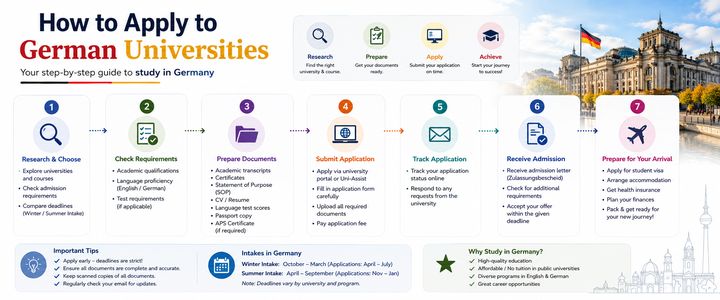
Applying to a German university is not something students should begin a few weeks before the application deadline.
A successful Germany application may involve:
Researching universities
Checking academic eligibility
Taking IELTS, TOEFL, TestDaF, or another language examination
Completing APS verification
Taking dMAT where applicable
Preparing transcripts and degree documents
Obtaining recommendation letters
Applying through uni-assist
Obtaining a VPD
Submitting direct university applications
Waiting for admission decisions
Arranging financial proof
Applying for a student visa
Finding accommodation
Completing enrollment
For international students, particularly those applying from India, the safest approach is to begin approximately 8 to 12 months before the intended semester.
Germany has two main university intakes:
Winter Semester: usually starts around September/October
Summer Semester: usually starts around March/April
At many universities, the commonly used application deadlines are:
Winter Semester: around July 15
Summer Semester: around January 15
However, these dates are not universal.
Some universities—especially English-taught Master’s programs—close applications several months earlier.
The best strategy is therefore to create your timeline based on the earliest deadline among your shortlisted universities.
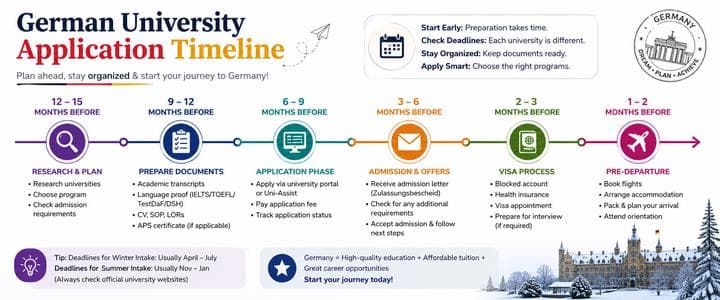
German University Application Timeline at a Glance
| Stage | Recommended Time Before Study Begins |
|---|---|
| Research Germany and courses | 10–12 months |
| Check academic eligibility | 10–12 months |
| Start language preparation | 9–12 months |
| Begin APS if applicable | 6–10 months |
| Prepare GRE/GMAT if required | 6–10 months |
| Prepare application documents | 5–8 months |
| Request recommendation letters | 5–7 months |
| Apply for VPD | At least 6–10 weeks before university deadline |
| Submit university applications | 3–6 months |
| Receive admission | 1–3 months after application period |
| Arrange financial proof | After/around admission |
| Apply for visa | As early as permitted |
| Search for accommodation | 2–4 months before arrival |
| Complete enrollment | Before semester begins |
| Travel to Germany | Shortly before orientation/classes |
Germany University Intakes
Understanding the academic calendar is the first step.
Winter Semester
The Winter Semester is Germany’s main university intake.
It usually runs from approximately:
October to March
Lectures generally begin around:
September or October
Winter offers the largest number of:
Bachelor’s programs
Master’s programs
English-taught degrees
German-taught degrees
Studienkolleg options
For most international students, Winter is the primary application cycle.
Summer Semester
The Summer Semester usually runs approximately:
April to September
Classes generally begin around:
March or April
Summer has fewer programs than Winter, particularly at Bachelor’s level.
However, many Master’s programs accept Summer applications.
Common Application Deadlines
At many German universities:
Winter Semester
Common deadline: July 15
Summer Semester
Common deadline: January 15
But students should never build their entire application around these dates.
Programs may close:
October
November
December
January
February
March
April
May
June
depending on the university and course.
Some programs also use separate deadlines for:
EU applicants
Non-EU applicants
German applicants
Applicants requiring uni-assist
Applicants requiring a VPD
Why You Should Start 8–12 Months Early
A German university application involves more than uploading a transcript.
An international applicant may need time for:
Academic recognition
APS
dMAT
IELTS
TOEFL
TestDaF
German preparation
GRE
GMAT
Certified translations
uni-assist
VPD
Recommendation letters
Portfolio
University applications
Starting early also gives students time to recover if:
IELTS score is too low
APS takes longer
A university requests additional documents
VPD processing is delayed
A recommendation letter is late
A university changes its requirements
An application is rejected and alternatives are needed
Complete Winter Intake Timeline
Students planning to begin university in Germany around September or October should ideally begin preparation during the previous year.
12 Months Before: September–October
This is the research stage.
Start by deciding:
Bachelor’s or Master’s
Subject
English or German
Public or private university
University or University of Applied Sciences
Preferred cities
Budget
Create an initial list of approximately:
15–25 programs
Do not immediately reduce the list to three or four universities.
At this stage, compare:
Eligibility
Course curriculum
Admission semester
Language requirement
Tuition
Application route
Deadline
10–12 Months Before: October–December
Begin checking academic eligibility.
For Bachelor’s applicants, determine whether you qualify for:
Direct university admission
Subject-restricted admission
Studienkolleg
For Master’s applicants, compare your Bachelor’s curriculum with the program requirements.
Look carefully at required credits in areas such as:
Mathematics
Programming
Statistics
Engineering
Economics
Finance
Business
Research Methods
This is one of the most important stages.
A famous university is irrelevant if your academic background does not meet its program requirements.
9–12 Months Before: Start Language Preparation
Identify whether you need:
IELTS
TOEFL
TestDaF
DSH
Goethe certificate
telc
Another accepted examination
Do not assume IELTS is accepted everywhere.
Do not assume an MOI certificate is accepted everywhere.
Each university sets its own language requirements.
8–10 Months Before: Take Your First Language Test
For a Winter start, try to complete your first English or German examination relatively early.
This gives you time for a retake.
Example:
Your target requires IELTS 6.5.
Your first result is 6.0.
If you took the test eight months before the intake, you still have time to:
Improve
Retake IELTS
Receive a new result
Submit applications on time
Taking your first test shortly before the deadline leaves little room for recovery.
8–10 Months Before: Indian Students Should Start APS Planning
Indian students should determine:
Which APS category applies
Which academic documents are required
Whether the institution is recognized
Whether the qualification is recognized
Whether dMAT applies
APS should not be treated as something to complete only after receiving admission.
Start early enough to avoid application and visa delays.
7–9 Months Before: Check dMAT if Applicable
Selected Master’s applicants from India in affected academic fields should determine whether the Digital Master Test applies.
Affected fields can include areas such as:
Engineering
Commerce
Accounting
Finance
Economics
Business
Management
For relevant applicants, dMAT becomes particularly important for Master’s applications connected with Summer Semester 2027 and later admission cycles.
Students should incorporate its registration and test dates into the application calendar.
7–9 Months Before: Prepare Your University Shortlist
Reduce your initial list to approximately:
8–15 serious applications
Divide them into:
Ambitious
Competitive universities where admission is possible but difficult.
Target
Programs that closely match your academic record.
Safer
Programs where your academic profile appears comfortably aligned with the published requirements.
There is no truly “guaranteed” German university.
6–8 Months Before: Prepare Your Documents
Begin collecting:
Passport
Class 10 certificate
Class 12 certificate
Bachelor’s certificate
Bachelor’s transcripts
Master’s documents if applicable
APS certificate
Language scores
CV
Motivation letter
Recommendation letters
Work-experience certificates
Internship certificates
Module descriptions
Creative programs may additionally require:
Portfolio
Audition
Artistic work
6–8 Months Before: Obtain Transcripts
Do not assume the marksheets you already have are sufficient.
Some universities may request:
Consolidated transcript
Semester-by-semester transcript
Official transcript
Grading scale
Credit information
Module descriptions
Universities can take several weeks to issue these documents.
Request them early.
6–8 Months Before: Prepare Module Descriptions
Master’s applicants frequently underestimate the importance of module descriptions.
German universities may assess whether you completed sufficient academic content in areas such as:
Calculus
Linear Algebra
Statistics
Data Structures
Algorithms
Thermodynamics
Control Engineering
Microeconomics
Macroeconomics
Accounting
Finance
Keep official curriculum or syllabus documents available.
5–7 Months Before: Prepare Your CV
A strong academic CV may include:
Education
Academic projects
Internships
Work experience
Research
Publications
Technical skills
Certifications
Language skills
Scholarships
Awards
Avoid making it unnecessarily decorative.
German academic applications generally benefit from clarity.
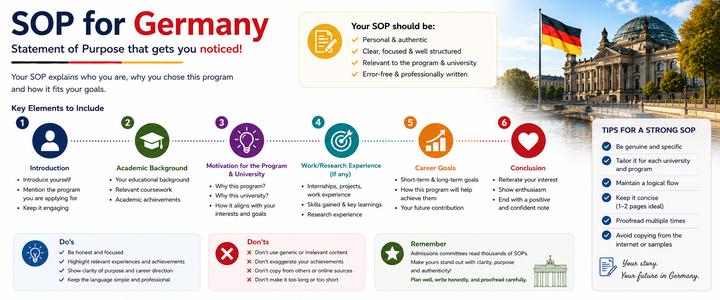
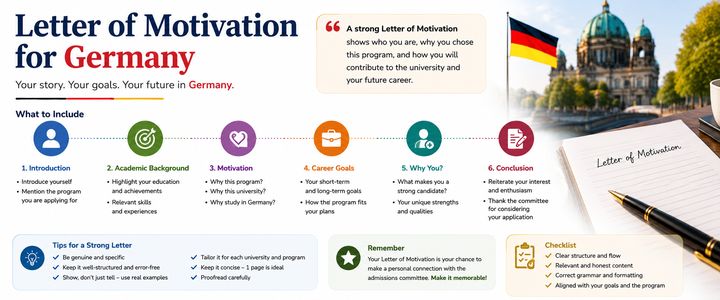
5–7 Months Before: Write Your Motivation Letter
Do not use one generic motivation letter for every program.
A strong letter should demonstrate:
Your academic background
Why the specific program fits your education
Relevant courses
Projects
Research
Professional experience
Future goals
Customize important sections for each university.
5–7 Months Before: Request Recommendation Letters
Professors may take time to prepare letters.
Contact them early.
Provide:
CV
Transcript
Program information
Career goal
Submission deadline
Request recommendations well before the university deadline.
4–6 Months Before: Check the Application Route
Germany does not have one application portal for every university.
You may need to apply:
Directly to the university
Through uni-assist
Through uni-assist for VPD
Through another university-specific system
Through Hochschulstart for applicable programs
Check every shortlisted program separately.
Understanding uni-assist
uni-assist evaluates international applications for participating German universities.
Depending on the university, it may:
Check academic documents
Assess eligibility
Convert grades
Forward the application
Students should submit applications well before the deadline.
A good target is approximately:
Eight weeks before the final deadline whenever possible.
Current uni-assist Processing Consideration
Normal evaluation is often described as taking several weeks.
During busy periods, processing may take longer.
Students whose educational certificates are from Asia can experience longer processing periods during peak seasons.
Do not submit a uni-assist application at the last minute unless absolutely necessary.
VPD Timeline
A VPD is:
Vorprüfungsdokumentation
or preliminary review documentation.
Some universities require students to:
Apply to uni-assist for a VPD.
Receive the VPD.
Apply separately to the university.
This means there are effectively two stages.
Students should allow enough time for both.
Important VPD Mistake
Receiving a VPD does not mean you applied to the university.
The VPD must normally be submitted to the university through its own application system before the university deadline.
Missing the second step can mean losing the entire admission cycle.
3–5 Months Before: Submit Applications
At this stage:
University portals begin opening
uni-assist applications become active
Direct applications can be submitted
VPD applications should already be underway
Do not wait for every university to open before submitting your first application.
Submit applications as they become available.
May–July: Main Winter Application Period
For many programs, this is the busiest application window.
A widely used deadline is:
July 15
But some Master’s programs close significantly earlier.
Therefore, students should treat July 15 as a common reference point—not a universal deadline.
June–July: Final Application Checks
Before every submission, verify:
Correct course
Correct semester
Passport uploaded
Transcripts uploaded
Degree uploaded
Language score included
APS included where required
Motivation letter included
Recommendation letters submitted
VPD included
Application fee paid
Correct document format used
One missing mandatory document can make an otherwise strong application unsuccessful.
July–September: Admission Decisions
Winter admission decisions commonly begin arriving during this period.
Possible outcomes include:
Admission
Conditional admission
Waiting list
Rejection
Do not immediately accept the first offer without comparing:
Curriculum
University
City
Cost
Career opportunities
Research
Tuition
Accommodation
After Admission: Accept Your Offer
The admission letter may specify a deadline for:
Accepting the place
Enrollment
Paying semester contribution
Submitting documents
Read the entire admission letter.
Do not assume the university will remind you repeatedly.
After Admission: Financial Proof
Students who need a German student visa must normally demonstrate sufficient financial resources.
Possible methods include:
Blocked account
Scholarship
Formal declaration of commitment
Other accepted financial arrangements
Financial thresholds can change, so applicants should verify the required amount for their visa application instead of relying on old figures.
After Admission: Health Insurance
Health insurance is required for students in Germany.
Insurance status may be needed for:
Visa
Enrollment
Residence procedures
Students should determine whether they need:
Public student insurance
Approved private insurance
Temporary incoming insurance before enrollment
July–September: Student Visa
Begin the student visa process as soon as the necessary requirements are available.
For Indian applicants, the process may involve:
Admission
APS certificate
Academic documents
Financial proof
Health insurance
Passport
Visa application
Language evidence
Germany uses a national visa for study lasting more than 90 days.
Do not leave the visa application until shortly before classes.
July–September: Search for Accommodation
Start searching as soon as you know which city you are likely to attend.
Possible options include:
Studentenwerk residence
Shared apartment
WG
Private student residence
Private apartment
Housing is particularly challenging in:
Munich
Berlin
Hamburg
Frankfurt
Stuttgart
Cologne
August–October: Enrollment
Admission and enrollment are different.
After admission, students must complete:
Immatrikulation
or university enrollment.
Documents can include:
Admission letter
Passport
Academic documents
Health-insurance confirmation
Proof of semester contribution
Enrollment forms
September–October: Travel to Germany
Try to arrive before:
Orientation
Course registration
Introductory events
Classes
Avoid arriving after lectures begin unless the university explicitly permits late arrival.
Winter Intake Month-by-Month Timeline
| Month | Recommended Action |
|---|---|
| September–October | Research universities |
| October–December | Check eligibility |
| October–January | Prepare IELTS/German |
| November–February | Begin APS |
| December–March | Take language tests |
| January–March | Finalize shortlist |
| January–April | Prepare CV/SOP/LORs |
| February–May | Request transcripts |
| March–May | Start VPD/uni-assist |
| April–July | Submit applications |
| July | Common final deadline for many programs |
| July–September | Admission decisions |
| August–September | Visa and finances |
| August–October | Accommodation and enrollment |
| September–October | Travel and orientation |
Summer Intake Application Timeline
Students planning to begin university around March or April should begin preparation during the previous spring or summer.
10–12 Months Before: April–June
Start researching:
Universities
Courses
Summer admission availability
Academic requirements
Language requirements
Summer has fewer programs than Winter.
Check specifically whether the program accepts:
Sommersemester
applications.
8–10 Months Before: June–August
Begin:
IELTS
TOEFL
German test preparation
APS
dMAT preparation where applicable
Transcript collection
For Summer applications, APS and dMAT planning can be particularly important for Indian Master’s applicants.
6–8 Months Before: August–October
Prepare:
CV
Motivation letter
Recommendation letters
Module descriptions
Work-experience evidence
Portfolio
Finalize the university shortlist.
4–6 Months Before: October–December
Start:
uni-assist
VPD
Direct university applications
Some Summer Master’s applications may already be open.
December–January: Main Application Period
A commonly used deadline is:
January 15
Again, individual programs may use different dates.
Never assume January 15 applies to every university.
January–March: Admission Decisions
Successful students should immediately begin:
Financial planning
Visa procedure
Health insurance
Accommodation
Because Summer offers a shorter period between common application deadlines and semester start, efficient planning is particularly important.
March–April: Enrollment and Arrival
Complete:
Enrollment
Semester contribution
Insurance
Housing
Travel
Attend orientation before lectures begin whenever possible.
Summer Intake Month-by-Month Timeline
| Month | Recommended Action |
|---|---|
| April–June | Research Summer-start programs |
| June–August | APS and language tests |
| July–September | Check dMAT if applicable |
| August–October | Prepare application documents |
| September–November | Obtain recommendations/transcripts |
| October–December | VPD and uni-assist |
| November–January | Submit applications |
| January | Common deadline for many programs |
| January–March | Admission and visa |
| February–March | Housing and enrollment |
| March–April | Travel and classes |
Timeline for Indian Bachelor’s Applicants
Indian undergraduate applicants should begin by determining their university entrance eligibility.
From Winter Semester 2026/27, updated evaluation rules apply to Indian Class 12 qualifications.
Applicants under relevant pathways generally need at least 70% overall in Class 12.
Possible pathways include:
Class 12 + APS
This may lead to subject-restricted eligibility through Studienkolleg when the applicable conditions are met.
Class 12 + One Successful Bachelor’s Year + APS
This may allow direct subject-restricted admission related to the previous field of study when all applicable requirements are satisfied.
Suggested Indian Bachelor’s Timeline
10–12 Months Before
Check Class 12 eligibility
Determine Studienkolleg requirement
Research universities
Begin German preparation
8–10 Months Before
Begin APS
Take language test
Research Studienkolleg where applicable
5–8 Months Before
Prepare applications
Check uni-assist
Obtain certified documents
3–6 Months Before
Submit applications
Complete entrance tests where required
After Admission
Arrange finances
Insurance
Visa
Housing
Timeline for Indian Master’s Applicants
Master’s applications require closer attention to previous academic coursework.
10–12 Months Before
Check:
Bachelor’s recognition
University recognition
Required degree
Required ECTS/credits
GPA
Language requirements
8–10 Months Before
Begin:
APS
IELTS/TOEFL
German test
GRE/GMAT where required
Check dMAT
For affected future Master’s applicants, determine whether dMAT applies to your academic category.
Do not leave this until university applications begin.
6–8 Months Before
Prepare:
CV
SOP
Recommendations
Transcripts
Module descriptions
Work experience
4–6 Months Before
Begin:
uni-assist
VPD
University applications
2–4 Months Before
Complete remaining applications and monitor admission portals.
After Admission
Begin:
Blocked account/financial proof
Insurance
Visa
Accommodation
Enrollment
What to Do 12 Months Before Germany
Your goal should be clarity.
Determine:
Degree level
Subject
Intake
Language
University type
Budget
Academic eligibility
Do not begin with rankings.
Begin with eligibility.
What to Do 9 Months Before
Your focus should shift to tests and verification.
Complete or begin:
APS
IELTS
TOEFL
German exam
GRE/GMAT
dMAT where applicable
What to Do 6 Months Before
Your application package should begin taking shape.
Prepare:
Transcript
Degree documents
CV
SOP
LORs
Module descriptions
Portfolio
What to Do 3 Months Before the Deadline
Applications should already be underway.
This is the time for:
uni-assist
VPD
Direct university applications
Do not use the final deadline as your target submission date.
What to Do 8 Weeks Before the Deadline
For uni-assist applications, this is a useful minimum planning benchmark.
Submitting earlier provides time to identify:
Missing documents
Incorrect uploads
Academic issues
What to Do After Applying
Check regularly:
University portal
My assist
Email
Spam folder
Universities may request additional information with short response deadlines.
What to Do While Waiting for Admission
Do not spend two months simply waiting.
Use this period to:
Research housing
Compare blocked-account options
Research health insurance
Prepare visa documents
Improve German
Research student jobs
Compare cities
What to Do After Receiving Admission
Create a new checklist immediately:
Accept admission.
Check enrollment deadline.
Arrange financial proof.
Arrange insurance.
Begin visa process.
Apply for housing.
Pay semester contribution.
Complete enrollment.
Plan travel.
Should You Wait for All Admission Offers?
Not always.
Suppose:
University A admits you in June.
University B may announce decisions in August.
Your visa appointment and housing search may need to begin earlier.
You can continue evaluating universities while preparing essential documentation.
Do not allow one delayed admission decision to disrupt the entire visa timeline.
German Student Visa Timeline
Visa processing should be treated as a separate project from university admission.
Non-EU students studying for longer than 90 days generally require a German national visa.
Prepare early.
Students applying from India should follow the current student visa procedure and required digital/appointment process.
Student Visa Documents
Depending on the case, documents can include:
Passport
University admission
APS certificate
Academic documents
Language evidence
Financial proof
Health insurance
Motivation documents
Visa forms
Requirements can change, so students should use the current visa checklist when applying.
Blocked Account Timeline
Do not open a blocked account extremely early without understanding your admission plan.
However, do not wait until days before the visa application either.
Once you have a strong admission outcome and know the required financing amount:
Select an acceptable financing route.
Transfer the required funds.
Obtain confirmation.
Use the confirmation for your visa application.
Accommodation Timeline
Housing should begin earlier than many students expect.
3–4 Months Before Arrival
Apply to:
Student residences
Studentenwerk housing
Private residences
1–3 Months Before
Search:
WG rooms
Shared apartments
Temporary accommodation
Do not transfer large deposits to unknown individuals without verification.
Enrollment Timeline
Each university provides its own enrollment period.
Enrollment may happen:
Online
By post
In person
Through a combination
Missing the enrollment deadline can cause the admission offer to lapse.
Application Timeline for Studienkolleg
Studienkolleg applications may follow different deadlines from ordinary university programs.
Students may need time for:
German preparation
Studienkolleg application
Entrance examination
Visa
FSP planning
Because German requirements can be high, preparation should begin well in advance.
Application Timeline for Medicine
Medicine has highly specific admission procedures.
International applicants should begin even earlier because they may need:
Advanced German
Academic recognition
Admission evaluation
Additional application procedures
Do not rely solely on the standard July 15 or January 15 timeline.
Application Timeline for PhD
PhD applications usually work differently.
There may be no fixed Winter or Summer deadline.
Students may apply when:
A funded PhD position opens
A professor accepts supervision
A graduate school opens applications
A doctoral timeline might look like:
9–12 Months Before
Define research area.
6–9 Months Before
Identify supervisors.
5–8 Months Before
Prepare research proposal.
4–8 Months Before
Contact professors/apply to positions.
After Offer
Arrange funding, residence documentation, insurance, and relocation.
Common Timing Mistakes
Starting Too Late
Beginning university research only two months before deadlines creates unnecessary risk.
Treating July 15 as Germany’s Only Deadline
Some programs close months earlier.
Treating January 15 as Universal
Summer deadlines also vary.
Taking IELTS Too Late
A low first score may leave no time for a retake.
Starting APS Too Late
Academic verification may depend on external institutions responding.
Requesting VPD Too Late
VPD adds an extra stage before university application.
Forgetting the Second VPD Application
The university application still needs to be submitted.
Asking Professors for LORs at the Last Minute
Recommendation letters should be requested early.
Waiting for Admission Before Researching Visa Requirements
Visa preparation should begin earlier.
Waiting Until Visa Approval to Search for Housing
This can make accommodation extremely difficult.
Best Strategy: Work Backward
The easiest way to create a German application timeline is to work backward from your earliest deadline.
Example:
Earliest university deadline:
April 30
Then plan:
February
VPD should ideally already be underway.
January
APS, IELTS, and transcripts should be ready.
December
SOP and LORs should be prepared.
October–November
Language tests and academic verification should be in progress.
This method is much safer than following one generic Germany deadline.
Build a Deadline Spreadsheet
Create columns for:
University
Program
Intake
Application opening
Application deadline
uni-assist
VPD
APS required
IELTS
German
GRE/GMAT
SOP
LOR
Application fee
Application status
Admission decision
Enrollment deadline
This can prevent expensive mistakes.
Recommended Number of Applications
There is no perfect number.
For competitive international Master’s admissions, a balanced strategy might include approximately:
2–4 ambitious programs
4–6 target programs
2–4 safer programs
Quality matters more than simply submitting dozens of applications.
Frequently Asked Questions
When should I start applying to Germany?
Begin preparation approximately 8–12 months before the semester starts.
When should I start for Winter intake?
Ideally begin research during the previous September to December period.
When should I start for Summer intake?
Ideally begin research around April to June of the previous year.
What is the common Winter deadline?
Many universities use July 15.
What is the common Summer deadline?
Many universities use January 15.
Are these deadlines universal?
No.
How early should I apply through uni-assist?
Submitting at least around eight weeks before the final deadline is a sensible target when possible.
How long does uni-assist take?
Evaluation commonly takes several weeks and may take longer during peak periods.
How long does VPD take?
Students should allow several weeks and request it well before the university deadline.
When should Indian students apply for APS?
Early enough that APS does not delay university or visa applications. Ideally, incorporate it into the 6–10 month preparation stage.
Should I take IELTS before APS?
The exact sequence depends on your case. Both can often be prepared in parallel.
Should I wait for APS before shortlisting universities?
No. University research and APS preparation can happen simultaneously.
When should I apply for a visa?
Begin as soon as you meet the requirements and the applicable visa procedure permits.
When should I search for accommodation?
Ideally begin serious housing preparation around two to four months before arrival.
Can I apply one day before the university deadline?
Technically some portals may permit this, but it is risky.
Can I submit uni-assist on the deadline?
The application must meet the applicable deadline requirements, but last-minute submission leaves no margin for problems.
Is Winter easier to plan than Summer?
Winter usually offers more programs and often provides a longer planning window, while Summer has fewer programs and can have a tighter admission-to-arrival schedule.
Final German University Application Checklist
10–12 Months Before
Select degree
Research universities
Check eligibility
Check intake
Start language preparation
8–10 Months Before
Start APS
Take IELTS/TOEFL/German test
Check dMAT
Check GRE/GMAT
6–8 Months Before
Obtain transcripts
Prepare CV
Prepare SOP
Request LORs
Collect module descriptions
4–6 Months Before
Start uni-assist
Request VPD
Submit early university applications
2–4 Months Before
Submit remaining applications
Track application status
Prepare visa documents
After Admission
Accept offer
Arrange finances
Arrange insurance
Apply for visa
Search for accommodation
Complete enrollment
Before Departure
Pay semester contribution
Confirm housing
Keep original documents
Register for orientation
Plan travel
Final Verdict
The ideal German university application timeline begins approximately 8–12 months before the intended intake.
For Winter intake, the basic flow is:
September–December: Research and eligibility
November–February: APS and language tests
January–April: Documents, CV, SOP, LOR
March–May: uni-assist and VPD
April–July: University applications
July–September: Admission, finances, visa and housing
September–October: Enrollment and travel
For Summer intake:
April–June: Research
June–September: APS and language tests
August–October: Documents
October–December: uni-assist/VPD
November–January: University applications
January–March: Admission and visa
March–April: Enrollment and travel
The most important principle is not to plan around a generic deadline such as July 15 or January 15.
Instead:
Find your earliest program deadline and work backward from it.
Students who complete APS, language tests, transcripts, and VPD early can focus on choosing the right university rather than racing against deadlines at the last moment.