Applying to universities in Germany can seem complicated because there is no single application system used by every institution.
Depending on the university, degree program, nationality, and previous academic qualification, students may need to apply:
Directly through the university
Through uni-assist
Through uni-assist for a VPD and then separately to the university
Through Hochschulstart for certain programs
Through a combination of these systems
Indian applicants may additionally need an APS Certificate, while selected Master’s applicants from India may also need the new dMAT for relevant future admission cycles.
The key to a successful German university application is therefore not simply filling out an application form.
Students must first determine:
What they want to study
Whether they are academically eligible
Whether their previous qualification is recognized
Which language requirements apply
Which application platform the university uses
Which documents are required
When the application deadline falls
Whether APS, VPD, Studienkolleg, dMAT, or another additional requirement applies
This guide explains the entire process from university research to admission and enrollment.
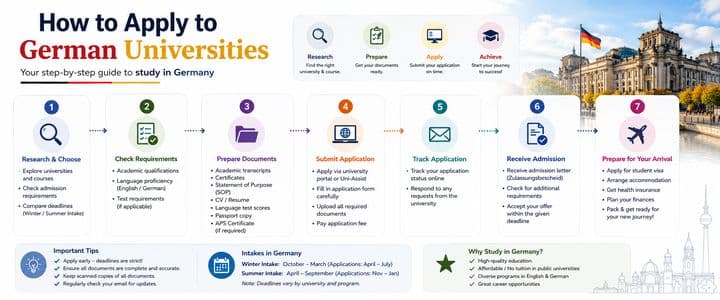
How to Apply to German Universities: Quick Overview
| Step | What to Do |
|---|---|
| 1 | Choose your degree and subject |
| 2 | Shortlist suitable universities |
| 3 | Check academic eligibility |
| 4 | Check whether Studienkolleg is required |
| 5 | Check language requirements |
| 6 | Complete APS if applicable |
| 7 | Check dMAT if applicable |
| 8 | Prepare documents |
| 9 | Identify the application route |
| 10 | Complete uni-assist/VPD if required |
| 11 | Submit university applications |
| 12 | Track application status |
| 13 | Receive admission decision |
| 14 | Accept your offer |
| 15 | Complete enrollment |
| 16 | Prepare finances, visa, insurance and travel |
Step 1: Decide What You Want to Study
Before searching for universities, decide:
Degree level
Subject
Specialization
Teaching language
Preferred university type
Budget
Preferred cities
International students can apply for:
Bachelor’s degrees
Master’s degrees
State Examination programs
Studienkolleg
Dual study programs
Doctoral programs
The application procedure can be completely different for each category.
Bachelor’s Degree
A Bachelor’s degree usually requires a recognized school-leaving qualification that provides access to German higher education.
Students may qualify for:
Direct general admission
Direct subject-restricted admission
Studienkolleg
Master’s Degree
Master’s applicants usually need:
A recognized Bachelor’s degree
Relevant academic background
Required subject credits
Competitive academic performance
Required language proficiency
PhD
PhD applications work differently.
Students commonly apply:
To a professor
To a research group
To a funded doctoral position
To a structured doctoral program
The standard Bachelor’s/Master’s application process therefore does not always apply to doctoral study.
Step 2: Understand the Types of German Universities
Germany has several types of higher-education institutions.
Universities
Traditional universities are generally more research-oriented.
They are strong choices for:
Sciences
Humanities
Economics
Mathematics
Medicine
Research
Doctoral study
Technical Universities
Technical universities focus heavily on:
Engineering
Computer Science
Technology
Mathematics
Natural Sciences
Examples of fields include:
Mechanical Engineering
Electrical Engineering
Computer Science
AI
Robotics
Automotive Engineering
Universities of Applied Sciences
These institutions place greater emphasis on:
Practical education
Industry projects
Internships
Applied research
Career-oriented learning
They can be excellent options for students seeking industry-focused education.
Private Universities
Private institutions often provide:
Smaller classes
English-taught programs
Structured career support
Business and technology specializations
However, tuition can be considerably higher.
Step 3: Shortlist Universities
Do not begin with only famous universities.
Instead of applying only to:
TUM
RWTH Aachen
LMU Munich
Heidelberg
build a broader shortlist.
A good application strategy can include:
Ambitious Universities
Highly competitive programs.
Target Universities
Programs where your profile closely matches the requirements.
Comparatively Safer Universities
Programs where your academic qualifications comfortably meet the published criteria.
There is no genuinely guaranteed university.
How Many Universities Should You Apply To?
There is no fixed number.
For a competitive Master’s applicant, a balanced strategy might include approximately:
2–4 ambitious programs
4–6 target programs
2–4 safer programs
Quality is more important than quantity.
Applying randomly to 30 programs without checking eligibility is often less effective than applying carefully to 10 well-matched programs.
Step 4: Check Academic Eligibility
This is one of the most important steps.
Do not assume that having a school certificate or university degree automatically makes you eligible.
German universities evaluate whether your previous education provides access to the chosen program.
University Entrance Qualification
For Bachelor’s applications, students generally need a qualification equivalent to the German university entrance requirement.
Possible outcomes include:
Direct admission
Subject-restricted admission
Studienkolleg
How to Check Eligibility
Eligibility can depend on:
Country
School system
Class 12 qualification
University study already completed
Bachelor’s degree
University recognition
Academic subject
International applicants should check recognition before spending money on applications.
Step 5: Understand Studienkolleg
Students whose school qualification does not provide direct university admission may need to complete a Studienkolleg.
Studienkolleg is a preparatory program usually lasting around one academic year.
Students normally complete a final examination called the:
Feststellungsprüfung — FSP
Passing the examination can qualify the student to apply for related university programs.
Main Studienkolleg Tracks
T-Kurs
Usually for:
Engineering
Mathematics
Computer Science
Natural Sciences
M-Kurs
Usually for:
Medicine
Biology
Pharmacy
Health-related fields
W-Kurs
Usually for:
Business
Economics
Social Sciences
G-Kurs
Usually for:
Humanities
S-Kurs
Usually for:
Languages
Important Rule for Indian Bachelor’s Applicants
For admissions beginning with Winter Semester 2026/27, updated evaluation rules apply to Indian Class 12 qualifications.
A minimum overall score of 70% of the maximum achievable marks in Class 12 applies to the relevant undergraduate pathways.
Two major routes include:
Class 12 + APS
Students meeting the applicable requirements may qualify for subject-restricted admission through Studienkolleg.
Class 12 + APS + One Successful Bachelor’s Year
Students may qualify for direct subject-restricted admission related to their previous academic field when all applicable conditions are met.
Completing one university year does not automatically guarantee direct admission.
The previous field of study and recognition still matter.
Step 6: Check Master’s Eligibility Carefully
Master’s admission is more program-specific.
A university may require a Bachelor’s degree in:
Computer Science
Mechanical Engineering
Economics
Business
Mathematics
Physics
or another closely related subject.
But the degree title alone may not be enough.
Universities frequently examine previous coursework.
Example
Suppose you completed:
Bachelor of Computer Applications
and want to apply for:
MSc Computer Science
The university may require previous credits in:
Algorithms
Data Structures
Programming
Mathematics
Theoretical Computer Science
If your Bachelor’s curriculum does not contain enough credits, you may be rejected even if your GPA is excellent.
Module Matching
Before applying to a Master’s program, compare your Bachelor’s syllabus with the admission requirements.
Check:
Required ECTS
Subject groups
Mathematics credits
Programming credits
Research credits
Engineering credits
Economics credits
This can save a significant amount of application money.
Step 7: Check GPA Requirements
Germany does not have one universal GPA requirement.
Each program can set:
Minimum GPA
German-equivalent grade
Minimum percentage
Ranking requirements
Some universities publish a minimum grade.
Others use competitive selection.
Meeting the minimum does not guarantee admission.
German Grading Scale
A common German university scale works approximately as follows:
1.0 = Excellent
4.0 = Lowest passing grade
Grades beyond the passing threshold are generally considered unsuccessful.
Foreign grades may be converted into the German system during application evaluation.
Step 8: Check Language Requirements
The required language depends on the program.
English-Taught Programs
Students may need:
IELTS Academic
TOEFL
Cambridge English
Other accepted evidence
Common IELTS requirements may include:
6.0
6.5
7.0
However, there is no universal requirement.
Medium of Instruction
Some universities accept a Medium of Instruction certificate.
Others do not.
Never assume that MOI automatically replaces IELTS or TOEFL.
German-Taught Programs
Accepted German qualifications can include:
TestDaF
DSH
Goethe certificates
telc Deutsch C1 Hochschule
Other recognized certificates
Many German-taught degrees require approximately:
B2
C1
DSH-2
TestDaF equivalent
depending on the university.
Step 9: Check Whether APS Is Required
Students with academic qualifications issued by Indian educational institutions should check whether APS applies.
APS verifies:
Academic documents
Educational qualifications
Academic history
APS does not grant:
University admission
Student visa
Scholarship
It is a verification process.
APS Fee
The standard individual APS procedure currently costs:
₹18,000
The fee is non-refundable.
Start APS Early
Students should not wait until they receive university admission.
APS can be needed for:
University applications
uni-assist
Student visa
depending on the case.
Digital APS Certificate
Successful applicants now receive a digital APS certificate.
The original digital file should remain unchanged.
Do not:
Edit it
Merge it
Modify it
Recreate it
Compress it unnecessarily
Upload the original certificate where required.
Step 10: Check dMAT for Selected Master’s Applicants
Selected Indian Master’s applicants face an additional requirement beginning with applications related to Summer Semester 2027 and later Master’s intakes.
The Digital Master Test, or dMAT, applies to selected applicants whose previous degrees fall within areas such as:
Engineering
Commerce
Accounting
Finance
Economics
Business
Management
Students outside the affected categories may not require it.
The requirement is connected to APS documentation and does not replace APS.
Students should check their degree classification before beginning the process.
Step 11: Prepare Your Application Documents
German universities may require different documents.
A typical application can include:
Passport
Passport photograph
School certificates
Class 10 certificate
Class 12 certificate
Bachelor’s degree
Bachelor’s transcripts
Master’s documents where applicable
APS certificate
IELTS/TOEFL
German-language certificate
CV
Motivation letter
Recommendation letters
Module descriptions
Work-experience certificates
Internship certificates
Portfolio
GRE/GMAT
Grading scale
Do not create one document package and assume every university needs exactly the same files.
Step 12: Prepare Your Academic CV
A German university CV should generally be simple and structured.
Useful sections include:
Education
Academic projects
Research
Internships
Work experience
Technical skills
Certifications
Languages
Awards
Avoid unnecessary decorative elements.
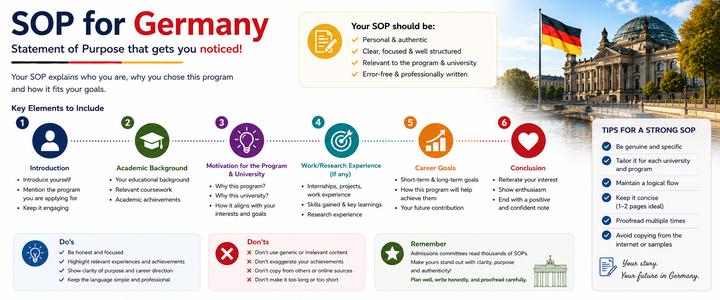
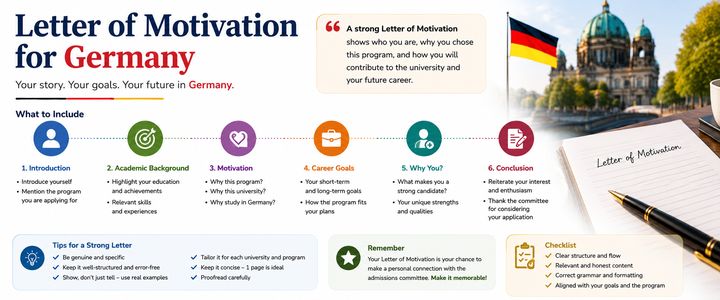
Step 13: Write a Strong Motivation Letter
A good motivation letter should explain:
What you studied
Why you chose this program
How your previous academics connect to it
Relevant projects or research
Career goals
Why the curriculum fits those goals
Avoid generic paragraphs such as:
“Germany has world-class education and excellent opportunities.”
Universities want to understand why their program fits your profile.
Step 14: Arrange Recommendation Letters
Some programs require:
One recommendation
Two recommendations
Academic references
Professional references
Ask professors early.
Provide your recommender with:
CV
Transcript
Program name
Career goal
Deadline
Do not request a recommendation two days before the deadline.
Step 15: Determine Where to Apply
This is where many students become confused.
There are several major routes.
Route 1: Direct University Application
Some German universities process international applications themselves.
You may need to:
Create an applicant account.
Select your course.
Complete the application form.
Upload documents.
Submit before the deadline.
Track your application.
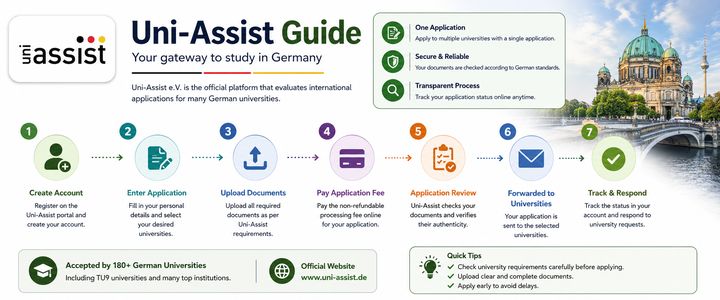
Route 2: Standard Uni-Assist Application
Some universities use uni-assist to evaluate international applications.
The process usually looks like:
Create My assist account.
Select university and course.
Complete application.
Upload documents.
Pay handling fee.
Submit.
uni-assist evaluates documents.
Eligible application proceeds to the university.
University makes final decision.
Uni-Assist Fees
The standard fee is:
€75 for the first chosen course in a semester
and
€30 for each additional chosen course in the same semester.
Current Processing Time
The normal evaluation period is generally around:
4–6 weeks
During the current July 2026 peak period, applications based on Asian educational certificates are taking approximately:
6–7 weeks
in many cases.
Students should apply early.
Recommended Uni-Assist Timing
Aim to apply approximately:
8 weeks before the application deadline
whenever possible.
This provides time to correct missing documents.
Route 3: VPD Application
Some universities use uni-assist only for preliminary academic evaluation.
In this case, students request:
VPD — Vorprüfungsdokumentation
The process is:
Apply for VPD through My assist.
Upload academic documents.
Pay the fee.
uni-assist evaluates qualifications.
Receive VPD.
Apply separately to the university.
Upload VPD.
Submit before university deadline.
Important VPD Warning
A VPD is not a university application.
Receiving a VPD does not mean you applied to the university.
You must normally submit a separate application directly to the university.
VPD Processing Time
VPD processing usually takes approximately:
4–6 weeks
after submission.
Apply early.
VPD Validity
A VPD is generally valid for:
One year from its issue date.
Route 4: Hochschulstart
Certain degree programs use Hochschulstart.
This can apply particularly to highly restricted subjects and coordinated admission procedures.
Fields such as:
Human Medicine
Dentistry
Veterinary Medicine
Pharmacy
have specific centralized procedures.
International applicants should carefully check which route applies to their applicant category.
Step 16: Check NC Requirements
Some programs have admission restrictions.
These are often referred to as:
Numerus Clausus — NC
NC can apply when the number of applicants exceeds available places.
Competitive fields can include:
Medicine
Psychology
Computer Science
Business
Economics
Architecture
NC is not necessarily one permanently fixed GPA.
It can change depending on:
Applicant quality
Number of seats
Semester
University
Step 17: Check Application Deadlines
Germany has two main intakes.
Winter Semester
Usually begins:
September/October
A commonly used deadline is:
15 July
Summer Semester
Usually begins:
March/April
A commonly used deadline is:
15 January
These are not universal deadlines.
Master’s programs may close significantly earlier.
Examples can include:
November
December
March
April
May
Always check the specific course.
When Should You Start?
Ideally begin approximately:
8–12 months before your intended semester.
Step 18: Submit Your Application Early
Do not wait until the deadline.
A deadline should be treated as the last possible date, not the ideal submission date.
Early submission provides time to handle:
Missing documents
Incorrect files
APS issues
VPD delays
Language-test problems
Final Application Checklist
Before clicking submit, check:
Correct university
Correct program
Correct semester
Correct application route
Passport
Degree certificates
Transcripts
APS
Language certificate
CV
Motivation letter
Recommendations
VPD
Module descriptions
GRE/GMAT where applicable
Application fee
Submission confirmation
Step 19: Track Your Application
After submission, monitor:
University application portal
My assist
Email
Spam folder
You may receive requests for:
Missing document
Additional transcript
Correct certification
Interview
Aptitude test
Respond quickly.
Step 20: Understand Uni-Assist Status
Common results can include:
In Evaluation
Application is being reviewed.
Faulty
Something is missing or does not meet requirements.
Okay
The preliminary uni-assist evaluation has been successful.
This does not mean you are admitted.
Case-by-Case Decision
The university may examine the application itself despite an issue that uni-assist cannot determine conclusively.
Step 21: Wait for the University Decision
The university may issue:
Admission
Conditional admission
Waiting-list result
Rejection
Conditional Admission
You may need to submit something later, such as:
Final degree certificate
Language result
Final transcript
Read the admission letter carefully.
Step 22: Compare Multiple Offers
Do not choose purely by ranking.
Compare:
Curriculum
University reputation in your field
Research
Career opportunities
City
Cost of living
Tuition
Housing
Internships
Industry access
A slightly less famous university may be a better academic and financial fit.
Step 23: Accept Your Admission
The admission letter usually explains what to do next.
You may need to:
Accept the offer online
Upload documents
Pay semester contribution
Submit health-insurance confirmation
Complete enrollment
Admission vs Enrollment
These are not the same.
Admission means you have been offered a place.
Enrollment means you have officially registered as a student.
You must usually complete both.
Step 24: Arrange Financial Proof
International students requiring a student visa generally need to demonstrate sufficient financial resources.
Accepted methods can include:
Blocked account
Scholarship
Declaration of commitment
Other approved funding
Financial thresholds can change, so students should verify the current amount when preparing the visa application.
Step 25: Arrange Health Insurance
Health insurance is mandatory for students in Germany.
Students may need insurance confirmation for:
Enrollment
Visa
Residence permit
The appropriate option depends on age and personal circumstances.
Step 26: Begin Student Visa Process
Students who require a visa should begin preparations as early as possible after admission.
Documents can include:
Passport
Admission letter
APS
Academic certificates
Language certificate
Financial proof
Health insurance
Visa forms
The university application and visa application are separate processes.
Admission does not automatically guarantee a visa.
Step 27: Find Accommodation
Start early.
Housing can be difficult in cities such as:
Munich
Berlin
Hamburg
Frankfurt
Stuttgart
Cologne
Possible options include:
Student residence
Shared apartment
WG
Private student housing
Private apartment
Apply for university or Studentenwerk housing as soon as possible.
Step 28: Complete Enrollment
Enrollment is known as:
Immatrikulation
Universities may require:
Passport
Admission letter
Health-insurance confirmation
Academic documents
Proof of semester contribution
Enrollment forms
After successful enrollment, you receive student status.
How to Apply for a Bachelor’s in Germany
The process typically looks like:
Complete Class 12.
Check German university entrance eligibility.
Determine whether Studienkolleg is required.
Obtain APS where applicable.
Meet language requirements.
Prepare academic documents.
Check whether application is direct or through uni-assist.
Apply.
Complete Studienkolleg/FSP if required.
Receive admission.
Complete enrollment and visa.
How to Apply for a Master’s in Germany
A typical process is:
Complete or approach completion of Bachelor’s degree.
Check university and degree recognition.
Match Bachelor’s modules with Master’s prerequisites.
Check minimum GPA.
Take IELTS/TOEFL/German test.
Obtain APS where applicable.
Check dMAT if applicable.
Prepare CV, SOP, LOR and transcripts.
Check uni-assist/VPD/direct route.
Submit applications.
Receive admission.
Arrange visa and enrollment.
How Indian Students Should Apply
Indian applicants should pay particular attention to:
APS
Class 12 eligibility
University recognition
dMAT where applicable
uni-assist
VPD
Language requirements
Visa preparation
Suggested Timeline for Indian Students
10–12 Months Before
Research programs
Check eligibility
Start language preparation
8–10 Months Before
Start APS
Take IELTS/TOEFL/German test
Check dMAT
6–8 Months Before
Prepare transcripts
CV
SOP
LOR
Module descriptions
4–6 Months Before
Start uni-assist
Request VPD
Submit early applications
2–4 Months Before
Complete remaining applications
Monitor admission decisions
After Admission
Financial proof
Insurance
Visa
Housing
Enrollment
Common Reasons German University Applications Are Rejected
1. Academic Background Does Not Match
Particularly common for Master’s applicants.
2. Insufficient Subject Credits
A program may require more:
Mathematics
Programming
Statistics
Engineering
than your Bachelor’s provided.
3. GPA Too Low
Meeting general university eligibility does not guarantee a competitive program.
4. Missing Language Requirement
The required certificate may be absent or below the minimum.
5. Incomplete Documents
A missing transcript or certification can make the application invalid.
6. APS Missing
Relevant Indian applicants may need APS.
7. VPD Missing
Some universities require VPD before the direct university application.
8. Deadline Missed
German university deadlines are usually strict.
9. Wrong Application Portal
Applying only through uni-assist when the university requires a separate VPD application can cause rejection.
10. Unrecognized Institution
A previous institution or qualification may not satisfy recognition requirements.
How to Improve Your Chances
Apply to a Balanced Mix
Do not apply only to the most famous universities.
Match Your Curriculum
For Master’s programs, academic compatibility is critical.
Apply Early
Do not use the deadline as your target date.
Improve Language Scores
Higher scores can strengthen your application when the program is competitive.
Customize Your Motivation Letter
Explain why the specific curriculum fits you.
Include Strong Academic Projects
Relevant projects can strengthen your profile.
Learn German
Even for an English-taught degree, German can improve:
Internships
Working-student jobs
Daily life
Employment prospects
Common Application Mistakes
Applying based only on ranking
Not checking academic eligibility
Assuming all universities use uni-assist
Confusing VPD with admission
Forgetting the university application after VPD
Applying too late
Starting APS too late
Ignoring dMAT
Submitting generic SOPs
Ignoring module-credit requirements
Assuming MOI is always accepted
Applying only to Munich and Berlin
Ignoring smaller cities
Missing enrollment deadlines
Waiting too long to begin visa preparation
Frequently Asked Questions
How do international students apply to German universities?
Students apply either directly to the university, through uni-assist, through a VPD procedure, through Hochschulstart, or through another specified university process.
Do all universities use uni-assist?
No.
What is a VPD?
A VPD is a preliminary academic evaluation produced by uni-assist for universities using that procedure.
Is VPD an application?
No. You usually still need to apply separately to the university.
How much does uni-assist cost?
The standard fee is €75 for the first chosen course in a semester and €30 for each additional course.
How long does uni-assist take?
The usual evaluation period is approximately four to six weeks, although peak-season times can be longer.
When should I apply through uni-assist?
Ideally at least eight weeks before the university deadline when possible.
What is the common Winter deadline?
Many universities use July 15.
What is the common Summer deadline?
Many universities use January 15.
Are these deadlines universal?
No.
Is APS required for Indian students?
APS is generally required for many students using qualifications issued by Indian educational institutions, subject to specific exemptions.
How much does APS cost?
The standard individual APS procedure costs ₹18,000.
Can I apply before receiving APS?
This depends on the university and application route. Because APS is required in many situations, applicants should begin the process early.
What is dMAT?
dMAT is an additional academic aptitude assessment introduced for selected Master’s applicants whose previous degree falls within specified fields.
Does dMAT apply to every Indian student?
No.
Can I apply to several universities?
Yes.
Do I need IELTS?
It depends on the language and program requirements.
Can MOI replace IELTS?
Some universities accept it; others do not.
Can I apply while completing my Bachelor’s degree?
Some Master’s programs allow this if sufficient credits have been completed. Others require the final degree.
Does uni-assist make the admission decision?
Usually no. The university makes the final admission decision.
Does admission guarantee a student visa?
No.
Is admission the same as enrollment?
No.
Final Application Checklist
Before submitting any German university application, confirm:
Academic eligibility checked
Qualification recognized
Correct intake
Correct deadline
Language requirement satisfied
APS completed where applicable
dMAT checked where applicable
Transcript ready
Degree documents ready
CV completed
SOP customized
LORs arranged
Module descriptions available
Correct application portal identified
uni-assist completed if required
VPD completed if required
Application fee paid
Application actually submitted
Final Verdict
Applying to German universities becomes much easier when the process is completed in the correct order.
The ideal sequence is:
Choose the program → Check eligibility → Check recognition → Meet language requirements → Complete APS/dMAT where applicable → Prepare documents → Identify application platform → Apply early → Track application → Receive admission → Complete enrollment → Arrange visa and travel
The most important part of the process is not submitting as many applications as possible.
It is identifying programs where:
your previous education genuinely matches the academic requirements.
A carefully researched list of universities, complete documents, early applications, and correct use of uni-assist or VPD can significantly improve your chances of successfully beginning your studies in Germany.