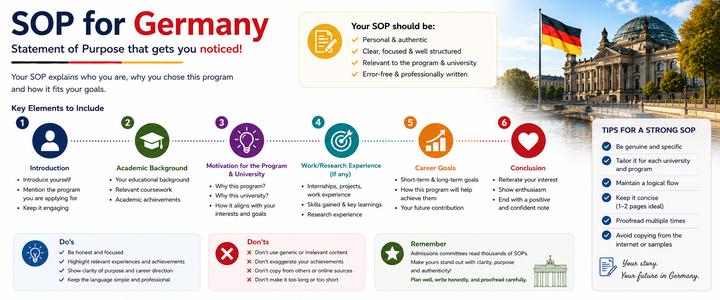
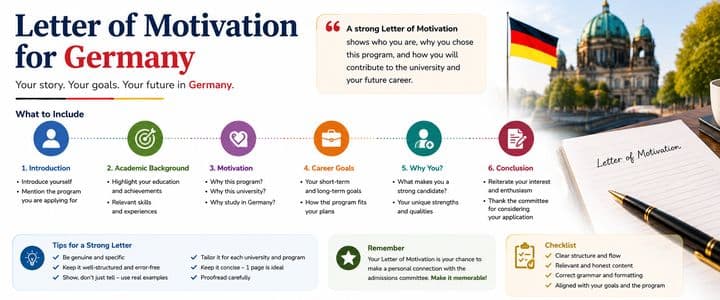
A Letter of Motivation for Germany, also commonly called a motivation letter, is one of the most important supporting documents required by many German universities.
It explains why you are applying to a particular program, how your previous academic or professional experience prepares you for it, and what you intend to achieve after completing the degree.
Unlike a CV, which primarily lists facts, a motivation letter connects those facts into a clear academic story.
A strong motivation letter should answer four fundamental questions:
Who are you academically?
Why have you chosen this particular program?
Why are you academically prepared for it?
How will the program help you achieve your future goals?
The strongest letters are specific, evidence-based, and customized for the program.
Generic statements about Germany having “world-class education” or “excellent universities” rarely make an application stand out.
This guide explains how to write a Letter of Motivation for German universities, including the correct structure, ideal length, Bachelor’s and Master’s formats, examples, common mistakes, and a sample motivation letter.
Letter of Motivation for Germany at a Glance
| Category | Recommended Approach |
|---|---|
| Purpose | Explain academic motivation and program fit |
| Typical Length | Around 1–2 pages unless specified |
| Tone | Formal, personal and academic |
| Main Focus | Academic background, program fit and goals |
| University Specific? | Yes |
| Same Letter for Every University? | No |
| Mention Germany? | Yes, but briefly and specifically |
| Mention Rankings? | Usually unnecessary |
| Include Personal Story? | Only when relevant |
| Include Career Goals? | Yes |
| Repeat CV? | No |
| Use AI-Generated Generic Text? | Avoid |
| Proofread? | Essential |
What Is a Letter of Motivation?
A Letter of Motivation is a written statement explaining why you want to pursue a particular academic opportunity.
German universities may use different names for similar documents, including:
Letter of Motivation
Motivation Letter
Statement of Motivation
Motivational Letter
Personal Statement
Statement of Purpose
These documents can overlap, but universities may define them differently.
Always follow the exact application instructions.
If the university asks for:
“A motivation letter of maximum 1,000 words answering three specific questions”
then answering those three questions is more important than following a generic motivation-letter template.
Is a Letter of Motivation Mandatory in Germany?
Not every German university requires one.
Some programs may require:
Motivation letter
CV
Recommendation letters
while others may base admission almost entirely on:
Previous degree
Grades
Subject credits
Language proficiency
A motivation letter is particularly common in:
Competitive Master’s programs
Business programs
International programs
Social Sciences
Humanities
Public Policy
Management
Research-oriented programs
Scholarship applications
Always check the individual program requirements.
Letter of Motivation vs Statement of Purpose
The terms are often used interchangeably, but there can be a slight difference.
A Statement of Purpose usually focuses more heavily on:
Academic background
Research interests
Professional goals
Program fit
A Motivation Letter can additionally emphasize:
Personal motivation
Why you chose the field
Experiences that influenced your decision
Reasons for choosing the institution
For German university applications, the safest approach is to combine both:
academic evidence + genuine motivation + specific program fit.
Letter of Motivation vs CV
Your CV lists information.
Your motivation letter explains it.
For example, your CV may say:
Machine Learning Intern — ABC Technologies
Your motivation letter can explain:
“During my internship, I worked on a classification model for customer behavior data, which strengthened my interest in statistical learning and motivated me to pursue advanced coursework in machine learning and data analytics.”
The second version provides context and relevance.
What German Universities Look for in a Motivation Letter
Admissions committees may want to understand:
Your academic preparation
Why you selected the program
Whether your previous education fits the curriculum
What academic interests you have
Whether your career goals are realistic
Whether you understand the program
Whether your motivation appears genuine
Whether you can communicate clearly
The letter should demonstrate that the application is intentional.
The reader should not feel that you randomly selected the program because it happened to be in Germany.
Ideal Length of a Motivation Letter
There is no universal length.
If the university specifies a limit, follow it exactly.
Possible requirements may include:
One page
Two pages
500 words
750 words
1,000 words
A character limit
When no limit is provided, approximately one to two pages is usually sufficient for most applications.
A letter that is too short may lack substance.
A letter that is excessively long can become repetitive.
Recommended Motivation Letter Structure
A strong motivation letter can follow this structure:
Introduction
Academic background
Relevant academic experience
Professional or research experience
Why this program
Why this university
Career goals
Why Germany
Conclusion
You do not necessarily need separate headings in the final letter.
The structure should flow naturally.
Paragraph 1: Introduction
The opening paragraph should immediately establish:
What program you are applying to
Your current academic background
Your main academic interest
Avoid starting with:
“Since childhood, I have always dreamed of studying in Germany.”
This is extremely common and usually adds little value.
A stronger opening might be:
“My undergraduate study in Mechanical Engineering introduced me to the relationship between computational modeling, manufacturing systems and sustainable product design. Through academic projects in finite-element analysis and production optimization, I developed a particular interest in advanced manufacturing, which has motivated my application to the MSc program in…”
This immediately tells the reader:
What you studied
What interests you
Why the Master’s makes sense
Paragraph 2: Academic Background
Explain your previous education.
Do not simply repeat:
“I completed my Bachelor of Technology from XYZ University with an 8.2 CGPA.”
Instead, explain what was academically relevant.
For example:
“My Bachelor’s curriculum provided a strong foundation in data structures, algorithms, database systems, probability and linear algebra. Courses in machine learning and artificial intelligence were particularly influential because they demonstrated how mathematical models could be applied to real-world prediction and decision-making problems.”
Mention only subjects relevant to the program.
Show Academic Progression
A strong motivation letter demonstrates progression.
For example:
Bachelor’s coursework → Academic project → Internship → Research interest → Master’s program
This makes your application logical.
Weak applications often present disconnected achievements without explaining how they relate to the chosen degree.
Paragraph 3: Academic Projects
Projects can be particularly important for students with limited professional experience.
Discuss:
Final-year project
Research project
Laboratory project
Technical project
Thesis
Capstone project
Explain:
What problem you worked on
What your role was
What methods or tools you used
What you learned
How it influenced your academic interests
Weak Project Description
“I completed a project on artificial intelligence.”
Stronger Project Description
“For my final-year project, I developed a machine-learning model to predict equipment failure using sensor data. Working with data preprocessing, feature engineering and classification algorithms helped me understand both the potential and limitations of predictive systems and motivated me to study machine learning at a deeper theoretical level.”
The stronger example shows intellectual development.
Paragraph 4: Work Experience or Internships
Professional experience should only be included when it strengthens your academic story.
Do not transform the motivation letter into a job description.
Instead of listing responsibilities, explain what you learned.
For example:
“During my internship in supply-chain analytics, I worked with operational datasets to identify inventory inefficiencies. The experience showed me how quantitative decision models influence business operations and strengthened my interest in studying business analytics.”
The focus remains on why the experience matters for the degree.
What If You Have No Work Experience?
That is completely acceptable for many university programs.
Focus instead on:
Academic courses
Projects
Thesis
Research
Internships
Competitions
Certifications
Independent learning
Students applying immediately after a Bachelor’s degree are not expected to invent professional experience.
Paragraph 5: Why This Program?
This is one of the most important sections.
A weak letter says:
“I selected this program because it provides excellent education.”
A strong letter identifies specific academic features.
Mention:
Relevant modules
Specializations
Research areas
Laboratories
Thesis opportunities
Interdisciplinary structure
Teaching approach
For example:
“The program’s combination of Statistical Learning, Data Engineering and Applied Machine Intelligence closely matches my goal of developing both theoretical and implementation skills. I am particularly interested in the opportunity to combine advanced coursework with a research-oriented Master’s thesis.”
This demonstrates genuine research.
Do Not Copy the University Website
It is useful to mention program features, but do not copy course descriptions word for word.
Explain why those features matter to you.
The admissions committee already knows what the program contains.
They want to understand why you need it.
Paragraph 6: Why This University?
Avoid generic statements such as:
Prestigious university
Excellent faculty
World-class infrastructure
High ranking
International environment
Almost every applicant can write these.
Instead, focus on relevant academic characteristics.
Possible factors include:
Specific research area
Particular laboratory
Interdisciplinary structure
Industry cooperation
Research institute collaboration
Project-based curriculum
Thesis structure
You do not need to flatter the university.
You need to demonstrate fit.
Should You Mention University Ranking?
Usually, ranking should not be your primary reason.
Writing:
“I selected this university because it ranks among the best universities in Germany”
does not demonstrate meaningful academic interest.
A better reason is:
“The program’s emphasis on embedded systems, autonomous technologies and real-time computing aligns closely with my undergraduate work in microcontrollers and control systems.”
Paragraph 7: Career Goals
Your goals should connect naturally to the degree.
Avoid vague goals such as:
“I want to become successful.”
or:
“I want to work in a multinational company.”
Explain:
What area you want to work in
What type of role interests you
What skills you need
How the degree contributes
Example:
“After completing the Master’s degree, I intend to work in industrial automation and intelligent manufacturing, particularly in roles combining control engineering with data-driven optimization. In the longer term, I hope to contribute to the development of efficient manufacturing systems for high-growth industrial markets.”
The goal is specific but not unrealistically rigid.
Short-Term vs Long-Term Goals
You can divide your goals into:
Short-Term
Complete Master’s
Develop technical expertise
Participate in research
Gain industry experience
Long-Term
Work in a specialized field
Lead technical projects
Enter research
Build expertise in an emerging technology
Pursue a PhD
Do not make dramatic promises.
Keep the goals realistic.
Paragraph 8: Why Germany?
Students often spend too much of the letter explaining Germany.
Remember:
You are applying to a university program.
The program should remain the central focus.
A short paragraph is usually enough.
Good reasons might include:
Strong research ecosystem
Engineering and industrial environment
Applied university system
Research institutions
Industry-academic collaboration
International academic environment
Avoid tourism-related reasons.
Weak Reasons for Germany
Avoid sentences such as:
Germany is a beautiful country.
Germany has many tourist attractions.
Germany is my dream destination.
Germany has a high standard of living.
Germany provides free education.
These do not demonstrate academic motivation.
Better Germany Explanation
“Germany’s strong integration of university research with engineering and industrial application makes it particularly relevant to my interest in advanced manufacturing. Studying in this environment would allow me to develop academically while understanding how research is translated into practical industrial systems.”
This connects Germany with the student's academic goal.
Final Paragraph: Conclusion
Your final paragraph should:
Restate your academic motivation
Reinforce program fit
Look forward
Avoid desperate statements.
Do not write:
“Please give me one chance to prove myself.”
Admission decisions are based on academic suitability, not sympathy.
A stronger conclusion:
“I believe my academic background in Computer Engineering, practical experience in software development, and growing interest in intelligent systems have prepared me well for advanced study in this field. The program would provide the theoretical depth and research exposure required for my long-term goal of working on scalable AI-driven systems.”
Recommended Motivation Letter Formula
A simple formula is:
Past → Present → Program → Future
Past
What did you study?
Present
What interests you now and what have you done about it?
Program
Why does this specific degree fit?
Future
What will you do with the knowledge?
This creates a logical narrative.
Motivation Letter for Master’s in Germany
For a Master’s application, focus strongly on:
Bachelor’s subject
Relevant modules
Academic projects
Thesis
Research
Internships
Work experience
Program curriculum
Future specialization
Master’s admissions often involve detailed academic matching.
Your letter should therefore demonstrate that the degree is a natural continuation of your education.
Suggested Master’s Structure
Paragraph 1
Current academic identity and Master’s objective.
Paragraph 2
Relevant Bachelor’s coursework.
Paragraph 3
Academic project/thesis/research.
Paragraph 4
Internship or professional experience.
Paragraph 5
Why the specific Master’s curriculum.
Paragraph 6
Career goals and conclusion.
Motivation Letter for Bachelor’s in Germany
Bachelor’s applicants usually have less academic and professional experience.
Focus on:
School subjects
Academic interests
Relevant competitions
Projects
Extracurricular activities
Why you selected the subject
Future academic goals
Do not try to imitate a Master’s applicant by inventing research experience.
Motivation Letter for Engineering
Engineering applicants should emphasize:
Mathematics
Physics
Technical coursework
Engineering projects
CAD/design
Programming
Laboratories
Manufacturing
Research
Internships
Explain why the chosen engineering specialization interests you.
Motivation Letter for Computer Science
Relevant areas may include:
Programming
Algorithms
Data structures
Software development
AI
Machine learning
Cybersecurity
Data science
Projects
Hackathons
Research
Do not simply list programming languages.
Explain how technical experiences developed your academic interests.
Motivation Letter for Data Science
Strong content may include:
Mathematics
Probability
Statistics
Programming
Machine learning
Databases
Data visualization
Research
Data projects
A Data Science motivation letter should demonstrate more than enthusiasm for AI.
Show quantitative preparation.
Motivation Letter for MBA or Management
Business applicants can discuss:
Professional experience
Leadership
Entrepreneurship
Project management
Business problems
Career progression
International exposure
An MBA motivation letter usually needs stronger emphasis on professional goals than a conventional academic Master’s letter.
Motivation Letter for Mechanical Engineering
Useful areas include:
Thermodynamics
Fluid mechanics
Manufacturing
CAD
Materials
Mechanics
Automation
Automotive systems
Simulation
Research projects
Demonstrate how your previous engineering work connects to the intended specialization.
Motivation Letter for Scholarship Applications
A scholarship motivation letter can require a different emphasis.
Along with academic suitability, discuss:
Academic achievements
Leadership
Social contribution
Future impact
Financial context where relevant
Why funding matters
Do not simply reuse the university admission letter.
Letter of Motivation Sample for Germany
The following sample demonstrates the recommended structure.
It should not be copied directly.
Replace the academic experiences, course references and goals with your own.
Sample Motivation Letter for MSc Computer Science
Dear Members of the Admissions Committee,
I am applying for the Master’s program in Computer Science because I want to deepen my understanding of intelligent software systems, algorithms and data-driven computing. My undergraduate education in Computer Science provided me with a foundation in programming, data structures, algorithms, databases and mathematics, while my academic projects gradually developed my interest in machine learning and scalable software systems.
During my Bachelor’s studies, I was particularly drawn to courses involving algorithms, probability, database management and artificial intelligence. These subjects showed me that effective computing systems depend not only on implementation skills but also on strong mathematical and theoretical foundations. This realization encouraged me to explore machine learning beyond the classroom through independent projects and technical coursework.
For my final-year project, I worked on a predictive analytics system designed to identify patterns in structured data. My responsibilities included preprocessing datasets, selecting features, comparing classification methods and evaluating model performance. The project taught me that obtaining a functional model is only one part of the problem; understanding data quality, algorithmic assumptions and evaluation methods is equally important. This experience strengthened my interest in advanced study.
My internship experience further exposed me to software development in a practical environment. Working with a development team taught me the importance of maintainable code, version control, testing and collaboration. It also helped me recognize the difference between completing an academic assignment and building a system that must operate reliably for actual users.
The Master’s curriculum is particularly attractive to me because of its combination of advanced computer science foundations with opportunities to specialize in intelligent systems and data-oriented computing. Courses involving advanced algorithms, machine learning and distributed systems would allow me to strengthen areas directly connected to my academic interests. I am also interested in completing a research-oriented Master’s thesis that would allow me to investigate a focused technical problem in greater depth.
Germany is particularly relevant to my academic goals because of its strong research environment and close relationship between universities, research institutes and technology-driven industries. Studying in such an environment would allow me to combine theoretical learning with exposure to practical research and engineering applications.
After completing the degree, I intend to work in software and intelligent systems engineering, particularly in roles involving machine learning, data-intensive applications and scalable computing. Over time, I hope to develop deeper expertise in building reliable AI-enabled systems and contribute to projects where advanced computing can solve meaningful industrial problems.
I believe my undergraduate preparation, project experience and commitment to developing stronger theoretical knowledge make this Master’s program a logical next step in my academic development. I look forward to contributing my technical background and curiosity to the university’s academic community while developing the knowledge required for my long-term professional goals.
Sincerely,
[Applicant Name]
Motivation Letter Template
Students can use the following framework.
Opening
“I am applying to the [Program Name] at [University Name] because…”
Then briefly explain:
Current qualification
Main academic interest
Reason for advanced study
Academic Background
“My undergraduate studies in [Degree] provided me with a foundation in…”
Mention relevant subjects only.
Academic Experience
“Through my project/thesis on [Topic], I…”
Explain:
Problem
Method
Result
Learning
Professional Experience
“During my internship/work experience at [Organization], I…”
Connect the experience to the program.
Program Fit
“The program particularly interests me because…”
Mention specific:
Modules
Research areas
Specialization
Thesis opportunities
Career Goal
“After completing the degree, I intend to…”
Make it specific.
Conclusion
“I believe my background in… combined with… makes this program the appropriate next step…”
Should You Mention Low Grades?
Only when necessary.
If one semester contains unusually low grades caused by a genuine situation, a brief explanation may be useful.
Do not spend half the letter defending poor academic performance.
Focus primarily on:
Academic progress
Stronger later results
Relevant skills
Evidence of improvement
Should You Mention Backlogs?
You generally do not need to highlight every backlog unless:
The university asks
It significantly affected your academic record
There is a meaningful explanation
Your transcript already contains the academic history.
The motivation letter should not become an apology letter.
Should You Mention a Study Gap?
A significant gap can be explained briefly.
For example:
“After completing my Bachelor’s degree, I worked for two years as a software engineer, where…”
A productive gap involving:
Employment
Research
Exam preparation
Family responsibilities
Skill development
can be presented naturally.
Should You Mention Career Change?
Yes, when relevant.
But explain the transition logically.
For example:
A Mechanical Engineering graduate applying for Data Science should explain:
Quantitative background
Programming experience
Data-related projects
Relevant coursework
Why the transition occurred
Simply saying “I became interested in Data Science” is usually insufficient.
Can You Use the Same Letter for Every German University?
You can reuse the underlying academic story.
But the program-specific section should be customized.
At minimum, change:
Program name
University
Relevant courses
Specialization
Research opportunities
Program-specific motivation
Sending exactly the same letter to every university can make the application appear generic.
How Much Should Be Customized?
A practical approach is:
60–70%
Core academic story.
30–40%
University and program-specific content.
This makes multiple applications manageable while preserving authenticity.
Should You Mention Professors?
Only when genuinely relevant.
Do not randomly insert professor names to appear informed.
Mention a professor when:
Their research directly matches yours
You have read their work
The program encourages research matching
You genuinely hope to work in that area
For many taught Master’s programs, mentioning professors is unnecessary.
Should You Mention Research Papers?
Yes, when directly relevant.
You can mention:
Research paper
Publication
Conference paper
Dissertation
Thesis
Focus on your contribution.
Using Numbers Makes the Letter Stronger
Specific details are more convincing.
Instead of:
“I performed well academically.”
write:
“I graduated among the top students in my department.”
when factually accurate.
Instead of:
“I worked on many projects.”
write:
“My final-year project involved developing…”
Specificity creates credibility.
Avoid Excessive Praise
Do not write sentences such as:
“Your esteemed and prestigious university is internationally renowned for its outstanding world-class excellence.”
This sounds artificial.
Use plain, professional language.
Avoid Emotional Overwriting
A motivation letter can be personal without becoming dramatic.
Avoid:
Childhood destiny stories
Excessive hardship narratives
Emotional pleading
Quotes from famous people
Inspirational clichés
Focus on your academic journey.
Do Not Start With a Quote
Opening with:
“Albert Einstein once said…”
rarely improves a university application.
Admissions officers are interested in your thinking, not a famous person's quote.
Avoid Repeating Your CV
If your CV already lists:
“Internship — XYZ Company — June to August”
the motivation letter should explain what that internship taught you.
Use the document to provide interpretation, not duplication.
Avoid Generic Germany Statements
Common weak phrases include:
Germany has world-class education.
Germany has excellent universities.
Germany is famous for technology.
Germany provides free education.
Germany is a developed country.
These statements are too broad.
Connect Germany to your academic field.
Avoid Overusing Technical Jargon
Technical knowledge is valuable, but your letter should remain readable.
Do not turn it into:
Research paper
Programming documentation
Technical manual
Use technical details only where they demonstrate preparation.
Grammar and Language
The letter should use:
Clear sentences
Professional vocabulary
Consistent tense
Correct grammar
Logical paragraphs
Complex vocabulary does not automatically make writing stronger.
Simple, precise language is usually more effective.
Should You Use AI to Write a Motivation Letter?
AI can be useful for:
Structure
Grammar checking
Identifying repetition
Improving clarity
Brainstorming
However, submitting a generic AI-generated letter is risky.
Such letters often contain:
Generic introductions
Excessive praise
Repeated phrases
Invented details
Artificial language
Vague academic goals
The final letter should reflect your real:
Education
Projects
Experiences
Interests
Career goals
Never allow AI to invent achievements.
Plagiarism in Motivation Letters
Do not copy motivation letters from:
Friends
Internet samples
Previous applicants
Consultancy templates
Universities may receive thousands of applications.
Repeated templates are easy to recognize.
Use samples only to understand structure.
Should You Pay an Agency to Write It?
A consultant may help with:
Editing
Structure
Grammar
But the content should come from you.
An agency that writes completely fabricated stories can actually weaken an application.
You should be able to explain every sentence in your letter during an interview.
Motivation Letter Formatting
Unless the university specifies otherwise:
Use a professional font
Keep font size readable
Use normal margins
Maintain consistent spacing
Keep paragraphs relatively short
Save as PDF when required
Do not overdesign the document.
A motivation letter is not a graphic-design portfolio.
File Name
Use a professional file name.
Example:
Motivation_Letter_ApplicantName.pdf
or:
Letter_of_Motivation_MSc_Data_Science.pdf
Avoid:
newfinalSOPlatest2.pdf
Motivation Letter Checklist
Before submitting, ask:
Academic Fit
Does the letter clearly show what I studied?
Program Fit
Does it explain why this particular course?
Evidence
Have I supported my claims with projects or experience?
Future Goals
Are my career plans understandable?
Germany
Have I explained Germany briefly and academically?
Customization
Could the same letter be sent to another university without changes?
If yes, customize it more.
Accuracy
Are all achievements factually correct?
Length
Am I within the university limit?
Language
Is the writing clear and professional?
Proofreading
Have I checked spelling, grammar and the university name?
Common Motivation Letter Mistakes
Copying an online template
Using the same letter for every university
Repeating the CV
Writing too much about Germany
Focusing heavily on rankings
Using clichés
Starting with famous quotes
Giving no evidence for claims
Writing vague career goals
Ignoring the curriculum
Mentioning unrelated achievements
Exaggerating skills
Inventing projects
Submitting an excessively long letter
Using overly complicated language
Sending the wrong university name
Using another program name by mistake
Ignoring university-specific questions
Submitting generic AI-generated content
Failing to proofread
Frequently Asked Questions
What is a Letter of Motivation for Germany?
It is a document explaining your academic background, reasons for choosing a program, relevant experience and future goals.
Is it the same as an SOP?
The documents are often similar, though the terminology and exact requirements can vary by university.
Is a motivation letter mandatory?
Not for every program. Check the exact university requirements.
How long should it be?
Follow the university limit. When no limit is provided, one to two pages is usually sufficient.
Should I mention Germany?
Yes, but keep the focus on academic reasons.
Should I mention university rankings?
Usually not as the main reason for applying.
Can I use the same letter for multiple universities?
Reuse your academic story, but customize the program-specific sections.
Should I mention modules?
Yes. Mentioning relevant modules can demonstrate that you researched the program.
Should I mention professors?
Only when their research genuinely relates to your interests.
Can I use ChatGPT to write my motivation letter?
AI can help with structure and editing, but the final content should accurately reflect your own academic experiences and goals.
Can I copy a sample motivation letter?
No. Samples should only be used for structure and inspiration.
Does a strong motivation letter guarantee admission?
No. German university admission can also depend heavily on grades, academic credits, language requirements and other program criteria.
Do German universities check plagiarism?
Applicants should assume that copied or highly templated content can be identified and should submit original work.
Should I include work experience?
Yes, when it is relevant to the chosen program.
What if I have no work experience?
Focus on academics, projects, research, internships and relevant skills.
Should I explain low grades?
Only briefly when there is a meaningful reason and the explanation adds useful context.
Should I mention backlogs?
Only when relevant or requested.
Should I explain an academic gap?
A significant gap can be explained briefly, especially when it involved work, study or other meaningful activity.
Should the letter be emotional?
It should show genuine motivation but remain professional and academically focused.
Should I write “Dear Sir/Madam”?
When no specific recipient is provided, “Dear Members of the Admissions Committee” is usually more appropriate for a university application.
Final Formula for a Strong Letter of Motivation
A strong German university motivation letter can be summarized in five questions:
What have you studied?
What did you learn from it?
Why does this program logically come next?
Why is this university a good academic fit?
What will you do with the degree?
The best letters do not try to sound extraordinary.
They make the applicant's academic journey logical, specific and credible.
A successful motivation letter should leave the admissions committee with a clear understanding of:
your preparation + your motivation + your program fit + your future direction.