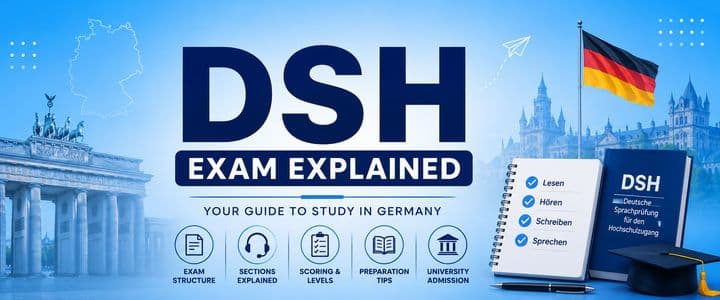
The DSH is an advanced German-language examination for international applicants who want to study at a university in Germany. It evaluates whether a student can understand lectures, read academic texts, write structured responses, and participate effectively in university discussions.
DSH stands for Deutsche Sprachprüfung für den Hochschulzugang, which means German Language Examination for University Admission.
Unlike TestDaF, which is a centrally standardized examination offered through international test centers, the DSH is generally organized by individual German universities and Studienkollegs. Each registered institution conducts its own examination under the national framework for German-language university entrance tests.
A successful DSH result is reported at one of three levels:
DSH-1
DSH-2
DSH-3
For most German-taught university programs, DSH-2 is the standard target. DSH-1 provides only limited language admission, while DSH-3 demonstrates exceptionally high academic German proficiency and may be required for selected language-intensive courses.
DSH Exam at a Glance
| Particular | Details |
|---|---|
| Full name | Deutsche Sprachprüfung für den Hochschulzugang |
| English meaning | German Language Examination for University Admission |
| Common abbreviation | DSH |
| Purpose | German-language proof for university admission |
| Main location | German universities and Studienkollegs |
| Target proficiency | Advanced academic German, generally B2–C1 or higher |
| Exam components | Written and oral examinations |
| Common university requirement | DSH-2 |
| Highest result | DSH-3 |
| Minimum passing level | DSH-1 |
| Standard passing threshold | At least 57% in the written and oral examinations |
| Recognition | Registered DSH examinations are recognized across German higher education |
| Test dates | Set independently by each university |
| Test fee | Determined by the examination center |
| Retakes | Governed by the university’s DSH regulations |
| Online home test | Generally no; candidates normally attend the university examination |
What Is the DSH Exam?
The DSH is designed to determine whether an international applicant has sufficient German proficiency to begin and complete a German-taught university degree.
It assesses skills needed in actual academic situations, including the ability to:
Understand an academic lecture
Take effective notes
Identify the main argument of a text
Understand complex sentence structures
Explain information in original wording
Describe and analyze a graph
Write a coherent academic response
Present an opinion
Support arguments with evidence
Participate in a formal discussion
Ask for clarification
Respond appropriately to another speaker
The DSH is not a general conversational German test. Candidates need advanced academic vocabulary, strong grammar, accurate reading comprehension, and the ability to communicate under time pressure.
Who Needs the DSH?
The DSH is mainly intended for applicants who:
Want to enter a German-taught bachelor’s degree
Want to enter a German-taught master’s degree
Have received conditional admission requiring German proof
Have completed a university preparatory German course
Need to satisfy the language condition before enrollment
Prefer a university-administered examination to TestDaF
Are already living in Germany
Have been invited to take the DSH by a German university
The DSH may not be necessary if the applicant possesses another language qualification accepted by the university, such as:
TestDaF with the required result
telc Deutsch C1 Hochschule
German Language Diploma, or DSD II
Goethe-Zertifikat C2
German section of the Feststellungsprüfung
Another certificate specifically recognized by the university
A qualification granting exemption under the university regulations
Applicants to fully English-taught programs may not need the DSH unless German is an additional program requirement.
Is DSH Accepted by All German Universities?
A DSH certificate from an institution with a properly registered examination regulation is recognized across German higher education.
The German Rectors’ Conference registers university DSH examination regulations, while the relevant professional bodies verify the content and standards. This registration ensures that the certificate meets the national framework known as RO-DT.
However, students must distinguish between:
A registered DSH examination
A DSH preparation course
An internal university placement test
A private language-school certificate
An unregistered examination using “DSH” in its marketing
Only completing a course called “DSH Preparation” does not provide the recognized DSH certificate.
Before registering, verify that the university or Studienkolleg appears on the current list of registered DSH examination regulations maintained by the German Rectors’ Conference.
DSH-1, DSH-2, and DSH-3 Explained
| DSH level | Minimum result | General meaning | Typical admission value |
|---|---|---|---|
| DSH-1 | 57% | Limited academic German proficiency | Accepted only for selected programs or conditional purposes |
| DSH-2 | 67% | Sufficient academic German for most university programs | Standard requirement for many German-taught degrees |
| DSH-3 | 82% | Particularly high academic German proficiency | May be required for linguistically demanding programs |
The minimum percentage must generally be achieved in both the written and oral examinations.
If a student earns 75% in the written examination but only 60% in the oral examination, the student cannot normally receive DSH-2. The lower oral performance limits the final result to DSH-1.
What Is DSH-1?
DSH-1 is awarded when a candidate achieves at least 57% in the written examination and at least 57% in the oral examination.
It demonstrates a limited level of academic language ability.
DSH-1 may be accepted for:
Selected degree programs
Programs with a lower German requirement
Certain bilingual courses
Conditional admission
Continued language preparation
University-specific study purposes
Some universities of applied sciences
DSH-1 is generally not sufficient for unrestricted admission to most German-taught degrees.
A student holding DSH-1 should request written confirmation before assuming that the certificate satisfies the chosen program.
What Is DSH-2?
DSH-2 is awarded when a candidate achieves at least 67% in both the written and oral examinations.
It is the most common DSH requirement for German-taught university admission.
DSH-2 demonstrates that the student can:
Understand academic lectures
Process complex written material
Write independently on university-related topics
Use academic vocabulary and grammar
Participate in structured discussions
Communicate effectively during university studies
According to uni-assist guidance, DSH-2 is sufficient for most courses of study at German universities.
A DSH-2 certificate does not guarantee admission. The applicant must still satisfy:
Academic eligibility
Subject prerequisites
Grade requirements
Application deadlines
APS requirements where applicable
uni-assist documentation
Program-specific selection criteria
What Is DSH-3?
DSH-3 is awarded when a candidate achieves at least 82% in both the written and oral examinations.
It demonstrates a particularly high command of academic German.
DSH-3 may be required or preferred for selected programs involving intensive language analysis, precise communication, or complex written expression, such as:
German language and literature
German as a foreign language
Linguistics
Law
Conference interpreting
Communication
Journalism
Teaching
Selected humanities programs
Certain medical programs
Not every medical or law program requires DSH-3. Students must check the current regulations of the exact university.
DSH Exam Structure
The DSH contains two major parts:
Written examination
Oral examination
The written examination is normally completed first. Candidates who fail the written examination may not be permitted to proceed to the oral part.
The written component generally tests:
Reading comprehension
Academic language structures
Listening comprehension
Written production
The oral component tests:
Academic speaking
Presentation
Discussion
Explanation
Argumentation
Interaction
The exact order, duration, and task design vary by university because each institution administers its own DSH under registered regulations.
DSH Written Examination
The written examination normally includes four skill areas.
| Written component | Main ability tested |
|---|---|
| Reading comprehension | Understanding and processing academic texts |
| Academic language structures | Recognizing and transforming complex German structures |
| Listening comprehension | Following a lecture and processing spoken information |
| Written production | Producing a coherent academic text |
At Heidelberg University, for example, the written components are weighted approximately as follows:
| Component | Illustrative weighting |
|---|---|
| Academic language structures | Approximately 14% |
| Reading comprehension | Approximately 29% |
| Listening comprehension | Approximately 29% |
| Written production | Approximately 29% |
This example helps students understand the general balance of the test, but the exact examination should be checked at the university where the candidate will take the DSH.
Reading Comprehension
The reading section assesses whether a candidate can understand and analyze a university-level text that does not require specialized professional knowledge.
Tasks may include:
Identifying main ideas
Answering questions about individual passages
Explaining expressions
Recognizing the argumentative structure
Selecting appropriate headings
Matching information
Completing a summary
Distinguishing true and false statements
Reproducing information in original wording
Identifying relationships between ideas
Texts may address topics related to:
Science
Society
Education
Technology
Environment
Psychology
Economics
Culture
Public policy
University life
The examination does not test subject expertise. The difficulty comes from the academic vocabulary, complex grammar, and required depth of comprehension.
Reading Preparation Tips
Identify the introduction, argument, evidence, contrast, and conclusion.
Mark connectors showing cause, result, comparison, and limitation.
Practice paraphrasing instead of copying entire sentences.
Learn common academic verbs and nominal structures.
Read questions before returning to the relevant section of the text.
Use context to understand unfamiliar vocabulary.
Avoid translating every sentence into English.
Academic Language Structures
The academic language structures component is commonly called Wissenschaftssprachliche Strukturen.
It assesses whether candidates understand and can use grammatical forms common in academic German.
Tasks may involve:
Sentence transformation
Paraphrasing
Passive constructions
Active-to-passive conversion
Nominalization
Verbalization
Relative clauses
Participial constructions
Conjunctions
Prepositions
Reported speech
Subordinate clauses
Complex sentence relationships
Gap-filling exercises
Academic word formation
This section does not test grammar as a list of isolated rules. Candidates must understand how grammatical structures convey meaning in an academic text.
Preparation Tips
Focus on:
Passive voice and alternative passive constructions
Nominal style
Relative clauses
Participial attributes
Subjunctive forms
Reported speech
Connectors and logical relationships
Sentence reduction and expansion
Academic collocations
Prepositional expressions
Candidates should practice transformation exercises using material from the university where they plan to take the DSH.
Listening Comprehension
The listening section assesses whether a candidate can follow an academic presentation or lecture and process its important information.
A lecture text may be read aloud or played according to the university’s examination format. It may be presented more than once, but candidates must follow local instructions.
Tasks can include:
Taking notes
Answering factual questions
Identifying the lecture structure
Completing an outline
Matching statements
Marking true or false
Summarizing important points
Explaining relationships
Reproducing information
Identifying examples supporting an argument
The material normally does not require specialized subject knowledge.
Listening Preparation Tips
Develop a personal system of German abbreviations.
Record keywords rather than complete sentences.
Listen for names, numbers, dates, causes, and conclusions.
Identify verbal signposts indicating a new section.
Distinguish the main point from supporting examples.
Practice reconstructing information from short notes.
Listen to German university lectures and educational podcasts.
Train under examination conditions without pausing the audio.
Written Production
The written production section requires candidates to create a coherent text on an academic or study-related topic.
The task may be based on:
A graph
A table
A diagram
An illustration
A quotation
A short statement
A list of keywords
A controversial question
Candidates may need to:
Describe data
Compare categories
Explain a trend
Discuss possible causes
Evaluate advantages and disadvantages
Present different viewpoints
Defend a position
Provide examples
Write a conclusion
Recommended Writing Structure
A practical structure is:
Introduction to the topic
Description of the source or graph
Explanation of significant information
Discussion of the issue
Presentation of arguments
Candidate’s own position
Conclusion
Not every task requires exactly this structure. The response should follow the instructions provided in the examination.
Writing Assessment
Evaluators commonly consider:
Task completion
Accuracy of information
Logical structure
Coherence
Vocabulary
Grammar
Sentence variety
Academic style
Clarity
Ability to communicate despite occasional errors
A grammatically perfect text that ignores half the task can receive a weak score.
DSH Oral Examination
The oral examination normally takes place after the written part, often on a separate day.
The format varies, but candidates may receive:
A short text
A graph
A statement
A quotation
An image
A diagram
A university-related problem
Candidates are usually given preparation time before the discussion.
The oral examination may require them to:
Summarize information
Present a topic
Explain a graph
Express an opinion
Defend an argument
Compare alternatives
Respond to questions
Clarify a statement
Give examples
Participate in a formal academic conversation
Unlike TestDaF speaking, the DSH oral examination commonly involves interaction with examiners.
Oral Examination Skills
Candidates should demonstrate:
Clear organization
Appropriate academic vocabulary
Accurate grammar
Fluency
Comprehensible pronunciation
Ability to respond spontaneously
Interaction with the examiner
Ability to ask for clarification
Ability to justify opinions
Appropriate use of the provided material
Oral Preparation Tips
Practice giving two- to five-minute structured presentations.
Record yourself summarizing newspaper and academic texts.
Describe graphs without memorizing a rigid script.
Practice responding to follow-up questions.
Learn expressions for agreeing, disagreeing, and qualifying a statement.
Do not give one-word answers.
Ask for clarification in German if a question is unclear.
Continue speaking after minor mistakes instead of restarting every sentence.
DSH Scoring System
The DSH result is based on percentage thresholds.
| Percentage achieved | DSH result |
|---|---|
| Below 57% | Failed |
| 57%–66% | DSH-1 |
| 67%–81% | DSH-2 |
| 82%–100% | DSH-3 |
Candidates must generally reach the applicable percentage in both major examination parts.
Example 1
| Component | Result |
|---|---|
| Written examination | 71% |
| Oral examination | 74% |
| Final level | DSH-2 |
Example 2
| Component | Result |
|---|---|
| Written examination | 84% |
| Oral examination | 70% |
| Final level | DSH-2 |
The candidate does not receive DSH-3 because the oral result is below 82%.
Example 3
| Component | Result |
|---|---|
| Written examination | 65% |
| Oral examination | 72% |
| Final level | DSH-1 |
The written result limits the final level to DSH-1.
Example 4
| Component | Result |
|---|---|
| Written examination | 55% |
| Oral examination | Not taken |
| Final level | Failed |
The candidate has not reached the minimum written threshold.
DSH Eligibility Requirements
There is no single national application rule for taking the DSH. Universities set their own eligibility conditions.
A university may require:
Admission or conditional admission to its degree program
Application to a university preparatory German course
Recognized academic eligibility
B2 or C1 German certificate
Placement-test result
Completed registration
Examination fee
Valid passport or identity document
Proof that the applicant intends to study at the institution
Some universities allow external candidates. Others reserve DSH places for students admitted to their own degree programs or language courses.
For example, one university may accept external candidates with B2, while another may allow only applicants holding that university’s admission letter.
What German Level Is Needed Before DSH?
Candidates should normally have at least a strong B2 level before beginning focused DSH preparation. Many students enter the examination at C1.
At B2, a student should already be able to:
Understand the main points of complex texts
Communicate with reasonable fluency
Write detailed responses
Discuss advantages and disadvantages
Follow standard spoken German
DSH preparation then develops:
Academic vocabulary
Lecture comprehension
Note-taking
Graph analysis
Academic grammar
Structured writing
Formal discussion skills
A short preparation course cannot take a beginner from A1 to DSH-2.
DSH Registration Process
The DSH does not have one national registration portal. Students must apply through the university or Studienkolleg conducting the examination.
Step 1: Check the Program Requirement
Confirm whether the program requires:
DSH-1
DSH-2
DSH-3
Another accepted certificate
Step 2: Find a Registered Examination Center
Use the current German Rectors’ Conference list of registered DSH regulations.
Step 3: Check Candidate Eligibility
Determine whether the center accepts:
Only admitted university applicants
Language-course participants
Applicants from partner universities
External candidates
Students retaking the examination
Step 4: Check the Required Entry Level
The institution may request:
B2 certificate
C1 certificate
Placement test
Completion of its preparatory course
Step 5: Submit the Application
The application may be submitted:
Directly through the university
Through the university application portal
Through uni-assist
Through the language center
As part of an application for a degree program
When applying through uni-assist, students may first have to select the intended degree and indicate that they are applying for the DSH or preparatory German course.
Step 6: Pay the Fee
Payment instructions are normally issued after successful registration.
Step 7: Download the Examination Information
Check:
Written examination date
Oral examination date
Location
Permitted dictionary
Identity requirements
Examination rules
Sample test
Result process
DSH Exam Dates
There are no nationwide DSH dates. Each university schedules its own examinations.
DSH dates are commonly arranged:
Before the summer semester
Before the winter semester
At the end of a preparatory German course
Several times annually at larger language centers
Some universities offer the DSH once a year, while others conduct it several times.
Students should consider both the written and oral dates. The oral examination may occur several days or weeks after the written examination.
DSH Exam Fees
There is no uniform national DSH fee. The cost depends on the university, candidate category, and whether the examination is included in a language course.
Current official university examples show that fees can differ:
Karlsruhe University of Applied Sciences lists €100 for external participants and no separate fee for enrolled HKA students.
TH Köln lists a €130 registration fee for eligible candidates.
Other universities may charge a lower or higher amount.
A preparatory course may have a separate fee in addition to the examination fee.
Students should budget for:
DSH examination fee
German preparation course
Travel
Accommodation
University application
uni-assist processing
Examination retake
Semester contribution where enrollment is required
The university’s current registration page is the final authority on fees.
DSH Results and Certificate
The result timeline depends on the university.
The process may involve:
Written examination
Publication of written results
Invitation to the oral examination
Oral examination
Final result
Issuance of the DSH certificate
Some universities announce the result on the oral examination day. Others publish it through a portal or issue the certificate later.
A registered DSH certificate should contain information showing that the examination regulation is registered under the applicable framework.
Students should retain the original certificate carefully and create high-quality scans for applications.
How Long Is the DSH Certificate Valid?
A valid DSH certificate does not generally have a standard national expiration period. However, universities can apply their own rules regarding the age, authenticity, or relevance of a language qualification.
Applicants with an older certificate should ask whether it remains acceptable for the intended program.
Can You Retake the DSH?
Retake rules vary by institution.
A university may:
Allow multiple attempts
Impose a waiting period
Limit the number of attempts
Require another preparation course
Restrict the next examination to its own applicants
Allow retaking only the full examination
Students should read the local DSH regulations before assuming they can register immediately for the next date.
A failed written or oral component does not always remain valid for a later attempt. Candidates may need to repeat both parts.
DSH Preparation Course
Many universities offer preparatory German courses that end with the DSH.
According to uni-assist, such courses commonly last approximately one semester, although the actual duration depends on:
Starting level
Course intensity
University
Placement result
Target DSH level
Student progress
Possible entry requirements include B1, B2, or a placement test.
A preparation course may cover:
Academic reading
Lecture comprehension
Note-taking
Academic grammar
Graph description
Argumentative writing
Oral presentations
Discussion strategies
Local DSH task types
Full mock examinations
Completing the course does not automatically guarantee that the student will pass the DSH.
Twelve-Week DSH Preparation Plan
| Week | Main focus |
|---|---|
| 1 | Diagnostic examination and format review |
| 2 | Academic vocabulary and connectors |
| 3 | Reading comprehension |
| 4 | Academic language structures |
| 5 | Listening and note-taking |
| 6 | Graph description |
| 7 | Argumentative writing |
| 8 | Oral presentation |
| 9 | Examiner interaction and discussion |
| 10 | Timed written examination |
| 11 | Full written and oral simulation |
| 12 | Error correction and final review |
Students below B2 need a longer general German-learning period before beginning this examination-specific preparation.
How to Prepare Without a Course
Independent preparation is possible for candidates who already possess strong B2 or C1 German.
Use:
Official sample examination from the target university
Registered DSH center information
German academic articles
Public lectures
Educational podcasts
Graphs and statistical reports
Timed writing exercises
Speaking partners
Recorded oral simulations
A monolingual German dictionary if permitted
Because DSH tasks vary between institutions, preparing with the target university’s sample examination is particularly important.
DSH vs TestDaF
| Factor | DSH | TestDaF |
|---|---|---|
| Administration | Individual German universities | Central TestDaF system |
| Main location | Germany | Germany and international test centers |
| Format | University-specific within a national framework | Standardized digital or paper format |
| Results | DSH-1, DSH-2, DSH-3 | TDN 3, TDN 4, TDN 5 per section |
| Common target | DSH-2 | TDN 4 in all four sections |
| Oral test | Usually interactive with examiners | Recorded computer response |
| Registration | University-specific | Central participant portal |
| Exam dates | Set by each university | Published TestDaF schedule |
| Best for | Students in Germany or with university admission | Students wanting proof before traveling |
| Fee | University-specific | Country- and format-specific |
Is DSH Easier Than TestDaF?
Neither test is universally easier.
DSH may suit students who:
Prefer interaction with human examiners
Are already in Germany
Have conditional university admission
Can prepare for one university’s specific format
Are strong in extended academic writing
Have attended a university DSH course
TestDaF may suit students who:
Want to take the examination outside Germany
Prefer a standardized format
Are comfortable speaking to a computer
Want centrally scheduled dates
Are applying to multiple universities before traveling
The best choice depends on the student’s strengths, location, timeline, and university requirement.
DSH vs telc Deutsch C1 Hochschule
| Factor | DSH | telc Deutsch C1 Hochschule |
|---|---|---|
| Provider | Registered universities and Studienkollegs | Licensed telc examination centers |
| Result | DSH-1, DSH-2, or DSH-3 | Certificate under telc scoring rules |
| Level range | Different university-admission levels | C1 university German |
| Local variation | Yes | Standardized |
| Oral format | University-specific interactive examination | telc examination format |
| Main advantage | Direct connection with university admission | Broader testing-center availability |
DSH and Studienkolleg
Students who must attend a Studienkolleg usually complete the Feststellungsprüfung rather than the standard DSH as their final qualification.
The Feststellungsprüfung includes:
German
Subject-specific components
Mathematics for selected tracks
Other subjects linked to the intended degree
In some institutions, the German component may closely resemble or be equivalent in scope to the DSH. Students should follow the regulations of their Studienkolleg.
DSH does not replace the Feststellungsprüfung’s academic components.
DSH for Indian Students
Indian applicants should understand the relationship between DSH, university admission, APS, and the student visa.
University Admission
A university may issue conditional admission stating that enrollment is possible after passing DSH-2 or another accepted German examination.
APS Certificate
APS India verifies academic documents and qualifications. It does not replace DSH.
Similarly, a DSH certificate does not replace APS where APS is required.
Student Visa
Because DSH is usually taken in Germany, Indian applicants may need:
Conditional university admission
Admission to a preparatory German course
Existing German-language proof
Confirmation of the planned DSH
Financial documentation
APS certificate where applicable
Other student visa documents
The current requirements of the German mission responsible for the application should be checked independently.
Practical Strategy
An Indian student planning to take DSH in Germany should:
Reach at least B1 or B2 before applying.
Obtain recognized proof of the current German level.
Apply to the degree and DSH pathway correctly.
Secure conditional admission or language-course admission.
Confirm the visa category and checklist.
Complete the university preparation course if needed.
Take DSH before enrollment in the degree.
Common DSH Mistakes
Registering for an Unregistered Examination
Always verify the center through the current HRK list.
Confusing a Course Certificate With DSH
A participation certificate from a DSH course is not the final DSH qualification.
Assuming DSH-1 Is Enough
Most German-taught programs require DSH-2.
Ignoring the Oral Examination
Candidates must prepare for formal interaction, not only grammar and writing.
Using Only General C1 Material
DSH has academic task types that require specific practice.
Preparing With Another University’s Format Only
The national framework creates comparability, but exact local tasks and timing may differ.
Booking Travel Before Confirming Eligibility
Some universities do not accept external candidates.
Forgetting the Second Examination Date
The written and oral parts may take place on different days.
Failing to Reach 57% in Both Parts
A strong written result does not compensate for an oral score below the minimum threshold.
Assuming DSH Includes Academic Admission
DSH proves language proficiency only. It does not evaluate whether the applicant’s school or university qualification is academically eligible.
DSH Application Checklist
Before registering, confirm:
Your program’s required DSH level
The examination center’s HRK registration
Whether external candidates are accepted
Minimum German level for registration
Need for conditional admission
Application route
Written examination date
Oral examination date
Examination fee
Permitted dictionary
Retake rules
Result-release timeline
Certificate-submission deadline
Visa requirements
APS requirement for Indian applicants
Frequently Asked Questions
What is the DSH exam?
DSH is a German-language university entrance examination administered by registered universities and Studienkollegs.
What is the full form of DSH?
DSH stands for Deutsche Sprachprüfung für den Hochschulzugang.
What DSH level is required for German universities?
DSH-2 is sufficient for most German-taught programs. Selected courses accept DSH-1 or require DSH-3.
What percentage is needed for DSH-1?
Candidates generally need at least 57% in both the written and oral examinations.
What percentage is needed for DSH-2?
Candidates generally need at least 67% in both major examination parts.
What percentage is needed for DSH-3?
Candidates generally need at least 82% in both the written and oral examinations.
Is DSH-1 enough for university admission?
Only for selected programs or limited study purposes. Most German-taught degrees require DSH-2.
Is DSH-2 equal to C1?
DSH-2 demonstrates academic German ability sufficient for most university programs and is commonly associated with an advanced level. It should not be treated as a simple one-to-one CEFR conversion in every context.
Is DSH-3 required for medicine?
Some universities may require DSH-3 or another high-level German result for medicine. Others accept DSH-2. Check the exact university requirement.
Is DSH accepted throughout Germany?
A certificate from a properly registered DSH examination is recognized across German higher education.
Can I take the DSH outside Germany?
The DSH is mainly administered through German universities and Studienkollegs. Students seeking an internationally available examination often choose TestDaF.
Can I take DSH without university admission?
It depends on the examination center. Some accept external participants, while others require admission to that university.
What German level do I need before DSH?
A strong B2 is a common minimum starting point. Many successful candidates prepare at C1.
How much does the DSH cost?
Fees are set by individual universities. Current university examples include approximately €100–€130, but actual costs can be lower or higher.
How long is the DSH exam?
The written examination can take several hours, while the oral examination is usually held separately. Exact timing varies by university.
Is a dictionary allowed?
Many DSH centers permit a monolingual German dictionary, but local examination rules must be checked. Bilingual dictionaries are commonly prohibited.
Is the oral DSH difficult?
It can be challenging because candidates must present, discuss, respond to questions, and use formal German spontaneously.
Can I retake the DSH?
Many universities allow retakes, but waiting periods and attempt limits depend on local regulations.
Is DSH easier than TestDaF?
The answer depends on the candidate. DSH offers a university-specific format and interactive oral examination, while TestDaF is centrally standardized.
Is DSH required for English-taught programs?
Usually not. English-taught programs generally require English-language proficiency unless German is an additional condition.
Does DSH replace APS for Indian students?
No. DSH proves German proficiency, while APS verifies Indian academic documents.
Can I apply for a visa to take the DSH in Germany?
Students may use a preparatory-study or conditional-admission pathway depending on their circumstances. The current visa requirements must be checked with the responsible German mission.
Final Verdict
The DSH is a university-administered German-language examination for international students entering German-taught degree programs.
The three result levels are:
DSH-1 from 57%
DSH-2 from 67%
DSH-3 from 82%
For most programs, DSH-2 is the appropriate target. DSH-1 provides only limited admission possibilities, while DSH-3 may be necessary for selected language-intensive courses.
The examination consists of written and oral components. Candidates must demonstrate academic reading, listening, writing, grammar, presentation, and discussion skills.
Because DSH is organized locally, students must check:
Whether the examination regulation is officially registered
Whether external applicants can register
The required entry-level German certificate
The local exam format and sample paper
The required DSH level for the intended course
The written and oral examination dates
The retake and fee rules
For students already in Germany or holding conditional admission, DSH can be an excellent alternative to TestDaF. Applicants outside Germany may find TestDaF easier to access because it is available through an international network of examination centers.