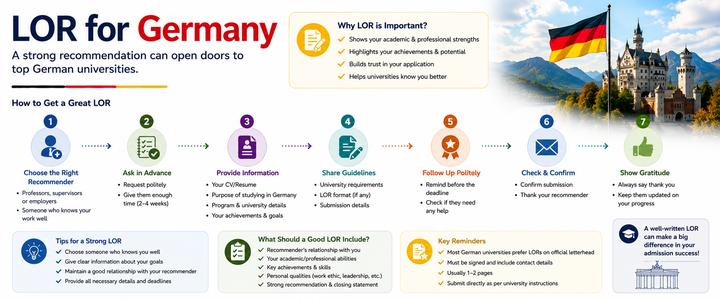
Studying in Germany requires more than securing university admission. International students must coordinate academic eligibility, language proof, application deadlines, APS, finances, health insurance, visa documentation, housing, enrollment and residence registration.
The safest approach is to divide the process into stages and complete each requirement using official university and government instructions. A document accepted for university admission may not automatically satisfy APS or student visa requirements.
Germany Study Checklist: Quick Overview
| Stage | Essential Task |
|---|---|
| Course planning | Select a recognized university and suitable program |
| Eligibility | Check degree recognition, grades and subject requirements |
| Language | Complete the accepted English or German test |
| APS | Obtain APS if applying with applicable Indian credentials |
| Documents | Prepare transcripts, certificates, CV and motivation letter |
| Application | Apply directly, through uni-assist or through the VPD process |
| Admission | Review all academic, language and tuition conditions |
| Finance | Arrange financial proof and separate tuition funds |
| Health insurance | Secure coverage accepted for visa and enrollment |
| Visa | Submit the correct national student visa application |
| Housing | Apply for student housing and private alternatives |
| Travel | Carry originals, temporary insurance and arrival funds |
| Address registration | Register the German address after moving in |
| University enrollment | Complete enrollment before the university deadline |
| Residence permit | Apply before the entry visa expires |
| Student life | Activate banking, transportation and university accounts |
| Career planning | Begin German, internships and job preparation early |
Phase 1: Define the Study Plan
Before applying, decide what you want to study and why Germany is appropriate for that goal.
Academic Planning Checklist
Select the intended degree level.
Identify the preferred subject and specialization.
Decide between a university and a university of applied sciences.
Choose between an English-taught, German-taught or bilingual program.
Determine whether the degree is research-oriented or career-oriented.
Check whether the program is consecutive or requires work experience.
Compare public and private universities.
Review the program duration.
Check whether the program begins in winter, summer or both semesters.
Identify possible career outcomes.
Estimate the complete cost of study.
University vs University of Applied Sciences
| Institution Type | Main Focus | Best Suited For |
|---|---|---|
| Research university | Theory, research and doctoral preparation | Research, academic and scientific careers |
| Technical university | Engineering, technology and research | Technical and scientific fields |
| University of applied sciences | Practical education and industry projects | Applied professional careers |
| Private university | Specialized programs and smaller classes | Students who can support higher tuition |
| Art, film or music school | Creative and performance education | Portfolio or audition-based applicants |
Institution type should be selected according to the student’s academic and career goals rather than ranking alone.
Phase 2: Find Suitable Programs
Use recognized course databases and official university websites to identify programs.
Program Search Checklist
Confirm the exact degree title.
Check the main language of instruction.
Read the official curriculum.
Review the module handbook.
Confirm whether all required modules are available in the chosen language.
Check the university’s recognition and status.
Review tuition and semester contributions.
Check city living costs.
Confirm the application deadline for non-EU applicants.
Identify the application route.
Check internship or thesis requirements.
Review graduate employment opportunities.
Do not rely on third-party course listings without confirming the information through the university.
Phase 3: Check Academic Eligibility
Master’s admissions in Germany are frequently based on subject compatibility rather than only the overall GPA.
Bachelor’s Applicants
Applicants may need:
Recognized school-leaving qualification
Direct university entrance eligibility
Studienkolleg where direct entry is unavailable
Subject-specific school qualifications
German or English language evidence
TestAS or another aptitude assessment where required
Portfolio or entrance examination for creative programs
Master’s Applicants
Applicants generally need:
Recognized Bachelor’s degree
Related academic background
Required academic credits
Competitive grades
Accepted language evidence
Research, internship or work experience where specified
Academic Eligibility Checklist
Confirm that the previous institution is recognized.
Check whether the previous degree is equivalent to a German degree.
Compare Bachelor’s modules with the Master’s prerequisites.
Calculate whether the required subject credits are available.
Check the minimum grade requirement.
Review thesis or research expectations.
Check work-experience requirements.
Obtain official module descriptions.
Prepare the grading-scale document.
Confirm whether a preliminary degree certificate is accepted.
Subject-Specific Credit Requirements
A university may require credits in:
Mathematics
Statistics
Programming
Computer science theory
Engineering fundamentals
Economics
Business administration
Research methods
Laboratory science
Design or studio work
Professional certificates may strengthen an application but usually do not replace missing university credits.
Phase 4: Complete the Language Requirement
The required language depends on the program.
English-Taught Program Checklist
Confirm the accepted English tests.
Check the minimum overall score.
Check minimum component scores.
Determine whether IELTS Academic is required.
Check whether TOEFL is accepted.
Verify acceptance of Cambridge English.
Confirm whether PTE Academic is accepted.
Check whether MOI is accepted.
Verify separate student visa language rules.
Submit the certificate before the deadline.
German-Taught Program Checklist
Check the required CEFR level.
Confirm whether TestDaF is accepted.
Confirm whether DSH is accepted.
Check Goethe certificate requirements.
Review telc or ÖSD acceptance.
Determine whether conditional admission is available.
Check whether a preparatory German course is required.
Confirm the visa-level language evidence.
Important Language Warning for Indian Applicants
Current German student visa guidance in India requires recognized evidence of the study language.
Applicants should not assume that the following will satisfy the visa authority:
Medium of Instruction letter
University IELTS waiver
Duolingo English Test
PTE Academic
TOEFL Home Edition
Online language examination
Informal exemption letter
A university may accept one of these documents for admission while the visa authority requests different evidence.
Phase 5: Complete APS
Applicants using Indian academic credentials usually require an APS certificate unless an official exemption applies.
APS verifies academic credentials and educational eligibility.
APS Checklist
Determine whether APS applies.
Create the APS application.
Complete the correct applicant category.
Pay the APS fee.
Prepare school certificates.
Prepare semester mark sheets.
Prepare the degree or provisional certificate.
Prepare identification documents.
Provide university verification details.
Submit documents in the required format.
Monitor verification communication.
Store the issued APS certificate safely.
Common APS Exemptions
An exemption may apply when:
The applicant is pursuing doctoral or postdoctoral research.
The applicant holds a qualifying German or European public scholarship.
The intended qualification is non-German.
The applicant’s qualifying degree is foreign but not Indian.
The applicant holds an eligible international Indian qualification.
Another official exemption applies.
APS does not replace:
University admission
Language proof
Student visa
Financial proof
Qualification recognition for employment
Phase 6: Prepare Application Documents
Start collecting documents early because transcripts, recommendations and translations may take time.
Complete University Application Checklist
Passport copy
School certificates
Bachelor’s degree certificate
Provisional degree certificate, if accepted
Complete semester transcripts
Consolidated transcript
Grading-system explanation
Module descriptions
English or German certificate
Curriculum vitae
Motivation letter
Recommendation letters
Internship certificates
Employment certificates
Research proposal, where required
Portfolio, where required
GRE or GMAT result, where required
APS certificate
uni-assist VPD, where required
University-specific application form
Documents not issued in English or German may require an authorized translation.
Curriculum Vitae Checklist
A strong academic CV should include:
Full name and contact information
Academic qualifications
Internship experience
Employment history
Academic projects
Research experience
Publications or presentations
Technical skills
Language skills
Certifications
Volunteer experience
Relevant achievements
Use clear dates and explain study or employment gaps honestly.
Motivation Letter Checklist
The motivation letter should answer:
Why this subject?
Why this university?
Why this specific program?
How does the previous degree provide preparation?
Which modules are most relevant?
What projects or experience support the application?
What are the career goals?
Why is Germany appropriate?
How will the applicant contribute to the class?
What is the long-term professional plan?
A generic letter praising Germany is not enough.
Recommendation Letter Checklist
A useful recommendation should describe:
Academic performance
Research ability
Technical knowledge
Initiative
Reliability
Communication
Project contribution
Suitability for graduate study
Choose recommenders who know the applicant’s work rather than selecting someone only because of seniority.
Phase 7: Understand the Application Route
German universities use different application systems.
Direct Application
The application is submitted through the university’s own portal.
uni-assist Standard Application
uni-assist evaluates the international academic documents and forwards eligible applications to the university.
VPD Application
uni-assist issues preliminary review documentation. The applicant must then submit the VPD and remaining documents directly to the university.
A VPD is not an admission letter.
uni-assist Checklist
Create a My assist account.
Enter the complete academic history.
Select the correct university and program.
Upload each required document.
Check country-specific instructions.
Pay the handling fee.
Submit before the deadline.
Monitor the application status.
Respond to missing-document requests.
Download the evaluation result or VPD.
Complete the separate university application if required.
Current uni-assist handling fees are:
€75 for the first selected program in one semester
€30 for each additional selected program in the same semester
VPD processing commonly requires four to six weeks after a complete paid application is submitted.
Phase 8: Apply Strategically
Do not apply only to the most selective universities.
Balanced Application List
A practical list may contain:
Two or three highly competitive programs
Three or four realistic programs
Two or three broader or safer choices
No university can be treated as guaranteed admission.
Application Tracking Checklist
Track:
University
Program
Intake
Deadline
Tuition
Semester contribution
Language requirement
Minimum grade
Academic prerequisites
Application route
VPD requirement
APS requirement
Documents submitted
Payment status
Final decision
Phase 9: Review the Admission Letter
An admission letter may contain conditions that must be completed before enrollment.
Admission Letter Checklist
Verify the student’s name and passport details.
Confirm the university and program.
Confirm the degree type.
Confirm the teaching language.
Check the semester start.
Check the enrollment deadline.
Review outstanding academic conditions.
Review outstanding language conditions.
Check tuition and semester fees.
Confirm whether the offer must be accepted online.
Check whether original documents are required.
Identify orientation dates.
Download and store multiple copies.
Conditional admission does not mean every condition can be completed after arrival. Read the exact wording.
Phase 10: Build the Financial Plan
Students should calculate more than the blocked-account amount.
Initial Cost Checklist
University application fees
APS fee
Language-test fee
Translation and certification costs
Tuition fees
Semester contribution
Blocked account
Visa fee
Health insurance
Flight ticket
Temporary housing
Security deposit
First month’s rent
Furniture and household items
Residence permit fee
Emergency funds
Current Financial Proof
The current standard financial-proof amount is:
€11,904 for the first 12 months
€992 maximum monthly blocked-account withdrawal
Accepted alternatives may include:
Qualifying scholarship
Formal declaration of commitment from a sponsor in Germany
Another form of proof accepted by the visa authority
An Indian family affidavit does not replace the official financial-proof methods required by the German mission.
Tuition-Fee Checklist
Check whether the university charges tuition.
Separate tuition from the semester contribution.
Review non-EU tuition rules.
Check Baden-Württemberg tuition.
Check TUM program-specific tuition.
Verify private university payment requirements.
Review refund conditions.
Check scholarship or waiver availability.
Retain official payment receipts.
Prepare separate tuition proof for the visa.
Applicants to tuition-charging institutions may need to prove payment or available funds in addition to normal living-cost proof.
Phase 11: Arrange Health Insurance
Health insurance is mandatory.
Health Insurance Checklist
Identify whether statutory or private coverage applies.
Obtain coverage starting on the correct date.
Arrange travel insurance for any gap before enrollment.
Request the visa confirmation.
Request the university enrollment notification.
Confirm the monthly premium.
Check coverage for preexisting conditions.
Store the insurance card and policy documents.
Do not cancel coverage without replacement.
Travel health insurance is generally intended for the period before regular student coverage starts. It is not normally a substitute for long-term student health insurance.
Phase 12: Submit the Student Visa Application
Most non-EU students require a national visa before traveling to Germany.
General Student Visa Checklist
Correct visa category
Completed application
Valid passport
Passport data-page copies
Biometric photographs
University admission letter
APS certificate, where required
Academic certificates
Language certificate
Motivation letter
Curriculum vitae
Financial proof
Tuition proof, where applicable
Health-insurance confirmation
Visa fee
Additional mission-specific declarations
The current national student visa fee is generally €75, payable according to the responsible mission’s instructions.
Indian Student Visa Checklist
Applicants from India should verify:
Correct Consular Services Portal category
APS certificate or valid exemption
Degree and semester mark sheets
Recognized language certificate
Full-time German university admission
Motivation letter written by the applicant
Tabular CV
Blocked account, scholarship or formal sponsorship
Separate tuition evidence where applicable
German-compliant health insurance
Passport issued within the permitted period
Required empty passport pages
Correct biometric photographs
Mission-specific declarations
Do not book an appointment under the wrong visa subcategory.
Visa Interview Preparation
Be ready to explain:
Why Germany was selected
Why the university was selected
Why the program matches previous education
How the studies will be financed
What the student knows about the curriculum
Where the student plans to live
What the career plan is
How the language requirement has been satisfied
Why any study or employment gaps exist
What the student intends to do after graduation
Answers should be accurate and consistent with the submitted documents.
Phase 13: Find Accommodation
Apply for housing as soon as admission is received.
Housing Options
Student residence
Shared apartment
Private room
Private studio
Temporary furnished accommodation
Sublet
Housing Checklist
Apply to the local student services organization.
Apply to multiple residence buildings.
Search for shared apartments.
Compare the base rent and total rent.
Check whether heating is included.
Check whether electricity is included.
Check internet availability.
Confirm furniture and kitchen equipment.
Review the deposit.
Read the notice period.
Confirm address-registration permission.
Request a written rental agreement.
Verify the landlord before paying.
Obtain the landlord’s move-in confirmation.
Housing Scam Warning
Do not transfer money when:
The property cannot be verified.
The landlord refuses a contract.
The landlord claims to be abroad and requests immediate payment.
The rent is unrealistically low.
Payment is requested through gift cards or cryptocurrency.
Passport originals are requested.
The landlord refuses address registration.
The applicant is pressured to decide immediately.
Phase 14: Prepare for Travel
Documents for Hand Luggage
Passport
Visa
Admission letter
APS certificate
Academic originals
Language certificate
Blocked-account confirmation
Health-insurance proof
Housing confirmation
University contact information
Emergency contacts
Prescription and medical documents
Printed and digital copies
Do not place essential immigration and enrollment documents only in checked baggage.
Travel Preparation Checklist
Book the flight after considering visa timing.
Confirm airport arrival and local transportation.
Arrange temporary accommodation if needed.
Carry accessible emergency funds.
Activate an international payment method.
Check baggage rules.
Pack weather-appropriate clothing.
Carry required prescription medicine.
Obtain an international prescription where needed.
Inform the university of late arrival if applicable.
Save the university’s emergency contact details.
Keep housing directions available offline.
Phase 15: Complete Address Registration
After moving into accommodation, students generally must register their address within two weeks.
The office may be called:
Bürgeramt
Bürgerbüro
Residents’ Registration Office
Citizens’ Service Center
Address Registration Checklist
Book the appointment.
Carry the passport.
Carry the visa or residence document.
Carry the rental agreement if requested.
Carry the landlord’s move-in confirmation.
Complete the registration form.
Obtain the registration certificate.
Store the certificate safely.
Address registration is needed for many later tasks, including banking and residence-permit applications.
Phase 16: Complete University Enrollment
Admission and enrollment are different.
Admission grants the right to join the program. Enrollment creates official student status.
Enrollment Checklist
Accept the admission offer.
Pay the semester contribution.
Pay tuition where applicable.
Submit health-insurance confirmation.
Submit certified academic documents.
Submit language evidence.
Submit passport and visa copies.
Submit APS where requested.
Provide a German address if required.
Complete the university enrollment form.
Obtain the enrollment certificate.
Activate the student portal.
Activate the university email account.
Collect or activate the student ID.
Register for orientation.
Register for courses and examinations.
Missing the enrollment deadline can cause the admission offer to lapse.
Phase 17: Open or Activate the Bank Account
Banking Checklist
Activate the blocked-account payments.
Open a German checking account if needed.
Provide the registered address.
Submit passport and enrollment documents.
Obtain the IBAN.
Set up rent payments.
Set up health-insurance payments.
Activate online banking.
Store account-recovery information securely.
Understand transfer and cash-withdrawal fees.
Never share online banking credentials or verification codes.
Phase 18: Apply for the Residence Permit
A national entry visa is not the same as the long-term student residence permit.
Apply through the foreigners authority responsible for the registered address.
Residence Permit Checklist
Book the appointment early.
Complete address registration.
Carry the valid passport.
Carry the entry visa.
Carry the enrollment certificate.
Provide financial proof.
Provide health-insurance confirmation.
Provide biometric photographs.
Provide housing evidence.
Complete the application.
Pay the residence-permit fee.
Request temporary status confirmation if processing extends beyond visa validity.
Check employment conditions printed on the permit.
Apply before the entry visa expires.
Phase 19: Set Up Daily Life
First-Month Checklist
Obtain a German SIM card.
Learn the public transportation system.
Register for the semester transportation benefit.
Locate the nearest grocery store and pharmacy.
Find a general physician.
Activate the health-insurance card.
Learn emergency numbers.
Register for university sports.
Join orientation and buddy programs.
Register for German classes.
Review broadcasting-fee obligations.
Store all official letters.
Put important deadlines on a calendar.
The broadcasting contribution is generally charged per household rather than per resident. Students sharing accommodation should coordinate payment and contribution details.
Phase 20: Begin Academic Preparation
German universities expect students to work independently.
Academic Checklist
Read the examination regulations.
Understand the credit system.
Register for modules.
Register separately for examinations.
Check withdrawal deadlines.
Learn the plagiarism rules.
Review attendance requirements.
Join academic advising sessions.
Meet professors during office hours.
Use the library and learning platforms.
Build a semester study plan.
Track earned credits.
Seek help before academic problems become serious.
Failure to register for an examination can prevent the student from taking it even after attending the complete course.
Phase 21: Understand Student Work Rules
Many third-country students can generally work:
Up to 140 full days
Up to 280 half days
Or under the applicable 20-hour weekly calculation during the lecture period
A working day of up to four hours generally counts as a half day. More than four hours normally counts as a full day.
Work Preparation Checklist
Read the residence-permit employment condition.
Obtain the tax identification number.
Obtain the social-insurance number.
Inform the health insurer.
Track every working day.
Combine hours from multiple jobs.
Confirm internship treatment.
Obtain approval before freelancing.
Keep contracts and pay statements.
Balance employment with academic progress.
The current statutory minimum wage is €13.90 gross per hour for covered employment.
Phase 22: Begin Career Preparation
Do not wait until graduation.
Career Checklist
Build a German-style CV.
Create a professional online profile.
Attend university career fairs.
Apply for internships.
Apply for relevant working-student jobs.
Join research projects.
Build a technical portfolio.
Attend employer presentations.
Connect with alumni.
Improve German toward B1 or B2.
Research target industries.
Learn German interview expectations.
Obtain employment references.
Relevant German work experience can be more valuable than an unrelated part-time job.
Phase 23: Monitor Residence and Academic Deadlines
Ongoing Compliance Checklist
Renew the residence permit on time.
Maintain valid health insurance.
Maintain required financial proof.
Re-register at the university each semester.
Pay semester charges.
Report address changes.
Report relevant employment changes.
Maintain satisfactory academic progress.
Keep the passport valid.
Retain all residence documents.
Check travel validity before leaving Germany.
Changing the university or study program can affect residence status. Confirm the immigration implications before making the change.
Phase 24: Prepare for Graduation
Final-Semester Checklist
Confirm all credits.
Register the thesis.
Complete outstanding examinations.
Request an official transcript.
Request degree-completion confirmation.
Apply for graduate jobs.
Update the CV and portfolio.
Review post-study residence options.
Maintain health insurance.
Confirm accommodation plans.
Apply for the next residence title before the student permit expires.
Post-Study Options
Third-country graduates may apply for a residence permit to search for qualified employment for up to 18 months.
During that period, graduates can generally accept any type of employment while searching for qualified work.
After finding suitable employment, they may apply for:
Skilled-worker residence permit
EU Blue Card
Research residence permit
Self-employment permit
Another eligible residence title
Suggested Planning Timeline
| Time Before Study Begins | Main Tasks |
|---|---|
| 12–18 months | Research programs, cities, tuition and eligibility |
| 9–12 months | Complete language test, APS and document collection |
| 6–9 months | Submit university and scholarship applications |
| 3–6 months | Review admission, arrange finance and begin visa process |
| 2–4 months | Apply for housing and organize insurance |
| 1–2 months | Finalize travel, enrollment documents and arrival funds |
| First two weeks after moving | Complete address registration |
| Before the entry visa expires | Apply for the student residence permit |
| During the first semester | Begin German, work experience and career preparation |
Common Mistakes to Avoid
Selecting a program without checking subject prerequisites
Applying only to highly selective universities
Confusing tuition with the semester contribution
Missing the separate VPD application
Applying for VPD too late
Assuming MOI satisfies the student visa
Delaying APS
Using an unrecognized language test
Submitting a generic motivation letter
Ignoring tuition proof for the visa
Depending only on the blocked-account withdrawal during arrival
Waiting too long to apply for housing
Paying an unverified landlord
Traveling without academic originals
Missing the enrollment deadline
Failing to register the address
Treating the visa as the final residence permit
Working beyond the permitted limit
Delaying German until graduation
Beginning the job search after the degree is complete
Frequently Asked Questions
What is the first step for studying in Germany?
Select a recognized program and check academic, language, tuition and application requirements.
When should students begin preparation?
Students should ideally begin researching programs and eligibility approximately 12–18 months before the intended start.
Is APS required for Indian students?
Most applicants using Indian academic credentials require APS unless an official exemption applies.
Should APS be completed before applying?
Some universities may allow application without the final APS certificate, while others require it. Starting APS early is the safest approach.
Does APS guarantee admission?
No. APS verifies academic credentials and does not decide admission.
Is IELTS compulsory?
Not universally. Universities may accept alternatives, but student visa requirements must be checked independently.
Can MOI replace IELTS?
Some universities accept MOI. Applicants from India should not assume it will satisfy the student visa language requirement.
Is German required for an English-taught program?
Usually not for admission, but German is highly valuable for daily life, internships and employment.
How many universities should a student apply to?
A balanced list of approximately eight to ten programs can reduce risk, but the ideal number depends on profile and budget.
What is uni-assist?
uni-assist evaluates international academic documents for participating universities.
What is a VPD?
It is preliminary review documentation issued by uni-assist and submitted separately to the university.
Does VPD guarantee admission?
No. The university makes the final decision.
How much financial proof is required?
The current standard amount is €11,904, corresponding to €992 per month.
Is the blocked account enough for all expenses?
Not necessarily. Students may need additional money for tuition, deposits, travel, furniture and emergencies.
How much is the student visa fee?
The national student visa fee is generally €75.
Is health insurance compulsory?
Yes. Students need coverage accepted for visa, enrollment and residence purposes.
When should housing applications begin?
As soon as the university and city are known. Student residences can have long waiting lists.
Can students travel without permanent housing?
Yes, but temporary accommodation should be arranged and a long-term housing search should continue.
When must students register their address?
Generally within two weeks after moving into accommodation.
Is university admission the same as enrollment?
No. Admission offers a place, while enrollment activates official student status.
When should the residence permit application be submitted?
As early as possible after arrival and before the entry visa expires.
Can students work in Germany?
Yes, within the employment limits attached to their residence status.
Can students freelance?
Third-country students generally require prior approval from the foreigners authority.
When should career preparation begin?
During the degree, preferably from the first semester.
Can graduates stay in Germany after completing the degree?
Eligible graduates may receive up to 18 months to search for qualified employment.
Does studying in Germany guarantee a job?
No. Employment depends on skills, language, experience, field and labor-market conditions.
Final Thoughts
A successful Germany study plan should follow a clear order:
Select the right program.
Confirm academic and language eligibility.
Complete APS where required.
Prepare accurate application documents.
Apply through the correct route.
Review every admission condition.
Arrange finances and health insurance.
Submit the correct student visa application.
Secure housing and prepare for travel.
Complete address registration, enrollment and the residence permit after arrival.
Begin German, internships and career preparation early.
Students should maintain digital and printed copies of every academic, financial, insurance and immigration document. Official university and government instructions should always take priority over information from agents, social media or informal student groups.