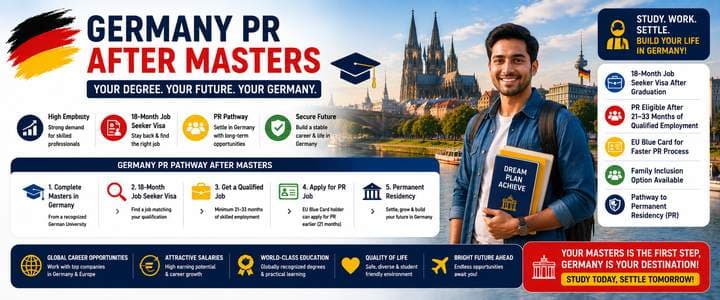
International students do not receive permanent residency automatically after completing a Master’s degree in Germany. The usual pathway is to graduate, obtain a post-study job-search residence permit if needed, secure qualified employment, change to a skilled-worker residence permit or EU Blue Card, complete the required employment and pension-contribution period, and then apply for a settlement permit.
Graduates of a German university may qualify for a settlement permit after holding an eligible skilled-employment residence permit for at least two years and completing 24 months of qualifying pension contributions. They normally also need B1 German, secure income, valid health insurance, sufficient accommodation and basic knowledge of German law and society.
EU Blue Card holders may qualify more quickly: after 21 months with B1 German or 27 months with A1 German, provided the remaining conditions are satisfied.
Germany PR After Masters: Quick Overview
| Stage | Main Requirement |
|---|---|
| Complete Master’s degree | Graduate successfully from a recognized German university |
| Post-study job search | Apply for a residence permit valid for up to 18 months if qualified employment has not yet been secured |
| Find qualified employment | The position must require academic or qualified vocational skills |
| Change residence status | Obtain an eligible skilled-worker permit, research permit or EU Blue Card |
| Fast-track German graduate route | At least two years on an eligible skilled-employment residence permit |
| Pension contribution requirement | Normally at least 24 months for the German-graduate route |
| German requirement | Normally B1 for the two-year graduate route |
| EU Blue Card route | 21 months with B1 or 27 months with A1 |
| Financial condition | Livelihood must generally be secured without prohibited public assistance |
| Integration requirement | Basic knowledge of German law, society and living conditions |
| Final application | Apply to the responsible foreigners authority |
What Is PR Called in Germany?
Permanent residency is commonly called PR, but the official German term is Niederlassungserlaubnis, meaning settlement permit.
A settlement permit is an unlimited residence title that normally allows the holder to:
Live permanently in Germany
Work without the restrictions attached to a temporary student permit
Change eligible employment more freely
Undertake self-employment, subject to applicable professional rules
Access broader residence rights
Avoid repeated renewal of a temporary work permit
Build a more secure long-term life in Germany
The physical electronic residence card may have an expiry date because it is connected to the passport or technical validity period. That does not necessarily mean the underlying permanent residence right has the same expiry.
Does a Master’s Degree Automatically Provide PR?
No. Completing a Master’s degree provides access to favourable post-study residence pathways, but it is not itself a permanent residence permit.
A graduate must normally establish:
Successful completion of a German degree
Eligible post-study residence status
Qualified employment
Required duration on an eligible employment permit
Pension-insurance contributions
German-language proficiency
Secure livelihood
Valid health insurance
Sufficient living space
Knowledge of German law and society
Compliance with immigration and criminal laws
Graduation is the starting point of the employment-based pathway, not the final PR approval.
Complete PR Pathway After a Master’s in Germany
Step 1: Complete the Master’s Degree
The applicant must successfully complete a recognized degree at a German higher education institution.
Useful evidence includes:
Final degree certificate
Provisional completion certificate
Official university confirmation
Final transcript
Thesis-completion confirmation
If the final certificate is delayed, the foreigners authority may accept formal confirmation that all academic requirements have been completed. Acceptance depends on the authority and the quality of the documentation.
Step 2: Apply for the Post-Study Job-Search Permit
A third-country graduate who has not secured suitable qualified employment can apply for a residence permit to search for a job.
This permit may be issued for up to 18 months.
During this period, the graduate can generally work in any occupation while searching for qualified employment. This may include temporary work, hospitality, retail, logistics or another job used to cover living expenses.
The graduate must usually demonstrate:
Successful completion of the German degree
Sufficient funds or income
Valid health insurance
Registered accommodation
Valid passport
A genuine intention to find qualified employment
The post-study permit is normally not renewable beyond its maximum period.
Step 3: Secure Qualified Employment
To move from the job-search permit to a skilled-worker residence permit, the graduate generally needs qualified employment.
A position is qualified when it requires knowledge and skills normally acquired through:
A university degree
Qualified vocational training
A comparable professional qualification
Purely auxiliary or unskilled employment does not normally support a skilled-worker residence permit.
Examples of qualified employment include:
Software engineer
Data analyst
Mechanical engineer
Electrical engineer
Financial analyst
Business consultant
Research associate
Marketing specialist
Supply-chain analyst
Architect
Biotechnologist
Product manager
The job does not always have to be in exactly the same academic subject for a standard skilled-worker permit, but it must genuinely be a qualified position. Regulated professions require the necessary professional recognition or licence.
Step 4: Change to an Employment Residence Permit
Once suitable employment is secured, the graduate must apply for the correct residence title.
Common options include:
Skilled-worker permit under Section 18b
EU Blue Card under Section 18g
Research residence permit under Section 18d
Self-employment permit under Section 21
Another eligible employment residence title
The PR route and timeline depend on the residence permit actually issued.
A graduate should not assume that receiving a job contract automatically changes the student or job-search residence permit.
Fast-Track Settlement Permit for German University Graduates
A person who completed a university degree in Germany can benefit from special settlement-permit conditions.
The applicant generally needs:
A completed degree from a German university
At least two years holding an eligible residence permit for skilled employment
Ongoing employment permitted by that residence title
At least 24 months of qualifying pension contributions
German-language ability at B1 level
Basic knowledge of Germany’s legal and social system
Secure livelihood
Valid German health insurance
Sufficient accommodation
No serious criminal or immigration issues
This route is usually the most relevant pathway for international Master’s graduates whose salary does not meet the EU Blue Card threshold.
When Does the Two-Year PR Period Begin?
The two-year period does not normally begin:
When the student first enters Germany
When the Master’s programme starts
When the thesis is submitted
On the graduation date alone
When an unqualified temporary job begins
When the post-study job-search permit is issued
The relevant period generally begins when the graduate holds an eligible skilled-employment residence permit and fulfils the associated employment conditions.
This distinction is extremely important.
A graduate who spends eight months on the job-search permit before changing to a skilled-worker permit should not automatically count those eight months toward the two-year skilled-employment requirement.
Pension contributions made during the job-search period may appear in the insurance record, but the applicant must still satisfy the separate requirement of holding the eligible skilled-worker residence permit for the required duration.
EU Blue Card Route to PR
The EU Blue Card can provide the fastest common pathway to permanent residency after a German Master’s degree.
PR with B1 German
An EU Blue Card holder may qualify for a settlement permit after:
21 months of qualifying employment
Corresponding pension contributions
B1 German
Secure livelihood
Basic knowledge of German law and society
Sufficient accommodation
Compliance with the remaining legal conditions
PR with A1 German
An EU Blue Card holder may qualify after:
27 months of qualifying employment
Corresponding pension contributions
A1 German
Secure livelihood
Basic knowledge of German law and society
Sufficient accommodation
Compliance with the remaining conditions
Which Blue Card Route Is Faster?
| German Level | Possible Blue Card PR Timeline |
|---|---|
| A1 | 27 months |
| B1 | 21 months |
Reaching B1 can reduce the qualifying period and improve employment, communication and long-term integration opportunities.
EU Blue Card Eligibility After a Master’s
A graduate may qualify for an EU Blue Card when:
The applicant has a recognized academic qualification.
A specific qualified job offer is available.
The employment normally lasts at least six months.
The position corresponds appropriately to the academic qualification.
The salary reaches the applicable EU Blue Card threshold.
Any required professional licence is available or expected.
Federal Employment Agency approval is obtained when required.
The EU Blue Card salary threshold changes regularly. A lower threshold may apply to specified shortage occupations and recent university graduates.
Eligible shortage areas may include selected occupations in:
Information technology
Mathematics
Engineering
Natural sciences
Medicine
Management
Education
Other officially designated professions
Applicants should verify the threshold applying on the date of application rather than relying on an old salary figure.
Skilled-Worker Permit vs EU Blue Card
| Condition | Skilled-Worker Permit | EU Blue Card |
|---|---|---|
| Academic qualification | German, recognized or comparable qualification | Recognized academic or qualifying tertiary-level background |
| Job requirement | Must be qualified employment | Must satisfy Blue Card qualification and job conditions |
| Relationship to degree | Exact subject match is not always required | Job must appropriately correspond to the qualification |
| Salary threshold | No general Blue Card-level threshold, but salary must be appropriate | Minimum annual salary threshold applies |
| German-graduate PR route | Normally after two years and 24 contribution months | May qualify after 21 or 27 months |
| Language for fast PR | Normally B1 | B1 for 21 months or A1 for 27 months |
| Job-change rules | Depend on permit conditions | Special Blue Card notification rules apply during the initial period |
| Best for | Graduates with qualified jobs below the Blue Card threshold | Graduates meeting Blue Card salary and qualification conditions |
The EU Blue Card is not automatically better for every graduate. A standard skilled-worker permit may provide an equally practical route when the Blue Card salary threshold is not met.
General Skilled-Worker PR Route
A skilled worker who did not complete higher education or vocational training in Germany may generally need:
Three years on an eligible skilled-worker, research or Blue Card-related residence title
At least 36 months of qualifying pension contributions
B1 German
Ongoing permitted employment
Secure livelihood
Basic legal and social knowledge
Sufficient accommodation
International students who complete their Master’s in Germany can normally use the more favourable German-graduate conditions when all requirements are met.
Does the Master’s Study Period Count Toward PR?
The study period does not normally replace the specific employment-residence and pension-contribution requirements of the fast-track German graduate route.
For that route, the decisive requirements include:
Two years on the relevant skilled-employment residence permit
24 months of qualifying pension contributions
Study time can be relevant under other long-term residence calculations. For example, part of the lawful study period may be counted toward certain EU long-term residence requirements.
Applicants should not mix the German-graduate settlement route with the separate permanent EU residence route.
Settlement Permit vs Permanent EU Residence Permit
Germany offers more than one permanent residence status.
Settlement Permit
The national settlement permit provides permanent residence and broad employment rights in Germany.
Permanent EU Residence Permit
The permanent EU residence permit can provide facilitated mobility to participating European Union countries, but it does not create automatic unrestricted employment rights throughout Europe.
A receiving country can still require:
A residence application
Employment evidence
Income proof
Health insurance
Accommodation
Compliance with national rules
| Feature | Settlement Permit | Permanent EU Residence Permit |
|---|---|---|
| Permanent residence in Germany | Yes | Yes |
| Broad employment access in Germany | Yes | Yes |
| Facilitated movement within participating EU states | Limited | Stronger |
| Automatic right to work anywhere in the EU | No | No |
| Main residence-period rule | Depends on applicant category | Generally longer lawful residence requirement |
| Treatment of study periods | Route-specific | Part of study residence may be counted |
| Absence rules | National settlement rules apply | Separate EU long-term absence rules apply |
German Language Requirement
B1 German is normally required for the two-year German graduate settlement route.
An English-taught Master’s degree does not automatically prove B1 German.
Applicants may use an accepted certificate or another form of evidence recognized by the local foreigners authority.
Possible evidence can include:
Accepted B1 language certificate
Integration-course certificate
German-language university degree
German school qualification
Other officially accepted educational evidence
The certificate must normally cover the required language skills rather than only attendance in a language course.
Does a German Master’s Degree Exempt the Language Test?
It depends on the teaching language and local authority’s assessment.
A German-language degree may provide strong evidence of language ability. An English-taught degree generally does not establish B1 German.
Completing any German degree may help demonstrate knowledge of German society and education, but applicants should not assume that it removes the separate B1 requirement.
Written confirmation should be obtained from the responsible foreigners authority.
Living in Germany Test
Settlement-permit applicants normally need basic knowledge of:
The German legal system
Democratic principles
Social structure
Rights and responsibilities
Everyday life in Germany
This is commonly proven through the “Living in Germany” test.
Alternative evidence may include:
Integration-course completion
Orientation-course completion
Naturalization test
German school qualification
German vocational qualification
Qualifying German university education
Requirements can vary according to the applicant’s educational history and local authority.
Pension-Contribution Requirement
German university graduates normally need 24 months of qualifying pension contributions for the fast-track settlement route.
These contributions are usually deducted automatically from salaried employment and shown on the employee’s payroll statement.
The applicant should request an official pension-insurance record showing:
Employment periods
Contribution months
Reported salary
Employer registrations
Any gaps
Correct personal information
Do Mini-Job Contributions Count?
Mini-job pension contributions may appear in the pension record, but whether they satisfy the relevant settlement-permit requirement depends on the contribution arrangement and individual case.
A mini-job also does not normally qualify as the skilled employment needed for the fast-track graduate route.
Does Student Work Count?
Pension contributions from student work may be recorded, but the fast-track route separately requires the applicant to hold an eligible skilled-employment residence permit for the prescribed period.
Student contributions should not be assumed to reduce that residence-permit period.
What About Private Pension Contributions?
Evidence of comparable qualifying pension provision may be considered in certain situations. The local foreigners authority determines whether the evidence satisfies the legal requirement.
Secure Livelihood Requirement
Applicants normally must show that they can support themselves and relevant family members without relying on prohibited public assistance.
Authorities may examine:
Net monthly salary
Employment stability
Rent and household costs
Health-insurance coverage
Family size
Childcare expenses
Existing debts
Public benefits received
Employment-contract duration
Probation status
There is no single salary that guarantees PR for every applicant. A salary sufficient for one person in a low-cost city may be inadequate for a larger family in an expensive city.
Does the Job Need to Be Permanent?
A permanent employment contract is helpful, but a fixed-term contract does not automatically make PR impossible.
The authority may consider:
Remaining contract duration
Employment history
Probability of renewal
Profession and labour-market demand
Monthly income
Completion of probation
Employer confirmation
Applicant’s overall financial stability
Applicants on short contracts or still in probation may face closer examination.
Can PR Be Granted During Probation?
There is no universal rule stating that every applicant must complete probation first. However, some foreigners authorities may hesitate when employment is new or uncertain.
Applicants can strengthen the case with:
Employer confirmation
Recent salary statements
Evidence that employment continues
Positive employment history
Sufficient savings
A contract extending well beyond the application date
Health Insurance Requirement
The applicant must have adequate health insurance in Germany.
Accepted coverage normally includes:
Statutory German health insurance
Qualifying comprehensive private health insurance
Travel insurance or limited foreign insurance is generally insufficient for permanent residence.
Sufficient Living Space
Applicants normally need suitable accommodation for themselves and family members living in the household.
Evidence may include:
Rental contract
Current rent confirmation
Proof of apartment size
Landlord confirmation
Property-ownership documents
Registration certificate
The appropriate space depends on household size and local assessment.
Documents Required for PR After a Master’s
A foreigners authority may request:
Completed settlement-permit application
Valid passport
Current residence permit
Biometric photograph
German Master’s degree certificate
Final transcript
Employment contract
Employer confirmation
Recent salary statements
Evidence of continued employment
Pension-insurance history
B1 German certificate
Living in Germany test certificate
Health-insurance confirmation
Rental agreement
Proof of accommodation size
Registration certificate
Bank statements
Tax documents
Marriage certificate, where relevant
Children’s documents, where relevant
Application-fee payment
Document requirements differ by city and applicant profile.
Step-by-Step PR Application Process
Step 1: Identify the Correct PR Route
Determine whether the application is based on:
German university graduate provisions
EU Blue Card provisions
General skilled-worker provisions
Self-employment
Family residence
Another permanent-residence category
Step 2: Check the Residence Permit History
Review the exact dates and legal sections printed on previous and current residence documents.
Step 3: Request the Pension Record
Obtain the official Versicherungsverlauf from German Pension Insurance and check whether every qualifying month has been recorded.
Step 4: Complete the German Requirement
Take an accepted B1 examination early. Blue Card holders choosing the 27-month route may use A1, but B1 can provide a faster pathway.
Step 5: Complete the Integration Requirement
Take the Living in Germany test or obtain confirmation that another qualification satisfies the requirement.
Step 6: Organize Employment Evidence
Collect:
Contract
Employer letter
Salary statements
Work-permit evidence
Confirmation that employment continues
Step 7: Prepare Financial and Housing Documents
Ensure income, health insurance and accommodation are clearly documented.
Step 8: Apply to the Foreigners Authority
Submit the application to the authority responsible for the applicant’s registered primary residence.
Step 9: Attend the Appointment
Bring originals and updated documents. The authority may ask about employment, residence history, family circumstances and German ability.
Step 10: Receive the Decision and Residence Card
After approval, the permanent status is issued and an electronic residence card is produced.
Estimated PR Timeline Examples
Example 1: Skilled-Worker Route
A student completes a German Master’s degree and immediately starts qualified employment under Section 18b.
The graduate may become eligible after:
Two years on the eligible skilled-worker permit
24 pension-contribution months
B1 German
Completion of all other requirements
Example 2: EU Blue Card with B1
A graduate starts qualifying Blue Card employment and already has B1 German.
Potential eligibility:
After 21 qualifying months
Required pension contributions
Secure livelihood
Integration knowledge
Suitable accommodation
Example 3: EU Blue Card with A1
A graduate holds a Blue Card but has only A1 German.
Potential eligibility:
After 27 qualifying months
Required pension contributions
Remaining settlement conditions
Example 4: Delayed Qualified Employment
A graduate spends eight months looking for qualified employment and then receives a skilled-worker permit.
The two-year fast-track employment period generally begins with the relevant skilled-employment residence status, not automatically from graduation.
What Happens When Changing Jobs?
Changing jobs can affect the residence permit and PR timeline.
Skilled-Worker Permit
The applicant should check whether the permit is:
Tied to a particular employer
Restricted to a specific occupation
Subject to foreigners-authority approval
Open to qualified employment generally
EU Blue Card
A job change during the initial period must generally be reported to the foreigners authority. The authority can examine whether the new position continues to meet Blue Card conditions.
The new job must continue to satisfy requirements such as:
Qualified employment
Relevant academic relationship
Salary threshold
Contract conditions
Changing employers does not necessarily restart the entire PR period when both jobs and residence status remain compliant. Gaps or a switch to an ineligible permit can affect the calculation.
What Happens If the Graduate Becomes Unemployed?
Unemployment does not automatically cancel every residence permit immediately, but it must be handled carefully.
The graduate should:
Notify the foreigners authority when required.
Register with the Federal Employment Agency.
Review health-insurance coverage.
Begin searching for new qualified employment.
Check the residence permit’s validity and conditions.
Avoid assuming that the PR timeline continues unchanged.
A prolonged employment gap can delay eligibility because the applicant may no longer satisfy:
Ongoing qualified-employment requirements
Pension-contribution requirements
Secure-livelihood requirements
EU Blue Card conditions
Can Self-Employment Lead to PR?
A graduate may switch to self-employment when the necessary residence permit is approved.
A person holding an eligible self-employment residence permit may qualify for a settlement permit after three years when:
The business has operated successfully.
The activity is expected to remain sustainable.
The applicant holds valid self-employment residence status.
The applicant and family can support themselves.
The business and tax records are complete.
Other residence conditions are satisfied.
Freelancing during a student or job-search residence period should not begin without confirming that it is permitted.
PR for a Spouse After the Graduate Gets PR
A spouse does not automatically receive permanent residency on the same date.
A facilitated pathway may be available when:
The main applicant holds a skilled-worker settlement permit.
The spouse has held an eligible residence permit for the required period.
The couple lives together.
The spouse works at least 20 hours per week where required.
The spouse has B1 German.
The spouse has basic legal and social knowledge.
Other residence conditions are satisfied.
The exact route depends on the spouse’s residence history and permit.
PR and German Citizenship Are Different
| Settlement Permit | German Citizenship |
|---|---|
| Permanent residence status | Full German nationality |
| Does not provide a German passport | Provides eligibility for a German passport |
| No general federal voting rights | Includes voting rights |
| Can expire after certain long absences | Citizenship is more durable |
| Retains foreign nationality subject to home-country rules | Nationality consequences depend on applicable law |
| Does not provide unrestricted EU citizenship rights | Includes European Union citizenship rights |
Permanent residency is not always required before applying for citizenship, but the applicant must hold a residence status accepted under citizenship law and satisfy all other conditions.
Citizenship rules can change and should be checked separately.
Can German PR Expire?
A settlement permit is permanent, but it can still cease to be valid in certain circumstances.
A common risk is leaving Germany:
For a reason that is not temporary
For longer than the permitted absence period
Without obtaining advance authorization for a longer stay abroad
A settlement permit can generally expire when the holder remains outside Germany for more than six months unless the foreigners authority has granted a longer period or a legal exception applies.
Before a long international assignment, family stay or relocation, the holder should request written confirmation from the foreigners authority.
Benefits of PR After a German Master’s
Permanent residency can provide:
Long-term residence security
Broader access to employment
Easier employer changes
Reduced dependence on one job contract
No regular temporary-permit renewal
Greater flexibility for career planning
Better conditions for business creation
More stability for family life
Easier long-term financial planning
A stronger foundation for future citizenship eligibility
PR does not automatically provide:
A German passport
Voting rights
Unrestricted employment in every EU country
Protection from every absence-related expiry rule
Automatic PR for family members
Common Reasons for PR Rejection or Delay
Applications may be delayed or rejected because:
The applicant applies before completing the required permit period.
Job-search months are incorrectly counted as skilled-worker months.
Pension contributions are below the required number.
The applicant does not hold an eligible residence permit.
Employment is not considered qualified.
The job no longer meets EU Blue Card conditions.
Income is insufficient for household expenses.
Employment is unstable.
B1 German evidence is missing.
The language certificate is not accepted.
Integration knowledge has not been proven.
Health insurance is inadequate.
Housing documents are incomplete.
The applicant receives disqualifying public assistance.
Criminal proceedings are pending.
Fines or immigration violations raise concerns.
Documents contain inconsistent employment dates.
The applicant has spent long periods outside Germany.
The application is filed with the wrong authority.
How to Improve the PR Application
Start German During the Master’s
Reaching B1 before graduation can prevent language from delaying PR eligibility.
Choose the Correct Employment Permit
Graduates meeting the Blue Card threshold should compare its 21-month route with the two-year German-graduate route.
Request Pension Records Regularly
Incorrect or missing employer registrations can take time to correct.
Avoid Unexplained Employment Gaps
Maintain records of job changes, unemployment registration and residence-permit updates.
Keep Every Residence Document
Retain:
Old permits
Supplementary sheets
Visa copies
Application confirmations
Foreigners-authority correspondence
Apply Before the Current Permit Expires
Appointment delays do not remove the obligation to submit a timely application.
Keep Finances Stable
Avoid relying on income that cannot be documented or is not permitted under the residence status.
Frequently Asked Questions
Can I get PR after completing a Master’s in Germany?
Yes. A German university graduate may qualify after obtaining eligible skilled employment and satisfying the residence, pension, language, income and integration requirements.
How quickly can a German Master’s graduate get PR?
A graduate may qualify after two years on an eligible skilled-employment residence permit with 24 pension-contribution months. A Blue Card holder with B1 German may qualify after 21 months.
Is PR guaranteed after two years?
No. The applicant must satisfy every condition, including eligible residence status, qualified employment, pension contributions, B1 German, livelihood, health insurance and integration requirements.
Does the two-year period include the Master’s programme?
No. The study period does not normally replace the two years required on the relevant skilled-employment permit.
Does the job-search period count toward PR?
It generally does not replace the required skilled-worker residence period under the fast-track graduate route.
Can I work during the 18-month job-search period?
Yes. Graduates can generally accept any type of employment while searching for qualified work.
Can the job-search permit be extended?
It is generally issued for a maximum of 18 months and is not ordinarily renewable beyond that maximum.
Do I need a job related to my Master’s?
For a standard skilled-worker permit, the job must be qualified but does not always need to match the exact subject. A Blue Card position must correspond appropriately to the qualification.
Can a restaurant job lead to PR?
A temporary restaurant job may support the graduate during the job-search period, but an unqualified job normally does not support the skilled-worker PR pathway.
Is the EU Blue Card mandatory?
No. Graduates can obtain PR through an eligible skilled-worker permit even when they do not qualify for the Blue Card.
Is the EU Blue Card faster?
With B1 German, the Blue Card route can allow eligibility after 21 months. The German-graduate skilled-worker route normally requires two years.
What German level is required?
The two-year German-graduate route normally requires B1. Blue Card holders may qualify after 27 months with A1 or 21 months with B1.
Does an English-taught Master’s waive B1?
No. An English-taught degree does not normally prove B1 German.
Is the Living in Germany test compulsory?
It is a common way to prove legal and social knowledge. Another accepted German educational qualification may satisfy the requirement.
How many pension-contribution months are required?
The fast-track German university graduate route normally requires at least 24 months.
Can student-job pension contributions reduce the PR period?
They may appear in the pension record, but they do not automatically replace the required period on an eligible skilled-employment residence permit.
Can I apply while in probation?
Possibly, but the authority may examine employment stability more closely.
Can I apply with a fixed-term contract?
Yes, potentially. The remaining contract duration, income, profession and likelihood of continued employment may be evaluated.
What happens if I change employers?
The new employment must remain compatible with the residence permit. Blue Card holders must report qualifying early job changes.
Will changing jobs restart the PR timeline?
Not necessarily. It depends on whether eligible employment, pension contributions and qualifying residence status continue without disqualifying interruption.
What happens if I lose my job?
Notify the relevant authorities, secure health insurance and search for new qualifying employment. Unemployment can delay PR eligibility.
Can I get PR through self-employment?
Yes, when the applicant holds an eligible self-employment residence permit and satisfies the relevant business, livelihood and residence conditions.
Can my spouse get PR with me?
Not automatically. The spouse must qualify through the applicable family or independent residence pathway.
Can I move anywhere in Europe after receiving German PR?
German PR does not provide automatic employment rights throughout Europe. Permanent EU residence may provide facilitated mobility, but the receiving country’s rules still apply.
Can I stay outside Germany after receiving PR?
Long absences can cause the settlement permit to expire. Written permission should be obtained before remaining outside Germany beyond the standard permitted period.
Is PR the same as German citizenship?
No. PR provides permanent residence, while citizenship provides German nationality, a passport and political rights.
Final Thoughts
The most direct Germany PR pathway after a Master’s is:
Complete the degree at a German university.
Obtain the 18-month job-search permit if required.
Secure qualified employment.
Change to a skilled-worker permit or EU Blue Card.
Complete the required employment and pension-contribution period.
Reach the required German level.
Prove secure livelihood, health insurance, accommodation and integration knowledge.
Apply for the settlement permit.
For most German university graduates, the relevant fast-track route requires two years on an eligible skilled-employment residence permit and 24 pension-contribution months. An EU Blue Card holder can potentially qualify after 21 months with B1 German or 27 months with A1 German.
Graduates should begin German-language preparation and pension-record management during their studies rather than waiting until the PR application becomes due.