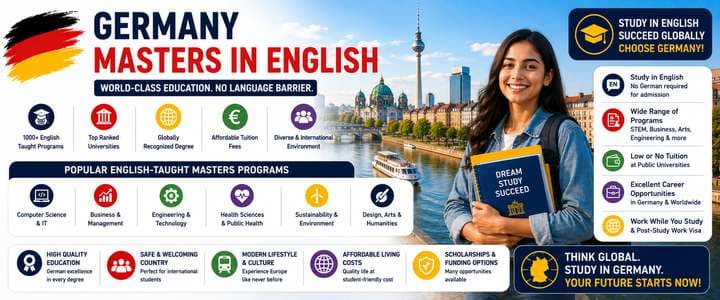
Germany offers a wide range of English-taught Master’s programmes in computer science, engineering, artificial intelligence, data science, business, economics, biotechnology, environmental science and other fields. Many of these programmes are available at public universities with no general tuition fee, although semester contributions and important tuition exceptions still apply.
Students do not normally need German-language proof for a programme taught entirely in English. They must instead satisfy the programme’s English-language requirement. German remains highly valuable for accommodation, part-time work, internships and graduate employment.
Admission is based on the individual programme rather than a single national standard. The applicant’s Bachelor’s subjects, academic credits, grades and language evidence are often more important than the general reputation of the previous university.
Masters in English in Germany: Quick Overview
| Factor | General Position |
|---|---|
| Programme language | English or predominantly English |
| Typical duration | Three or four semesters |
| Main degree types | MSc, MA, MEng, MBA and LLM |
| Public university tuition | Often no general tuition, with important exceptions |
| Semester contribution | Commonly around €150–€400 |
| Non-EU tuition in Baden-Württemberg | Generally €1,500 per semester |
| TUM non-EU Master’s tuition | Commonly €4,000 or €6,000 per semester, depending on programme |
| Private university tuition | Frequently €10,000–€40,000 or more |
| English requirement | Commonly IELTS, TOEFL, Cambridge or another accepted proof |
| Typical IELTS range | Approximately 6.0–7.0 |
| German requirement | Usually not required for fully English-taught study |
| Main intake | Winter semester |
| Secondary intake | Summer semester for selected programmes |
| Monthly living cost | Approximately €900–€1,200 in many locations |
| Current financial proof | €11,904 with a monthly withdrawal of €992 |
| Post-study job search | Up to 18 months after completing a German degree |
These are general planning figures. Every applicant must follow the exact rules of the selected programme.
Are Master’s Degrees in Germany Available Completely in English?
Yes. German universities offer programmes that can be completed entirely in English.
However, applicants should distinguish between:
Fully English-Taught Programme
Lectures, examinations and the thesis can be completed in English.
Predominantly English Programme
Most compulsory modules are in English, but selected electives may be offered only in German.
Bilingual Programme
The degree includes both English and German modules. A German certificate may be required.
English Track Within a Programme
The university offers separate English and German tracks. Students must select the correct track during application.
Reading only the programme title is insufficient. The official module handbook and examination regulations should confirm the actual teaching language.
Types of English-Taught Master’s Degrees
Consecutive Master’s
A consecutive Master’s builds directly on a related Bachelor’s degree.
Examples include:
Bachelor’s in Computer Science to MSc Computer Science
Bachelor’s in Mechanical Engineering to MSc Automotive Engineering
Bachelor’s in Economics to MSc Economics
These programmes frequently examine subject-specific academic credits.
Non-Consecutive Master’s
A non-consecutive programme may permit applicants from several academic backgrounds and can focus on interdisciplinary or professional education.
Continuing-Education Master’s
These programmes normally require professional experience and often charge tuition.
Examples include:
MBA
Executive MBA
Professional management programme
Specialized continuing-education Master’s
Research-Oriented Master’s
Research-oriented programmes prepare students for:
Doctoral study
Academic research
Research and development
Scientific careers
Applied Master’s
Universities of applied sciences emphasize:
Practical projects
Industry cooperation
Applied research
Internship experience
Career-oriented learning
Universities Offering Master’s Programmes in English
The following institutions offer selected English-taught Master’s programmes. This does not mean every programme at the university is taught in English.
| University | Common English-Taught Areas |
|---|---|
| Technical University of Munich | Informatics, engineering, data, sustainability and selected management fields |
| RWTH Aachen University | Engineering, computer science, simulation, materials and applied sciences |
| Karlsruhe Institute of Technology | Engineering, computing, energy and natural sciences |
| Technical University of Berlin | Computer science, engineering, energy, urban studies and management |
| Technical University of Darmstadt | Computer science, artificial intelligence, engineering and information systems |
| Dresden University of Technology | Engineering, electronics, physics, biotechnology and computational fields |
| University of Stuttgart | Computer science, computational linguistics, engineering and information technology |
| Saarland University | Computer science, cybersecurity, data science, artificial intelligence and language technology |
| Friedrich-Alexander University Erlangen-Nuremberg | Engineering, computing, medical technology and data-related subjects |
| University of Bonn | Computer science, economics, mathematics, agriculture and life sciences |
| Heidelberg University | Molecular sciences, data-related fields, physics and biosciences |
| University of Freiburg | Computer science, neuroscience, environmental science and engineering |
| University of Göttingen | Neuroscience, economics, agriculture, mathematics and natural sciences |
| University of Hamburg | Computer science, economics, earth sciences and international studies |
| University of Mannheim | Management, economics, data science and social sciences |
| University of Hohenheim | Economics, bioeconomy, agriculture and environmental sciences |
| University of Passau | Computer science, artificial intelligence, business and governance |
| University of Bremen | Digital media, marine sciences, engineering and social sciences |
| RPTU Kaiserslautern-Landau | Computer science, mathematics, engineering and embedded systems |
| Leipzig University | Physics, data-oriented fields, economics and life sciences |
| Ruhr University Bochum | Engineering, computational science, economics and social sciences |
| University of Duisburg-Essen | Engineering, computer science, business and energy |
| University of Potsdam | Data science, cognitive science, public policy and biosciences |
| Otto von Guericke University Magdeburg | Engineering, data, computer science and medical systems |
| Chemnitz University of Technology | Engineering, automotive, computing and manufacturing |
| Brandenburg University of Technology | Energy, environmental engineering, architecture and technology |
Programme names, admission conditions and teaching languages can change. Students should verify the official programme page and module catalogue.
Technical University of Munich
TUM offers English-taught and bilingual programmes across:
Informatics
Data-related disciplines
Engineering
Environmental science
Biotechnology
Sustainability
Management
International applicants from outside the European Economic Area may be required to pay programme-specific tuition. Master’s tuition is commonly €4,000 or €6,000 per semester, in addition to the semester fee.
Some students may qualify for exemptions, need-based waivers or merit-based tuition waivers. Availability is limited and should not be assumed before an award is confirmed.
RWTH Aachen University
RWTH Aachen is particularly relevant for students interested in:
Mechanical engineering
Automotive engineering
Electrical engineering
Materials science
Computer science
Production
Simulation
Energy
Some English-taught programmes are standard public-university degrees, while selected international or academy-administered programmes can charge substantial tuition.
Applicants must check the individual programme rather than assuming all RWTH Master’s degrees are tuition-free.
Saarland University
Saarland University has a strong international academic environment in:
Computer science
Artificial intelligence
Data science
Cybersecurity
Computational linguistics
Language technology
The surrounding research ecosystem makes Saarbrücken attractive for students interested in technology and academic research.
Admission can be highly selective, and applicants normally need strong theoretical foundations.
University of Stuttgart
The University of Stuttgart offers selected English programmes in areas such as:
Computational linguistics
Computer science
Engineering
Information technology
Simulation
Infrastructure
Technology management
Non-EU students in Baden-Württemberg are generally subject to state tuition of €1,500 per semester unless an exemption applies.
University of Hohenheim
The University of Hohenheim is particularly relevant for English-taught study in:
Economics
Agricultural economics
Bioeconomy
Food science
Environmental science
International business-related fields
As a university in Baden-Württemberg, non-EU tuition rules may apply.
Best English-Taught Master’s Courses
Computer Science
Relevant specializations include:
Software engineering
Distributed systems
Cloud computing
Algorithms
Human-computer interaction
Information systems
Cybersecurity
Embedded systems
Computer science programmes can be selective about credits in:
Programming
Algorithms
Data structures
Mathematics
Theoretical computer science
Computer architecture
Artificial Intelligence
AI programmes may include:
Machine learning
Deep learning
Robotics
Natural-language processing
Computer vision
Intelligent systems
Responsible artificial intelligence
Applicants commonly need strong mathematics, probability, statistics and programming.
Data Science
Data science programmes may require previous credits in:
Linear algebra
Calculus
Probability
Statistics
Programming
Databases
Algorithms
A general business degree with only one analytics module may not satisfy a technical data-science programme.
Mechanical Engineering
English-taught options may focus on:
Automotive systems
Production engineering
Computational engineering
Robotics
Mechatronics
Simulation
Materials
Energy systems
Electrical Engineering
Popular specializations include:
Communications
Microelectronics
Embedded systems
Power systems
Automation
Signal processing
Semiconductor technology
Control engineering
Renewable Energy
Relevant programmes may cover:
Energy engineering
Solar systems
Wind energy
Energy storage
Grid technology
Hydrogen systems
Environmental management
Sustainable engineering
Business and Management
English-taught business programmes include:
International management
Finance
Economics
Business analytics
Supply-chain management
Entrepreneurship
Innovation
MBA programmes
Business applicants may need:
Economics or business credits
Statistics
Mathematics
Professional experience
GMAT or GRE
Interview
Motivation letter
Biotechnology and Life Sciences
Relevant fields include:
Molecular biology
Biotechnology
Biochemistry
Neuroscience
Bioinformatics
Pharmaceutical science
Molecular medicine
Laboratory experience and detailed subject prerequisites can be important.
Environmental Sciences
Programmes may focus on:
Climate science
Environmental engineering
Natural-resource management
Sustainability
Water management
Earth systems
Environmental policy
Social Sciences and Public Policy
English-taught programmes are available in:
International relations
Public policy
Development studies
Governance
Political science
Sociology
Peace and conflict studies
German is particularly useful for internships involving local government, policy and social organizations.
Admission Requirements
There is no single admission standard for all German universities.
Common requirements include:
Recognized Bachelor’s degree
Relevant academic background
Required subject credits
Minimum academic grade
English-language proof
Curriculum vitae
Motivation letter
Academic transcripts
Degree certificate
Recommendation letters
Internship or work experience
GRE or GMAT for selected programmes
Portfolio for design-related courses
APS certificate for applicable Indian applicants
Bachelor’s Degree Requirement
The applicant’s first degree must normally be equivalent to a German Bachelor’s degree.
Universities may evaluate:
Institution recognition
Degree accreditation
Programme duration
Total academic workload
Subjects completed
Final grade
Thesis
Practical components
A recognized degree does not automatically guarantee subject eligibility.
Subject-Specific Credit Requirements
German Master’s admissions are often strict about academic credits.
A programme may require a defined number of credits in:
Mathematics
Statistics
Programming
Economics
Engineering fundamentals
Theoretical computer science
Research methods
Laboratory work
Business administration
Professional experience or online certificates may strengthen the application but may not replace missing university credits.
ECTS Requirements
Many Master’s programmes accept applicants with a Bachelor’s equivalent to 180 ECTS.
Some programmes require:
210 ECTS
A longer Bachelor’s degree
Additional academic modules
A qualifying semester
Relevant professional experience
An Indian credit cannot always be converted directly into one ECTS credit. The university or uni-assist evaluates the academic workload.
CGPA Requirements
Germany does not have one national CGPA requirement for English-taught Master’s programmes.
Universities may use:
A published minimum grade
A German-grade equivalent
An aptitude assessment
Ranking within the applicant pool
Subject-specific grade evaluation
Holistic selection
A German grade of approximately 2.5 or better is a common minimum for many programmes, but competitive programmes may expect around 2.0 or better.
Selective computer science, data, economics and engineering programmes may admit students with stronger academic profiles.
German Grade Scale
| German Grade | General Interpretation |
|---|---|
| 1.0–1.5 | Excellent |
| 1.6–2.0 | Very good |
| 2.1–2.5 | Good |
| 2.6–3.0 | Satisfactory |
| 3.1–4.0 | Passing |
| Above 4.0 | Failing |
Foreign grades should not be converted using a simple percentage table unless the university instructs applicants to use one.
English Language Requirements
English-taught Master’s programmes commonly accept one or more of the following:
IELTS Academic
TOEFL iBT
Cambridge English
PTE Academic
University-specific English certificate
Previous English-medium degree
Medium of Instruction certificate
Acceptance is programme-specific.
Typical English Score Ranges
| Test | Common Planning Range |
|---|---|
| IELTS Academic | 6.0–7.0 |
| TOEFL iBT | 80–100 |
| PTE Academic | 56–65 |
| Cambridge English | B2 or C1 qualification |
| CEFR | B2 or C1 |
These are only general ranges. Some competitive programmes require higher results or minimum component scores.
Can Students Apply Without IELTS?
Yes, if the programme accepts another form of evidence.
Possible alternatives include:
TOEFL
Cambridge English
PTE Academic
English-medium Bachelor’s degree
Medium of Instruction certificate
Internal assessment
Another listed certificate
An IELTS waiver from a university does not automatically guarantee that the same evidence will be accepted for a student visa.
Applicants from India should check current language-evidence requirements issued by the responsible German mission. PTE, Duolingo and the TOEFL Home Edition should not be assumed acceptable for the Indian student-visa process simply because a university accepts them.
Is German Required?
German is generally not required for admission to a fully English-taught programme unless the programme states otherwise.
However, German is highly valuable for:
Finding accommodation
University administration
Healthcare
Part-time jobs
Internships
Working-student positions
Graduate employment
Social integration
Permanent-residence preparation
A practical target is:
A1 or A2 before arrival
B1 during the degree
B2 for broader professional access
Application Routes
Direct University Application
The applicant uses the university’s own application portal.
uni-assist Standard Procedure
The applicant submits documents through My assist. uni-assist evaluates the international qualification and forwards an eligible application to the university.
VPD Procedure
The applicant requests preliminary review documentation from uni-assist and then submits the VPD directly to the university before its deadline.
Receiving the VPD does not constitute admission.
uni-assist Fees
The current handling fees are:
€75 for the first selected programme in one semester
€30 for each additional selected programme in the same semester
Some universities pay the fee for applicants.
A VPD normally requires approximately four to six weeks after a complete paid application has been submitted. Applicants should allow additional time to submit the VPD to the university.
Application Deadlines
Winter Semester
Applications commonly open in the first half of the calendar cycle. A frequent deadline is around mid-July, but many international and selective programmes close earlier.
Summer Semester
A common deadline is around mid-January. Programme availability is more limited.
Important Exceptions
Deadlines can differ for:
Non-EU applicants
EU applicants
German applicants
Scholarship applicants
VPD applicants
Aptitude-assessment programmes
Private universities
Programmes with entrance examinations
The official programme deadline is the only reliable deadline.
Documents Required
A typical application may require:
Passport copy
Bachelor’s degree certificate
Complete academic transcripts
Grading-system explanation
English-language certificate
Curriculum vitae
Motivation letter
Recommendation letters
Module descriptions
Internship certificates
Employment certificates
GRE or GMAT result
Portfolio
APS certificate
VPD
Preliminary graduation certificate
University-specific application form
Documents not issued in German or English generally require an authorized translation.
APS Requirement for Indian Students
Indian applicants usually need an APS certificate when applying with Indian academic credentials.
APS evaluates:
Academic documents
Institution details
Degree information
Educational eligibility
Document authenticity
APS does not provide:
University admission
English-language exemption
Student visa approval
Scholarship approval
Common APS exemptions can apply to:
Doctoral or postdoctoral applicants
Recipients of qualifying German or European public scholarships
Applicants pursuing certain non-German degrees
Applicants holding a non-Indian foreign qualification
Other officially exempt categories
Applicants should verify their individual APS requirement before applying.
Statement of Purpose
A strong motivation letter should explain:
Why the programme was selected
How the Bachelor’s degree provides preparation
Which modules match the applicant’s goals
Relevant projects and research
Career objectives
Why the university is appropriate
How the applicant will contribute
Why Germany supports the academic plan
Generic praise of Germany does not demonstrate programme fit.
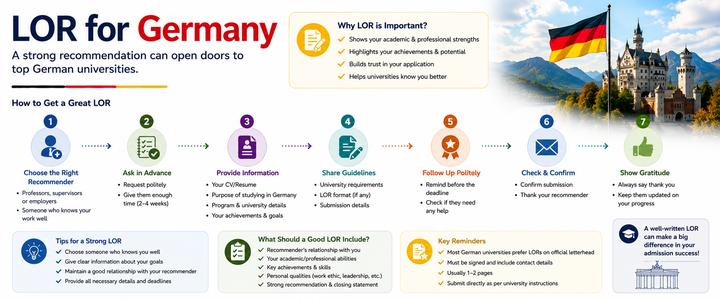
Letter of Recommendation
A useful recommendation should discuss:
Academic performance
Research ability
Technical skills
Initiative
Communication
Reliability
Suitability for graduate study
The recommender should know the applicant’s work well enough to provide specific evidence.
Public University Tuition Fees
Many public universities do not charge general tuition for standard consecutive Master’s programmes.
Students still pay a semester contribution that may support:
Student services
Student representation
Administration
Campus facilities
Public transport
Important Tuition Exceptions
Baden-Württemberg
Non-EU students generally pay €1,500 per semester at public universities in Baden-Württemberg unless an exemption applies.
Technical University of Munich
Non-EU students commonly pay €4,000 or €6,000 per semester for Master’s programmes, depending on the course.
Continuing-Education Programmes
MBA, executive and professional programmes frequently charge tuition.
Private Universities
Private tuition can range from approximately €10,000 to €40,000 or more for the complete programme.
Specialized International Programmes
Selected programmes at public universities may charge additional tuition.
Estimated Cost of Studying
| Expense | Estimated Amount |
|---|---|
| Semester contribution | €150–€400 per semester |
| Baden-Württemberg non-EU tuition | €1,500 per semester |
| TUM non-EU Master’s tuition | Commonly €4,000 or €6,000 per semester |
| Private or professional Master’s | €10,000–€40,000+ total |
| Monthly living costs | €900–€1,200 |
| Munich monthly living costs | Approximately €1,300–€2,000 |
| Health insurance | Approximately €130–€160 per month |
| uni-assist first application | €75 |
| Additional uni-assist application | €30 |
Student Visa Financial Proof
The current standard financial-proof amount is €11,904, corresponding to a monthly withdrawal of €992 from a blocked account.
Other possible financial evidence can include:
Qualifying scholarship
Formal declaration of commitment
Accepted financial guarantee
Education loan documentation
Other evidence accepted by the visa authority
Students attending a tuition-charging programme may need to prove that tuition can be paid separately from living expenses.
Scholarships
Possible funding sources include:
DAAD
DAAD administers multiple scholarships for postgraduate students, graduates and researchers.
Deutschlandstipendium
Selected students may receive €300 per month through participating universities.
Erasmus Mundus
Some joint Master’s programmes involving German universities offer comprehensive scholarships.
Political Foundations
Foundations may support academically strong and socially engaged students. German ability is often important.
University Scholarships
Universities may offer:
Merit awards
Completion grants
Emergency support
International student scholarships
Tuition waivers
Research assistantships
Scholarship requirements and availability vary.
Working While Studying
Third-country students can generally work:
Up to 140 full days
Up to 280 half days
Or up to 20 hours per week during the lecture period under the applicable calculation
A day of up to four working hours generally counts as a half day. More than four hours normally counts as a full day.
Recognized university assistant activities may receive different treatment.
Common Student Jobs
Research assistant
Teaching assistant
Software developer
Data analyst
Engineering assistant
Laboratory assistant
Tutor
Retail employee
Restaurant worker
Warehouse employee
Office assistant
The current statutory minimum wage is €13.90 gross per hour for covered employment.
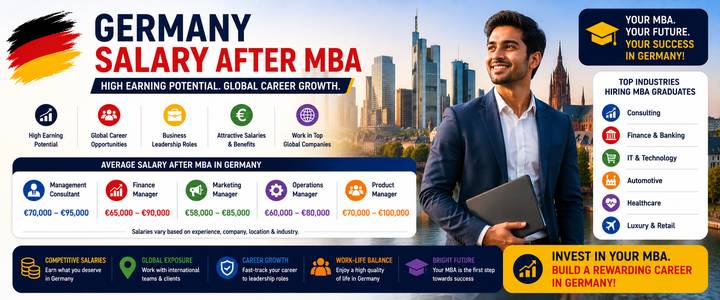
Jobs After an English-Taught Master’s
| Degree Area | Common Graduate Roles | Illustrative Gross Annual Salary |
|---|---|---|
| Computer science | Software engineer, cloud engineer, developer | €45,000–€65,000 |
| Data science | Data analyst, data engineer, ML engineer | €48,000–€68,000 |
| Artificial intelligence | ML engineer, AI specialist, research engineer | €48,000–€70,000 |
| Mechanical engineering | Design, production or project engineer | €45,000–€62,000 |
| Electrical engineering | Automation, electronics or power engineer | €46,000–€64,000 |
| Renewable energy | Energy analyst, project engineer | €44,000–€62,000 |
| Business analytics | Business analyst, BI analyst | €44,000–€60,000 |
| Finance and economics | Analyst, controller, consultant | €45,000–€65,000 |
| Biotechnology | Researcher, QA or process specialist | €42,000–€58,000 |
| Environmental science | Consultant, analyst, project specialist | €42,000–€58,000 |
Salary depends on experience, city, employer, language and specialization.
Post-Study Work Permit
Graduates of a German university may apply for a residence permit to search for qualified employment for up to 18 months.
During the job-search period, graduates can generally work in any occupation while seeking qualified employment.
After securing a suitable job, the graduate may change to:
Skilled-worker residence permit
EU Blue Card
Research residence permit
Self-employment permit
Another eligible residence title
An English-taught degree does not prevent graduates from using the post-study pathway.
How to Select the Right Programme
Applicants should compare:
Programme curriculum
Teaching language
Subject-credit requirements
Academic grade requirement
Tuition and semester contribution
City living costs
Research or industry orientation
Internship opportunities
Graduate job market
German-language support
Application route
Visa and APS requirements
Do not select a programme only because its title contains a popular term such as artificial intelligence or data science.
Common Application Mistakes
Applying without checking subject credits
Assuming all programmes at a university are in English
Using a generic motivation letter
Missing the separate VPD application
Requesting VPD too late
Uploading incomplete transcripts
Applying with an unaccepted English test
Assuming MOI is accepted everywhere
Ignoring non-EU tuition
Confusing semester contribution with tuition
Submitting unofficial grade conversions
Failing to provide module descriptions
Applying only to highly selective universities
Ignoring APS processing
Checking visa requirements only after admission
Assuming English alone is sufficient for graduate employment
Application Strategy
A balanced application list may include:
Two or three highly competitive programmes
Three or four programmes matching the applicant’s profile
Two or three safer programmes with broader admission criteria
No German university can be treated as a guaranteed admission option.
Students should maintain a spreadsheet containing:
University
Programme
Teaching language
Tuition
Deadline
Application route
VPD requirement
English score
Academic prerequisites
APS requirement
Application status
Frequently Asked Questions
Can I complete a Master’s in Germany entirely in English?
Yes. Many programmes can be completed entirely in English.
Is German required for an English-taught Master’s?
Usually not for admission, unless the programme includes German modules or states a separate German requirement.
Can I study at a public university in English?
Yes. Public universities offer many English-taught Master’s programmes.
Are English-taught Master’s degrees tuition-free?
Many public consecutive programmes have no general tuition, but Baden-Württemberg, TUM, private universities and specialized programmes are important exceptions.
How much is the semester contribution?
It commonly ranges from approximately €150 to €400 per semester.
What IELTS score is required?
Many programmes require approximately 6.0 to 7.0, but the exact score is programme-specific.
Can I apply without IELTS?
Yes, if the programme accepts TOEFL, Cambridge, PTE, MOI or another approved alternative.
Is MOI accepted?
Selected programmes accept a Medium of Instruction certificate. Acceptance is not universal.
Is PTE accepted?
Some universities accept PTE Academic. Applicants should also verify whether their visa authority accepts it.
Is Duolingo accepted?
Selected programmes may accept it, but university and visa acceptance can differ.
What CGPA is required?
There is no national minimum. Competitive programmes may expect a German equivalent of approximately 2.5 or better, with selective programmes requiring stronger grades.
Can a low-CGPA student get admission?
Possible options exist when the programme uses holistic evaluation, but strict minimum-grade requirements cannot normally be waived.
Is GRE compulsory?
No. GRE is required or recommended only by selected programmes.
Is GMAT required for business programmes?
Selected management, finance and MBA programmes require or recommend GMAT or GRE.
Is work experience required?
It is common for MBA and continuing-education programmes. Consecutive MSc and MA programmes may not require it.
Can students apply before finishing their Bachelor’s?
Some universities accept provisional transcripts and expected-graduation confirmation. Others require the completed degree by application or enrolment.
What is uni-assist?
uni-assist evaluates international academic documents for participating German universities.
What is VPD?
VPD is preliminary review documentation issued by uni-assist and submitted separately to the university.
Does VPD guarantee admission?
No. The university makes the final admission decision.
Do Indian students need APS?
Most applicants using Indian academic credentials require APS unless an official exemption applies.
Does APS guarantee admission?
No. APS verifies academic credentials and does not decide university admission.
How much money is required for the student visa?
The current standard amount is €11,904, subject to change.
Can students work during the Master’s?
Yes, within the employment conditions attached to the residence permit.
Can I get a job with an English-taught degree?
Yes. However, German proficiency substantially expands the employment market.
How long can graduates stay to find work?
Graduates may receive up to 18 months to search for qualified employment.
Can an English-taught Master’s lead to PR?
Yes. After graduation, the student must move to an eligible employment residence permit and satisfy the relevant permanent-residence conditions.
Final Thoughts
Germany offers high-quality English-taught Master’s programmes across technical, scientific, business and social-science disciplines. Many public programmes remain affordable, but applicants must check tuition exceptions, subject-credit requirements and application procedures carefully.
A strong application should include:
A recognized related Bachelor’s degree
Required academic credits
Competitive grades
Accepted English evidence
Complete academic documents
Programme-specific motivation
Timely VPD or uni-assist processing
APS where applicable
A realistic financial plan
Students should also begin learning German even when the programme is fully in English. B1 or B2 German can make a major difference in internships, part-time work, graduate employment and long-term settlement.