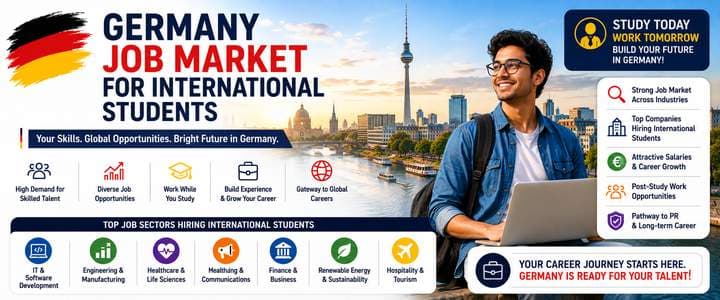
Germany has a large and diverse job market for international students, particularly in engineering, information technology, healthcare, scientific research, green energy, logistics and advanced manufacturing. However, employment is not guaranteed simply because a student graduates from a German university.
The current market is competitive. Hiring has slowed in parts of manufacturing, automotive and entry-level technology, while demand remains stronger for experienced or highly qualified candidates in specialized roles. International students with German-language ability, internships, relevant technical skills and German work experience generally have much better prospects.
The strongest strategy is to begin career preparation during the degree rather than waiting until graduation.
Germany Job Market: Quick Overview
| Factor | Current Position |
|---|---|
| Overall market | Large but more competitive than many promotional articles suggest |
| Strong-demand sectors | Healthcare, engineering, IT, green energy, science, skilled trades and logistics |
| Best prospects | Candidates with German skills, internships and specialized experience |
| English-only opportunities | Available mainly in technology, research, start-ups and multinational companies |
| German for office careers | B1 to B2 significantly improves access |
| German for regulated professions | B2 to C1 may be required |
| Student work limit | Up to 140 full days or 280 half days for many third-country students |
| Lecture-period alternative | Up to 20 hours per week under applicable rules |
| Post-study job search | German graduates may receive up to 18 months |
| EU Blue Card | Available when qualification, job and salary conditions are met |
| Entry-level challenge | Many employers prefer candidates with German work experience |
| Main hiring advantage | A German degree combined with local professional experience |
Is Germany a Good Job Market for International Students?
Germany can be an excellent employment destination for international students who choose a relevant course and build a job-ready profile.
The country offers opportunities through:
Large multinational companies
Small and medium-sized enterprises
Research institutes
Universities
Hospitals and healthcare providers
Technology companies
Engineering consultancies
Industrial manufacturers
Logistics companies
Financial institutions
Energy and environmental businesses
Start-ups
The job market is not equally accessible in every field. A software engineer with B1 German, internship experience and a strong portfolio may receive significantly more opportunities than a business graduate who speaks only English and has no work experience.
Current Reality of the German Job Market
Germany continues to need skilled professionals, but the market is experiencing two trends at the same time.
Long-Term Skills Shortages
Employers continue to need qualified workers in areas such as:
Healthcare
Nursing
Medicine
Engineering
Information technology
Scientific research
Energy
Construction
Transport
Education
Skilled trades
Short-Term Hiring Caution
Economic uncertainty has caused some employers to:
Delay recruitment
Reduce entry-level openings
Increase technical requirements
Prioritize experienced candidates
Extend interview processes
Limit English-only hiring
Restructure graduate programmes
Information technology illustrates this mixed situation. Digitalization, artificial intelligence, cloud infrastructure and cybersecurity continue to generate demand, but junior hiring has become more selective.
A shortage occupation does not mean every applicant will receive a job. Employers may still require specific technical skills, German proficiency and practical experience.
Best Job Sectors for International Students
| Sector | Relative Opportunity | German Requirement | Common Challenge |
|---|---|---|---|
| Software and IT | Strong for specialized candidates | English may work in international companies | Generic junior roles are competitive |
| Data and artificial intelligence | Good for technically strong applicants | English possible; German expands access | Employers often expect strong programming and statistics |
| Engineering | Strong in specialized areas | B1 or B2 frequently preferred | German documentation and workplace communication |
| Healthcare | Very strong | Usually B2 or higher | Qualification recognition and professional licensing |
| Scientific research | Good in selected disciplines | English commonly used in research | Temporary contracts and high qualification expectations |
| Renewable energy | Growing | German often preferred | Industry and regulatory knowledge |
| Logistics and supply chain | Good | B1 to B2 frequently needed | Operational communication is often German |
| Finance and accounting | Moderate to good | B2 or C1 often preferred | Local regulations and German reporting |
| Consulting | Competitive | B2 or C1 frequently required | Strong communication and case-interview performance |
| Marketing and communications | Highly competitive | B2 or C1 normally valuable | Local-language content and market knowledge |
| Architecture | Moderate | B2 frequently needed | Professional rules and technical German |
| Humanities and social sciences | Competitive | C1 can be important | Fewer English-only private-sector roles |
Information Technology Jobs
Germany offers IT opportunities in start-ups, industrial companies, banks, insurers, consultancies, public institutions and research organizations.
In-demand areas include:
Software engineering
Cloud engineering
Cybersecurity
Data engineering
Enterprise software
SAP consulting
DevOps
Embedded systems
Industrial automation
Artificial intelligence
Machine learning
IT architecture
Network engineering
Business intelligence
Product development
Best Skills for IT Jobs
Employers may look for:
Java
Python
JavaScript or TypeScript
C or C++
SQL
Cloud platforms
Containerization
CI/CD pipelines
SAP technologies
Cybersecurity tools
Data pipelines
Machine-learning deployment
System design
German data-protection knowledge
Current IT Market Reality
Candidates should not assume that every coding graduate will immediately find work.
General entry-level roles are competitive, especially in:
Basic front-end development
Manual testing
Junior data science
Generic business analysis
Entry-level product management
Students can improve their position through:
A technical portfolio
Open-source contributions
Working-student experience
An internship
Cloud certifications
German proficiency
Specialization in an industry such as automotive, finance or healthcare
Engineering Jobs
Engineering remains central to the German economy.
Major employment areas include:
Mechanical engineering
Electrical engineering
Mechatronics
Automation
Robotics
Civil engineering
Process engineering
Energy engineering
Environmental engineering
Semiconductor engineering
Automotive systems
Aerospace
Production engineering
Industrial engineering
Skills Employers Value
CAD and simulation
Programmable logic controllers
Industrial automation
Embedded systems
Manufacturing systems
Quality management
Project management
Technical documentation
Data analysis
Energy-system modelling
Regulatory compliance
German and European technical standards
German is particularly valuable because technical documentation, production-floor communication and safety instructions may be in German.
Automotive Job Market
Germany has a major automotive and mobility ecosystem, but the sector is undergoing structural change.
Traditional mechanical roles are increasingly connected to:
Electric vehicles
Battery technology
Power electronics
Embedded software
Autonomous systems
Advanced driver-assistance systems
Mobility platforms
Charging infrastructure
Sustainable manufacturing
Hiring can be selective because companies are restructuring around electrification, software and automation.
Students should avoid relying only on traditional combustion-engine knowledge. A combination of mechanical engineering, electronics, programming and data analysis can provide better long-term prospects.
Data Science and Artificial Intelligence Jobs
AI and data roles remain attractive, but they are not easy entry-level careers.
Employers commonly expect:
Python
SQL
Statistics
Machine learning
Data engineering
Cloud platforms
Model deployment
Software-engineering fundamentals
Data visualization
Business understanding
Responsible AI knowledge
Strong communication
A degree titled “Data Science” is not enough without projects or practical experience.
Candidates with only academic notebook projects may struggle against applicants who have:
Built production data pipelines
Deployed models
Worked with real business data
Completed a relevant internship
Demonstrated software-engineering practices
Explained measurable project outcomes
Healthcare Jobs
Germany has substantial demand for qualified healthcare professionals.
Relevant occupations include:
Physicians
Nurses
Midwives
Medical technologists
Physiotherapists
Pharmacists
Healthcare managers
Care professionals
Medical researchers
Many healthcare professions are regulated.
Applicants may need:
Recognition of foreign qualifications
Professional licence
German-language certificate
Medical-language examination
Health and background documents
Proof of professional competence
English-only employment is uncommon in patient-facing roles. B2 German is frequently required, while doctors may need additional professional or medical German.
Life Sciences, Biotechnology and Pharmaceuticals
Germany offers opportunities in:
Pharmaceutical production
Biotechnology
Medical devices
Clinical research
Quality assurance
Quality control
Regulatory affairs
Laboratory science
Bioinformatics
Chemical research
Process development
Validation
A Master’s degree can support entry into applied industry roles, but research-intensive positions may prefer or require a doctorate.
German can be important in:
Quality documentation
Manufacturing operations
Regulatory communication
Laboratory safety
Cross-functional teams
Scientific Research and University Careers
International students can find English-speaking positions at:
Universities
Research institutes
Graduate schools
Public laboratories
Corporate research centres
Common roles include:
Research assistant
Doctoral researcher
Laboratory researcher
Scientific programmer
Project coordinator
Research engineer
Academic data analyst
Research jobs can be internationally accessible, but applicants should consider:
Fixed-term contracts
Funding duration
Publication expectations
Doctoral admission
Teaching responsibilities
Grant dependence
Long-term career competition
Renewable Energy and Green Jobs
Germany’s energy transition supports demand in:
Wind power
Solar energy
Battery systems
Energy storage
Electrical grids
Hydrogen technologies
Energy consulting
Environmental engineering
Sustainable construction
Electric mobility
Carbon management
Circular economy
Relevant employers include utilities, manufacturers, consultancies, infrastructure companies and public-sector organizations.
German is often valuable because projects interact with local communities, public authorities, construction teams and national regulations.
Business and Management Jobs
Business students can find opportunities in:
Finance
Controlling
Procurement
Supply chain
Business development
Sales
Consulting
Human resources
Operations
Project management
Business analytics
Risk management
Business jobs are more language-dependent than many technical roles.
B2 German can be a major advantage because the position may require:
Client communication
Internal meetings
Contract review
Presentations
Local market analysis
Supplier negotiations
German reporting
An international MBA or management degree does not automatically overcome limited German and limited professional experience.
Finance and Accounting Jobs
Finance opportunities are concentrated in:
Frankfurt
Munich
Hamburg
Berlin
Düsseldorf
Cologne
Stuttgart
Relevant roles include:
Financial analyst
Risk analyst
Controller
Auditor
Compliance analyst
Corporate-finance associate
Treasury analyst
Tax assistant
Fintech analyst
German is especially important for accounting, tax, auditing and compliance roles involving local laws and clients.
English-only positions are more common in:
International banking
Fintech
Global corporate finance
Quantitative analysis
Risk technology
Multinational companies
Logistics and Supply-Chain Jobs
Germany’s central European location creates opportunities in:
Supply-chain planning
Procurement
Warehouse management
Transport planning
Customs operations
Demand forecasting
Inventory management
Logistics analytics
Port and airport operations
E-commerce fulfillment
German is frequently required for operational roles because employees communicate with drivers, warehouses, suppliers and local authorities.
Students with skills in SAP, data analysis, forecasting and process improvement can improve their prospects.
Marketing, Media and Communications
Marketing is one of the most competitive fields for international graduates.
Common roles include:
Digital marketing
Performance marketing
Content marketing
Search optimization
Social-media management
Market research
Brand management
Communications
Customer acquisition
E-commerce
German is often essential because the employee must understand:
Local consumers
Cultural references
German-language content
Advertising regulations
Customer communication
English-only marketing roles exist, but they attract large international applicant pools.
Best German Cities for International Careers
| City or Region | Major Employment Areas | Main Limitation |
|---|---|---|
| Berlin | Technology, start-ups, media, fintech, research | High competition and housing costs |
| Munich | IT, automotive, insurance, aerospace, consulting, biotechnology | Very high living costs |
| Frankfurt | Banking, finance, consulting, logistics, technology | High rent and competitive hiring |
| Hamburg | Logistics, aviation, media, renewable energy, trade | Expensive accommodation |
| Stuttgart | Automotive, manufacturing, engineering, IT | German often important |
| Cologne | Media, insurance, telecommunications, business services | Competitive housing market |
| Düsseldorf | Consulting, telecommunications, fashion, finance, trade | German helpful for many corporate roles |
| Dresden | Semiconductors, electronics, engineering, research | Smaller English-only market |
| Leipzig | Logistics, e-commerce, services and technology | Lower salaries than some western cities |
| Nuremberg and Erlangen | Engineering, automation, medical technology, IT | German commonly requested |
| Mannheim and Rhine-Neckar | Chemicals, pharmaceuticals, software, manufacturing | Regional mobility may be needed |
| Aachen | Engineering, research, automotive technology, start-ups | Graduate competition around the university ecosystem |
English-Only Jobs vs German-Speaking Jobs
| Employment Factor | English Only | German at B1 or B2 |
|---|---|---|
| Number of suitable vacancies | Limited | Substantially larger |
| Start-up access | Reasonable | Strong |
| Small and medium-sized companies | Limited | Much better |
| Customer-facing roles | Difficult | More accessible |
| Engineering production roles | Restricted | Better |
| Research positions | Good in selected fields | Broader |
| Healthcare | Very limited | Potentially accessible with required professional level |
| Career progression | Can be slower | Generally improved |
| Geographic flexibility | Concentrated in major cities | Nationwide opportunities |
| Interview competition | High | Lower for many local-language roles |
German does not guarantee employment, but it removes one of the largest filters applied to international applicants.
How Much German Is Needed?
A1 to A2
Useful for daily life but normally insufficient for professional office communication.
B1
Can support:
Basic workplace communication
Technical-team interaction
Selected working-student roles
Smaller-company applications
Everyday administrative tasks
B2
Often the most practical target for professional employment. It can support meetings, presentations, emails and client interaction.
C1
Frequently valuable for:
Consulting
Law
Policy
Communications
Human resources
Teaching
Healthcare
Senior client-facing positions
Technical students should not postpone German until after graduation.
Graduate Salary Estimates
| Field | Illustrative Entry-Level Gross Annual Salary |
|---|---|
| Software engineering | €45,000–€65,000 |
| Data and artificial intelligence | €48,000–€68,000 |
| Cybersecurity | €48,000–€68,000 |
| Mechanical engineering | €45,000–€62,000 |
| Electrical engineering | €46,000–€64,000 |
| Automotive engineering | €48,000–€65,000 |
| Civil engineering | €42,000–€58,000 |
| Renewable energy | €44,000–€62,000 |
| Business analytics | €44,000–€60,000 |
| Supply chain and logistics | €42,000–€58,000 |
| Finance and controlling | €45,000–€65,000 |
| Marketing | €38,000–€52,000 |
| Life sciences | €42,000–€58,000 |
| Scientific research | €45,000–€60,000 |
| Consulting | €45,000–€65,000 |
These are broad planning ranges, not guaranteed salaries. Compensation varies by location, company, collective agreement, degree level, experience and technical specialization.
Gross Salary vs Net Salary
German job advertisements and contracts normally state gross salary.
Deductions can include:
Income tax
Pension insurance
Health insurance
Unemployment insurance
Long-term care insurance
Church tax, where applicable
Net income depends on:
Gross salary
Tax class
Marital status
Health insurer
Children
Federal state
Church-tax status
Additional benefits
Students should compare net salary with the cost of living rather than evaluating gross salary alone.
A higher salary in Munich may provide less disposable income than a moderate salary in Leipzig, Dresden or Magdeburg.
Part-Time Jobs While Studying
International students commonly work in:
University research
Retail
Restaurants
Cafés
Warehouses
Delivery services
Customer support
Tutoring
Software development
Data analysis
Engineering support
Office administration
Student Work Limits
Third-country students can generally work:
Up to 140 full days
Up to 280 half days
Or up to 20 hours per week during the lecture period under the applicable alternative calculation
A working day of up to four hours generally counts as a half day. More than four hours normally counts as a full day.
Recognized university student-assistant work may receive different treatment. Compulsory internships are generally treated differently from voluntary internships.
Student Job Salary Estimates
| Student Job | Illustrative Gross Hourly Pay |
|---|---|
| Retail or café work | €13.90–€17 |
| Warehouse work | €14–€19 |
| Delivery work | €13.90–€18 |
| University assistant | €13.90–€20 |
| Office assistant | €14–€20 |
| Engineering Werkstudent | €15–€24 |
| IT Werkstudent | €16–€27 |
| Private tutoring | €15–€25 |
The current statutory minimum wage is €13.90 gross per hour for covered employment.
Why Werkstudent Experience Is Valuable
A Werkstudent position is one of the most effective ways to enter the German graduate job market.
It can provide:
German work experience
Industry references
Practical technical skills
Professional German practice
Knowledge of company processes
Internal job opportunities
A possible full-time offer
Better understanding of workplace culture
A relevant Werkstudent role is usually more valuable for graduate employment than an unrelated casual job, even when the hourly wage is similar.
Internships and Graduate Employment
Internships can help students:
Test a career field
Gain experience with German employers
Build professional contacts
Improve technical skills
Develop interview examples
Receive a thesis opportunity
Convert into a working-student or graduate role
Students should understand the difference between:
Compulsory internship
Voluntary internship
Paid internship
Thesis placement
Working-student employment
Trainee programme
A compulsory internship required by the curriculum is normally treated differently from an optional internship under immigration and minimum-wage rules.
Post-Study Work Opportunities
A third-country student who completes a German university degree can apply for a residence permit to search for qualified employment.
This permit may be granted for up to 18 months.
During the job-search period, graduates can generally work in any occupation while looking for a qualified position.
Once suitable employment is secured, the graduate may change to:
Skilled-worker residence permit
EU Blue Card
Research residence permit
Self-employment permit
Another eligible residence status
The graduate should apply for the new permit before the current residence title expires.
EU Blue Card and Graduate Jobs
Graduates may qualify for an EU Blue Card when:
They hold an eligible recognized qualification.
The job appropriately corresponds to the qualification.
The employment contract meets the required duration.
The gross salary reaches the applicable threshold.
Required professional permission is available.
Other immigration conditions are satisfied.
The salary threshold is adjusted regularly. A lower threshold may apply to shortage occupations and recent graduates.
Not qualifying for the EU Blue Card does not necessarily prevent employment. A standard skilled-worker permit may still be available.
Qualification Recognition
Most non-regulated private-sector professions do not require professional recognition in the same way as regulated professions.
Regulated professions can include areas such as:
Medicine
Nursing
Pharmacy
Teaching in public schools
Legal professions
Selected professional titles
Applicants may need:
Qualification recognition
Professional licence
German-language evidence
Practical adaptation period
Knowledge examination
Health and background checks
Students completing the relevant degree in Germany may have a more direct path, but professional authorization can still be required.
How German Employers Evaluate International Graduates
Employers commonly examine:
Relevance of the degree
Technical skills
Internship experience
Working-student experience
German proficiency
Communication ability
Project quality
Teamwork
Visa and work status
Salary expectations
Willingness to relocate
Understanding of the company
Availability date
A strong university ranking cannot compensate for a profile lacking practical skills.
German-Style CV Requirements
A German CV is usually concise and structured.
It should include:
Full name
Contact information
Professional summary
Education
Employment history
Internships
Working-student roles
Projects
Technical skills
Language levels
Certifications
Relevant achievements
Students should:
Use reverse chronological order.
Match keywords from the job description.
Quantify achievements.
Explain relevant academic projects.
State German proficiency honestly.
Remove unrelated personal information.
Avoid long paragraphs.
Keep formatting readable.
A photograph is optional and should not be treated as compulsory.
Cover Letter Strategy
A useful cover letter explains:
Why the applicant selected the role
Why the company is relevant
How previous experience matches the position
What results the applicant can contribute
When the applicant can start
What residence or work status applies
Generic letters sent to every employer are less effective.
Job Application Documents
Employers may request:
CV
Cover letter
University transcript
Degree certificate
Enrolment certificate
Internship certificates
Work references
Language certificates
Portfolio
Project repository
Residence-permit information
Professional recognition
Salary expectation
Earliest starting date
Students should use clear file names and submit documents in the requested language.
Where to Find Jobs
Students can search through:
Federal Employment Agency
Make it in Germany
EURES
University career portals
Company career pages
Research institute websites
LinkedIn
Xing
StepStone
Indeed
Job fairs
Alumni networks
Professors and research groups
Local chambers of commerce
Professional associations
No single portal contains every opportunity. Many small and medium-sized companies advertise only on their own websites or in German.
Job Search Timeline
During the First Part of the Degree
Begin learning German.
Join university clubs.
Attend employer presentations.
Create a professional CV.
Develop technical projects.
During the Middle of the Degree
Apply for internships.
Search for a relevant Werkstudent job.
Build relationships with professors.
Attend career fairs.
Improve interview skills.
Before Graduation
Begin applying for graduate roles.
Confirm post-study residence options.
Collect reference letters.
Update the portfolio.
Prepare for salary discussions.
Apply beyond one city.
After Graduation
Apply for the correct job-search residence permit.
Maintain health insurance.
Register with relevant employment services.
Continue German learning.
Track every application.
Accept suitable temporary employment when necessary.
Keep searching for qualified work.
How Many Job Applications Are Needed?
There is no universal number.
A specialized candidate with strong German and a referral may succeed quickly. An English-only generalist may require a much broader search.
Application quality matters more than sending hundreds of identical CVs.
Students should track:
Company
Position
Application date
Contact person
Required language
Job location
Response
Interview stage
Follow-up date
Rejection reason
Patterns can reveal whether the main problem is the CV, language level, technical profile or interview performance.
Best Ways to Improve Job Prospects
Reach B1 or B2 German
Language ability provides access to a far larger employer pool.
Gain German Work Experience
An internship, research role or Werkstudent position demonstrates that the candidate can work within a German organization.
Build Specialized Skills
Specialization is more valuable than listing many beginner-level tools.
Examples include:
Cloud security
Embedded automotive software
Energy-system simulation
Semiconductor design
SAP supply-chain systems
Clinical data management
Regulatory affairs
Industrial automation
Apply to Small and Medium-Sized Companies
Germany’s economy includes many successful companies outside major cities. These employers may receive fewer international applications but frequently expect German.
Be Geographically Flexible
Limiting the search to Berlin or Munich can increase competition and living costs.
Use Referrals and Networking
Professional relationships can help candidates understand unadvertised opportunities and hiring expectations.
Prepare for Technical Interviews
Students should practice:
Coding problems
Case studies
Technical presentations
Engineering questions
Portfolio explanations
Behavioural interviews
German self-introduction
Common Reasons International Graduates Struggle
Beginning the job search only after graduation
Speaking no German
Applying only to English-language jobs
Having no internship or Werkstudent experience
Using one CV for every role
Selecting an oversaturated specialization
Applying only in large cities
Weak understanding of visa options
Poor interview preparation
Unrealistic salary expectations
Failing to explain foreign experience
Missing German-style references
Relying only on online applications
Applying to jobs that do not match the degree
Assuming a shortage occupation guarantees employment
Employment Scams and Warning Signs
Students should be cautious when an employer or agent:
Guarantees a job for payment
Requests money for an interview
Uses an unverifiable email account
Refuses to provide a written contract
Offers salary only in cash
Asks the employee to work without registration
Provides vague job responsibilities
Requests passport originals
Promises a guaranteed EU Blue Card
Misrepresents an unqualified job as skilled employment
Charges illegal placement fees
Pressures the student to sign immediately
A legitimate employer should provide clear company information, employment terms and salary details.
Frequently Asked Questions
Is Germany’s job market good for international students?
It can be good for students with in-demand skills, practical experience and German proficiency. The market is competitive for English-only entry-level applicants.
Which field has the best job opportunities?
Healthcare, specialized IT, engineering, scientific research, renewable energy and technical skilled professions generally offer strong possibilities.
Is it easy to get an IT job?
Not automatically. Specialized and experienced IT professionals remain valuable, while generic junior roles can receive many applications.
Can I get a job with only English?
Yes, especially in technology, research, start-ups and multinational companies. English-only applicants face a smaller and more competitive vacancy pool.
What German level is best for jobs?
B1 can improve technical and internal opportunities. B2 is a stronger professional target. Healthcare, consulting, communication and regulated roles may require B2 or C1.
Is a German degree enough to get a job?
No. Employers also assess work experience, technical skills, language, projects and interview performance.
Which cities offer the most English-speaking jobs?
Berlin, Munich, Frankfurt, Hamburg and selected international technology and research centres offer more English-language positions.
Which cities are best for engineering?
Stuttgart, Munich, Dresden, Aachen, Erlangen, Nuremberg and major manufacturing regions provide substantial engineering ecosystems.
Which city is best for finance?
Frankfurt is Germany’s largest finance centre, with additional opportunities in Munich, Hamburg, Düsseldorf and Berlin.
Can students work while studying?
Yes. Many third-country students can work up to 140 full days or 280 half days, or use the applicable 20-hour weekly calculation.
What is a Werkstudent job?
It is a student employment arrangement commonly used by companies for part-time, degree-related work.
Does a Werkstudent job guarantee full-time employment?
No, but it can significantly improve the chance of receiving a graduate offer.
How much can a student earn?
Many student jobs pay between the statutory minimum wage and approximately €25 per hour, depending on skills and sector.
Can international students work remotely?
Potentially, but residence, tax, social-insurance and employment rules still apply.
How long can graduates remain for a job search?
Graduates of German universities may receive a job-search residence permit for up to 18 months.
Can graduates work during the job-search period?
Yes. They can generally work in any occupation while searching for qualified employment.
Does the graduate job need to match the degree?
For a standard skilled-worker permit, the position must be qualified but does not always need an exact subject match. EU Blue Card rules require an appropriate relationship with the qualification.
What if the salary is below the EU Blue Card threshold?
The graduate may still qualify for a standard skilled-worker residence permit.
Are humanities graduates able to find jobs?
Yes, but the market is more language-dependent and competitive. C1 German, internships and specialization can be important.
Is an MBA enough for a German job?
An MBA alone does not guarantee employment. Previous experience, German proficiency, specialization and local networking strongly influence outcomes.
Are Indian students successful in the German job market?
Many Indian graduates work successfully in IT, engineering, research, consulting and business. Individual results depend on skills, language, experience and application strategy.
Does university ranking matter to employers?
It can influence initial recognition, but practical experience and relevant skills frequently matter more.
Should students learn German even for an English-taught course?
Yes. German can improve part-time work, internships, graduate employment, workplace integration and permanent-residence prospects.
When should students begin applying?
Graduate applications should generally begin several months before completing the degree. Internships and Werkstudent applications should start much earlier.
Can a part-time job pay all living costs?
It may cover a substantial portion, but students should not depend on employment that has not been secured. Work limits and academic responsibilities also apply.
Is permanent residency possible after employment?
Yes. German university graduates may qualify through a skilled-worker permit or EU Blue Card after satisfying the applicable employment, pension, language and livelihood conditions.
Final Thoughts
The Germany job market for international students offers genuine opportunities, but success depends on preparation.
The strongest candidates usually have:
A relevant German degree
B1 or B2 German
Internship or Werkstudent experience
Specialized technical skills
A targeted CV
Geographic flexibility
Realistic salary expectations
Knowledge of post-study residence options
A professional network
International students should not build their plans around the assumption that Germany’s skills shortage makes employment automatic. Shortages are concentrated in specific occupations and employers still select candidates carefully.
Students who begin learning German, gain local experience and build an industry-relevant specialization during their studies have the best chance of moving successfully from university into the German labour market.