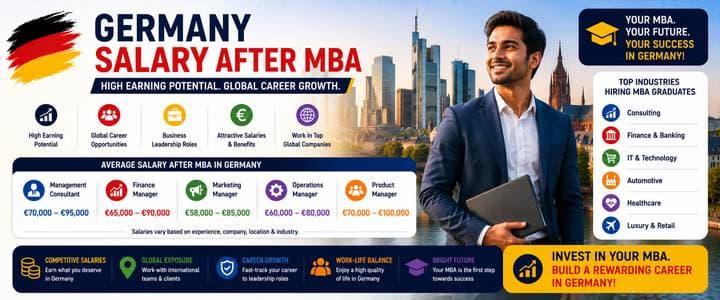
The average salary after an MBA in Germany commonly ranges from approximately €50,000 to €80,000 gross per year. Graduates entering consulting, technology, finance, product management or corporate strategy may earn more, while candidates with limited work experience, no German proficiency or a career change into a new field may start below this range.
An MBA does not create a standard salary. Employers usually pay for the candidate’s previous experience, functional expertise, industry knowledge, language ability and suitability for the position rather than the degree title alone.
Experienced MBA graduates entering senior consulting, strategy, technology management or finance roles may earn €80,000 to €120,000 or more. However, these salaries should not be presented as typical outcomes for every international graduate.
Germany Salary After MBA: Quick Overview
| Candidate Profile | Illustrative Gross Annual Salary |
|---|---|
| MBA graduate with limited experience | €45,000–€60,000 |
| MBA graduate with 3–5 years of experience | €55,000–€75,000 |
| MBA graduate with 6–10 years of experience | €70,000–€100,000 |
| Senior manager or specialist | €90,000–€130,000+ |
| Consulting and strategy roles | €55,000–€95,000+ |
| Product and technology management | €55,000–€90,000+ |
| Finance and investment roles | €50,000–€110,000+ |
| Operations and supply chain | €48,000–€75,000 |
| Marketing and business development | €45,000–€75,000 |
| Human resources | €43,000–€65,000 |
The ranges represent broad market estimates. Salary varies by role, city, employer, experience, bonus structure and German-language ability.
What Is the Average MBA Salary in Germany?
There is no official nationwide salary category covering only MBA graduates. German employment statistics generally report earnings by occupation, qualification, industry and location rather than by MBA status.
The latest Federal Employment Agency reporting places the median gross monthly salary of full-time employees at approximately €4,217. Full-time employees with university-level qualifications have a substantially higher reported median of approximately €6,146 per month.
This does not mean every new MBA graduate will earn €6,146 per month. The graduate-level figure includes experienced professionals, specialists and senior employees across many occupations.
A realistic salary assessment must consider:
Pre-MBA work experience
Post-MBA job title
Industry
Employer size
German proficiency
City or region
Technical and analytical skills
Leadership experience
Fixed and variable compensation
Quality of the business school’s employer network
MBA Salary by Work Experience
MBA with Less Than Two Years of Experience
Candidates with limited professional experience may be evaluated similarly to Master’s in Management or general business graduates.
Expected salary:
€45,000 to €60,000 gross per year
Common roles include:
Junior business analyst
Graduate consultant
Management trainee
Marketing specialist
Operations analyst
Financial analyst
Project coordinator
Junior product analyst
An MBA without meaningful professional experience may not immediately qualify the candidate for a management position.
MBA with Three to Five Years of Experience
This is a common profile for full-time MBA candidates.
Expected salary:
€55,000 to €75,000 gross per year
Possible roles include:
Consultant
Product manager
Project manager
Business development manager
Supply-chain manager
Corporate-finance analyst
Operations manager
Strategy analyst
Candidates with German work experience or B2 German may access a broader employer market.
MBA with Six to Ten Years of Experience
Experienced candidates can target management, specialist and senior consulting roles.
Expected salary:
€70,000 to €100,000 gross per year
Possible positions include:
Senior consultant
Senior product manager
Programme manager
Corporate strategy manager
Senior controller
Operations lead
Regional business-development manager
Transformation manager
MBA with More Than Ten Years of Experience
Senior professionals may target executive, director or specialized leadership roles.
Expected salary:
€90,000 to €130,000 or more
Potential positions include:
Director
Head of operations
Head of strategy
Senior programme manager
Finance director
Commercial director
Management consultant
General manager
The MBA does not guarantee promotion into these positions. Relevant leadership history remains essential.
Salary After MBA by Job Role
| Job Role | Illustrative Gross Annual Salary |
|---|---|
| Business analyst | €45,000–€62,000 |
| Management consultant | €52,000–€78,000 |
| Senior consultant | €68,000–€95,000 |
| Strategy analyst | €50,000–€70,000 |
| Strategy manager | €65,000–€100,000 |
| Product manager | €55,000–€82,000 |
| Senior product manager | €70,000–€100,000 |
| Project manager | €50,000–€76,000 |
| Programme manager | €65,000–€95,000 |
| Financial analyst | €48,000–€68,000 |
| Corporate controller | €48,000–€72,000 |
| Risk analyst | €48,000–€70,000 |
| Investment-banking associate | €70,000–€110,000+ |
| Supply-chain manager | €50,000–€75,000 |
| Operations manager | €48,000–€75,000 |
| Procurement manager | €50,000–€76,000 |
| Marketing manager | €45,000–€68,000 |
| Business-development manager | €48,000–€78,000 |
| Sales manager | €50,000–€85,000+ |
| Human-resources manager | €48,000–€70,000 |
| Technology consultant | €55,000–€85,000 |
| Digital-transformation manager | €60,000–€95,000 |
Sales, consulting, finance and leadership roles may include substantial variable compensation.
Salary After MBA by Industry
Consulting
Consulting is one of the most popular post-MBA industries.
Typical salary:
€55,000 to €95,000 gross per year
High-end strategy firms may offer greater total compensation, particularly to candidates with strong professional experience and excellent case-interview performance.
Relevant roles include:
Management consultant
Strategy consultant
Digital-transformation consultant
Operations consultant
Technology consultant
Sustainability consultant
German is frequently important because consultants work directly with German-speaking clients.
Technology
Typical salary:
€55,000 to €90,000 gross per year
Relevant positions include:
Product manager
Technology consultant
Digital-transformation manager
Business-operations manager
Programme manager
Technology strategy analyst
Candidates combining business knowledge with software, cloud, data or cybersecurity experience can command stronger salaries.
Banking and Financial Services
Typical salary:
€50,000 to €100,000 or more
Relevant positions include:
Financial analyst
Risk manager
Corporate-finance associate
Investment-banking associate
Treasury analyst
Compliance manager
Fintech product manager
Investment banking, private equity and selected corporate-finance positions can exceed general MBA salary ranges, but they are highly competitive and bonus-dependent.
Automotive and Manufacturing
Typical salary:
€55,000 to €85,000 gross per year
Common roles include:
Product manager
Supply-chain manager
Operations manager
Procurement manager
Transformation manager
Corporate strategy manager
Candidates with engineering or manufacturing experience are often more competitive than general management applicants.
Pharmaceuticals and Healthcare
Typical salary:
€52,000 to €85,000 gross per year
Relevant positions include:
Healthcare consultant
Commercial manager
Market-access analyst
Product manager
Operations manager
Business-development manager
Industry knowledge, regulation and scientific understanding can improve salary prospects.
Logistics and Supply Chain
Typical salary:
€48,000 to €75,000 gross per year
Possible jobs include:
Supply-chain manager
Logistics manager
Procurement manager
Demand-planning manager
Operations manager
Process-improvement manager
German proficiency is often requested because the work involves local suppliers, warehouses, production teams and transport providers.
Energy and Sustainability
Typical salary:
€50,000 to €82,000 gross per year
Relevant positions include:
Sustainability manager
Energy consultant
ESG analyst
Project manager
Commercial manager
Renewable-energy business developer
Candidates with technical energy knowledge can have an advantage over general management graduates.
Consumer Goods and Retail
Typical salary:
€45,000 to €72,000 gross per year
Common roles include:
Brand manager
Category manager
E-commerce manager
Commercial analyst
Retail operations manager
Supply-chain manager
German is often important for customer, supplier and market-facing responsibilities.
Highest-Paying MBA Careers
| Career Area | Salary Potential | Entry Difficulty |
|---|---|---|
| Strategy consulting | Very high | Very competitive |
| Investment banking | Very high | Very competitive |
| Private equity | Very high | Extremely competitive |
| Technology product management | High | Competitive |
| Corporate strategy | High | Competitive |
| Digital transformation | High | Good with relevant experience |
| Programme management | High | Experience-dependent |
| Pharmaceutical management | High | Industry knowledge valuable |
| Enterprise technology consulting | High | Technical skills preferred |
| Senior sales leadership | High | Variable compensation dependent |
Salary potential should not be confused with the probability of receiving an offer. The highest-paying roles usually have the most demanding selection processes.
MBA Salary by German City
| City or Region | Typical MBA Career Areas | Illustrative Salary Range |
|---|---|---|
| Munich | Technology, automotive, insurance, consulting | €58,000–€90,000 |
| Frankfurt | Banking, finance, consulting, fintech | €55,000–€95,000 |
| Stuttgart | Automotive, manufacturing, engineering management | €55,000–€85,000 |
| Hamburg | Logistics, aviation, media, trade, energy | €52,000–€82,000 |
| Berlin | Technology, start-ups, e-commerce, fintech | €48,000–€78,000 |
| Düsseldorf | Consulting, telecommunications, consumer goods | €52,000–€82,000 |
| Cologne | Insurance, media, consulting, telecommunications | €50,000–€78,000 |
| Mannheim and Rhine-Neckar | Chemicals, software, manufacturing, consulting | €52,000–€82,000 |
| Leipzig and Dresden | Logistics, technology, semiconductors, services | €45,000–€68,000 |
Munich and Frankfurt may offer higher salaries, but accommodation and daily expenses are also higher. A lower salary in Leipzig or Dresden may provide comparable disposable income.
MBA Salary in Munich
Munich offers high-paying opportunities in:
Technology
Automotive
Aerospace
Insurance
Consulting
Biotechnology
Finance
A post-MBA salary may range from approximately €58,000 to €90,000. Senior and specialized candidates may earn more.
However, Munich has one of Germany’s most expensive housing markets. Salary negotiations should consider rent, commuting and relocation expenses.
MBA Salary in Frankfurt
Frankfurt is Germany’s primary financial centre.
Strong career areas include:
Banking
Investment management
Consulting
Fintech
Risk
Compliance
Corporate finance
Logistics
Post-MBA salaries commonly range from approximately €55,000 to €95,000, with higher potential in investment banking and specialized financial roles.
German remains important for locally regulated, client-facing and accounting-related positions.
MBA Salary in Berlin
Berlin offers opportunities in:
Technology
Start-ups
E-commerce
Fintech
Digital products
Media
Venture-backed companies
Post-MBA salaries may range from approximately €48,000 to €78,000.
Berlin has more English-speaking roles than many German cities, but international competition is strong. Start-ups may offer equity or stock options instead of a higher fixed salary.
MBA Salary in Stuttgart
Stuttgart is a strong location for:
Automotive
Engineering
Manufacturing
Industrial technology
Supply-chain management
Corporate strategy
Post-MBA salaries may range from approximately €55,000 to €85,000.
Candidates combining an MBA with engineering, production or automotive experience can be particularly competitive.
German Language and MBA Salary
German proficiency affects both job availability and salary growth.
English Only
English-only candidates can access selected opportunities in:
International technology companies
Start-ups
Research-linked organizations
Multinational consulting
Global finance teams
International business development
These roles attract applicants from across the world.
B1 German
B1 can support:
Internal workplace communication
Applications to medium-sized companies
Degree-related working-student roles
Basic interviews in German
Regional employment outside major international cities
B2 German
B2 is a strong professional target for MBA students.
It can improve access to:
Consulting
Project management
Supply chain
Operations
Corporate finance
Procurement
Sales
Human resources
Local management roles
C1 German
C1 is valuable for positions requiring complex client, legal or employee communication.
An MBA graduate with B2 German may have access to a much larger job market than an otherwise similar English-only candidate.
MBA Salary for Indian Students
Indian MBA graduates are generally evaluated under the same employer salary structures as other applicants. Nationality should not determine the salary for comparable work, although residence status can affect the hiring process.
Indian students commonly target:
Technology consulting
Product management
Business analytics
Supply chain
Automotive management
Finance
Business development
Operations
Digital transformation
Strong candidates typically combine:
Previous professional experience
A German MBA
B1 or B2 German
Internship or working-student experience
Knowledge of German workplace practices
Appropriate residence status
An Indian student should not convert the gross German salary directly into Indian rupees without considering German taxes, rent, health insurance and living costs.
Gross Salary vs Net Salary
German employment contracts normally state gross salary.
Employees may pay:
Income tax
Pension insurance
Health insurance
Unemployment insurance
Long-term care insurance
Church tax, where applicable
Approximate Net Salary After MBA
The following estimates assume a single employee in a standard tax class, statutory insurance and no church tax. Actual results vary.
| Gross Annual Salary | Gross Monthly Salary | Approximate Net Monthly Salary |
|---|---|---|
| €45,000 | €3,750 | €2,400–€2,500 |
| €50,000 | €4,167 | €2,600–€2,750 |
| €60,000 | €5,000 | €3,050–€3,200 |
| €70,000 | €5,833 | €3,450–€3,650 |
| €80,000 | €6,667 | €3,850–€4,100 |
| €90,000 | €7,500 | €4,250–€4,500 |
| €100,000 | €8,333 | €4,600–€4,950 |
These figures are for general planning only. Individual payroll calculations can differ substantially.
Cost of Living vs MBA Salary
| Location | Illustrative Monthly Living Cost |
|---|---|
| Munich | €1,500–€2,300 |
| Frankfurt | €1,400–€2,100 |
| Berlin | €1,300–€2,000 |
| Hamburg | €1,300–€1,950 |
| Stuttgart | €1,300–€1,950 |
| Cologne or Düsseldorf | €1,250–€1,900 |
| Mannheim | €1,150–€1,750 |
| Leipzig or Dresden | €950–€1,500 |
Lifestyle, household size and accommodation type can move the budget far outside these ranges.
MBA Salary Components
Total compensation may include more than fixed salary.
Fixed Salary
The guaranteed annual gross amount.
Performance Bonus
A percentage linked to personal, team or company performance.
Sales Commission
Common in business-development and sales roles.
Signing Bonus
Occasionally offered for competitive or senior positions.
Profit Sharing
Available in selected companies and consulting partnerships.
Stock or Equity
More common in technology companies and start-ups.
Company Pension
Employers may provide additional pension contributions.
Company Car
Possible in senior sales, consulting and management roles.
Other Benefits
Benefits may include:
Public transport support
Meal allowance
Relocation payment
Remote-work allowance
Training budget
Phone or laptop
Additional leave
Childcare support
Gym membership
Candidates should compare total compensation rather than fixed salary alone.
MBA Salary Negotiation in Germany
German salary discussions normally refer to Bruttojahresgehalt, meaning gross annual salary.
Before accepting an offer, ask:
Is the stated salary fixed or total target compensation?
Is the bonus guaranteed or performance-based?
Is salary paid in 12 or 13 instalments?
Is overtime included?
Are there collective-agreement salary bands?
Is there a probation-period salary?
Is relocation support provided?
Are stock options included?
What is the pension contribution?
When is the first salary review?
Candidates should provide a researched salary range rather than a single inflexible number.
How to Improve Salary After an MBA
Build Pre-MBA Experience
Previous professional experience is one of the strongest salary predictors.
Learn German
B2 German can unlock better-paying roles at medium-sized German companies and in client-facing functions.
Gain German Work Experience
An internship or Werkstudent position demonstrates familiarity with the local workplace.
Develop Technical Business Skills
Useful skills include:
Financial modelling
SQL
Data visualization
SAP
Project management
Process improvement
Product analytics
Cloud-business fundamentals
Supply-chain systems
Artificial-intelligence applications
Select a Valuable Specialization
Strong combinations include:
MBA plus engineering
MBA plus software
MBA plus healthcare
MBA plus finance
MBA plus supply chain
MBA plus energy
MBA plus data analytics
Apply Beyond Famous Companies
Germany has many successful small and medium-sized employers that may offer strong salaries and career progression.
MBA Specializations and Salary Potential
| MBA Specialization | Common Roles | Salary Potential |
|---|---|---|
| Finance | Analyst, controller, risk manager, corporate finance | High |
| Strategy | Consultant, strategy analyst, transformation manager | High |
| Technology management | Product manager, technology consultant | High |
| Operations | Operations manager, process manager | Moderate to high |
| Supply chain | Procurement, logistics and planning manager | Moderate to high |
| Marketing | Brand, digital and product marketing | Moderate |
| Human resources | HR business partner, talent manager | Moderate |
| Healthcare | Healthcare consultant, commercial manager | Moderate to high |
| Sustainability | ESG analyst, sustainability manager | Growing |
| Entrepreneurship | Founder, business-development manager | Highly variable |
MBA vs Master’s in Management Salary
| Factor | MBA | Master’s in Management |
|---|---|---|
| Typical applicant | Experienced professional | Recent graduate |
| Expected work experience | Usually several years | Often limited |
| Common entry level | Managerial, consulting or specialist track | Analyst or graduate track |
| Illustrative starting salary | €50,000–€80,000 | €42,000–€60,000 |
| Salary driver | Previous experience plus MBA | Academic profile plus internships |
| Best use | Career acceleration or career change | Entry into business careers |
An MBA candidate without meaningful experience may receive salary offers closer to a Master’s in Management graduate.
MBA vs Technical Master’s Salary
A technical Master’s graduate in software, data, electrical engineering or another shortage field may earn as much as or more than an MBA graduate.
The MBA becomes especially valuable when it is combined with:
Technical knowledge
Leadership experience
Commercial responsibility
Project ownership
Industry expertise
Students should not choose an MBA only because they assume it pays more than every technical degree.
MBA Return on Investment
MBA tuition in Germany can range from approximately €10,000 to more than €50,000. Private and internationally ranked programmes are generally more expensive.
ROI should include:
Tuition fees
Semester charges
Living costs
Lost salary during study
Loan interest
Relocation expenses
Post-MBA salary
Salary increase over previous earnings
Time required to secure employment
Long-term career progression
Simple ROI Formula
Total MBA cost ÷ annual post-MBA salary increase = approximate payback period
For example, if the total MBA cost is €40,000 and the candidate earns €15,000 more annually after graduation, the simple payback period is approximately 2.7 years before tax differences and financing costs.
When an MBA May Have Weak ROI
The return may be poor when:
The student has no prior work experience.
The programme has weak employer connections.
Tuition is high.
The student speaks no German.
The target industry does not value the degree.
The candidate expects immediate senior management.
The student has no internship.
The career change is not supported by relevant skills.
The student borrows the entire cost at a high interest rate.
When an MBA Can Have Strong ROI
The MBA may provide stronger value when:
The candidate already has 4–8 years of experience.
The programme has strong career services.
The candidate moves into consulting, strategy or technology management.
German proficiency reaches B1 or B2.
The candidate completes an internship.
The degree supports a clear industry transition.
The student builds a strong professional network.
The programme has active employer partnerships.
Post-MBA Job Search Strategy
Begin Before Graduation
MBA recruitment can begin several months before the programme ends.
Target Roles Matching Previous Experience
A candidate with engineering experience may be more competitive for industrial strategy or product management than for unrelated investment banking.
Use the Business School Network
Contact:
Alumni
Career-services teams
Visiting employers
Professors
Guest speakers
Internship partners
Prepare a German-Style CV
The CV should highlight:
Professional results
Leadership
Revenue or cost impact
Team size
Projects
International experience
Technical skills
German level
Residence status
Quantify Achievements
Instead of writing “managed operations,” write the scale and result of the work.
Apply in German Where Possible
A German application can improve access even when the working language is partly English.
Job Titles to Search
International students should search both English and German job titles.
| English Title | Common German Search Term |
|---|---|
| Management consultant | Unternehmensberater |
| Business analyst | Business Analyst |
| Controller | Controller |
| Project manager | Projektmanager |
| Product manager | Produktmanager |
| Operations manager | Betriebsleiter or Operations Manager |
| Supply-chain manager | Supply-Chain-Manager |
| Procurement manager | Einkaufsmanager |
| Business-development manager | Business Development Manager |
| Strategy manager | Strategiemanager |
| Marketing manager | Marketingmanager |
| Human-resources manager | Personalmanager |
| Sales manager | Vertriebsmanager |
| Finance manager | Finanzmanager |
| Risk manager | Risikomanager |
Post-Study Work and Visa Options
An international student graduating from a German university can apply for a post-study residence permit to search for qualified employment.
This permit may be issued for up to 18 months.
During this period, the graduate can generally work in any occupation while searching for a qualified MBA-level position.
After securing employment, the graduate may apply for:
Skilled-worker residence permit
EU Blue Card
Research residence permit
Self-employment permit
Another eligible work residence title
EU Blue Card After MBA
An MBA graduate may qualify for an EU Blue Card when:
The academic qualification is recognized.
The job appropriately matches the qualification.
The contract meets the required duration.
The gross salary reaches the applicable threshold.
Other immigration conditions are satisfied.
The EU Blue Card salary threshold is adjusted regularly. A lower threshold may apply to recent graduates and officially designated shortage occupations.
An MBA job below the Blue Card threshold may still qualify for a standard skilled-worker residence permit.
Common MBA Salary Myths
Every MBA Graduate Earns €100,000
False. This level is more common among experienced candidates in senior, specialized or bonus-heavy roles.
A Top Business School Guarantees a High Salary
False. The school can improve access, but employers still evaluate experience, language and role fit.
English Is Enough for Every Management Job
False. Many German management, consulting and business roles require German.
Salary Is Determined by the MBA Ranking
False. Role, industry, experience and employer have a stronger direct effect.
Munich Always Provides the Best Financial Outcome
False. The salary may be higher, but housing and living costs can reduce disposable income.
An MBA Guarantees a Blue Card
False. The employment contract must independently meet Blue Card conditions.
Frequently Asked Questions
What is the salary after an MBA in Germany?
A common range is approximately €50,000 to €80,000 gross per year. Individual salaries may be lower or much higher.
Can an MBA graduate earn €100,000?
Yes, particularly with substantial experience in strategy, consulting, finance, technology or leadership. It is not a standard starting salary.
What is the starting salary for an MBA fresher?
Candidates with limited work experience may receive approximately €45,000 to €60,000.
Which MBA specialization pays the most?
Finance, strategy, technology management and consulting often offer high salary potential.
Which city pays MBA graduates the most?
Munich, Frankfurt and Stuttgart commonly offer high salaries, but they also have higher living costs.
Is German required after an MBA?
Not for every role, but B1 or B2 German substantially improves access to management and client-facing positions.
Can I get an English-speaking MBA job?
Yes, particularly in international technology, consulting, finance and start-ups. Competition is high.
Does an MBA guarantee a management job?
No. Employers usually require prior leadership or functional experience.
Is previous work experience important?
Yes. It is one of the strongest factors influencing post-MBA salary.
Is an MBA in Germany worth it?
It can be worthwhile when tuition is reasonable, the programme has strong employer links and the candidate has a clear career plan.
How much tax is deducted from salary?
Deductions depend on salary, tax class, health insurance, marital status and other personal factors.
Is €60,000 a good salary in Germany?
It is a solid professional salary in many cities. Its purchasing power depends on rent and household size.
Is €60,000 enough in Munich?
It can support a reasonable lifestyle, but housing costs can consume a large share of net income.
Do MBA salaries include bonuses?
Published salary figures may represent fixed salary or total compensation. Candidates must check the offer structure.
Which industry is best for MBA graduates?
Consulting, technology, finance, manufacturing, pharmaceuticals, energy and supply chain offer relevant roles.
Can an Indian student get a high-paying MBA job?
Yes. Outcomes depend on experience, specialization, German ability, local work experience and interview performance.
Does the university ranking affect salary?
It may affect employer access and interview opportunities, but it does not independently determine salary.
Is an internship important during the MBA?
Yes. An internship can provide German work experience, references and a possible full-time offer.
Can I work while completing an MBA?
Yes, subject to residence-permit work limits and programme workload.
Can a Werkstudent position become a permanent job?
Yes, but conversion is not guaranteed.
How long can I stay after the MBA to find work?
A graduate of a German university may receive a job-search residence permit for up to 18 months.
Can I work during the job-search period?
Yes. Graduates can generally work in any occupation while seeking qualified employment.
Does every MBA salary qualify for the EU Blue Card?
No. The position and salary must meet the applicable Blue Card conditions.
What if my salary is below the Blue Card threshold?
A skilled-worker residence permit may still be possible when the job is qualified and the remaining requirements are satisfied.
Should I negotiate salary?
Yes. Candidates should research the role and discuss fixed salary, bonus, benefits, overtime and review periods.
Is an MBA better than a technical Master’s for salary?
Not always. Technical graduates in high-demand fields may earn equal or higher starting salaries.
Final Thoughts
A realistic salary after an MBA in Germany is approximately €50,000 to €80,000 gross per year. Experienced candidates in consulting, technology, finance, product management and strategy may earn substantially more.
The most important salary factors are:
Pre-MBA experience
German proficiency
Industry
Job function
Technical and analytical skills
German work experience
Employer size
City
Negotiation ability
Fixed and variable compensation
An MBA should be treated as a career accelerator rather than a guaranteed high-salary certificate. Candidates who combine the degree with relevant experience, B1 or B2 German and a focused job strategy are more likely to achieve a strong financial return.