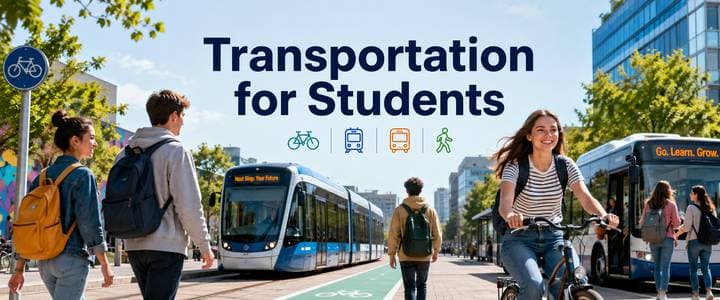
Germany has an extensive transportation network connecting university campuses, residential areas, city centers, airports, and neighboring European countries. Most students can manage daily life without owning a car by using buses, trams, underground trains, suburban trains, regional trains, and bicycles.
Many German universities include a semester ticket or discounted nationwide student ticket within the semester contribution. Its coverage differs by university. Some tickets are valid only within a city or regional transport association, while the Deutschlandsemesterticket allows eligible students to use local and regional public transportation throughout Germany.
Students who do not receive a suitable semester ticket can consider the standard Deutschlandticket. Its price is €63 per month in 2026, and it covers most local and regional public transportation. It does not normally cover ICE, IC, EC, or other long-distance services.
Understanding train categories, fare zones, ticket validation, subscription conditions, bicycle rules, and student discounts can prevent unnecessary expenses and fines. This guide explains the transportation system, ticket options, travel costs, and practical rules for Indian and international students in Germany.
Transportation for Students in Germany: Quick Overview
| Category | Main information |
|---|---|
| Common city transport | Bus, tram, U-Bahn, and S-Bahn |
| Regional transport | RB, RE, IRE, and regional buses |
| Long-distance trains | ICE, IC, and EC |
| Standard Deutschlandticket | €63 per month in 2026 |
| Deutschlandticket coverage | Local and regional public transport |
| Long-distance trains included | Normally no |
| Semester ticket | Depends on university and region |
| Deutschlandsemesterticket | Nationwide local and regional transport |
| Ticketless-travel penalty | At least €60 in most cases |
| Student identification | Usually required with student ticket |
| Bicycle ticket | Depends on the transport association and train |
| Best local travel option | Semester ticket or local student pass |
| Best intercity budget option | Regional trains or advance saver fares |
| Car required | Usually no |
| Main railway application | DB Navigator |
| Common navigation options | Local transport apps and digital maps |
Public Transportation in Germany
German public transportation is divided between municipal networks, regional transport associations, and long-distance operators.
A typical journey may combine:
Bus
Tram
U-Bahn
S-Bahn
Regional train
Local ferry
Walking
Bicycle
A single local ticket may cover several forms of transportation within the purchased zones and validity period.
For example, a student may travel by bus from home to a railway station, continue by S-Bahn, and then take a tram to the university without buying separate tickets if the entire journey falls within the ticket’s conditions.
Bus
Buses operate in cities, suburbs, villages, and rural regions.
They are particularly important in:
Smaller university towns
Areas without trams
Residential neighborhoods
Late-night transport networks
Rural campuses
Connections between railway stations and universities
Depending on the city, passengers may:
Enter through any door
Enter through the front and show a ticket
Purchase a ticket from the driver
Buy a ticket from a machine
Use a mobile application
Cash payment may not be available on every service. Students should buy or activate a digital ticket before boarding when required.
Tram
Trams are common in cities such as:
Berlin
Dresden
Leipzig
Cologne
Frankfurt
Stuttgart
Freiburg
Karlsruhe
Mannheim
Heidelberg
Trams are useful because they:
Operate frequently
Connect residential and university districts
Stop closer together than regional trains
Provide easy city-center access
Often run late in major cities
Some tram tickets must be validated before or immediately after boarding.
U-Bahn
The U-Bahn is an urban rapid-transit system. It may operate underground, above ground, or both.
Major U-Bahn systems exist in:
Berlin
Hamburg
Munich
Frankfurt
Nuremberg
The U-Bahn is normally used for travel within the city and nearby urban districts.
S-Bahn
The S-Bahn connects city centers with suburbs and surrounding towns.
It is useful for students who:
Live outside expensive city centers
Commute from neighboring towns
Travel to airports
Attend classes at different campuses
Work in another part of the metropolitan region
The S-Bahn is generally classified as local public transportation, even though it may cover longer distances than a tram or U-Bahn.
Regional Trains
Regional trains connect cities, smaller towns, airports, and rural areas.
Common categories include:
Regionalbahn or RB
Regional-Express or RE
Interregio-Express or IRE
Regional private-operator trains
Regional trains make it possible to travel long distances using a Deutschlandticket or eligible Deutschlandsemesterticket, although the journey may require several changes.
Regionalbahn
Regionalbahn trains stop at many smaller stations and are generally slower.
Regional-Express
Regional-Express trains stop at fewer stations and provide faster connections between larger towns and cities.
Interregio-Express
IRE services operate on selected regional routes. Their ticket treatment should be checked in the journey information.
Long-Distance Trains
Germany’s main long-distance train categories are:
Intercity-Express or ICE
Intercity or IC
EuroCity or EC
These trains are faster and more comfortable than regional services but are not normally included in the Deutschlandticket or Deutschlandsemesterticket.
Separate tickets are usually required.
ICE
ICE is Germany’s high-speed train network. It connects major cities such as:
Berlin
Munich
Hamburg
Frankfurt
Cologne
Stuttgart
Düsseldorf
Leipzig
Nuremberg
IC and EC
Intercity trains connect major domestic destinations. EuroCity services connect German cities with destinations in neighboring countries.
Semester Ticket
A semester ticket is a student transportation pass connected to university enrollment.
It may be funded through the semester contribution.
Depending on the university, the ticket may cover:
Buses
Trams
U-Bahn
S-Bahn
Regional trains
Local ferries
A city
A transport-association region
A federal state
Local and regional transport throughout Germany
Coverage is not identical at every institution.
What Students Must Check
Before using a semester ticket, confirm:
Geographical area
Start and end date
Whether nationwide travel is included
Eligible train categories
Whether a student ID is required
Whether the ticket is digital
Whether it must be activated
Bicycle conditions
Guest or companion privileges
Night-service coverage
Refund or exemption rules
Transition arrangements between semesters
A semester ticket valid in one city cannot automatically be used throughout Germany.
Digital Semester Ticket
Many institutions provide a digital ticket through:
University application
Transport-provider application
Wallet application
Personalized ticket portal
Students should:
Activate the ticket before traveling.
Keep the phone charged.
Carry official identification.
Check whether screenshots are accepted.
Update the ticket each semester.
Retain enrollment confirmation as backup.
A screenshot may not be considered a valid ticket because some digital tickets use changing security features.
Deutschlandsemesterticket
The Deutschlandsemesterticket is a discounted student version of the nationwide local-transport ticket.
At participating institutions, it generally covers:
Buses
Trams
U-Bahn
S-Bahn
RB trains
RE trains
Eligible IRE trains
Participating local ferries
Other approved regional services
It generally does not cover:
ICE
IC
EC
Private long-distance trains
Long-distance buses
Reserved tourist trains
Most international transportation outside Germany
Participation depends on the university and student-body agreement. Not every student automatically receives it.
Deutschlandticket
The standard Deutschlandticket provides nationwide access to local and regional public transportation.
Its price is €63 per month from January 2026.
Services Generally Included
City buses
Regional buses
Trams
U-Bahn
S-Bahn
RB trains
RE trains
Eligible IRE services
Participating local ferries
Services Generally Excluded
ICE trains
IC trains
EC trains
Long-distance private trains
Long-distance coaches
Seat reservations
First-class travel
Most transportation outside Germany
Certain tourist and special services
A small number of long-distance trains may be approved for local-ticket use on specific sections. Students should rely on the journey planner rather than assuming inclusion.
Subscription Conditions
The Deutschlandticket is a subscription rather than a normal one-time monthly ticket.
Students should check:
Cancellation deadline
Automatic renewal
Payment method
Ticket-delivery method
First valid month
Provider-specific terms
Cancellation conditions can differ between providers. Deleting an application does not cancel the subscription.
Local Transport Tickets
Students without a semester ticket or nationwide subscription may use local tickets.
Common options include:
Single ticket
Short-trip ticket
Day ticket
Group day ticket
Weekly pass
Monthly pass
Airport ticket
Extension ticket
Bicycle ticket
First-class supplement
Single Ticket
A single ticket is valid for one journey within specified zones and a defined period.
It may allow transfers but usually does not permit unlimited return travel.
Short-Trip Ticket
A short-trip ticket covers a limited number of stops. Rules vary by city.
Day Ticket
A day ticket allows multiple journeys during its validity period.
It can be more economical when completing several trips in one day.
Group Ticket
A group ticket can reduce the cost when several students travel together. The maximum group size and validity differ by region.
Extension Ticket
Students whose semester ticket covers only part of a journey may need an extension ticket before leaving the covered area.
Fare Zones
Local transport associations often divide their networks into zones.
Ticket prices may depend on:
Number of zones
Distance
City boundary
Time validity
Airport zone
Regional coverage
Students should not assume that a city ticket includes the airport. Airports are often in an outer fare zone.
Ticket Validation
Some paper tickets are valid immediately when purchased. Others must be stamped in a validating machine.
A ticket that requires validation is not valid until it has been stamped.
Validation machines may be located:
On the platform
Inside the tram
Inside the bus
Near the ticket machine
At the station entrance
Digital tickets may need to be purchased or activated before boarding.
Students should read the ticket and application instructions carefully.
Ticket Inspections and Fines
German public transportation often operates without entrance barriers. This does not mean travel is free.
Ticket inspectors may check passengers inside:
Bus
Tram
U-Bahn
S-Bahn
Regional train
Long-distance train
Traveling without a valid ticket can result in a penalty of at least:
€60
A passenger may be treated as traveling without a valid ticket when:
No ticket was purchased
The ticket was not activated
The paper ticket was not validated
The ticket expired
The passenger traveled outside its zones
The ticket did not cover the train category
Required identification was missing
A personalized ticket belonged to someone else
A bicycle ticket was required but not purchased
If a student had a valid personalized pass but could not present it, the transport provider may permit later proof and reduce the charge. This depends on provider rules and should be completed within the stated deadline.
Student ID and Identification
A personalized student transportation ticket may be valid only with:
Student identity card
Passport
German residence permit
Official national identity document
A photocopy or photograph of identification may not be accepted.
Students should carry the identification specified by the ticket provider.
Long-Distance Train Tickets
Students traveling by ICE, IC, or EC can choose among several fares.
Super Saver Fare
The lowest advance fare is usually train-specific and has limited or no cancellation options.
Saver Fare
A saver fare costs more but may allow cancellation under specific conditions.
Flexible Fare
A flexible fare generally provides greater flexibility but costs significantly more.
Students should compare:
Train binding
Cancellation
Refund method
City-ticket inclusion
Seat reservation
Connection rules
BahnCard discount
Young-Person Train Fares
Passengers up to and including age 26 can access selected young-person fares.
Current offers can include:
Super Saver Fare Young from €4.99 on selected routes
Saver Fare Young from €16.99 on selected routes
Flexible fares with age-based discounts
Availability and price depend on the route, train, booking time, and demand.
Age is checked on the first day of travel, so eligible students should carry identification.
BahnCard
A BahnCard provides discounts on many Deutsche Bahn long-distance fares.
BahnCard 25
It generally provides a 25% discount on eligible fares.
BahnCard 50
Its discount depends on the selected ticket type. It can provide a larger discount on flexible fares while saver-fare treatment differs.
Young-Person BahnCard
Discounted BahnCard products may be available to passengers under a specified age.
Before purchasing, calculate whether expected savings exceed the card price.
Also check:
Renewal conditions
Cancellation deadline
Validity period
Digital-card requirements
Eligible fares
Some BahnCards renew automatically if not canceled in time.
Seat Reservations
A seat reservation is normally separate from a standard second-class long-distance ticket.
Reservations can be useful:
On Friday and Sunday
During holidays
On popular routes
When traveling with luggage
When traveling in a group
During major events
A reservation does not replace a transportation ticket.
Regional trains generally do not offer standard individual seat reservations.
Train Delays and Missed Connections
When booking a journey, check whether the ticket is tied to a specific long-distance train.
If a delay or cancellation affects the journey, passenger-rights rules may allow:
Use of another eligible train
Reimbursement
Partial compensation
Hotel or alternative transportation in qualifying situations
The appropriate action depends on the delay, ticket, operator, and journey.
Students should:
Keep the ticket.
Save delay information.
Take screenshots of the journey.
Request documentation when necessary.
Submit claims through the official application or form.
Deutschlandticket users have more limited compensation rights than holders of individual long-distance tickets in some situations.
Traveling With the Deutschlandticket
The Deutschlandticket can reduce intercity travel costs when the student has time.
For example, a journey between major cities can be completed using only regional trains.
Advantages include:
No separate regional fare
Flexible regional train selection
Nationwide local transportation at the destination
Lower cost for frequent travelers
Disadvantages include:
Longer journey
Multiple changes
Greater exposure to delays
Crowded regional trains
No guaranteed seat
Limited compensation
Overnight gaps in service
For a long journey, an advance ICE fare can sometimes be more practical and only moderately more expensive.
Combining Regional and Long-Distance Tickets
A student may use a Deutschlandticket for the first part of a journey and a separate ICE ticket for the second part.
This creates separate transportation contracts.
If the regional service is delayed and the separately booked ICE is missed, the long-distance ticket may not automatically permit use of another train.
To reduce risk:
Allow a generous connection time.
Book the entire journey on one long-distance ticket where appropriate.
Avoid relying on a tight connection from an independently covered regional train.
Review the ticket’s train-binding conditions.
Intercity Buses
Long-distance coaches connect German and European cities.
They can be economical for:
Weekend travel
Airport connections
International journeys
Routes without convenient trains
Students should check:
Departure station
Luggage allowance
Cancellation policy
Travel time
Overnight schedule
Passport requirements
Border rules
Long-distance buses are not included in the Deutschlandticket.
Air Travel
Domestic flights are generally less practical than trains for many German routes after airport travel, security, waiting, and baggage are considered.
Flights may be useful for:
Long international journeys
Distant European destinations
Connections to India
Routes with poor rail connections
Students should compare the complete journey cost, including:
Airport transportation
Checked baggage
Seat selection
Travel time
Cancellation conditions
Overnight accommodation
A low advertised airfare may become expensive after additional charges.
Cycling in Germany
Cycling is one of the cheapest forms of student transportation.
Student-friendly cycling cities include:
Münster
Freiburg
Göttingen
Karlsruhe
Heidelberg
Erlangen
Bremen
Leipzig
Buying a Bicycle
Students can consider:
New bicycle
Used bicycle
Refurbished bicycle
University bicycle auction
Local bicycle shop
Short-term bicycle subscription
City bike-sharing system
When buying a used bicycle, request proof of ownership where possible. An unusually cheap bicycle without any explanation may be stolen.
Required and Recommended Equipment
A bicycle should have:
Working front light
Working rear light
Reflectors
Reliable brakes
Bell
Strong lock
A helmet is strongly recommended even when it is not legally compulsory for an adult cyclist.
Cycling Rules
Cyclists must follow traffic rules, including:
Traffic lights
Direction of travel
Marked bicycle lanes
Pedestrian restrictions
Night-light requirements
Alcohol limits
Mobile-phone restrictions
Cycling on a sidewalk may be prohibited unless signs permit it.
Bicycle Theft
Use a strong lock attached to a fixed object. Locking only the wheel does not adequately protect the bicycle.
Record:
Frame number
Purchase receipt
Photographs
Brand and model
Taking a Bicycle on Public Transport
Bicycle rules differ by region and time.
Possible requirements include:
Separate bicycle ticket
Restrictions during rush hour
Designated carriage
No guarantee of boarding
Priority for passengers with wheelchairs or strollers
A Deutschlandticket does not automatically include nationwide bicycle transportation.
Walking
Walking is practical in compact student cities.
Advantages include:
No cost
Exercise
No parking
Predictable travel time
Easier exploration
Students can reduce transport costs by choosing accommodation within walking or cycling distance of the university.
A lower-rent room far outside the city may not be economical if it requires a long and expensive commute not covered by the student ticket.
Taxis and Ride Services
Taxis are widely available but expensive for everyday student use.
They may be useful for:
Late-night travel
Heavy luggage
Medical situations
Travel from an isolated station
Shared group rides
Students should use official taxi stands, recognized applications, or verified providers.
A standard public-transport ticket does not cover taxis.
Car Sharing
Car-sharing services can be useful for:
Moving
Furniture collection
Trips to rural areas
Group excursions
Requirements may include:
Valid driving license
Minimum age
Driving-experience period
Identity verification
Registration fee
Security deposit
Students with non-EU driving licenses must check how long the license remains valid in Germany and whether a translation or conversion is required.
Owning a Car as a Student
Most students do not need a car.
Car ownership involves:
Purchase price
Insurance
Fuel
Vehicle tax
Registration
Maintenance
Inspection
Parking
Winter tires where required
In a large city, public transportation and cycling are usually more economical.
A car may be more useful in:
Rural areas
Remote campuses
Industrial internships outside transport networks
Family situations
Employment involving travel
Transportation Between Airport and University City
Before traveling, identify:
Arrival terminal
Airport railway station
Local or long-distance train category
Required ticket
Luggage limitations
Final local connection
Night-service availability
Some airports are located far from the city they serve.
Examples include airports requiring:
Regional train
S-Bahn
Airport bus
Long-distance train
Multiple connections
Do not assume the Deutschlandticket covers every airport train. Check the service category.
Night Transportation
Large cities may offer:
Night buses
Weekend U-Bahn
Weekend S-Bahn
Late trams
On-demand local services
Smaller cities may have limited nighttime transportation.
Before attending a late event, check:
Last train
Night-bus route
Weekend schedule
Construction changes
Safe walking route
Taxi availability
Transportation Applications
Useful digital tools include:
DB Navigator
Local transport-association application
University mobility application
Digital map service
Bicycle-sharing application
Long-distance coach application
Car-sharing application
DB Navigator can display many regional and long-distance connections, but local provider applications may provide better information about disruptions, replacement buses, and fare zones.
Common German Transport Terms
| German term | Meaning |
|---|---|
| Hauptbahnhof or Hbf | Main railway station |
| Haltestelle | Stop |
| Gleis | Platform or track |
| Abfahrt | Departure |
| Ankunft | Arrival |
| Verspätung | Delay |
| Ausfall | Cancellation |
| Umstieg | Transfer |
| Ersatzverkehr | Replacement transport |
| Schienenersatzverkehr | Rail-replacement bus |
| Fahrkarte | Ticket |
| Einzelfahrschein | Single ticket |
| Tageskarte | Day ticket |
| Monatskarte | Monthly pass |
| Entwerter | Ticket-validating machine |
| Anschluss | Connection |
| Wagen | Carriage |
| Fahrradmitnahme | Bicycle transportation |
| Zugbindung | Binding to a specific train |
| Sitzplatzreservierung | Seat reservation |
Replacement Transport
Construction, strikes, or technical problems may result in rail-replacement buses.
Signs may use:
SEV
Ersatzverkehr
Bus replacement service
Replacement-bus stops may not be directly outside the railway station. Allow additional time and follow signs or application instructions.
Accessibility
Many modern stations and vehicles provide:
Elevators
Ramps
Low-floor entry
Accessible toilets
Priority seating
Audio announcements
Visual displays
Mobility assistance
Accessibility is not perfect at every station. Students with disabilities should check:
Elevator status
Step-free route
Assistance-booking requirements
Accessible replacement transport
Wheelchair spaces
Station construction
Transportation Safety
Public transportation is generally safe, but students should take normal precautions.
Keep bags closed.
Do not leave luggage unattended.
Stay in well-lit areas at night.
Use official transport services.
Monitor the final connection.
Keep the phone charged.
Avoid sleeping with valuables exposed.
Report harassment or threats.
Use emergency communication points where available.
Stay behind platform safety markings.
Emergency numbers in Germany are:
Police: 110
Fire and medical emergency: 112
Transportation Costs for Students
A student’s monthly cost can vary substantially.
| Transportation situation | Approximate cost |
|---|---|
| Semester ticket included in contribution | No additional regular local fare |
| University regional semester ticket | Included or paid through semester contribution |
| Deutschlandsemesterticket | Discounted through university arrangement |
| Standard Deutschlandticket | €63 per month in 2026 |
| Occasional local tickets | €20–€100 per month |
| Regular ICE travel | Highly variable |
| Used bicycle | Approximately €100–€400 |
| Bicycle maintenance | Approximately €30–€150 annually |
Students should include long-distance trips separately from their daily transportation budget.
Transportation Tips for Indian Students
Indian students may notice several differences from transportation in India.
Follow the Published Ticket Rules
Public transportation often has no physical gate. Students must still possess and validate the correct ticket.
Doors May Not Open Automatically
On some buses and trains, passengers must press a button to open the door.
Requesting a Bus Stop
Passengers may need to press the stop button before the desired stop.
Board Quickly and Allow Others to Exit
Allow passengers to leave before entering. Doors may close according to the schedule.
Quiet Behavior
Loud phone calls and music can disturb other passengers. Use headphones and maintain a moderate speaking volume.
Prepare for Schedule Changes
Weekend schedules, construction, and replacement buses can change the route.
Do Not Assume Student ID Is a Ticket
A student card provides transportation only if the university has activated or included the relevant ticket.
Carry Identification
A personalized digital ticket may be invalid without official identification.
Saving Money on Transportation
Students can reduce transportation costs by:
Using the university semester ticket
Checking Deutschlandsemesterticket eligibility
Living near the campus
Cycling
Booking ICE tickets early
Using young-person fares
Comparing regional and long-distance journeys
Traveling in groups
Avoiding peak travel periods
Checking BahnCard value
Using day tickets for several local journeys
Using local and regional transport for flexible trips
Canceling subscriptions before renewal when no longer needed
Common Transportation Mistakes
Entering transport without a ticket
Forgetting to validate a paper ticket
Using a screenshot instead of an active digital ticket
Assuming the Deutschlandticket covers ICE trains
Traveling beyond semester-ticket zones
Forgetting official identification
Missing a subscription cancellation deadline
Buying a BahnCard without checking automatic renewal
Assuming bicycle transport is included
Booking separate tickets with a risky connection
Going to the wrong station or platform
Confusing Frankfurt Main with Frankfurt Oder
Confusing a city’s main station with an airport station
Ignoring replacement-bus information
Expecting every local ticket to cover the airport
Frequently Asked Questions
Is public transportation free for students in Germany?
Not automatically. Many students receive a transport ticket through their semester contribution, but coverage and cost vary by university.
What is a semester ticket?
It is a student transport pass that may cover local, regional, state-wide, or nationwide transportation, depending on the institution.
What is the Deutschlandsemesterticket?
It is a discounted nationwide student ticket offered through participating universities and student bodies. It generally covers local and regional public transport.
How much is the Deutschlandticket?
The standard Deutschlandticket costs €63 per month from January 2026.
Can students use ICE trains with the Deutschlandticket?
Normally no. ICE, IC, and EC services generally require separate long-distance tickets.
Can students travel throughout Germany with a semester ticket?
Only if their university provides a nationwide Deutschlandsemesterticket. A regional semester ticket may have limited coverage.
Does the Deutschlandticket include buses and trams?
Yes, participating local buses, trams, U-Bahn, and S-Bahn services are generally included.
Does it include regional trains?
Yes, eligible RB, RE, and other participating regional services are generally included.
Does it cover airport transportation?
It covers eligible local or regional airport transportation. It does not cover a long-distance service merely because it travels to an airport.
What is the fine for traveling without a ticket?
The increased fare is generally at least €60.
Do digital tickets require identification?
Personalized tickets generally require official identification during inspection.
Do tickets need to be validated?
Some paper tickets require validation, while others are immediately valid. Check the ticket and machine instructions.
Can a student take a bicycle on a train?
Yes on many services, but local rules, time restrictions, and bicycle-ticket requirements apply.
Is a bicycle included in the Deutschlandticket?
Not automatically nationwide. Bicycle conditions depend on the regional transport association.
Is owning a car necessary?
Usually not. Most university cities have public transportation, cycling routes, and intercity rail connections.
What is the cheapest way to travel between German cities?
The cheapest option may be regional trains covered by a nationwide ticket, an advance saver fare, a young-person fare, or a long-distance coach.
Are train seats automatically reserved?
Not normally in standard second-class German long-distance travel. Seat reservations are generally separate.
Can students get train discounts?
Eligible passengers under 27 can use selected young-person fares. BahnCard products may provide additional discounts.
Does a BahnCard renew automatically?
Some BahnCard products may renew unless canceled by the required deadline. Students should check the contract.
What happens if a train is delayed?
Passenger rights depend on the delay, ticket, and operator. Keep the ticket and submit a claim through the official process where eligible.
Can students use the Deutschlandticket for international travel?
It is primarily valid within Germany. Limited cross-border local routes may have special arrangements, but international travel should not be assumed.
Which German cities are best for cycling?
Münster, Freiburg, Göttingen, Karlsruhe, Erlangen, Bremen, Heidelberg, and Leipzig are known for active cycling cultures.
What should a student do if the phone battery dies?
A digital ticket may become impossible to present. Keep the phone charged and carry a power bank when traveling long distances.
Are Indian driving licenses valid in Germany?
Validity depends on residence duration and license conditions. Students should check whether a translation or German conversion is required.
Final Thoughts
Germany’s public transportation system allows most students to live without a car. Buses, trams, U-Bahn, S-Bahn, and regional trains cover daily travel, while ICE, IC, and EC trains provide faster long-distance connections.
The most important step is checking what the university’s semester ticket actually covers. A local semester ticket may be valid only in one transport association, while a Deutschlandsemesterticket generally provides nationwide access to local and regional services.
The standard Deutschlandticket is useful for students without equivalent university coverage. Its current price is €63 per month, but it does not normally include ICE, IC, EC, or other long-distance services.
Students must always carry a valid and properly activated ticket. Open stations and vehicles without barriers still have inspections, and traveling without the correct ticket can result in a fine of at least €60.
For affordable travel, students can combine public transportation with cycling, advance train bookings, young-person fares, and group tickets. Learning the difference between local, regional, and long-distance transport makes commuting and travel throughout Germany considerably easier.