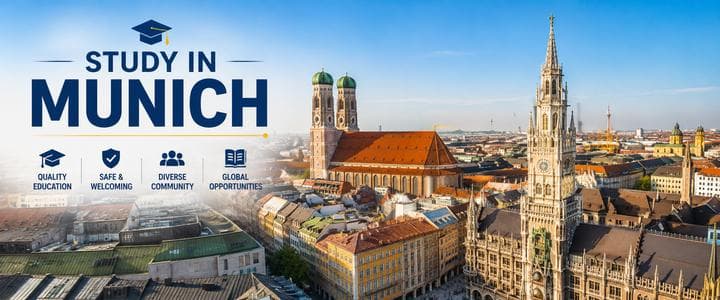
Munich is one of Germany’s strongest academic, research, and employment centers. The Bavarian capital is home to Ludwig-Maximilians-Universität München, the Technical University of Munich, Munich University of Applied Sciences, leading art and film institutions, research organizations, multinational companies, technology firms, and a growing startup ecosystem.
The city is particularly attractive for engineering, computer science, artificial intelligence, medicine, life sciences, business, physics, automotive technology, aerospace, data science, and management. Students can combine university education with research projects, industry collaboration, internships, and working-student positions.
Munich is also one of Germany’s most expensive student cities. Accommodation is limited, residence waiting periods are long, and private rents are considerably higher than in many smaller university towns. International students must therefore evaluate the complete cost of attendance rather than looking only at university tuition.
Tuition policies also differ among Munich institutions. LMU Munich generally does not charge tuition for regular degree programs, while TUM usually charges tuition to students from non-EU countries. Munich University of Applied Sciences also charges comparatively smaller tuition fees to many non-EU students.
This guide explains how to study in Munich, including universities, courses, tuition fees, admission requirements, APS, application procedures, accommodation, transportation, scholarships, part-time jobs, and student life.
Study in Munich: Quick Overview
| Factor | Key information |
|---|---|
| City | Munich |
| Federal state | Bavaria |
| Major universities | LMU Munich, TUM, Munich University of Applied Sciences |
| Specialized institutions | Academy of Fine Arts, HFF Munich, University of Music and Theatre Munich |
| Popular fields | Engineering, computer science, AI, medicine, business, physics, life sciences |
| LMU regular tuition | Generally no tuition; semester contribution applies |
| TUM non-EU tuition | Usually €2,000–€3,000 per semester for bachelor’s and €4,000–€6,000 for master’s |
| HM non-EU tuition | Currently €500 per semester for bachelor’s and €700 for master’s |
| Semester contribution | Approximately €97 at several public institutions |
| Suggested monthly budget | Approximately €1,300–€2,000 |
| Student residence | Approximately €400–€600 |
| Private room | Approximately €700–€1,000 |
| Private studio | Frequently €1,000–€1,500 |
| Student transportation | Reduced Deutschlandticket currently €43 per month |
| Main intake | Winter semester |
| Secondary intake | Summer semester with fewer courses |
| Main languages | German and English |
| International student work limit | Up to 140 full or 280 half working days annually under current rules |
| Main advantage | Strong academic and industry environment |
| Main challenge | High cost and limited accommodation |
Why Study in Munich?
Munich offers a powerful combination of research universities, practical education, established companies, technology development, cultural institutions, and high living standards.
Internationally Recognized Universities
LMU and TUM provide research-intensive education across a wide range of subjects. Munich University of Applied Sciences offers career-oriented programs with practical projects and employer connections.
Specialized institutions support students in fine arts, music, television, film, design, and performing arts.
Strong Research Environment
Students can access research opportunities involving:
Artificial intelligence
Robotics
Quantum technology
Automotive engineering
Aerospace
Biotechnology
Medical research
Neuroscience
Renewable energy
Climate science
Advanced manufacturing
Data science
Physics
Chemistry
Digitalization
Munich’s universities collaborate with research institutes, hospitals, companies, and public organizations.
Career and Industry Connections
Munich has a diversified economy covering:
Automotive
Software
Engineering
Electronics
Aerospace
Financial services
Insurance
Biotechnology
Pharmaceuticals
Consulting
Media
Research
Telecommunications
Energy
Mobility
Advanced manufacturing
Students in technical and business fields may find internships, research roles, working-student positions, and graduate employment.
High Quality of Life
Munich offers:
Reliable public transportation
Extensive parks
Cultural institutions
Museums
Sports facilities
Lakes
Access to the Alps
Organized public services
International communities
Student cultural events
The high quality of life is accompanied by high housing and living expenses.
Central European Location
Students can travel conveniently to other German cities, Austria, Switzerland, Italy, and the Czech Republic. Munich Airport also provides international connections.
Top Universities in Munich
| University | Institution type | Major academic strengths |
|---|---|---|
| Ludwig-Maximilians-Universität München | Public research university | Medicine, humanities, natural sciences, law, economics, social sciences |
| Technical University of Munich | Public technical university | Engineering, computer science, AI, natural sciences, management, life sciences |
| Munich University of Applied Sciences | Public university of applied sciences | Engineering, business, computer science, design, applied sciences |
| Academy of Fine Arts Munich | Public art academy | Fine arts, visual arts, art education, architecture-related artistic studies |
| University of Television and Film Munich | Public film institution | Film, television, production, screenwriting, media |
| University of Music and Theatre Munich | Public arts university | Music, performance, composition, theater, cultural management |
| Munich Business School | Private university | Business, international management, entrepreneurship |
| Munich School of Philosophy | Specialized institution | Philosophy, ethics, social thought |
The right university depends on the selected program, teaching language, academic goals, budget, and preferred learning style.
Ludwig-Maximilians-Universität München
Ludwig-Maximilians-Universität München, commonly called LMU Munich, is a comprehensive public research university.
Its main academic areas include:
Medicine
Biology
Chemistry
Pharmacy
Physics
Mathematics
Computer science
Psychology
Economics
Business administration
Law
Political science
Sociology
Philosophy
History
Languages
Literature
Cultural studies
Education
LMU’s central facilities are concentrated around Maxvorstadt, while medical, natural-science, and research locations are spread across Munich and nearby areas such as Großhadern and Martinsried.
Who Should Consider LMU Munich?
LMU may suit students seeking:
Research-intensive education
Medicine or health sciences
Natural sciences
Humanities and social sciences
Economics or business
Academic research careers
Interdisciplinary master’s or doctoral study
Many bachelor’s programs are taught in German. LMU offers a selection of English-taught master’s programs requiring strong English proficiency.
Technical University of Munich
The Technical University of Munich, commonly called TUM, is one of Germany’s major technical and research universities.
Its academic strengths include:
Mechanical engineering
Electrical engineering
Computer engineering
Computer science
Artificial intelligence
Robotics
Civil engineering
Environmental engineering
Aerospace
Automotive technology
Physics
Chemistry
Mathematics
Biotechnology
Food science
Agricultural science
Medicine and health
Management
Architecture
TUM Campuses
Applicants must check where their program is taught. TUM is not located on one single Munich campus.
| Campus or location | Common academic areas |
|---|---|
| Munich city campus | Architecture, civil engineering, electrical engineering, management, selected sciences |
| Garching | Engineering, computer science, physics, mathematics, chemistry |
| Weihenstephan in Freising | Life sciences, biotechnology, agriculture, food science |
| Klinikum rechts der Isar area | Medicine and health |
| Straubing | Biotechnology, sustainability, renewable resources |
| Heilbronn | Management, technology, information engineering |
A program listed under TUM may therefore require living or commuting outside central Munich.
Who Should Consider TUM?
TUM may be suitable for students seeking:
Advanced technical education
Strong engineering or computer science programs
Industry-linked research
Entrepreneurship
Applied scientific innovation
Interdisciplinary technology and management programs
International non-EU applicants must include tuition in their financial planning.
Munich University of Applied Sciences
Munich University of Applied Sciences is also known as Hochschule München or HM.
It emphasizes applied education, practical projects, laboratories, and professional preparation.
Major areas include:
Mechanical engineering
Electrical engineering
Automotive engineering
Computer science
Applied sciences
Mechatronics
Business administration
Tourism
Design
Architecture
Civil engineering
Social work
Renewable energy
Bioengineering
Microtechnology
Who Should Consider Hochschule München?
HM may appeal to students who prefer:
Practical coursework
Industry projects
Applied engineering
Smaller course structures
Professional preparation
Internship-oriented education
Direct application of theory
Most bachelor’s programs are taught in German, but English-taught bachelor’s, master’s, and individual modules are also available.
Specialized Art, Film, and Music Institutions
Academy of Fine Arts Munich
The Academy of Fine Arts offers artistic education in areas such as:
Fine arts
Painting
Sculpture
Media art
Art education
Interior architecture
Artistic research
Admission usually requires a portfolio and artistic assessment.
University of Television and Film Munich
The University of Television and Film Munich offers specialized education in:
Film direction
Screenwriting
Production
Cinematography
Documentary
Television
Media management
Admission is highly selective and may involve creative work samples, written assignments, interviews, and practical assessments.
University of Music and Theatre Munich
Programs can include:
Instrumental performance
Vocal performance
Composition
Conducting
Theater
Dance
Music education
Cultural management
Applicants typically complete auditions or artistic entrance examinations.
Popular Courses to Study in Munich
Engineering
Munich is a major destination for:
Mechanical engineering
Electrical engineering
Automotive engineering
Aerospace engineering
Civil engineering
Environmental engineering
Mechatronics
Industrial engineering
Energy engineering
Robotics
Production engineering
Transportation engineering
TUM offers research-oriented technical programs, while HM provides applied and professionally oriented alternatives.
Computer Science and Artificial Intelligence
Popular areas include:
Computer science
Artificial intelligence
Machine learning
Data science
Robotics
Software engineering
Information systems
Computational science
Cybersecurity
Human-computer interaction
Bioinformatics
Students should examine mathematics, programming, theoretical-computer-science, and subject-credit requirements before applying.
Business and Management
Munich universities offer programs in:
Business administration
Economics
Management and technology
Finance
Entrepreneurship
Innovation management
Marketing
Business analytics
International management
Supply-chain management
Students should compare LMU’s research-based programs, TUM’s technology-management focus, HM’s applied programs, and private business-school options.
Medicine and Health Sciences
Munich offers opportunities involving:
Human medicine
Dentistry
Pharmacy
Public health
Epidemiology
Neuroscience
Biomedical science
Molecular medicine
Health management
Professional medicine and dentistry are generally taught in German and require highly competitive admission results.
Natural and Life Sciences
Strong areas include:
Physics
Chemistry
Mathematics
Biology
Biochemistry
Biotechnology
Molecular biology
Agricultural science
Food science
Neuroscience
Environmental science
Students interested in TUM life-science programs should check whether the course is based in Freising rather than Munich city.
Arts, Film, and Design
Students can study:
Fine arts
Film
Television
Music
Theater
Architecture
Industrial design
Communication design
Photography
Digital media
Portfolio, audition, or artistic-test requirements usually have earlier preparation timelines than ordinary academic applications.
English-Taught Programs in Munich
English-taught options are more common at the master’s and doctoral levels.
Popular English-taught areas include:
Computer science
Data science
Artificial intelligence
Engineering
Physics
Mathematics
Biotechnology
Neuroscience
Economics
Management
Business
Public health
Fully English-taught bachelor’s programs are less common at public universities. Private institutions may offer more English bachelor’s options but usually charge higher tuition.
Is German Necessary?
A student may enter a completely English-taught program without advanced German if the university permits it. German remains useful for:
Accommodation
Government appointments
Part-time jobs
Internships
Healthcare
Customer service
Social integration
Long-term employment
Students seeking customer-facing, medical, legal, educational, or public-sector work generally need stronger German.
Admission Requirements to Study in Munich
Each program sets its own requirements.
Bachelor’s Admission Requirements
International applicants generally need a recognized university entrance qualification.
Depending on the qualification, admission may involve:
Direct university admission
Subject-restricted admission
Studienkolleg
Previous university study
Recognized entrance-examination results
Artistic assessment
Aptitude procedure
Indian applicants should not assume that Class 12 automatically provides direct admission. The route can depend on the board, marks, academic stream, JEE results, and previous university study.
Studienkolleg
Applicants without direct university access may need Studienkolleg followed by the Feststellungsprüfung.
| Preparatory track | Typical future field |
|---|---|
| T-Course | Engineering, mathematics, natural sciences |
| M-Course | Medicine, biology, pharmacy |
| W-Course | Business, economics, social sciences |
| G-Course | Humanities |
| S-Course | Languages |
Public Studienkolleg instruction is generally in German. Applicants usually need German proficiency before beginning the course.
Master’s Admission Requirements
A master’s application may require:
Recognized bachelor’s degree
Relevant discipline
Specific academic modules
Minimum grade
Language certificate
CV
Motivation letter
Recommendation letters
Work experience
Aptitude assessment
Interview
GRE or GMAT for selected programs
Portfolio for creative programs
TUM programs frequently examine the academic curriculum in detail. Applicants may be evaluated through an aptitude assessment that considers grades, modules, written documents, and sometimes an interview or test.
Language Requirements
German-Taught Programs
Accepted qualifications may include:
TestDaF
DSH
telc Deutsch C1 Hochschule
Goethe certificates where accepted
German school or university qualifications
Other institution-approved certificates
Applicants must meet the exact score required by the university.
English-Taught Programs
Commonly accepted evidence can include:
IELTS Academic
TOEFL
Cambridge English qualifications
Previous English-medium degree where explicitly accepted
Other program-approved certificates
A medium-of-instruction letter is not automatically accepted by every program.
APS Requirements for Indian Students
APS India verifies academic documents and qualifications issued by Indian educational institutions. An APS certificate is generally required as part of the student visa documentation.
APS does not replace:
University admission
uni-assist evaluation
VPD
Language certification
Visa approval
Requirements differ according to the applicant’s academic background. Additional testing may apply to certain master’s applicants, subjects, and intakes.
Indian applicants should begin the APS process early and use the checklist for their exact qualification.
Application Process for Munich Universities
Step 1: Choose the Program and Campus
Review:
University
Degree title
Campus
Teaching language
Tuition
Semester contribution
Application deadline
Academic requirements
Required internship
Program structure
For TUM, campus location should be checked before selecting accommodation.
Step 2: Confirm Academic Eligibility
Determine whether the qualification permits:
Direct bachelor’s admission
Studienkolleg
Subject-restricted admission
Master’s admission
Need for a VPD
Step 3: Identify the Application Route
Depending on the institution and program, students may apply through:
University application portal
International office
Academic department
uni-assist
VPD followed by direct university application
Artistic application portal
TUM generally requires international applicants with foreign educational qualifications to obtain preliminary review documentation through uni-assist for many programs.
LMU procedures vary. Bachelor’s, state-examination, and master’s programs may use different routes, with some applications handled by the International Office and others by individual departments.
Hochschule München uses uni-assist evaluation for many international applications, followed by the institution’s required process.
Step 4: Prepare Documents
Common documents include:
Passport
Academic certificates
Mark sheets
APS certificate
Language certificate
CV
Motivation letter
Recommendation letters
Module descriptions
Grading-system information
VPD
Work-experience letters
Portfolio
Test scores
Documents may need certified copies and official translations.
Step 5: Submit Before the Deadline
The following are common German reference dates:
July 15 for many winter-semester programs
January 15 for many summer-semester programs
Munich universities frequently use different deadlines. TUM master’s programs, aptitude-assessment programs, artistic courses, and programs requiring a VPD may have earlier closing dates.
Step 6: Complete Enrollment
After admission, students normally submit:
Enrollment form
Health insurance notification
Semester contribution
Tuition payment where applicable
Certified documents
Passport details
Additional program documents
Admission and enrollment are separate stages.
Tuition Fees in Munich
Munich does not have one common tuition policy. Students must check the selected institution.
The following current published fees were verified in August 2026.
TUM Tuition Fees for Non-EU Students
Students from non-EU and non-EEA countries generally pay tuition at TUM unless an exemption or waiver applies.
| Degree level | Common TUM tuition |
|---|---|
| Bachelor’s program | Usually €2,000 or €3,000 per semester |
| Master’s program | Usually €4,000 or €6,000 per semester |
| Semester fee | Additional mandatory contribution |
The exact tuition depends on the degree program. Some programs may have different amounts.
An Indian student beginning a two-year master’s with tuition of €6,000 per semester could pay €24,000 in tuition over four standard semesters, excluding the semester contribution and living costs.
TUM Exemptions and Waivers
Possible arrangements include:
Statutory exemption
Merit-based waiver
Need-based waiver
Family-related waiver
Program-specific scholarship
Special status under applicable regulations
Eligibility is not automatic. Waiver scholarships are limited and may need to be renewed.
LMU Munich Fees
LMU generally does not charge tuition for regular bachelor’s and master’s degree programs. Students pay the semester contribution.
The current LMU semester contribution is approximately €97.
Tuition or separate fees may apply to:
Continuing-education programs
Executive degrees
Special certificate programs
Guest studies
Summer programs
Selected postgraduate programs
Hochschule München Fees
Munich University of Applied Sciences currently charges many non-EU students:
| Degree level | Tuition per semester |
|---|---|
| Bachelor’s | €500 |
| Master’s | €700 |
| Mandatory Studierendenwerk fee | Approximately €97 |
Exemptions may apply to EU or EEA students, applicants with a German university entrance qualification, and other categories recognized in the institution’s fee regulations.
Private University Fees
Private universities may charge between approximately €8,000 and more than €25,000 per academic year.
Students should check:
Total tuition
Enrollment fee
Examination fee
Internship charges
International module costs
Refund policy
Scholarship conditions
Accreditation
State recognition
Complete Cost of Studying in Munich
A student must combine tuition and living expenses.
Estimated Annual Cost
| Student category | Tuition estimate | Living costs | Approximate annual total |
|---|---|---|---|
| LMU regular public program | Usually €0 | €15,600–€24,000 | €15,600–€24,000 plus semester fees |
| HM non-EU bachelor’s | €1,000 | €15,600–€24,000 | €16,600–€25,000 plus semester fees |
| HM non-EU master’s | €1,400 | €15,600–€24,000 | €17,000–€25,400 plus semester fees |
| TUM non-EU bachelor’s | €4,000–€6,000 | €15,600–€24,000 | €19,600–€30,000 plus semester fees |
| TUM non-EU master’s | €8,000–€12,000 | €15,600–€24,000 | €23,600–€36,000 plus semester fees |
| Private university | €8,000–€25,000+ | €15,600–€24,000 | €23,600–€49,000+ |
These are planning estimates. The exact cost depends on the program, accommodation, duration, and student’s lifestyle.
Cost of Living in Munich
LMU recommends planning approximately €1,500 per month. TUM estimates that a single person in the greater Munich area may require approximately €1,300–€2,000 monthly.
Estimated Monthly Budget
| Expense | Estimated monthly cost |
|---|---|
| Student residence | €400–€600 |
| Private room or WG | €700–€1,000 |
| Private studio | €1,000–€1,500 |
| Food | €250–€350 |
| Health insurance | €140–€150 |
| Reduced student Deutschlandticket | €43 |
| Phone and internet | €20–€50 |
| Study materials | €20–€60 |
| Broadcasting contribution share | Up to €18.36 per dwelling |
| Personal and leisure expenses | €100–€250 |
| Suggested total budget | Approximately €1,300–€2,000 |
Tuition is not included in the monthly living-cost estimate.
Accommodation in Munich
Accommodation is the greatest practical challenge for many Munich students.
Studierendenwerk Residences
Studierendenwerk München Oberbayern manages more than 9,000 student rooms and apartments across Munich, Freising, and Rosenheim.
The current average monthly rent is approximately €400.60.
Advantages include:
Lower rent
Student community
Official provider
Predictable conditions
Access to public transportation
Locations near several campuses
The major disadvantage is the waiting time. Depending on the residence, students may wait between one and seven semesters.
Students should not assume that submitting an application guarantees accommodation for the first semester.
Shared Apartments
A shared apartment is called a Wohngemeinschaft or WG.
Private rooms commonly cost approximately €700–€1,000, although less expensive rooms may be available farther from the center.
Confirm whether the price is:
Kaltmiete: base rent
Warmmiete: rent including specified operating costs
Electricity, internet, heating adjustments, and broadcasting contribution may be separate.
Private Studio Apartments
An unfurnished one-room apartment in Munich can have:
Cold rent of approximately €800–€1,300
Warm rent of approximately €1,000–€1,500
Furnished and short-term apartments may cost more.
Upfront Housing Costs
Students may need:
Security deposit
First month’s rent
Furniture
Kitchen equipment
Electricity payment
Internet installation
Temporary accommodation
A deposit can commonly equal two or three months of base rent.
Housing Scam Protection
Munich’s difficult rental market creates opportunities for fraud.
Warning signs include:
Unusually low rent
Landlord claiming to be abroad
No viewing
Payment before verification
Keys supposedly sent by courier
Cryptocurrency or gift-card payment
Copied photographs
Incomplete contract
Payment to an unrelated account
Extreme urgency
Students should verify the property, landlord, contract, and payment details before transferring money.
Best Areas for Students in Munich
The best area depends heavily on the campus.
| Area | Student advantages |
|---|---|
| Maxvorstadt | Close to LMU, TUM city campus, libraries, and museums |
| Schwabing | Access to LMU, student life, and northern transport routes |
| Garching | Convenient for major TUM engineering and science departments |
| Freising | Suitable for TUM Weihenstephan life-science programs |
| Milbertshofen | Access to northern Munich and U-Bahn connections |
| Olympiapark area | Student residences and access to central universities |
| Moosach | Transport connections and potentially lower rent |
| Pasing | S-Bahn connections and access to western Munich |
| Laim | Practical transport and residential options |
| Sendling | City access and residential neighborhoods |
| Neuperlach | Farther from central campuses but sometimes more affordable |
| Unterhaching or Ottobrunn | Suburban options with S-Bahn connections |
| Dachau | Possible alternative with a longer commute |
| Erding | Potential option for eastern locations and airport access |
Students should calculate door-to-door travel time rather than only the distance on a map.
Transportation for Students
Munich’s public transportation includes:
U-Bahn
S-Bahn
Trams
Buses
Regional trains
Reduced Deutschlandticket for Students
Bavaria’s discounted Deutschlandticket for eligible students currently costs €43 per month.
The ticket generally covers:
Munich U-Bahn
S-Bahn
Trams
Buses
Participating local transportation across Germany
Regional trains such as RB and RE
It does not generally cover:
ICE trains
IC trains
EC trains
Other ordinary long-distance services
The ticket is a personal subscription and is not automatically included in the semester contribution.
Munich’s former semester-ticket arrangement is currently suspended, so a university student ID alone does not provide public transportation.
Food and University Dining
Studierendenwerk München Oberbayern operates Mensa cafeterias and student dining facilities.
Students can access subsidized prices for:
Main meals
Vegetarian food
Vegan food
Salads
Soups
Snacks
Coffee
Bakery items
Eating at Mensa facilities and cooking at home can significantly reduce expenses.
Munich supermarkets, weekly markets, international stores, and discount grocery chains provide additional options.
Health Insurance
Health insurance is compulsory.
Most eligible students under 30 choose statutory student health insurance, commonly costing approximately €140–€150 per month including long-term care insurance.
Students need recognized coverage for:
University enrollment
Residence permit
Doctor visits
Hospital treatment
Prescriptions
Medical emergencies
Insurance confirmation is usually sent electronically to the university.
Scholarships and Financial Support
Students can explore:
DAAD scholarships
Deutschlandstipendium
TUM waiver scholarships
TUM international student scholarships
LMU funding programs
Hochschule München scholarships
Erasmus+
Political foundations
Religious foundations
Corporate foundations
Research-assistant funding
Subject-specific organizations
TUM Waiver Scholarships
TUM provides limited tuition-waiver opportunities for eligible non-EU students.
A tuition waiver normally reduces or removes tuition but may not cover:
Semester contribution
Rent
Food
Health insurance
Transportation
Personal expenses
Students must read the duration and renewal conditions carefully.
Scholarship Preparation
Common requirements include:
Academic record
Motivation letter
CV
Recommendation letters
Social engagement
Research proposal
Financial information
Admission evidence
Language certificate
Scholarship and university applications are generally separate.
Part-Time Jobs in Munich
Students can search for jobs in:
University departments
Research institutes
Engineering companies
Software companies
Automotive firms
Financial services
Insurance
Consulting
Biotechnology
Retail
Hotels
Restaurants
Event management
Tutoring
Logistics
Working-Student Positions
Werkstudent positions can provide subject-related experience in:
Engineering
Software development
Data analysis
Product management
Finance
Marketing
Research
Operations
Human resources
Consulting support
German proficiency increases the range of available positions.
Work Restrictions
Eligible non-EU students may generally work up to:
140 full days annually, or
280 half days annually
Specific rules may apply to:
Mandatory internships
Voluntary internships
Student-assistant positions
Freelance work
Self-employment
Study-preparation courses
Students should check their residence permit and consult the immigration authority when uncertain.
Income from a part-time job should not be assumed before arriving or used as the only plan for financing Munich living costs.
Career Opportunities After Graduation
Munich offers opportunities in:
Automotive engineering
Aerospace
Software
Artificial intelligence
Data science
Electronics
Mechanical engineering
Biotechnology
Medical technology
Finance
Insurance
Consulting
Research
Media
Energy
Advanced manufacturing
Students can improve employability through:
German proficiency
Internships
Working-student jobs
Research projects
Technical portfolios
University career events
Professional networking
Thesis collaboration with employers
Student Life in Munich
Munich offers a quieter and more structured urban environment than Berlin while still providing extensive academic and social activities.
Students can explore:
English Garden
Museums
Concerts
Theaters
University societies
Sports facilities
Public parks
Lakes
Hiking
Cycling
Alpine trips
Seasonal festivals
International restaurants
University sports and student cultural events can provide affordable alternatives to commercial entertainment.
Safety in Munich
Munich is generally considered manageable for students, but normal precautions remain necessary.
Students should:
Protect belongings at busy stations and festivals.
Verify accommodation before paying.
Lock bicycles securely.
Use valid public transportation tickets.
Avoid leaving laptops unattended.
Use well-lit routes at night.
Protect banking credentials.
Report harassment or discrimination.
Save emergency numbers.
Important numbers include:
110 for police emergencies
112 for ambulance and fire emergencies
116117 for urgent non-life-threatening medical care
Advantages and Disadvantages of Studying in Munich
| Advantages | Disadvantages |
|---|---|
| Strong research universities | Very expensive accommodation |
| Major engineering and technology environment | Long residence waiting periods |
| Excellent career opportunities | TUM tuition for many non-EU students |
| High quality of life | Competitive admissions |
| Reliable public transportation | Student transport ticket is purchased separately |
| Strong healthcare and research sector | German is important for many jobs |
| Access to nature and the Alps | Private studios are expensive |
| Safe and organized environment | Some TUM campuses are outside Munich |
| International student community | Part-time work cannot guarantee affordability |
| Strong employer connections | High complete cost of attendance |
Application Timeline
12–18 Months Before Enrollment
Research universities and programs.
Check campus locations.
Review non-EU tuition.
Determine academic eligibility.
Begin APS preparation.
Prepare for language tests.
Estimate the complete budget.
8–12 Months Before Enrollment
Complete APS application.
Take IELTS, TOEFL, TestDaF, or another required test.
Request academic transcripts.
Prepare the CV and motivation letter.
Check VPD requirements.
Research scholarships and tuition waivers.
4–8 Months Before Enrollment
Submit uni-assist or VPD requests.
Complete university applications.
Apply for scholarships.
Research accommodation.
Prepare financial proof.
Compare health insurance.
After Admission
Accept the offer.
Apply for tuition waiver where eligible.
Arrange financial proof.
Apply for the visa.
Pay tuition and semester contribution.
Apply for student housing.
Arrange temporary accommodation.
Prepare travel.
After Arrival
Register the address.
Activate health insurance.
Complete enrollment.
Obtain the student card.
Apply for the discounted transport ticket.
Open a bank account where needed.
Apply for the residence permit.
Attend university orientation.
Checklist for Indian Students
Confirm direct admission or Studienkolleg eligibility.
Review the exact APS checklist.
Check whether additional APS testing applies.
Obtain the required language certificate.
Verify whether a VPD is required.
Compare TUM, LMU, and HM tuition carefully.
Check the program campus.
Apply before the university deadline.
Arrange visa financial proof.
Budget more than the official financial minimum.
Obtain recognized health insurance.
Search for housing early.
Apply for scholarships and tuition waivers separately.
Learn basic German.
Keep certified and digital copies of documents.
Common Mistakes to Avoid
Assuming TUM Is Tuition-Free
TUM generally charges tuition to non-EU students. The amount can reach €6,000 per semester for a master’s program.
Confusing TUM With LMU
TUM and LMU are separate universities with different subjects, application processes, campuses, and tuition policies.
Ignoring Campus Location
A TUM student may study in Garching, Freising, Straubing, Heilbronn, or Munich city. Housing should be selected accordingly.
Underestimating Living Costs
The official visa funding minimum may be lower than a realistic Munich budget.
Depending on Student Housing
Residence waiting periods can reach several semesters. Students need alternative accommodation plans.
Applying for a VPD Too Late
VPD processing takes time, and the student must still submit the university application before the deadline.
Assuming a Scholarship Is Automatic
Admission does not guarantee a tuition waiver or living-cost scholarship.
Relying Entirely on Part-Time Work
Jobs are competitive, and the first salary may arrive only after several months.
Ignoring German
English may be sufficient for an academic program but not for every internship, part-time job, landlord, or administrative process.
Frequently Asked Questions
Is Munich a good city for international students?
Yes. Munich provides excellent universities, research facilities, employment opportunities, public transportation, cultural activities, and a large international academic community.
Is studying in Munich free?
It depends on the university. LMU generally does not charge tuition for regular degree programs. TUM usually charges non-EU students, while Hochschule München currently charges smaller non-EU tuition fees.
Does TUM charge tuition for Indian students?
Indian students generally fall under TUM’s non-EU tuition policy unless they qualify for an exemption or waiver.
How much is TUM tuition?
TUM bachelor’s tuition is usually €2,000 or €3,000 per semester. Master’s tuition is usually €4,000 or €6,000 per semester.
Does LMU charge tuition?
LMU generally does not charge tuition for regular degree programs. Students pay the semester contribution, and special or continuing-education programs may charge fees.
How much does Hochschule München charge?
The current non-EU tuition is €500 per semester for bachelor’s programs and €700 for master’s programs, plus the mandatory semester contribution.
How much money does a student need in Munich?
A realistic monthly budget is approximately €1,300–€2,000, excluding tuition.
How much does student accommodation cost?
Studierendenwerk residences average approximately €400 per month, while university-housing estimates commonly range from €400–€600.
Is student housing easy to find?
No. Waiting periods at official residences can range from one to seven semesters.
How much does a private room cost?
Students should commonly budget approximately €700–€1,000 for a private-market room including utilities.
Are English-taught programs available?
Yes, especially at the master’s and doctoral levels. English-taught public bachelor’s options are more limited.
Is German compulsory?
German is compulsory for German-taught programs. It may not be required for a fully English-taught degree, but it is highly useful for employment and daily life.
Is APS required for Indian students?
APS certification is generally part of the student visa documentation for applicants with Indian academic qualifications, subject to applicable procedures and exemptions.
Can Indian students study at TUM after Class 12?
Yes, if they satisfy the applicable university entrance requirements. Depending on the qualification, the student may receive direct access or need Studienkolleg or previous university study.
Can international students work in Munich?
Eligible students may generally work up to 140 full or 280 half days annually. Residence-permit conditions and employment type must be checked.
Is public transportation free for students?
No. Munich’s university student ID alone does not currently provide transportation. Eligible students can purchase the reduced Deutschlandticket, currently costing €43 per month.
Does the student Deutschlandticket cover ICE trains?
No. It generally covers local and regional transportation, not ordinary ICE, IC, or EC journeys.
Which is better, LMU or TUM?
TUM is particularly strong in engineering, technology, and applied sciences. LMU is a comprehensive research university with major strengths in medicine, natural sciences, humanities, law, economics, and social sciences.
Is Munich better than Berlin for students?
Munich may offer stronger access to certain engineering, automotive, finance, insurance, and research sectors. Berlin offers a different cultural and startup environment and generally has more tuition-free public options for non-EU students. Munich is usually more expensive.
Can I live outside Munich?
Yes. Students can consider Garching, Freising, Dachau, Unterhaching, Ottobrunn, and other connected areas. They should calculate total travel time and campus access.
Final Thoughts
Munich is an outstanding study destination for students seeking high-quality education, research, technology, engineering, medicine, business, and strong career connections. LMU, TUM, and Munich University of Applied Sciences offer different academic models and fee structures, allowing applicants to choose between research-intensive and applied education.
Indian students must pay particular attention to TUM’s non-EU tuition policy. A TUM master’s degree can require €8,000–€12,000 in tuition per academic year before living expenses. LMU remains generally tuition-free for regular programs, while Hochschule München applies smaller non-EU fees.
Accommodation planning is equally important. Students should apply for official housing early but maintain private alternatives because residence waiting periods can be long. A realistic living budget of €1,300–€2,000 per month is safer than relying only on the minimum financial amount used for visa purposes.
With careful university selection, early APS preparation, realistic budgeting, German-language development, and a housing strategy, Munich can provide exceptional academic and professional opportunities.