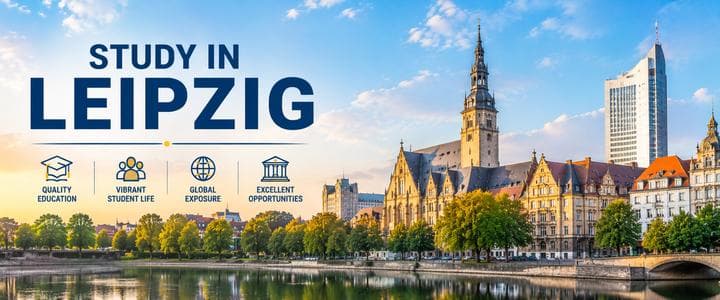
Leipzig is one of Germany’s most attractive student cities for international applicants seeking affordable public education, comparatively reasonable living costs, a large student community, and growing career opportunities. Located in the state of Saxony, Leipzig combines the academic range of a major research university with practice-oriented engineering education, private business programs, specialized arts and music institutions, and access to expanding technology, automotive, logistics, healthcare, and energy industries.
Leipzig University offers programs across medicine, veterinary science, economics, natural sciences, humanities, law, social sciences, education, and sports. HTWK Leipzig focuses on applied engineering, computer science, business, construction, media, and cultural studies. Students interested in management can consider HHL Leipzig Graduate School of Management, while creative applicants can explore the Academy of Fine Arts Leipzig and the University of Music and Theatre Leipzig.
Regular degrees at Leipzig University and HTWK Leipzig generally do not charge tuition fees, including for most non-EU students. Students pay a semester contribution that includes student services and a Germany-wide local and regional transportation ticket. Important exceptions include private universities, specialized international programs, long-term study fees, and non-EU tuition at the University of Music and Theatre Leipzig.
Although Leipzig remains less expensive than Munich, Frankfurt, or Stuttgart, housing costs have increased. Students should use current accommodation figures rather than relying on older descriptions of Leipzig as an extremely cheap city.
Study in Leipzig at a Glance
| Category | Details |
|---|---|
| City | Leipzig, Saxony |
| Major public university | Leipzig University |
| Major applied sciences university | HTWK Leipzig |
| Leading private business school | HHL Leipzig Graduate School of Management |
| Specialized institutions | Academy of Fine Arts Leipzig and University of Music and Theatre Leipzig |
| Popular study areas | Medicine, economics, computer science, engineering, biotechnology, psychology, social sciences, logistics, music, arts, and business |
| Main languages of instruction | German and English |
| Public university tuition | Usually no tuition for regular degree programs |
| Typical semester contribution | Approximately €330, depending on the institution and semester |
| Estimated student budget | Approximately €900–€1,250 per month |
| Student residence rent | Commonly €215–€435, depending on room type |
| Main advantage | Lower living costs than many major German cities |
| Main challenge | Limited English-taught bachelor’s options |
| Public transportation | Trams, buses, S-Bahn, regional trains, and Deutschlandsemesterticket |
| Nearby cities | Halle, Dresden, Chemnitz, Jena, Berlin, and Magdeburg |
| Major industries | Automotive, logistics, IT, e-commerce, life sciences, energy, media, and advanced manufacturing |
Why Study in Leipzig?
Leipzig is suitable for students who want the cultural and academic opportunities of a major German city without the living costs associated with Germany’s most expensive metropolitan areas.
Affordable Public Education
Most regular bachelor’s and consecutive master’s programs at Leipzig University and HTWK Leipzig do not charge tuition fees.
Students pay a semester contribution covering:
Student services
Student representation
Public transportation
Mobility services
Subsidized cafeterias
Social and counseling services
Unlike public universities in Baden-Württemberg, Leipzig’s state universities do not generally impose a separate €1,500-per-semester tuition fee on non-EU students.
Comparatively Affordable Housing
Leipzig offers some of the most affordable student residence rents among Germany’s major cities. Studentenwerk Leipzig operates approximately 5,200 rooms across 15 residential complexes.
Typical residence prices include:
€215–€325 for many shared-flat rooms
€295–€435 for many apartments
Higher amounts for larger or centrally located units
Private housing is more expensive, but students can still find shared rooms at prices below those common in Munich, Frankfurt, Hamburg, or Stuttgart.
Large Student Community
Approximately 40,000 students study across Leipzig’s universities and academies. This creates an active student environment with:
Student clubs
International associations
Sports programs
Language exchanges
Cultural events
Music venues
Art exhibitions
Career fairs
Student initiatives
Affordable restaurants and cafés
The city’s student population is distributed across central, southern, eastern, and western neighborhoods.
Growing Career Market
Leipzig has developed beyond its traditional role as a cultural, publishing, and trade-fair city. Important employment sectors now include:
Automotive manufacturing
Logistics
E-commerce
Information technology
Artificial intelligence
Healthcare
Biotechnology
Energy
Environmental technology
Advanced manufacturing
Media and broadcasting
Consulting
Startups
Students can access internships and working-student positions with companies, research institutes, hospitals, logistics businesses, software firms, and public organizations.
Strong Research Environment
Leipzig has important research organizations, including:
Helmholtz Centre for Environmental Research
German Centre for Integrative Biodiversity Research
German Biomass Research Centre
Max Planck institutes
Fraunhofer-related research activities
University Hospital Leipzig
Leipzig University research centers
This environment is particularly valuable for students in environmental science, biodiversity, medicine, neuroscience, biotechnology, physics, chemistry, data science, and sustainability.
Cultural and Creative Atmosphere
Leipzig is known for music, visual arts, publishing, literature, theater, classical culture, and alternative creative communities.
The city has historical associations with composers such as Johann Sebastian Bach and Felix Mendelssohn. It also has contemporary art galleries, independent studios, music venues, media organizations, and festivals.
Excellent Regional Transportation
Leipzig has a major central railway station with connections to Berlin, Dresden, Frankfurt, Munich, Hamburg, and other German cities.
Leipzig/Halle Airport supports passenger and cargo operations, while the local network includes trams, buses, S-Bahn services, and regional trains.
Best Universities in Leipzig
| Institution | Type | Major strengths | Tuition profile |
|---|---|---|---|
| Leipzig University | Public research university | Medicine, sciences, economics, law, humanities, psychology, veterinary medicine, and social sciences | No general tuition for regular programs; semester contribution |
| HTWK Leipzig | Public university of applied sciences | Engineering, IT, construction, business, media, and cultural studies | No general tuition for most programs; semester contribution |
| HHL Leipzig Graduate School of Management | Private business school | Management, entrepreneurship, finance, leadership, and MBA education | Substantial private tuition |
| Academy of Fine Arts Leipzig | Public arts academy | Painting, printmaking, photography, graphic design, book art, and media art | Semester contribution; program-specific fees may apply |
| University of Music and Theatre Leipzig | Public specialized university | Music, theater, performance, composition, and dramaturgy | Non-EU tuition plus semester contribution |
| Duale Hochschule Sachsen – Leipzig | Public dual-study institution | Computer science, real estate, taxation, auditing, and applied business | No general tuition; employer-linked study |
| Lancaster University Leipzig | Private international institution | Business, computer science, software engineering, and data-related fields | Private tuition |
Leipzig University
Leipzig University is one of Germany’s major comprehensive public research universities. It provides education in the humanities, natural sciences, medicine, veterinary medicine, economics, social sciences, law, education, sports, and language studies.
Major Academic Areas
The university offers programs related to:
Medicine
Dentistry
Veterinary medicine
Pharmacy
Biology
Biochemistry
Chemistry
Physics
Mathematics
Computer science
Economics
Business information systems
Law
Psychology
Political science
Sociology
Sports science
Education
Linguistics
History
Philosophy
Cultural studies
Communication and media studies
Campus Locations
Leipzig University is spread across several locations.
Augustusplatz Campus
The central Augustusplatz Campus includes:
Lecture halls
University administration
Central academic facilities
Humanities and social-science activities
Economics-related facilities
The central university library environment
Its central location provides easy access to public transportation, shops, restaurants, and cultural venues.
Medical Campus
Medical education and clinical research are connected with University Hospital Leipzig and facilities near Liebigstraße.
Veterinary Campus
Veterinary medicine has specialized facilities located away from the main Augustusplatz Campus. Veterinary students should check commute times before selecting housing.
Science and Research Locations
Natural-science institutes and research centers are distributed across several areas. Students may need to travel between teaching, laboratory, and research locations.
Popular Programs
Popular Leipzig University study areas include:
Medicine
Veterinary medicine
Psychology
Economics
Computer science
Business information systems
Biology
Biodiversity
Biochemistry
Physics
Chemistry
Sport science
Law
Global studies
Linguistics
Communication
Political science
Sociology
English-Taught Programs
English-taught opportunities are mainly available at the master’s level.
Depending on the current intake, programs can include:
Economics
Global Studies
Global British Studies
American Studies
Linguistics
Sport and Exercise Psychology
Biodiversity, Ecology and Evolution
International Physics Studies
Advanced Spectroscopy
Sustainable Development
Small Enterprise Promotion and Training
Selected double-degree programs
Selected international law and social-science programs
Some programs are fully taught in English, while others combine English courses with German electives or administrative requirements.
Tuition and Semester Contribution
Leipzig University does not generally charge tuition for regular bachelor’s and consecutive master’s degrees.
For the winter semester 2025/26, the semester contribution was €332.30.
| Semester-fee component | Amount |
|---|---|
| Student body | €11.50 |
| Studentenwerk Leipzig | €90 |
| Deutschlandsemesterticket | €226.80 |
| Mobility fund | €4 |
| Total | €332.30 |
The contribution can change each semester.
Specialized international programs may charge tuition. Second-degree and long-term study charges can also apply under specific conditions.
Second-Degree and Long-Term Study Fees
Leipzig University may charge:
€350 per semester for certain second-degree cases
€500 per semester for long-term study beyond the permitted period
These charges are added to the regular semester contribution.
HTWK Leipzig
HTWK Leipzig, officially Leipzig University of Applied Sciences, provides practice-oriented education and applied research.
It is particularly strong in engineering, computer science, business, construction, media, and cultural studies.
Major Study Areas
HTWK Leipzig offers programs in:
Mechanical engineering
Electrical engineering
Energy technology
Civil engineering
Architecture
Industrial engineering
Computer science
Media computer science
Information technology
Business administration
International management
Publishing
Museum studies
Social work
Applied mathematics
Automation
Building technology
Teaching Style
HTWK programs commonly emphasize:
Applied projects
Laboratory work
Practical exercises
Industry collaboration
Internships
Small-group teaching
Professionally relevant skills
Applied research
Students seeking direct preparation for technical or business employment may prefer this structure over a more theoretical research-university program.
Language of Instruction
Most HTWK Leipzig degree programs are taught in German.
The International Management bachelor’s program includes a significant English-language component, but it is not necessarily a completely English-taught degree.
International students should expect to demonstrate strong German proficiency for most full-degree programs.
Application Route
International degree applicants generally apply through uni-assist.
The application may require:
Recognized university entrance qualification
School or university transcripts
German-language certificate
APS certificate
Passport
Certified translations
Subject-specific documents
Evidence of previous study
Internship documentation where applicable
Tuition and Semester Fees
HTWK Leipzig generally does not charge tuition for first bachelor’s degrees and most master’s programs.
Students pay a semester contribution that supports student services and public transportation.
Exceptions can include:
Specialized master’s programs
International cooperative programs
Long-term study
Continuing-education programs
HTWK can charge €500 per semester when students exceed the standard study period by the applicable number of semesters.
HHL Leipzig Graduate School of Management
HHL Leipzig Graduate School of Management is a private business school focused on management, leadership, finance, entrepreneurship, strategy, and executive education.
Popular Programs
HHL offers programs such as:
Master in Management
Master in Management with a finance focus
Full-Time MBA
Part-Time MBA
Part-Time Master in Management
Doctoral programs
Executive education
Programs are designed for students seeking private business education, international cohorts, entrepreneurship support, career coaching, and corporate networking.
Tuition Fees
HHL charges substantial tuition.
| Program | Current total tuition |
|---|---|
| Full-Time Master in Management | €38,500 |
| Full-Time MBA | €42,500 |
| Part-Time Master in Management | €38,500 |
| Part-Time MBA | €42,500 |
The school offers early-application discounts, scholarships, installment plans, and financing options.
Students should compare HHL with tuition-free public alternatives and assess:
Career objectives
Program specialization
Work experience
Scholarship probability
Expected return on investment
Personal borrowing capacity
Academy of Fine Arts Leipzig
The Academy of Fine Arts Leipzig, commonly known as HGB Leipzig, is a public institution specializing in visual arts and design.
Study Areas
Programs include:
Painting
Printmaking
Photography
Book design
Graphic design
Media art
Fine arts
Artistic postgraduate study
The academy is known for studio-based education, artistic experimentation, individual supervision, workshops, exhibitions, and interdisciplinary practice.
Admission
Applicants generally need:
Artistic portfolio
Work samples
Entrance examination
Academic documents
Language proficiency
Evidence of artistic ability
Additional enrollment documents after passing selection
International and German applicants are assessed through the artistic entrance procedure. Qualification and language documents may be required after the applicant passes the artistic selection.
Students pay semester charges supporting Studentenwerk services, transportation, and student representation. Certain specialized programs can have additional tuition.
University of Music and Theatre Leipzig
The University of Music and Theatre “Felix Mendelssohn Bartholdy” Leipzig is one of Germany’s historically important music academies.
Study Areas
Programs include:
Instrumental performance
Vocal performance
Composition
Conducting
Church music
Jazz
Popular music
Dramaturgy
Acting
Music education
Early music
Theater studies
Admission
Admission usually requires:
Online application
Artistic résumé
Audition recording
Entrance examination
Language certificate
Academic documents
Program-specific repertoire
Interview or theoretical examination
Non-EU Tuition
Unlike Leipzig University and HTWK Leipzig, the University of Music and Theatre charges non-EU students €1,800 per semester in addition to the semester contribution.
The institution offers a scholarship program for enrolled non-EU students with demonstrated financial need. Funding can cover up to the amount of tuition, but students can apply only after enrollment and should not assume they will receive it.
Duale Hochschule Sachsen – Leipzig
Duale Hochschule Sachsen offers employer-linked dual programs. Students divide their time between university study and practical training with an approved partner organization.
Leipzig-based programs can include:
Computer science
Real estate management
Tax consulting
Auditing
Sustainable engineering for real estate and facilities
Dual students generally:
Sign a contract with a practice partner
Receive monthly compensation
Gain work experience
Alternate between study and employment
Pay no general tuition
Most programs are taught in German. International applicants need strong German skills and must secure a participating employer.
Popular Courses in Leipzig
Medicine and Healthcare
Leipzig University and University Hospital Leipzig provide education and research in:
Medicine
Dentistry
Pharmacy
Neuroscience
Public health
Clinical research
Medical biotechnology
Psychology
Medicine and dentistry are primarily taught in German and have highly competitive admission requirements.
Veterinary Medicine
Leipzig University is one of the German institutions offering veterinary medicine. The program is taught in German and includes scientific, clinical, laboratory, and practical training.
International applicants need:
Recognized university entrance qualification
Strong German proficiency
Competitive academic results
Complete application through the designated process
Computer Science and Information Technology
Students can pursue:
Computer science
Software engineering
Data science
Artificial intelligence
Business information systems
Media computer science
Information technology
Automation
Digital business
Cybersecurity
Logistics technology
Leipzig’s growing IT and digital sector provides opportunities in software development, e-commerce, AI, logistics systems, and health technology.
Engineering
HTWK Leipzig offers applied programs in:
Mechanical engineering
Electrical engineering
Civil engineering
Energy technology
Industrial engineering
Building services
Automation
Architecture
Construction management
The local automotive, manufacturing, logistics, and energy sectors create opportunities for practical projects and employment.
Economics and Business
Students can study:
Economics
Business administration
Information systems
Finance
Entrepreneurship
International management
Sustainable economics
Small enterprise development
Business analytics
Leipzig University provides public academic options, while HHL offers premium private management education.
Environmental Science and Sustainability
Leipzig is an important location for:
Biodiversity
Ecology
Environmental science
Bioenergy
Climate research
Sustainable development
Environmental economics
Renewable energy
Urban systems
The presence of UFZ, iDiv, DBFZ, and university research centers supports research-oriented study and employment.
Psychology and Sports Science
Leipzig University offers programs and research related to:
Psychology
Cognitive science
Sports science
Exercise science
Sport and exercise psychology
Rehabilitation
Movement science
The English-taught Sport and Exercise Psychology master’s is a notable option for international students with a relevant academic background.
Arts, Music, and Media
Students can pursue:
Painting
Photography
Graphic design
Book art
Media art
Music
Acting
Composition
Conducting
Dramaturgy
Publishing
Media technology
Admission to artistic programs depends heavily on portfolios, auditions, and entrance examinations.
Admission Requirements
Requirements vary by institution, degree, teaching language, and previous qualification.
Bachelor’s Admission Requirements
A typical international bachelor’s application may require:
Recognized school-leaving qualification
Proof of university entrance eligibility
School transcripts
German-language certificate
APS certificate
Passport
Certified translations
Curriculum vitae
Portfolio or audition
Entrance examination
Studienkolleg application where required
Indian Class 12 qualifications do not automatically provide direct admission to every German bachelor’s degree.
Eligibility depends on:
School board
Academic marks
Completed subjects
Previous university study
Entrance-examination results
Intended program
Current qualification-recognition rules
Some Indian applicants need to complete Studienkolleg and pass the Feststellungsprüfung before applying for a degree.
Studienkolleg Sachsen
Applicants without direct university entrance eligibility may apply for Studienkolleg Sachsen through uni-assist.
The Studienkolleg offers preparation for fields such as:
Natural sciences
Engineering
Economics
Humanities
Languages
Medicine and biology
Applicants generally need at least B2 German for the focus-course application and must pass an entrance examination.
The entrance examination includes:
German for all focus courses
Mathematics for selected technical, medical, and economics courses
A personal contribution of €750 is currently charged at the start of the Studienkolleg course. Examination charges may be payable separately.
Passing Studienkolleg does not automatically guarantee admission to a restricted university program.
Master’s Admission Requirements
A master’s application can require:
Recognized relevant bachelor’s degree
Minimum academic grade
Subject-specific credits
Degree certificate
Transcript
Module descriptions
Grading-system explanation
English or German language proof
APS certificate
Curriculum vitae
Statement of purpose
Letters of recommendation
Work experience
Portfolio
Faculty-specific application
Online assessment or interview
Departments evaluate the content of the previous degree. Applicants should compare their transcript with the required academic areas rather than relying only on the degree title.
German Language Requirements
Most bachelor’s and many master’s programs in Leipzig are taught in German.
Commonly accepted qualifications can include:
TestDaF with TDN 4 in all sections
DSH-2 or DSH-3
telc Deutsch C1 Hochschule
Goethe-Zertifikat C2
Deutsches Sprachdiplom at the accepted level
Other qualifications recognized by the institution
Leipzig University generally expects C1 German for enrollment in German-taught undergraduate programs. Some applications may begin with B2 proof, but the final approved certificate must be submitted by the required stage.
English Language Requirements
English-taught programs may accept:
IELTS Academic
TOEFL iBT
Cambridge English
Approved previous education in English
Program-specific alternative evidence
Typical requirements range from IELTS 6.0 to 7.0.
Leipzig University’s international Small Enterprise Promotion and Training program, for example, accepts IELTS Academic 6.0 or TOEFL iBT 78 among its listed options.
A medium-of-instruction certificate is accepted only when the program explicitly allows it.
APS Certificate for Indian Students
Indian applicants generally need APS verification when their relevant academic qualification was issued by an Indian institution.
APS may be required for:
Leipzig University admission
HTWK Leipzig admission
uni-assist document evaluation
German student visa application
Enrollment at selected institutions
Applicants should:
Identify the appropriate APS procedure.
Review the latest checklist.
Check whether dMAT applies to their academic field.
Collect complete academic documents.
Apply early.
Upload the digital APS certificate in the required form.
Follow separate university and visa procedures.
APS verifies academic documentation. It does not provide admission and does not decide the visa application.
Application Routes
Leipzig University
International applicants commonly apply through uni-assist.
Bachelor’s, Diplom, state-examination, and many master’s applications with foreign qualifications are submitted through My assist.
Some programs also require:
Additional faculty application
Aptitude assessment
Portfolio
Interview
Department-specific documents
Enrollment through Leipzig University’s AlmaWeb system
HTWK Leipzig
International degree applicants generally use uni-assist. Eligible applications are then processed according to the university’s admission procedure.
HHL Leipzig
HHL uses its own application system. Applicants may need:
University degree
English-language proof
Curriculum vitae
Work experience
GMAT, GRE, or HHL Entry Test
Interview
Motivation documents
Arts and Music Institutions
HGB and HMT Leipzig use their own application and artistic-selection procedures. Portfolio and audition deadlines may be earlier than general university deadlines.
Cost of Studying in Leipzig
Public University Costs
| Expense | Estimated amount |
|---|---|
| Tuition at Leipzig University | Usually €0 |
| Tuition at HTWK Leipzig | Usually €0 |
| Semester contribution | Approximately €330 |
| Study materials | €20–€60 per month |
| Studienkolleg personal contribution | €750 for the preparatory course |
| Long-term study fee | €500 per semester where applicable |
| Second-degree fee | Program and eligibility dependent |
Private and Specialized Tuition
| Institution or program | Indicative tuition |
|---|---|
| HHL Master in Management | €38,500 total |
| HHL MBA | €42,500 total |
| HMT Leipzig non-EU tuition | €1,800 per semester |
| Specialized Leipzig University programs | Program-specific |
| Private international institutions | Program-specific |
Cost of Living in Leipzig
Leipzig University advises students to plan around €1,000 per month for living expenses.
| Expense | Typical monthly range |
|---|---|
| Student residence room | €215–€325 |
| Student residence apartment | €295–€435 |
| Private shared-flat room | €400–€600 |
| Private studio | €600–€900 or more |
| Food and groceries | €220–€320 |
| Health insurance | €140–€180 |
| Semester contribution, monthly equivalent | Approximately €55 |
| Phone and internet | €15–€35 |
| Study materials | €20–€60 |
| Leisure and personal expenses | €80–€160 |
| Broadcasting fee per household | Approximately €18 |
| Miscellaneous costs | €50–€100 |
Estimated Monthly Budget
| Living arrangement | Estimated monthly budget |
|---|---|
| Student residence | €850–€1,100 |
| Private shared apartment | €950–€1,250 |
| Private studio | €1,100–€1,500 |
Estimated Annual Budget
A student using a residence or shared apartment should prepare approximately €10,800–€15,000 annually, excluding private tuition, international travel, and major emergencies.
The German study-visa financial-proof amount for 2026 is €11,904, equivalent to €992 per month. Leipzig students with affordable residence housing may remain close to this amount, but private rent and personal expenses can push the real budget higher.
Student Accommodation in Leipzig
Leipzig’s housing market is easier than those of Munich or Frankfurt, but affordable rooms still receive significant demand.
Studentenwerk Leipzig Residences
Studentenwerk Leipzig operates around 5,200 rooms in 15 residential complexes.
Housing options include:
Single rooms in shared apartments
Larger shared apartments
One-room apartments
Furnished rooms
Accessible accommodation
Family accommodation
Most rents are flat-rate warm rents and can include:
Heating
Electricity
Water
Internet
Television connection
Furniture
A typical deposit is €450.
Private Shared Apartments
Private WG rooms commonly cost €400–€600. Prices depend on:
Neighborhood
Room size
Renovation
Furnishing
Utility inclusion
Public transportation
Distance from the university
Existing residents often choose new tenants through a WG interview. Applicants should send a short introduction describing their study program, lifestyle, language ability, and intended move-in date.
Private Studios
Private studios generally cost €600–€900 or more. Central or newly built units can exceed this range.
Students should confirm:
Cold rent
Warm rent
Electricity
Internet
Heating
Deposit
Furniture
Minimum contract period
Anmeldung eligibility
Popular Student Neighborhoods
| Area | Suitable for | General character |
|---|---|---|
| Zentrum | Central university access | Convenient and comparatively expensive |
| Zentrum-Süd | Leipzig University and arts students | Central, attractive, and popular |
| Südvorstadt | Students seeking cafés and nightlife | Lively and well connected |
| Connewitz | HTWK and alternative-culture students | Creative and popular |
| Reudnitz-Thonberg | University and medical-campus access | Diverse with comparatively reasonable rents |
| Stötteritz | Students seeking a quieter area | Residential and well connected |
| Plagwitz | Creative and media students | Industrial character, arts, and cafés |
| Lindenau | Students seeking western Leipzig | Diverse with cultural venues |
| Schleußig | Students seeking parks and waterways | Attractive but increasingly expensive |
| Gohlis | Students preferring a residential district | Quiet with tram connections |
| Grünau | Budget-focused students | Farther from the center but more affordable |
| Paunsdorf | Students considering eastern alternatives | Residential with public transportation |
Accommodation Scam Protection
Before paying:
Request an in-person or live video viewing.
Verify the property address.
Confirm the landlord’s identity and authority.
Read the rental agreement.
Check whether Anmeldung is permitted.
Identify warm and cold rent.
Confirm the deposit.
Avoid cryptocurrency and gift cards.
Do not send unnecessary sensitive documents.
Keep communication and payment records.
Be cautious with unusually low rent.
Avoid paying before receiving a credible contract.
Transportation for Students
Leipzig has one of Germany’s largest tram networks. Students can use:
Trams
Buses
S-Bahn
Regional trains
Bicycle-sharing services
Regional night services
The semester contribution at Leipzig University and HTWK includes a Deutschlandsemesterticket.
The ticket generally provides unlimited eligible travel on:
Local buses
Trams
U-Bahn systems in other cities
S-Bahn
Regional trains
Participating local transportation throughout Germany
It does not normally include:
ICE trains
IC trains
EC trains
First-class travel
Private long-distance buses
Seat reservations
Leipzig is relatively flat and suitable for cycling. Many students combine bicycles with trams and S-Bahn services.
Health Insurance
Health insurance is mandatory for enrollment and residence purposes.
Eligible students under 30 can generally join statutory health insurance at a reduced student rate. Students should budget approximately €140–€180 per month, depending on age, insurer, and care-insurance surcharge.
A policy should be accepted for:
Visa processing
University enrollment
Residence permits
Regular medical care
Long-term study
Travel insurance generally does not replace full student health coverage after enrollment.
Scholarships
Students in Leipzig can consider:
DAAD scholarships
Deutschlandstipendium
Erasmus+ funding
University scholarships
Foundation scholarships
STIBET support
HHL scholarships
HMT non-EU tuition scholarship
Subject-specific research funding
Completion grants
Doctoral funding
Deutschlandstipendium
The Deutschlandstipendium provides €300 per month to selected students.
Selection can consider:
Academic performance
Social engagement
Personal circumstances
Leadership
Professional experience
Family responsibilities
Voluntary activities
DAAD Scholarships
DAAD funding is more common for master’s, doctoral, exchange, research, and development-related programs than for complete bachelor’s degrees.
HHL Scholarships
HHL provides scholarships, early-application discounts, and financing options for selected master’s and MBA applicants.
Awards are competitive and do not automatically cover the complete tuition amount.
HMT Non-EU Scholarship
Eligible enrolled non-EU students at HMT Leipzig can apply for need-based support covering up to the tuition amount. Students should still prepare to pay the fee because support is not guaranteed before enrollment.
Part-Time Jobs in Leipzig
Potential student jobs include:
University research assistant
Teaching assistant
Library employee
Software developer
IT support assistant
Logistics employee
Warehouse assistant
E-commerce employee
Automotive working student
Manufacturing assistant
Hospital support employee
Laboratory assistant
Restaurant employee
Retail worker
Event staff
Tutor
Media-production assistant
Customer-support employee
Non-EU students with the appropriate study residence permit can generally work up to 140 full days or 280 half days per year. An alternative framework may permit up to 20 hours per week during the lecture period.
Mandatory internships and university student-assistant roles can be treated differently.
Studentenwerk Leipzig operates a student job service through which enrolled students can search for vacancies.
German proficiency improves access to customer-facing, administrative, healthcare, and office roles.
Internships and Career Opportunities
Automotive Manufacturing
Leipzig has major automotive operations connected with BMW and Porsche.
Students can pursue opportunities in:
Production engineering
Automotive technology
Quality management
Logistics
Supply chain management
Industrial automation
Electric mobility
Software
Manufacturing systems
Logistics and E-Commerce
Leipzig/Halle Airport is an important European cargo and logistics location. DHL operates a major hub in the region.
Career areas include:
Logistics planning
Warehouse management
Supply chain analytics
Transportation
Procurement
E-commerce operations
Aviation logistics
IT systems
Process optimization
Information Technology
The Leipzig region has a growing digital economy involving:
Software development
Artificial intelligence
Big data
Cybersecurity
E-health
E-commerce
Logistics technology
Cloud systems
Digital platforms
IT consulting
Energy and Environmental Technology
Students can explore roles in:
Renewable energy
Energy markets
Bioenergy
Climate technology
Environmental consulting
Biodiversity research
Sustainability
Resource management
Organizations such as UFZ, DBFZ, and the European Energy Exchange contribute to Leipzig’s environmental and energy ecosystem.
Life Sciences and Healthcare
Leipzig offers opportunities in:
Hospitals
Clinical research
Biotechnology
Medical technology
Pharmaceutical logistics
Laboratory science
Public health
Neuroscience
Veterinary research
Media and Creative Industries
Career areas include:
Broadcasting
Film
Publishing
Photography
Graphic design
Media technology
Music
Journalism
Digital content
Advertising
Student Life in Leipzig
Leipzig has a lively student culture with a combination of historic architecture, alternative neighborhoods, music, art, parks, lakes, and nightlife.
Popular activities include:
Visiting Augustusplatz
Exploring the city center
Walking through Clara-Zetkin Park
Cycling along waterways
Visiting Leipzig Zoo
Attending concerts
Exploring Plagwitz
Visiting art galleries
Attending Bach-related cultural events
Visiting the Leipzig Book Fair
Swimming in nearby lakes
Joining university sports
Exploring cafés in Südvorstadt
Taking day trips to Dresden or Berlin
Food
Students can reduce costs by using university cafeterias and cooking at home.
Leipzig offers:
Indian restaurants
South Asian grocery stores
Turkish and Middle Eastern food
Asian supermarkets
Vegetarian and vegan restaurants
German bakeries
International street food
Affordable cafés
Indian Student Life
Indian students can connect through:
University international groups
Cultural associations
Professional networks
Religious communities
Regional Indian events
Social-media groups
Language-exchange programs
Learning German remains important even when the degree is taught in English.
Climate
Leipzig has warm summers and cold winters.
Students can expect:
Warm or occasionally hot summers
Cold winter periods
Occasional snow
Rain throughout the year
Short winter daylight hours
Variable spring and autumn weather
A waterproof jacket, winter coat, layered clothing, and suitable footwear are recommended.
Safety
Leipzig is generally safe for international students.
Students should:
Secure valuables on public transportation.
Avoid poorly lit routes late at night.
Use official taxis or transportation services.
Protect passports and residence cards.
Verify accommodation offers.
Avoid carrying large amounts of cash.
Learn late-night transport routes.
Take care during crowded festivals.
Report stolen documents immediately.
Keep emergency contacts available.
Germany’s emergency number for medical and fire emergencies is 112. Police can be contacted at 110.
Advantages and Disadvantages of Studying in Leipzig
| Advantages | Disadvantages |
|---|---|
| No general tuition at major public universities | Limited English-taught bachelor’s programs |
| Affordable student residences | Private housing costs are increasing |
| Large and active student community | German is necessary for most undergraduate study |
| Growing automotive, IT, and logistics sectors | Part-time wages may be lower than in western German cities |
| Strong environmental and life-science research | Some specialized programs charge tuition |
| Excellent arts and music environment | HMT charges non-EU tuition |
| Semester contribution includes transportation | Not every neighborhood is close to every campus |
| Good connections to Berlin and Dresden | Affordable residence availability is not guaranteed |
Application Timeline
Twelve to Eighteen Months Before Enrollment
Research universities and programs.
Check the language of instruction.
Verify direct admission eligibility.
Review Studienkolleg requirements.
Begin German preparation.
Review APS and dMAT requirements.
Estimate the complete budget.
Nine to Twelve Months Before Enrollment
Take IELTS, TOEFL, TestDaF, or another required test.
Collect academic documents.
Arrange translations.
Apply for APS.
Prepare the statement of purpose.
Request recommendations.
Prepare a portfolio or audition.
Six to Nine Months Before Enrollment
Apply through uni-assist.
Complete faculty-specific applications.
Apply for scholarships.
Submit artistic applications.
Apply for student residences.
Track application status.
Three to Six Months Before Enrollment
Accept the admission offer.
Pay semester fees.
Arrange health insurance.
Prepare financial proof.
Submit the visa application.
Confirm temporary or permanent accommodation.
Before Departure
Complete enrollment.
Prepare original documents.
Arrange travel.
Carry essential medicines.
Review campus locations.
Learn basic administrative German.
Arrange funds for the deposit and first rent.
After Arrival
Register the address.
Activate a German bank account.
Complete health-insurance registration.
Activate the semester ticket.
Apply for a residence permit when necessary.
Attend orientation.
Register for courses.
Join student and career networks.
Checklist for Indian Students
Indian applicants should prepare:
Valid passport
Class 10 documents
Class 12 documents
University transcripts
Bachelor’s degree or provisional certificate
APS certificate
dMAT certificate if applicable
German or English language certificate
Curriculum vitae
Statement of purpose
Recommendation letters
Module descriptions
Work-experience documents
Portfolio or audition materials
uni-assist application
Admission letter
Proof of financial resources
Health-insurance evidence
Visa documents
Accommodation plan
Certified translations where required
Common Mistakes to Avoid
Assuming Every English Course Forms an English-Taught Degree
A university may offer individual English modules while the full program remains German-taught.
Using Outdated Living-Cost Figures
Older guides may describe monthly expenses of €650–€750. Leipzig University currently recommends planning around €1,000 per month.
Applying Without APS
APS may be required during uni-assist evaluation, university admission, and the visa process.
Missing the Studienkolleg Language Requirement
Applicants usually need German before entering Studienkolleg. It is not a zero-level language course.
Ignoring Separate Program Fees
Regular Leipzig University programs may be tuition-free, but international joint programs, HHL degrees, and HMT programs can charge substantial fees.
Applying Only for Residence Housing
Students should apply for a residence while continuing to search for private shared accommodation.
Depending Entirely on Part-Time Employment
Student jobs should supplement an existing financial plan. They should not be the only source for rent and essential expenses.
Ignoring German Language Skills
German is essential for most bachelor’s programs and improves housing, employment, internships, and social integration.
Frequently Asked Questions
Is Leipzig a good city for international students?
Yes. Leipzig offers affordable public universities, comparatively reasonable housing, active student life, and growing employment opportunities.
Is studying at Leipzig University free?
Most regular bachelor’s and consecutive master’s programs do not charge tuition. Students pay a semester contribution.
Do Indian students pay tuition at Leipzig University?
Indian students usually do not pay general tuition for regular Leipzig University degrees. Specialized, long-term, second-degree, or international programs may charge fees.
How much does it cost to live in Leipzig?
Students should plan approximately €900–€1,250 per month with residence or shared accommodation.
Is Leipzig cheaper than Berlin?
Leipzig is generally more affordable, especially for accommodation, although the gap has narrowed as Leipzig rents have increased.
Can I study in Leipzig in English?
Yes, mainly at the master’s level. Leipzig University, HHL, and selected private institutions offer English-taught programs.
Are English-taught bachelor’s degrees common?
No. Most public bachelor’s programs are taught in German. Private institutions may offer more English options.
Which university is best for engineering?
HTWK Leipzig is the city’s principal practice-oriented engineering institution.
Which university is best for business?
Leipzig University offers public economics and business-related programs. HHL offers specialized private management and MBA education.
Which university is best for medicine?
Leipzig University is the city’s major institution for medicine, dentistry, pharmacy, and clinical research.
Is Leipzig good for computer science?
Yes. Students can study computer science, information systems, media computer science, and related fields while accessing a growing regional IT industry.
Is IELTS required?
IELTS is accepted by many English-taught programs, but TOEFL and other approved qualifications may also be accepted.
Is German required for an English-taught program?
It may not be required for admission, but German is useful for daily life, student jobs, internships, and long-term employment.
Is APS required for Indian students?
Applicants with Indian academic qualifications generally need APS verification for admission and the visa process.
Is dMAT required for every Indian master’s applicant?
No. It applies only to selected academic fields and applicant groups under current APS rules.
Does Leipzig University use uni-assist?
Yes. International applicants with foreign qualifications commonly apply through uni-assist.
Is student accommodation easy to find?
Leipzig is easier than many expensive German cities, but affordable residence rooms are still limited. Early application is recommended.
Does the semester contribution include transportation?
At Leipzig University and HTWK Leipzig, it includes a Deutschlandsemesterticket for eligible local and regional transportation.
Can international students work part time?
Eligible non-EU students can generally work up to 140 full days or 280 half days annually, subject to residence and employment rules.
Is Leipzig safe for Indian students?
Yes. Leipzig is generally safe for Indian and other international students. Standard urban precautions are recommended.
Final Thoughts
Leipzig is one of Germany’s strongest value-for-money study destinations. It offers the academic range of a major research university, applied engineering education, respected arts and music institutions, and an increasingly diverse employment market.
Leipzig University is particularly attractive for medicine, veterinary medicine, sciences, economics, psychology, biodiversity, and humanities. HTWK Leipzig provides career-oriented engineering, IT, construction, and business education. HHL serves applicants seeking premium private management education, while HGB and HMT support artistic and musical careers.
The city’s principal advantages are tuition-free public study, affordable student residences, an active cultural environment, and growing opportunities in automotive manufacturing, logistics, IT, environmental science, healthcare, and energy.
Students should still budget approximately €1,000 per month, begin learning German, complete APS early, and apply for accommodation before demand increases around the semester start.
With realistic financial planning and the right program choice, Leipzig can provide international students with an affordable, academically rewarding, and professionally valuable German study experience.