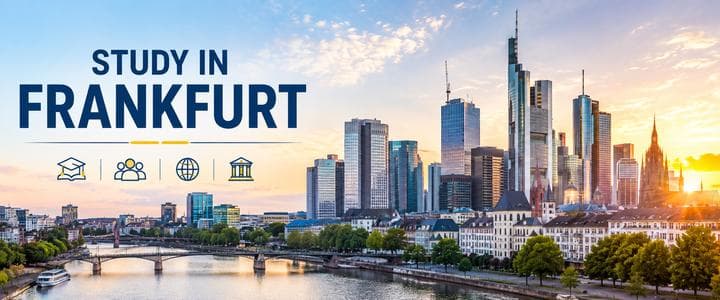
Frankfurt am Main is one of Germany’s most international cities and one of Europe’s most important financial, commercial, and transportation centers. Best known as the home of the European Central Bank, Frankfurt also offers respected public universities, specialized arts institutions, practice-oriented programs, and internationally recognized private business schools.
For international students, Frankfurt provides a combination that is difficult to find elsewhere: affordable public education, English-taught master’s programs, strong industry connections, excellent public transportation, and direct access to employers in banking, consulting, technology, logistics, aviation, healthcare, and professional services.
However, Frankfurt is also one of Germany’s more expensive student cities. Accommodation is competitive, private rents are high, and students need to plan their finances carefully. The city is therefore best suited to applicants who value career exposure and international opportunities and are prepared to begin their housing search early.
Study in Frankfurt at a Glance
| Category | Details |
|---|---|
| City | Frankfurt am Main, Hesse |
| Best known for | Finance, banking, consulting, aviation, logistics, trade fairs, technology, and international business |
| Major public university | Goethe University Frankfurt |
| Major applied sciences university | Frankfurt University of Applied Sciences |
| Leading private institution | Frankfurt School of Finance & Management |
| Other institutions | Städelschule, HfMDK Frankfurt, Provadis School, and specialized colleges |
| Popular study areas | Finance, economics, management, computer science, data science, engineering, logistics, medicine, law, social sciences, architecture, arts, and music |
| Main languages of instruction | German and English |
| Public university tuition | Usually no general tuition fee for standard degree programs |
| Semester contribution | Commonly around €390–€410 per semester, depending on the institution |
| Typical student budget | Approximately €1,100–€1,500 per month with private shared accommodation |
| Main challenge | Expensive and highly competitive housing |
| Main advantage | Exceptional access to international employers and professional networks |
| Nearest major airport | Frankfurt Airport |
| Public transportation | U-Bahn, S-Bahn, trams, buses, regional trains, and national rail connections |
Why Study in Frankfurt?
Frankfurt is not traditionally described as a low-cost student city. Its appeal comes from professional exposure, international connectivity, and the quality of its academic and research institutions.
International Business Environment
Frankfurt is one of Europe’s most important financial centers. It is home to the European Central Bank, Deutsche Bundesbank, major commercial banks, insurance companies, investment firms, consulting organizations, and financial technology businesses.
This environment is particularly attractive for students in:
Finance
Economics
Business administration
Management
Accounting
Business analytics
Data science
Information systems
Law
Public policy
International relations
The city also hosts many multinational companies and regional offices, creating opportunities for internships, working-student positions, company projects, and graduate employment.
Strong Career Opportunities
Frankfurt’s economy extends well beyond banking. Important sectors include:
Financial services
Management consulting
Information technology
Cybersecurity
Data analytics
Logistics and supply chain management
Aviation and airport services
Pharmaceuticals and life sciences
Healthcare
Media and advertising
Trade fairs and events
Real estate
Legal and compliance services
Public institutions and international organizations
Students who combine a relevant degree with German-language ability can access a broad regional job market covering Frankfurt, Eschborn, Offenbach, Darmstadt, Wiesbaden, Mainz, and other parts of the Rhine-Main region.
Excellent Transportation Connections
Frankfurt is one of Germany’s most connected cities. Frankfurt Hauptbahnhof is a major national and international railway station, while Frankfurt Airport is one of Europe’s largest aviation hubs.
Students can travel easily to cities such as Cologne, Stuttgart, Heidelberg, Mannheim, Mainz, Wiesbaden, and Darmstadt. Local transportation includes S-Bahn trains, U-Bahn lines, trams, buses, and regional trains.
Multicultural Student Experience
A significant part of Frankfurt’s population has an international background. English is widely used in multinational workplaces and university environments, although German remains important for administration, daily life, part-time employment, and long-term career development.
International students can find cultural associations, religious communities, language-exchange groups, student organizations, international restaurants, and events representing communities from around the world.
Central European Location
Frankfurt’s location is useful for students who want to explore Germany and neighboring European countries. High-speed trains and international flights make travel relatively convenient.
This connectivity can also help students attending conferences, interviews, internships, academic events, or exchange programs.
Best Universities in Frankfurt
Frankfurt has public, private, research-oriented, practice-oriented, artistic, and specialized higher education institutions.
| Institution | Type | Major strengths | Tuition profile |
|---|---|---|---|
| Goethe University Frankfurt | Public research university | Finance, economics, law, medicine, sciences, humanities, and social sciences | Usually tuition-free, with a semester contribution |
| Frankfurt University of Applied Sciences | Public university of applied sciences | Engineering, IT, architecture, business, social work, logistics, and health | Usually tuition-free, with a semester contribution; exceptions apply |
| Frankfurt School of Finance & Management | Private university | Finance, management, banking, analytics, and business | Substantial tuition fees |
| Hochschule für Musik und Darstellende Kunst Frankfurt | Public arts institution | Music, theater, dance, and performing arts | Semester charges; aptitude-based admission |
| Städelschule | Public art academy | Fine arts, artistic practice, and curatorial studies | Generally no standard tuition for many programs, but semester charges apply |
| Provadis School of International Management and Technology | Private institution | Industry-linked science, technology, management, and dual programs | Program-specific tuition or employer-supported models |
| Sankt Georgen Graduate School | Specialized institution | Philosophy and theology | Program-specific conditions |
Goethe University Frankfurt
Goethe University Frankfurt is the city’s largest and most comprehensive public research university. It offers programs across economics, law, medicine, natural sciences, social sciences, humanities, education, computer science, and related disciplines.
The university operates across several campuses.
Campus Westend
Campus Westend is associated primarily with:
Economics and business
Law
Social sciences
Humanities
Theology
Educational sciences
University administration
It is known for modern academic buildings, large libraries, landscaped spaces, and proximity to central Frankfurt.
Campus Riedberg
Campus Riedberg focuses mainly on natural and life sciences, including:
Biology
Biochemistry
Chemistry
Physics
Pharmacy
Geosciences
Science-related research programs
Students attending Riedberg should consider transportation connections carefully when choosing accommodation.
Campus Niederrad
Campus Niederrad is connected with the University Hospital and medical education. It serves students and researchers in medicine, clinical science, and related healthcare disciplines.
Campus Bockenheim
Some university functions and departments have historically remained connected to the Bockenheim area. Applicants should check the exact teaching location of their chosen program because Goethe University is not concentrated on one campus.
Popular Programs at Goethe University
Popular study areas include:
Economics
Finance
Money and macroeconomics
Management science
International economics
Law
Medicine
Computer science
Data and digital technologies
Psychology
Political science
Sociology
Biosciences
Physics
Chemistry
Pharmacy
Linguistics
Literature and cultural studies
English-taught or substantially English-based master’s options include programs such as Management Science, Money, Macro and Finance, Empirical Linguistics, Anglophone Literatures, and several science-oriented degrees. Program availability and teaching language must be checked individually.
Tuition and Semester Contribution
Goethe University generally does not charge standard tuition fees for regular bachelor’s and consecutive master’s programs, including most international students. Students instead pay a semester contribution.
For the winter semester 2026/27, the total Goethe University semester contribution is €408.28. It includes the student-services contribution, administrative charge, student-body charges, mobility benefits, and the Germany-wide semester transport ticket.
This amount can change each semester. Specialized continuing-education, executive, or non-consecutive programs may charge additional tuition.
Frankfurt University of Applied Sciences
Frankfurt University of Applied Sciences, commonly called Frankfurt UAS, emphasizes practical education, applied research, project work, and employer cooperation.
Its major academic areas include:
Architecture
Civil engineering
Geomatics
Mechanical engineering
Electrical engineering
Information technology
Computer science
Business
Law
Logistics
Social work
Healthcare
Nursing
Urban development
Frankfurt UAS is a strong option for students who want professionally oriented programs and practical exposure rather than a purely theoretical academic structure.
English-Taught Programs
The university offers a limited but useful selection of fully English-taught master’s programs. Examples may include:
Information Technology
Global Logistics
Advanced Architecture
General Computer Science
High Integrity Systems
Urban Agglomerations
The list can change, and not every English-taught program follows the same tuition model. Certain specialized international programs may charge tuition even though regular public programs are generally tuition-free.
Application Route
Applicants with international educational qualifications usually apply through uni-assist, although the exact process depends on the program and applicant category.
Master’s applicants should check:
Required bachelor’s subject
Minimum academic credits
Grade requirements
Language certificate
Professional experience, if required
Portfolio or aptitude requirements
Application deadline
Whether additional program fees apply
Frankfurt UAS reports semester fees of approximately €390 twice per year, but the final amount should always be confirmed for the intended semester.
Frankfurt School of Finance & Management
Frankfurt School of Finance & Management is a private university specializing in finance, business, management, economics, analytics, and professional education.
It is known for:
Finance-focused education
Corporate partnerships
International student cohorts
English-taught degrees
Career services
Banking and consulting networks
Executive and professional programs
Popular programs include:
Bachelor in Business Administration
Master of Finance
Master in Management
Master of Applied Data Science
Full-Time MBA
Executive MBA
Doctoral programs
Frankfurt School is considerably more expensive than public universities. As an illustration, its Bachelor in Business Administration is priced at €8,200 per semester for the 2026 intake, while the Master of Finance carries total tuition of €42,000. Application and enrollment fees may be charged separately.
Students should evaluate the total cost against scholarship availability, career objectives, expected salary, and alternative public-university programs. Frankfurt School offers merit scholarships, diversity scholarships, financing arrangements, and other tuition-support options, but awards are competitive.
Hochschule für Musik und Darstellende Kunst Frankfurt
The Hochschule für Musik und Darstellende Kunst Frankfurt, or HfMDK, is a specialized public institution for music and performing arts.
Study areas include:
Instrumental performance
Vocal studies
Conducting
Composition
Music education
Theater
Dance
Performing arts
Admission normally depends heavily on an artistic aptitude test or audition. Applicants may need to submit recordings, portfolios, artistic résumés, or other evidence before being invited to an entrance examination.
German proficiency may be required even when musical instruction or individual supervision can partly take place in another language.
Städelschule
Städelschule is an internationally known art academy with a distinctive studio-based educational model. It is particularly suitable for students seeking intensive contemporary fine-art practice.
Admission is highly selective and based primarily on artistic potential and portfolio quality rather than conventional academic metrics alone.
Students should expect:
Portfolio evaluation
A competitive selection process
Studio-based work
Independent artistic development
Critical discussions
Close interaction with practicing artists
A diverse international community
The institution currently charges a semester fee rather than conventional high private-school tuition. Applicants must verify the amount and program-specific language requirements before applying.
Popular Courses in Frankfurt
Finance, Economics, and Banking
Frankfurt is one of Germany’s strongest locations for finance-related education. Students can study:
Finance
Financial economics
Banking
Monetary economics
Accounting
Risk management
Quantitative finance
Corporate finance
International economics
Financial regulation
The presence of banks, regulatory institutions, consultancies, and fintech companies makes the city especially valuable for internships and professional networking.
Business and Management
Business students can choose between research-oriented public programs, applied programs, and premium private-school degrees.
Common specializations include:
Management science
International management
Marketing analytics
Supply chain management
Business information systems
Strategy
Entrepreneurship
Human resource management
Sustainability management
Consulting
Computer Science and Data Science
Frankfurt’s financial and corporate sectors generate demand for graduates with skills in:
Software development
Artificial intelligence
Data analytics
Machine learning
Cybersecurity
Cloud computing
Business intelligence
Financial technology
Information systems
High-integrity systems
Students with both technical knowledge and German-language skills may find opportunities across Frankfurt and the broader Rhine-Main technology corridor.
Engineering and Information Technology
Frankfurt UAS and nearby Rhine-Main institutions offer programs related to:
Electrical engineering
Mechanical engineering
Civil engineering
Information technology
Telecommunications
Infrastructure
Renewable systems
Industrial engineering
Construction
Geomatics
Students interested in highly specialized engineering fields can also consider nearby institutions in Darmstadt, Friedberg, Rüsselsheim, and Wiesbaden.
Logistics and Aviation
Frankfurt Airport and the city’s central location create a strong ecosystem for:
Global logistics
Aviation management
Supply chain management
Transportation planning
International trade
Warehouse systems
Operations management
Airport services
These programs can lead to positions with logistics providers, airlines, airport operators, consultancies, and multinational companies.
Medicine, Pharmacy, and Life Sciences
Goethe University and University Hospital Frankfurt provide education and research opportunities in:
Medicine
Dentistry
Pharmacy
Biology
Biochemistry
Neuroscience
Molecular medicine
Clinical research
Public health
Medicine and pharmacy are generally taught in German and have demanding admission requirements. International applicants need strong German proficiency and must satisfy qualification-recognition requirements.
Law and Social Sciences
Frankfurt’s role as a financial and institutional center makes it a useful location for:
Law
Commercial law
European regulation
Political science
Sociology
International relations
Peace and conflict studies
Public policy
Social work
Most undergraduate law programs are German-taught. Some international or specialized postgraduate programs may be offered in English.
Architecture, Arts, and Music
Frankfurt also offers programs in:
Architecture
Urban development
Fine arts
Curatorial studies
Music
Theater
Dance
Design-related disciplines
Portfolios, auditions, artistic examinations, or interviews may be central to admission.
Admission Requirements
Admission requirements depend on the institution, degree level, teaching language, and chosen program.
Bachelor’s Admission Requirements
A typical bachelor’s application may require:
Recognized secondary-school qualification
Academic transcripts
School-leaving certificate
Proof of university entrance eligibility
Passport copy
German-language certificate
APS certificate where applicable
Certified translations
Curriculum vitae, if requested
Portfolio or aptitude test for creative programs
Application through the designated portal
Indian Class 12 qualifications do not automatically provide direct entry to every German bachelor’s program. Eligibility depends on the school board, marks, subjects, previous university study, and the rules applicable to the qualification.
Some Indian applicants may need to:
Complete eligible university study in India before applying
Attend a Studienkolleg
Pass the Feststellungsprüfung
Provide additional entrance-test results
Follow a qualification-specific admission route
Students should verify eligibility through the university, uni-assist, and official qualification databases instead of assuming that Class 12 alone guarantees direct admission.
Master’s Admission Requirements
A typical master’s application may require:
Relevant recognized bachelor’s degree
Minimum number of academic credits
Required modules in the subject
Minimum grade
Academic transcripts
Degree certificate or provisional certificate
English or German language proof
Statement of purpose
Curriculum vitae
Letters of recommendation
Work experience for selected programs
GRE or GMAT for certain business programs
Portfolio for architecture, design, or arts programs
APS certificate where applicable
German universities often assess the subject content of a bachelor’s degree, not only its title. A student with a degree carrying the correct name can still be rejected if the transcript lacks the required quantitative, technical, economics, or research-method modules.
German Language Requirements
Most bachelor’s programs at public universities in Frankfurt are taught in German.
Commonly accepted qualifications may include:
TestDaF with the required score in all sections
DSH-2 or a higher result
telc Deutsch C1 Hochschule
Goethe-Zertifikat C2
Other certificates specifically accepted by the university
A program may require B2 for application but C1-level evidence for enrollment. Applicants must distinguish between the minimum application requirement and the final enrollment requirement.
For daily life and student employment, reaching at least B1 or B2 German is highly beneficial.
English Language Requirements
English-taught programs commonly accept:
IELTS Academic
TOEFL iBT
Cambridge English qualifications
An eligible previous degree taught in English, if the university permits a waiver
Typical expectations range from IELTS 6.0 to 7.0, but competitive business and research programs may require higher results. For example, Goethe University’s Management Science master’s program specifies IELTS Academic 7.0 or TOEFL iBT 95 among its accepted options.
A medium-of-instruction certificate is not universally accepted. Applicants should not assume it can replace IELTS or TOEFL unless the program explicitly allows it.
APS Certificate for Indian Students
Applicants with academic qualifications issued by Indian institutions generally need an APS certificate for the German student visa process. Some universities and programs also require it during admission.
APS India verifies academic documents and qualifications. It does not issue university admission and does not decide visa applications.
Indian applicants should:
Identify the APS procedure matching their academic background.
Read the latest official checklist.
Prepare complete academic documentation.
Check whether a Digital Master Test requirement applies to their subject group.
Apply sufficiently early.
Keep the digital APS certificate safely.
Submit it according to the university and visa instructions.
Selected master’s applicants may be affected by changing dMAT-related requirements. Applicants should check the latest APS notice for their discipline before submitting documents.
Application Routes
Frankfurt institutions may use different application systems.
Direct University Application
Some programs accept applications through the university’s own portal.
Standard uni-assist Application
The applicant submits documents through My assist. Uni-assist evaluates the international qualification and forwards an eligible application to the university.
VPD Procedure
Under the VPD procedure, uni-assist evaluates the applicant’s academic documents and issues preliminary review documentation. The applicant must then submit the VPD and the remaining application to the university before its deadline.
A VPD application is not the same as applying to the university. Uni-assist normally advises allowing four to six weeks for VPD processing.
Program-Specific Faculty Procedure
Some master’s, arts, music, architecture, or business programs have additional faculty applications, aptitude tests, portfolios, or interviews.
Always follow the instructions for the exact program. Procedures used by another department at the same university may be different.
Cost of Studying in Frankfurt
Public University Costs
Regular degrees at Goethe University and Frankfurt UAS are generally tuition-free. Students pay a semester contribution instead.
| Expense | Estimated amount |
|---|---|
| Tuition at most public programs | €0 |
| Semester contribution | Approximately €390–€410 per semester |
| Study materials | €25–€60 per month |
| Initial administrative expenses | Approximately €100–€250 |
| Specialized program tuition | Varies by program |
Public universities may charge tuition for continuing-education, executive, international, or non-consecutive programs. Always check the individual program page.
Private University Costs
Private-university tuition varies considerably.
| Program type | Indicative cost |
|---|---|
| Private bachelor’s program | Approximately €8,000 or more per semester |
| Private master’s program | Approximately €30,000–€45,000 in total |
| Full-time MBA | Approximately €40,000 or more |
| Application and enrollment fees | Usually charged separately |
Scholarships may reduce tuition, but students should not prepare their financial plan on the assumption that they will receive one.
Cost of Living in Frankfurt
Frankfurt is more expensive than many traditional German university cities. Housing has the greatest effect on the monthly budget.
| Expense | Typical monthly range |
|---|---|
| Student residence | €300–€500 |
| Private shared-flat room | €550–€850 |
| Private studio | €900–€1,400 or more |
| Food and groceries | €220–€350 |
| Health insurance | €120–€150 |
| Semester contribution, monthly equivalent | €60–€70 |
| Phone and internet | €15–€35 |
| Study materials | €25–€60 |
| Leisure and personal expenses | €80–€180 |
| Clothing and miscellaneous costs | €60–€120 |
Estimated Monthly Budget
| Lifestyle | Estimated monthly budget |
|---|---|
| Residence-based budget | €900–€1,200 |
| Shared-flat budget | €1,100–€1,500 |
| Private-studio budget | €1,500–€2,000 or more |
The blocked-account minimum should not be treated as proof that the same amount will comfortably cover life in Frankfurt. A student paying high private rent may need substantially more.
For a German study visa in 2026, the standard proof-of-finance amount is €11,904, equivalent to €992 per month. Because Frankfurt can cost more than this, students should maintain additional savings for deposits, temporary accommodation, furniture, travel, and emergencies.
Student Accommodation in Frankfurt
Housing is often the most difficult part of studying in Frankfurt. Students should begin searching as soon as they have a realistic chance of receiving admission.
Student Residences
Studierendenwerk Frankfurt operates residence halls offering:
Single rooms
Rooms in shared apartments
Cluster-flat rooms
Small apartments
Accessible accommodation
Residence halls are generally the most affordable option, but places are limited. Applying does not guarantee immediate accommodation.
Students should submit a residence application early and continue searching privately at the same time.
Private Shared Apartments
A shared apartment, or WG, is a common choice. Each student normally rents a private bedroom while sharing the kitchen and bathroom.
A private WG room can cost approximately €550–€850, depending on:
Neighborhood
Room size
Furnishing
Proximity to campus
Utility inclusion
Building condition
Transportation access
Frankfurt UAS indicates that a private room of approximately 10–15 square meters can average around €650.
Private Studios
Studios provide greater privacy but are considerably more expensive. Students may pay €900–€1,400 or more each month.
Deposits, electricity, internet, furniture, broadcasting fees, and agency charges may not be included.
Areas to Consider
| Area | Suitable for | General character |
|---|---|---|
| Westend | Goethe University students | Central, attractive, and expensive |
| Bockenheim | Students seeking an established university area | Lively and well connected |
| Nordend | Frankfurt UAS and Frankfurt School students | Popular, central, and relatively expensive |
| Bornheim | Students wanting cafes and neighborhood life | Social and well connected |
| Gallus | Access to the main station and business districts | Developing, diverse, and practical |
| Niederrad | Medical students and airport-related workers | Convenient for the university hospital |
| Riedberg | Natural-science students | Modern and close to Goethe’s science campus |
| Sachsenhausen | Arts students and city-center access | Lively, attractive, and costly |
| Offenbach | Students seeking alternatives outside Frankfurt | Often more affordable with good S-Bahn links |
| Eschborn | Students working near corporate offices | Employment-focused suburban location |
Living outside the municipal boundary can reduce rent, but students should calculate transportation time and late-night connectivity.
Avoiding Accommodation Scams
Never send money simply because a landlord claims that many other students are interested.
Before paying:
Request a live video viewing or in-person inspection.
Confirm the full name and identity of the landlord.
Read the rental agreement.
Verify the address.
Check whether Anmeldung is permitted.
Do not pay through gift cards or cryptocurrency.
Be suspicious of landlords claiming to live abroad.
Avoid sending a deposit before receiving a credible contract.
Keep all messages and payment records.
Confirm which utilities are included.
Never submit unnecessary sensitive documents.
The ability to register the address is essential for immigration and administrative procedures.
Transportation for Students
Frankfurt has an extensive public transportation system operated within the Rhine-Main transport network.
Students use:
U-Bahn
S-Bahn
Trams
Buses
Regional trains
Bicycle-sharing systems
National rail services
At participating universities, the semester contribution may include a Deutschlandsemesterticket. This generally provides local and regional public transportation across Germany, subject to ticket rules. It does not normally cover long-distance ICE, IC, or EC trains.
For the winter semester 2026/27, Goethe University allocates €226.80 of its semester contribution to the Germany-wide semester transport ticket and student mobility.
Students should confirm:
Whether their institution participates
Ticket activation procedures
Digital ticket requirements
Validity dates
Refund or exemption conditions
Whether additional identification is required
Frankfurt is also reasonably bicycle-friendly, although traffic in the city center can be busy.
Health Insurance
Health insurance is mandatory for enrollment and residence purposes.
Eligible students under 30 can usually join German statutory health insurance at a reduced student rate. Depending on the provider and care-insurance surcharge, students should budget approximately €120–€150 per month.
Students should not purchase the cheapest policy without checking whether it is accepted for:
University enrollment
Visa processing
Residence-permit applications
Medical treatment
Long-term study
Private insurance decisions should be made carefully because changing back to statutory insurance may be difficult in some situations.
Scholarships
International students in Frankfurt may consider:
DAAD scholarships
Deutschlandstipendium
Erasmus+ funding
Foundation scholarships
University emergency funds
STIBET support
Subject-specific scholarships
Private-university merit scholarships
Country-specific funding
Research or teaching assistantships
Deutschlandstipendium
Participating universities can award the Deutschlandstipendium to high-achieving and socially engaged students. It normally provides €300 per month.
Academic performance is important, but selection may also consider:
Social engagement
Personal circumstances
Leadership
Family responsibilities
Professional experience
Achievements outside academics
DAAD Scholarships
DAAD maintains a large scholarship database. Funding is more common for master’s, doctoral, research, and specialized postgraduate programs than for an entire bachelor’s degree.
Frankfurt School Scholarships
Frankfurt School offers tuition reductions and scholarship programs for selected bachelor’s, master’s, and MBA applicants. Scholarship availability, deadlines, and award percentages vary.
Applicants should submit a strong application early and provide clear evidence of academic achievement, leadership, motivation, and relevant experience.
Part-Time Jobs in Frankfurt
Frankfurt offers a comparatively strong student job market, although competition is significant and many customer-facing jobs require German.
Potential student jobs include:
University research assistant
Teaching assistant
Library assistant
Working student in banking
Data analyst intern
Software-development working student
Finance or accounting assistant
Compliance assistant
Logistics coordinator
Airport-service employee
Trade-fair staff
Hotel or restaurant employee
Retail assistant
Customer-support employee
Tutor
Delivery worker
Non-EU students with the appropriate study residence permit can generally work up to 140 full days or 280 half days per year. An alternative framework may permit work for up to 20 hours per week during the lecture period. Student-assistant and mandatory-internship rules can differ, so students should verify how a particular job is counted.
A part-time job should supplement a secure financial plan. It should not be the only way a student expects to pay rent and essential expenses.
Internships and Career Opportunities
Frankfurt is particularly valuable for students who want professional experience during their studies.
Finance and Banking
Opportunities exist in:
Commercial banking
Investment banking
Asset management
Risk management
Financial regulation
Audit
Tax
Insurance
Fintech
Compliance
Consulting and Professional Services
Major consulting, audit, legal, and advisory firms have Frankfurt offices. Students in business, economics, law, information systems, engineering, and analytics can find relevant opportunities.
Aviation and Logistics
Frankfurt Airport supports a large employment ecosystem involving:
Airlines
Cargo services
Airport operations
Logistics companies
Ground services
Engineering providers
Hospitality
Retail
Security and technology
Technology and Data
Banks, consultancies, logistics companies, research institutions, and multinational corporations recruit students for:
Software engineering
Cybersecurity
Data analytics
Machine learning
Cloud infrastructure
Business intelligence
Product management
IT risk
Pharmaceuticals and Life Sciences
The Rhine-Main region has employers in pharmaceuticals, chemicals, biotechnology, medical technology, and healthcare. Students may need to commute beyond central Frankfurt for some roles.
Student Life in Frankfurt
Frankfurt has a more professional atmosphere than many smaller university towns, but it still offers an active student life.
Popular activities include:
Walking along the Main River
Visiting museums on the Museumsufer
Exploring Sachsenhausen
Relaxing in the Palmengarten
Attending concerts and festivals
Visiting international restaurants
Joining university sports
Participating in student associations
Exploring nearby towns and wine regions
Traveling through the Rhine-Main region
The city has nightlife, cafes, theaters, music venues, sports clubs, and cultural events. Students looking for a traditional campus-town atmosphere may find Frankfurt more dispersed, but the city offers greater professional and cultural diversity.
Climate
Frankfurt has relatively moderate weather by German standards.
Students can expect:
Warm summers
Cold and occasionally snowy winters
Rain throughout the year
Short winter daylight hours
Variable spring and autumn weather
A waterproof jacket, layered clothing, winter shoes, and suitable bedding are useful. Air-conditioning is uncommon in many student apartments.
Safety
Frankfurt is generally safe for students, but ordinary urban precautions are necessary.
Areas around the main railway station can feel uncomfortable late at night because of visible drug activity, homelessness, nightlife, and crowded streets. This does not mean students must avoid the entire area, but they should remain alert.
Recommended precautions include:
Keep valuables secure on public transportation.
Avoid poorly lit shortcuts late at night.
Use official transport options.
Do not leave drinks unattended.
Learn the route home before going out.
Save emergency contacts.
Report stolen documents immediately.
Avoid carrying large amounts of cash.
Use caution when meeting landlords or online sellers.
Choose housing based on both rent and neighborhood conditions.
Germany’s general emergency number is 112 for medical and fire emergencies. Police can be contacted at 110.
Advantages and Disadvantages of Studying in Frankfurt
| Advantages | Disadvantages |
|---|---|
| Strong finance and business ecosystem | High housing costs |
| Excellent employment opportunities | Competitive rental market |
| Respected public universities | Student life is geographically dispersed |
| English-taught master’s programs | German is still important for many jobs |
| International population | Central neighborhoods can be expensive |
| Excellent airport and railway connections | Private university tuition can be very high |
| Strong public transportation | Fast-paced professional environment |
| Access to the wider Rhine-Main job market | Affordable residence rooms are limited |
Application Timeline
Twelve to Eighteen Months Before Enrollment
Research universities and programs.
Check direct-entry eligibility.
Review subject prerequisites.
Begin German preparation.
Prepare for IELTS, TOEFL, TestDaF, or DSH.
Estimate total costs.
Review APS requirements.
Nine to Twelve Months Before Enrollment
Take required language tests.
Collect transcripts and certificates.
Arrange certified translations.
Prepare the APS application.
Request recommendation letters.
Draft the statement of purpose.
Prepare a portfolio if required.
Six to Nine Months Before Enrollment
Apply through uni-assist or the university portal.
Request a VPD if required.
Track program deadlines.
Apply for scholarships.
Begin searching for accommodation.
Prepare visa finances.
Three to Six Months Before Enrollment
Accept the admission offer.
Arrange proof of financial resources.
Purchase suitable health insurance.
Submit the visa application.
Apply for student housing.
Reserve temporary accommodation if necessary.
Before Departure
Complete enrollment requirements.
Pay the semester contribution.
Activate university accounts.
Confirm accommodation.
Prepare original documents.
Arrange travel.
Carry essential medicines and prescriptions.
Learn basic German administrative terms.
After Arrival
Complete address registration.
Open or activate a German bank account.
Activate health insurance.
Obtain the semester transport ticket.
Apply for a residence permit when required.
Attend orientation.
Register for courses and examinations.
Explore university career and language services.
Checklist for Indian Students
Indian applicants should prepare:
Valid passport
Class 10 certificate and marksheet
Class 12 certificate and marksheet
Bachelor’s transcripts for master’s applications
Degree or provisional certificate
APS certificate
dMAT certificate if applicable
IELTS, TOEFL, TestDaF, or other language proof
Curriculum vitae
Statement of purpose
Recommendation letters if required
Work-experience documents
Portfolio for creative programs
uni-assist or VPD documentation
Admission letter
Proof of financial resources
Health-insurance evidence
Visa documentation
Accommodation plan
Certified translations where necessary
Common Mistakes to Avoid
Choosing the City Before the Program
Frankfurt may be attractive, but the program’s curriculum, entry requirements, language, and career relevance should come first.
Assuming Every Public Program Is Free
Most standard public programs do not charge tuition, but specialized international or continuing-education degrees may have substantial fees.
Applying Too Late for Housing
Admission does not include accommodation. Begin searching early and maintain several alternatives.
Confusing Frankfurt am Main with Frankfurt an der Oder
These are different cities in different regions of Germany. Always confirm the university’s full name and location.
Ignoring German Language Skills
An English-taught degree does not eliminate the value of German. German can improve housing communication, social integration, internship access, and graduate employment.
Submitting a Generic Statement of Purpose
A strong statement should explain why the specific program, institution, curriculum, and career path fit the applicant’s background.
Overlooking Module Requirements
Master’s admissions often require specific credits in mathematics, economics, programming, engineering, research methods, or another discipline.
Depending Entirely on Part-Time Work
It can take time to find suitable employment. Students need enough money to cover initial expenses without relying on immediate income.
Treating the Blocked-Account Amount as a Comfortable Frankfurt Budget
The legal minimum may be lower than the real cost of private housing and everyday life in Frankfurt.
Missing the Second Step of a VPD Application
Obtaining a VPD does not automatically submit the final application to the university.
Frequently Asked Questions
Is Frankfurt a good city for international students?
Yes. Frankfurt is international, well connected, economically strong, and home to respected universities. It is particularly attractive for finance, business, economics, data, logistics, law, and technology students.
Is studying at Goethe University free?
Most regular bachelor’s and consecutive master’s programs do not charge tuition. Students pay a semester contribution. Specialized or continuing-education programs may charge additional fees.
How much money does a student need in Frankfurt?
A realistic budget with private shared accommodation is approximately €1,100–€1,500 per month. Students with residence accommodation may spend less, while private-studio residents can spend considerably more.
Is Frankfurt more expensive than Berlin?
Costs depend heavily on housing, but Frankfurt is generally considered one of Germany’s more expensive rental markets. Students should compare actual accommodation offers rather than relying only on citywide averages.
Can I study in Frankfurt in English?
Yes, particularly at the master’s level. Goethe University, Frankfurt UAS, and Frankfurt School offer English-taught programs. Most public bachelor’s degrees remain primarily German-taught.
Is IELTS required?
IELTS is accepted by many English-taught programs, but it is not universally mandatory. Some programs accept TOEFL, Cambridge certificates, or specific waiver evidence.
Is German required for an English-taught program?
German may not be required for admission to a fully English-taught degree. However, it is useful for daily life, administration, part-time jobs, internships, and long-term employment.
Which Frankfurt university is best for finance?
Goethe University and Frankfurt School are major options. Goethe offers public, research-oriented education with low academic fees, while Frankfurt School offers specialized private programs with higher tuition and extensive corporate connections.
Which university is best for engineering?
Frankfurt University of Applied Sciences is the city’s main practice-oriented option for engineering, IT, architecture, and infrastructure-related programs.
Is Frankfurt School a public university?
No. Frankfurt School of Finance & Management is a private university and charges substantial tuition fees.
Is accommodation difficult to find?
Yes. Affordable accommodation is highly competitive. Students should apply for residence housing early and continue searching for shared apartments and alternatives in nearby areas.
Can students live in Offenbach and study in Frankfurt?
Yes. Offenbach has S-Bahn and regional transportation connections to Frankfurt. It can be a practical alternative, but students should check the exact commute to their campus.
Does the semester contribution include public transportation?
At participating institutions, the contribution may include a semester transport ticket. Coverage and activation rules depend on the university and semester.
Can international students work part time?
Yes. Non-EU students with the appropriate residence permit can generally work up to 140 full days or 280 half days annually, subject to applicable rules.
Are part-time jobs easy to find?
Frankfurt has many employers, but job availability depends on language ability, experience, timing, and field. German-speaking students usually have access to a wider range of positions.
Is APS required for Indian students?
Applicants with Indian academic qualifications generally need APS verification for the German student visa. Some universities also require the APS certificate during admission.
Is dMAT required for every Indian master’s applicant?
No. It applies only to selected applicant groups and academic fields under current APS rules. Applicants should check their applicable APS checklist.
Can I apply without my final bachelor’s certificate?
Some master’s programs permit applications after a specified percentage of the bachelor’s coursework has been completed. The final degree must normally be submitted later. The exact rule is program-specific.
What is Frankfurt best known for academically?
Frankfurt is particularly strong in finance, economics, management, law, medicine, social sciences, data-oriented fields, logistics, arts, and interdisciplinary research.
Is Frankfurt safe for Indian students?
Frankfurt is generally safe, including for Indian and other international students. Normal precautions are advisable, particularly around crowded transportation areas and late-night entertainment districts.
Final Thoughts
Frankfurt is one of Germany’s strongest study destinations for students who want academic quality combined with direct access to international employers. Its universities cover research-focused, practice-oriented, business, technical, medical, artistic, and performing-arts education.
The city is especially compelling for finance, economics, business analytics, computer science, logistics, aviation, law, medicine, and international management. Frankfurt’s corporate ecosystem can create valuable opportunities for internships, working-student roles, professional networking, and graduate employment.
The principal challenge is cost. Students need to approach accommodation and budgeting seriously, begin their housing search early, and avoid relying entirely on the blocked-account minimum or future part-time income.
For students who select the right program, prepare financially, and build German-language ability alongside their degree, Frankfurt can provide an excellent combination of education, international exposure, and long-term career potential.