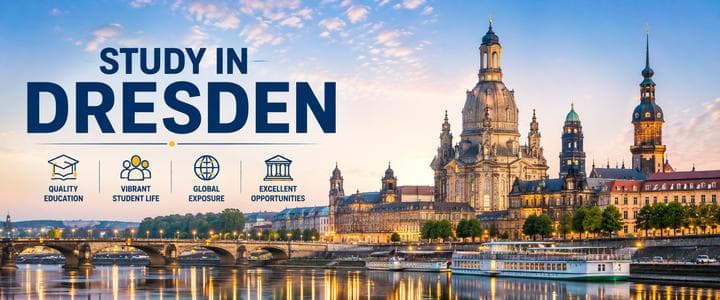
Dresden is one of Germany’s most attractive study destinations for students interested in engineering, computer science, semiconductors, artificial intelligence, biotechnology, environmental sciences, architecture, fine arts, and music. The capital of Saxony combines respected public universities with an expanding high-technology economy, a strong research network, comparatively manageable living costs, and a rich cultural environment.
The city is especially relevant to international students who want access to Germany’s technology and research ecosystem without paying the higher rents commonly found in Munich, Frankfurt, Hamburg, or Berlin. Dresden is part of Silicon Saxony, one of Europe’s most important microelectronics and information technology clusters. Semiconductor manufacturers, research institutions, software companies, biotechnology organizations, and engineering businesses create opportunities for internships, working-student positions, research assistantships, and graduate employment.
Indian students may find Dresden particularly attractive for master’s programs in computer science, nanoelectronics, computational modeling, engineering, biotechnology, and environmental subjects. However, applicants must carefully verify academic prerequisites, APS requirements, application routes, language certificates, and program-specific deadlines before applying.
Study in Dresden: Quick Overview
| Factor | Details |
|---|---|
| Federal state | Saxony |
| Major public university | TUD Dresden University of Technology |
| Major university of applied sciences | HTW Dresden |
| Specialized institutions | Dresden University of Fine Arts, Dresden University of Music, Palucca University of Dance, Evangelische Hochschule Dresden |
| Private institution | Dresden International University |
| Leading study areas | Engineering, computer science, microelectronics, AI, natural sciences, biotechnology, environmental sciences, architecture, business, fine arts, and music |
| General tuition at major public universities | Usually no general tuition for a first regular degree, although exceptions apply |
| Semester contribution | Approximately €300 at TU Dresden; institution-specific elsewhere |
| Estimated monthly living cost | Approximately €920–€1,200 |
| Typical student residence rent | Approximately €220–€380, depending on room and residence |
| Private shared-room rent | Approximately €350–€550 |
| Primary languages of instruction | German and English |
| Important industries | Semiconductors, microelectronics, software, AI, engineering, materials, biotechnology, healthcare, energy, and environmental technology |
| Public transportation | Trams, buses, S-Bahn, regional trains, and student transportation benefits |
| Best suited for | Students seeking research strength, technical careers, moderate costs, and a quieter alternative to Germany’s largest cities |
Why Study in Dresden?
Dresden offers a combination of academic quality, affordability, research opportunities, and career relevance. It does not have the scale or international visibility of Berlin or Munich, but that can be an advantage for students who prefer a more manageable city.
Strong Reputation in Engineering and Research
TU Dresden is one of Germany’s major research universities. It offers extensive academic opportunities across engineering, natural sciences, medicine, computer science, environmental sciences, humanities, and social sciences.
Students can benefit from interdisciplinary connections between the university and organizations belonging to the Fraunhofer Society, Max Planck Society, Leibniz Association, and Helmholtz Association. These institutions conduct research in areas such as:
Microelectronics and semiconductor technology
Artificial intelligence and robotics
Advanced materials and nanotechnology
Computational science
Biotechnology and regenerative medicine
Energy systems
Environmental science
Transportation and mobility
Medical technology
Wireless communication
This concentration of universities, companies, and research organizations makes Dresden valuable for students planning research-oriented careers or doctoral studies.
A Major European Semiconductor Location
Dresden is widely associated with Silicon Saxony, a major European cluster for microelectronics, information technology, software, and related technologies.
Companies and organizations connected to Dresden’s semiconductor ecosystem include Infineon Technologies, GlobalFoundries, Bosch, X-FAB, European Semiconductor Manufacturing Company, Fraunhofer institutes, and numerous suppliers and technology startups.
This ecosystem can be particularly relevant to students studying:
Electrical engineering
Electronics
Nanoelectronics
Embedded systems
Computer engineering
Materials science
Physics
Automation
Mechanical engineering
Industrial engineering
Data science
Software engineering
Admission to a university does not guarantee an internship or job. Nevertheless, studying near a significant industrial cluster can improve access to company presentations, research projects, professional events, thesis collaborations, student employment, and networking opportunities.
Lower Living Costs Than Many Large German Cities
Dresden is not Germany’s cheapest city, and international students should not underestimate their budget. However, housing and general expenses are often more manageable than in Munich, Frankfurt, Stuttgart, or central Berlin.
Official university guidance suggests that students should expect approximately €920–€1,050 per month, while a more flexible budget of €950–€1,200 provides additional protection against private-market rent, deposits, travel, and personal expenses.
Students who obtain a room in a Studentenwerk residence and cook regularly may spend less. Those renting a private studio, traveling frequently, or maintaining a more expensive lifestyle may spend considerably more.
Good Quality of Life
Dresden offers historical architecture, museums, music, riverside spaces, parks, cycling routes, student clubs, and access to the surrounding Saxon countryside. The city is large enough to provide international communities and cultural activities but compact enough for students to travel conveniently.
The Elbe River, Großer Garten, Neustadt district, Altstadt, Saxon Switzerland National Park, and nearby towns provide a variety of recreational opportunities. Students can combine academic life with hiking, cycling, concerts, exhibitions, cafés, and day trips.
Best Universities in Dresden
Dresden has research universities, universities of applied sciences, arts institutions, and private providers. Students should select an institution based on subject strength, teaching language, academic style, accreditation, tuition, and career objectives.
| Institution | Type | Major Strengths | Tuition Situation |
|---|---|---|---|
| TUD Dresden University of Technology | Public research university | Engineering, computer science, sciences, medicine, architecture, environmental subjects, humanities | Usually no general tuition for a first regular degree; semester contribution applies |
| HTW Dresden | Public university of applied sciences | Applied engineering, informatics, business, design, agriculture, environment, geoinformation | Generally no tuition for regular undergraduate and consecutive programs; semester contribution applies |
| Dresden University of Fine Arts | Public specialized institution | Fine arts, restoration, stage design, costume design | Semester contribution and program-specific rules |
| Dresden University of Music Carl Maria von Weber | Public specialized institution | Performance, composition, conducting, jazz, music education | Tuition may apply to certain students or programs, including some non-EU applicants |
| Palucca University of Dance Dresden | Public specialized institution | Dance, choreography, dance education | Institution- and program-specific charges |
| Evangelische Hochschule Dresden | State-recognized university of applied sciences | Social work, childhood education, nursing, religious education | Semester contribution; program-specific conditions |
| Dresden International University | Private university | Professional and industry-oriented postgraduate programs | Program-specific tuition |
| Berufsakademie Sachsen, Dresden location | Cooperative education institution | Dual and practice-integrated study programs | Depends on program and company arrangement |
TUD Dresden University of Technology
TUD Dresden University of Technology is the city’s largest and most internationally visible institution. It is a comprehensive research university rather than an institution focused only on technology.
The university has approximately 29,000 students, with a significant international population. Its academic structure covers engineering sciences, science, medicine, civil and environmental engineering, and humanities and social sciences.
Popular Study Areas at TU Dresden
International students commonly consider TU Dresden for:
Computer science
Computational modeling and simulation
Nanoelectronic systems
Electrical engineering
Mechanical engineering
Materials science
Civil engineering
Architecture
Transportation sciences
Physics
Chemistry
Mathematics
Biotechnology
Molecular bioengineering
Regenerative biology and medicine
Environmental science
Hydro science
Forestry
Economics
International relations
Psychology
Medicine and dentistry
English-Taught Programs
TU Dresden offers several English-taught postgraduate programs. Availability, titles, admission requirements, and application cycles can change, so students should verify every program in the university’s official Study Information System.
Examples of English-taught or internationally oriented master’s programs include:
Computational Modeling and Simulation
Computer Science
Nanoelectronic Systems
Hydro Science and Engineering
Tropical Forestry
Cartography
Molecular Bioengineering
Regenerative Biology and Medicine
Physics of Life
Advanced Computational and Civil Engineering Structural Studies
International Studies in Intellectual Property Law and Data Law
Some programs that previously appeared in university brochures may be restructured, renamed, suspended, or offered at a different TU Dresden location. Applicants should not rely only on education portals or old program lists.
Campus Locations
TU Dresden is not limited to one enclosed campus. Important academic locations include:
The main campus in and around Südvorstadt
Engineering and science facilities near Zellescher Weg
Medical facilities in Johannstadt
Forestry facilities in Tharandt
Research centers and partner institutes across Dresden
Selected programs at other university locations, including Zittau
Students should check where their faculty is situated before choosing accommodation. A forestry student in Tharandt has different housing and commuting needs from a computer science student based near the main Dresden campus.
HTW Dresden
HTW Dresden, officially the University of Applied Sciences Dresden, focuses on applied teaching, professional practice, laboratory work, and cooperation with industry.
It is a strong option for students who prefer practical education over the broader theoretical and research orientation of a traditional university.
Major Academic Fields
HTW Dresden offers programs in areas such as:
Civil engineering
Electrical engineering
Mechanical engineering
Informatics
Geoinformation
Business administration
Agriculture
Environmental chemistry
Horticulture
Design
Product development
Industrial engineering
The university operates a main campus close to Dresden Hauptbahnhof and another important campus in Pillnitz for agriculture, environment, and horticulture-related subjects.
Language of Instruction
Many complete degree programs at HTW Dresden are taught primarily in German. The university offers modules in English, international activities, language courses, and selected English-taught programs, but applicants should not assume that every technical master’s program is available entirely in English.
One relevant English-taught option is the master’s program in International Management. Applicants should review the current program catalog for additional offerings.
Applied Study Model
The university of applied sciences model may include:
Smaller classes
Laboratory-based teaching
Mandatory practical semesters
Industry projects
Applied research
Company-linked bachelor’s or master’s theses
Graduates can enter industry directly or continue into further academic study. Students interested in a doctorate should investigate the doctoral pathway because universities of applied sciences may cooperate with degree-awarding universities for doctoral supervision.
Specialized Arts, Music, Dance, and Social Sciences Institutions
Dresden University of Fine Arts
The Dresden University of Fine Arts is suited to students interested in:
Fine arts
Painting
Sculpture
New artistic media
Stage and costume design
Theater design
Art technology
Conservation and restoration
Admission is generally based not only on academic certificates but also on artistic aptitude. Portfolios, practical assignments, interviews, and entrance examinations may be required.
International applicants should review the exact language and document requirements for their chosen field. A strong academic record cannot replace an unsuitable portfolio.
Dresden University of Music Carl Maria von Weber
The Dresden University of Music offers programs in performance, composition, conducting, jazz, popular music, music theory, and music education.
Applicants may need to complete:
A preliminary video assessment
A live audition
Music theory examinations
Language verification
An interview
Program-specific artistic tasks
Unlike the standard tuition position at TU Dresden and HTW Dresden, the music university states that tuition may apply in certain circumstances, including to some non-EU students. Applicants must check the latest fee regulations for their nationality, qualification, residence status, and program.
Palucca University of Dance Dresden
Palucca University is a specialized institution for dance. Programs may cover classical dance, contemporary dance, choreography, and dance education.
Admission is highly selective and normally involves physical, artistic, and technical assessment. International students should verify age conditions, audition schedules, medical requirements, language expectations, and application formats.
Evangelische Hochschule Dresden
Evangelische Hochschule Dresden specializes in subjects such as:
Social work
Childhood education
Nursing and healthcare
Religious and community education
Students do not necessarily have to belong to a Protestant church, but they should be comfortable engaging with the institution’s educational profile and relevant theological content.
Many programs are German-taught and may require advanced German because students participate in placements involving direct communication with children, patients, public agencies, and social-service users.
Dresden International University
Dresden International University is a private institution offering professional and industry-oriented programs. Its study portfolio can include fields such as healthcare, management, engineering, logistics, and microelectronics.
Private programs charge tuition, sometimes amounting to several thousand euros. Students should check:
Total tuition for the complete program
Enrollment and examination charges
Refund conditions
Program accreditation
Whether the course is full-time or part-time
Language of instruction
Eligibility for a German study visa
Internship and employment claims
Degree-awarding authority
A private program should be evaluated on its academic fit and career value rather than selected solely because its admission process appears easier.
Best Courses to Study in Dresden
Computer Science and Artificial Intelligence
Dresden offers opportunities in computer science, distributed computing, computational modeling, data-based simulation, software development, and AI-related research.
Students may find research or employment connections in:
Scientific computing
Embedded systems
Computer vision
Robotics
Machine learning
Simulation
Software engineering
Cybersecurity
Communication networks
High-performance computing
Applicants should compare each program’s prerequisite modules. A general computer science bachelor’s degree does not automatically satisfy a specialized master’s requirement if essential credits in mathematics, programming, algorithms, systems, or theoretical computer science are missing.
Electrical Engineering and Nanoelectronics
Nanoelectronics is one of Dresden’s most distinctive academic and industrial strengths. The local semiconductor cluster creates a particularly relevant environment for students in electrical engineering, microelectronics, chip design, sensor systems, and semiconductor manufacturing.
The TU Dresden master’s program in Nanoelectronic Systems expects subject knowledge in areas such as mathematics, analog and digital circuits, electromagnetic fields, systems theory, electronic devices, and programming.
Career directions may include:
Integrated circuit design
Semiconductor process technology
Verification and testing
Embedded hardware
Sensor development
Equipment engineering
Manufacturing automation
Quality engineering
Research and development
Mechanical, Civil, and Transportation Engineering
Dresden has a long engineering tradition. Students can study mechanical engineering, civil engineering, materials, transportation systems, rail systems, and related disciplines.
The city’s research and industrial ecosystem supports applications in:
Manufacturing
Lightweight construction
Mobility
Railway engineering
Structural analysis
Energy systems
Automation
Materials testing
Production technology
German proficiency can significantly expand internship and job options, particularly in medium-sized engineering companies.
Biotechnology and Life Sciences
Dresden has a substantial life-sciences and biomedical research network. TU Dresden’s Center for Molecular and Cellular Bioengineering connects academic study with research in molecular bioengineering, regenerative medicine, biological physics, and related fields.
Potential academic and career areas include:
Molecular biology
Bioengineering
Tissue engineering
Regenerative medicine
Biophysics
Biomedical research
Imaging
Medical technology
Pharmaceutical research
Applicants should examine whether the program expects prior coursework in biology, chemistry, physics, engineering, or quantitative methods.
Environmental Sciences, Forestry, and Hydro Science
Dresden and the nearby TU Dresden location in Tharandt provide options in forestry, water management, environmental sciences, climate-related subjects, and natural-resource management.
Programs such as Hydro Science and Engineering and Tropical Forestry attract international cohorts. Depending on the program, students may study:
Water systems
Hydrology
Wastewater
Environmental modeling
Forest management
Climate adaptation
Ecosystem services
Sustainable resource use
Fieldwork, excursions, laboratory components, and quantitative prerequisites should be considered when evaluating these programs.
Architecture, Fine Arts, and Cultural Subjects
Dresden’s architectural history, museums, galleries, theaters, opera, and artistic institutions make it an appealing location for architecture and arts students.
Architecture programs generally combine design studios, technical knowledge, urban development, construction, and presentation skills. Fine arts and design programs may require portfolios and entrance examinations.
Tuition Fees in Dresden
Public University Tuition
At TU Dresden and HTW Dresden, regular first-degree and consecutive programs generally do not charge standard tuition. Students instead pay a semester contribution.
However, “tuition-free” does not mean studying is free. Students must budget for semester charges, rent, insurance, food, study materials, residence-permit expenses, deposits, and travel.
Possible tuition exceptions include:
Second-degree study under specified conditions
Long-term study beyond the permitted period
Distance-learning programs
Continuing-education programs
Specialized fee-charging courses
Private university programs
Certain arts or music programs
Non-consecutive postgraduate programs
TU Dresden currently lists €500 per semester for long-term study when the relevant legal conditions are met. It also lists a fee for qualifying second-degree cases and separate charges for certain special programs.
Semester Contribution
The semester contribution normally supports student services, student representation, and transportation benefits.
TU Dresden advises international students to expect a contribution of approximately €300 per semester, although the exact figure varies.
At HTW Dresden, the semester contribution is €364.03 for the winter semester 2026/27. It includes contributions to student organizations and the applicable student transportation ticket.
Students should always use the amount shown in their admission or re-registration instructions. Old figures published on blogs or discussion forums may no longer be valid.
Private University Tuition
Private university fees vary considerably. A student could pay several thousand euros for a complete program or per semester.
Before paying a deposit, ask for a written fee schedule covering:
Tuition
Enrollment fee
Examination fee
Thesis supervision fee
Study materials
Mandatory excursions
Repeat examinations
Refund rules
Administrative charges
Cost of Living in Dresden
A realistic monthly budget for an international student is approximately €920–€1,200.
| Expense | Estimated Monthly Cost |
|---|---|
| Student residence or low-cost shared room | €220–€400 |
| Private WG room | €350–€550 |
| Private studio | €550–€850 |
| Food and groceries | €220–€320 |
| Health insurance | €130–€160 |
| Phone and internet | €20–€45 |
| Study materials | €20–€50 |
| Personal expenses | €80–€160 |
| Leisure and local travel | €50–€120 |
| Broadcasting contribution | Up to €18.36 per apartment |
| Estimated total | €920–€1,200 |
A student living in a low-cost residence may manage on less. A student renting a private studio should prepare for a higher total.
Initial Arrival Costs
The first month is usually more expensive because students may need to pay:
Rental deposit
First month’s rent
Temporary accommodation
Semester contribution
Residence-permit fee
Basic furniture or household supplies
Bedding and kitchen equipment
SIM card
Winter clothing
Transportation before ticket activation
A separate arrival reserve of approximately €1,000–€2,000 can prevent serious financial pressure.
Student Accommodation in Dresden
Studentenwerk Residences
Studentenwerk Dresden manages 28 residence halls with approximately 5,730 places in Dresden. Most rooms are furnished, although layouts and facilities vary.
Examples of current residence prices include shared rooms from approximately €221 and furnished studios from approximately €300–€380. Exact rent depends on the building, room type, size, renovation standard, and whether the unit is shared.
Advantages include:
Lower rent than many private apartments
Furnished rooms
Student community
Predictable contracts
Internet in many residences
Locations near university facilities
Reduced need to purchase furniture
Demand can be high. Apply as soon as permitted after receiving or expecting admission, and continue searching privately until a room is confirmed.
Private Shared Apartments
A shared apartment is called a Wohngemeinschaft or WG. Students normally rent a private bedroom and share the kitchen and bathroom.
A WG can offer more independence than a dormitory and may help with German-language practice. However, applicants often need to attend a viewing or interview.
Watch for scams. Never transfer money merely to receive a viewing, and do not rely on a contract that cannot be connected to a verifiable property or landlord.
Private Studios
Studios provide privacy but cost more. Students must also consider electricity, internet, heating, furniture, deposits, and minimum rental periods.
A private studio can increase monthly expenses enough to make part-time work feel necessary. Students should avoid building a financial plan that depends on immediately obtaining a job.
Best Areas for Students
| Area | Best For | Considerations |
|---|---|---|
| Südvorstadt | TU Dresden main campus access | Popular with students; convenient but competitive |
| Plauen | Quiet living near TU Dresden | Some properties are more residential |
| Löbtau | Shared apartments and local amenities | Commute depends on exact location |
| Strehlen | Campus access and residential atmosphere | Rent varies significantly |
| Neustadt | Nightlife, cafés, international atmosphere | Noisier and sometimes more expensive |
| Johannstadt | Medicine and hospital-related studies | Good transportation connections |
| Striesen | Quiet residential environment | Farther from parts of the main campus |
| Friedrichstadt | Central access and developing residential areas | Check building and street conditions |
| Pillnitz | HTW agriculture and horticulture students | Far from central Dresden |
| Tharandt | TU Dresden forestry students | Separate town atmosphere and commuting requirements |
Admission Requirements
Bachelor’s Programs
Bachelor’s applicants need a qualification equivalent to the German university entrance qualification.
Indian Class 12 certificates do not always provide direct entry on their own. Eligibility depends on the examination board, subjects, grades, previous university study, and the selected degree.
Possible outcomes include:
Direct subject-restricted admission
Eligibility after successful university study in India
Studienkolleg followed by the Feststellungsprüfung
Ineligibility for the selected route
Applicants should use official university guidance, uni-assist evaluation criteria, and the DAAD or Anabin databases.
Master’s Programs
Master’s admission normally requires:
A recognized bachelor’s degree
Sufficient subject compatibility
Required academic credits
Minimum grade, where specified
Language proof
APS documentation for Indian qualifications
Curriculum vitae
Motivation letter, if requested
Academic transcripts
Module descriptions
Internship or professional experience, where required
Aptitude assessment for selected programs
German universities often examine the precise content of the previous degree. The degree title alone is not enough.
Application Through Uni-Assist
Many applicants with international qualifications apply to TU Dresden through uni-assist. Documents are uploaded online and must be complete by the program deadline.
TU Dresden commonly requests:
Application form
Passport identification page
Curriculum vitae
School certificate
University transcripts
Degree certificate
Certified translations where necessary
Language proof
APS certificate for Indian academic documents
Program-specific supporting documents
Some programs use different application portals or procedures. Always follow the instructions displayed for the exact degree.
APS for Indian Students
APS India verifies academic documents issued by Indian educational institutions. The APS certificate is generally required for the German student visa process and is also requested in relevant university applications.
APS does not grant university admission or a visa. It verifies academic documentation.
Selected master’s applicants in affected academic fields may also need a dMAT certificate for the summer semester 2027 intake and subsequent intakes, subject to the eligibility scope, affected-field list, and transitional exemptions published by APS India.
Applicants should check the current APS rules before submitting documents. This is especially important for candidates with engineering, technology, or other affected degrees.
Language Requirements
German-Taught Programs
Most German-taught degrees require advanced German, often at C1 level. Commonly accepted evidence may include:
TestDaF with the required result in every section
DSH-2
telc Deutsch C1 Hochschule
Goethe-Zertifikat C2
Other officially recognized qualifications
Requirements vary by institution and degree. Some applicants may be allowed to apply with a lower level but must submit the final qualification before enrollment.
English-Taught Programs
English-taught programs may accept:
IELTS Academic
TOEFL
Cambridge English qualifications
A previous degree taught in English, if expressly accepted
Other program-approved evidence
Typical requirements range from IELTS 6.0 to 6.5, but some programs require a higher level. TU Dresden’s English-taught Computer Science master’s, for example, requires English at C1, while Computational Modeling and Simulation requires B2.
Do not assume that a medium-of-instruction letter automatically replaces IELTS or TOEFL. The program must explicitly accept it.
Is German Necessary for English-Taught Students?
German may not be required for admission to an English-taught program, but it remains highly valuable for:
Part-time jobs
Internships
Housing communication
Medical appointments
Government offices
Social integration
Graduate employment
Reaching at least B1 or B2 before graduation can substantially increase career options.
Application Timeline
| Period Before Enrollment | Recommended Action |
|---|---|
| 12–15 months | Research programs, eligibility, teaching language, and finances |
| 10–12 months | Prepare for IELTS, TOEFL, TestDaF, or other language examinations |
| 8–10 months | Begin APS procedure and collect academic documents |
| 6–9 months | Prepare CV, motivation letter, module descriptions, and translations |
| 4–7 months | Submit applications according to program deadlines |
| After admission | Arrange finance, blocked account, insurance, and visa application |
| 2–4 months | Apply for housing and prepare travel arrangements |
| Before departure | Confirm enrollment documents, semester contribution, and arrival plan |
| After arrival | Complete address registration, health insurance activation, enrollment, and residence-permit steps |
These periods are planning guidelines, not university deadlines. Some arts programs, restricted bachelor’s programs, and international master’s programs have significantly earlier deadlines.
Student Visa and Proof of Funds
Non-EU students generally need a German student visa before traveling for long-term study.
Typical requirements include:
University admission
Valid passport
APS certificate where applicable
Proof of financial resources
Health insurance
Academic documents
Language evidence
Visa forms and photographs
Statement of study purpose, where requested
The blocked-account benchmark is at least €11,904 for 2026, equivalent to €992 per month. A qualifying scholarship or formal declaration of commitment may be accepted instead.
The financial requirement can change. Students must confirm the applicable amount with the German mission handling their application.
Scholarships for Students in Dresden
DAAD Scholarships
DAAD provides a searchable scholarship database covering postgraduate courses, research, doctoral studies, and selected subject-specific programs.
DAAD scholarships are competitive. They commonly consider:
Academic performance
Motivation
Professional experience
Development relevance
Research quality
Language proficiency
Social or extracurricular engagement
Deutschlandstipendium
Participating universities may award the Deutschlandstipendium to students with strong academic achievement and relevant personal or social accomplishments. The scholarship generally provides €300 per month.
Availability and application periods depend on the institution.
TU Dresden Funding
TU Dresden may offer or administer:
STIBET scholarships
Degree-completion support
Scholarships for international students
Emergency assistance
Exchange funding
Research and doctoral funding
These opportunities may only become available after enrollment and should not be treated as guaranteed funding for the visa.
Foundations and Other Funding
Students can also investigate:
Friedrich Ebert Foundation
Heinrich Böll Foundation
Konrad Adenauer Foundation
Rosa Luxemburg Foundation
Friedrich Naumann Foundation
Hans Böckler Foundation
Erasmus+
Subject-specific organizations
Indian education scholarships
Employer sponsorship
Many German foundations expect academic strength, social engagement, and German-language ability.
Part-Time Jobs in Dresden
International students can search for work as:
Research assistants
Student assistants
Tutors
Software developers
Laboratory assistants
Working students in engineering companies
Retail employees
Restaurant or café staff
Logistics workers
Event staff
Office assistants
Customer-support employees
Technical students should search for Werkstudent, studentische Hilfskraft, wissenschaftliche Hilfskraft, Praktikum, and Abschlussarbeit positions.
Students from non-EU countries may generally work up to 140 full days or 280 half-days per year without separate Federal Employment Agency approval. An alternative calculation based on up to 20 hours per week may apply. Mandatory and voluntary internships can be treated differently.
Students must check the conditions printed on their residence permit and obtain advice before exceeding permitted limits.
Can a Part-Time Job Cover All Expenses?
A part-time job may cover part of the budget, but it should not be the foundation of a visa or study plan.
Job availability depends on:
German proficiency
Technical skills
Class schedule
Previous experience
Residence status
Economic conditions
Willingness to commute
Competition
Students should arrive with sufficient financial resources for several months without employment.
Internships and Career Opportunities
Leading Career Sectors
| Sector | Relevant Study Backgrounds |
|---|---|
| Semiconductors and microelectronics | Electrical engineering, physics, materials, computer engineering |
| Software and AI | Computer science, data science, mathematics, robotics |
| Manufacturing and automation | Mechanical engineering, mechatronics, industrial engineering |
| Research and development | Sciences, engineering, biotechnology, computational disciplines |
| Biotechnology and healthcare | Biology, biochemistry, bioengineering, medicine |
| Energy and environmental technology | Environmental science, electrical engineering, hydro science |
| Transportation and mobility | Civil, mechanical, electrical, and transportation engineering |
| Smart materials and nanotechnology | Materials science, chemistry, physics |
| Architecture and construction | Architecture, civil engineering, urban development |
| Creative and cultural industries | Fine arts, design, music, stage design |
Students may find opportunities with large companies, research institutes, university chairs, startups, and specialized medium-sized businesses.
Research institutions in and around Dresden include Fraunhofer institutes, Max Planck institutes, Leibniz institutions, the Helmholtz-Zentrum Dresden-Rossendorf, and university-affiliated research centers.
Importance of German for Careers
English may be sufficient for selected research teams, multinational companies, and specialized technical positions. However, German remains important for many employers.
German proficiency is especially valuable for:
Client-facing positions
Manufacturing operations
Healthcare
Construction
Public administration
Social work
Smaller companies
Team leadership
Long-term career progression
Transportation in Dresden
Dresden has an extensive tram and bus network operated within the regional transportation system. Students can also use S-Bahn and regional services for many journeys.
Depending on the institution and semester arrangement, the semester contribution may include a Deutschlandsemesterticket or comparable transportation benefit. Students must activate the ticket using the procedure provided by their university.
Cycling is common, especially around the main TU Dresden campus and central districts. Students should use suitable lights and locks and learn German traffic rules.
Dresden Hauptbahnhof and Dresden-Neustadt station provide connections to cities such as Leipzig, Berlin, Prague, and other parts of Germany. Long-distance trains are not automatically included in standard local or Deutschlandticket-based student passes.
Student Life in Dresden
Altstadt
Altstadt contains many of Dresden’s best-known landmarks, including the Frauenkirche, Semperoper, Zwinger, museums, and historic riverfront. It is culturally significant but not necessarily the center of everyday student nightlife.
Neustadt
Neustadt is known for cafés, restaurants, bars, street culture, music venues, and an international atmosphere. It is popular among students but can be noisy, and housing may cost more than in quieter districts.
Parks and Outdoor Activities
Students can visit:
Großer Garten
Elbe riverbanks
Dresden Heath
Pillnitz Palace area
Saxon Switzerland
Moritzburg
Meissen
Tharandt Forest
Saxon Switzerland is particularly popular for hiking and climbing, although students should plan transportation, weather, and safety carefully.
Food and Indian Community
Dresden has international supermarkets, Indian restaurants, Asian grocery stores, student cafeterias, and vegetarian options. Students who cook at home can control expenses more effectively.
University cafeterias operated by Studentenwerk offer subsidized meals. Menus, locations, and prices vary.
Cultural Life
Dresden is particularly strong in:
Classical music
Opera
Museums
Visual arts
Theater
Architecture
Seasonal markets
Student clubs
Local festivals
The Striezelmarkt is one of the city’s best-known winter traditions. Students should also explore smaller neighborhood events rather than limiting themselves to tourist areas.
Weather in Dresden
Dresden has warm summers, cold winters, and variable conditions in spring and autumn.
Students arriving from India may need:
A waterproof jacket
Layered winter clothing
Thermal wear
Waterproof shoes
Gloves and a cap
Moisturizer
Vitamin D guidance if recommended by a medical professional
Heating and daylight patterns may require adjustment. Buying every winter item before leaving India is not always necessary; students can purchase clothing after arrival based on actual conditions.
Safety and Student Support
Dresden is generally manageable for students, but normal precautions remain important.
Students should:
Secure bicycles properly
Avoid leaving bags unattended
Verify landlords and contracts
Protect passports and residence documents
Save emergency numbers
Use licensed transportation
Remain aware when returning late
Avoid confrontations at public events
Report discrimination or harassment
Universities provide counseling, international offices, student representatives, psychological support, disability services, and conflict-resolution channels.
International students may occasionally experience social isolation, cultural misunderstandings, or discrimination. Building connections through university groups, language courses, student initiatives, sports, and international networks can make adjustment easier.
Advantages and Disadvantages of Studying in Dresden
| Advantages | Disadvantages |
|---|---|
| Strong engineering and research university | Many bachelor’s programs are German-taught |
| Major semiconductor and microelectronics cluster | English-only part-time jobs can be competitive |
| Lower rent than several large western German cities | Smaller international job market than Berlin or Munich |
| Extensive research-institute network | Specialized admissions can be academically strict |
| Good public transportation | Direct international flight options are limited |
| Rich cultural and architectural environment | Winters can feel cold and dark |
| Access to parks and Saxon Switzerland | Some students may prefer a larger, more diverse metropolis |
| English-taught technical master’s programs | German is important for long-term integration |
| Student residences at relatively moderate rents | Affordable accommodation is not guaranteed |
| Compact and manageable city | Campuses such as Tharandt and Pillnitz require location-specific planning |
Checklist for Indian Students
Before applying:
Confirm whether your qualification permits direct admission.
Check the precise academic prerequisites.
Review whether APS is required at the application stage.
Verify whether dMAT applies to your intended intake and previous degree.
Confirm the teaching language.
Check accepted language certificates.
Prepare detailed module descriptions.
Review tuition and semester charges.
Check the exact campus location.
Apply before the official deadline.
After receiving admission:
Arrange proof of funds.
Purchase appropriate insurance.
Apply for a student visa.
Apply for Studentenwerk housing.
Search for private backup accommodation.
Pay the semester contribution when instructed.
Prepare original documents.
Plan temporary accommodation if necessary.
Carry sufficient arrival funds.
Learn basic German before departure.
After reaching Dresden:
Register your address.
Complete university enrollment.
Activate health insurance.
Apply for the residence permit.
Activate the student transportation ticket.
Open or activate a bank account.
Register for university orientation.
Learn local waste-separation rules.
Join language courses and student organizations.
Begin internship preparation early.
Common Mistakes to Avoid
Selecting a Program Only Because It Is Tuition-Free
Academic compatibility, language, location, and career relevance matter more than the absence of tuition.
Assuming Every Technical Program Is in English
Many bachelor’s and master’s programs are German-taught. Read the official curriculum and language requirements.
Ignoring Module-Level Requirements
A relevant degree title does not guarantee admission. Universities may require specific credits in mathematics, programming, circuits, physics, statistics, or other subjects.
Applying for APS Too Late
Document verification can affect both admission and visa planning. Start early and monitor changes to APS and dMAT requirements.
Underestimating Living Costs
Low public-university tuition does not remove the need for a substantial living budget.
Depending on Immediate Employment
It may take weeks or months to find suitable work. German ability and technical experience strongly influence the outcome.
Sending Money to an Unverified Landlord
Housing scams target international students. Verify the property, landlord, contract, and payment conditions.
Ignoring German Until Graduation
German can improve daily life, professional networking, internships, and graduate employment. Start learning during the application period.
Frequently Asked Questions
1. Is Dresden a good city for international students?
Yes. Dresden offers respected universities, moderate living costs, student residences, cultural activities, research institutions, and a growing technology economy.
2. Is TU Dresden a good university?
TU Dresden is a major German research university with particular strengths in engineering, computer science, natural sciences, medicine, environmental subjects, and interdisciplinary research.
3. Is studying at TU Dresden free?
Most regular first-degree programs do not charge general tuition, but students pay a semester contribution and all living expenses. Exceptions can apply.
4. How much does it cost to live in Dresden as a student?
A realistic budget is approximately €920–€1,200 per month. Private studios and frequent travel can increase the total.
5. How much is student accommodation in Dresden?
Studentenwerk rooms may cost approximately €220–€380. Private shared rooms commonly cost about €350–€550, depending on location and condition.
6. Are English-taught programs available?
Yes, especially at the master’s level. TU Dresden offers English-taught options in computer science, computational modeling, nanoelectronics, biotechnology, hydro science, forestry, and other fields.
7. Can I study for a bachelor’s degree in English?
Options are limited. Most bachelor’s programs are taught in German, although selected international or partially English-taught programs may exist.
8. Is IELTS required for TU Dresden?
It depends on the program. English-taught degrees may accept IELTS, TOEFL, Cambridge qualifications, or another approved form of evidence. Some accept a medium-of-instruction document, while others do not.
9. Is German required for an English-taught master’s?
It may not be required for admission, but learning German is strongly recommended for part-time work, internships, administration, and graduate employment.
10. Is APS required for Indian students?
The APS certificate is generally required for the German student visa process and may be required during university applications involving Indian qualifications.
11. Is dMAT required for all Indian students?
No. It applies only to selected applicants within the academic fields, intakes, and procedural conditions published by APS India.
12. Does TU Dresden use uni-assist?
Many international applicants apply through uni-assist, but the exact route depends on the program and academic background.
13. Is Dresden good for computer science?
Yes. The city has university programs, research institutes, software companies, AI activities, semiconductor employers, and technology startups.
14. Is Dresden good for semiconductor careers?
Dresden is one of Europe’s most important microelectronics locations. It offers relevant academic programs and proximity to manufacturers, suppliers, and research institutions.
15. Can international students work while studying?
Eligible non-EU students can generally work within the limits attached to their study residence status, commonly 140 full or 280 half-days per year.
16. Can part-time work cover my living costs?
It may cover some expenses, but students should not assume they will find immediate employment or earn enough to fund their complete budget.
17. Which Dresden neighborhood is best for TU Dresden students?
Südvorstadt, Plauen, Strehlen, and parts of Löbtau are popular. The best choice depends on the faculty, rent, and public transportation.
18. Is Dresden cheaper than Munich?
Dresden is generally more affordable, especially for rent. However, individual costs depend heavily on accommodation.
19. What are the main disadvantages of studying in Dresden?
Potential disadvantages include fewer English-only jobs than in larger metropolitan areas, limited English-taught bachelor’s options, and the need for German in many workplaces.
20. Can graduates stay in Germany after studying?
Eligible international graduates can apply for a post-study residence permit to search for qualified employment. After obtaining an appropriate job, they may change to a suitable employment residence permit or EU Blue Card if the conditions are met.
Final Thoughts
Dresden is an excellent study destination for students seeking strong technical education, research opportunities, manageable living costs, and access to a major semiconductor and high-technology cluster.
TU Dresden is the city’s strongest option for research-oriented engineering, computer science, natural science, biotechnology, and environmental programs. HTW Dresden is well suited to students who prefer applied teaching and closer links to professional practice. Dresden’s specialized institutions also create opportunities in fine arts, music, dance, social work, and healthcare.
The strongest applicants will look beyond rankings and tuition. They will compare curricula, academic prerequisites, campus locations, language requirements, total expenses, and career pathways. Indian students should pay particular attention to APS, possible dMAT requirements, uni-assist procedures, and visa preparation.
For students prepared to learn German, engage with the local research ecosystem, and begin career planning early, Dresden can offer an effective route into German academia and technology-driven employment.