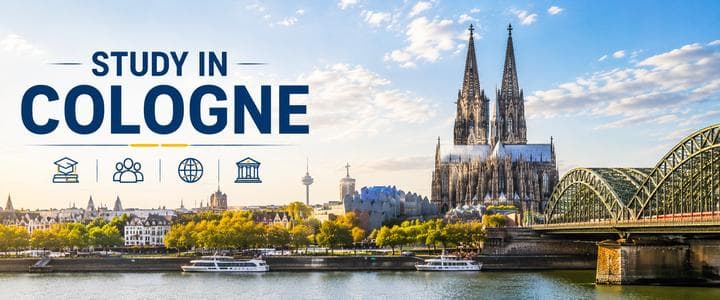
Cologne, officially known as Köln in German, is one of Germany’s largest and most vibrant university cities. Located on the Rhine River in North Rhine-Westphalia, the city combines major public universities, specialized arts and sports institutions, a multicultural population, and strong career opportunities in media, information technology, insurance, automotive manufacturing, healthcare, logistics, retail, and professional services.
For international students, Cologne offers an attractive balance between academic quality and city life. The University of Cologne is one of Germany’s major research universities, while TH Köln provides practice-oriented programs in engineering, computer science, business, media, architecture, and sustainability. The city also has highly specialized institutions for sports science, music, dance, media arts, and private business education.
Most standard programs at Cologne’s public universities do not charge tuition fees, including for non-EU students. Students usually pay a semester contribution that covers student services and a Germany-wide local and regional transport ticket. The main challenge is accommodation: housing demand is high, and affordable rooms can be difficult to secure.
Study in Cologne at a Glance
| Category | Details |
|---|---|
| City | Cologne, North Rhine-Westphalia |
| German name | Köln |
| Major public university | University of Cologne |
| Major applied sciences university | TH Köln – University of Applied Sciences |
| Specialized institutions | German Sport University Cologne, Academy of Media Arts Cologne, Cologne University of Music and Dance |
| Private university option | CBS University of Applied Sciences |
| Popular study areas | Business, economics, computer science, engineering, law, medicine, sports science, media, arts, music, sustainability, and social sciences |
| Main languages of instruction | German and English |
| Public university tuition | Usually no general tuition fee for regular degree programs |
| Typical semester contribution | Approximately €320–€415, depending on the institution |
| Estimated student budget | Approximately €1,100–€1,500 per month |
| Main advantage | Large student community with diverse universities and industries |
| Main challenge | Competitive housing market |
| Public transportation | U-Bahn, trams, buses, S-Bahn, regional trains, and semester transport benefits |
| Nearby cities | Bonn, Düsseldorf, Aachen, Leverkusen, and Wuppertal |
| Major industries | Media, insurance, ICT, automotive, healthcare, retail, logistics, gaming, and professional services |
Why Study in Cologne?
Cologne is suitable for students who want the academic resources of a large German city without the strongly corporate atmosphere associated with Frankfurt or the exceptionally high living costs of Munich.
Large and Diverse Student Community
Cologne has several major universities and specialized higher education institutions. This creates a large student population spread across different academic disciplines.
International students can participate in:
University clubs
Student councils
International associations
Language-exchange programs
University sports
Cultural organizations
Music and arts events
Career fairs
Entrepreneurship programs
Academic conferences
Because the student population is distributed throughout the city, Cologne feels like both a major urban center and an active university destination.
Affordable Public Education
North Rhine-Westphalia does not generally impose a separate non-EU tuition fee at public universities. At the University of Cologne, TH Köln, German Sport University Cologne, and other public institutions, students usually pay a semester contribution instead of tuition for regular degree programs.
There are exceptions. Continuing-education degrees, executive programs, and certain specialized international courses can charge tuition. Applicants must check the fee page for their exact program.
Strong Academic Choice
Cologne offers education across a broad range of fields:
Economics and business
Law
Medicine
Computer science
Data science
Engineering
Natural sciences
Psychology
Social sciences
Sports science
Media and communication
Film and digital arts
Music and dance
Architecture
Sustainability
Development studies
Students can choose between research-oriented universities, applied sciences institutions, artistic academies, and private career-focused universities.
Major Media and Creative Industries
Cologne is one of Germany’s most important media locations. Television, broadcasting, film production, advertising, journalism, digital media, gaming, and creative agencies form a substantial part of the city’s economy.
This is especially useful for students studying:
Media management
Communication
Journalism
Film
Animation
Game development
Sound
Design
Marketing
Digital storytelling
Media arts
Major media organizations, production companies, broadcasters, studios, and events create opportunities for internships and working-student positions.
Employment Across Several Industries
Cologne’s economy is more diverse than its media reputation suggests. Important sectors include:
Insurance and financial services
Information and communications technology
Automotive manufacturing
Chemicals and pharmaceuticals
Healthcare and life sciences
Retail and e-commerce
Logistics
Trade fairs
Tourism
Consulting
Public administration
Sports management
Students can also access the wider Rhine-Ruhr employment market, including Bonn, Düsseldorf, Leverkusen, Aachen, and the Ruhr region.
Excellent Transportation Connections
Cologne is a major railway hub. High-speed and regional trains connect it with Frankfurt, Düsseldorf, Brussels, Amsterdam, Paris, and many German cities.
Cologne Bonn Airport provides European and international connections, while Düsseldorf Airport is also accessible by train.
The city’s public transportation system includes trams, underground sections, buses, S-Bahn services, and regional trains. At participating institutions, the semester contribution includes a Deutschlandsemesterticket for local and regional public transportation throughout Germany.
Multicultural Environment
Cologne has a large international population and a reputation for openness. Students can find international grocery stores, cultural associations, religious communities, multilingual services, and restaurants representing many regions of the world.
Indian students can find South Asian supermarkets, restaurants, student groups, cultural events, and community networks in Cologne and nearby Rhine-Ruhr cities.
Best Universities in Cologne
| Institution | Type | Major strengths | Fee structure |
|---|---|---|---|
| University of Cologne | Public research university | Business, economics, law, medicine, sciences, humanities, and social sciences | No general tuition; semester contribution |
| TH Köln | Public university of applied sciences | Engineering, IT, business, architecture, media, sustainability, and social sciences | No general tuition for most programs; semester contribution |
| German Sport University Cologne | Public specialized university | Sports science, exercise, coaching, sports management, and sports medicine | No general tuition; semester contribution |
| Academy of Media Arts Cologne | Public arts institution | Film, media arts, animation, photography, sound, and digital arts | Semester contribution |
| Cologne University of Music and Dance | Public arts institution | Music, dance, composition, conducting, and performance | Semester contribution and admission-test fee |
| CBS University of Applied Sciences | Private university | Business, management, marketing, finance, logistics, and business psychology | Program-specific tuition plus semester fees |
| Catholic University of Applied Sciences NRW | Private, state-recognized institution | Social work, healthcare, education, and applied social sciences | Institution-specific fees |
| Cologne Business School of the University of Cologne | University-affiliated business education | Executive and specialized business programs | Program-specific tuition |
University of Cologne
The University of Cologne is one of Germany’s largest and most established research universities. It offers programs in business, economics, law, medicine, natural sciences, humanities, education, and social sciences.
Its six principal faculties cover:
Management, economics, and social sciences
Law
Medicine
Arts and humanities
Mathematics and natural sciences
Human sciences
The university is particularly attractive to students seeking research-based education, broad subject choice, interdisciplinary study, and access to academic institutes.
Popular Study Areas
Popular fields at the University of Cologne include:
Business administration
Economics
Business analytics
Econometrics
Information systems
Political science
Sociology
Psychology
Law
Medicine
Biology
Biochemistry
Chemistry
Physics
Mathematics
Geosciences
Linguistics
Education
Philosophy
History
Cultural studies
English-Taught Programs
Most bachelor’s programs are taught primarily in German. English-taught opportunities are more common at the master’s and doctoral levels.
Depending on current availability, international students may find English-based programs in areas such as:
Economics
Business analytics and econometrics
International management
Chemistry
Physics
Biological sciences
Neuroscience
Computational science
Linguistics
Political science
Culture and environment
Double-degree business programs
Some programs are entirely in English, while others combine English and German. Applicants must verify the official language of instruction and examination requirements.
Tuition and Semester Contribution
The University of Cologne does not charge general tuition fees for regular degree programs. Students pay a social contribution each semester.
For the summer semester 2026, the semester contribution was €335.65. It supported the Cologne Student Services organization, student representation, university sports, and the Deutschlandsemesterticket.
Semester contributions are recalculated regularly. Executive, non-consecutive, and continuing-education programs can charge tuition in addition to the semester contribution.
Campuses and Academic Locations
The university is concentrated mainly in and around Lindenthal, with many buildings accessible from Sülz, Neustadt-Süd, and the city center.
Medical students may attend facilities connected with University Hospital Cologne. Other departments and research institutes are distributed across nearby locations, so students should check where most classes for their program are held before choosing accommodation.
TH Köln – University of Applied Sciences
TH Köln is one of Germany’s largest universities of applied sciences. It focuses on practical education, applied research, interdisciplinary projects, and cooperation with companies and public organizations.
The institution offers more than 90 bachelor’s and master’s programs.
Major Academic Areas
TH Köln is particularly strong in:
Mechanical engineering
Electrical engineering
Automotive engineering
Computer science
Information technology
Civil engineering
Architecture
Business
International management
Insurance
Logistics
Social work
Information science
Media
Game development
Design
Renewable energy
Natural-resource management
Water management
Regional planning
TH Köln Campus Locations
TH Köln operates across several campuses.
| Campus | Main academic focus |
|---|---|
| Deutz Campus | Engineering, technology, and related disciplines |
| Südstadt Campus | Business, architecture, social sciences, and humanities-related programs |
| Gummersbach Campus | Computer science, engineering, and technical programs |
| Leverkusen Campus | Applied natural sciences and related fields |
Not every TH Köln student studies in central Cologne. Gummersbach is a separate town, while Leverkusen lies north of Cologne. Applicants should confirm the campus before signing a rental agreement.
English-Taught Programs
English-taught or internationally oriented master’s options may include:
International Business and Global Transformation
Renewable Energy Management
Natural Resources Management and Development
Integrated Water Resources Management
Information Systems
Digital Narratives
Game Development and Research
3D Animation for Film and Games
Spatial Development and Infrastructure Systems
Web Science
The exact language, intake, fees, and campus vary by program.
Application Route
Applicants with foreign qualifications commonly apply through uni-assist. They may also need to complete additional steps through the TH Köln Campus Management System.
The university may require:
Recognized previous qualification
Subject-specific academic credits
APS certificate
German or English language proof
Curriculum vitae
Professional experience
Pre-study internship
Portfolio
Aptitude examination
Faculty-specific documents
Aptitude-test or portfolio deadlines can be earlier than the general university deadline.
Tuition and Semester Fees
TH Köln generally does not charge tuition for regular bachelor’s and consecutive master’s programs. Its semester fee is approximately €320.
Some continuing-education and specialized programs charge tuition. Examples include selected programs in animation, game development, insurance law, taxation, library science, and web science.
International students must check the exact fee structure rather than assuming every TH Köln program is tuition-free.
German Sport University Cologne
German Sport University Cologne is Germany’s specialized university for sports science. It is known for teaching and research related to human movement, exercise, coaching, health, performance, sports management, and sports education.
Study Areas
Programs and specializations can cover:
Sports science
Sports management
Sports communication
Physical education
Exercise science
Coaching
Sports psychology
Sports medicine
Rehabilitation
Human performance
Physical activity and health
Sports technology
The university offers bachelor’s, master’s, teacher-training, and doctoral programs.
Admission Requirements
Bachelor’s applicants usually need both:
A recognized university entrance qualification
Successful completion of the university’s physical aptitude test
The aptitude test can assess performance across several sports and physical disciplines. Registration for the test may close well before the degree application deadline.
Master’s applicants normally need a relevant bachelor’s degree, required academic credits, language evidence, and program-specific qualifications. Some master’s programs are available in English.
The university is located near Müngersdorf, making neighborhoods in western Cologne convenient for students.
Academy of Media Arts Cologne
The Academy of Media Arts Cologne, known as KHM, is a public art and media institution offering an interdisciplinary Media and Fine Art diploma.
Academic and artistic areas include:
Film
Television
Animation
Photography
Video art
Sound
Experimental media
Digital art
Media theory
Writing
Interactive art
Installation
Artistic research
The program emphasizes individual artistic projects and interdisciplinary practice rather than a rigid conventional curriculum.
Admission
Admission is competitive and generally requires:
Artistic work samples
Portfolio
Evidence of creative ability
Application documents
German proficiency
Possible interview or additional selection
Recognized academic qualification
Courses begin in the winter semester. Applicants should prepare their portfolios well in advance.
KHM indicates a current semester contribution of approximately €415, although published figures can differ by page and semester. Students should use the amount stated in their official enrollment instructions.
Cologne University of Music and Dance
The Cologne University of Music and Dance is one of Europe’s major institutions for music and performing arts. It has locations in Cologne, Aachen, and Wuppertal.
Study areas include:
Instrumental performance
Vocal performance
Composition
Conducting
Jazz
Music education
Church music
Dance
Contemporary dance
Music theory
Performance practice
Admission is based heavily on artistic aptitude. Applicants may need to submit recordings and complete live or digital auditions.
The university charges a €50 selection-procedure participation fee. Enrolled students generally pay approximately €300–€400 per semester for transportation and student services.
CBS University of Applied Sciences
CBS University of Applied Sciences is a private, state-recognized institution offering career-oriented education in English and German.
Popular subjects include:
International business
Finance
Marketing
Entrepreneurship
Business psychology
Human resources
Logistics management
Sales management
Digital management
Technology management
MBA studies
CBS may suit students who want smaller classes, structured career support, English-taught options, and employer-linked projects. However, tuition is substantially higher than at public universities.
Private-program tuition commonly falls within several thousand euros per semester. CBS also charges an enrollment fee and a semester contribution of approximately €300. Students should request the complete fee schedule for their intake.
Popular Courses in Cologne
Business, Economics, and Management
The University of Cologne has a strong reputation in economics, management, and social sciences. TH Köln and CBS offer more practice-oriented alternatives.
Students can specialize in:
Economics
Business administration
International management
Finance
Accounting
Marketing
Business analytics
Econometrics
Supply chain management
Entrepreneurship
Human resources
Insurance
Business information systems
Cologne’s insurance, retail, media, consulting, and technology sectors provide relevant employment opportunities.
Computer Science and Information Technology
Computer science students can pursue areas such as:
Software engineering
Data science
Artificial intelligence
Cybersecurity
Information systems
Cloud computing
Web technologies
Human-computer interaction
Game development
Digital media
Business intelligence
TH Köln’s Gummersbach Campus is especially relevant for technical and computer science programs. Students should not assume that all courses take place in Cologne city.
Engineering
Engineering options include:
Mechanical engineering
Electrical engineering
Automotive engineering
Civil engineering
Industrial engineering
Communication systems
Energy systems
Production technology
Environmental engineering
Infrastructure development
Applied programs commonly include laboratory work, practical projects, internships, and industry cooperation.
Media, Film, and Communication
Cologne is one of Germany’s best locations for media-related education and careers.
Students can study:
Media arts
Film
Television
Animation
Game development
Digital narratives
Communication
Journalism
Media management
Sound
Photography
Interactive media
The combination of universities, broadcasters, studios, agencies, production companies, and major events gives Cologne a distinctive advantage in this field.
Medicine and Life Sciences
The University of Cologne and University Hospital Cologne support study and research in:
Medicine
Dentistry
Neuroscience
Biology
Biochemistry
Chemistry
Molecular science
Healthcare research
Medicine and dentistry are primarily taught in German and have highly competitive admission requirements.
Sports Science
German Sport University Cologne makes the city a leading destination for:
Sports management
Coaching
Exercise science
Sports medicine
Sports psychology
Rehabilitation
Performance analysis
Sports communication
Physical education
Applicants should examine whether the program requires a physical aptitude test, previous sports-science credits, or professional experience.
Sustainability and Development
TH Köln offers internationally oriented programs related to:
Renewable energy
Natural-resource management
Water management
Infrastructure
Regional development
Environmental management
Urban systems
Some programs may participate in development-focused scholarship schemes, including selected DAAD funding pathways.
Arts, Music, and Dance
Specialized institutions provide education in:
Fine arts
Media arts
Instrumental music
Vocal performance
Composition
Conducting
Jazz
Dance
Artistic research
Admission depends heavily on portfolio or audition performance.
Admission Requirements
Requirements differ by institution, program, qualification, and degree level.
Bachelor’s Admission Requirements
A standard bachelor’s application may require:
Recognized school-leaving qualification
Proof of university entrance eligibility
School transcripts
Passport
German-language certificate
APS certificate where applicable
Certified translations
Curriculum vitae
Aptitude test for sports, arts, or music
Portfolio or artistic work samples
Pre-study internship for selected applied programs
Indian Class 12 qualifications do not automatically provide direct admission to every German bachelor’s program.
Eligibility can depend on:
School board
Subjects completed
Academic marks
Previous university study
Entrance-examination results
Intended course
Current qualification-recognition rules
Some Indian students may need to attend a Studienkolleg and pass the Feststellungsprüfung. Others may become eligible through recognized university study completed in India.
Applicants should obtain an individual evaluation through official university and uni-assist guidance.
Master’s Admission Requirements
A typical master’s application can require:
Relevant recognized bachelor’s degree
Minimum grade
Subject-specific academic credits
Degree certificate
Academic transcripts
Grading-system explanation
English or German language certificate
Curriculum vitae
Statement of purpose
Letters of recommendation
APS certificate
Portfolio
Work experience
Research proposal
Aptitude examination
GRE or GMAT for selected programs
German universities examine the modules completed during the bachelor’s degree. The name of the degree alone does not establish eligibility.
For example, a business analytics program may demand prior credits in mathematics, statistics, economics, information systems, or programming. An engineering program may require specific technical modules and laboratory work.
German Language Requirements
Most public bachelor’s programs in Cologne are taught in German. Applicants commonly need C1-level academic German.
Accepted qualifications can include:
TestDaF with the required score in every section
DSH-2 or DSH-3
telc Deutsch C1 Hochschule
Goethe-Zertifikat C2
Other officially accepted certificates
TH Köln states that most German-taught programs require proof of at least C1 German at the time of application.
Arts, sports, and music institutions may set different requirements. KHM generally expects at least B2 German, while other creative programs may require stronger language evidence for theory-based coursework.
Applicants must check whether the certificate is required at application, admission, or enrollment.
English Language Requirements
English-taught programs may accept:
IELTS Academic
TOEFL iBT
Cambridge English certificates
Approved previous education in English
Other program-specific proof
Typical expectations range from IELTS 6.0 to 7.0. Requirements can include minimum scores in individual sections.
A medium-of-instruction letter is accepted only when explicitly permitted. Some departments require a standardized English test even if the previous degree was taught in English.
APS Certificate for Indian Students
Applicants with relevant academic qualifications issued by Indian institutions generally need APS verification for the German student visa. Cologne universities may also require the APS certificate during admission.
For example:
University of Cologne master’s applicants with Indian degrees may need APS for their VPD and university application.
TH Köln requires applicants with documents from India to upload the APS certificate through applicable uni-assist procedures.
Specialized programs may include APS in their individual document checklists.
APS India verifies academic documents. It does not grant admission or issue visas.
Applicants should:
Identify the correct APS procedure.
Review the latest checklist.
Check whether dMAT applies to their subject group.
Collect complete academic records.
Submit documents in the required format.
Apply early.
Preserve the digital APS certificate.
Follow separate university and visa procedures.
Application Routes
University of Cologne VPD Route
Many international master’s applicants with foreign degrees follow a two-stage process:
Request a VPD for the University of Cologne through uni-assist.
Submit the VPD and remaining documents through the University of Cologne’s KLIPS portal.
The university advises allowing approximately four to eight weeks for VPD processing. A VPD issued for another institution may not be accepted.
Not every University of Cologne program follows precisely the same procedure. Certain faculties may have direct or specialized routes.
TH Köln Application Route
International applicants commonly apply through uni-assist. Depending on the program, an additional application or enrollment step through the TH Köln Campus Management System may be necessary.
Direct Applications
Some private, artistic, musical, and specialized institutions use their own online systems.
Aptitude-Based Applications
Sports, music, media, arts, architecture, animation, and game-development programs may require a separate aptitude process before the standard application.
Missing an aptitude-test deadline can make an applicant ineligible even if the university’s general application window remains open.
Cost of Studying in Cologne
Public University Costs
| Expense | Estimated amount |
|---|---|
| Tuition for most public programs | €0 |
| Semester contribution | Approximately €320–€415 |
| Study materials | €20–€60 per month |
| Initial administrative expenses | Approximately €100–€250 |
| Specialized program tuition | Program-specific |
The semester contribution usually covers:
Student services
Student representation
University sports
Social support
Deutschlandsemesterticket
Other institution-specific services
Private and Specialized Program Costs
| Program category | Indicative cost |
|---|---|
| Private bachelor’s or master’s degree | Several thousand euros per semester |
| Executive program | Can exceed €20,000 in total |
| Specialized continuing-education degree | Program-specific |
| Artistic admission-test fee | Approximately €50 at selected institutions |
| Private university enrollment fee | Commonly charged separately |
Public institutions can also charge tuition for executive or continuing-education programs. The University of Cologne’s regular degree tuition policy does not automatically apply to every program operated through its business-school structures.
Cost of Living in Cologne
The University of Cologne estimates student living costs at approximately €1,200 per month. Actual costs depend mainly on accommodation.
| Expense | Typical monthly range |
|---|---|
| Student residence | €300–€500 |
| Private shared-flat room | €500–€800 |
| Private studio | €850–€1,300 or more |
| Food and groceries | €200–€320 |
| Health insurance | €120–€150 |
| Semester contribution, monthly equivalent | €55–€70 |
| Phone and internet | €15–€35 |
| Study materials | €20–€60 |
| Leisure and personal costs | €80–€180 |
| Clothing and miscellaneous expenses | €60–€120 |
Estimated Monthly Budgets
| Living arrangement | Estimated monthly budget |
|---|---|
| Student residence | €900–€1,200 |
| Private shared apartment | €1,100–€1,500 |
| Private studio | €1,450–€1,900 or more |
Estimated Annual Living Cost
A student using residence or shared accommodation should plan approximately €13,200–€18,000 annually, excluding private tuition, international travel, and major emergencies.
The standard student financial-proof requirement for 2026 is €11,904, equivalent to €992 per month. Since actual Cologne expenses can exceed this figure, students should maintain additional savings.
Student Accommodation in Cologne
Housing is the most important practical challenge for many students in Cologne.
Cologne Student Services Residences
Kölner Studierendenwerk operates residence halls offering:
Dormitory rooms
Shared-flat rooms
Apartments
Furnished and unfurnished units
Accessible accommodation
Family apartments
The organization reports that Cologne students spend an average of approximately €442 per month on rent including utilities. Individual residence rents can be lower or higher.
Demand exceeds availability. Students should apply for residence accommodation early and search for private alternatives simultaneously.
Private Shared Apartments
A WG is a shared apartment in which each resident has a private bedroom and shares common facilities.
Private rooms commonly cost around €500–€800, depending on location, size, condition, furnishing, and utility inclusion.
Students may be invited to a WG interview because existing residents often choose the new tenant. A short, friendly introduction in German or English can improve the chances of receiving a response.
Private Studios
Studios provide privacy but often cost €850–€1,300 or more. Electricity, internet, furniture, broadcasting fees, and utilities may be charged separately.
Neighborhoods for Students
| Area | Suitable for | General character |
|---|---|---|
| Lindenthal | University of Cologne students | Close to the main university area and relatively expensive |
| Sülz | University students | Popular, lively, and well connected |
| Neustadt-Süd | Central-campus access and nightlife | Urban, convenient, and expensive |
| Zollstock | Students seeking a quieter alternative | Residential with useful transport connections |
| Ehrenfeld | Creative and media students | Lively, diverse, and popular |
| Nippes | Students seeking neighborhood life | Well connected and less tourist-oriented |
| Deutz | TH Köln and trade-fair access | Convenient for the Deutz Campus and city center |
| Kalk | Budget-conscious students | More affordable than some western districts |
| Mülheim | Students seeking more housing options | Diverse and improving transport connections |
| Müngersdorf | German Sport University students | Convenient for the sports university |
| Hürth | Alternative outside central Cologne | Potentially lower rent with commuting |
| Leverkusen | TH Köln Leverkusen students | Practical for the Leverkusen Campus |
| Gummersbach | TH Köln Gummersbach students | Separate town with a different housing market |
Accommodation Scam Protection
Students should never transfer money merely to reserve an unseen room.
Before paying:
Request an in-person or live video viewing.
Confirm the complete address.
Verify the landlord or authorized tenant.
Read the contract carefully.
Confirm whether Anmeldung is permitted.
Check whether rent is warm or cold.
Identify which utilities are included.
Avoid cryptocurrency and gift-card payments.
Do not send unnecessary identity documents.
Keep messages and payment records.
Be cautious when the advertised rent is unusually low.
Do not trust pressure-based demands for immediate deposits.
Anmeldung is essential for residence procedures, banking, and other administrative tasks.
Transportation for Students
Cologne has an integrated transportation network involving:
Trams
Underground tram sections
Buses
S-Bahn
Regional trains
Bicycle-sharing services
National and international trains
The Deutschlandsemesterticket is included in the semester contribution at participating institutions. It generally permits local and regional public transportation across Germany.
It does not normally cover:
ICE trains
IC trains
EC trains
Private long-distance buses
First-class travel
Reservation charges
The University of Cologne issues its semester ticket digitally. Students normally receive activation instructions through their university account after enrollment.
Students living outside Cologne should confirm that their complete commute can be made using eligible local or regional services.
Health Insurance
Health insurance is compulsory for university enrollment and residence purposes.
Eligible students under 30 can normally join a German statutory health insurer at a reduced student rate. A realistic budget is approximately €120–€150 per month, depending on the insurer and care-insurance surcharge.
Students should verify whether a policy is accepted for:
Visa processing
University enrollment
Residence-permit applications
Regular medical care
Long-term study
Short-term travel insurance is generally not a substitute for full student health insurance after enrollment.
Scholarships
International students in Cologne can explore:
DAAD scholarships
Deutschlandstipendium
Erasmus+ funding
University of Cologne scholarships
TH Köln scholarships
STIBET support
End-of-study scholarships
Foundation scholarships
Subject-specific grants
Artistic scholarships
Sports-related funding
Private university scholarships
Deutschlandstipendium
The Deutschlandstipendium generally provides €300 per month to selected high-performing and engaged students.
Selection may consider:
Academic performance
Social engagement
Leadership
Personal background
Professional achievements
Family responsibilities
Voluntary work
University of Cologne Scholarships
The University of Cologne offers selected scholarship programs that commonly provide approximately €300 per month. Availability and eligibility change by call.
TH Köln Funding
TH Köln provides access to the Deutschlandstipendium and selected assistance for international students, including end-of-study support.
DAAD Scholarships
DAAD funding is most commonly available for master’s, doctoral, research, exchange, and development-oriented programs.
Applicants interested in TH Köln’s sustainability and development degrees should investigate whether the particular program participates in DAAD EPOS or another scholarship scheme.
Part-Time Jobs in Cologne
Potential student jobs include:
University research assistant
Teaching assistant
Library employee
Software-development working student
Data-analysis assistant
Media-production assistant
Film or event crew member
Social media assistant
Marketing working student
Insurance intern
Retail employee
Trade-fair staff
Restaurant or café employee
Hotel employee
Logistics assistant
Tutor
Sports trainer
Customer-support employee
Non-EU students with a study residence permit can generally work up to 140 full days or 280 half days annually. Alternative working-time rules and special treatment for university assistantships or mandatory internships may apply.
German at B1 or B2 level can significantly increase access to customer-facing and office-based jobs.
Part-time income should be treated as supplementary funding. Students should not expect an immediate job to cover all living expenses.
Internships and Career Opportunities
Media and Entertainment
Cologne has strong opportunities in:
Television
Film production
Broadcasting
Advertising
Digital media
Journalism
Gaming
Animation
Event production
Music
Communication
Students can target broadcasters, production companies, agencies, game studios, streaming-related businesses, and media technology firms.
Insurance and Financial Services
Cologne is an important insurance and professional-services center. Relevant roles include:
Risk analysis
Underwriting
Actuarial support
Claims
Compliance
Finance
Auditing
Consulting
Business analytics
InsurTech
Automotive and Industrial Production
Automotive manufacturing and industrial companies in Cologne and nearby cities offer opportunities in:
Mechanical engineering
Production
Supply chain management
Quality assurance
Industrial IT
Automation
Sustainability
Logistics
Information Technology
ICT employers recruit students for:
Software engineering
Data science
Cybersecurity
Cloud computing
Product management
Artificial intelligence
Web development
Business intelligence
Healthcare and Life Sciences
Cologne and nearby Leverkusen have hospitals, research institutes, healthcare organizations, pharmaceutical businesses, and life-science companies.
Retail and Logistics
Major retail, e-commerce, trade, and logistics organizations operate in the region. Cologne’s central position and transport infrastructure support employment in supply chains, procurement, warehouse systems, and operations.
Student Life in Cologne
Cologne is known for its social, cultural, and comparatively relaxed atmosphere.
Popular student activities include:
Walking along the Rhine
Visiting Cologne Cathedral
Exploring the Old Town
Attending university sports
Visiting museums
Exploring Ehrenfeld
Joining student clubs
Attending concerts
Visiting Christmas markets
Participating in Carnival
Cycling through parks
Attending games and media events
Taking day trips to Bonn or Düsseldorf
Cologne Carnival
Carnival is one of Cologne’s defining cultural events. It includes parades, costumes, music, parties, and neighborhood celebrations.
International students should expect crowded transportation and changes to normal city routines during major Carnival days.
Food
Cologne offers:
Student cafeterias
International restaurants
Indian restaurants
Turkish and Middle Eastern food
Asian supermarkets
Vegetarian and vegan options
Bakeries
Affordable takeaway food
Traditional Rhineland cuisine
Cooking at home and using student cafeterias can substantially reduce monthly food expenses.
Climate
Cologne has a moderate but often rainy climate.
Students can expect:
Mild to warm summers
Cool winters
Regular rainfall
Occasional snow
Cloudy winter periods
Variable spring and autumn weather
A waterproof jacket, layered clothing, durable shoes, and winter bedding are useful.
Safety
Cologne is generally safe for international students. Standard urban precautions remain important.
Students should:
Keep valuables secure in crowded areas.
Take care around the central station and major tourist locations.
Avoid poorly lit routes late at night.
Use official transport or licensed taxis.
Protect phones and wallets during Carnival.
Do not leave drinks unattended.
Save emergency contacts.
Verify rental offers.
Avoid carrying large amounts of cash.
Report stolen passports or residence cards immediately.
Germany’s emergency number for medical and fire emergencies is 112. Police can be contacted at 110.
Advantages and Disadvantages of Studying in Cologne
| Advantages | Disadvantages |
|---|---|
| Major public universities with no general tuition | Competitive housing market |
| Large and diverse student community | Private rents can be high |
| Strong media, ICT, insurance, and automotive sectors | Some campuses are outside central Cologne |
| Excellent programs in sports and media arts | German is important for many jobs |
| English-taught master’s options | Public transportation can be crowded |
| Multicultural and socially active city | Central neighborhoods are expensive |
| Germany-wide semester transport benefits | Some specialized programs charge tuition |
| Access to the Rhine-Ruhr employment market | Student life is spread across the city |
Application Timeline
Twelve to Eighteen Months Before Enrollment
Research universities and programs.
Confirm the campus location.
Check direct-entry eligibility.
Review language requirements.
Begin German preparation.
Review APS requirements.
Estimate tuition and living costs.
Nine to Twelve Months Before Enrollment
Take IELTS, TOEFL, TestDaF, or another required test.
Collect academic records.
Arrange translations.
Apply for APS.
Prepare the statement of purpose.
Request recommendations.
Prepare a portfolio or audition.
Six to Nine Months Before Enrollment
Request a University of Cologne VPD if required.
Apply through uni-assist.
Complete faculty-specific procedures.
Register for aptitude tests.
Apply for scholarships.
Start searching for housing.
Three to Six Months Before Enrollment
Accept the admission offer.
Pay required university charges.
Arrange health insurance.
Prepare financial proof.
Apply for the visa.
Apply for student residences.
Reserve temporary accommodation if necessary.
Before Departure
Complete enrollment documents.
Confirm accommodation.
Prepare original certificates.
Arrange travel.
Carry essential medicines.
Review university orientation information.
Learn basic German administrative vocabulary.
After Arrival
Register the address.
Activate the bank account.
Complete health-insurance registration.
Obtain the semester ticket.
Apply for a residence permit when necessary.
Register for courses.
Attend orientation.
Join student and career networks.
Checklist for Indian Students
Indian students should prepare:
Valid passport
Class 10 documents
Class 12 documents
University transcripts
Bachelor’s degree or provisional certificate
APS certificate
dMAT certificate if applicable
Language certificate
Curriculum vitae
Statement of purpose
Recommendation letters
Work-experience documents
Portfolio or audition materials
uni-assist application
VPD where required
Admission letter
Proof of financial resources
Health-insurance evidence
Visa documents
Accommodation plan
Certified translations where required
Common Mistakes to Avoid
Confusing Köln With Another Location
“Köln” is the German name for Cologne. However, TH Köln has campuses in Gummersbach and Leverkusen, so applicants must verify the actual study location.
Assuming Every Public Program Is Free
Regular programs are generally tuition-free, but continuing-education, executive, animation, gaming, and other specialized programs may charge fees.
Applying for a VPD Too Late
VPD processing can take several weeks. Without the correct University of Cologne VPD, an application may be incomplete.
Forgetting the Final University Application
A VPD is an academic evaluation, not an admission application. Applicants must complete the university’s required second step.
Missing Aptitude-Test Deadlines
Sports, media, arts, music, architecture, and gaming programs can have earlier selection deadlines.
Ignoring Module Requirements
Master’s admission depends on relevant academic credits, not only the title of the previous degree.
Delaying the Housing Search
Students should not wait for the visa before beginning their accommodation search.
Depending Entirely on Part-Time Work
Jobs are not guaranteed, and earnings may not cover Cologne’s complete living cost.
Ignoring German
English may be sufficient for the degree, but German improves daily life, internships, employment, and social integration.
Frequently Asked Questions
Is Cologne a good city for international students?
Yes. Cologne has major universities, a large student population, a multicultural environment, strong transportation, and career opportunities across several industries.
Is studying at the University of Cologne free?
The University of Cologne does not charge general tuition for regular degree programs. Students pay a semester contribution.
How much does it cost to live in Cologne?
The University of Cologne estimates approximately €1,200 per month. Students with expensive private accommodation may need €1,500 or more.
Is Cologne cheaper than Frankfurt or Munich?
Cologne is often less expensive than Munich, but it is not a low-cost city. Accommodation can still be expensive and competitive.
Can I study in Cologne in English?
Yes, especially at the master’s level. English-taught programs are available at the University of Cologne, TH Köln, German Sport University Cologne, CBS, and selected specialized institutions.
Are bachelor’s programs available in English?
Some options exist, particularly at private institutions, but most public bachelor’s degrees are taught mainly in German.
What is the best university in Cologne?
The answer depends on the subject. The University of Cologne is strong in research, economics, law, medicine, and sciences. TH Köln is suitable for applied engineering, IT, media, and sustainability. German Sport University is the leading specialist option for sports science.
Which university is best for media studies?
KHM and TH Köln are important options for media arts, film, animation, gaming, and digital storytelling. The best choice depends on whether the student wants artistic or technical education.
Is TH Köln located only in Cologne?
No. TH Köln has campuses in Deutz, Südstadt, Gummersbach, and Leverkusen.
Is IELTS required?
IELTS is accepted by many English-taught programs, but programs may also accept TOEFL, Cambridge English, or approved alternative evidence.
Is German required for an English-taught degree?
It may not be required for admission, but German is strongly recommended for daily life, student jobs, internships, and long-term employment.
Is APS required for Indian students?
Applicants with Indian academic qualifications generally need APS verification for the student visa. Many Cologne universities also require APS during admission.
Is dMAT required for all Indian master’s applicants?
No. It applies only to selected academic fields and applicant groups under current APS rules.
Does Cologne have a Studienkolleg?
Studienkolleg availability and admission routes can change. Applicants who lack direct bachelor’s eligibility should check the preparation route accepted by their intended institution.
Is student accommodation difficult to find?
Yes. Residence rooms and affordable private rooms receive high demand. Students should apply early and maintain multiple alternatives.
Can students live outside Cologne?
Yes. Hürth, Leverkusen, Bergisch Gladbach, Brühl, and other nearby locations may be practical, depending on campus and transportation.
Does the semester contribution include transportation?
At participating institutions, it includes the Deutschlandsemesterticket for local and regional public transportation. Long-distance trains are generally excluded.
Can international students work part time?
Yes. Eligible non-EU students can generally work up to 140 full days or 280 half days per year, subject to residence and employment rules.
What jobs are popular among students?
Students work in universities, media, retail, hospitality, events, software, insurance, logistics, sports, marketing, and customer support.
Is Cologne safe for Indian students?
Cologne is generally safe for Indian and other international students. Normal precautions are advisable in crowded areas and during major public events.
Final Thoughts
Cologne is one of Germany’s most complete student destinations. It combines a major research university, a large university of applied sciences, internationally recognized sports education, specialized media and arts institutions, and private business programs.
The city is particularly suitable for students interested in economics, business, law, medicine, computer science, engineering, media, gaming, sustainability, sports science, music, and creative disciplines.
Its greatest advantages are academic variety, affordable public education, multicultural student life, transportation connections, and access to the wider Rhine-Ruhr employment market. Its main disadvantage is the competitive housing market.
Students who research their exact campus, request admission evaluations early, develop German-language skills, and begin searching for accommodation well before enrollment can build a rewarding academic and professional life in Cologne.