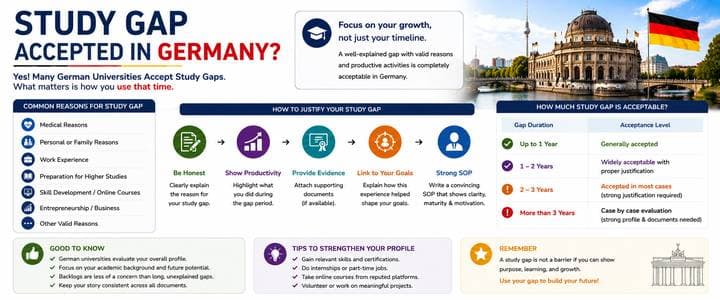
A study gap does not automatically prevent you from studying in Germany.
International students regularly apply to German universities after spending several years working, preparing for examinations, completing internships, managing family responsibilities, learning a language, or pursuing other activities.
There is no general German rule stating that every university applicant must begin their next degree within one, two, three, or five years of completing the previous qualification.
However, a study gap can still become relevant during:
University admission
Motivation-letter evaluation
CV review
Student visa assessment
Scholarship selection
The important question is usually not simply:
“How many years is your gap?”
It is:
“What did you do during that period, and does your decision to return to education make academic and career sense?”
A well-documented five-year gap involving relevant employment can sometimes be easier to explain than an unexplained one-year period with no information.
This guide explains how much study gap is generally acceptable for Germany, how universities and visa authorities may view it, acceptable reasons for a gap, documentation, Bachelor’s and Master’s cases, long study gaps, and how to explain the gap properly.
Study Gap in Germany at a Glance
| Question | General Answer |
|---|---|
| Does Germany accept study gaps? | Yes |
| Is there one maximum gap for Germany? | No universal limit |
| Is 1-year gap accepted? | Generally yes |
| Is 2-year gap accepted? | Generally yes |
| Is 3-year gap accepted? | Possible |
| Is 5-year gap accepted? | Possible with a logical profile |
| Is 7–10 year gap accepted? | Can be possible, especially with relevant work experience |
| Does work experience count negatively? | Usually no; it can strengthen the profile |
| Must gaps be explained? | Strongly recommended |
| Does gap automatically cause visa rejection? | No |
| Can universities set their own rules? | Yes |
| Is documentation important? | Yes |
| Best approach | Explain the complete academic/professional timeline honestly |
Does Germany Accept Study Gaps?
Yes.
Having a break between two qualifications does not automatically make an applicant ineligible for German universities.
Consider these examples:
Example 1
Bachelor’s completed in 2022.
Worked as a software engineer from 2022 to 2026.
Applied for MSc Computer Science in Germany.
This is technically a four-year period between degrees, but it is not an unexplained academic gap.
It represents professional experience.
Example 2
Bachelor’s completed in 2024.
Spent one year preparing for competitive examinations and improving German.
Applied for a Master’s in 2026.
This can also be explained.
Example 3
Class 12 completed in 2024.
Spent one year preparing for university entrance examinations.
Applied for Germany afterward.
Again, the gap itself does not automatically make the applicant ineligible.
Is There a Maximum Study Gap for Germany?
There is no universal nationwide maximum study-gap rule applicable to all German universities.
Statements such as:
“Germany accepts only a two-year gap.”
or:
“Germany rejects everyone with more than five years of gap.”
are misleading.
Universities establish their own admission criteria.
A program may care much more about:
Previous qualification
GPA
Academic credits
Subject compatibility
Language proficiency
than the number of years since graduation.
Study Gap vs Work Experience
These should not automatically be treated as the same thing.
Suppose you completed your Bachelor’s in 2020 and worked continuously until 2026.
You have six years between your Bachelor’s and Master’s.
But you have not necessarily been academically or professionally inactive.
You have:
six years of professional experience.
For programs such as:
MBA
Management
Engineering Management
Data Analytics
Professional Master’s degrees
this experience may actually strengthen your application.
Is a One-Year Study Gap Accepted in Germany?
A one-year gap is generally straightforward to explain.
Common reasons include:
Entrance exam preparation
Language learning
Internship
Employment
University application preparation
Personal responsibilities
Skill development
A one-year break normally should not be treated as a major concern when the applicant otherwise meets admission requirements.
Is a Two-Year Study Gap Accepted?
Yes, a two-year gap can be accepted.
Applicants should clearly explain what they did during that period.
Examples include:
Employment
Internships
German language preparation
Professional certification
Family business
Competitive examination preparation
Research
Entrepreneurship
Supporting documents can make the timeline stronger.
Is a Three-Year Gap Accepted?
A three-year gap can also be acceptable.
At this stage, a clear explanation becomes more useful.
Suppose you graduated with a BTech in Mechanical Engineering and spent three years working in manufacturing.
You then apply for an MSc in Production Engineering.
The progression is logical:
Mechanical Engineering → Manufacturing Experience → Production Engineering Master’s
The gap may actually strengthen your reason for pursuing graduate study.
Is a Five-Year Study Gap Accepted?
Yes, a five-year gap can be possible.
The main consideration is what happened during those five years.
A candidate who spent five years working in a relevant professional field can have a strong Master’s profile.
Example:
2017–2021: Bachelor of Technology in Computer Science
2021–2026: Software Engineer
2026: MSc Software Engineering application
This is a logical academic and professional progression.
Is a 7-Year Study Gap Accepted?
It can be.
There is no automatic Germany-wide rejection rule simply because seven years have passed.
However, applicants with longer gaps should pay greater attention to:
Program relevance
Current technical knowledge
Professional experience
Motivation for returning to university
Supporting documentation
A strong application should explain why graduate study is necessary now.
Is a 10-Year Study Gap Accepted?
Even long gaps can sometimes be accepted.
Applicants returning to education after eight, ten, or more years are often better described as experienced professionals rather than traditional recent graduates.
Such applicants may be particularly suitable for:
MBA
Executive programs
Management
Specialized professional Master’s degrees
Continuing education
A research-heavy academic Master’s may require stronger evidence that the applicant's academic foundation remains suitable.
What Is Considered an Acceptable Study-Gap Reason?
There is no official list of “approved” gap reasons.
However, several situations are easy to explain when genuine.
Employment
One of the strongest explanations.
Relevant employment can demonstrate:
Professional development
Practical knowledge
Career progression
Clear reason for pursuing further study
Internship
Internships can help explain shorter gaps while demonstrating relevant experience.
Competitive Examination Preparation
Students may spend time preparing for:
Government examinations
Professional entrance tests
University entrance examinations
Be honest about this period.
Language Preparation
Preparing for:
IELTS
TOEFL
TestDaF
Goethe examinations
German language levels
can form part of the timeline.
However, claiming that four years were spent solely preparing for IELTS would naturally require a stronger explanation.
Professional Certifications
Examples can include:
Programming certifications
Accounting qualifications
Cloud computing
Project management
Finance certifications
Technical training
These can show continued development.
Family Business
Working in a family business can be legitimate professional experience.
Describe:
Role
Responsibilities
Duration
Skills developed
Supporting evidence can strengthen the explanation.
Entrepreneurship
Starting or managing a business can be valuable experience.
Relevant evidence might include:
Registration
Professional records
Client work
Business documentation
Research
Research assistantships, publications, independent projects, and laboratory experience can strongly support applications.
Family Responsibilities
Applicants sometimes pause their education because of:
Family obligations
Care responsibilities
Financial circumstances
These can be explained briefly and honestly.
There is no need to reveal unnecessary private details.
Personal Circumstances
Not every gap needs to have resulted in a certificate.
Some students experience unavoidable personal circumstances.
The explanation should remain:
Honest
Concise
Consistent
Do not invent employment to make the application look stronger.
Gap After Class 12 for Germany
A gap after Class 12 does not automatically prevent a student from applying.
However, Bachelor’s applicants still need to satisfy Germany’s university entrance requirements.
For Indian students, this includes checking the applicable pathway involving:
Class 12
APS
Studienkolleg where required
Previous university study where applicable
The gap does not replace these academic requirements.
Example: One-Year Gap After Class 12
Suppose a student completed Class 12 in 2025 and spent 2025–2026 preparing for university admission and German-language requirements.
They can still apply for the appropriate German university pathway if they satisfy the required academic conditions.
Gap After Bachelor’s for Germany
A gap after Bachelor’s is especially common among Master’s applicants.
It may represent:
Employment
Internship
Research
Exam preparation
Career change
Skill development
For Master’s admission, universities are generally more concerned with:
Bachelor’s recognition
GPA
Required academic credits
Subject relevance
Language proficiency
than simply how recently the Bachelor’s was completed.
Study Gap for Master’s in Germany
Master’s applicants with gaps should ask:
Is my Bachelor’s still relevant?
A Computer Science graduate working in software for five years has a very logical profile for many computing Master’s programs.
Do I meet academic prerequisites?
Work experience does not normally replace mandatory academic credits.
Can I explain why I need the degree now?
This is particularly important for experienced applicants.
Example of a Strong Master’s Gap Profile
Bachelor’s:
Mechanical Engineering
Experience:
Four years in automotive manufacturing
Master’s:
Automotive Engineering
Reason:
Professional experience exposed the applicant to advanced vehicle systems and manufacturing optimization, creating a need for deeper technical specialization.
This profile can make strong academic sense.
Example of a More Difficult Profile
Bachelor’s:
Civil Engineering
Gap:
Six years with no stated activity
Master’s:
Artificial Intelligence
No evidence of:
Mathematics preparation
Programming
Computer Science
Relevant work
The study gap is not the only problem.
The larger concern is the lack of academic progression.
Career Change After a Study Gap
Germany can still be possible for students changing fields.
However, German Master’s programs frequently require previous academic credits in the same or related discipline.
For example:
Electrical Engineering → Renewable Energy
may be relatively straightforward.
Computer Science → Data Science
may also be compatible.
But:
English Literature → MSc Computer Science
can be much more difficult because formal Computer Science prerequisites may be missing.
Work experience alone does not always replace academic requirements.
Study Gap for MBA in Germany
A gap after Bachelor’s is often not a disadvantage for MBA applicants.
In fact, MBA programs commonly expect professional experience.
An applicant who worked five years after university may be stronger than someone applying immediately after graduation.
Relevant areas include:
Leadership
Business development
Project management
Consulting
Entrepreneurship
Finance
Operations
Study Gap for PhD in Germany
PhD applicants may have several years between Master’s and doctoral study.
This can be acceptable, especially when the period includes:
Research
University teaching
Industry R&D
Publications
Professional practice
Research relevance matters much more than simply counting the number of years.
Can a Study Gap Affect German Student Visa?
A study gap does not automatically mean a student visa will be refused.
The current student-visa requirements focus on matters such as:
Valid admission
Academic documents
Language proficiency
APS where applicable
Financial proof
Health insurance
Motivation to study
Complete educational and professional history
For applicants in India, the visa process currently requires a CV listing previous training, qualifications, and activities, together with a written explanation of the intention to study.
Therefore, gaps should not simply disappear from your timeline.
Why Visa Authorities May Ask About a Gap
A long unexplained period can raise practical questions such as:
What was the applicant doing?
Why return to education now?
Why choose this specific degree?
How does it fit the applicant's previous career?
Is the study plan genuine and logical?
The solution is not to fear the gap.
The solution is to explain it clearly.
Can Study Gap Cause Visa Rejection?
A gap alone should not be treated as an automatic rejection reason.
However, a weak overall study plan can create problems.
For example:
Long unexplained inactivity
Unrelated new degree
No logical career progression
False employment claims
Contradictory CV and SOP
Weak explanation for returning to education
can weaken an application.
How to Explain Study Gap in Your SOP
Do not make the study gap the central theme of your SOP.
Explain it naturally.
Example: Work Experience
“After completing my Bachelor’s degree in Mechanical Engineering, I joined an automotive components manufacturer, where I worked for three years in production engineering. My experience with process optimization and automated manufacturing systems developed my interest in advanced production technologies and motivated me to pursue graduate study in this area.”
This turns the gap into progression.
Example: Exam Preparation
“Following graduation, I spent a year preparing for competitive examinations while also strengthening my quantitative and analytical skills. During this period, I reassessed my long-term academic goals and decided to pursue graduate study in…”
Keep it factual.
Example: Skill Development
“After completing my undergraduate degree, I focused on developing practical programming skills through structured training and independent projects in Python and data analytics. These experiences strengthened my interest in…”
Example: Family Responsibility
“Following graduation, I temporarily postponed further study due to family responsibilities. Once these circumstances were resolved, I returned to professional development and prepared for graduate study in…”
There is no need to provide excessive personal details.
How NOT to Explain a Gap
Avoid phrases such as:
“I wasted three years but now I want to study.”
or:
“I had no idea what to do with my life.”
Frame the period honestly but professionally.
Do You Need a Separate Gap Certificate?
Germany does not have one universal document officially called a mandatory:
Study Gap Certificate
for every university applicant.
Some agents may use this terminology.
German universities normally care about the actual supporting records and application requirements rather than one standardized national gap certificate.
Documents That Can Support a Study Gap
Depending on what you did, useful documents can include:
Employment
Experience letter
Employment certificate
Payslips
Appointment letter
Internship
Internship certificate
Recommendation
Business
Business registration
Professional documentation
Training
Course certificate
Certification
Language Study
Language certificates
Examination results
Research
Research certificate
Publication
Supervisor letter
Not every gap requires all of these.
Importance of Your CV
Your CV should present a complete timeline.
For example:
2020–2024: BTech Computer Science
July 2024–December 2024: Data Analytics Internship
January 2025–June 2026: Junior Data Analyst
October 2026: Intended MSc start
This is easier to understand than leaving two blank years.
Should You Hide a Gap?
No.
Never manipulate dates or invent activities.
Academic and employment records can be checked.
False information is much more serious than an honest study gap.
Study Gap and APS
For Indian students, APS verifies academic documentation.
APS should not be viewed as a process for “approving” or “rejecting” a study gap.
The applicant still needs to provide correct academic records under the appropriate APS procedure.
Study Gap and Uni-Assist
uni-assist primarily evaluates educational qualifications and application requirements for participating universities.
A gap does not automatically make a uni-assist application invalid.
The important questions remain:
Are your qualifications recognized?
Are your documents complete?
Do you satisfy the program requirements?
Study Gap and GPA
A gap does not erase a low GPA.
Similarly, a high GPA does not eliminate the need to explain a long unexplained period when relevant.
These are separate considerations.
Does Work Experience Improve Admission Chances?
It depends on the program.
For some programs, work experience can be valuable.
For others, admission is heavily academic.
Example:
A Master’s requiring:
20 ECTS Mathematics
will not necessarily replace those credits because an applicant worked five years in IT.
Formal academic requirements still apply.
Long Gap Applicants: Best Strategy
Applicants with five or more years since graduation should focus on four areas.
1. Choose a Logical Program
The degree should connect with either:
Previous education
Professional experience
Ideally both.
2. Demonstrate Current Knowledge
Show that your academic or technical skills remain relevant.
This can come through:
Work
Research
Projects
Certifications
3. Explain Why Now
Why is graduate education necessary at this stage?
A strong answer could be:
“I have reached a point in my professional work where deeper knowledge of energy systems is necessary for me to move into advanced technical roles.”
4. Document the Timeline
Avoid unexplained periods.
Is a Study Gap More Difficult at Public Universities?
There is no general rule that public universities reject long-gap students while private universities accept them.
Admission depends on the program.
A public university may admit an experienced applicant if the academic criteria are met.
Is a Private University Better for Long Gaps?
Some private universities offer professionally oriented programs that may suit experienced applicants.
However, students should not choose a university solely because they believe it “accepts gaps.”
Evaluate:
Recognition
Accreditation
Curriculum
Career outcomes
Tuition
Academic fit
Common Study-Gap Myths
“Germany accepts only a two-year gap.”
False as a universal rule.
“A five-year gap means automatic visa rejection.”
False.
“Work experience is considered a study gap.”
Not in the same practical sense as unexplained inactivity.
“You need a gap certificate for every German university.”
There is no single nationwide mandatory gap-certificate rule.
“Private universities are the only option after a long gap.”
False.
“A strong IELTS score can solve the gap problem.”
IELTS demonstrates language proficiency, not academic progression.
Frequently Asked Questions
Is study gap accepted in Germany?
Yes. A study gap does not automatically prevent university admission.
How much gap is accepted in Germany?
There is no single nationwide maximum gap applicable to all German universities.
Is a one-year gap accepted?
Generally yes.
Is a two-year gap accepted?
Yes, provided the overall profile meets admission requirements.
Is a three-year gap accepted?
It can be.
Is a five-year study gap accepted in Germany?
Yes, particularly when the applicant can demonstrate employment, training, or another logical activity.
Is a seven-year gap accepted?
It can be, depending on the university, program, and applicant's profile.
Is a ten-year gap accepted?
Some experienced applicants successfully return to education after long periods, particularly for professional programs. Individual program requirements still apply.
Does work experience count as a gap?
There may be several years between qualifications, but relevant employment is professional experience rather than unexplained inactivity.
Can I study in Germany after working for five years?
Yes, assuming you meet the university's academic and language requirements.
Can I apply for a Master’s after a long gap?
Yes.
Do German public universities accept study gaps?
They can. There is no universal public-university gap ban.
Do I need a study gap certificate?
There is no nationwide German requirement for every applicant to submit a document called a study gap certificate.
Should I mention the gap in my SOP?
Explain it briefly when relevant, especially when it helps clarify your academic or professional progression.
Should I mention the gap in my CV?
Your CV should provide an accurate timeline of education, employment, training, and other significant activities.
Does a gap affect the German student visa?
A gap itself does not automatically cause refusal, but your study plan and timeline should be credible and clearly documented.
Can I hide the gap?
No. Always provide accurate information.
Can work experience compensate for a low GPA?
Sometimes it can strengthen the overall application, but it cannot normally override mandatory academic requirements.
Can I change my field after a long gap?
Possibly, but German Master’s programs frequently require a relevant previous degree and specific academic credits.
Final Verdict
Yes, study gaps are accepted in Germany.
There is no universal rule stating that:
One year is allowed
Three years is the maximum
Five years causes rejection
The strength of the application depends on the complete profile.
A useful way to think about study gaps is:
Gap length matters less than gap explanation and academic progression.
A student with:
Bachelor’s → five years relevant employment → related Master’s
may have a very logical application.
A student with:
Bachelor’s → unexplained five-year period → completely unrelated Master’s
may need a much stronger explanation.
The safest approach is:
Be honest → Document your timeline → Choose a logical program → Explain why you are returning to study → Connect the degree to your future career
For university admission, continue focusing on the core requirements:
Qualification recognition
GPA
Subject compatibility
Required academic credits
Language proficiency
For visa preparation, maintain a complete and consistent CV and clearly explain why the chosen program makes sense at this stage of your academic or professional life.
A study gap is therefore not automatically a barrier to studying in Germany. What matters most is whether the applicant can demonstrate a credible academic and career pathway.