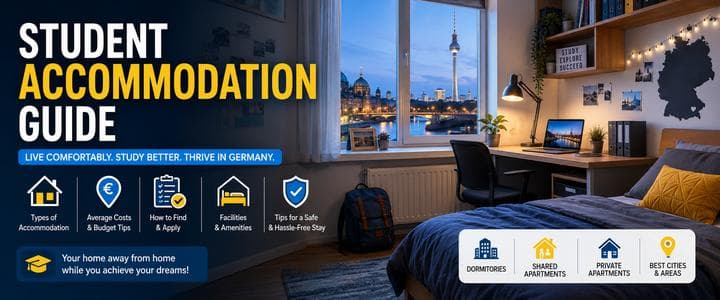
Finding student accommodation in Germany can be more difficult than securing university admission. Affordable rooms are limited in major university cities, and students are normally responsible for arranging their own housing. Admission to a German university does not automatically include a room in a residence hall.
The main accommodation options are student residences, shared apartments, private rooms, studio apartments, sublets, and temporary housing. Student residences operated by local Studierendenwerke are generally the most affordable, but waiting lists can be long. Private accommodation provides more choice but usually requires a larger budget, a security deposit, and additional documents.
Students should begin searching as soon as they receive admission. In Munich, Berlin, Hamburg, Frankfurt, Cologne, Stuttgart, Heidelberg, and Freiburg, starting three to six months before arrival may still be necessary. Students who cannot secure permanent housing before traveling should book verified temporary accommodation for the first few weeks.
This guide explains accommodation types, rent, deposits, contracts, registration, broadcasting fees, application documents, scams, and the housing process for Indian and international students in Germany.
Student Accommodation in Germany: Quick Overview
| Category | 2026 guidance |
|---|---|
| Cheapest housing option | Studierendenwerk residence |
| National dormitory rent benchmark | Approximately €318 per month, including running costs |
| Typical private shared-room rent | €400–€900 per month |
| Private studio rent | €650–€1,500 or more |
| Security-deposit limit | Up to three months’ basic rent |
| Deposit payment | Tenant may generally pay in three monthly installments |
| Address-registration deadline | Within two weeks of moving |
| Required registration document | Wohnungsgeberbestätigung |
| Broadcasting fee | €18.36 per household per month |
| Housing automatically provided by university | Usually no |
| Best time to apply for a dormitory | Immediately after admission |
| Common rental term | Mietvertrag |
| Shared apartment | Wohngemeinschaft or WG |
| Basic rent | Kaltmiete |
| Rent including operating costs | Warmmiete |
| Security deposit | Kaution |
| Service charges | Nebenkosten |
Rent varies substantially according to the city, neighborhood, room type, furnishing, and utilities included.
Is Student Accommodation Guaranteed in Germany?
No. German universities generally do not guarantee accommodation to admitted students.
A university may provide:
Information about local residences
Links to private listings
Emergency accommodation guidance
Housing advice through its international office
Limited rooms for exchange students
Service packages for selected international students
The student is normally responsible for:
Submitting housing applications
Contacting landlords
Attending viewings
Checking contracts
Paying the deposit
Registering the address
Arranging electricity and internet where necessary
Students should not wait for visa approval before beginning the housing search. A dormitory application can often be submitted after receiving admission or proof of application, depending on the local Studierendenwerk.
Types of Student Accommodation in Germany
Student Residence or Dormitory
A student residence is called a Studentenwohnheim or Studierendenwohnheim.
Many public student residences are operated by regional Studierendenwerke rather than directly by universities.
Possible room types include:
Single room with shared kitchen and bathroom
Single room in a shared apartment
Furnished studio
Unfurnished studio
Couple’s apartment
Family apartment
Accessible room
Short-term exchange-student room
Average Dormitory Rent
The latest national housing statistics place the average monthly rent in Studierendenwerk residences at approximately:
€318 per month, including running costs
This is a national average. Actual rents may range from approximately €250 to €600 or more depending on the city, room, building, and services.
Advantages of Student Residences
Lower rent
Furnished rooms in many buildings
Utilities may be included
Internet may be included
Easy contact with other students
Campus proximity
Simplified application process
International community
Lower deposit in some residences
Disadvantages
Long waiting lists
Limited choice
Shared bathrooms or kitchens
Fixed eligibility requirements
Maximum residence periods
Restrictions on subletting
Limited availability for couples and families
When to Apply
Apply immediately after receiving university admission. Waiting lists of several months are common, particularly before the winter semester.
Students should not assume that joining a waiting list guarantees a room.
Shared Apartment
A shared apartment is called a Wohngemeinschaft, commonly shortened to WG.
Each person normally has a private bedroom while sharing:
Kitchen
Bathroom
Hallway
Living room, if available
Washing machine
Utility costs
Cleaning responsibilities
Typical Shared-Room Rent
| City category | Approximate monthly WG rent |
|---|---|
| Munich and other premium locations | €650–€1,000 or more |
| Berlin, Hamburg, Frankfurt, Cologne | €550–€900 |
| Stuttgart, Heidelberg, Freiburg | €500–€850 |
| Aachen, Karlsruhe, Münster, Erlangen | €400–€700 |
| Leipzig, Dresden, Göttingen, Saarbrücken | €300–€600 |
These ranges generally refer to a private bedroom in a shared apartment. Students must check whether the price is Kaltmiete or Warmmiete.
WG Interview
Existing residents may invite applicants to a WG-Casting, an informal meeting used to select a new roommate.
They may ask about:
Study program
Daily schedule
Cleanliness
Smoking
Cooking
Guests
Parties
Pets
Shared activities
Languages
Length of stay
The meeting is partly about personality and compatibility. A student should answer honestly rather than trying to provide the “perfect” response.
Advantages of a WG
Lower cost than a private studio
Social interaction
Shared household expenses
Larger common areas
Opportunity to practice German
Easier integration
Challenges
Shared cleaning
Different schedules
Noise
Unequal household responsibilities
Shared bills
Potential roommate conflict
Private Studio Apartment
A studio apartment provides a private living area, kitchen or kitchenette, and bathroom.
It may be listed as:
Einzimmerwohnung
1-Zimmer-Wohnung
Studio
Apartment
In German property listings, “one room” generally refers to the main living and sleeping room. The kitchen and bathroom are not normally counted as separate rooms.
Typical Studio Rent
A private studio may cost:
€650–€1,500 or more per month
The highest prices are common in Munich, Frankfurt, Hamburg, Berlin, Stuttgart, Heidelberg, and Freiburg.
Advantages
Complete privacy
Independent schedule
No shared kitchen or bathroom
Easier household management
Suitable for students who require quiet
Disadvantages
Higher rent
Larger security deposit
More utility contracts
Greater furnishing costs
Potential isolation
More competitive application process
Private Student Residence
Private companies operate purpose-built student residences in many cities.
These buildings may offer:
Furnished studios
Internet
Gym
Study rooms
Laundry facilities
Common areas
Reception
Security systems
Shorter application procedures
Private residences are usually more expensive than publicly supported Studierendenwerk housing. A room or studio can cost €600–€1,400 or more per month.
Students should examine:
Administration fees
Booking fees
Deposit
Minimum contract period
Cancellation conditions
Utility limits
End-of-tenancy cleaning charges
Sublet
A sublet is called Untermiete. It is common when a student temporarily leaves for an exchange semester, internship, or vacation.
Sublets can be useful for:
The first semester
Short courses
Internships
Exchange programs
Temporary housing while searching for a permanent room
The main tenant should normally have permission to sublet. The student should request:
Written sublease
Landlord or authorized tenant details
Exact rent
Deposit conditions
Inventory list
Registration confirmation
Subletting authorization where relevant
A sublet that does not permit address registration may create difficulties for international students who need Anmeldung and a residence permit.
Temporary Accommodation
If permanent housing is unavailable before arrival, students can use:
Hostel
Guesthouse
Hotel
Short-term furnished apartment
Youth hostel
University guesthouse
Verified sublet
Temporary private residence
Temporary housing is more expensive, but it can be safer than transferring money for an unverified room.
Students should book enough time to attend viewings after arrival. One or two nights may not be sufficient in a competitive city.
Host Family Accommodation
Some organizations arrange rooms with German families.
Possible benefits include:
Furnished room
Cultural integration
Language practice
Utilities included
Support during initial adjustment
Students should confirm:
Meals
Guest policies
Kitchen access
Curfew
Laundry
Address registration
Travel distance
Contract duration
Privacy expectations
Understanding German Rent Terms
German rental advertisements use terms that international students must understand.
| German term | Meaning |
|---|---|
| Kaltmiete | Basic rent excluding most service costs |
| Warmmiete | Rent including specified operating costs |
| Nebenkosten | Additional or operating costs |
| Heizkosten | Heating costs |
| Strom | Electricity |
| Kaution | Security deposit |
| Provision | Brokerage commission |
| Möbliert | Furnished |
| Unmöbliert | Unfurnished |
| Zwischenmiete | Temporary sublet |
| Untermiete | Sublease |
| Hauptmieter | Main tenant |
| Untermieter | Subtenant |
| Mietvertrag | Rental agreement |
| Hausordnung | Building rules |
| Kündigungsfrist | Notice period |
| Wohnungsgeberbestätigung | Landlord’s residence confirmation |
| Anmeldung | Address registration |
| Wohnfläche | Living area |
| Einbauküche | Fitted kitchen |
| Staffelmiete | Rent increasing according to a schedule |
| Indexmiete | Rent linked to an official price index |
| Nachmieter | Replacement tenant |
Kaltmiete vs Warmmiete
Kaltmiete
Kaltmiete is the basic rent for using the room or apartment. It normally excludes operating costs.
Warmmiete
Warmmiete includes the basic rent and specified service charges. It may include:
Water
Heating
Waste disposal
Building cleaning
Communal electricity
Property operating costs
Warmmiete does not always include:
Personal electricity
Internet
Broadcasting fee
Telephone
Furniture
Parking
Laundry
Students should ask for a written list of everything included.
Example
| Cost | Monthly amount |
|---|---|
| Kaltmiete | €500 |
| Nebenkosten | €150 |
| Warmmiete | €650 |
| Electricity | €40 |
| Internet | €25 |
| Broadcasting contribution share | Approximately €5–€18.36 |
| Effective monthly housing cost | €720–€733.36 |
The share of the broadcasting fee depends on the number of adults sharing the registered dwelling.
Estimated Student Rent by City
| City | Shared-room estimate | Studio estimate |
|---|---|---|
| Munich | €650–€1,000+ | €1,000–€1,600+ |
| Berlin | €550–€900 | €850–€1,400+ |
| Hamburg | €550–€850 | €850–€1,350 |
| Frankfurt | €550–€900 | €900–€1,450 |
| Cologne | €500–€850 | €800–€1,300 |
| Stuttgart | €500–€850 | €800–€1,300 |
| Heidelberg | €500–€800 | €800–€1,250 |
| Freiburg | €500–€800 | €800–€1,250 |
| Aachen | €400–€650 | €650–€1,000 |
| Karlsruhe | €400–€700 | €650–€1,050 |
| Leipzig | €350–€600 | €550–€900 |
| Dresden | €350–€600 | €550–€900 |
| Göttingen | €350–€600 | €550–€900 |
| Saarbrücken | €300–€550 | €500–€850 |
These are planning ranges rather than regulated prices. Furnishing, location, utilities, and market conditions can move an individual property outside the range.
Where to Find Student Accommodation
Students can search through:
Local Studierendenwerk
University international office
University noticeboards
University housing office
WG-Gesucht
ImmoScout24
Immowelt
Kleinanzeigen
Student social-media groups
Private student-residence websites
Local newspapers
Church student communities
Alumni groups
Municipal housing companies
Students should apply through several channels simultaneously.
How to Apply for a Student Residence
The process normally involves:
Identify the Studierendenwerk responsible for the university.
Create an online housing application.
Select acceptable residences and room types.
Enter the expected study period.
Upload admission or enrollment evidence.
Join the waiting list.
Confirm continued interest when requested.
Respond immediately when an offer arrives.
Pay the deposit only through the official process.
Sign the contract and follow move-in instructions.
Some residence applications must be renewed or reconfirmed periodically. Missing a confirmation email can remove the student from the list.
Documents Required for Private Accommodation
A landlord may request:
Passport or identity card
University admission letter
Enrollment certificate
Visa or residence permit
Proof of income
Employment contract
Blocked-account confirmation
Scholarship confirmation
Parent or sponsor guarantee
Bank statements
German credit report
Previous landlord reference
Tenant self-disclosure form
Liability-insurance evidence
New international students may not have a German credit history. They can explain this and provide alternative evidence, such as:
Blocked-account confirmation
Scholarship award
Financial-guarantee letter
Parent’s income documents
Advance proof of study funding
German guarantor, if available
A landlord may choose among applicants, but students should avoid sending excessive personal data before verifying the listing and landlord.
Rental Security Deposit
The rental deposit is called Kaution.
For a standard residential tenancy, the cash security deposit may generally not exceed:
Three months of Kaltmiete
The maximum is calculated using basic rent without operating-cost prepayments.
Example
If:
Kaltmiete is €500
Nebenkosten are €150
Warmmiete is €650
The standard maximum deposit is generally:
€1,500
It is not calculated as three times the €650 Warmmiete.
Paying the Deposit in Installments
A tenant paying a cash deposit is generally entitled to pay it in three equal monthly installments. The first installment becomes due at the beginning of the tenancy under the statutory arrangement.
Contract terms cannot simply remove mandatory tenant protections.
Deposit Return
The landlord may retain the deposit temporarily after move-out to evaluate:
Unpaid rent
Damage beyond normal wear
Missing keys
Outstanding service-charge calculations
Contractual obligations
Students should provide their new address and bank details after moving out.
What to Check in a Rental Contract
Never sign a contract without reading it.
Check:
Full landlord details
Tenant details
Complete property address
Room or apartment description
Floor and room size
Start date
End date
Fixed or open-ended term
Kaltmiete
Nebenkosten
Warmmiete
Heating
Electricity
Internet
Deposit
Payment date
Bank-account details
Notice period
Subletting rules
Furnishings
House rules
Repair clauses
Rent increases
Broadcasting-fee arrangements
Address-registration eligibility
Students who do not understand German can request an explanation or independent review. A translated summary is helpful, but the signed German contract may remain legally controlling.
Fixed-Term and Open-Ended Contracts
Fixed-Term Contract
A fixed-term contract ends on a specified date, subject to its legal validity and terms.
It may be difficult to terminate early unless:
The contract permits it
The landlord agrees
A legally recognized reason applies
A replacement tenant is accepted
Open-Ended Contract
An open-ended contract continues until terminated.
A tenant’s standard notice period is often three months, but the contract and legal circumstances should be checked.
Student residences and temporary accommodation can follow different occupancy rules.
Move-In Inspection
Students should complete a written move-in inspection or Übergabeprotokoll.
Record:
Wall damage
Floor scratches
Window condition
Mold
Furniture damage
Appliance condition
Bathroom condition
Kitchen condition
Number of keys
Electricity meter reading
Gas meter reading
Water meter reading
Heating-meter reading
Take timestamped photographs and keep them with the contract.
Without evidence, a student may later be blamed for damage that existed before move-in.
Address Registration
Students must normally register their German address within two weeks of moving.
This process is called:
Anmeldung
Registration is completed at the local:
Bürgeramt
Bürgerbüro
Einwohnermeldeamt
Residents’ Registration Office
Documents for Anmeldung
Students commonly need:
Passport
Completed registration form
Wohnungsgeberbestätigung
Visa or residence document where requested
Marriage or family documents when relevant
The Wohnungsgeberbestätigung is completed by the landlord or authorized housing provider. A rental contract alone may not replace it.
After registration, the student receives a Meldebescheinigung.
Why Anmeldung Is Important
The registration certificate may be required for:
Residence permit
Bank account
Tax identification number
Health insurance
University administration
Employment
Mobile contracts
Broadcasting contribution
Other official services
Students should avoid long-term housing that refuses Anmeldung without a legitimate reason.
Broadcasting Contribution
Germany charges a public broadcasting contribution known as Rundfunkbeitrag.
The current contribution is:
€18.36 per month per dwelling
The principle is:
One dwelling, one contribution
If four students share one apartment, only one person normally registers and pays the full household contribution. The roommates can divide the cost privately.
The registered payer should share the contribution number with the other occupants if they receive letters.
Students do not automatically receive an exemption simply because they are international or enrolled at a university. Certain students receiving qualifying public assistance may apply for exemption.
Electricity, Internet, and Utilities
The tenant may need separate contracts for:
Electricity
Gas
Internet
Telephone
Before signing, ask:
Is electricity included?
Is heating included?
Is hot water included?
Is internet included?
Is there a consumption limit?
Who selects the provider?
Is a previous contract active?
Are utility bills estimated or fixed?
Annual Service-Charge Statement
Service charges may be paid monthly in advance and adjusted later through an annual statement.
The tenant may receive:
A refund if usage was lower than estimated
An additional bill if costs were higher
Students should reserve money for possible additional heating or utility charges.
Furnished vs Unfurnished Accommodation
A German unfurnished apartment may not include:
Bed
Wardrobe
Desk
Lamps
Washing machine
Refrigerator
Kitchen cabinets
Cooking appliances
A listing with an Einbauküche includes a fitted kitchen, although the exact appliances must be checked.
Before renting, ask for an inventory of:
Bed and mattress
Desk and chair
Wardrobe
Kitchen
Refrigerator
Oven or cooktop
Washing machine
Curtains
Lighting
Internet router
Furnishing an empty apartment can add several hundred or several thousand euros to initial costs.
Initial Housing Costs
A student renting a private room may need:
| Initial expense | Possible amount |
|---|---|
| First month’s Warmmiete | €500–€900 |
| Deposit | €900–€2,100 |
| Temporary accommodation | €200–€800 |
| Furniture and household items | €100–€1,000 |
| Internet setup | €0–€100 |
| Transportation and moving | €50–€250 |
| Total initial requirement | €1,750–€5,150 or more |
The deposit is refundable subject to the contract, but it still creates an initial cash requirement.
Student Housing Scams in Germany
Housing fraud is a serious risk in competitive student cities.
Common Scam Pattern
A supposed landlord claims to be outside Germany and cannot show the property. The student is asked to transfer rent or deposit before receiving keys. The advertisement may use photographs copied from another property.
Warning Signs
Rent is far below the local market.
The landlord refuses a video or physical viewing.
The landlord claims to be permanently abroad.
Money is requested before contract verification.
Payment is requested through cryptocurrency, gift card, or transfer service.
The bank account belongs to an unrelated person.
The landlord pressures the student to pay immediately.
The email address appears unofficial.
The contract contains inconsistent names or addresses.
Identity documents look edited.
The room cannot be registered.
A viewing fee is requested.
The listing uses the logo of a rental platform but communicates outside it.
The landlord asks for a passport scan before providing basic property information.
How to Protect Yourself
Compare the rent with similar listings.
Search the property photographs online.
Verify the address.
Attend a viewing or arrange a live video tour.
Confirm the landlord’s identity.
Read the contract.
Check that bank-account and contract names are consistent.
Do not transfer money solely to reserve a viewing.
Use the official residence application system.
Ask the university or Studierendenwerk for help.
Keep all messages and payment records.
German official guidance warns that paying rent or a deposit before signing the agreement and receiving possession or keys is not customary. Pressure to transfer money early is a major warning sign.
Housing Advice for Indian Students
Indian students should begin the housing search immediately after admission rather than waiting for the final visa decision.
A practical sequence is:
Apply to the Studierendenwerk residence.
Search verified shared apartments.
Join university housing groups.
Contact the international office.
Prepare a German and English introduction.
Arrange temporary accommodation as backup.
Keep funds available for the deposit.
Confirm Anmeldung before signing.
Verify the landlord and bank details.
Document the move-in condition.
Payment Precautions
Students should not transfer a large amount merely because someone shares:
Passport copy
Property photograph
Rental-platform logo
Foreign identification
A professional-looking contract
Scammers can use stolen identities and copied documents.
Cultural Expectations in Shared Housing
German shared apartments may have written or informal rules regarding:
Cleaning schedule
Quiet hours
Recycling
Kitchen use
Overnight guests
Smoking
Shared purchases
Heating
Ventilation
Discuss these matters before moving in.
Housing for Couples and Families
Couple and family accommodation is more limited than single-student housing.
Students should search for:
Couple apartments
Family residences
Two-room apartments
Municipal housing
Private apartments
Studierendenwerk family housing
Additional documents may include:
Marriage certificate
Child’s birth certificate
Family visa documents
Proof of sufficient space
Proof of financial resources
Families should apply early because suitable units are limited.
Accessible Accommodation
Students with disabilities or chronic illnesses should contact:
University disability representative
Studierendenwerk social counseling
International office
Residence administration
Accessible rooms may include:
Step-free access
Elevator
Wider doors
Adapted bathroom
Accessible kitchen
Reserved parking
Emergency equipment
Early application is essential because the number of suitable rooms is limited.
Emergency Accommodation
Some cities arrange temporary emergency housing at the beginning of the semester. This may include:
Hostel beds
Shared halls
Temporary rooms
Short-term residences
Emergency guesthouses
Availability is not guaranteed. Contact the university, student union, and Studierendenwerk before arrival if housing has not been secured.
Moving Out of Student Accommodation
Before leaving:
Submit notice according to the contract.
Request written confirmation.
Arrange a move-out inspection.
Repair damage for which the tenant is responsible.
Clean according to the contract.
Remove personal belongings.
Record meter readings.
Return every key.
Obtain a signed handover report.
Provide forwarding address and bank details.
Deregister or update the address.
Cancel electricity, internet, and other contracts.
Update the broadcasting contribution.
Do not rely on a replacement tenant to cancel the contract unless the landlord accepts the arrangement in writing.
Sample Accommodation Search Timeline
| Period before arrival | Recommended action |
|---|---|
| Five to six months | Research cities and apply for dormitory housing |
| Four months | Search private residences and WG listings |
| Three months | Prepare rental documents and contact landlords |
| Two months | Attend virtual viewings and compare contracts |
| One month | Confirm permanent or temporary housing |
| Arrival week | Inspect property and collect keys |
| Within two weeks | Complete Anmeldung |
| First month | Arrange utilities and broadcasting contribution |
Common Accommodation Mistakes
Starting the search too late
Applying only for student residences
Assuming university admission includes housing
Ignoring accommodation outside the city center
Confusing Kaltmiete with Warmmiete
Forgetting electricity and internet
Paying without verifying the property
Accepting housing without Anmeldung
Not reading the notice period
Failing to document existing damage
Paying an excessive deposit
Assuming the deposit is calculated from Warmmiete
Ignoring annual utility adjustments
Signing a German contract without understanding it
Failing to cancel contracts when moving
Frequently Asked Questions
How much does student accommodation cost in Germany?
A student residence may cost approximately €250–€600 per month. A shared room generally costs €400–€900, while a studio can cost €650–€1,500 or more.
What is the cheapest student accommodation?
Studierendenwerk residences are generally the cheapest option. The latest national statistical average is approximately €318 per month, including running costs.
Does a German university provide accommodation?
Usually not automatically. Students must normally apply separately to the Studierendenwerk or private housing providers.
When should I apply for a student residence?
Apply immediately after receiving admission. Waiting lists can last several months.
What is a WG?
WG is the abbreviation for Wohngemeinschaft, meaning a shared apartment in which residents have private bedrooms and share common areas.
What is Warmmiete?
Warmmiete is the rent including specified operating costs. Electricity, internet, and broadcasting fees may still be separate.
What is Kaltmiete?
Kaltmiete is the basic rent before most utility and operating charges.
How much deposit can a landlord request?
For a normal residential tenancy, the cash deposit generally cannot exceed three months of Kaltmiete.
Can the deposit be paid in installments?
A tenant paying a cash deposit generally has the right to pay it in three equal monthly installments.
Should I pay before viewing a room?
Students should be extremely cautious. Paying merely to view or reserve an unverified property is a major scam warning.
Is Anmeldung compulsory?
Residents must generally register their address within two weeks of moving.
What is a Wohnungsgeberbestätigung?
It is the landlord or housing provider’s confirmation that the tenant has moved into the property. It is used for address registration.
Can I register using a hostel address?
It depends on whether the accommodation provider issues the required confirmation and the stay qualifies for registration. Students should ask before booking.
What is the German broadcasting fee?
The current fee is €18.36 per month per dwelling, regardless of the number of residents or devices.
Does every WG roommate pay €18.36?
No. One contribution is charged per dwelling. Roommates can divide it among themselves.
Is electricity included in German rent?
Not always. Many tenants arrange and pay for electricity separately.
Are German student rooms furnished?
Student residences are often furnished, but private rooms and apartments may be partly furnished or completely empty.
Can I live outside my university city?
Yes. Nearby towns can provide lower rent if public transportation and commuting time are reasonable.
Which German cities have the highest rent?
Munich, Frankfurt, Berlin, Hamburg, Stuttgart, Cologne, Heidelberg, and Freiburg generally have expensive and competitive housing markets.
Which cities are more affordable?
Leipzig, Dresden, Saarbrücken, Magdeburg, Chemnitz, Halle, and Göttingen generally offer more affordable accommodation.
Can Indian students book housing before receiving a visa?
Applications can usually begin after admission, although contract and cancellation conditions must be checked carefully.
Is a private student residence worth it?
It can provide furnished housing and an easier application process, but it is usually more expensive than a public student residence.
How long does a landlord have to return the deposit?
There is no single immediate deadline that fits every case. The landlord may retain it for a reasonable period to check damage, unpaid rent, and outstanding service-charge calculations.
Can a landlord charge for viewing a property?
Official guidance states that charging a prospective tenant merely to view a property is not permitted.
What should I do if I cannot find housing?
Contact the university international office, Studierendenwerk, student union, emergency accommodation services, and verified temporary housing providers.
Final Thoughts
Student accommodation is one of the most important and challenging parts of studying in Germany. University admission does not normally include housing, and demand is especially high in Munich, Berlin, Hamburg, Frankfurt, Cologne, Stuttgart, Heidelberg, and Freiburg.
Studierendenwerk residences offer the lowest average rents, but students must apply early and maintain backup options. Shared apartments provide a balance between cost and social life, while private studios offer privacy at a significantly higher price.
Before signing a contract, students must understand Kaltmiete, Warmmiete, Nebenkosten, deposit rules, notice periods, registration eligibility, and utility arrangements. The deposit for a standard residential tenancy is generally limited to three months of basic rent and can normally be paid in three installments.
International students should never send money solely because a landlord creates urgency or provides a professional-looking document. A verified temporary room is safer than an attractive but unverified long-term offer.
After moving in, students should complete Anmeldung within two weeks, obtain their registration certificate, arrange utilities, and deal with the household broadcasting contribution. Careful preparation can prevent financial loss, administrative problems, and unnecessary stress during the first semester.