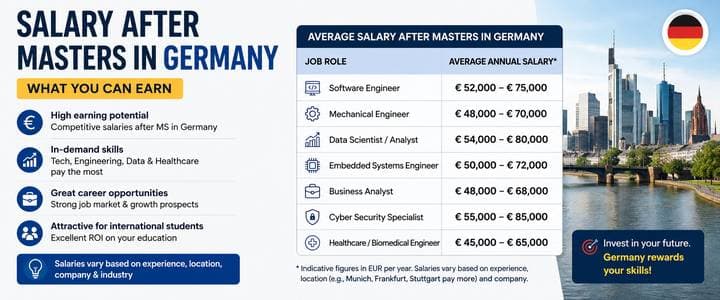
Germany offers strong career opportunities for international graduates in engineering, computer science, artificial intelligence, data science, business, finance, healthcare, renewable energy, and research. However, the salary after a master’s degree in Germany varies considerably according to the graduate’s specialization, professional experience, German-language ability, employer, industry, and work location.
In 2026, a realistic starting salary after a master’s degree in Germany generally falls between €45,000 and €60,000 gross per year. Graduates entering high-demand technical fields, major corporations, management consulting, banking, pharmaceuticals, or specialized engineering may receive offers above €60,000. Graduates entering social sciences, architecture, communications, nonprofit organizations, small companies, or academic research may start below €45,000.
A master’s degree alone does not guarantee a particular salary. Employers pay for the role, required skills, experience, and measurable value that the applicant can bring to the company. Internships, working-student experience, German-language ability, software expertise, and industry knowledge can therefore influence the first salary as much as the degree title.
Salary After Masters in Germany: Quick Overview
| Category | Approximate gross salary |
|---|---|
| Typical master’s graduate starting salary | €45,000–€60,000 per year |
| Technical master’s graduate | €50,000–€65,000 per year |
| Business or management graduate | €45,000–€60,000 per year |
| Data science or AI graduate | €52,000–€68,000 per year |
| Engineering graduate | €48,000–€65,000 per year |
| Finance or consulting graduate | €50,000–€70,000 per year |
| Research or academic graduate | €42,000–€58,000 per year |
| Experienced master’s professional | €60,000–€85,000 per year |
| Senior specialist or manager | €80,000–€120,000 or more |
| Overall German full-time median salary | Approximately €53,900 per year |
| Median for employees with a university degree | Approximately €68,250 per year |
| Median for career starters with less than one year of experience | Approximately €46,250 per year |
The overall university-degree median includes experienced professionals, specialists, and managers. It should not be interpreted as the guaranteed starting salary for a new master’s graduate.
What Is the Average Salary After Masters in Germany?
Most international graduates can expect an initial gross annual salary between €45,000 and €60,000 after completing a master’s degree in Germany.
A reasonable salary classification for fresh graduates is:
| Annual gross salary | General interpretation |
|---|---|
| Below €40,000 | Low for many master’s-level professional roles |
| €40,000–€45,000 | Common in smaller firms and lower-paying fields |
| €45,000–€50,000 | Competitive graduate starting salary |
| €50,000–€60,000 | Strong starting salary for a master’s graduate |
| €60,000–€70,000 | Excellent starting salary, usually in high-demand fields |
| Above €70,000 | Exceptional for a fresh graduate outside selected sectors |
These classifications are general. A €44,000 offer in Leipzig may provide greater purchasing power than a €52,000 offer in Munich after rent and other living costs are considered.
Graduates should therefore compare:
Gross annual salary
Estimated monthly net salary
City and housing costs
Working hours
Annual bonus
Overtime arrangements
Vacation entitlement
Pension or insurance benefits
Relocation support
Remote-work policy
Training budget
Salary-review schedule
Salary After Masters in Germany by Field
The following ranges represent approximate 2026 starting salaries for graduates entering full-time employment. They are not guaranteed salary scales.
| Master’s specialization | Common starting salary |
|---|---|
| Computer Science | €50,000–€65,000 |
| Software Engineering | €50,000–€65,000 |
| Artificial Intelligence | €52,000–€68,000 |
| Data Science | €50,000–€65,000 |
| Cybersecurity | €50,000–€67,000 |
| Business Analytics | €48,000–€62,000 |
| Mechanical Engineering | €48,000–€62,000 |
| Automotive Engineering | €50,000–€65,000 |
| Electrical Engineering | €50,000–€65,000 |
| Industrial Engineering | €50,000–€65,000 |
| Robotics and Automation | €50,000–€66,000 |
| Civil Engineering | €45,000–€58,000 |
| Renewable Energy | €48,000–€62,000 |
| Biotechnology | €45,000–€60,000 |
| Pharmaceutical Sciences | €48,000–€65,000 |
| Supply Chain Management | €45,000–€58,000 |
| Finance | €50,000–€65,000 |
| Economics | €45,000–€60,000 |
| MBA | €50,000–€75,000 |
| Marketing | €40,000–€52,000 |
| Architecture | €40,000–€50,000 |
| Psychology | €42,000–€55,000 |
| Public Health | €42,000–€56,000 |
| Environmental Science | €42,000–€55,000 |
| Academic Research | €42,000–€58,000 |
| Media and Communication | €38,000–€50,000 |
| Hospitality Management | €38,000–€50,000 |
The salary can fall outside these ranges depending on the role, employer, previous experience, location, and industry.
Salary After MS in Computer Science in Germany
Computer science graduates are among the better-paid master’s graduates in Germany.
A fresh graduate may earn approximately:
€50,000–€65,000 gross per year
Common jobs include:
Software developer
Software engineer
Backend developer
Full-stack developer
Cloud engineer
DevOps engineer
Systems engineer
Solutions architect
IT consultant
Product engineer
Database engineer
Cybersecurity analyst
Software developers across all experience levels can earn considerably more than the graduate range. However, those national medians include senior professionals and should not be used as entry-level expectations.
Graduates with experience in cloud computing, Java, Python, C++, cybersecurity, distributed systems, enterprise software, or SAP may receive stronger offers.
Salary After Masters in Artificial Intelligence
An AI graduate may receive an initial salary of approximately:
€52,000–€68,000 gross per year
Common positions include:
AI engineer
Machine-learning engineer
Natural-language-processing engineer
Computer-vision engineer
Applied scientist
AI consultant
Machine-learning operations engineer
AI product specialist
Research engineer
Employers generally expect more than theoretical knowledge. Strong applicants can demonstrate:
Python programming
Machine-learning frameworks
Data preparation
Model evaluation
Cloud deployment
Version control
MLOps
Statistical analysis
Practical AI projects
Responsible AI knowledge
Research-intensive AI roles may prefer or require a doctorate. However, many applied engineering and consulting positions accept a relevant master’s degree.
Salary After Masters in Data Science
A data science graduate can typically expect:
€50,000–€65,000 gross per year
Common roles include:
Data scientist
Data analyst
Data engineer
Business-intelligence analyst
Analytics consultant
Machine-learning engineer
Risk analyst
Quantitative analyst
Product analyst
The salary is often higher when the applicant combines data skills with industry expertise in areas such as automotive manufacturing, finance, insurance, healthcare, logistics, energy, or e-commerce.
Data engineering and machine-learning engineering positions may pay more than general reporting or junior data analyst roles because they require stronger software and infrastructure skills.
Salary After Masters in Cybersecurity
Cybersecurity graduates may start at approximately:
€50,000–€67,000 gross per year
Possible roles include:
Security analyst
Security engineer
Cloud-security specialist
Penetration tester
Security consultant
Governance, risk, and compliance analyst
Identity and access management specialist
Security operations center analyst
Relevant certifications, practical labs, cloud-security experience, network knowledge, and German-language ability can strengthen the salary offer.
Government, defense, and critical-infrastructure roles may have nationality or security-clearance restrictions.
Salary After Masters in Mechanical Engineering
A mechanical engineering graduate may earn:
€48,000–€62,000 gross per year
Common employers operate in:
Manufacturing
Machinery
Automotive production
Aerospace
Industrial automation
Medical technology
Energy systems
Consumer products
Engineering consulting
Common positions include:
Mechanical design engineer
Manufacturing engineer
Production engineer
Quality engineer
Project engineer
Research and development engineer
Simulation engineer
Process engineer
Knowledge of CAD, finite-element analysis, manufacturing systems, quality standards, and technical German can improve employability.
Salary After Masters in Automotive Engineering
Automotive engineering graduates generally earn:
€50,000–€65,000 gross per year
Opportunities exist in:
Vehicle engineering
Electric mobility
Battery systems
Embedded software
Autonomous driving
Vehicle safety
Production engineering
Automotive electronics
Testing and validation
Supply-chain management
Major automotive companies and established suppliers may pay more than small engineering service providers. Competition for direct permanent positions at leading manufacturers can be intense.
Electric vehicles, embedded systems, software-defined vehicles, batteries, and autonomous-driving technology can provide stronger long-term prospects than purely traditional mechanical specializations.
Salary After Masters in Electrical Engineering
Electrical engineering graduates may receive:
€50,000–€65,000 gross per year
Popular positions include:
Electrical engineer
Electronics engineer
Control-systems engineer
Power-systems engineer
Embedded-systems engineer
Semiconductor engineer
Automation engineer
Hardware-development engineer
Demand is supported by Germany’s automotive, semiconductor, industrial automation, energy, and advanced-manufacturing sectors.
Knowledge of embedded software, power electronics, automation, control engineering, or semiconductor design can lead to higher starting salaries.
Salary After Masters in Robotics and Automation
A robotics or automation graduate may start at:
€50,000–€66,000 gross per year
Potential positions include:
Robotics engineer
Automation engineer
Control-systems engineer
Mechatronics engineer
Computer-vision engineer
Autonomous-systems engineer
Industrial software engineer
Research and development engineer
Graduates who combine mechanical engineering, electronics, programming, sensors, control systems, and artificial intelligence can access a wider range of jobs.
Salary After Masters in Civil Engineering
Civil engineering graduates may earn:
€45,000–€58,000 gross per year
Common positions include:
Structural engineer
Construction project engineer
Transportation engineer
Geotechnical engineer
Infrastructure planner
Building-services engineer
Construction manager
German-language ability can be particularly important because the work may involve German regulations, local authorities, contractors, safety documents, and construction teams.
Salary After Masters in Renewable Energy
Renewable-energy graduates can generally expect:
€48,000–€62,000 gross per year
Potential employers operate in:
Wind energy
Solar energy
Battery storage
Hydrogen technology
Power-grid modernization
Energy consulting
Environmental engineering
Electric mobility
Industrial decarbonization
Possible roles include:
Renewable-energy engineer
Energy analyst
Grid engineer
Sustainability consultant
Wind-energy project engineer
Solar project engineer
Hydrogen project specialist
Energy-market analyst
Technical graduates with energy-market knowledge, project-management skills, and German-language ability may receive stronger offers.
Salary After Masters in Biotechnology
Biotechnology graduates may start at approximately:
€45,000–€60,000 gross per year
Common roles include:
Research associate
Process-development scientist
Quality-control specialist
Quality-assurance specialist
Regulatory-affairs associate
Clinical research associate
Bioprocess engineer
Laboratory scientist
Salaries tend to be higher in commercial pharmaceutical, chemical, medical-technology, and industrial-biotechnology companies than in university research.
Some scientific research and senior development positions prefer applicants with doctoral degrees.
Salary After Masters in Pharmaceutical Sciences
Graduates entering the pharmaceutical industry may earn:
€48,000–€65,000 gross per year
Possible areas include:
Regulatory affairs
Quality assurance
Quality control
Clinical research
Pharmacovigilance
Manufacturing
Medical affairs
Pharmaceutical development
Working as a licensed pharmacist is a regulated professional route. International applicants may need formal recognition, German-language competence, and professional authorization.
Salary After Masters in Business Analytics
A business analytics graduate may expect:
€48,000–€62,000 gross per year
Common positions include:
Business analyst
Data analyst
Business-intelligence analyst
Product analyst
Operations analyst
Analytics consultant
Customer-insights analyst
Supply-chain analyst
Graduates who combine business understanding with SQL, Python, statistics, visualization tools, and enterprise software generally have stronger employment prospects.
Salary After MBA in Germany
An MBA graduate may earn approximately:
€50,000–€75,000 gross per year
However, MBA salary expectations must be evaluated differently from salaries following a technical master’s degree.
MBA outcomes depend heavily on:
Experience before the MBA
Previous salary
Business school reputation
Internship experience
Industry
Management responsibilities
German-language ability
Professional network
Target function
An MBA does not automatically place a fresh graduate in a management position. A candidate with five years of relevant professional experience will generally command a higher post-MBA salary than someone who began an MBA immediately after a bachelor’s degree.
Common post-MBA areas include:
Management consulting
Corporate strategy
Product management
Business development
Finance
Operations
Supply-chain management
Technology management
Marketing
General management
Top consulting, banking, and corporate strategy positions may exceed the general range, but recruitment is highly competitive.
Salary After Masters in Finance
A finance graduate may earn:
€50,000–€65,000 gross per year
Potential positions include:
Financial analyst
Risk analyst
Investment analyst
Corporate finance analyst
Controller
Treasury analyst
Audit associate
Compliance analyst
Banking associate
Frankfurt is Germany’s leading banking and financial-services center. Finance salaries can be high, but housing costs and competition are also significant.
Bonuses may form a meaningful part of compensation in banking, investment, and sales-related positions. Graduates should distinguish between guaranteed fixed salary and performance-dependent compensation.
Salary After Masters in Supply Chain Management
Supply-chain and logistics graduates may start at:
€45,000–€58,000 gross per year
Common positions include:
Supply-chain analyst
Logistics planner
Procurement specialist
Demand planner
Operations analyst
Inventory planner
Transportation analyst
Purchasing specialist
Germany’s manufacturing, automotive, e-commerce, retail, chemical, and logistics sectors create opportunities in this field.
Knowledge of German, SAP, procurement systems, analytics, and international trade can improve both employment prospects and salary.
Salary After Masters in Architecture
Architecture graduates may receive:
€40,000–€50,000 gross per year
Architecture salaries are often lower than salaries in software, engineering, or finance, particularly at small architectural practices.
Potential roles include:
Junior architect
Urban-planning assistant
Building-information-modeling specialist
Design coordinator
Sustainability consultant
Project assistant
Professional use of German is important because architects work with clients, municipal authorities, building codes, planning documents, and contractors.
The right to use a protected professional title may require registration with the relevant state chamber.
Salary After Masters in Psychology
Psychology graduates may earn:
€42,000–€55,000 gross per year
Possible career areas include:
Organizational psychology
Human resources
Market research
User research
Behavioral research
Rehabilitation
Counseling
Academic research
Clinical psychology
Clinical practice and psychotherapy are regulated areas. A master’s degree alone may not provide permission to work independently as a psychotherapist.
Psychology graduates entering corporate user research, organizational development, or specialized human resources may earn more than graduates beginning in social organizations or academic research.
Salary After Masters in Public Health
Public-health graduates may start at:
€42,000–€56,000 gross per year
Possible employers include:
Hospitals
Public-health agencies
Research institutions
Health-insurance organizations
Consulting companies
Pharmaceutical firms
Nonprofit organizations
German-language ability is frequently important in public administration, healthcare delivery, patient-facing research, and policy work.
Salary After Masters in Academic Research
A master’s graduate entering academic research may earn:
€42,000–€58,000 gross per year
Many German universities and publicly funded research institutions use collective salary agreements. Research employees may be placed within a public-sector salary group according to their qualifications and duties.
Actual earnings depend on:
Salary group
Experience level
Full-time or part-time contract
Federal or state agreement
Contract duration
Research institution
Doctoral researchers may be hired on contracts representing only a percentage of a full-time position. Applicants should therefore check the contractual working percentage instead of looking only at the full-time salary group.
Gross Salary vs Net Salary in Germany
German employment contracts normally state the gross salary. The employee receives a lower net amount after taxes and social-security contributions are deducted.
Typical deductions can include:
Income tax
Pension insurance
Health insurance
Unemployment insurance
Long-term care insurance
Church tax, where applicable
Solidarity surcharge in applicable cases
Employees and employers generally share important social-insurance contributions.
Estimated Monthly Net Salary After Masters
The following estimates illustrate possible take-home income for a single employee in Tax Class I with statutory health insurance and no church tax.
| Annual gross salary | Monthly gross salary | Approximate monthly net salary |
|---|---|---|
| €40,000 | €3,333 | €2,200–€2,350 |
| €45,000 | €3,750 | €2,400–€2,550 |
| €50,000 | €4,167 | €2,600–€2,800 |
| €55,000 | €4,583 | €2,850–€3,000 |
| €60,000 | €5,000 | €3,050–€3,250 |
| €65,000 | €5,417 | €3,250–€3,500 |
| €70,000 | €5,833 | €3,450–€3,750 |
| €80,000 | €6,667 | €3,850–€4,200 |
These are approximate estimates rather than payroll calculations. The actual amount depends on tax class, insurance, marital status, children, church-tax liability, bonus payments, and other individual circumstances.
Salary After Masters by German City
Salaries are generally higher in major commercial and industrial centers. Housing costs, however, can reduce the value of the salary difference.
| City or region | Strong employment sectors | General salary level |
|---|---|---|
| Munich | Automotive, technology, finance, consulting, engineering | Very high |
| Frankfurt | Banking, finance, consulting, technology, logistics | Very high |
| Stuttgart | Automotive, manufacturing, engineering, software | Very high |
| Hamburg | Logistics, aviation, media, technology, trade | High |
| Düsseldorf | Consulting, telecom, business, finance, fashion | High |
| Cologne | Media, insurance, automotive, technology | High |
| Berlin | Startups, software, AI, media, research | Moderate to high |
| Nuremberg–Erlangen | Engineering, automation, healthcare technology | High |
| Dresden | Semiconductors, engineering, research | Moderate |
| Leipzig | Logistics, automotive, e-commerce, services | Moderate |
| Aachen | Engineering, research, automotive technology | Moderate |
| Mannheim–Ludwigshafen | Chemicals, business, manufacturing | High |
Current salary research shows a continuing regional difference. Median earnings in western Germany are higher than in eastern Germany excluding Berlin. Munich, Frankfurt, and Hamburg remain among the higher-paying major cities.
Is a Higher Salary in Munich Always Better?
Not necessarily. Consider two offers:
Munich: €58,000 gross per year
Leipzig: €50,000 gross per year
The Munich offer is €8,000 higher before tax. However, the employee may pay substantially more for a studio apartment or shared accommodation. After tax, rent, transportation, and other expenses, the Leipzig position could provide comparable or even better monthly savings.
Salary should therefore be evaluated together with the local cost of living.
Salary by Company Size
Company size can significantly affect compensation.
Current German salary data indicates approximate overall median salaries of:
| Company size | Overall gross median salary |
|---|---|
| Up to 50 employees | Approximately €48,800 |
| 51–500 employees | Approximately €54,100 |
| 501–5,000 employees | Approximately €59,750 |
| More than 5,000 employees | Approximately €63,000 |
These figures cover employees at different experience levels and are not master’s graduate starting salaries. They nevertheless illustrate the effect of employer size.
Large companies may offer:
Higher fixed salaries
Collective bargaining agreements
Annual bonuses
Occupational pension plans
Training budgets
Relocation packages
More structured career progression
Startups and small companies may compensate with:
Greater responsibility
Faster learning
Flexible work arrangements
Equity or stock options
Faster promotion potential
Stock options should not be treated as guaranteed salary.
Industries Offering Higher Salaries
Master’s graduates commonly find higher compensation in:
Banking
Pharmaceuticals
Aerospace
Insurance
Chemicals
Automotive manufacturing
Telecommunications
Management consulting
Enterprise software
Medical technology
Lower starting salaries are more common in:
Hospitality
Arts and culture
Nonprofit organizations
Small media companies
Social services
Early-stage startups
Certain academic positions
A graduate’s industry can have as much effect on salary as the job title.
For example, a data analyst working in banking may earn more than a data analyst performing similar work at a nonprofit organization.
Does a Masters Degree Increase Salary in Germany?
A master’s degree can improve access to specialized positions and support higher long-term earnings, but it does not create a universal salary premium.
The degree is particularly valuable when:
The occupation requires advanced technical knowledge
The job is research-intensive
The employer prefers graduate-level specialization
The role is part of a structured leadership program
The applicant is entering consulting, engineering, science, or advanced analytics
The degree provides access to regulated or specialized employment
In some software, sales, product, design, and business roles, relevant professional experience may be more valuable than an additional academic qualification.
An experienced bachelor’s graduate may earn more than a master’s graduate with no professional experience.
Factors Affecting Salary After Masters in Germany
Specialization
AI, software, engineering, finance, pharmaceuticals, and other technical specializations often pay more than general or oversupplied fields.
Professional Experience
Previous full-time work experience can move an applicant beyond a standard graduate salary band. Internships and working-student roles also improve negotiation power.
German-Language Ability
English-only positions exist, especially in technology, research, and multinational companies. German expands access to:
Small and medium-sized companies
Customer-facing jobs
Consulting
Management
Healthcare
Government-related work
Construction and architecture
Local sales and operations
B1 German can improve employability, while B2 or C1 may be expected for communication-intensive roles.
Employer Size
Large corporations generally pay more than small employers, although the recruitment process is usually more competitive.
Industry
Banking, pharmaceuticals, chemicals, aerospace, automotive, and enterprise technology often provide stronger compensation.
Location
Munich, Frankfurt, Stuttgart, and Hamburg generally offer higher salaries. Their living costs can also be considerably higher.
Collective Agreements
Some employers follow collective bargaining agreements that determine salary groups, working hours, bonuses, and annual increases.
Technical Skills
Employers pay more for skills that are difficult to find and directly relevant to business needs.
Examples include:
Cloud computing
Cybersecurity
Machine learning
Embedded systems
SAP
Semiconductor design
Power electronics
Regulatory affairs
Quantitative risk
Industrial automation
Negotiation
Two graduates with similar profiles may receive different compensation because one researched the market and negotiated the offer.
How to Negotiate Salary After Masters
Graduates should negotiate using evidence rather than personal financial needs.
A practical approach is:
Research salaries for the specific role and city.
Compare several salary databases rather than one figure.
Identify the fixed salary and variable compensation.
Evaluate the company’s size and industry.
Highlight internships, working-student experience, certifications, and projects.
Provide a reasonable salary range.
Ask about the full compensation package.
Request a written salary review after the probation period if the company cannot increase the initial offer.
A graduate targeting a market range of €50,000–€58,000 might state an expectation of approximately €55,000–€58,000, depending on the complete package.
Avoid providing an unrealistically wide range because employers may focus on the lowest number.
Benefits to Evaluate Along With Salary
The best employment offer is not always the one with the highest fixed salary.
Consider:
Annual performance bonus
Christmas or holiday bonus
Relocation allowance
Signing bonus
Public-transport subsidy
Company car
Remote-work allowance
Meal benefits
Additional vacation days
Occupational pension
Training and certification budget
Flexible working hours
Overtime compensation
Stock or equity program
Salary-review schedule
Guaranteed and nonguaranteed payments should be evaluated separately.
Post-Study Work Permit After Masters in Germany
International graduates from German universities can generally apply for a residence permit allowing them to search for qualified employment for up to 18 months.
During this period, graduates may work in any occupation while looking for an appropriate qualified position. The job-search permit is generally not renewable.
After finding qualified employment, a graduate may switch to:
EU Blue Card
Skilled-worker residence permit
Research residence permit
Another appropriate employment permit
The application should be submitted before the student residence permit expires.
EU Blue Card Salary After Masters
A job after graduation may qualify for an EU Blue Card if it satisfies the qualification, employment, and salary requirements.
The 2026 salary thresholds are:
| Blue Card category | Minimum gross salary |
|---|---|
| Standard occupations | €50,700 per year |
| Eligible shortage occupations | €45,934.20 per year |
| Recent graduates within three years of qualification | €45,934.20 per year |
The recent-graduate threshold can apply to entry-level jobs across different professions, subject to the applicable approval and eligibility requirements.
A salary below the Blue Card threshold does not necessarily prevent the graduate from working in Germany. A skilled-worker residence permit may still be available.
Can Indian Students Get Jobs After Masters in Germany?
Indian graduates can work in Germany if they secure suitable employment and obtain the correct residence permit.
Strong employment areas for Indian graduates include:
Software development
Data science
Artificial intelligence
Cybersecurity
Mechanical engineering
Automotive engineering
Electrical engineering
Supply-chain management
Business analytics
Pharmaceuticals
Renewable energy
Research
Employers generally cannot pay an Indian employee less merely because of nationality. However, international graduates may begin with weaker negotiating power if they lack German experience, language skills, or knowledge of local hiring practices.
Indian students can improve their salary prospects by completing:
Working-student employment
Internships
Industry thesis projects
German-language courses
Technical certifications
Practical portfolio projects
Networking activities
Career fairs
University-industry programs
Converting German Salary Into Indian Rupees
Currency conversion can make a German salary appear extremely high. However, this comparison can be misleading because the employee earns and spends money in Germany.
A meaningful comparison should consider:
German income taxes
Social-insurance deductions
Rent
Health insurance
Transportation
Food
Utilities
Inflation
Purchasing power
Exchange-rate movement
Use the current exchange rate only when transferring savings or comparing a specific financial commitment. Do not evaluate a German job by multiplying the gross salary by a fixed rupee exchange rate.
How Much Can a Masters Graduate Save?
Monthly savings depend heavily on the city and lifestyle.
A single graduate with a net salary of approximately €2,800 might have the following monthly budget:
| Expense | Approximate monthly amount |
|---|---|
| Rent and utilities | €700–€1,300 |
| Food and groceries | €250–€400 |
| Transportation | €50–€150 |
| Phone and internet | €30–€60 |
| Personal insurance | €20–€80 |
| Leisure and miscellaneous costs | €200–€400 |
| Potential savings | €400–€1,300 |
Savings may be lower in Munich, Frankfurt, Hamburg, and expensive parts of Berlin. Shared accommodation and smaller cities can substantially improve savings.
Common Salary Mistakes Made by International Graduates
Comparing gross German salary with net Indian salary
Expecting an experienced-professional median as a starting salary
Ignoring the cost of housing
Counting uncertain bonuses as fixed compensation
Giving salary expectations without market research
Accepting unpaid overtime without checking the contract
Focusing only on the job title
Ignoring the employer’s industry and size
Assuming an MBA guarantees a management salary
Waiting until graduation to gain professional experience
Applying only for English-speaking jobs in major cities
Rejecting smaller cities without comparing savings potential
Believing that every master’s job qualifies for a Blue Card
Frequently Asked Questions
What is the average salary after masters in Germany?
A fresh master’s graduate generally earns between €45,000 and €60,000 gross per year. Technical and specialized graduates may start above this range.
Is €50,000 a good salary after masters in Germany?
Yes. €50,000 is a competitive starting salary for a fresh master’s graduate, although its purchasing power depends on the city.
Is €60,000 a good salary in Germany?
Yes. €60,000 is a strong salary for an early-career professional and an excellent offer for many fresh graduates.
How much is €50,000 gross per year after tax?
A single employee in Tax Class I may receive approximately €2,600–€2,800 per month after common deductions. The exact amount depends on personal circumstances.
Which master’s degree has the highest salary in Germany?
Degrees connected to medicine, computer science, AI, cybersecurity, engineering, finance, quantitative fields, pharmaceuticals, and management consulting can lead to higher salaries.
What is the salary after MS in Computer Science in Germany?
A fresh computer science graduate may earn approximately €50,000–€65,000 gross per year.
What is the salary after MBA in Germany?
An MBA graduate may earn approximately €50,000–€75,000. Previous professional experience and the target industry strongly affect the outcome.
What is the salary after MS in Mechanical Engineering?
A mechanical engineering graduate may receive approximately €48,000–€62,000 gross per year.
Can a fresh graduate earn €70,000 in Germany?
It is possible but not typical. Such offers are more likely in specialized technology, finance, consulting, pharmaceuticals, major corporations, or roles requiring valuable previous experience.
Is German required to obtain a high salary?
Not always, but German-language ability opens more jobs and can improve long-term promotion and negotiation opportunities.
Do international graduates earn less than German graduates?
Salary should be based on the role, qualification, experience, and collective or company compensation structure. Differences often arise because international graduates have less local experience, smaller professional networks, or limited German ability.
Does university ranking affect salary?
University reputation can influence access to interviews in competitive industries, but professional experience, technical ability, language skills, and role fit generally become more important after employment begins.
Does a public university degree result in a lower salary?
No. German public universities are widely respected. Employers usually evaluate the program, skills, experience, and relevance of the degree rather than assuming that a private degree is superior.
Can I stay in Germany after completing my masters?
Eligible international graduates from German universities can generally obtain an 18-month residence permit to search for qualified employment.
Can I work during the 18-month job-search period?
Yes. Graduates may generally work in any occupation during the 18-month period while searching for qualified employment.
What salary is required for a Blue Card in 2026?
The standard threshold is €50,700 gross per year. The lower threshold is €45,934.20 for eligible shortage occupations and qualifying recent graduates.
Is a salary below the Blue Card threshold acceptable?
Yes. A graduate may qualify for a skilled-worker residence permit even when the salary does not meet the Blue Card threshold.
Is it better to work in Munich or a smaller city?
Munich generally offers high salaries and excellent employers, but housing is expensive. A lower salary in a smaller city may provide equal or better savings.
How quickly does salary increase after graduation?
Salary growth depends on performance, specialization, employer, job changes, and responsibility. Many professionals receive their most substantial increases when moving to a higher-level role or changing employers after gaining experience.
Can I earn €100,000 after a masters in Germany?
Yes, but it is uncommon immediately after graduation. A six-figure salary becomes more realistic for senior specialists, managers, consultants, doctors, finance professionals, and employees in high-paying industries.
Final Thoughts
The typical salary after a master’s degree in Germany ranges from €45,000 to €60,000 gross per year. Computer science, AI, data science, cybersecurity, engineering, finance, pharmaceuticals, and specialized consulting generally offer some of the strongest starting salaries.
A master’s degree is only one part of the employment profile. Graduates who combine their qualification with internships, working-student experience, German-language competence, industry knowledge, and practical technical skills usually receive better opportunities.
International students should compare the complete compensation package rather than concentrating exclusively on annual gross salary. Net income, rent, location, working conditions, residence-permit eligibility, professional development, and long-term career potential determine the actual value of an employment offer.