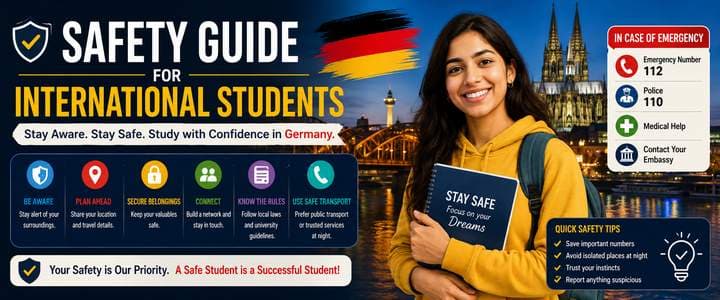
Germany is generally a well-organized destination for international students, with reliable emergency services, regulated universities, extensive public transportation, and strong legal protections. Nevertheless, students still need to prepare for theft, housing fraud, online scams, traffic risks, discrimination, medical emergencies, severe weather, and unfamiliar administrative procedures.
International students can be especially vulnerable during their first few weeks because they may not speak German fluently, understand local systems, or recognize which communications are genuine. Scammers may exploit the urgency surrounding accommodation, visa appointments, blocked accounts, part-time employment, and university payments.
Personal safety in Germany is not only about avoiding crime. It also includes using public transportation correctly, protecting personal information, understanding emergency numbers, complying with cycling rules, maintaining insurance, recognizing unsafe employment, and knowing where to report harassment or discrimination.
This guide provides practical safety information for Indian and other international students before departure, after arrival, on campus, at home, online, and while traveling.
Safety in Germany: Quick Overview
| Situation | Correct action |
|---|---|
| Immediate police emergency | Call 110 |
| Fire, ambulance, or life-threatening medical emergency | Call 112 |
| Urgent but non-life-threatening medical problem | Call 116117 |
| Violence against women support | Call 116 016 |
| Lost bank card | Block it immediately through the bank or card-blocking service |
| Lost passport | Report it to the police and contact the relevant embassy or consulate |
| Housing scam suspicion | Do not transfer money; verify the landlord and property |
| Phishing message | Do not click links or provide passwords, PINs, or TANs |
| Discrimination | Document the incident and contact the university or a counseling body |
| Severe weather or civil emergency | Follow official warnings and the NINA warning application |
| Theft on public transportation | Contact police and the transport operator |
| Unsafe university situation | Contact campus security, university administration, or police |
| Immediate danger from another person | Move to a safe place and call 110 |
| Mental health crisis with immediate danger | Call 112 or go to the nearest emergency department |
Students should save important numbers before an emergency occurs and learn how to state their name, location, and situation clearly.
Is Germany Safe for International Students?
Germany is generally considered a safe study destination, but safety conditions vary by city, neighborhood, time, and activity. Larger cities may have more pickpocketing, nightlife-related incidents, bicycle theft, and accommodation scams. Smaller university towns may feel quieter but can still have online fraud, harassment, traffic accidents, or poorly lit areas.
International students should avoid two opposite assumptions:
Germany is completely risk-free.
International students are unsafe everywhere.
Neither is accurate. Most students complete their degrees without experiencing serious crime, but practical precautions remain important.
Common risks include:
Pickpocketing
Bicycle theft
Housing fraud
Phishing
Fake job offers
Banking scams
Parcel-delivery scams
Harassment
Discrimination
Unsafe nightlife situations
Traffic accidents
Medical emergencies
Fire and severe weather
Loss of identification documents
Awareness and preparation are more useful than fear.
Important Emergency Numbers in Germany
Police Emergency: 110
Call 110 when immediate police assistance is required.
Examples include:
Violence or threats
Burglary in progress
Stalking with immediate danger
Serious harassment
Robbery
Active theft
A dangerous person
A serious road incident requiring police
Witnessing a violent crime
The police emergency line operates around the clock and calls are free.
If the situation is not urgent, contact the nearest police station instead. A crime can generally be reported at any police station, even if the incident occurred elsewhere.
Ambulance and Fire Emergency: 112
Call 112 for:
Fire
Severe accident
Unconsciousness
Serious breathing difficulty
Suspected heart attack
Suspected stroke
Severe bleeding
Life-threatening allergic reaction
Immediate risk of suicide or serious self-harm
Any condition involving immediate danger to life
The number works throughout Germany and the European Union.
Medical On-Call Service: 116117
Call 116117 when:
Regular medical practices are closed.
Medical attention is needed the same day.
The condition is not life-threatening.
The service can help students locate an on-call practice. Telephone assistance is primarily provided in German, so a student with limited German may need support from a German-speaking friend.
Violence Against Women Helpline: 116 016
The Violence Against Women Helpline provides free, anonymous, confidential assistance around the clock. It supports people affected by domestic violence, sexual violence, stalking, harassment, cyber violence, forced marriage, exploitation, or human trafficking.
Advice can be provided in multiple languages through interpretation.
What to Say During an Emergency Call
Try to provide:
Your name.
Exact location.
What happened.
Number of people affected.
Whether anyone is injured.
Whether the danger is continuing.
Do not end the call until the emergency operator tells you to do so.
Useful German phrases include:
“Ich brauche Hilfe.” — I need help.
“Rufen Sie bitte die Polizei.” — Please call the police.
“Rufen Sie bitte einen Krankenwagen.” — Please call an ambulance.
“Es gibt ein Feuer.” — There is a fire.
“Ich bin verletzt.” — I am injured.
“Ich bin in Gefahr.” — I am in danger.
“Ich spreche nur wenig Deutsch.” — I speak only a little German.
“Meine Adresse ist…” — My address is…
Safety Checklist Before Traveling to Germany
International students should complete several safety preparations before departure.
Save Important Documents
Create secure digital and physical copies of:
Passport
Student visa
Admission letter
Accommodation contract
Health insurance confirmation
Blocked-account documents
Academic records
Prescriptions
Vaccination records
Emergency contact information
Travel tickets
Passport photographs
Keep the copies separately from the original documents. Do not store every original and copy in the same bag.
Record Emergency Contacts
Save:
110
112
116117
116 016
University international office
Accommodation office
Health insurer
Bank
Landlord or residence manager
Trusted friend in Germany
Family contact
Indian embassy or nearest consulate, where relevant
Students should also share their German address and travel details with a trusted family member.
Arrange Valid Health Insurance
Travel insurance may cover the entry period, but students generally need recognized comprehensive insurance for university enrollment and long-term residence.
Keep insurance membership information accessible. If the health card has not arrived, request a temporary insurance certificate.
Bring Essential Medicine Safely
Students carrying regular medicines should retain:
Original packaging
Doctor’s prescription
Medical letter
Generic medicine name
Required import documentation
Controlled medicines may be subject to additional rules.
Plan the Arrival Journey
Before landing, confirm:
Airport-to-city route
Final station
Train or bus ticket requirements
Accommodation check-in time
Key-collection process
Emergency contact if delayed
Availability of mobile data
Alternative route if public transportation stops
Avoid accepting unlicensed transportation from strangers at an airport or station.
Personal Safety After Arrival
Learn the Local Area
During daylight, identify:
Nearest police station
Hospital or emergency department
Pharmacy
Emergency pharmacy information
General practitioner
Public transport stops
Well-lit walking routes
Campus security office
Supermarkets and late-opening stores
Safe taxi or ride-booking options
Knowing the neighborhood reduces confusion during an emergency.
Keep Someone Informed
When traveling late, meeting an unknown person, or visiting a new city:
Tell a trusted person where you are going.
Share the expected return time.
Keep the phone charged.
Share live location when appropriate.
Arrange a check-in message.
Carry enough money for an alternative journey.
Location sharing should be limited to trusted people.
Remain Aware in Public
Avoid walking while completely distracted by a phone or noise-canceling headphones, particularly:
Near roads
At railway platforms
Late at night
In unfamiliar areas
Around crowded events
Near nightlife venues
The objective is not to appear fearful but to notice changes in the surroundings.
Housing Safety and Rental Scams
Accommodation fraud is one of the most serious financial risks for international students.
Students searching remotely may feel pressure to transfer a deposit immediately. Scammers take advantage of housing shortages and urgent university deadlines.
Common Housing-Scam Warning Signs
Be cautious when:
Rent is far below the local market rate.
The landlord claims to be permanently abroad.
Viewing the room is impossible.
Communication takes place only through messaging applications.
The landlord refuses a video call.
Payment is requested through cryptocurrency, gift cards, cash-transfer services, or an unknown payment platform.
The student is asked to pay before receiving a complete contract.
The property address cannot be verified.
Photographs appear copied from another listing.
The landlord requests excessive personal documents immediately.
The landlord creates extreme urgency.
Keys are supposedly sent by courier after payment.
Payment is requested to an unrelated third party.
The listing disappears and reappears under different names.
How to Verify Accommodation
Before transferring money:
Check the complete address.
Search the listing photographs.
Verify the landlord or authorized property manager.
Request a live video viewing.
Ask a trusted person in Germany to visit, if possible.
Obtain a written rental agreement.
Check the name on the payment account.
Confirm what the rent includes.
Review deposit and cancellation conditions.
Contact the university housing office if uncertain.
A residential rental deposit is generally limited to three months of base rent excluding operating costs. Unusual demands should be examined carefully.
Protect Passport Copies
A landlord may reasonably request identification, but passport copies can be misused.
When sending a copy:
Confirm the recipient.
Use a watermark stating the purpose and date.
Hide information that is not required where legally appropriate.
Send it through a secure method.
Retain a record of who received it.
Do not send passport scans to every person advertising a room.
Safety During a Viewing
When viewing private accommodation:
Meet during daylight when possible.
Tell someone the address.
Take a friend.
Keep your phone available.
Do not allow yourself to be isolated.
Leave if the situation feels unsafe.
Do not carry large amounts of cash.
Do not sign a contract you do not understand.
Students can request time to review the agreement or obtain advice.
Safety in Student Residences and Shared Apartments
Lock Doors and Windows
Even in a university residence:
Lock the room when leaving.
Do not leave keys in shared spaces.
Close accessible windows.
Do not allow unknown people into the building.
Report broken locks.
Avoid labeling keys with the full address.
Notify management immediately if a key is lost.
Shared-Apartment Boundaries
Flatmates should agree on:
Guests
Overnight visitors
Door security
Shared-key rules
Cleaning
Food and property
Quiet hours
Emergency contacts
Utility use
A student has the right to feel safe at home. Threats, coercion, stalking, sexual harassment, or violence by a flatmate or partner should not be dismissed as a private disagreement.
Fire Safety
Students should:
Locate smoke detectors.
Learn the evacuation route.
Keep hallways and exits clear.
Never disable smoke alarms.
Avoid unattended cooking.
Use electrical appliances correctly.
Avoid overloading extension leads.
Keep flammable items away from heaters.
Follow residence rules for candles and smoking.
Call 112 if a fire creates danger.
Do not use an elevator during a building fire.
Public Transportation Safety
Germany’s transportation system is extensive, but students should remain careful at stations, on platforms, and inside vehicles.
At Railway Platforms
Remain behind the safety line.
Do not enter or cross tracks.
Do not climb on stationary trains.
Keep away from overhead electrical equipment.
Hold bags securely in crowds.
Confirm the correct train before boarding.
Use official signs rather than following strangers.
Railway tracks and overhead electrical systems can be fatal even when a train does not appear to be approaching.
On Buses, Trams, and Trains
Keep wallets and phones in secure pockets.
Do not leave bags unattended.
Keep luggage visible.
Avoid displaying large amounts of cash.
Move away from aggressive passengers.
Use the emergency intercom when necessary.
Contact staff or police if threatened.
Validate tickets when required.
Traveling without a valid ticket can result in an increased fare even if the mistake was unintentional.
Late-Night Travel
Check the final connection before leaving.
Wait in well-lit areas.
Sit near other passengers or the driver.
Avoid empty carriages when alternatives exist.
Keep enough phone battery for the journey.
Use an official taxi if connections stop.
Avoid sleeping deeply while traveling alone.
Do not accept rides from unknown people.
If someone follows you, move toward staff, a staffed business, other passengers, or a police station rather than going directly home.
Pickpocketing and Theft Prevention
Pickpocketing is more likely in:
Busy railway stations
Airports
Festivals
Christmas markets
Tourist areas
Crowded buses and trains
Nightlife districts
Queues
Large public demonstrations
Protect Your Belongings
Close bag zippers.
Keep the bag in front in crowded areas.
Avoid placing a phone in an open outer pocket.
Do not hang a bag on the back of a chair.
Never leave a laptop unattended in a library.
Use hotel or residence storage for valuable documents.
Carry only the payment cards you need.
Keep emergency cash separately.
Activate device-tracking features.
Record device serial numbers.
If Something Is Stolen
Move to a safe place.
Block bank cards.
Change compromised passwords.
Contact police.
Obtain a police report or reference number.
Notify the transport operator or property manager.
Contact the insurer, if applicable.
Contact the embassy or consulate if the passport was stolen.
Notify the residence authority if a residence permit was lost.
Act quickly when financial cards or identity documents are involved.
Bicycle Safety and Bicycle Theft
Cycling is popular among students, but traffic rules apply.
Safe Cycling Practices
Use required front and rear lights in darkness.
Ensure brakes work.
Use designated bicycle lanes correctly.
Obey traffic signals.
Do not cycle while holding a phone.
Avoid cycling under the influence of alcohol or drugs.
Signal turns.
Watch for car doors.
Give way where required.
Use reflective clothing or accessories at night.
A helmet is strongly recommended even where it is not generally compulsory for ordinary cycling.
Prevent Bicycle Theft
Use a strong lock.
Attach the frame to a fixed object.
Secure removable wheels.
Avoid leaving an expensive bicycle in an isolated place overnight.
Record the frame number.
Keep the purchase receipt.
Photograph the bicycle.
Consider bicycle registration where available.
Review household or bicycle insurance.
A cheap cable lock is often insufficient for long-term outdoor parking.
Road and Pedestrian Safety
International students may initially misunderstand German traffic patterns.
Remember:
Vehicles drive on the right.
Bicycle lanes may cross pedestrian areas.
Trams can approach quietly.
Pedestrians should follow traffic signals.
Red bicycle lanes are not ordinary pedestrian space.
Jaywalking in unsafe conditions can cause serious accidents.
Zebra crossings and traffic lights must be used carefully.
Emergency vehicles may approach quickly.
Do not assume that a quiet street is empty. Check for bicycles, trams, and vehicles before crossing.
Nightlife and Party Safety
Germany has an active nightlife culture, but students should maintain clear boundaries and a safe return plan.
Before Going Out
Charge the phone.
Save the accommodation address.
Plan the return journey.
Tell a friend where you are going.
Carry identification.
Avoid taking the passport unless required.
Set a spending limit.
Arrange group check-ins.
During the Event
Do not leave drinks unattended.
Do not accept an opened drink from a stranger.
Keep track of friends.
Respect consent and personal boundaries.
Leave if a person becomes controlling or aggressive.
Do not mix unknown substances.
Seek medical help if someone appears unusually confused, unconscious, or seriously ill.
Consent must be voluntary, informed, and ongoing. Intoxication does not justify sexual contact without consent.
Getting Home
Travel with trusted friends when possible.
Use official transport or a recognized taxi.
Confirm the vehicle and driver.
Do not reveal the building access code publicly.
Do not allow a stranger to follow you inside.
Contact police if you feel threatened.
Cybersecurity for International Students
Students rely heavily on online banking, university portals, immigration appointments, housing platforms, and digital communication. This makes account security essential.
Use Strong, Unique Passwords
Use a different password for:
Email
University account
Banking
Accommodation portals
Social media
Shopping
Cloud storage
A password manager can help generate and store unique passwords.
Enable Two-Factor Authentication
Activate two-factor authentication for:
Primary email
Bank account
University services
Cloud storage
Social media
Messaging accounts
Authentication applications or security keys are generally safer than relying only on SMS where alternatives are supported.
Recognize Phishing
A phishing message may:
Create urgency.
Threaten account closure.
Claim a payment failed.
Request a password, PIN, or TAN.
Use a slightly incorrect domain.
Contain an unexpected attachment.
Pretend to be the university, bank, police, tax authority, delivery company, or immigration office.
Ask the student to move communication to a private messenger.
Request payment through an unusual method.
Do not access important accounts through suspicious links. Open the official application or type the known address independently.
Protect Online Banking
A genuine bank will not ask a customer to disclose a complete PIN, password, or TAN through an unsolicited email, message, or phone call.
If contacted unexpectedly:
End the conversation.
Do not approve any transaction.
Contact the bank through the official number.
Check account activity.
Block access if compromise is suspected.
Report unauthorized transactions immediately.
Use Public Wi-Fi Carefully
On public networks:
Avoid sensitive banking where possible.
Confirm the network name.
Disable automatic connection.
Use encrypted websites.
Keep file sharing turned off.
Use the university VPN when appropriate.
Forget the network after use.
A network name that resembles a café or university network may still be fraudulent.
Common Scams Targeting International Students
Fake Immigration or Police Calls
A caller may claim that:
The student’s visa will be canceled.
A criminal case has been registered.
The passport is linked to illegal activity.
Immediate payment is required.
Money must be transferred for verification.
Cash or valuables must be handed to an officer.
Communication must remain secret.
Real authorities do not resolve criminal or immigration cases through gift cards, cryptocurrency, or secret transfers.
End the call and contact the authority through independently verified contact information.
Fake Blocked-Account Messages
Students may receive messages requesting:
Reverification of the blocked account
A new transfer
Login credentials
Payment to release funds
Remote access to the computer
Use only the provider’s official portal and customer-support channels.
Fake Part-Time Jobs
Warning signs include:
High salary for minimal work
No interview
Upfront training or equipment payment
Receiving and forwarding parcels
Using a personal bank account to transfer company money
Purchasing gift cards
Cryptocurrency payments
Requests to recruit more students
No written employment contract
Pressure to work beyond legal limits
A student who transfers criminal funds or receives fraudulent parcels may face legal consequences even if they believed the job was genuine.
Parcel and Delivery Scams
Fraudulent messages may claim that:
A parcel requires a small fee.
An address must be corrected.
Customs payment is outstanding.
Delivery failed.
A link must be opened immediately.
Access the delivery company’s official website independently and enter the tracking number there.
Marketplace Scams
When buying or selling secondhand items:
Meet in a public place.
Inspect the item.
Avoid advance payments to unknown sellers.
Be cautious with external payment links.
Do not trust screenshots as proof of payment.
Confirm money in the actual account.
Avoid overpayment-and-refund requests.
Retain communication records.
Scholarship and Admission Scams
Be suspicious if someone guarantees:
University admission
Scholarship selection
Visa approval
APS approval
Examination results
Residence-permit extensions
Official decisions cannot be purchased through private agents.
Financial and Document Safety
Protect the Passport and Residence Permit
Keep original documents in a secure place when they are not required.
Maintain protected copies, but do not post:
Passport number
Residence-permit details
Visa images
University login information
Bank account screenshots
Blocked-account balance
Boarding passes containing personal data
Carry Payment Methods Safely
Keep one backup card separately.
Set transaction alerts.
Review statements.
Use contactless limits appropriately.
Shield the PIN.
Never let another person take the card away.
Block lost cards immediately.
Avoid keeping all emergency cash in one location.
Do Not Sign Documents You Do Not Understand
This applies to:
Rental agreements
Employment contracts
Mobile contracts
Gym memberships
Insurance policies
Loan agreements
Guarantor documents
Payment authorizations
Request an English explanation, translation, or independent advice. Do not rely only on the person selling the product.
Campus and Laboratory Safety
General Campus Safety
Students should learn:
Campus security number
Emergency exits
Assembly points
Building opening hours
Laboratory rules
After-hours access policy
Reporting process for harassment
First-aid locations
Do not lend university access cards to another person.
Laboratory and Workshop Safety
Students working in laboratories, engineering workshops, kitchens, studios, or medical environments should:
Complete required training.
Wear personal protective equipment.
Follow chemical and equipment instructions.
Label materials.
Report spills and injuries.
Avoid working alone when prohibited.
Know the emergency shower and eyewash locations.
Follow waste-disposal procedures.
Report damaged equipment.
Language uncertainty is not a reason to guess. Ask the supervisor to explain unclear safety instructions.
Field Trips and University Excursions
Confirm:
Insurance coverage
Emergency contact
Weather conditions
Required equipment
Transportation
Medical needs
Check-in procedures
University accident insurance may cover qualifying academic activities, but not every private extension of a trip.
Harassment, Stalking, and Sexual Violence
Harassment can occur:
On campus
At work
In accommodation
Online
At social events
On public transportation
Within a relationship
The affected student is not responsible for another person’s behavior.
Practical Response
Depending on safety and circumstances:
Move to a secure place.
Contact a trusted person.
Call 110 if danger is immediate.
Preserve messages, photographs, and records.
Note dates, times, places, and witnesses.
Seek medical attention if needed.
Contact university counseling or an equal-opportunity office.
Obtain legal or victim-support advice.
Review digital and physical security.
Do not confront a dangerous person alone.
Stalking Safety
A student experiencing stalking should:
Clearly document incidents.
Save unwanted messages.
Review privacy settings.
Change predictable routines when necessary.
Inform trusted people.
Tell residence or campus security.
Avoid sharing location publicly.
Contact police when threatened or repeatedly pursued.
Discrimination and Hate Incidents
International students may experience discrimination connected to nationality, ethnic origin, religion, gender, disability, age, or sexual identity.
Possible sources of support include:
University anti-discrimination office
International office
Equal-opportunity office
Student representative body
Departmental ombudsperson
Federal Anti-Discrimination Agency
Local counseling organizations
Police, when a crime or threat occurs
The Federal Anti-Discrimination Agency offers confidential counseling free of charge and can help identify appropriate local services.
Documenting an Incident
Record:
Date and time
Location
Words or actions
Names or descriptions
Witnesses
Screenshots
Photographs
Emails
Relevant contracts or decisions
Effect on the student
Students should retain original evidence rather than only edited screenshots.
If racist or discriminatory behavior involves violence, threats, property damage, or another suspected crime, contact police.
Safety for Female International Students
Female students should receive the same freedom and access to public life as anyone else. Safety guidance should support independence rather than restrict it.
Useful precautions include:
Know the late-night transport options.
Keep trusted contacts informed when necessary.
Use well-lit routes.
Trust discomfort and leave unsafe situations.
Maintain control over drinks.
Establish clear boundaries.
Report stalking or harassment.
Use official counseling services.
Call 110 during immediate danger.
Call 116 016 for confidential violence-related support.
A residence permit normally does not prevent a victim from seeking police or medical assistance.
LGBTQ+ Student Safety
LGBTQ+ students can contact university diversity offices, queer student groups, local counseling centers, and the Federal Anti-Discrimination Agency.
Students should report:
Threats
Assault
Stalking
Blackmail
Nonconsensual sharing of private material
Discriminatory treatment
Housing or workplace harassment
During immediate danger, call 110.
International students concerned about family or community reactions should seek confidential counseling before disclosing personal information.
Workplace and Part-Time Job Safety
Confirm That the Job Is Legal
Before starting:
Obtain a written contract.
Confirm employer identity.
Review working hours.
Understand the wage.
Check residence-permit conditions.
Confirm insurance arrangements.
Clarify duties.
Retain timesheets and payslips.
Unsafe Employment Warning Signs
Be cautious when an employer:
Keeps the passport.
Refuses a contract.
Pays entirely in unexplained cash.
Demands unpaid trial work for an unreasonable period.
Threatens visa cancellation.
Requires unsafe tasks without training.
Ignores working-hour rules.
Withholds wages.
Pressures the student to provide false information.
Demands sexual or personal favors.
An ordinary employer does not control a student’s passport or independently cancel the student’s residence permit.
Students can contact the university career service, international office, employee counseling services, or relevant authorities.
Mental Health and Personal Safety
Culture shock, isolation, financial pressure, academic expectations, and winter conditions can affect student well-being.
Warning signs requiring support may include:
Persistent hopelessness
Severe anxiety
Inability to sleep
Panic attacks
Withdrawal
Substance misuse
Thoughts of self-harm
Feeling unable to stay safe
Students can contact:
University psychological counseling
Studierendenwerk counseling
Hausarzt
Psychotherapist
Psychiatrist
Crisis service
Emergency department
If there is an immediate risk of suicide or serious self-harm, call 112.
Seeking help does not represent academic failure and should not be delayed because of language concerns.
Severe Weather and Civil Emergencies
Germany can experience:
Storms
Flooding
Heat
Snow and ice
Power disruptions
Local fires
Transportation shutdowns
NINA Warning Application
NINA is Germany’s official emergency information and warning application. It can provide location-based warnings about severe weather, floods, hazardous incidents, and civil emergencies.
Students should:
Install the application.
Enable location-based warnings.
Add their university and home locations.
Allow notifications.
Follow official instructions.
Keep the phone charged.
Warnings may also be distributed through cell broadcast, sirens, transportation announcements, local authorities, and public broadcasters.
Basic Emergency Preparation
Maintain reasonable supplies such as:
Drinking water
Essential food
Required medicine
Flashlight
Power bank
Basic first-aid items
Copies of important documents
Small amount of cash
Warm clothing
Emergency contact list
Preparation should be proportionate to the location and official recommendations.
Safety While Traveling Outside Germany
Before international travel:
Check visa and residence-permit validity.
Review passport validity.
Verify entry requirements.
Arrange travel health insurance.
Save embassy contacts.
Share the itinerary.
Protect the residence permit.
Keep documents in separate locations.
Check transport disruptions.
Carry prescriptions for medicine.
Students should not assume that German health insurance provides complete worldwide protection or medical repatriation.
What to Do After a Crime
Immediate Steps
Move away from danger.
Call 110 or 112 when required.
Seek medical attention.
Preserve evidence.
Contact a trusted person.
Avoid deleting communications.
Record events while memory is fresh.
Reporting to Police
Anyone can approach the German police, regardless of nationality, age, religion, gender, or origin.
A student may take a trusted person or lawyer to the police station. If communication in German is difficult, explain this clearly and request communication assistance.
Bring:
Identification
Relevant photographs
Screenshots
Messages
Receipts
Bank records
Witness information
A written timeline
After Reporting
Keep:
Police report reference
Officer or station details
Medical documents
Receipts
Insurance communication
University reports
Copies of evidence
Do not post detailed evidence publicly if it could affect an investigation or expose private information.
Safety Applications and Phone Preparation
A student’s phone should include:
110
112
116117
116 016
NINA
Health insurer application
Banking application
University application
Public transportation application
Secure password manager
Device-location service
Trusted emergency contacts
Also enable:
Screen lock
Device encryption
Automatic security updates
Remote device location
Remote data deletion
Two-factor authentication
Emergency medical information where appropriate
Do not display sensitive notification content on a locked screen.
First-Week Safety Checklist
Register the German address.
Activate health insurance.
Obtain a working German SIM or reliable mobile connection.
Save emergency numbers.
Learn the route to campus.
Identify the nearest police station and hospital.
Verify the rental agreement and landlord.
Check smoke detectors and exits.
Secure doors and windows.
Install NINA.
Enable bank alerts.
Activate two-factor authentication.
Join official university communication channels.
Locate campus security and counseling services.
Share the address with a trusted family member.
Learn basic emergency German phrases.
Common Safety Mistakes International Students Make
Sending a Rental Deposit Too Quickly
Housing pressure can make an attractive listing seem urgent. Verify the property and landlord before paying.
Trusting a Caller Because They Know Personal Details
Personal information can come from leaked databases, public profiles, or previous phishing. Knowledge of a name or passport detail does not prove authority.
Sharing OTPs, TANs, or Banking Credentials
No legitimate person needs a student’s confidential banking authentication code.
Carrying Every Original Document Daily
Losing a bag containing a passport, residence permit, bank cards, and all original certificates creates multiple problems at once.
Ignoring Official Letters
A genuine administrative letter may contain an important deadline. Verify it independently rather than ignoring it or paying immediately.
Assuming Public Wi-Fi Is Secure
A network with a familiar name is not automatically operated by the university, railway station, or café.
Cycling Without Learning the Rules
Bicycle lanes, tram tracks, right-of-way rules, and mandatory lights can be unfamiliar to new students.
Not Reporting Harassment
Silence can allow behavior to continue. Students can seek confidential advice even if they are uncertain about making a formal complaint.
Using Emergency Services Incorrectly
Use 110 for immediate police danger, 112 for life-threatening medical emergencies or fire, and 116117 for urgent non-life-threatening medical care outside ordinary practice hours.
Working Without a Written Contract
A verbal promise provides limited protection when wages, duties, or hours are disputed.
Frequently Asked Questions
Is Germany safe for Indian students?
Germany is generally a safe destination for Indian students. They should follow ordinary precautions involving accommodation, transportation, online banking, identification documents, and nightlife.
What is the police number in Germany?
Call 110 when immediate police assistance is required.
What is the ambulance number in Germany?
Call 112 for an ambulance, fire, or life-threatening emergency.
When should students call 116117?
Call 116117 for urgent medical assistance outside ordinary practice hours when the situation is not life-threatening.
Can international students report a crime?
Yes. Anyone can contact the German police regardless of nationality, immigration status, gender, religion, or origin.
What should I do if my passport is stolen?
Report the theft to police, obtain documentation, contact the relevant embassy or consulate, and notify the residence authority if the residence permit was also lost.
How can students avoid accommodation scams?
Verify the address, landlord, contract, payment account, and property before transferring money. Use a live viewing or trusted local representative whenever possible.
Should I pay rent before viewing an apartment?
Advance payment to an unverified person is dangerous. If a physical viewing is impossible, use stronger verification through the university, recognized housing provider, live viewing, written agreement, and verified landlord identity.
Is it safe to share a passport copy with a landlord?
A verified landlord may require identification, but the copy should be watermarked, limited to the necessary purpose, and sent securely.
What should I do if someone claims to be the police and asks for money?
End the call. German police do not resolve cases through gift cards, cryptocurrency, secret bank transfers, or collection of cash and jewelry. Call the police using independently verified contact information.
Are German trains safe at night?
Public transportation is generally reliable, but students should use well-lit areas, remain near other passengers, protect valuables, and avoid isolated carriages when possible.
Is a cycling helmet compulsory?
A helmet is not generally compulsory for ordinary bicycle use, but it is strongly recommended. Functional lights and compliance with traffic rules are essential.
What happens if I experience discrimination?
Document the incident and contact the university anti-discrimination office, international office, Federal Anti-Discrimination Agency, or police when threats or crimes are involved.
Where can female students seek confidential support?
The Violence Against Women Helpline is available free of charge and anonymously at 116 016. Immediate danger should be reported to police through 110.
How can students protect online banking?
Use unique passwords, enable two-factor authentication, avoid suspicious links, never disclose PINs or TANs, and contact the bank directly when uncertain.
What should I do if my bank card is lost?
Block the card immediately, review transactions, contact the bank, and report theft to police where appropriate.
Is travel insurance necessary outside Germany?
German health insurance may not provide complete international coverage or repatriation. Students should check coverage and consider separate travel health insurance.
Which official warning application should students install?
NINA is Germany’s official emergency information and warning application.
Can an employer keep an international student’s passport?
An ordinary employer should not retain a student’s passport. A demand to surrender it can indicate exploitation or an unsafe employment situation.
What should I do if I feel unsafe in my shared apartment?
Move to a safe place, contact a trusted person, inform residence management or the landlord, seek counseling, and call 110 if there is an immediate threat.
Final Thoughts
International students can live and study safely in Germany by combining ordinary awareness with knowledge of local systems. The most important steps are learning the emergency numbers, verifying accommodation before paying, protecting banking credentials, understanding transportation and cycling rules, and knowing where to report harassment or discrimination.
Students should save 110, 112, 116117, and 116 016; install the NINA warning application; maintain secure copies of important documents; and identify university support services soon after arrival.
Safety concerns should be taken seriously regardless of whether they involve a stranger, landlord, employer, flatmate, partner, classmate, or online contact. International students have the right to contact police, receive emergency medical treatment, report discrimination, and seek confidential support.
Preparation does not require constant fear. It allows students to respond calmly, protect their rights, and focus on their academic and personal life in Germany.