One of the most common questions international students ask before applying to German universities is:
“What GPA do I need to study in Germany?”
There is no single GPA requirement that applies to every university in Germany.
A German university may require:
A specific minimum German grade
A minimum foreign GPA
A minimum percentage
A particular class of degree
No published minimum GPA at all
For Master’s programs, GPA is only one part of the admission decision. Universities may also evaluate:
Relevance of your Bachelor’s degree
Required academic credits
Mathematics background
Programming or technical coursework
Language proficiency
Work experience
GRE or GMAT
Motivation letter
Research experience
Competition for available seats
This means an applicant with an excellent GPA can still be rejected if their previous coursework does not match the Master’s program.
Similarly, a student with a moderate GPA may still find several suitable German universities when their academic background strongly matches the program.
This guide explains the German grading system, common GPA requirements, CGPA conversion, Indian GPA considerations, low-GPA strategies, and how to judge your realistic admission chances.
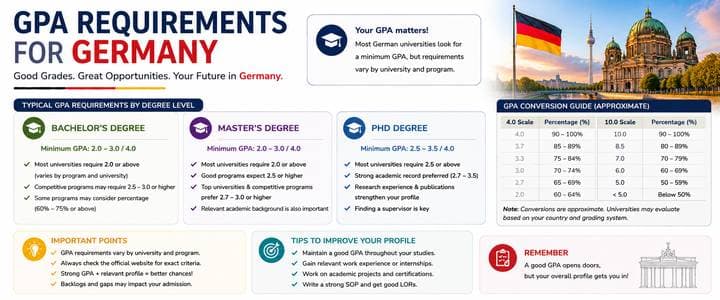
GPA Requirements for Germany at a Glance
| Category | General Guidance |
|---|---|
| Universal Germany GPA | None |
| German Grading Scale | Usually 1.0 to 4.0 for passing grades |
| Best German Grade | 1.0 |
| Lowest Passing Grade | Commonly 4.0 |
| Common Master’s Cutoffs | Often around 2.0–2.5, but vary widely |
| Highly Competitive Programs | May effectively require stronger grades |
| Bachelor’s Admission | School qualification more important than university GPA |
| Master’s Admission | Bachelor’s grade usually important |
| PhD Admission | Strong academic record generally expected |
| GPA Alone Guarantees Admission? | No |
| Subject Credits Matter? | Yes, especially for Master’s |
| Foreign Grades Converted? | Often yes |
| uni-assist Grade Evaluation | Used by participating universities |
Does Germany Have a Minimum GPA?
No.
There is no nationwide rule saying every international student needs:
7.0 CGPA
7.5 CGPA
8.0 CGPA
3.0 GPA
70%
German grade 2.5
to study in Germany.
Each university and degree program establishes its own admission requirements.
For example, one Master’s program may require a German-equivalent grade of:
2.5 or better
while another may require:
2.0 or better
Another program may use a ranking system instead of a fixed minimum.
Some universities may simply require a recognized Bachelor’s degree and then rank eligible candidates according to several criteria.
Understanding the German Grading System
German university grades work differently from many international grading systems.
A simplified version is:
| German Grade | General Meaning |
|---|---|
| 1.0–1.5 | Very Good |
| 1.6–2.5 | Good |
| 2.6–3.5 | Satisfactory |
| 3.6–4.0 | Sufficient / Pass |
| Above 4.0 | Usually Fail |
The important difference is:
Lower numbers are better.
Therefore:
1.0 is excellent
while:
4.0 is generally the lowest passing grade.
This is the opposite of systems where a higher GPA is better.
Is 1.0 the Best German GPA?
Yes, in the conventional German university grading system, 1.0 is the strongest standard grade.
Grades near 1.0 indicate excellent academic performance.
However, admission committees do not always evaluate applicants exclusively by final converted grade.
German Grade 1.0–1.5
This usually represents an excellent academic record.
Applicants in this range can be academically competitive for many selective programs, assuming they also meet subject prerequisites.
German Grade 1.6–2.0
This is still a strong academic range.
Many competitive Master’s applicants fall within or around this level.
German Grade 2.1–2.5
This is commonly considered a good academic result.
A large number of German Master’s programs publish eligibility thresholds somewhere in this general range.
However, simply meeting 2.5 does not mean admission is guaranteed.
German Grade 2.6–3.0
Admission options can become more limited, particularly for competitive Master’s programs.
However, several universities and programs may still be possible depending on:
Degree relevance
Required credits
Program demand
Work experience
Additional selection criteria
German Grade Above 3.0
Admission can become more challenging for academically selective Master’s programs.
Students should search carefully for programs:
Without strict GPA cutoffs
Using broader selection criteria
At Universities of Applied Sciences
Closely aligned with their academic background
GPA for Bachelor’s in Germany
For international Bachelor’s admission, the situation is different.
Your school-leaving qualification is usually more important than a university GPA.
Germany first determines whether your school qualification provides:
Hochschulzugangsberechtigung — HZB
or university entrance eligibility.
Possible outcomes include:
Direct admission
Subject-restricted admission
Studienkolleg
Therefore, asking:
“What GPA do I need for a Bachelor’s in Germany?”
can be misleading.
The answer depends on your country's school system and qualification.
GPA Requirements for Indian Bachelor’s Applicants
Indian undergraduate applicants should distinguish between:
Class 12 percentage
University GPA
German converted grade
For the relevant Indian undergraduate pathways beginning with Winter Semester 2026/27, updated criteria use a 70% overall Class 12 benchmark.
This is an undergraduate eligibility condition rather than a conventional Master’s GPA requirement.
Applicants may qualify through pathways involving:
Class 12 + APS + Studienkolleg
Class 12 + APS + one successful Bachelor’s year for applicable direct subject-restricted admission
The exact pathway must be checked separately.
GPA Requirements for Master’s in Germany
GPA becomes much more important for Master’s applications.
German universities generally evaluate:
Final Bachelor’s grade
Degree relevance
Academic credits
Required subjects
Language proficiency
Some universities publish an explicit minimum grade.
Others use competitive selection.
Is 2.5 German Grade Good Enough?
A German-equivalent grade of 2.5 can satisfy the formal minimum for many programs that use this threshold.
However:
minimum eligibility is not the same as competitive admission.
Suppose a program requires:
2.5 or better
and receives 2,000 applications for 100 places.
Many admitted students may have grades much stronger than 2.5.
Therefore, do not interpret the minimum cutoff as an expected admission score.
Is 2.0 German Grade Good?
Yes.
A German-equivalent grade around 2.0 generally represents a strong academic record.
It can make an applicant competitive for many programs, provided other requirements are satisfied.
Is 1.5 German Grade Good?
Yes.
A grade around 1.5 is academically very strong.
However, even a 1.5 applicant can be rejected when mandatory academic prerequisites are missing.
GPA Is Not Everything in Germany
This is one of the most important points for international applicants.
Suppose a Master’s program requires:
20 credits in Mathematics
20 credits in Computer Science
10 credits in Theoretical Computer Science
Applicant A has:
German grade 1.6
but does not have enough Mathematics credits.
Applicant B has:
German grade 2.1
and satisfies every required subject-credit condition.
Applicant B may be academically more suitable.
German Master’s admissions frequently emphasize curriculum compatibility.
GPA vs Academic Credits
For Master’s applications, ask two questions separately:
Question 1
Is my GPA high enough?
Question 2
Does my Bachelor’s curriculum satisfy the academic prerequisites?
Both matter.
A high GPA does not replace missing academic credits.
How Foreign GPA Is Evaluated in Germany
International applicants may come from grading systems such as:
4.0 GPA
5.0 GPA
10-point CGPA
100-point percentage
Letter grades
Class divisions
German universities or evaluation organizations may convert these results into a comparable German grade.
The conversion requires information about your original grading system.
Why Your University’s Grading Scale Matters
To evaluate a foreign grade correctly, German institutions may need to know:
Highest possible grade
Minimum passing grade
Final grade achieved
This is why applicants can be asked to provide an official grading-system document.
For example, two universities may both use a:
10-point CGPA system
but their minimum passing requirements may differ.
Therefore:
8.0/10 at University A is not automatically identical to 8.0/10 at University B for German conversion purposes.
Grading System Document
Your grading scale may already appear on:
Transcript
Degree supplement
Transcript legend
If it does not, applicants may need an official document from their university explaining:
Maximum grade
Minimum passing grade
Classification system
This can be important for uni-assist evaluation.
Does Uni-Assist Convert GPA?
For participating universities and applicable procedures, uni-assist can evaluate foreign educational certificates and convert grades into the German grading system.
The university then uses the resulting academic evaluation according to its admission procedure.
A uni-assist evaluation does not itself guarantee admission.
Modified Bavarian Formula
Students frequently encounter the Modified Bavarian Formula when researching German grade conversion.
A commonly used representation is:
German Grade = 1 + 3 × [(Maximum Grade − Obtained Grade) / (Maximum Grade − Minimum Passing Grade)]
This can provide a rough estimate.
However, students should not treat an online calculation as an official admission result.
Universities and evaluation authorities determine the official grade used for an application.
Why Online German GPA Calculators Can Be Wrong
An online calculator may ask you to enter:
Maximum grade
Minimum passing grade
Your grade
The most common mistake is entering the wrong minimum passing grade.
For example, a university may use:
10 as maximum
but the minimum grade required for successfully completing the degree may not be the number a student assumes.
Using the wrong value changes the converted German grade.
10-Point CGPA to German GPA
There is no universal table such as:
| Indian CGPA | German GPA |
|---|---|
| 9.0 | 1.5 |
| 8.0 | 2.0 |
| 7.0 | 2.5 |
Such tables can be misleading.
The exact conversion depends on the grading system associated with the degree.
Students should therefore avoid relying on generic conversion charts.
Is 7.0 CGPA Enough for Germany?
Possibly.
A 7.0/10 CGPA can be acceptable for some programs and insufficient for others.
The result depends on:
Official converted German grade
Program cutoff
Subject prerequisites
Competition
University
Therefore, there is no Germany-wide answer that 7.0 is either “good enough” or “not good enough.”
Is 7.5 CGPA Good for Germany?
A 7.5/10 CGPA can open several opportunities, but admission still depends on how that CGPA converts and what the chosen program requires.
Students around this level should build a balanced university list rather than applying exclusively to highly selective programs.
Is 8.0 CGPA Good for Germany?
An 8.0/10 CGPA is generally a strong academic result in many Indian grading systems.
It can make an applicant competitive for numerous German Master’s programs.
However, the exact German equivalent and admission outcome depend on the original grading scale and individual program criteria.
Is 8.5 CGPA Good for Germany?
An 8.5 CGPA is generally academically strong.
Students with this profile can consider competitive programs but should still verify:
Subject credits
Degree relevance
Language requirements
Specific selection criteria
Is 9.0 CGPA Good for Germany?
A 9.0/10 academic record is usually excellent.
However, even very strong GPA applicants should avoid applying exclusively based on ranking.
Program fit remains essential.
Percentage to German GPA
Students with percentage-based degrees should not assume:
80% = one fixed German grade
for every university.
Conversion again depends on:
Maximum possible result
Minimum passing result
Grading regulations
The institution evaluating your application determines the official result.
Is 60% Enough for a Master’s in Germany?
It can be possible, but options may be more limited.
Whether 60% is sufficient depends heavily on:
University grading scale
Converted German grade
Program cutoff
Previous degree
Course prerequisites
Applicants should search specifically for programs without strict high-grade thresholds.
Is 65% Enough?
Yes, some German Master’s programs may be possible.
But a 65% applicant should not assume eligibility everywhere.
Build a shortlist based on actual requirements rather than generalized admission predictions.
Is 70% Good for a Master’s in Germany?
A 70% Bachelor’s result can provide a reasonable academic profile for many programs depending on the university grading system.
However, universities can still reject candidates for:
Missing credits
Insufficient degree relevance
Competitive ranking
Is 75% Good?
A 75% academic record can be competitive for many German universities.
The exact converted grade still matters.
Is 80% Good?
An 80% Bachelor’s result is generally academically strong in many systems.
Students with strong curriculum compatibility can consider a broad range of German Master’s programs.
GPA Requirements for Top German Universities
Popular German universities often receive large numbers of international applications.
Competition can be particularly strong at institutions and programs associated with areas such as:
Computer Science
Artificial Intelligence
Data Science
Automotive Engineering
Mechanical Engineering
Management
Students should not assume that meeting the published minimum grade guarantees admission.
At selective universities, actual successful applicant profiles can be significantly stronger.
GPA for TU9 Universities
Germany's major technical universities attract many international Engineering and Computer Science applicants.
Admissions depend on the individual program.
There is no single “TU9 GPA requirement.”
One university may require:
Specific German grade
while another may evaluate:
Academic modules
Credits
Aptitude assessment
GRE
Additional documents
Check the individual Master’s program.
GPA for Universities of Applied Sciences
Universities of Applied Sciences can sometimes offer more options for applicants with moderate grades.
However, they should not automatically be considered “easy universities.”
Many programs are competitive.
They may emphasize:
Applied academic background
Internships
Professional experience
Subject relevance
GPA Requirements for Computer Science
Computer Science programs can be highly competitive.
Universities may evaluate:
GPA
Algorithms
Data Structures
Mathematics
Theoretical Computer Science
Programming
Software Engineering
Strong GPA without the required CS coursework may not be sufficient.
GPA Requirements for Data Science
Data Science admissions frequently emphasize quantitative preparation.
Expect scrutiny of:
Mathematics
Statistics
Probability
Programming
Algorithms
A candidate with a high overall GPA but weak mathematics preparation may struggle with eligibility.
GPA Requirements for Mechanical Engineering
Mechanical Engineering Master’s programs may evaluate:
Overall grade
Engineering Mathematics
Mechanics
Thermodynamics
Fluid Mechanics
Manufacturing
Materials
A relevant engineering curriculum remains important.
GPA Requirements for Electrical Engineering
Typical academic areas include:
Mathematics
Circuits
Electronics
Signals
Control
Communications
Embedded Systems
Again, GPA is combined with subject compatibility.
GPA Requirements for Business and Management
Business programs may evaluate:
Overall GPA
Business coursework
Economics
Statistics
Mathematics
Some programs may additionally require:
GMAT
GRE
Work experience
GPA Requirements for MBA
MBA admissions can be more holistic.
Programs may consider:
Bachelor’s academic record
Work experience
Leadership
GMAT/GRE
Interview
Essays
A slightly weaker GPA can sometimes be balanced by substantial professional achievements, depending on the school.
GPA Requirements for PhD in Germany
PhD admissions generally favor strong academic performance.
However, research suitability can be even more important.
Doctoral candidates may be evaluated on:
Bachelor’s and Master’s grades
Thesis performance
Research experience
Publications
Research proposal
Supervisor fit
There is no universal German PhD GPA cutoff.
Does GPA Matter for Scholarships?
Yes.
Academic excellence is important for many scholarships.
Scholarship competition may be substantially stronger than ordinary university admission.
Selection can also consider:
Motivation
Leadership
Research
Social engagement
Professional experience
What If Your GPA Is Low?
A lower GPA does not necessarily end your plans to study in Germany.
You need a more careful application strategy.
Strategy 1: Avoid Applying Only to Famous Universities
Do not create a shortlist containing only:
TUM
RWTH Aachen
LMU Munich
Heidelberg
TU Berlin
Germany has hundreds of higher-education institutions.
Broaden your search.
Strategy 2: Find Programs Matching Your Bachelor’s Exactly
Academic fit can strengthen your application.
For example:
Mechanical Engineering Bachelor’s → Production Engineering Master’s
may be more realistic than applying to a completely different discipline.
Strategy 3: Check Universities of Applied Sciences
These institutions offer strong practical programs in:
Engineering
IT
Business
Logistics
Renewable Energy
Some may consider professional and applied experience alongside academics.
Strategy 4: Use Relevant Work Experience
When the program considers professional experience, strong relevant work can strengthen the overall profile.
Examples:
Software developer applying for Software Engineering
Mechanical engineer applying for Manufacturing
Financial analyst applying for Finance
Strategy 5: Build Strong Projects
Relevant academic and technical projects can demonstrate subject preparation.
They do not normally erase a formal GPA requirement, but they can strengthen applications where evaluation is holistic.
Strategy 6: Strong SOP
Your SOP should explain:
Academic direction
Relevant experience
Program fit
Career goals
A strong SOP does not override a mandatory GPA cutoff.
But it can strengthen a competitive application when motivation is considered.
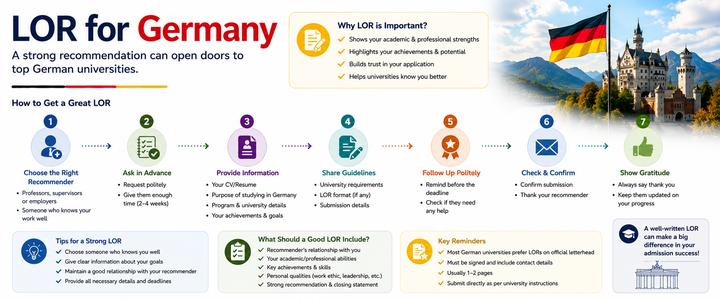
Strategy 7: Strong LORs
Recommendation letters can provide evidence of:
Academic ability
Research potential
Technical strength
Professional maturity
Again, they cannot replace mandatory eligibility requirements.
Strategy 8: GRE or GMAT
Some programs accept or require standardized tests.
A strong score may improve the profile when the university uses it as part of selection.
Strategy 9: Apply Broadly
A balanced shortlist might include:
Ambitious
Programs where your GPA is near or below the typical competitive level.
Target
Programs where your GPA and academic background align well.
Comparatively Safer
Programs where your academics comfortably satisfy the published requirements.
There are no guaranteed universities.
Strategy 10: Avoid Random Applications
Submitting 30 applications without checking eligibility is not a good strategy.
A carefully chosen group of 8–15 suitable programs can be more effective.
Can Work Experience Compensate for Low GPA?
Sometimes.
It depends entirely on the program.
Professionally oriented programs may value experience heavily.
Research-oriented Master’s programs may place much more emphasis on academic grades and subject credits.
If a university states:
Minimum German grade 2.5
and your official converted grade is worse than the permitted threshold, professional experience may not override the formal requirement.
Can GRE Compensate for Low GPA?
Only when the university's selection procedure allows it.
A strong GRE score cannot automatically override a mandatory minimum Bachelor’s grade.
Can IELTS Compensate for Low GPA?
No.
IELTS demonstrates English proficiency.
It does not replace academic performance.
Can SOP Compensate for Low GPA?
Only to a limited extent.
A good SOP can help an applicant when selection is holistic.
It cannot normally override formal eligibility rules.
Can Research Compensate for Low GPA?
Research experience can be particularly valuable for:
Research-oriented Master’s
PhD
Thesis-heavy programs
But mandatory minimum grades still apply when specified.
Minimum GPA vs Competitive GPA
This distinction is essential.
Suppose a program states:
Minimum German grade: 2.5
That means:
2.5 = potentially eligible
It does not mean:
2.5 = likely admitted
If the program is highly competitive, admitted candidates may frequently have stronger profiles.
Why GPA Predictions Are Difficult
Students often ask:
“I have 8.1 CGPA. Which German university will admit me?”
No one can accurately answer this from GPA alone.
You also need:
Degree title
Transcript
Subject credits
University recognition
Language score
Program requirements
Application semester
Admission probability cannot responsibly be calculated from one number.
How to Evaluate Your GPA Before Applying
Use this process:
Step 1
Find the exact Master’s program.
Step 2
Locate its minimum grade requirement.
Step 3
Check whether the requirement refers to:
German grade
Foreign GPA
Percentage
Step 4
Estimate your German grade.
Step 5
Check your required academic credits.
Step 6
Review additional selection criteria.
Step 7
Classify the program as ambitious, target, or comparatively safer.
GPA Documents Required
German universities or uni-assist may need:
Complete transcript
Degree certificate
Final grade
Official grading system
Minimum passing grade
Maximum achievable grade
Do not omit pages of the transcript.
What If Your Transcript Does Not Show the Grading Scale?
Obtain an official document from the university explaining the grading system.
This can include:
Official university regulations
Transcript supplement
Grading-scale certificate
German evaluators need enough information to interpret your academic performance accurately.
Should You Convert GPA Yourself Before Applying?
You can calculate an approximate result for planning.
However, do not alter your transcript or replace your official GPA with a self-calculated German grade.
Submit the original academic documents.
The responsible university or evaluation service will determine the official conversion.
GPA and Uni-Assist
For applications processed through uni-assist, your foreign educational documents are evaluated according to the applicable procedure.
uni-assist may:
Evaluate certificates
Convert foreign grades
Check general requirements
Provide the evaluation to the university
The university remains responsible for the final admission decision.
GPA and VPD
When applying to a university requiring a VPD, uni-assist evaluates your qualification before the university application.
The VPD can contain information relevant to your academic qualification and converted grade.
You then normally submit the VPD to the university as part of the separate application.
GPA and APS
APS and GPA conversion are different.
APS primarily verifies academic documents associated with Indian educational qualifications.
It does not guarantee:
A particular German GPA
Master’s eligibility
University admission
Indian applicants may therefore require both:
APS verification + academic grade evaluation
GPA and dMAT
For selected Indian Master’s applicants, dMAT may form part of the APS-related process for applicable future intakes.
dMAT does not replace:
GPA
Bachelor’s degree
Required credits
Academic eligibility
A strong dMAT result does not automatically erase a university's minimum GPA requirement.
Common GPA Mistakes
Assuming Germany has one minimum CGPA
Using random online GPA tables
Ignoring the minimum passing grade
Comparing Indian CGPA directly with German grades
Applying only to universities with famous names
Ignoring subject-credit requirements
Assuming minimum GPA means guaranteed admission
Believing IELTS can compensate for low GPA
Thinking work experience always overrides grades
Altering transcripts to show converted GPA
Ignoring university-specific requirements
Applying without providing an official grading scale
Frequently Asked Questions
What GPA is required to study in Germany?
There is no universal GPA requirement. Each university and program sets its own academic criteria.
What is a good GPA in Germany?
On the conventional German scale, lower is better. Grades between approximately 1.0 and 2.5 generally represent very good to good academic performance.
Is German grade 2.5 good?
It is generally considered a good/passable academic result and is a common eligibility threshold for some Master’s programs.
Is 2.0 German GPA good?
Yes. It generally represents a strong academic record.
Is 1.5 German GPA good?
Yes. It is very strong.
Can I study in Germany with a 7.0 CGPA?
Potentially yes. It depends on the official grade conversion and program requirements.
Is 7.5 CGPA enough?
It can be sufficient for many programs, but no universal guarantee exists.
Is 8 CGPA good for Germany?
Generally yes, but eligibility depends on the degree, conversion, and required academic credits.
Is 8.5 CGPA good?
It is generally a strong academic result.
Is 9 CGPA good?
It is typically an excellent academic profile, though program prerequisites must still be met.
Is 60% enough for Germany?
Some Master’s options may be possible, but they may be limited depending on the converted grade and program cutoff.
Is 70% good for Germany?
It can be a reasonable academic profile for many applications, depending on the original grading system and program.
Does Germany accept low GPA?
Some universities and programs may accept applicants with moderate grades. Requirements vary considerably.
Can work experience compensate for low GPA?
Sometimes in programs using holistic selection, but it normally cannot override a mandatory minimum grade.
Can GRE compensate for low GPA?
Only when the university incorporates GRE results into its selection system.
Can IELTS compensate for low GPA?
No. IELTS evaluates language proficiency.
Can a strong SOP compensate for low GPA?
It may strengthen the overall application but cannot normally override mandatory academic requirements.
Does uni-assist calculate German GPA?
uni-assist evaluates and converts foreign grades for relevant applications to participating universities.
Do I need my university grading system?
Yes, it can be required when the grading scale is not clearly stated on your academic documents.
Should I use an online German GPA calculator?
Use it only for rough planning. The official evaluation is made by the responsible institution.
Does APS convert GPA?
APS should not be treated as a substitute for university or uni-assist grade evaluation.
Is GPA more important than subject credits?
Both matter. For many German Master’s programs, missing required subject credits can cause rejection even with a high GPA.
Final Verdict
There is no universal GPA requirement for studying in Germany.
For Master’s applicants, the key factors are usually:
Converted German grade + relevant Bachelor’s degree + required academic credits + program-specific requirements
A German-equivalent grade around:
1.0–1.5: Excellent
1.6–2.0: Strong
2.1–2.5: Good and eligible for many programs
2.6–3.0: More limited but still possible
Above 3.0: Requires more careful program selection
These ranges should be treated as general guidance rather than admission guarantees.
Students should also avoid relying on generic statements such as:
“Germany requires 7 CGPA.”
or:
“8 CGPA guarantees admission.”
Neither statement is accurate.
The safest strategy is:
Find the exact program → Check its minimum grade → Estimate your German conversion → Check subject credits → Review additional requirements → Build a balanced university shortlist.
In Germany, the right question is not simply:
“Is my GPA good?”
It is:
“Does my complete academic profile meet the requirements of this specific program?”