A Germany student visa rejection can be frustrating, particularly after receiving university admission, arranging finances, completing academic verification, and preparing for an international move.
However, university admission does not automatically guarantee a German student visa.
The university and the visa authority perform different functions.
A university primarily determines whether an applicant is academically suitable for a program.
The visa authority considers whether the applicant satisfies the immigration requirements for entering and studying in Germany.
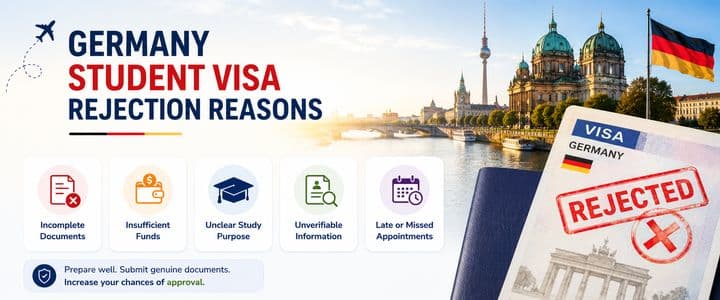
A student visa application can therefore face problems relating to:
Financial resources
Study purpose
Academic progression
University admission
Language proficiency
Health insurance
Incomplete documents
APS requirements
Inconsistent information
Study gaps
Tuition financing
Incorrect visa category
False or unverifiable documents
A visa refusal should not automatically be interpreted as a permanent ban on studying in Germany.
The refusal notice normally explains the basis for the decision, and applicants should first understand the exact issue before deciding whether to submit a new application or use any legal remedy available at that time.
This guide explains the major Germany student visa rejection reasons, how students can reduce avoidable risks, and what to consider after receiving a refusal.
Germany Student Visa Rejection Reasons at a Glance
| Possible Problem | Why It Can Affect the Application |
|---|---|
| Insufficient Financial Proof | Student cannot demonstrate sufficient resources |
| Incorrect Blocked Account | Required financial proof is incomplete |
| Tuition Funding Unclear | Living costs may be covered but tuition is not |
| Weak Study Purpose | Academic plan is not convincing |
| Unrelated Course | New program does not logically follow previous education |
| Incomplete Documents | Required evidence is missing |
| Incorrect Visa Category | Application does not match intended purpose |
| Language Requirement Not Met | Required language ability is not demonstrated |
| APS Missing | Applicable Indian academic verification is incomplete |
| Invalid Health Insurance | Required coverage is not demonstrated |
| Inconsistent CV | Education or employment timeline does not match other records |
| Unexplained Study Gap | Important periods in applicant history are unclear |
| False Documents | Serious credibility and immigration issue |
| Admission Problems | University admission is unclear, expired, or unsuitable |
| Financial Sponsor Issues | Sponsorship does not meet applicable rules |
| Poor Interview Answers | Answers conflict with documents or study plan |
Not every rejection will fall neatly into one of these categories.
The refusal letter issued in an individual case is the most important document for understanding why that particular application was unsuccessful.
Current Post-Rejection Procedure — Verify Before Taking Action
Post-refusal procedures are controlled by law and government policy and may change over time.
Students should always follow the instructions contained in their actual refusal notice.
Under the current German system, the former administrative remonstration procedure is no longer available for visa refusals worldwide.
Applicants can generally consider:
Submitting a new visa application after correcting the problem
Seeking judicial review through the applicable legal process
The correct legal deadline, court procedure, and available remedies should always be checked from the refusal notice or current official information.
This section should be updated whenever Germany changes its visa-refusal procedure.
1. Insufficient Financial Proof
Financial resources are one of the most important Germany student visa requirements.
Germany expects international students who require a study residence permit to demonstrate that they can support themselves.
A visa application may become problematic when:
Required funds are insufficient
Financial proof is incomplete
Blocked account confirmation is missing
Financial documents cannot be verified
The funding method is not accepted
Sponsor documentation is inadequate
Students should not assume that having some money in a regular bank account automatically satisfies the financial requirement.
Use a financial-proof method accepted for your visa category.
2. Incorrect Blocked Account Amount
The required blocked-account amount can change.
A student using an outdated financial threshold may submit insufficient proof.
For this reason, never permanently rely on:
Old articles
Old YouTube videos
Previous applicants
Old consultant checklists
Confirm the required amount close to the application date.
Does a Blocked Account Guarantee Visa Approval?
No.
A blocked account addresses financial capability.
The visa authority may still evaluate:
Admission
Academic history
Language
Insurance
Study purpose
Documents
A correct blocked account is important, but it is not a visa guarantee.
3. Tuition Fees Are Not Properly Funded
Students sometimes focus entirely on living expenses.
This can become a problem when the chosen university also charges significant tuition.
Suppose a student has:
Required living-cost financial proof
but must additionally pay:
€15,000 per year in tuition
The visa authority may reasonably need to understand how both expenses will be financed.
This issue is particularly relevant for:
Private universities
Tuition-charging public programs
Specialized international degrees
Prepare a realistic funding plan covering:
Living expenses + tuition + health insurance + initial relocation costs
4. Weak or Unclear Study Purpose
A student visa is intended for genuine education.
Applicants should be able to explain why they have selected:
Germany
The university
The particular degree
The specialization
The explanation should connect with the applicant's academic or professional development.
Weak answers such as:
“I chose Germany because education is free.”
or:
“I want to move to Europe.”
do not explain the academic purpose of the application.
Stronger Study Purpose
A better explanation could be:
“My undergraduate work in Computer Engineering and subsequent experience in software development led me toward distributed computing. The Master's curriculum allows me to develop this area through advanced systems modules and a research-oriented thesis.”
This demonstrates:
Past preparation → Current interest → Specific program → Future goal
5. Course Does Not Match Previous Education
Academic progression is particularly important for many Master's applicants.
German Master's programs are often consecutive.
This means the new degree builds on previous university study.
Examples of natural progression include:
Mechanical Engineering → Automotive Engineering
Computer Science → Artificial Intelligence
Economics → Finance
Electrical Engineering → Renewable Energy
A major unrelated shift may require stronger evidence.
Example of a Difficult Academic Transition
Consider:
Bachelor’s in English Literature
followed by:
MSc Mechanical Engineering
without university-level:
Mathematics
Physics
Engineering
Technical coursework
The problem may begin even before the visa because the applicant may not satisfy university academic requirements.
Even where admission has been obtained, an unusual academic transition should be clearly understood and explained.
6. Poor Explanation of Career Change
Changing fields is not automatically a visa problem.
However, the transition should make sense.
Suppose an Electronics graduate has spent three years working in software development and now applies for Data Science.
The applicant can explain:
Electronics degree → Programming experience → Data-related professional projects → Data Science Master’s
That creates a reasonable bridge.
A statement such as:
“I suddenly became interested in Data Science because it has many jobs”
is much weaker.
7. Incomplete Visa Application
Missing documents are one of the most avoidable problems.
Depending on the application, required documents can include:
Passport
Admission letter
Academic documents
Financial proof
Health insurance
Language certificate
CV
Motivation letter
APS
Tuition-related evidence
Use the current checklist for your responsible German mission.
Do not build the application only from a friend's checklist.
8. Incorrect Visa Category
Germany has different immigration routes for purposes including:
Full university study
Study preparation
Studienkolleg
Seeking a university place
Language study
Doctoral research
The visa category should match what the applicant is actually going to Germany to do.
For example, someone admitted only to an independent language course may not necessarily qualify under the same route as a student with direct Master's admission.
9. Language Proficiency Problems
Applicants need to satisfy the language requirements applicable to their study and visa situation.
For English-taught programs, evidence can include accepted English-language qualifications.
For German-taught programs, students commonly need an accepted German qualification.
Potential problems include:
Score below the required level
Certificate not accepted
Language evidence missing
Expired or invalid documentation
Applicant unable to reasonably demonstrate expected language ability
University Language Acceptance vs Visa Requirement
These should not always be assumed to be identical.
A university may have accepted your application under its own rules.
The visa process may still require suitable language documentation.
Students should check both.
10. Assuming MOI Is Always Enough
Some applicants use a:
Medium of Instruction certificate
to demonstrate that previous education was conducted in English.
This can be accepted in certain university or visa situations.
It is not universally accepted.
Do not assume:
MOI = IELTS waiver everywhere
Check the requirement applicable to your case.
11. Missing APS Certificate
Many applicants using Indian educational qualifications need APS verification.
When APS is required and not provided, the visa application can be incomplete.
Students should check whether their applicant category requires APS before reaching the visa stage.
What APS Does
APS verifies relevant academic documentation.
It does not guarantee:
University admission
Visa approval
Financial eligibility
Students sometimes misunderstand APS as a preliminary visa approval.
It is not.
12. Problems With Academic Documents
Academic documentation must be complete and genuine.
Problems can arise from:
Missing semesters
Missing degree certificate
Inconsistent names
Unclear institution
Unverified documents
Altered documents
Contradictory academic dates
Review your complete academic record before submission.
13. False or Manipulated Documents
This is one of the most serious mistakes an applicant can make.
Never submit fabricated or altered:
Bank statements
Employment certificates
Academic records
Language scores
Internship certificates
Admission documents
Sponsorship documents
False documents can lead to refusal and may have consequences for future immigration applications.
An honest weak point is safer than fabricated evidence.
14. Inconsistent Information
All major documents should tell the same story.
Compare:
Visa form
CV
SOP
Motivation letter
Academic certificates
Employment letters
University application
Dates and major facts should be consistent.
Example of an Inconsistency
CV:
Software Engineer: 2022–2025
Employment certificate:
Software Engineer: 2023–2024
Motivation letter:
Four years of professional experience
These contradictions may create credibility questions.
15. Unexplained Study Gap
Germany does not have one universal maximum study-gap rule.
However, applicants should provide a complete educational and professional timeline.
A gap itself is not automatically negative.
Acceptable real-life circumstances can include:
Employment
Internship
Exam preparation
Family responsibilities
Language study
Entrepreneurship
Professional training
Research
The issue is usually an unexplained period rather than simply the number of years.
Good Study-Gap Explanation
“After completing my Bachelor’s degree, I worked for three years as a production engineer, where my responsibilities in process optimization motivated me to pursue advanced study in Manufacturing Engineering.”
The gap becomes professional progression.
16. Weak CV
A visa CV should clearly present:
Education
Employment
Internships
Training
Relevant activities
Avoid:
Contradictory dates
Missing years
Unverifiable employment
Inflated job titles
A simple, factual CV is stronger than an exaggerated one.
17. Weak Motivation Letter
The motivation letter should explain why the intended study makes sense.
A poor letter may:
Repeat university rankings
Focus entirely on low tuition
Contain generic praise
Fail to explain career goals
Ignore previous education
Sound copied
Contradict the CV
A strong letter connects:
Academic background → Experience → Program → Career
18. Copy-Pasted or Generic Motivation
Statements such as:
“Germany is a developed country with world-class education and globally ranked universities.”
could apply to thousands of applicants.
Instead, discuss specific academic reasons.
For example:
“The curriculum's focus on embedded systems and industrial automation closely aligns with the work I completed during my final-year electronics project.”
Specific explanations are more credible.
19. University Admission Problems
An admission letter should be valid for the intended intake.
Potential concerns include:
Admission expired
Wrong semester
Admission conditions not fulfilled
Program status unclear
Institution recognition problems
Applicant applying under the wrong study category
Review the admission letter carefully.
20. Conditional Admission Is Misunderstood
Conditional admission can mean different things.
A student might need to complete:
Language requirement
Studienkolleg
Academic document submission
Entrance examination
Understand exactly what your university is offering.
The visa category and supporting documents may depend on the condition.
21. Health Insurance Problems
Appropriate health insurance is required.
Potential problems can include:
Insufficient coverage
Incorrect policy
Coverage dates not suitable
Insurance not accepted for the relevant stage
Students may need different arrangements during:
Travel → Enrollment → Residence
Check the current insurance requirements rather than purchasing the first inexpensive travel policy available.
22. Weak Financial Sponsor Documentation
A student may be supported by:
Parents
Scholarship
Formal sponsor
Other accepted funding mechanism
However, simply providing a letter saying:
“My uncle will pay all expenses”
may not satisfy the financial-proof rules.
Use the officially recognized method applicable to your case.
23. Scholarship Does Not Cover Enough
A scholarship can be strong financial proof.
But the amount matters.
If the scholarship covers only part of the required living expenses, the applicant may need additional accepted financial evidence.
Review:
Monthly amount
Duration
Tuition coverage
Living-cost coverage
24. Depending on Future Part-Time Work
A student should not base the initial visa-financing plan on:
“I will find a job after arriving.”
Part-time work may help students supplement income later.
It does not replace the need to meet the initial financial requirements.
25. Weak Answers During Visa Interview
Not every applicant experiences the same interview format.
Where questions are asked, students should know basic information about:
University
Course
Study location
Curriculum
Financing
Previous education
Career plans
You do not need memorized speeches.
You do need to understand your own application.
Example Questions
Applicants may be asked:
Why Germany?
Why this university?
Why this course?
What will you study?
Who is financing you?
What did you do after graduation?
What are your career plans?
Why does this degree follow your previous education?
Answers should remain consistent with the documents.
26. Memorized or Artificial Interview Answers
Over-rehearsed answers can sound less credible than simple factual responses.
Do not memorize paragraphs from:
Consultants
YouTube
Online visa scripts
AI-generated interview answers
Know your actual reasons.
27. Applicant Does Not Know the Course
Someone applying for:
MSc Data Science
should have at least a basic understanding of:
Course focus
Major modules
Why it fits their background
Not knowing what you will study can weaken the credibility of the application.
28. Applicant Does Not Know the University
You should know:
University name
Location
Degree
Duration
Major academic features
You do not need to memorize the university's entire history.
But choosing a university you know almost nothing about can raise obvious questions.
29. Weak “Why Germany?” Answer
Avoid answers based entirely on:
Free tuition
Europe
Travel
Lifestyle
Immigration
Academic reasons are stronger.
Discuss:
Curriculum
Research
Engineering ecosystem
Applied education
Industry-academic connection
30. Unrealistic Career Plan
Your career goals should reasonably connect with the degree.
Example:
MSc Cybersecurity → Cybersecurity analyst/security engineer → Advanced security roles
is logical.
An unrelated and unexplained career goal can make the overall application less coherent.
31. Major Financial Contradictions
Suppose the applicant claims:
“My family has no financial difficulty.”
but financial documents show uncertainty about:
Tuition
Blocked account
Living costs
The issue is not family wealth itself.
It is whether the required funding is actually demonstrated in the accepted manner.
32. Sponsor Cannot Demonstrate Financial Capacity
Where a sponsorship route is permitted, the sponsor may need to satisfy specific financial requirements.
An informal promise does not always establish financial capability.
Use the correct official process.
33. Applying Too Late
Applying late does not automatically cause rejection.
However, it can create practical problems.
For example:
Admission may become unusable
Enrollment deadline may pass
University may not permit late arrival
Updated documents may become necessary
Apply as early as the applicable process permits.
34. Expired Documents
Check validity dates for:
Passport
Language certificate where applicable
Insurance
Admission
Financial documentation
Do not submit outdated documents where updated evidence is required.
35. Passport Problems
Potential issues include:
Insufficient validity
Damaged passport
Name discrepancies
Incorrect personal information
Review your passport before beginning the university and visa process.
36. Name Mismatch Across Documents
Indian applicants in particular sometimes have different name formats across:
Passport
Class 10 certificate
Class 12 certificate
Degree
Transcript
Minor formatting variations are common, but significant discrepancies may require explanation or supporting documentation.
Resolve major inconsistencies early.
37. Employment Claims Cannot Be Verified
Do not exaggerate work experience.
If claiming professional experience, supporting evidence may include:
Employment certificate
Contract
Payslips
Reference
The exact documents requested vary.
38. Fake Study Gap Employment
Some students are tempted to create employment certificates to cover a gap.
Do not do this.
An honest explanation such as:
“Prepared for competitive examinations”
is much safer than inventing two years of professional experience.
39. Using an Agent Without Reviewing the Application
Using a consultant does not transfer responsibility for the information submitted.
Applicants should personally review:
Visa form
Financial documents
CV
Motivation letter
Academic records
Never allow someone to submit information you know is inaccurate.
40. Assuming an Agent Can Guarantee Visa Approval
No consultant can guarantee a German student visa.
Visa decisions belong to the responsible German authorities.
Be cautious of statements such as:
“100% visa guarantee.”
Does Low GPA Cause Germany Student Visa Rejection?
Low GPA by itself does not necessarily equal visa rejection.
The university has already evaluated your academic profile when issuing admission.
However, the overall study progression should remain credible.
The visa authority may still consider the academic and professional history as part of the complete application.
Does Study Gap Cause Rejection?
Not automatically.
There is no universal German rule such as:
“More than five years gap = rejected.”
Relevant work experience can make a long gap entirely logical.
The important factor is the complete timeline.
Does Backlog Cause Visa Rejection?
Past academic backlogs do not automatically mean visa refusal.
Again, university admission and visa approval are different processes.
Applicants should submit accurate transcripts and avoid hiding academic records.
Does Previous Visa Refusal Cause Another Rejection?
Not automatically.
If a previous visa application was refused, identify exactly why.
A new application should directly address the earlier problem.
Simply submitting the same application again without changes may produce the same result.
What Happens When a Germany Student Visa Is Rejected?
The applicant receives a refusal decision.
Read the refusal notice carefully.
Do not rely only on:
Friends
Consultants
Online forums
The refusal document is the primary source for understanding the individual decision.
First Step After Rejection
Identify the exact issue.
Examples:
Financial Problem
Correct the financing.
Missing Document
Obtain and submit the proper evidence in a new application where appropriate.
Study-Purpose Problem
Strengthen the academic explanation.
Language Problem
Meet the required language level.
Insurance Problem
Obtain appropriate coverage.
Can You Reapply After Germany Student Visa Rejection?
Under the current system, applicants can submit a new application after refusal.
There is not necessarily a universal waiting period simply because an application was rejected.
However:
Do not reapply without correcting the reason for refusal.
Example
First application:
Financial proof insufficient.
Second application:
Same financial proof.
Result:
The core problem remains.
Instead, correct the deficiency before submitting again.
Should You Reapply or Challenge the Decision?
This depends on why the application was refused.
A new application may be practical when:
Missing document can be supplied
Financing can be corrected
Admission has been updated
Language requirement can be met
Legal review may be considered when the applicant believes the decision is legally incorrect.
Legal proceedings involve deadlines and legal consequences, so professional legal advice may be appropriate for individual cases.
Remonstration After Germany Visa Rejection
Students may encounter old articles recommending:
Remonstration
after a visa refusal.
This information is outdated under the current German system.
The administrative remonstration procedure has been discontinued.
Because post-refusal rules can change again in the future, students should always follow the legal-remedy information printed on the current refusal notice.
Can You Apply to a Different University After Rejection?
Yes, where appropriate.
However, changing universities does not automatically fix the underlying issue.
If the original refusal involved:
Finance
Fake documents
Language
Insurance
switching universities alone may not solve the problem.
Can You Apply for the Next Intake?
Yes, where the university admits you for a later semester.
A later intake may provide additional time to correct:
APS
Financial proof
Language
Academic documents
Does Germany Refund Visa Fees After Rejection?
Visa application fees generally cover processing rather than successful approval.
Students should not assume the government visa fee will be refunded simply because the application is refused.
Current refund rules should be checked for the applicable process.
What Happens to Blocked Account Money After Rejection?
The money remains the student's funds.
However, releasing or closing the blocked account can require documentation showing that the visa was refused or that the blocking condition can be removed.
The procedure depends on the provider.
Provider charges may not necessarily be refundable.
Can Tuition Be Refunded After Visa Rejection?
This depends entirely on the university's refund policy.
Before paying substantial tuition, check:
Visa-refusal refund policy
Administrative deductions
Deadlines
Required rejection letter
Refund processing terms
This is particularly important for private universities.
How to Reduce Germany Student Visa Rejection Risk
Use a simple framework:
Eligibility → Documentation → Finance → Academic Logic → Consistency
1. Choose a Suitable Degree
Make sure your academic background genuinely fits.
2. Understand Your University
Know:
Program
Curriculum
Location
Duration
3. Prepare Financial Proof Correctly
Use current official requirements.
4. Complete APS Early
Where applicable.
5. Provide Valid Language Evidence
Do not assume exemptions.
6. Prepare a Clear CV
No unexplained or contradictory timeline.
7. Write a Genuine Motivation Letter
Avoid generic templates.
8. Review Every Document
Ensure dates and facts match.
9. Never Submit False Information
No application weakness justifies document fraud.
10. Use the Current Checklist
Visa requirements change.
Do not rely exclusively on an article published years earlier.
Final Pre-Submission Checklist
Confirm:
Admission
Valid
Correct semester
Correct degree
Academics
Complete
Genuine
APS where required
Financial
Current required proof
Accepted method
Tuition funding considered
Insurance
Correct coverage
Language
Correct test
Required level
CV
Complete timeline
Motivation
Logical academic progression
Visa
Correct category
Current documents
Consistency
No conflicting dates or claims
Frequently Asked Questions
Why is a Germany student visa rejected?
Rejection can result from financial, documentation, academic, language, insurance, credibility, or other immigration-related issues.
Does admission guarantee a student visa?
No.
Does blocked account guarantee visa approval?
No.
Can insufficient funds cause rejection?
Yes, insufficient or unacceptable financial proof can create a serious problem.
Can study gap cause rejection?
A gap alone does not automatically cause refusal, but unexplained periods can weaken an application.
Can low GPA cause rejection?
Low GPA alone does not automatically determine the visa outcome, particularly after valid university admission.
Can backlogs cause rejection?
Not automatically.
Can a wrong course cause visa problems?
A course that does not logically connect with your academic or professional background may require stronger explanation.
Can IELTS cause rejection?
Failure to provide acceptable required language evidence can affect the application.
Can MOI be used?
It may be accepted in some situations but should not be assumed to work universally.
Can missing APS cause rejection?
Where APS is mandatory, not meeting that requirement can make the application incomplete.
Can fake documents cause rejection?
Yes, and they may result in more serious immigration consequences.
Can a private university cause visa rejection?
Private-university admission does not automatically cause rejection. Recognition, finances, tuition, study purpose, and the complete application matter.
Can I reapply after rejection?
Yes under the current system, but the reason for refusal should be corrected first.
Is there a waiting period after rejection?
There is not necessarily a universal waiting period solely because a previous application was refused.
Can I challenge a rejection?
Legal review may be available according to the current procedure and information contained in the refusal notice.
Can I still use remonstration?
Under the current rules, the former visa remonstration procedure has been discontinued.
Will my blocked account money be lost?
No. It remains your money, although provider procedures and charges can apply when closing or unblocking the account.
Will university tuition be refunded?
That depends on the university's individual refund policy.
Can an agent guarantee Germany student visa approval?
No.
Final Verdict
Germany student visa rejection is usually not about one isolated factor.
The complete application must demonstrate:
Valid Study Purpose + Academic Logic + Financial Security + Proper Insurance + Genuine Documents + Consistent Information
Some of the most avoidable problems are:
Insufficient financial proof
Incomplete documents
Weak academic progression
Missing APS
Incorrect language evidence
Unexplained timeline
Inconsistent information
False documentation
Students should not fear legitimate issues such as:
Moderate GPA
Study gap
Career change
Previous rejection
These situations can often be explained when the application remains academically logical and properly documented.
The most serious mistake is trying to hide a weakness by providing false information.
After a refusal:
Read the rejection notice → Identify the exact problem → Correct it → Choose the appropriate next step
Do not submit the same application repeatedly without understanding why it failed.
And because visa regulations and legal-remedy procedures change over time, always verify the current process before reapplying or challenging a refusal.