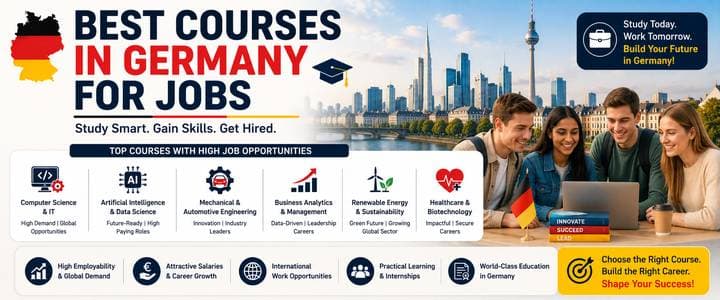
The best courses in Germany for jobs are generally found in computer science, artificial intelligence, data science, cybersecurity, engineering, renewable energy, healthcare, biotechnology, logistics, and business analytics.
Germany’s official skilled-worker portal identifies IT specialists, engineers, scientists, physicians, nursing professionals, green-energy specialists, transport professionals, educators, and skilled technical workers as important areas of demand.
The latest official figures indicate approximately 109,000 unfilled IT positions and around 76,000 unfilled engineering positions. However, completing a degree does not automatically guarantee employment. German language ability, internships, working-student experience, technical skills, city selection, and programme specialization strongly influence graduate outcomes.
Best Courses in Germany for Jobs: Quick Overview
| Course | Employment outlook | Indicative graduate salary |
|---|---|---|
| Computer Science | Excellent | €45,000–€70,000 |
| Artificial Intelligence | Excellent | €50,000–€80,000 |
| Data Science | Excellent | €48,000–€75,000 |
| Cybersecurity | Excellent | €50,000–€80,000 |
| Software Engineering | Excellent | €45,000–€72,000 |
| Electrical Engineering | Very strong | €48,000–€72,000 |
| Mechatronics and Robotics | Very strong | €47,000–€72,000 |
| Mechanical Engineering | Strong | €45,000–€68,000 |
| Automotive Engineering | Strong | €46,000–€72,000 |
| Renewable Energy Engineering | Very strong | €45,000–€70,000 |
| Industrial Engineering | Very strong | €48,000–€75,000 |
| Civil Engineering | Strong | €44,000–€65,000 |
| Business Analytics | Very strong | €45,000–€70,000 |
| Information Systems | Very strong | €45,000–€70,000 |
| Supply Chain and Logistics | Strong | €42,000–€68,000 |
| Biotechnology | Strong | €42,000–€65,000 |
| Pharmaceutical Sciences | Strong | €45,000–€75,000 |
| Nursing | Excellent demand | €38,000–€52,000 |
| Medicine | Excellent demand | €60,000–€100,000+ |
| Finance and Quantitative Economics | Competitive | €45,000–€80,000 |
Salary figures are broad annual gross planning ranges, not guaranteed starting salaries. Actual compensation depends on experience, company size, collective agreements, city, industry, qualifications, and negotiation.
Which Courses Have the Best Job Opportunities in Germany?
The strongest employment prospects are generally connected to five major areas:
Digitalization and information technology
Engineering and advanced manufacturing
Healthcare and life sciences
Energy transition and sustainability
Logistics, business technology, and industrial management
Students should select a course that matches both their academic background and a clearly identifiable job family.
A degree title alone is not enough. Employers also evaluate whether the student possesses the software, technical, analytical, communication, and language skills required for the role.
1. Computer Science
Computer science is one of the best courses in Germany for international students seeking employment.
Germany’s technology sector includes:
Software companies
Manufacturing businesses
Automotive companies
Banks
Insurance companies
Logistics businesses
Consulting firms
Research institutions
Government organizations
Start-ups
Popular Specializations
Software engineering
Cloud computing
Distributed systems
Database systems
Computer networks
Human-computer interaction
Algorithms
Mobile development
Enterprise software
Scientific computing
Common Job Roles
Software developer
Backend developer
Frontend developer
Full-stack developer
Cloud engineer
DevOps engineer
Systems engineer
Application developer
Solutions architect
Database engineer
IT consultant
Product engineer
Indicative Salary
€45,000 to €70,000 per year
Experienced professionals in high-demand specializations may earn more.
Important Skills
Java
Python
C++
JavaScript
SQL
Git
Linux
Cloud platforms
Software architecture
Testing
Agile development
Containers
Continuous integration
Recommended Universities
Technical University of Munich
Karlsruhe Institute of Technology
Saarland University
Technical University of Berlin
RWTH Aachen University
Technical University of Darmstadt
LMU Munich
University of Freiburg
University of Stuttgart
TU Dresden
German Language Requirement
English may be sufficient for certain international technology teams. German at B1 or B2 level considerably expands the number of available employers and client-facing roles.
2. Artificial Intelligence and Machine Learning
Artificial intelligence has become an important employment field across automotive engineering, manufacturing, healthcare, finance, logistics, robotics, and software.
Popular Specializations
Machine learning
Deep learning
Computer vision
Natural language processing
Reinforcement learning
Responsible AI
Generative AI
Autonomous systems
Intelligent robotics
Medical AI
Common Job Roles
Machine learning engineer
AI engineer
Computer vision engineer
Natural language processing engineer
Applied scientist
AI researcher
Robotics perception engineer
Data scientist
AI product specialist
Research engineer
Indicative Salary
€50,000 to €80,000 per year
Research-intensive roles may require a Master’s degree or doctorate.
Important Skills
Python
PyTorch
TensorFlow
Statistics
Linear algebra
Probability
Data structures
Model deployment
Cloud computing
MLOps
SQL
Data engineering
Recommended Universities
Technical University of Munich
University of Tübingen
Saarland University
Technical University of Berlin
Technical University of Darmstadt
Karlsruhe Institute of Technology
LMU Munich
University of Freiburg
RWTH Aachen University
Students should choose technically rigorous programmes rather than degrees that use “AI” mainly as a marketing term.
3. Data Science
Data science provides opportunities in technology, finance, consulting, healthcare, retail, manufacturing, energy, and logistics.
Popular Specializations
Statistical modelling
Machine learning
Big data
Data visualization
Business intelligence
Predictive analytics
Data engineering
Computational statistics
Decision science
Quantitative analytics
Common Job Roles
Data scientist
Data analyst
Data engineer
Business intelligence analyst
Analytics engineer
Product analyst
Risk analyst
Quantitative analyst
Machine learning engineer
Research analyst
Indicative Salary
€48,000 to €75,000 per year
Important Skills
Python
R
SQL
Statistics
Machine learning
Data visualization
Cloud platforms
Spark
Data warehouses
Dashboard tools
Experimental design
Communication
Recommended Universities
Technical University of Munich
LMU Munich
University of Mannheim
Technical University of Dortmund
University of Tübingen
Saarland University
University of Hildesheim
Technical University of Berlin
RWTH Aachen University
Students should build a portfolio with practical projects rather than depending entirely on coursework.
4. Cybersecurity
Cybersecurity professionals are required across financial services, software, government, critical infrastructure, manufacturing, energy, and telecommunications.
Popular Specializations
Network security
Cloud security
Application security
Digital forensics
Cryptography
Security engineering
Penetration testing
Identity and access management
Incident response
Governance, risk, and compliance
Common Job Roles
Cybersecurity analyst
Security engineer
Application security engineer
Cloud security specialist
Penetration tester
Security consultant
Incident response analyst
Digital forensics specialist
Security architect
Governance and risk analyst
Indicative Salary
€50,000 to €80,000 per year
Important Skills
Networks
Linux
Python
Cloud security
Security testing
Cryptography
Threat modelling
Incident response
Security frameworks
Risk management
Recommended Universities
Saarland University
Technical University of Darmstadt
Ruhr University Bochum
Technical University of Munich
Technical University of Berlin
University of Bonn
Karlsruhe Institute of Technology
German becomes more important for government, compliance, consulting, and customer-facing security roles.
5. Software Engineering
Software engineering focuses more directly on designing, developing, testing, and maintaining complex software systems.
Common Job Roles
Software engineer
Platform engineer
DevOps engineer
Site reliability engineer
Quality assurance engineer
Software architect
Embedded software developer
Mobile application developer
Cloud developer
Indicative Salary
€45,000 to €72,000 per year
Students should prioritize programmes containing:
Software architecture
Algorithms
Testing
Databases
Distributed systems
Cloud computing
Security
Team development projects
Industry internships
6. Electrical Engineering
Electrical engineering is closely connected with Germany’s industrial, automotive, energy, semiconductor, automation, and manufacturing sectors.
Popular Specializations
Power engineering
Electronics
Communication systems
Embedded systems
Semiconductor technology
Signal processing
Control engineering
Automation
Renewable energy
Electric mobility
Common Job Roles
Electrical engineer
Electronics engineer
Control systems engineer
Power systems engineer
Hardware engineer
Semiconductor engineer
Automation engineer
Embedded systems engineer
Test engineer
Grid integration engineer
Indicative Salary
€48,000 to €72,000 per year
Recommended Universities
Technical University of Munich
RWTH Aachen University
Karlsruhe Institute of Technology
Technical University of Berlin
Technical University of Dresden
University of Stuttgart
Technical University of Darmstadt
FAU Erlangen-Nuremberg
TU Braunschweig
German Language Requirement
German at B1 or B2 level is strongly recommended because many engineering teams, suppliers, safety documents, production environments, and smaller employers operate mainly in German.
7. Mechatronics and Robotics
Mechatronics combines mechanical engineering, electronics, software, sensors, and control systems.
Popular Specializations
Industrial robotics
Autonomous systems
Control engineering
Embedded systems
Smart manufacturing
Human-robot interaction
Sensor technology
Automation
Machine vision
Mobile robotics
Common Job Roles
Mechatronics engineer
Robotics engineer
Automation engineer
Control systems engineer
Systems integration engineer
Commissioning engineer
Embedded systems engineer
Robotics software developer
Production automation engineer
Indicative Salary
€47,000 to €72,000 per year
Recommended Universities
Technical University of Munich
RWTH Aachen University
Karlsruhe Institute of Technology
Leibniz University Hannover
Technical University of Dortmund
University of Stuttgart
Technical University of Hamburg
TU Dresden
Students with a combination of mechanical, electronics, programming, and control-system skills can access a wider range of positions.
8. Mechanical Engineering
Mechanical engineering remains important in Germany’s machinery, production, automotive, energy, aerospace, and industrial-equipment sectors.
Popular Specializations
Production engineering
Computational engineering
Thermal engineering
Fluid mechanics
Manufacturing
Product development
Materials engineering
Energy systems
Aerospace engineering
Automotive engineering
Common Job Roles
Mechanical engineer
Design engineer
Manufacturing engineer
Production engineer
Process engineer
Quality engineer
Simulation engineer
Development engineer
Project engineer
Maintenance engineer
Indicative Salary
€45,000 to €68,000 per year
Important Skills
CAD
Finite element analysis
Computational fluid dynamics
Product lifecycle management
Manufacturing systems
Technical drawing
Simulation tools
Quality management
Project management
Programming basics
Mechanical engineering job prospects improve considerably when students add automation, software, electrical systems, simulation, or sustainability skills.
9. Automotive Engineering and Electric Mobility
Germany has a large automotive ecosystem involving manufacturers, component suppliers, engineering service providers, software companies, and research organizations.
The sector is changing through:
Electric vehicles
Battery technology
Automotive software
Autonomous driving
Connected vehicles
Power electronics
Lightweight materials
Sustainable manufacturing
Common Job Roles
Automotive engineer
Vehicle development engineer
Battery systems engineer
Electric powertrain engineer
Automotive software engineer
Functional safety engineer
Testing and validation engineer
Simulation engineer
Advanced driver-assistance systems engineer
Quality engineer
Indicative Salary
€46,000 to €72,000 per year
Recommended Universities
RWTH Aachen University
Technical University of Munich
University of Stuttgart
Karlsruhe Institute of Technology
TU Braunschweig
Technical University of Dresden
Esslingen University of Applied Sciences
Ingolstadt Technical University of Applied Sciences
Students should avoid limiting themselves exclusively to traditional combustion-engine technology. Electric mobility, software, batteries, electronics, automation, and sustainability offer broader future options.
10. Renewable Energy Engineering
Germany’s energy transition creates opportunities in renewable generation, power systems, storage, energy efficiency, buildings, and industrial decarbonization.
Popular Specializations
Solar energy
Wind energy
Energy storage
Hydrogen technology
Smart grids
Power electronics
Energy management
Sustainable buildings
Environmental engineering
Energy efficiency
Common Job Roles
Renewable energy engineer
Energy systems engineer
Solar project engineer
Wind energy engineer
Grid integration engineer
Energy consultant
Sustainability engineer
Hydrogen systems engineer
Battery engineer
Energy manager
Indicative Salary
€45,000 to €70,000 per year
Recommended Universities
Technical University of Munich
Karlsruhe Institute of Technology
University of Freiburg
Technical University of Berlin
University of Oldenburg
University of Kassel
Hamburg University of Technology
Brandenburg University of Technology
RWTH Aachen University
Green jobs also employ IT specialists, data scientists, automation engineers, environmental experts, and construction professionals.
11. Industrial Engineering
Industrial engineering combines engineering, management, operations, and economics.
It is particularly valuable in Germany because many employers need graduates who can work between technical and commercial teams.
Popular Specializations
Production management
Operations research
Supply chain
Technology management
Energy management
Quality management
Logistics
Digital manufacturing
Project management
Business analytics
Common Job Roles
Industrial engineer
Operations analyst
Production planner
Supply chain analyst
Project engineer
Quality manager
Technical consultant
Procurement analyst
Process improvement specialist
Product manager
Indicative Salary
€48,000 to €75,000 per year
Recommended Universities
Karlsruhe Institute of Technology
RWTH Aachen University
Technical University of Berlin
Technical University of Munich
Technical University of Darmstadt
University of Hamburg
University of Duisburg-Essen
FAU Erlangen-Nuremberg
German language ability is highly valuable because many roles require coordination with suppliers, production teams, customers, and management.
12. Civil Engineering and Construction Management
Germany requires infrastructure development, housing construction, renovation, transport systems, sustainable buildings, and energy-efficient modernization.
Popular Specializations
Structural engineering
Construction management
Transportation engineering
Geotechnical engineering
Water engineering
Building technology
Sustainable construction
Urban infrastructure
Digital construction
Building information modelling
Common Job Roles
Civil engineer
Structural engineer
Construction project manager
Site engineer
Transportation engineer
Geotechnical engineer
Building information modelling specialist
Water resources engineer
Infrastructure planner
Indicative Salary
€44,000 to €65,000 per year
Recommended Universities
Technical University of Munich
RWTH Aachen University
Technical University of Berlin
Karlsruhe Institute of Technology
University of Stuttgart
Technical University of Dresden
Technical University of Darmstadt
Bauhaus University Weimar
German at B2 level can be especially important because of building regulations, site communication, safety requirements, contracts, and public authorities.
13. Business Analytics
Business analytics combines data, technology, statistics, and business decision-making.
Popular Specializations
Business intelligence
Predictive analytics
Marketing analytics
Financial analytics
Operations analytics
Customer analytics
Data visualization
Decision science
Digital transformation
Process mining
Common Job Roles
Business analyst
Business intelligence analyst
Data analyst
Analytics consultant
Product analyst
Operations analyst
Process mining analyst
Digital transformation consultant
Customer insights analyst
Indicative Salary
€45,000 to €70,000 per year
Recommended Universities
University of Mannheim
Technical University of Munich
LMU Munich
University of Cologne
Frankfurt School of Finance and Management
University of Münster
Otto von Guericke University Magdeburg
University of Hildesheim
Students should develop SQL, Python, statistics, visualization, and business communication skills.
14. Information Systems and Business Informatics
Business informatics, known as Wirtschaftsinformatik, connects software, data, business processes, and management.
Common Job Roles
IT business analyst
ERP consultant
Technology consultant
Business process analyst
Product manager
Systems analyst
Digital transformation consultant
IT project manager
Data analyst
Enterprise applications consultant
Indicative Salary
€45,000 to €70,000 per year
German language ability is particularly useful because consulting and enterprise-system roles often involve German-speaking clients and internal teams.
15. Supply Chain Management and Logistics
Germany’s central European location, manufacturing economy, ports, airports, road network, and international trade support a large logistics sector.
Popular Specializations
Supply chain analytics
Procurement
Operations management
Transportation
Warehouse management
Production planning
International logistics
Maritime logistics
Digital supply chains
Sustainable logistics
Common Job Roles
Supply chain analyst
Logistics planner
Procurement specialist
Operations manager
Demand planner
Inventory analyst
Transport planner
Warehouse process specialist
Production planner
Supply chain consultant
Indicative Salary
€42,000 to €68,000 per year
Recommended Institutions
Kühne Logistics University
Technical University of Munich
Technical University of Berlin
University of Duisburg-Essen
Hamburg University of Technology
University of Bremen
Otto von Guericke University Magdeburg
Technical University of Dortmund
German at B1 or B2 level significantly improves access to operational and supplier-facing roles.
16. Nursing and Healthcare
Nursing is one of Germany’s clearest shortage occupations.
Employment opportunities exist in:
Hospitals
Residential care facilities
Outpatient services
Rehabilitation centres
Disability support
Hospices
Community care
Common Job Roles
Registered nursing professional
Hospital nurse
Elderly care professional
Rehabilitation nurse
Community care professional
Intensive care nurse
Operating theatre nurse
Indicative Salary
€38,000 to €52,000 per year
Important Conditions
Nursing is a regulated profession. Long-term work generally requires:
Recognition of the qualification
Authorization to practise
German language proficiency
Health and reliability requirements
Possible adaptation measure or knowledge examination
German at B2 level is commonly expected, subject to the competent authority’s rules.
International applicants should distinguish between:
Academic nursing degrees
German vocational nursing training
Recognition of an overseas nursing qualification
Nursing-assistant routes
17. Medicine
Germany requires qualified physicians, but medicine is one of the most demanding educational and regulatory routes.
Common Career Areas
General medicine
Internal medicine
Surgery
Anaesthesiology
Psychiatry
Radiology
Paediatrics
Neurology
Emergency medicine
Medical research
Indicative Salary
€60,000 to €100,000 or more per year
The amount depends on training stage, hospital agreement, specialization, experience, and working hours.
Important Conditions
Medicine is a regulated profession. Doctors generally need:
Recognized medical qualification
Professional licence
German language proficiency
Medical language examination
Possible knowledge examination
Compliance with state-specific recognition procedures
Medical education in Germany is predominantly German-taught and highly competitive.
18. Biotechnology
Germany has a developed biotechnology, life-science, medical-research, diagnostics, and industrial-biotechnology ecosystem.
Popular Specializations
Molecular biotechnology
Bioinformatics
Bioprocess engineering
Medical biotechnology
Industrial biotechnology
Molecular biology
Computational biology
Biopharmaceutical technology
Common Job Roles
Biotechnologist
Research associate
Bioprocess engineer
Laboratory scientist
Bioinformatics specialist
Quality assurance specialist
Regulatory affairs associate
Clinical research associate
Validation specialist
Indicative Salary
€42,000 to €65,000 per year
Research and academic roles may require a doctorate. Industry roles often value quality systems, regulatory knowledge, data skills, and practical laboratory experience.
19. Pharmaceutical Sciences
Germany’s pharmaceutical industry offers positions in research, manufacturing, quality, clinical studies, regulation, and medical affairs.
Popular Specializations
Drug development
Pharmaceutical technology
Medicinal chemistry
Clinical research
Regulatory affairs
Quality assurance
Biopharmaceuticals
Pharmacology
Common Job Roles
Pharmaceutical scientist
Formulation scientist
Quality assurance specialist
Quality control analyst
Regulatory affairs specialist
Clinical research associate
Validation specialist
Medical affairs associate
Production specialist
Indicative Salary
€45,000 to €75,000 per year
Working as a pharmacist is regulated and requires the applicable professional authorization. Pharmaceutical industry roles may follow different requirements.
20. Finance and Quantitative Economics
Germany has important financial and business centres, particularly in Frankfurt, Munich, Berlin, Hamburg, Düsseldorf, and Cologne.
Popular Specializations
Finance
Quantitative finance
Risk management
Economics
Econometrics
Financial technology
Accounting
Banking
Insurance
Controlling
Common Job Roles
Financial analyst
Risk analyst
Controller
Quantitative analyst
Audit associate
Banking analyst
Insurance analyst
Treasury analyst
Financial consultant
Compliance analyst
Indicative Salary
€45,000 to €80,000 per year
Recommended Universities
University of Mannheim
Goethe University Frankfurt
LMU Munich
University of Bonn
University of Cologne
Frankfurt School of Finance and Management
WHU – Otto Beisheim School of Management
University of Münster
German language proficiency is important for accounting, audit, compliance, local banking, insurance, and client-facing roles.
21. Embedded Systems and Internet of Things
Embedded technology connects software with physical products and is important in automotive, manufacturing, medical devices, robotics, and consumer electronics.
Common Job Roles
Embedded software engineer
Firmware engineer
Hardware-software integration engineer
Internet of Things engineer
Automotive software engineer
Real-time systems developer
Functional safety engineer
Control systems developer
Indicative Salary
€48,000 to €75,000 per year
Important Skills
C
C++
Microcontrollers
Real-time operating systems
Electronics
Communication protocols
Control systems
Hardware debugging
Functional safety
Linux
22. Aerospace Engineering
Germany has opportunities in aircraft manufacturing, spacecraft systems, propulsion, aviation technology, research, and advanced materials.
Common Job Roles
Aerospace engineer
Flight systems engineer
Structural engineer
Propulsion engineer
Simulation engineer
Avionics engineer
Systems integration engineer
Testing engineer
Space systems engineer
Indicative Salary
€48,000 to €75,000 per year
Recommended Universities
Technical University of Munich
University of Stuttgart
TU Braunschweig
RWTH Aachen University
Technical University of Berlin
Bremen University of Applied Sciences
Technical University of Dresden
Certain defence or security-related positions may involve nationality, clearance, or export-control restrictions.
23. Environmental Engineering
Environmental engineering combines science, infrastructure, sustainability, regulation, and technology.
Common Job Roles
Environmental engineer
Waste management specialist
Water treatment engineer
Sustainability consultant
Environmental compliance specialist
Circular economy specialist
Climate risk analyst
Remediation engineer
Indicative Salary
€42,000 to €65,000 per year
German language proficiency is important for regulatory work, public-sector communication, documentation, and consulting.
24. Architecture and Urban Planning
Germany’s EU Blue Card shortage list includes academic professionals in architecture, spatial planning, and transport planning.
Common Job Roles
Architect
Urban planner
Spatial planner
Building information modelling specialist
Sustainable building consultant
Transport planner
Project coordinator
Design architect
Indicative Salary
€40,000 to €60,000 per year
The professional title “architect” is regulated. Registration and recognition requirements can apply.
German at B2 or C1 level may be required for building law, planning permissions, contracts, client communication, and public authorities.
Best Courses Based on Job Demand
| Demand category | Recommended courses |
|---|---|
| Highest digital demand | Computer science, AI, cybersecurity, software engineering |
| Best for industrial jobs | Mechanical, electrical, mechatronics, industrial engineering |
| Best for green jobs | Renewable energy, electrical engineering, environmental engineering |
| Best for healthcare demand | Nursing, medicine, medical technology |
| Best for analytical careers | Data science, business analytics, quantitative economics |
| Best for manufacturing | Automation, robotics, production engineering, mechatronics |
| Best for transport and trade | Logistics, supply chain, transport planning |
| Best for research careers | Biotechnology, physics, chemistry, pharmaceutics |
| Best interdisciplinary choices | Business informatics, industrial engineering, computational engineering |
Best Courses for English-Speaking Jobs
Courses with comparatively more English-language employment opportunities include:
Computer science
Software engineering
Artificial intelligence
Data science
Cybersecurity
Cloud computing
Bioinformatics
Scientific research
Semiconductor engineering
Certain international finance roles
Certain multinational engineering roles
English-speaking roles are concentrated in:
International companies
Technology start-ups
Research institutions
Large industrial groups
Multinational consulting teams
Global financial organizations
The number of suitable vacancies becomes much larger when the applicant learns German.
Courses Where German Is Especially Important
German is particularly important for:
Nursing
Medicine
Psychology
Teaching
Social work
Law
Civil engineering
Architecture
Public administration
Human resources
Local sales
Accounting
Customer service
Construction management
Healthcare management
Students should not wait until graduation to begin learning German.
Recommended German Level for Employment
| Career field | Practical target |
|---|---|
| Software and international IT | B1 helpful, B2 stronger |
| Data science and AI | B1 helpful, B2 expands options |
| Engineering | B1 minimum target, B2 preferred |
| Manufacturing and operations | B2 strongly recommended |
| Business and consulting | B2 commonly important |
| Finance and accounting | B2 or higher |
| Nursing | B2 commonly required |
| Medicine | Advanced general and medical German |
| Teaching and social work | Advanced German |
| Architecture and construction | B2 or higher |
| Research | English may be sufficient in some groups |
Formal requirements can differ from practical employer expectations.
Best Master’s Courses for Jobs
Strong Master’s choices include:
MSc Computer Science
MSc Artificial Intelligence
MSc Data Science
MSc Cybersecurity
MSc Software Engineering
MSc Electrical Engineering
MSc Embedded Systems
MSc Mechatronics
MSc Robotics
MSc Mechanical Engineering
MSc Automotive Engineering
MSc Renewable Energy
MSc Energy Engineering
MSc Industrial Engineering
MSc Business Analytics
MSc Information Systems
MSc Supply Chain Management
MSc Biotechnology
MSc Pharmaceutical Sciences
MSc Computational Engineering
The best Master’s programme builds directly on the applicant’s previous degree and gives access to identifiable job titles.
Best Bachelor’s Courses for Jobs
Strong Bachelor’s choices include:
BSc Computer Science
BSc Business Informatics
BSc Electrical Engineering
BSc Mechanical Engineering
BSc Mechatronics
BSc Industrial Engineering
BSc Civil Engineering
BSc Nursing
BSc Biotechnology
BSc Logistics
BSc Renewable Energy Engineering
Most Bachelor’s programmes at public universities are taught in German.
Ausbildung Options With Strong Job Prospects
Not every high-demand career requires a university degree. Germany’s vocational training system provides paid training connected with employment.
Strong Ausbildung areas include:
Nursing
Mechatronics
Electronics
Industrial mechanics
IT specialist
Logistics
Railway operations
Heating and air-conditioning technology
Automotive mechatronics
Hotel and gastronomy
Medical assistance
Elderly care
Ausbildung normally requires German because training, examinations, workplace communication, and vocational school are primarily German-language.
Courses With Competitive or Limited Job Markets
The following courses are not automatically poor choices, but international students need a stronger career strategy:
General management without experience
International business without specialization
Media studies
International relations
Political science
Humanities
Literature
Fine arts
Psychology without recognition planning
Law based on a foreign legal system
Tourism management
Generic marketing
Communication studies
Students can improve employability by adding:
German language
Data analysis
Digital marketing
Programming
Finance
Project management
Regulatory knowledge
Internships
Industry specialization
Portfolio work
Why Some Graduates Struggle to Find Jobs
Graduates may face difficulty when they:
Choose a course only because it is English-taught
Ignore German language learning
Graduate without an internship
Have no working-student experience
Apply only to famous companies
Use a generic CV
Lack role-specific technical skills
Start the job search too late
Apply only in one city
Cannot explain their projects
Select an overly broad management degree
Ignore small and medium-sized companies
Do not understand German recruitment practices
Have unrealistic salary expectations
Lack recognition for a regulated profession
How to Make Any Course More Employable
Learn German
German is one of the strongest employability investments an international student can make.
Gain Working-Student Experience
Werkstudent roles provide:
German work experience
Professional references
Industry knowledge
Workplace language
Networking
Potential full-time conversion
Complete Relevant Internships
Choose internships connected to the intended full-time role.
Build Technical Skills
Examples include:
Programming
Data analysis
CAD
Simulation
ERP systems
Cloud computing
Project management
Laboratory methods
Quality management
Select an Industry-Relevant Thesis
A thesis completed with a company or applied research institute can create direct employment opportunities.
Build a Portfolio
Portfolios are useful for:
Software
Data science
AI
Design
Architecture
Product management
Digital marketing
Engineering projects
Apply Beyond Major Cities
Employment opportunities exist throughout Germany, including smaller industrial centres.
Working During Studies
International students from third countries can generally work:
Up to 140 full working days per year
Up to 280 half working days per year
Alternatively, up to 20 hours per week during the lecture period
Different treatment may apply to student-assistant roles, compulsory internships, voluntary internships, and self-employment.
Students should follow the conditions printed on their residence permit and obtain clarification when necessary.
Staying in Germany After Graduation
International graduates from third countries can generally apply for a residence permit allowing up to 18 months to search for qualified employment.
During this period, graduates can take employment while searching for the appropriate skilled position.
The job-search residence permit is not automatically renewable. Graduates should begin preparing their employment strategy before completing the degree.
Work Visa After Graduation
After finding qualified employment, a graduate may move to an appropriate residence category, such as:
Residence permit for qualified employment
EU Blue Card
Residence permit for research
Residence permit for self-employment
Another applicable employment category
The correct permit depends on qualification, job, salary, professional recognition, and individual circumstances.
EU Blue Card and Shortage Occupations
The EU Blue Card is available to qualifying professionals with an eligible qualification and employment offer.
The current general salary threshold is €50,700 gross per year.
A lower current threshold of €45,934.20 gross per year applies to qualifying shortage occupations and certain new labour-market entrants, subject to the applicable conditions and Federal Employment Agency approval.
Shortage occupations include categories such as:
Academic STEM professionals
ICT managers
Architects and planners
Physicians
Pharmacists
Academic nursing professionals
Education professionals
Certain management occupations
Salary thresholds are revised regularly. Applicants must verify the amount applicable when submitting their application.
Settlement Permit After Studying in Germany
Graduates who complete higher education in Germany may qualify for a settlement permit under facilitated conditions when they meet requirements including:
Qualified employment residence status
Two years of qualifying employment
Twenty-four months of pension contributions
B1 German
Secure living expenses
Sufficient housing
Knowledge of Germany’s legal and social system
Individual eligibility must be assessed by the responsible foreigners authority.
How to Select the Best Course for Jobs
Step 1: Check Your Academic Background
The programme should match your previous subjects and credits.
Step 2: Identify Specific Job Titles
Do not select “data science” only because it is popular. Identify the actual roles, skills, and employer requirements.
Step 3: Examine the Curriculum
Look for:
Practical modules
Technical depth
Internship opportunities
Industry projects
Laboratory work
Programming
Thesis partnerships
Career services
Step 4: Research the City
Consider local industries.
| Region | Major employment strengths |
|---|---|
| Munich | Technology, automotive, aerospace, finance, insurance |
| Berlin | Software, start-ups, media, research, public policy |
| Frankfurt | Finance, banking, consulting, data centres |
| Hamburg | Logistics, aviation, media, trade, renewable energy |
| Stuttgart | Automotive, manufacturing, engineering |
| Cologne and Düsseldorf | Media, business, consulting, telecommunications |
| Aachen | Engineering, automotive research, technology |
| Dresden | Semiconductors, electronics, research |
| Nuremberg and Erlangen | Technology, electronics, energy, medical systems |
| Rhine-Neckar region | Software, chemicals, pharmaceuticals, engineering |
| Wolfsburg and Braunschweig | Automotive, mobility, research |
Step 5: Compare Total Cost
A higher salary in Munich may be offset by substantially higher rent.
Step 6: Check Language Expectations
Choose a realistic German-learning plan alongside the degree.
Step 7: Review Graduate Outcomes
Look for evidence of:
Employer partnerships
Internships
Alumni roles
Company thesis opportunities
Career fairs
Research collaboration
Best Course Selection Checklist
Programme
Matches previous qualification
Contains practical modules
Offers technical depth
Includes internship opportunities
Supports industry thesis
Has clear job outcomes
Career
Target job titles identified
Skills listed from real vacancies
Regional employer demand checked
Indicative salary researched
German requirement understood
Regulated-profession rules reviewed
University
State recognition confirmed
Programme accreditation checked
Laboratories reviewed
Career services assessed
Industry partnerships examined
City employment market evaluated
Financial Planning
Tuition checked
Semester contribution checked
Living expenses calculated
Accommodation researched
Blocked account arranged
Salary expectations kept realistic
Frequently Asked Questions
Which course is best for jobs in Germany?
Computer science, AI, data science, cybersecurity, electrical engineering, mechatronics, renewable energy, nursing, and industrial engineering provide strong opportunities.
Which field has the highest demand?
Official sources identify IT, engineering, healthcare, science, green jobs, transport, and skilled technical work as major demand areas.
Which IT course is best?
Computer science provides the broadest base. AI, cybersecurity, cloud computing, data engineering, and software engineering offer strong specialization options.
Which engineering course has the best scope?
Electrical engineering, mechatronics, industrial engineering, automation, and energy engineering offer broad opportunities. Mechanical engineering remains valuable when combined with digital skills.
Is automotive engineering still a good choice?
Yes, particularly with electric mobility, batteries, electronics, software, autonomous systems, and functional safety.
Is data science a good course?
Yes, but students need strong programming, statistics, SQL, data engineering, and practical project experience.
Is AI better than computer science?
Computer science provides broader foundations. AI is more specialized and may be better suited to students with strong mathematics and programming ability.
Is cybersecurity in demand?
Yes. Demand exists across finance, industry, software, government, and critical infrastructure.
Which course is best for non-technical students?
Business analytics, information systems, supply chain management, quantitative finance, and industrial management can offer strong opportunities.
Is an MBA good for employment?
An MBA is more valuable for applicants with relevant professional experience. It is not automatically the best route for a fresh graduate.
Is nursing in demand?
Yes. Nursing has strong demand, but it is regulated and requires recognition and German proficiency.
Is medicine a good career choice?
Medicine offers strong demand but requires advanced German, competitive admission, and professional licensing.
Which course provides the highest salary?
AI, software engineering, cybersecurity, quantitative finance, medicine, and specialized engineering can provide high salaries. Individual outcomes vary.
Can I get a job with only English?
It is possible in certain technology, research, engineering, and multinational roles, but German greatly expands opportunities.
What German level is recommended?
B1 is a useful minimum career target, while B2 provides access to a much wider range of jobs. Regulated professions may require specific advanced language evidence.
Do German employers prefer public universities?
Employers usually consider programme quality, skills, experience, and institutional credibility rather than public status alone.
Does university ranking determine employment?
No. Internships, technical ability, German language, projects, and role fit often matter more.
Are Universities of Applied Sciences good for jobs?
Yes. Their practical curriculum and industry relationships can provide strong employment outcomes.
Should I choose a university or University of Applied Sciences?
Choose a research university for theory, research, and doctoral plans. Choose an applied university for practical education and industry-oriented learning.
Can I work while studying?
Eligible international students can generally work up to 140 full days, 280 half days, or use the applicable weekly working arrangement.
How long can graduates stay to find a job?
Eligible third-country graduates can generally obtain up to 18 months to search for qualified employment.
Is a job guaranteed after graduation?
No. Demand does not eliminate competition or employer requirements.
Which cities have the most technology jobs?
Munich, Berlin, Hamburg, Frankfurt, Stuttgart, Cologne, Düsseldorf, Karlsruhe, Darmstadt, and the Rhine-Neckar region have significant technology activity.
Which cities are best for automotive jobs?
Stuttgart, Munich, Wolfsburg, Ingolstadt, Braunschweig, and parts of Bavaria and Baden-Württemberg have major automotive ecosystems.
Which cities are best for finance jobs?
Frankfurt is the main financial centre, with additional opportunities in Munich, Berlin, Düsseldorf, Hamburg, and Cologne.
Which cities are best for logistics?
Hamburg, Bremen, Frankfurt, Duisburg, Cologne, Leipzig, and major industrial regions offer logistics opportunities.
Can a generic management degree lead to a job?
It can, but specialization, work experience, German language, analytics, and industry knowledge improve employability.
Is German required for engineering?
Not always formally, but it is strongly recommended for production, supplier, construction, testing, and client-facing positions.
Can I obtain an EU Blue Card after graduation?
Yes, if the qualification, job offer, salary, and other conditions meet the current requirements.
Do shortage occupations receive a lower Blue Card threshold?
Qualifying shortage occupations can use the lower salary threshold when all applicable conditions are met.
Final Thoughts
The best courses in Germany for jobs combine strong labour demand with practical skills, industry access, and a clear professional pathway.
Computer science, AI, data science, cybersecurity, electrical engineering, mechatronics, industrial engineering, renewable energy, business analytics, nursing, biotechnology, and supply chain management offer particularly strong potential.
Students should not select a programme only because it appears on a high-demand list. The strongest employment outcomes come from combining the right course with German proficiency, internships, working-student experience, technical projects, and a city connected to the target industry.
A well-selected applied programme with strong industry access can produce better career results than a famous degree with limited practical relevance.