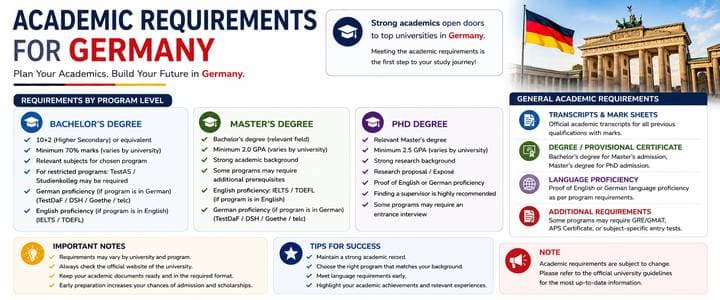
Understanding the academic requirements for Germany is one of the most important steps before applying to a German university.
Germany does not have one universal admission standard for every university or degree. Requirements can vary based on:
Degree level
Country of previous education
School-leaving qualification
Bachelor’s degree
University recognition
Previous subject
Academic credits
GPA
Language of instruction
Individual university rules
A student may satisfy the general requirements to study in Germany but still be ineligible for a particular degree program.
This is especially important for Master’s admissions, where universities often evaluate not only the degree title but also the subjects and credits completed during the Bachelor’s program.
International applicants should therefore check academic eligibility before paying application fees or preparing documents.
Academic Requirements for Germany at a Glance
| Degree | Main Academic Requirement |
|---|---|
| Bachelor’s | Recognized higher education entrance qualification |
| Studienkolleg | School qualification that does not provide direct university admission |
| Master’s | Recognized relevant Bachelor’s degree |
| MBA | Bachelor’s degree; many programs also require work experience |
| PhD | Relevant Master’s or equivalent advanced degree in most cases |
| Medicine | Recognized university entrance qualification plus highly competitive subject requirements |
| Engineering | Appropriate academic qualification and relevant subject background |
| Indian Bachelor’s Applicant | Class 12 eligibility rules + APS |
| Indian Master’s Applicant | Recognized Bachelor’s + APS; dMAT may apply to selected fields |
The Most Important Requirement: Academic Recognition
The first question is not:
“What percentage do I need?”
It is:
“Is my previous qualification recognized for the degree I want to study?”
For undergraduate applicants, Germany evaluates whether the school qualification provides a Higher Education Entrance Qualification, commonly known as:
Hochschulzugangsberechtigung — HZB
Your HZB determines whether you can:
Enter university directly
Enter only certain subject areas
Attend Studienkolleg first
Require additional previous university study
The final admission decision belongs to the university.
Academic Requirements for Bachelor’s in Germany
International Bachelor’s applicants generally need a recognized school-leaving qualification comparable to the German university entrance qualification.
Depending on the country and education system, the result may be:
Direct General Admission
You may apply to programs across broad subject areas.
Direct Subject-Restricted Admission
You may apply only to subjects related to your previous academic preparation.
Studienkolleg Eligibility
You must first complete a preparatory course and pass the Feststellungsprüfung.
Is Class 12 Enough to Study in Germany?
Not necessarily.
Having completed 12 years of schooling does not automatically guarantee direct Bachelor’s admission to Germany.
Eligibility depends on:
Country
School board
Subjects studied
Grades
Entrance examinations
Previous university study
Recognition rules
Some international qualifications provide direct admission.
Others require Studienkolleg or additional university study.
Academic Requirements for Indian Students After Class 12
Indian applicants should pay particular attention to the updated undergraduate eligibility criteria.
For admissions beginning with Winter Semester 2026/27, the updated evaluation criteria introduce a minimum overall score of:
70% of the maximum achievable marks in Class 12
for the relevant admission pathways.
Route 1: Class 12 + APS
An applicant with:
Indian Class 12 qualification
At least 70% overall
APS Certificate
may qualify for subject-restricted admission through Studienkolleg, subject to the applicable evaluation rules.
Route 2: Class 12 + APS + One Successful Bachelor’s Year
Applicants who have:
At least 70% in Class 12
APS Certificate
One successfully completed academic year in a recognized Bachelor’s program
may qualify for direct subject-restricted admission to their previous academic field or closely related subjects.
One year of university study does not automatically guarantee admission.
The field of study and other university requirements still matter.
What Does Subject-Restricted Admission Mean?
Subject-restricted admission means you cannot necessarily switch into any subject.
For example, a student who completed one successful university year in Engineering may be eligible primarily for:
Engineering
Closely related technical subjects
rather than an unrelated program such as Literature or History.
The exact decision depends on the evaluation of previous education.
What Is Studienkolleg?
Studienkolleg is a preparatory academic program for students whose school qualification does not provide direct entry to a German university.
It usually prepares students for the:
Feststellungsprüfung — FSP
Passing the FSP allows students to apply to relevant university programs.
Studienkolleg Academic Tracks
Common tracks include:
T-Kurs
For subjects such as:
Engineering
Computer Science
Mathematics
Physics
Technical subjects
M-Kurs
For:
Medicine
Biology
Pharmacy
Health-related sciences
W-Kurs
For:
Economics
Business
Management
Social Sciences
G-Kurs
For:
Humanities
S-Kurs
For:
Languages
The available track depends on the subject you intend to study.
German Requirements for Studienkolleg
Studienkolleg is usually taught in German.
Students commonly need German proficiency around:
B1–B2
depending on the institution.
Some Studienkollegs require higher levels.
Applicants may also have to pass an entrance examination.
What Subjects Matter for Bachelor’s Admission?
Your school subjects can influence eligibility.
Examples:
Engineering
Relevant preparation commonly includes:
Mathematics
Physics
Computer Science
Useful academic preparation includes:
Mathematics
Computer Science
Physics
Medicine
Strong preparation in:
Biology
Chemistry
Physics
is particularly relevant.
Economics
Useful subjects include:
Mathematics
Economics
Business
Individual universities can impose additional requirements.
Percentage Required to Study in Germany
There is no single Germany-wide percentage requirement.
Admission can depend on:
Qualification recognition
University
Program
Competition
Applicant pool
For Indian undergraduate pathways affected by the 2026 criteria, the Class 12 benchmark is now 70%.
For other nationalities and degree levels, the requirements differ.
Is 60% Enough to Study in Germany?
Possibly for some programs and applicant categories, but there is no universal rule.
For Indian students seeking the undergraduate pathways governed by the new Winter 2026/27 criteria, 60% in Class 12 would not meet the new 70% benchmark.
Master’s applicants are evaluated differently based on their Bachelor’s degree.
Is 70% Enough?
Meeting a minimum academic requirement only establishes eligibility.
It does not guarantee admission.
A competitive program may receive applications from candidates with much stronger academic profiles.
Is 80% Enough?
An 80% academic record can be competitive for many applications, but admission still depends on:
Degree recognition
Subject compatibility
Required modules
Language proficiency
Program competition
Percentage alone cannot predict admission.
Academic Requirements for Master’s in Germany
Master’s admission is more program-specific than Bachelor’s admission.
Applicants generally need:
A recognized Bachelor’s degree
A relevant academic discipline
Required academic credits
Sufficient grades
Required language proficiency
Some programs additionally require:
GRE
GMAT
Work experience
Portfolio
Motivation letter
Recommendations
Entrance test
Is Any Bachelor’s Degree Accepted for a German Master’s?
No.
Germany frequently follows a consecutive Master’s model.
This means the Master’s program is expected to build on previous Bachelor’s education.
For example:
BTech Mechanical Engineering → MSc Mechanical Engineering
is a natural progression.
But:
BA English → MSc Mechanical Engineering
would generally not meet the academic subject requirements.
Degree Title Is Not Enough
Two students may both have degrees called:
Bachelor of Computer Science
but their curricula can differ significantly.
A German university may evaluate:
Programming
Algorithms
Mathematics
Databases
Theoretical Computer Science
Software Engineering
A degree title alone does not prove sufficient subject preparation.
ECTS Requirements
European universities often describe academic requirements using:
ECTS — European Credit Transfer and Accumulation System
A Master’s program might require previous study in areas such as:
20 ECTS Mathematics
15 ECTS Programming
10 ECTS Statistics
20 ECTS Economics
International transcripts may use another credit system.
The university evaluates whether the previous coursework is equivalent.
Example: MSc Computer Science Requirements
A program may require previous coursework in:
Algorithms
Data Structures
Programming
Operating Systems
Databases
Mathematics
Theoretical Computer Science
A candidate with a related degree but insufficient mathematics or theoretical CS credits may still be rejected.
Example: MSc Data Science Requirements
Typical academic preparation can include:
Mathematics
Linear Algebra
Calculus
Probability
Statistics
Programming
Algorithms
Databases
A student who has only completed short online courses in Data Science may not satisfy formal academic requirements.
Example: Mechanical Engineering
Relevant prerequisites may include:
Engineering Mathematics
Mechanics
Thermodynamics
Fluid Mechanics
Materials
Manufacturing
Machine Design
Example: Electrical Engineering
Possible prerequisites:
Circuit Theory
Electronics
Mathematics
Signals
Control Systems
Embedded Systems
Communications
Example: Business Analytics
Programs can require:
Statistics
Economics
Business
Mathematics
Programming
Quantitative methods
Applicants from purely qualitative backgrounds may lack sufficient quantitative credits.
Bachelor’s Degree Duration for Master’s Admission
Many German Master’s programs expect a Bachelor’s qualification equivalent to:
180 ECTS
or more.
A typical European three-year Bachelor’s degree represents 180 ECTS.
Some Master’s programs may expect:
180 ECTS
210 ECTS
Specific additional academic credits
Applicants with fewer equivalent credits may face additional conditions.
Three-Year Bachelor’s Degree from India
A three-year Indian Bachelor’s degree can be accepted by many German universities when:
The institution is recognized
The degree itself is recognized
The subject fits the Master’s program
Program-specific requirements are met
However, acceptance is not universal.
Always verify the specific program.
Four-Year Bachelor’s Degree
Four-year degrees such as:
BTech
BE
Some professional Bachelor’s degrees
are commonly suitable for German Master’s applications when subject requirements are met.
Again, degree length alone does not guarantee eligibility.
GPA Requirements for Master’s in Germany
There is no universal German GPA requirement.
Programs may specify:
German grade 2.5 or better
German grade 2.0 or better
Specific percentage
Minimum GPA
No published minimum
Highly competitive programs may admit applicants substantially above the minimum.
Understanding the German Grading System
A common German university grading system is:
| German Grade | General Interpretation |
|---|---|
| 1.0–1.5 | Very Good |
| 1.6–2.5 | Good |
| 2.6–3.5 | Satisfactory |
| 3.6–4.0 | Sufficient/Pass |
| Above 4.0 | Usually Fail |
Foreign grades may be converted for admissions purposes.
Do not rely entirely on unofficial online GPA calculators.
Does CGPA Matter?
Yes, but it is only one factor.
A strong GPA cannot always compensate for missing academic prerequisites.
Example:
Applicant A:
Very high GPA
Insufficient Mathematics credits
Applicant B:
Slightly lower GPA
Full required Mathematics and CS credits
Applicant B may be academically better matched to the program.
Academic Requirements for Indian Master’s Applicants
Indian applicants normally need:
Recognized Bachelor’s qualification
Required academic subjects
Appropriate grades
APS Certificate
Required language qualification
Selected applicants may additionally need dMAT.
dMAT Requirement for Indian Master’s Applicants
The Digital Master Test (dMAT) was introduced as an additional element of APS documentation for selected Indian Master’s applicants.
It currently affects previous degrees in:
Engineering
Commerce
Accounting
Finance
Economics
Business
Management
The requirement applies to relevant applicants for:
Summer Semester 2027 and later Master’s intakes
subject to the applicable exemptions.
Does dMAT Replace Academic Eligibility?
No.
dMAT does not replace:
Bachelor’s degree
Required academic credits
GPA
University eligibility
APS verification
It is an additional part of the APS procedure for selected applicants.
APS Academic Requirement
APS verifies academic documentation issued by Indian educational institutions.
It confirms the authenticity and formal plausibility of the qualification.
APS is not:
University admission
Qualification recognition by itself
Guarantee of eligibility
Visa approval
A valid APS Certificate does not guarantee that a German university will consider your previous coursework sufficient.
Language Academic Requirements
Language requirements form part of academic admission.
The required test depends on the teaching language.
English-Taught Programs
Commonly accepted qualifications can include:
IELTS
TOEFL
Cambridge English
Other university-approved certificates
There is no universal IELTS score.
A university might require:
IELTS 6.0
IELTS 6.5
IELTS 7.0
depending on the course.
Is IELTS Mandatory?
Not always.
Some universities may accept:
TOEFL
Cambridge English
Other recognized tests
Medium of Instruction evidence
However, MOI is not universally accepted.
German-Taught Programs
Common accepted qualifications can include:
TestDaF
DSH
telc Deutsch C1 Hochschule
Goethe certificates
Other approved qualifications
German-taught university programs often require approximately:
B2–C1 level
depending on the institution.
TestDaF
A common university benchmark is achieving the required level across the TestDaF components.
Exact requirements are university-specific.
DSH
Many programs require:
DSH-2
although requirements can vary.
Academic Requirements for MBA in Germany
MBA programs differ from conventional academic Master’s degrees.
Typical requirements can include:
Recognized Bachelor’s degree
Professional work experience
English proficiency
GMAT/GRE in some cases
CV
Essays
Interview
Many MBA programs expect:
2–5 years of professional experience
although requirements vary significantly.
Academic Requirements for PhD in Germany
Doctoral admission typically requires:
Relevant Master’s degree or equivalent
Strong academic record
Research suitability
Research proposal in many cases
Supervisor acceptance for individual doctorates
Structured doctoral programs may also require:
Research statement
Recommendations
English/German proficiency
Interview
Is a Master’s Mandatory for a PhD?
Usually, but not universally.
Some institutions offer exceptional fast-track doctoral routes for outstanding Bachelor’s graduates.
These routes are comparatively uncommon and subject to strict requirements.
Academic Requirements for Medicine
Medicine in Germany is highly competitive.
International students generally need:
Recognized university entrance qualification
Excellent academic record
Strong German proficiency
Relevant application route
Medicine is predominantly taught in German.
Students should not confuse English-taught:
Biomedical Sciences
Medical Sciences
Public Health
with the German medical qualification required to become a physician.
Academic Requirements for Engineering
Engineering programs commonly evaluate:
Mathematics
Physics
Engineering fundamentals
Relevant Bachelor’s curriculum for Master’s applications
Popular fields include:
Mechanical Engineering
Electrical Engineering
Civil Engineering
Automotive Engineering
Mechatronics
Industrial Engineering
Academic Requirements for Computer Science
Bachelor’s programs usually require appropriate university entrance eligibility and strong mathematics preparation.
Master’s programs commonly expect previous university coursework in:
Programming
Algorithms
Data Structures
Mathematics
Theoretical Computer Science
Software Systems
Academic Requirements for Business Programs
Depending on the degree, applicants may need previous study in:
Business
Economics
Finance
Accounting
Statistics
Mathematics
Some management Master’s programs accept students from broader disciplines.
Others require a business-related Bachelor’s.
Academic Requirements for Architecture
Applicants may need:
Recognized academic qualification
Relevant previous architecture/design education
Portfolio
Specific design coursework
At Master’s level, a relevant Bachelor’s in Architecture is commonly expected.
Academic Requirements for Arts and Design
Creative programs often assess:
Portfolio
Artistic aptitude
Entrance test
Interview
Academic grades can be less dominant than in conventional academic programs.
Can Backlogs Affect Admission?
They can.
Universities can examine:
Final degree
Transcript
Number of attempts
GPA
However, Germany does not have one universal backlog limit.
Some programs may not care about backlog count once the degree is completed.
Others may evaluate the full academic record.
Can You Apply With an Incomplete Bachelor’s Degree?
Many German Master’s programs allow students to apply during the final stages of their Bachelor’s.
The university may require:
Minimum completed credits
Current transcript
Expected graduation date
Final degree documentation may then be required before enrollment.
Other programs require the Bachelor’s to be fully completed before the deadline.
Can You Change Your Field for a Master’s?
Sometimes, but major changes can be difficult.
German Master’s programs often expect academic continuity.
Examples:
Easier Transition
Mechanical Engineering → Automotive Engineering
Computer Science → Artificial Intelligence
Economics → Finance
More Difficult Transition
English Literature → Computer Science
Commerce → Mechanical Engineering
Electrical Engineering → Clinical Psychology
Interdisciplinary degrees can provide more flexibility.
University Recognition
Your previous university may need to be recognized.
Recognition can be checked through Germany’s academic recognition systems.
For international qualifications, factors can include:
Institution status
Qualification level
Mode of study
Program recognition
Applicants with degrees from unrecognized institutions may face problems.
Distance and Online Degrees
Recognition of distance or online degrees should be checked carefully.
Acceptance depends on:
University recognition
Program recognition
Mode of study
Degree field
Applicable German recognition rules
Do not assume an online or distance degree is automatically accepted.
Documents Used to Verify Academic Requirements
Applicants may need:
School certificates
Class 10 documents
Class 12 documents
Bachelor’s degree
Semester marksheets
Transcript
Master’s degree
Grading scale
Module descriptions
APS certificate
Language test certificate
Entrance examination result
Some universities may also request certified translations.
Why Module Descriptions Matter
Master’s applicants should keep official course descriptions or syllabi available.
Suppose a university requires:
20 credits in Mathematics
Your transcript may simply list:
Engineering Mathematics I
Mathematics II
Numerical Methods
The university may need detailed module descriptions to understand whether these subjects satisfy its requirements.
Academic Eligibility vs Admission
These are different concepts.
Eligibility
You meet the minimum formal requirements.
Admission
The university decides to offer you a place.
A student can be academically eligible and still be rejected because:
Seats are limited
Other candidates have stronger grades
Ranking-based selection applies
Interview performance is weak
Subject compatibility is not strong enough
Restricted vs Unrestricted Admission
German programs may be:
Admission Restricted
Places are limited.
Selection can depend on:
Grades
Ranking
Tests
Interviews
Admission Unrestricted
Applicants who meet the academic requirements may have a better chance of receiving a place.
However, all formal requirements still need to be met.
What Is Numerus Clausus?
Numerus Clausus, commonly called:
NC
refers to admission restrictions when demand exceeds available capacity.
NC should not always be understood as one permanently fixed grade.
The effective admission threshold can vary between semesters.
Common Academic Rejection Reasons
Qualification Not Recognized
Previous education does not provide required eligibility.
Wrong Subject Background
Previous degree does not sufficiently match the Master’s.
Missing Academic Credits
Applicant lacks required modules.
Low GPA
Academic performance does not meet the minimum or competitive level.
Incomplete Degree
Program requires a completed degree before application.
Missing APS
Applicable Indian applicant did not provide APS documentation.
Language Requirement Not Met
IELTS, TOEFL, TestDaF, or other requirement is insufficient.
Studienkolleg Needed
Applicant incorrectly applied for direct Bachelor’s admission.
Missing Module Descriptions
University cannot verify subject prerequisites.
How to Check Your Academic Eligibility
Use this order:
Step 1
Determine the degree you want.
Step 2
Check recognition of your previous qualification.
Step 3
Read the exact university program requirements.
Step 4
Compare your transcript with required subjects.
Step 5
Check GPA requirements.
Step 6
Check language requirements.
Step 7
Check APS or additional requirements.
Step 8
Apply only after confirming reasonable academic compatibility.
Master’s Academic Compatibility Checklist
Before applying, ask:
Is my Bachelor’s recognized?
Is my Bachelor’s field relevant?
Do I have required mathematics credits?
Do I have required technical/business credits?
Does my GPA meet the threshold?
Do I meet language requirements?
Do I need GRE/GMAT?
Do I need APS?
Does dMAT apply?
Do I need module descriptions?
Bachelor’s Academic Compatibility Checklist
Check:
Is my school qualification recognized?
Do I qualify for direct admission?
Is admission subject restricted?
Do I require Studienkolleg?
Do my subjects match the intended program?
Do I meet the language requirement?
Do I need APS?
Do I meet the current Class 12 threshold?
Frequently Asked Questions
What are the academic requirements to study in Germany?
Students need a recognized academic qualification appropriate for their intended degree and must meet the university’s subject, grade, and language requirements.
What percentage is required for Germany?
There is no universal percentage. Requirements depend on the university and program.
What percentage do Indian students need after Class 12?
For relevant undergraduate pathways beginning with Winter Semester 2026/27, the updated benchmark is 70% overall in Class 12.
Is 12th enough to study in Germany?
Not always. Some applicants need Studienkolleg or prior university study.
Is Studienkolleg mandatory?
Only when your previous education does not provide direct admission.
Can Indian students enter Germany after one year of college?
Under the applicable eligibility pathway, Class 12 + APS + one successful Bachelor’s year may lead to direct subject-restricted admission when the other requirements are satisfied.
What is required for a Master’s in Germany?
A recognized relevant Bachelor’s degree, required academic credits, suitable grades, and language proficiency are typically required.
Is a three-year Bachelor’s accepted?
Many German universities accept recognized three-year degrees, but the exact program requirements must be checked.
Does Germany require 16 years of education?
Not universally. Eligibility depends on qualification recognition and the specific degree program rather than one universal “16-year” rule.
Is CGPA important?
Yes, but subject-credit requirements can be equally important.
Can I study a different subject for my Master’s?
Minor or related transitions may be possible. Major subject changes can be difficult because many German Master’s programs require a relevant previous degree.
Is APS an academic qualification?
No. APS verifies relevant academic documentation.
Does dMAT replace the Bachelor’s requirement?
No.
Is IELTS an academic requirement?
For many English-taught programs, an approved English-language qualification is required.
Can MOI replace IELTS?
Some universities accept it, while others do not.
Do I need German for an English-taught program?
German may not be required for admission when the program is completely English-taught, though learning German remains useful.
Can I apply in my final Bachelor’s semester?
Some universities permit this, while others require the completed degree.
Do backlogs prevent admission?
Not automatically. Requirements vary between universities.
Do German universities accept distance degrees?
Some may be recognized depending on the institution, qualification, mode of study, and field. Recognition should be checked carefully.
Final Verdict
Academic eligibility for Germany cannot be reduced to one percentage or GPA.
For Bachelor’s applicants, the key question is:
Does your school qualification provide university entrance eligibility, or do you need Studienkolleg?
For Master’s applicants, the central question is:
Does your Bachelor’s degree contain the academic subjects and credits required by the chosen Master’s program?
For Indian applicants, additional considerations include:
APS verification
The new 70% Class 12 benchmark for relevant undergraduate pathways from Winter Semester 2026/27
dMAT for selected Master’s applicant groups from Summer Semester 2027 onward
The safest application strategy is:
Recognition → Subject compatibility → Required credits → GPA → Language → Additional requirements → Application
Students who check these requirements carefully before applying can avoid many unnecessary rejections and application fees.