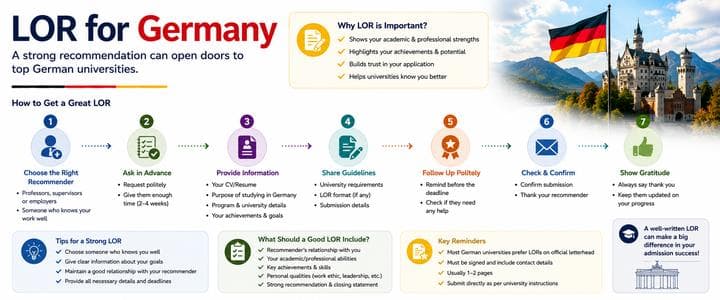
A Letter of Recommendation (LOR) for Germany is a supporting document written by a professor, academic supervisor, employer, or another qualified referee who can evaluate an applicant’s abilities and suitability for a university program.
Unlike a Statement of Purpose or Letter of Motivation, an LOR should not primarily be written from the student’s perspective.
It provides an independent assessment of qualities such as:
Academic ability
Subject knowledge
Research potential
Technical skills
Professional performance
Analytical thinking
Communication
Teamwork
Leadership
Motivation for further study
German universities do not universally require recommendation letters. Some programs ask for one or two LORs, while others do not request them at all.
Where an LOR is required, the strength of the recommendation depends less on the recommender’s job title and more on how well that person knows the applicant and how specifically they can evaluate their work.
LOR for Germany at a Glance
| Factor | Recommended Approach |
|---|---|
| Full Form | Letter of Recommendation |
| Required by Every University? | No |
| Common Number | 1–2 when required |
| Typical Length | Around 1 page |
| Best Recommender for Master’s | Relevant professor or academic supervisor |
| Best Recommender for MBA | Manager or professional supervisor |
| Best Recommender for PhD | Research supervisor or professor |
| Should Student Write It? | Ideally no |
| University Letterhead | Recommended where available |
| Signature | Usually recommended |
| Official Email | Preferred where university requests direct submission |
| Same LOR Everywhere | Possible only where requirements allow, but customization is stronger |
| Main Requirement | Specific evidence of applicant’s abilities |
What Is an LOR?
LOR stands for:
Letter of Recommendation
It is written by someone who has directly taught, supervised, researched with, or worked with the applicant.
The recommender explains:
How they know the student
How long they have known them
In what capacity they interacted
What the applicant does well
Examples demonstrating those abilities
Why they believe the applicant is prepared for further study
A strong recommendation does not simply say:
“Mr. X is hardworking and sincere.”
It explains why the recommender believes this.
Is LOR Mandatory for Germany?
No.
Germany does not have a universal requirement that every international applicant submit recommendation letters.
Some programs may require:
No LOR
One academic LOR
Two academic LORs
One academic and one professional LOR
Two professional references
Online recommendation forms
Requirements depend on the individual university and program.
Students should therefore check the exact application checklist before requesting recommendations.
Which German Programs Commonly Ask for LORs?
Recommendation letters are more commonly found in applications for:
Competitive Master’s programs
MBA programs
Management programs
Research-oriented Master’s degrees
PhD programs
Scholarships
Graduate schools
Specialized international programs
Some highly technical Master’s programs may not require recommendation letters at all and instead place greater weight on academic credits and grades.
Academic LOR vs Professional LOR
There are two major categories.
Academic LOR
Written by someone such as:
Professor
Lecturer
Department head
Thesis supervisor
Research supervisor
Project guide
It focuses on:
Academic performance
Subject knowledge
Research potential
Analytical ability
Projects
Classroom contribution
Professional LOR
Written by:
Manager
Team leader
Supervisor
Senior professional
Employer
It focuses on:
Job performance
Technical ability
Leadership
Problem solving
Professional maturity
Teamwork
Responsibility
Which LOR Is Better for Germany?
The answer depends on the degree.
Bachelor’s Applicant
Academic recommendations are usually more appropriate.
Master’s Applicant
Academic recommendations are generally strongest, particularly for recent graduates.
MBA Applicant
Professional recommendations are often more valuable because MBA programs focus heavily on career and leadership experience.
PhD Applicant
Research-focused academic recommendations are particularly important.
Best Recommender for a Master’s in Germany
For a Master’s application, choose someone who:
Taught you a relevant subject
Supervised your thesis
Guided your major project
Worked with you on research
Knows your academic abilities
Suppose you are applying for an MSc in Artificial Intelligence.
A recommendation from a professor who taught:
Machine Learning
Algorithms
Mathematics
Artificial Intelligence
can be more useful than a recommendation from a senior administrator who barely knows you.
Famous Professor vs Professor Who Knows You
Choose the person who knows your work.
A detailed recommendation from an assistant professor who supervised your project can be much stronger than:
“I recommend this student for higher studies.”
signed by a famous department head who never worked with you.
Specific knowledge creates credibility.
How Many LORs Are Required?
There is no universal requirement.
Programs may ask for:
1 LOR
2 LORs
Occasionally 3 references
Never submit additional letters unless the university permits them.
More recommendations do not automatically strengthen an application.
Ideal LOR Length
When no specific limit is provided, approximately:
400–600 words
or around:
one page
is generally sufficient.
The letter should be detailed enough to provide evidence but concise enough to remain focused.
Recommended LOR Structure
A strong recommendation letter can follow this structure:
Recommender introduction
Relationship with applicant
Academic/professional evaluation
Specific example
Personal/professional qualities
Suitability for the program
Final recommendation
Paragraph 1: Introduce the Recommender
The first paragraph should establish:
Recommender’s position
Institution/company
Relationship with applicant
Duration of relationship
Example:
“I am pleased to recommend [Student Name], whom I have known for three years as a student in the Department of Computer Science at [University]. I taught them courses in Data Structures and Machine Learning and later supervised their final-year project.”
This immediately establishes credibility.
Paragraph 2: Academic Performance
The recommender can discuss:
Performance in relevant courses
Understanding of concepts
Analytical ability
Class participation
Assignments
Technical skills
Avoid unsupported adjectives.
Instead of:
“She is extremely intelligent.”
write:
“She consistently demonstrated an ability to connect theoretical concepts with implementation, particularly during assignments involving algorithm optimization.”
Evidence is stronger.
Paragraph 3: Discuss a Specific Project
The best LORs contain examples.
The recommender could discuss:
Thesis
Research project
Laboratory work
Capstone project
Presentation
Technical assignment
Example:
“During her final-year project on predictive maintenance, she was responsible for preprocessing sensor data and comparing several classification models. What impressed me most was her decision to investigate why model performance changed under different sampling methods rather than simply reporting the highest accuracy.”
This demonstrates intellectual curiosity.
Paragraph 4: Personal Qualities
Relevant qualities can include:
Independence
Curiosity
Communication
Teamwork
Discipline
Initiative
Leadership
Persistence
Again, use examples.
Weak Statement
“He has excellent leadership skills.”
Stronger Statement
“While working on a four-member project team, he coordinated task allocation and regularly organized technical discussions when the team encountered difficulties integrating different system components.”
Paragraph 5: Suitability for Graduate Study
The recommender should explain why the applicant is prepared for the chosen level of study.
For example:
“Based on her strong quantitative background, independent approach to technical problems, and interest in data-driven systems, I believe she is well prepared for graduate study in Data Science.”
Paragraph 6: Final Recommendation
The letter should conclude clearly.
For example:
“I recommend [Name] for admission to your Master’s program with confidence. I believe the analytical discipline and curiosity demonstrated during their undergraduate work will allow them to contribute positively to a demanding graduate environment.”
What Makes a Strong LOR?
A strong recommendation contains:
Relationship + Evidence + Comparison + Program Fit
Relationship
How does the recommender know you?
Evidence
What specific work did they observe?
Comparison
How do you compare with other students or employees?
Program Fit
Why are you prepared for advanced study?
Using Comparative Statements
Comparative evaluation can strengthen an LOR when genuinely supportable.
Examples:
“She ranked among the strongest students I taught in the course.”
or:
“Among the undergraduate projects I supervised that year, his work demonstrated particularly strong analytical independence.”
Avoid fake claims such as:
“Top 1% student”
unless the recommender can genuinely support them.
Academic LOR Format
A typical academic recommendation can contain:
Date
To the Admissions Committee
Opening paragraph establishing the recommender relationship.
Academic evaluation.
Specific project or research example.
Skills and personal qualities.
Suitability for graduate education.
Final recommendation.
Sincerely
Recommender name
Designation
Department
Institution
Official email
Contact information
Does an LOR Need University Letterhead?
Where possible, an academic recommendation should be provided on official institutional letterhead.
Similarly, professional recommendations can use company letterhead.
However, universities increasingly use online recommendation systems where the recommender submits the letter directly.
In such cases, separate letterhead requirements may differ.
Follow the program instructions.
Does an LOR Need a Signature?
A signed recommendation is generally preferable when the letter is uploaded as a document.
Some universities may specifically require:
Signature
Official letterhead
Date
Contact information
When the recommendation is submitted directly through an online portal, the system itself may authenticate the recommender.
Does It Need an Official Email Address?
Where universities request the recommender’s email address, an institutional email is preferable.
Examples:
or
rather than a generic personal email.
An official address can make the relationship easier to verify.
How Are LORs Submitted?
German universities may use several methods.
Applicant Upload
The recommender gives the signed letter to the student, who uploads it.
Recommender Upload
The university emails the recommender a private submission link.
The applicant usually cannot view or upload the recommendation.
Online Questionnaire
Instead of a traditional letter, the recommender answers questions and provides ratings.
Email Submission
Some programs may request recommendations sent directly from the recommender.
Follow the exact procedure.
Confidential LOR
Some universities prefer confidential recommendations.
This means the student may waive the right to read the letter.
Confidential recommendations can carry more credibility because the recommender submits their assessment directly.
Never pressure a recommender to provide a positive letter if they are uncomfortable doing so.
When Should You Ask for an LOR?
Request recommendations approximately:
4–8 weeks before the application deadline
when possible.
Professors can be extremely busy, especially near:
Examinations
Semester endings
Research deadlines
Holidays
Asking one day before the deadline is risky.
What Should You Give Your Recommender?
Make the process easier by providing:
CV
Transcript
SOP or motivation letter draft
Program name
University name
Deadline
Project details
Relevant achievements
Submission instructions
You can also remind them which courses or projects you completed under their supervision.
Should You Give the Recommender a Draft?
This depends on local practice.
Ideally, the recommender should write the recommendation independently.
However, some professors may ask students to provide:
Bullet points
Project details
Achievement summary
Initial draft
If this happens, provide accurate information and allow the recommender to revise the letter in their own voice.
Do not fabricate praise or achievements.
Can the Student Write Their Own LOR?
Ideally, no.
A recommendation is supposed to represent the referee’s independent assessment.
A letter written entirely by the student often sounds suspiciously similar to:
SOP
Motivation letter
Other recommendation letters
When a professor asks for a draft, the safest approach is to prepare factual points rather than exaggerated praise.
Two LORs Should Not Sound Identical
Suppose you need two recommendations.
One professor might focus on:
Academic performance
Machine learning project
Mathematical ability
Another could discuss:
Thesis research
Independent learning
Teamwork
Presentation skills
If both letters contain exactly the same wording and examples, they appear artificial.
LOR for Master’s in Germany
A Master’s recommendation should focus on:
Relevant undergraduate courses
Academic strength
Project work
Research potential
Technical skills
Ability to handle graduate-level study
Example Master’s LOR Focus
For MSc Computer Science:
Algorithms
Mathematics
Programming
AI
Final project
Research capability
For MSc Mechanical Engineering:
Mechanics
Manufacturing
CAD
Simulation
Laboratory work
Engineering projects
LOR for MBA in Germany
MBA recommendations are usually more professionally oriented.
A manager may discuss:
Leadership
Decision-making
Career progression
Responsibility
Communication
Business impact
Use measurable evidence when possible.
Example:
“She coordinated a five-member project team and helped reduce reporting delays by redesigning the team's workflow.”
This is stronger than:
“She is an excellent employee.”
LOR for PhD in Germany
A doctoral recommendation should be more research-focused.
Useful areas include:
Research ability
Scientific thinking
Methodology
Independent work
Thesis performance
Publications
Academic writing
Persistence
Research potential
For PhD applicants, the recommender's ability to evaluate research potential is particularly important.
LOR for Scholarship Applications
Scholarship recommendations can additionally discuss:
Academic excellence
Leadership
Social contribution
Responsibility
Future potential
Community involvement
A scholarship LOR should be customized where possible rather than simply recycling a university admission recommendation.
Sample LOR for Germany
The following example is intended to demonstrate structure and should not be copied word for word.
Sample Academic LOR for MSc Computer Science
To the Admissions Committee,
I am pleased to recommend Mr./Ms. [Student Name] for admission to the Master’s program in Computer Science at your university. I have known [Student Name] for approximately three years as a student in the Department of Computer Science at [University Name]. I taught [him/her/them] in Data Structures and Machine Learning and subsequently supervised [his/her/their] final-year project.
During my interactions with [Student Name], I found [him/her/them] to be a disciplined and analytically capable student. In my Machine Learning course, [Student Name] demonstrated a strong understanding of both the mathematical foundations and practical implementation of classification and regression techniques. Rather than treating assignments simply as programming exercises, [he/she/they] regularly attempted to understand why particular methods produced different results.
I had the opportunity to observe these qualities more closely while supervising [Student Name]'s final-year project on predictive maintenance using sensor data. [His/Her/Their] responsibilities included data preprocessing, feature selection, model comparison and performance evaluation. One of the strongest aspects of the project was [his/her/their] willingness to investigate inconsistent results instead of selecting the model with the highest initial accuracy. This demonstrated the analytical discipline and curiosity required for advanced academic work.
[Student Name] also worked effectively within a team. [He/She/They] communicated technical ideas clearly, accepted feedback constructively and remained consistent in meeting project milestones. During project discussions, [he/she/they] frequently raised questions that demonstrated an ability to connect theoretical concepts learned in class with practical implementation challenges.
Based on my experience teaching and supervising [Student Name], I believe [he/she/they] possesses the academic preparation, technical ability and motivation required for graduate study in Computer Science. [His/Her/Their] interest in intelligent systems and advanced computing represents a logical continuation of the work [he/she/they] completed during undergraduate study.
I am therefore pleased to recommend [Student Name] for admission to your Master’s program. I am confident that [he/she/they] will approach graduate study with the same curiosity, discipline and willingness to learn that [he/she/they] demonstrated throughout [his/her/their] undergraduate education.
Sincerely,
[Professor Name]
[Designation]
[Department]
[University Name]
[Official Email]
[Contact Information]
Professional LOR Sample Structure
For working professionals, the letter may use this structure:
Opening
How long the manager has supervised the applicant.
Role
Applicant's responsibilities.
Achievement
Specific professional example.
Qualities
Leadership, analytical ability, communication, initiative.
Graduate Suitability
Why additional education makes sense.
Recommendation
Clear endorsement.
Example Professional LOR Paragraph
“I supervised [Applicant Name] for two years while [he/she/they] worked as a Business Analyst in our operations team. During this period, [Applicant Name] was responsible for analyzing sales and inventory information across multiple business units. One particularly valuable contribution involved redesigning a reporting workflow that reduced manual reconciliation and improved the team's ability to identify inventory discrepancies.”
Specific examples make the letter believable.
LOR for Freshers
Students without professional experience should not worry.
Academic recommendations are usually more appropriate.
Choose professors who know your:
Coursework
Academic performance
Projects
Thesis
Laboratory work
LOR After Several Years of Work Experience
Applicants who graduated several years ago may have difficulty obtaining academic recommendations.
If the program permits professional references, choose:
Current manager
Previous manager
Project supervisor
Senior colleague with direct supervisory responsibility
Avoid recommendations from friends or family members.
Can HOD Write an LOR?
Yes, especially when the Head of Department directly knows your academic work.
However, an HOD recommendation is not automatically stronger.
A professor who taught and supervised you may provide a more detailed assessment.
Can Principal or Dean Write an LOR?
Technically yes when permitted.
But again, personal knowledge matters.
A recommendation from someone highly senior who cannot describe your academic ability provides limited value.
Can an Assistant Professor Write an LOR?
Yes.
The recommender's academic rank is usually less important than whether they can credibly discuss your work.
Can an Employer Write an LOR?
Yes, particularly for:
MBA
Management
Professional Master’s
Applicants with significant work experience
Check whether the university requests academic or professional recommendations.
Can a Colleague Write an LOR?
Usually a direct supervisor is preferable.
Peer recommendations are less persuasive unless explicitly permitted.
Can a Family Friend Write an LOR?
No.
Recommendation letters should come from someone who can professionally or academically evaluate you.
Should LOR Mention CGPA?
It can, but it is not necessary.
The admissions committee already receives your transcript.
A recommendation is more valuable when it provides information not obvious from your grades.
Should LOR Mention Class Rank?
Yes, when accurate.
Example:
“Among approximately 60 students in the course, she consistently performed within the strongest group.”
This can provide useful context.
Should LOR Mention Weaknesses?
Some recommendation forms specifically ask about weaknesses.
A useful answer should be honest but constructive.
For example:
“Early in the project, he sometimes spent excessive time evaluating alternative approaches. Over time, he improved his ability to balance technical exploration with deadlines.”
This sounds more credible than claiming the applicant has no weaknesses.
Generic LOR Phrases to Avoid
Avoid excessive statements such as:
He is hardworking.
She is sincere.
He is very intelligent.
She is a brilliant student.
He has good communication skills.
These statements need supporting evidence.
Better Approach
Instead of:
“He is hardworking.”
write:
“Despite encountering difficulties during the data-collection stage of his thesis, he independently revised the methodology and completed the experimental work within the project deadline.”
Show rather than tell.
Should LOR Mention Germany?
Usually there is no need to spend much space explaining Germany.
The recommender's task is to evaluate the applicant.
The letter should primarily discuss:
Applicant
Academic abilities
Professional skills
Potential
Should LOR Mention the University Name?
Where possible, yes.
For example:
“I recommend Ms. X for the MSc Data Science program at [University].”
However, when one recommendation is being used for multiple universities, a more general:
“for graduate study in Data Science”
may be practical where permitted.
Customized vs Generic LOR
A customized recommendation is usually stronger.
However, professors may need to support applications to several German universities.
A practical solution is to keep most of the recommendation common while adjusting:
University name
Program
Relevant academic fit
Submission method
Can One LOR Be Used for Multiple German Universities?
Possibly, depending on each university's submission requirements.
Some universities allow uploaded PDF letters.
Others send individual recommendation links to referees.
Always follow the required procedure.
Common LOR Mistakes
Choosing someone who barely knows the applicant
Focusing only on the recommender's seniority
Using generic praise without examples
Copying online templates
Writing all LORs in identical language
Including false achievements
Asking too close to the deadline
Using personal email when official email is available
Missing signature where required
Ignoring university-specific forms
Exceeding requested length
Uploading the letter yourself when confidential submission is required
Sending professional LORs when academic LORs are specifically requested
Submitting outdated contact information
LOR Submission Checklist
Before the deadline, confirm:
Correct recommender selected
Number of recommendations checked
Academic/professional requirement checked
Recommender informed about program
CV shared
SOP/motivation information shared
Deadline shared
Submission instructions shared
Official email used where possible
Online invitation received
Letter submitted
Application portal shows completion
How to Ask a Professor for an LOR
Keep the request respectful and clear.
Tell them:
Which program you are applying to
Why you selected them as recommender
Deadline
Submission process
Do not simply write:
“Sir, send LOR urgently.”
Provide sufficient notice.
What Information Should You Send?
A simple recommender package can include:
| Document | Purpose |
|---|---|
| CV | Overview of profile |
| Transcript | Academic performance |
| SOP | Future academic direction |
| Project Summary | Reminder of supervised work |
| University List | Where recommendations are needed |
| Deadlines | Submission planning |
| Links/Instructions | How recommendation must be submitted |
Frequently Asked Questions
What is an LOR for Germany?
An LOR is a Letter of Recommendation written by a professor, supervisor, or employer evaluating your suitability for university study.
Is LOR compulsory for German universities?
No. Requirements differ between programs.
How many LORs are required?
One or two are common when recommendations are required.
Who should write my LOR?
Someone who directly knows your academic or professional work.
Is a professor better than an employer?
For academic Master’s programs, professors are often preferable. For MBA and professionally oriented programs, employers can be more appropriate.
Can an assistant professor write my LOR?
Yes.
Can my HOD write an LOR?
Yes, especially if they know your work personally.
Can my manager write an LOR?
Yes, when professional recommendations are accepted.
Can a friend write an LOR?
No.
How long should an LOR be?
Around one page is usually sufficient unless the university specifies otherwise.
Does it need letterhead?
Official letterhead is preferable for document-based recommendations where available.
Does it need a signature?
Usually recommended when submitted as a document.
Does the professor need an official email?
An institutional email is preferable when available.
Can I write my own LOR?
Ideally, the recommender should write it. If asked to provide supporting material, provide factual information for them to review.
Can I use the same LOR everywhere?
Possibly where universities allow uploaded letters, but customized recommendations are stronger.
Should I include LOR if the university does not ask for it?
Usually no. Submit only requested or permitted documents.
When should I request an LOR?
Ideally four to eight weeks before the deadline.
Can the professor submit it directly?
Yes. Many universities use direct confidential submission systems.
Can I see my recommendation letter?
This depends on the university and whether the recommendation is confidential.
Does a good LOR guarantee admission?
No. Admission also depends on academic eligibility, grades, prerequisites, language requirements, and competition.
Final Verdict
A strong LOR for Germany should not be a page of generic praise.
It should answer three important questions:
How does the recommender know the applicant?
What evidence demonstrates the applicant's ability?
Why is the applicant ready for the chosen program?
For most Master’s applicants, a professor who taught relevant courses or supervised a project is an excellent choice.
For MBA applicants, a professional supervisor may provide greater value.
For PhD applicants, research-focused recommendations are particularly important.
The strongest formula is:
Relationship → Specific evidence → Academic/professional qualities → Graduate potential → Clear recommendation
A credible, detailed letter from someone who genuinely knows your work is far more valuable than a generic recommendation from the most senior person you can find.