Germany’s Federal Ministry of Research, Technology and Space has presented a draft BAföG reform proposing higher student-support rates, an increased housing allowance and a fully digital application process. The proposal also includes a stricter age limit and reduced housing support for students living with their parents. The changes have not yet become law.
Germany BAföG Reform 2026 Latest Update
The German government is considering significant changes to the Federal Training Assistance Act, commonly known as BAföG. The draft proposes increasing the basic student allowance in two phases between 2027 and 2029.
Students living independently could also receive a higher housing allowance. However, students living with their parents may lose their separate housing support by 2029.
The proposal must still pass through the federal government and legislative process. Therefore, the announced amounts and implementation dates should be treated as proposed changes rather than confirmed entitlements.
Proposed BAföG Reform at a Glance
| Proposed change | Current provision | Proposed provision |
|---|---|---|
| Basic allowance | €475 per month | €503 from August 2027 |
| Second basic-allowance increase | €475 per month | €563 from April 2029 |
| Housing allowance for students living independently | €380 per month | €440 from April 2027 |
| Housing allowance for students living with parents | Existing allowance | €41 from August 2027 and removed from April 2029 |
| Maximum age for starting a funded course | 45, with certain exceptions | Strict age limit of 45 with most exceptions removed |
| Application method | Online and other permitted methods | Mandatory digital application |
| Academic-performance certificate | Generally required after fourth semester | Proposed removal |
| Parental-income exemptions | Periodically adjusted | Annual 1.5% increase from August 2028 |
When Will the New BAföG Rates Start?
The draft proposes introducing the changes in different stages.
| Proposed measure | Expected implementation |
|---|---|
| Housing allowance increased to €440 | April 2027 |
| Basic allowance increased to €503 | August 2027 |
| Housing allowance for students living with parents reduced to €41 | August 2027 |
| Annual increase in parental-income exemptions begins | August 2028 |
| Basic allowance increased to €563 | April 2029 |
| Housing allowance for students living with parents removed | April 2029 |
These dates remain provisional because the proposal has not received final legislative approval.
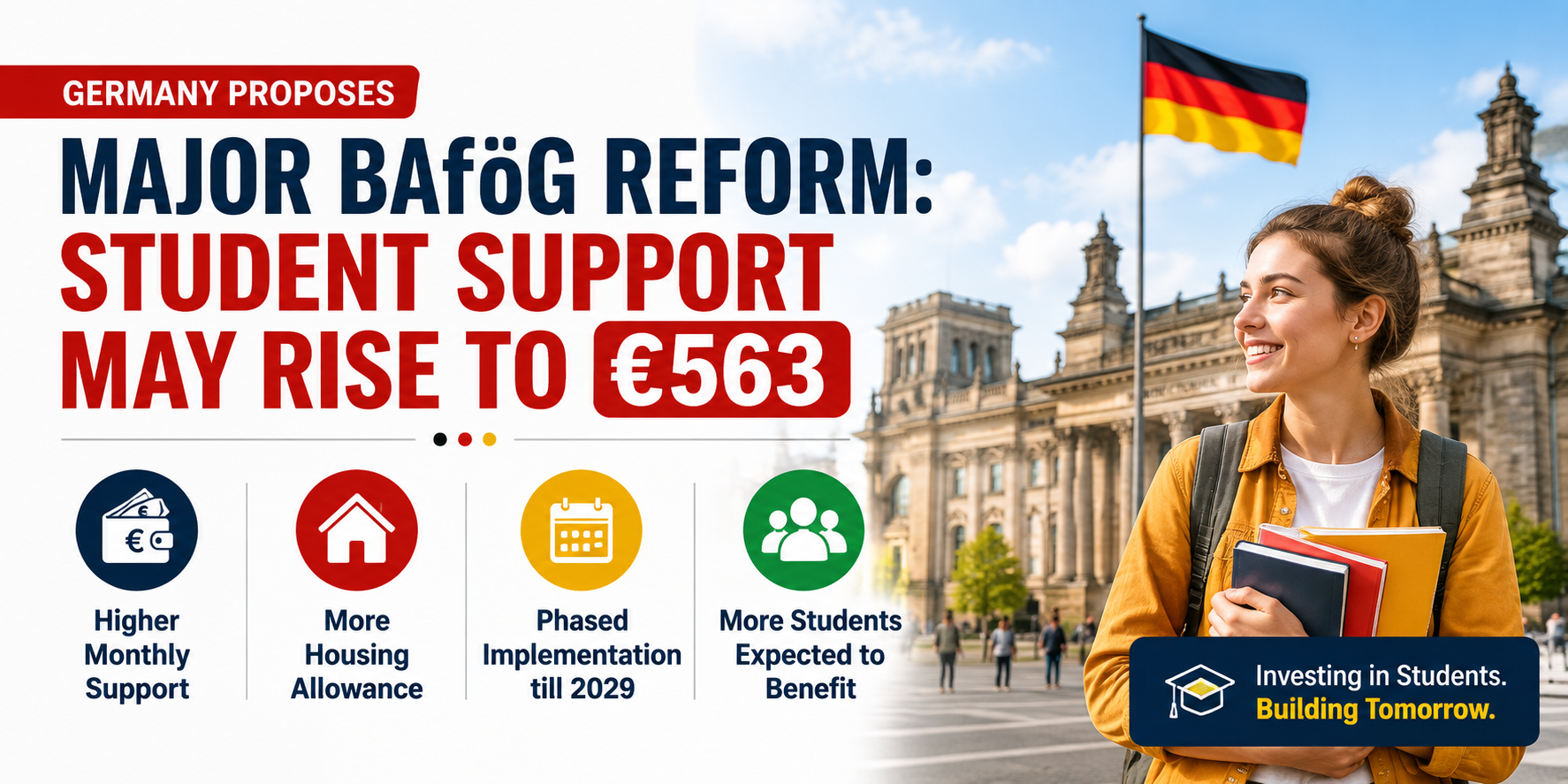
Basic BAföG Allowance May Rise to €563
Under the draft reform, the basic BAföG allowance would increase from the current €475 per month to €503 beginning August 1, 2027.
A second increase would raise the basic allowance to €563 per month from April 1, 2029.
The increase is intended to help students manage higher everyday expenses. However, the total amount a student receives would still depend on factors such as income, parental income, residence, health-insurance status and other applicable BAföG calculations.
The proposed €563 figure represents the basic allowance and should not be confused with the maximum total BAföG payment available after housing and other eligible supplements are added.
Housing Allowance May Increase to €440
Students who do not live with their parents could benefit from a higher housing allowance. The draft proposes increasing this component from €380 to €440 per month from the beginning of the summer semester in April 2027.
This €60 monthly increase is intended to provide additional support to students paying rent for student accommodation, shared apartments or private housing.
Actual rents in major German university cities such as Munich, Berlin, Hamburg, Frankfurt and Heidelberg can be considerably higher than the proposed allowance.
Housing Support for Students Living With Parents May End
The proposal contains a less favorable change for students who continue living in their parents’ home.
Their housing allowance would reportedly be reduced to €41 per month in August 2027. It would then be completely removed from April 2029.
Although these students would receive the proposed increase in the basic allowance, the removal of their housing component means their overall increase could remain comparatively small.
The German Student Services organization and opposition representatives have criticized this part of the proposal, arguing that students living with their parents may also belong to financially vulnerable households.
Stricter BAföG Age Limit Proposed
The draft would introduce a stricter rule for students beginning their education at age 45 or later.
Under the current system, BAföG generally has an age limit of 45, but exceptions can apply in certain circumstances. These may include students who:
Obtained their university entrance qualification through a second educational pathway.
Started higher education later because of personal or family circumstances.
Raised children before beginning their studies.
Entered university based on professional qualifications.
Turned 45 during a bachelor’s degree and immediately continued to a master’s program.
The draft proposes removing most of these exceptions. As a result, students starting an eligible program after reaching 45 may no longer qualify for BAföG.
A transitional provision is proposed for some people who have already reached the age of 43 by January 1, 2028. The precise protection available will depend on the final wording of the enacted legislation.
BAföG Applications May Become Fully Digital
The reform seeks to make digital applications mandatory through the official BAföG Digital platform.
Applicants would complete the application, upload their evidence and communicate digitally with the responsible office. The system is expected to include improved guidance, preliminary selections and completeness checks.
The government expects the change to reduce administrative work and make incomplete applications less common. However, the quality and speed of processing will also depend on the systems and staffing available at local BAföG offices.
Academic-Progress Certificate May Be Removed
Students currently need to provide evidence of satisfactory academic progress, generally after completing the fourth semester, to continue receiving BAföG.
The proposed reform would remove this requirement. If approved, students would no longer need to obtain and submit the existing academic-performance certificate after the fourth semester.
This change could reduce paperwork for students, universities and BAföG offices. Other requirements concerning enrollment, maximum funding periods and notification of changes would still apply.
Parental-Income Exemptions May Increase Annually
BAföG is a means-tested form of financial assistance. The income of a student’s parents is normally included when determining eligibility and the amount awarded, subject to applicable exemptions.
The proposal would increase parental-income exemptions by 1.5% annually beginning August 1, 2028. Raising these exemptions could allow some students from middle-income households to qualify or receive a higher amount.
The actual effect would depend on household income, family circumstances and the final BAföG calculation.
Is the BAföG Reform Approved?
No. The announced changes are contained in a ministerial draft and have not yet become law.
The proposal must proceed through government consideration and the required parliamentary process. Its provisions, implementation dates and financial amounts may be amended before final approval.
The federal cabinet’s consideration of the proposal, initially expected in July, was reportedly postponed until August 2026.
Students should continue following the existing BAföG rules until an amended law is formally approved and enters into force.
What Is BAföG?
BAföG is Germany’s need-based financial assistance program for eligible school and university students.
For higher-education students, the assistance is generally provided as a combination of:
A non-repayable government grant.
An interest-free state loan that must be partially repaid after completing the course.
The amount is calculated according to the applicant’s financial and personal circumstances. Receiving BAföG is not based only on academic merit.
Can International Students Receive BAföG?
Some international students can receive BAföG, but eligibility depends heavily on nationality and residence status.
International students who move to Germany solely for studying and hold an ordinary student residence permit are generally not eligible. Eligibility may apply to certain:
Citizens of the European Union or European Economic Area.
Permanent residents.
Recognized refugees.
Students with specific family or employment connections to Germany.
Individuals holding qualifying residence permits.
Indian and other non-EU students should not assume they can receive BAföG simply because they have secured admission to a German university.
They should ask the responsible Studierendenwerk or BAföG office to assess their residence status before planning their study budget around this support.
Does the Proposal Change Germany’s Blocked-Account Requirement?
No blocked-account change has been announced as part of this BAföG draft.
For 2026, international students may generally need to demonstrate access to at least €11,904 for one year, equivalent to €992 per month, when meeting the financial requirements for a German student visa.
BAföG payments and student-visa financial proof are separate matters. Most non-EU students must establish sufficient funding before receiving their visa and cannot rely on a future BAföG application.
Does the Proposal Introduce Tuition Fees?
No. The BAföG proposal concerns financial assistance for eligible students. It does not introduce a nationwide tuition fee for German universities.
Most public universities in Germany continue to charge semester contributions rather than general tuition fees. Exceptions may apply in certain states, universities and specialized degree programs, particularly for some non-EU students.
How the Proposed Reform Could Affect Students
Students Living Independently
They could benefit from both a higher basic allowance and an increased housing component.
Students Living With Their Parents
They would receive a higher basic allowance but could lose their separate housing support by 2029.
Students From Middle-Income Families
Annual increases in parental-income exemptions could make more students eligible for assistance.
Students Over 45
Later-life learners could face tighter restrictions because most exceptions to the age limit may be removed.
Continuing BAföG Recipients
The removal of the academic-performance certificate could simplify the continuation process after the fourth semester.
International Students
The reform would only help international students who independently satisfy BAföG’s nationality and residence requirements.
What Should Students Do Now?
Students should not change their financial planning based only on the proposed rates.
Current and prospective applicants should:
Continue applying under the existing BAföG rules.
Monitor announcements from the federal government and BAföG Digital.
Submit applications early because processing can take time.
Ask the responsible BAföG office for an individual eligibility assessment.
Avoid assuming that every proposed change will appear unchanged in the final legislation.
Maintain separate financial arrangements for rent, health insurance and living expenses.
Frequently Asked Questions
What is the proposed new BAföG basic allowance?
The draft proposes increasing the basic allowance from €475 to €503 in August 2027 and then to €563 in April 2029.
Will every student receive €563 per month?
No. €563 would be the proposed basic allowance. Actual BAföG eligibility and payment amounts depend on the applicant’s circumstances and other components of the calculation.
What is the proposed housing allowance?
The housing allowance for eligible students living independently may increase from €380 to €440 per month in April 2027.
Will students living with their parents receive a housing allowance?
The draft proposes reducing their allowance to €41 in August 2027 and removing it completely in April 2029.
Has the BAföG reform become law?
No. It remains a draft proposal and could change before receiving final approval.
Can Indian students receive BAföG?
Most Indian students entering Germany solely on a student residence permit are generally not eligible. Eligibility may exist under particular residence, family or employment circumstances.
Is BAföG a scholarship?
BAföG is need-based government assistance rather than a conventional merit scholarship. For university students, it generally combines a grant and an interest-free loan.
Will BAföG applications become online-only?
The draft proposes making applications fully electronic through BAföG Digital.
Does the proposal change German student-visa rules?
No. The BAföG proposal does not itself change student-visa, blocked-account or international-student employment rules.
Official Sources
Federal Ministry draft:
https://www.bmftr.bund.de/SharedDocs/Downloads/DE/gesetze/bafoeg_30_AendG/referentenentwurf/referentenentwurf_bafoeg_30.pdf
BAföG Digital:
https://www.bafoeg-digital.de/