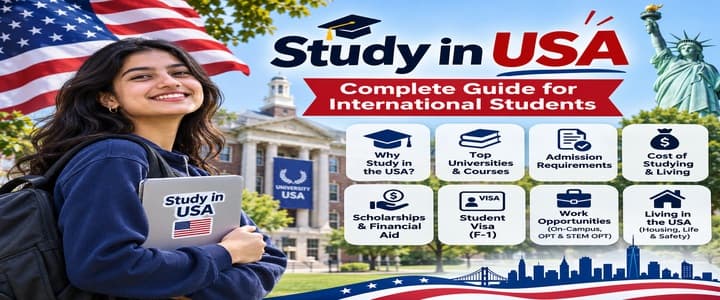
The United States of America (USA) is one of the world’s top destinations for international higher education. The country has the advantage of many colleges and universities, a diversity of academic options, state-of-the-art research facilities, and diverse educational environments that draw students pursuing undergraduate degrees, master’s programs, doctoral research, and professional credentials.
The United States provides many opportunities for acquiring specialized skills, conducting research, experiencing different cultures and making important professional contacts. American universities provide degrees in engineering , computer science , business management , medicine , biotechnology , finance , economics , humanities , social sciences and many other fields .
However, there are many important decisions to be made when preparing to study in the USA as an international student. Scholars need to research suitable universities, understand the academic prerequisites, take required standardized tests, evaluate the costs of education, explore scholarship options, and apply for a student visa.
How much does it cost to get an education in the U.S.? It is contingent upon what school, what major, what location, and what your lifestyle choices are. Some institutions have very low tuition fees, while others require a significant financial outlay. Similarly, the cost of living in large cities can be exponentially higher than that in smaller academic towns.
Immigration Status: International scholars should be familiar with the regulations associated with their immigration status, including enrollment requirements, work limitations, and practical training opportunities.
This complete guide includes all the important things that foreign students should know about their education in USA such as how to choose a university, popular courses, admission procedures, eligibility criteria, tuition fees, scholarships, student visa, accommodation, career opportunities and life after graduation.
1. Study in USA: Key Highlights
Before exploring the admission process, international students should understand the basic structure of higher education in the United States.
Important: Tuition and living-cost figures are broad planning estimates, not official national averages or quotations from individual universities. Actual expenses may fall outside these ranges.
2. Why Study in the USA?
The United States offers a higher education experience that blends academic focus, research opportunities, experiential learning and cultural diversity.
Although studying abroad requires a huge amount of time and money, there are a lot of reasons why American universities are attractive to international applicants.
2.1 Large selection of universities and courses
America has a complex system of higher education with large research universities, small teaching colleges, various technical schools, and community colleges.
Learners will be able to select the educational establishments based on their academic goals, not just on the globally esteemed university titles.
For example, a student who wants to pursue advanced scientific research might choose institutions with specialized labs and doctoral programs. If you are interested in undergraduate education, you might prefer a liberal arts college with small classes.
Likewise, students seeking lower-cost options for education may want to explore community colleges that have transfer agreements with four-year universities.
2.2. Pedagogical Framework of Flexibility
Many American undergraduate programs are flexible in terms of course selection and academic focus.
Students can also meet general education requirements, take elective courses, pursue a minor, or combine courses from various disciplines.
For example, a student studying computer science might study math, economics, entrepreneurship or communications in addition to technical subjects.
However, flexibility varies across institutions and academic programs. Professional degrees can be very structured curricula.
2.3 Research and innovation perspectives
American research universities run laboratories and academic institutions that enable scientific, technological, medical, and social inquiry.
Depending on the institution, students may be involved in faculty-led projects, undergraduate research projects, lab duties, or graduate research assistant positions.
Opportunities for further research are of special interest to graduate students in artificial intelligence, engineering, biotechnology, environmental science, medicine and related fields.
2.4 Career Development
Vocational counseling, job training seminars, internship assistance, professional networking opportunities, and employer recruitment programs may be offered by colleges and universities.
The services assist learners in acquiring practical skills and an understanding of professional standards.
However, career assistance does not guaranty jobs, internships or immigration support.
2.5 Global Exposure
University campuses are often home to students from a wide variety of cultures, languages and academic backgrounds.
Such an environment can help to improve your communication skills, cultural awareness, teamwork and flexibility.
Scholars may participate in global student organizations, cultural celebrations, scholarly societies, service initiatives, and campus activities.
2.6 Instructional programs with a focus
The United States has specialized curricula in aerospace engineering, robotics, financial engineering, public policy, biomedical sciences, cybersecurity, and computational biology.
Students should examine the program content carefully, as institutions offering degrees with similar titles can have very different course requirements.
3. Understanding the USA Education System
The American higher education system differs from those of many countries because academic institutions generally establish their own admission requirements, curriculum structures, and degree policies.
There is no single nationwide application or admission examination required by every American university.
Students normally apply directly to institutions or through application platforms accepted by those institutions.
Types of Higher Education Institutions in the USA
3.1 Public institutions
State governments provide financial support to public universities . The funding varies .
Such institutions typically differentiate between in-state and out-of-state tuition fees.
International students are charged the nonresident tuition rate unless they qualify for an exemption, waiver, or scholarship.
Tuition at some public universities is low, while others charge high rates, especially for specialized graduate and professional programs.
3.2 Private higher education institutions
Private universities are not under the ownership of state government.
They may be not-for-profit or for profit institutions in some cases.
Private nonprofit institutions can offer financial aid, scholarships based on merit, research grants, and special academic programs. But tuition at some private colleges is much higher than at public universities.
They should calculate the final costs after getting scholarships and not believe that all private schools are expensive.
3.3 Community Colleges
Community colleges usually offer two-year associate degree programs, vocational certifications and transfer opportunities to universities.
A student may start their undergraduate studies at a community college and then transfer applicable credits to a four-year university for a bachelor’s degree.
It is often referred to as the 2+2 pathway.
Credit transfer, however, is not automatic. Students should check articulation agreements, course equivalencies, admission requirements, and any credit limits that may apply.
3.4 Colleges of Liberal Arts
Liberal arts colleges are usually undergraduate colleges with a general education focus.
Students may take courses in the humanities, natural sciences, mathematics, and social sciences before focusing on a specific major.
Some liberal arts colleges provide small class sizes and opportunities to work directly with faculty.
3.5 System of Academic Credits
In the U.S. , academic credits are usually employed by higher education institutions to evaluate the completion of courses .
Most bachelor’s degrees require about 120 credits over several semesters. Some schools may require more.
Graduate programs have their own credit requirements.
Students must meet academic progress requirements and complete required courses, electives, research projects or internships as appropriate.
4. Types of Degrees Available in the USA
International students can pursue qualifications at different educational levels.
Bachelor's Degree in the USA
A bachelor's degree is the standard undergraduate qualification offered by American colleges and universities.
Students generally complete a combination of general education courses, major-specific requirements, electives, and practical assignments.
Common undergraduate qualifications include Bachelor of Arts, Bachelor of Science, Bachelor of Engineering, and Bachelor of Business Administration.
The duration is typically four years, but engineering, architecture, combined-degree, and other specialized programs may have different requirements.
Master's Degree in the USA
A master's degree allows graduates to develop advanced knowledge in a particular academic or professional field.
Common qualifications include Master of Science, Master of Arts, Master of Engineering, and Master of Public Health.
Some master's programs focus on coursework, while others involve research projects, a thesis, or a combination of academic and practical work.
MBA in the USA
The Master of Business Administration is a graduate business qualification designed to develop knowledge of management, leadership, finance, marketing, strategy, and business operations.
MBA programs may be full-time, part-time, accelerated, or executive programs.
International students planning to study in the USA should confirm whether a particular MBA format meets the requirements for their intended visa status.
Many established MBA programs value professional experience, although requirements differ.
PhD in the USA
Doctoral programs emphasize original research and advanced academic training.
Depending on the university, students may enter a PhD program after completing a bachelor's degree or may need a master's qualification.
Doctoral students may undertake advanced coursework, qualifying examinations, research methodology training, teaching assignments, and dissertation research.
Some universities offer funded doctoral positions, but funding arrangements and obligations vary considerably.
5. Popular Courses to Study in the USA
Selecting the right academic program is one of the most important decisions for international students.
The ideal course depends on academic qualifications, interests, financial resources, long-term career plans, and professional requirements.
Popular Courses and Career Pathways
Computer Science
Computer science programs explore software development, algorithms, databases, operating systems, computer networks, and related areas.
Students may choose specializations in artificial intelligence, machine learning, cybersecurity, or distributed computing.
A strong program should provide substantial technical coursework, practical assignments, and opportunities to develop software projects.
Engineering
Engineering remains a broad academic field with numerous specializations.
Students can pursue mechanical, electrical, civil, chemical, industrial, aerospace, biomedical, and computer engineering.
Engineering applicants should investigate program accreditation, laboratory facilities, design projects, and professional requirements.
Data Science and Artificial Intelligence
Data science programs typically combine statistics, programming, mathematics, and analytical methods.
Artificial intelligence courses may cover machine learning, computational models, natural language processing, computer vision, and related subjects.
Students should examine mathematical prerequisites because some graduate programs expect prior knowledge of calculus, linear algebra, statistics, and programming.
Business and Management
Business degrees offer education in management, accounting, marketing, economics, organizational behavior, and operations.
Students considering MBA programs should evaluate professional experience requirements, total program cost, career services, and the backgrounds of admitted students.
Healthcare and Public Health
Public health, healthcare administration, biomedical sciences, and related programs attract students interested in healthcare systems and research.
However, completing an academic qualification does not automatically provide permission to practice a licensed healthcare profession in the United States.
Professional licensing and clinical training requirements must be assessed separately.
6. Top Universities in the USA
The United States has numerous internationally recognized universities offering undergraduate, graduate, professional, and research programs.
However, the most suitable university is not necessarily the institution with the highest overall ranking.
Students should compare academic departments, course content, tuition costs, admission requirements, financial aid, and professional outcomes.
Well-Known Universities in the USA
Important: This is an illustrative selection of established universities, not a current ranking. Admission competitiveness and academic strengths vary by program.
How to Choose the Right University
International students should evaluate several factors before submitting applications.
Academic compatibility: Confirm that the university offers the required degree and specialization.
Admission eligibility: Compare qualifications, academic performance, prerequisites, and test requirements.
Total cost: Calculate tuition, mandatory fees, accommodation, food, insurance, transportation, and personal expenses.
Financial assistance: Check whether scholarships or assistantships are available to international applicants.
Institutional accreditation: Confirm appropriate institutional accreditation and relevant program-level recognition.
Campus location: Evaluate safety, transportation, climate, accommodation availability, and living expenses.
Career services: Examine internships, employer engagement, alumni networks, and career development facilities.
Research opportunities: For research-focused programs, assess laboratories, research groups, and faculty expertise.
A practical university shortlist should include ambitious choices, institutions with a reasonable admission match, and financially realistic alternatives.
7. USA University Intakes for International Students
American universities commonly admit students during fall and spring terms. Some institutions also offer summer admissions.
The availability of each intake depends on the academic calendar and the specific program.
USA Admission Intakes
Fall Intake
The fall intake is generally the largest admission period at many American universities.
It offers a broad selection of undergraduate and graduate programs.
Students interested in fall admission should begin researching universities well in advance because some application deadlines fall several months before the academic term begins.
Scholarship deadlines may also differ from general admission deadlines.
Spring Intake
Spring admission provides an alternative for students who cannot join during fall.
However, some academic departments accept new students only during fall, and certain scholarships or assistantships may be limited.
Students should confirm whether their selected program admits new students during spring.
Summer Intake
Summer admissions are less widely available for full degree programs.
Some universities offer summer entry for particular graduate programs, bridge courses, or specialized academic pathways.
Students should not assume that summer admission is available simply because the university operates summer classes.
Which Intake Is Better?
For students seeking the widest selection of courses, the fall intake is often a practical choice.
Spring can be suitable for applicants who need additional time to prepare documents or complete academic qualifications.
The best intake is the one that aligns with the program's actual admission schedule, financial planning, and the student's academic readiness.
8. Eligibility Requirements to Study in the USA
Eligibility criteria vary according to the institution, program, and academic level.
International students must satisfy the admission requirements established by their selected university.
General Eligibility Requirements
Undergraduate Eligibility
Applicants typically submit secondary school transcripts and proof of graduation.
Universities may examine academic performance across several school years, subject selection, and preparation for the intended major.
Engineering and science programs frequently expect strong preparation in mathematics and relevant sciences.
Some institutions require standardized test results, while others operate under test-optional or test-free policies.
Master's Degree Eligibility
Graduate applicants normally need a recognized undergraduate qualification.
Some programs require a degree in a closely related subject, while others accept students from multiple academic backgrounds.
Applicants may need to demonstrate relevant coursework in mathematics, statistics, programming, economics, or other foundational subjects.
MBA Eligibility
MBA programs typically require an undergraduate degree.
Depending on the institution, applicants may also need professional experience, recommendation letters, essays, and GMAT or GRE results.
Some universities offer test waivers or do not require standardized management admission tests.
PhD Eligibility
Doctoral applicants are often evaluated on academic performance, research experience, research interests, recommendation letters, and compatibility with faculty expertise.
In certain fields, applicants may enter doctoral study directly after a bachelor's degree.
Other programs expect a master's qualification.
There is no universal minimum GPA, percentage, or test score that guarantees admission to American universities.
9. English Language Requirements for USA Universities
Most degree programs in the United States are taught in English.
International applicants whose previous education does not meet an institution's English proficiency exemption criteria may need to demonstrate language proficiency.
Commonly accepted examinations include TOEFL, IELTS Academic, PTE Academic, and the Duolingo English Test.
English Language Tests
Students should examine the specific requirements for their intended degree.
A university may establish different English proficiency standards for undergraduate, graduate, teaching assistantship, or professional programs.
Some institutions offer conditional admission or English language pathways for applicants who meet academic requirements but need additional language preparation.
However, conditional admission does not necessarily mean that English proficiency requirements can be ignored.
Applicants should also check whether test results must be submitted directly by the testing organization.
10. Standardized Examinations for Studying in the USA
Standardized tests are not universally compulsory for admission to American universities.
Their importance depends on the university's admissions policy and the particular program.
Common Admission Examinations
SAT and ACT
The SAT and ACT are standardized examinations used by some universities when evaluating undergraduate applicants.
Admissions policies vary significantly.
Some universities require standardized scores, others allow applicants to choose whether to submit them, and some do not consider test scores.
Students should review the actual admission policy for the intended entry term.
GRE
The Graduate Record Examination is used by selected graduate programs.
GRE requirements have changed across many academic departments, and a program's current policy may differ from older admission information.
A strong GRE score does not compensate automatically for missing academic prerequisites.
GMAT
The Graduate Management Admission Test is commonly associated with MBA and other graduate business programs.
However, some business schools accept GRE scores, offer waivers, or do not require either examination.
Preparing for Standardized Tests
Students should first establish which examinations are actually required.
Taking unnecessary tests increases application costs and preparation time.
When examinations are compulsory, applicants should allow enough time for preparation, registration, score reporting, and possible retakes.
11. Documents Required for USA University Admission
Universities usually require academic records and supporting documents to evaluate international applications.
The exact requirements depend on the institution and academic level.
University Admission Document Checklist
Academic Transcripts
Transcripts provide a record of subjects studied, grades earned, and academic performance.
Applicants should follow the institution's instructions regarding official transcripts, translations, and credential evaluations.
Not every university requires a third-party credential evaluation.
Statement of Purpose
The statement of purpose explains why the applicant wants to pursue a particular program.
A strong statement connects previous education, academic interests, relevant experiences, and future objectives.
Recommendation Letters
Universities may ask for recommendations from teachers, professors, research supervisors, or employers.
Graduate programs often prefer recommendations that demonstrate academic ability, technical knowledge, research potential, or professional performance.
Resume or Curriculum Vitae
A resume may include education, projects, internships, employment, certifications, research experience, and extracurricular activities.
Research-oriented applications may require a more detailed academic CV.
Portfolio
Architecture, design, fine arts, and certain creative programs may require portfolios.
Applicants should review portfolio instructions carefully, including the required number of projects, presentation format, and submission deadline.
12. Step-by-Step USA University Admission Process
The university application process involves several stages, from identifying institutions to accepting an admission offer.
Although procedures differ, the following sequence provides a practical framework.
Step 1: Identify Your Academic Goals
Start by selecting the degree level and field of study.
Consider your academic strengths, professional interests, financial capacity, and preferred learning environment.
Students should avoid choosing a subject solely because it appears popular or is associated with high salaries.
Step 2: Research Universities
Prepare a list of institutions offering suitable programs.
Examine course structures, admission requirements, tuition fees, scholarships, program duration, and campus locations.
Graduate applicants should also investigate departmental research interests and faculty expertise.
Step 3: Check Admission Eligibility
Confirm that previous qualifications satisfy the university's requirements.
Pay particular attention to prerequisite courses, minimum academic standards, language tests, and standardized examinations.
Step 4: Prepare for Required Tests
Register for examinations only after confirming the relevant university requirements.
Allow sufficient time for preparation and official score reporting.
Step 5: Prepare Application Documents
Collect transcripts, qualifications, recommendations, statements, resumes, and any program-specific materials.
Ensure that names, dates, academic records, and other details are consistent across documents.
Step 6: Submit University Applications
Complete applications through the university's accepted platform.
Some undergraduate institutions participate in shared application systems, while graduate programs commonly use university-specific portals.
Application fees vary.
Step 7: Monitor Application Status
After submission, universities may request additional documents, interviews, or clarification.
Applicants should monitor their registered email accounts and university application portals regularly.
Step 8: Evaluate Admission Offers
Compare offers based on academic suitability, financial requirements, scholarship awards, and enrollment conditions.
An admission offer does not automatically mean that a scholarship has been awarded.
Step 9: Accept an Admission Offer
Follow the selected university's acceptance procedure.
Some institutions require an enrollment deposit or additional confirmation documents.
Students should understand refund policies before making payments.
Step 10: Complete Financial and Immigration Documentation
After admission, eligible students provide the documentation required for issuance of Form I-20.
This commonly involves demonstrating sufficient financial resources for the estimated educational and living expenses.
Step 11: Apply for a Student Visa
Once the required immigration documentation is available, students can begin the appropriate visa application process.
Step 12: Prepare for Enrollment
After receiving the necessary travel authorization, arrange accommodation, travel, health insurance, and university registration.
Students should also complete any mandatory orientation or academic preparation activities.
13. How to Write a Strong Statement of Purpose
A Statement of Purpose (SOP) is an important component of many graduate applications.
It provides an opportunity to explain academic preparation, intellectual interests, and reasons for choosing a particular program.
A strong statement should be specific, credible, and relevant.
What Should an SOP Include?
Academic background: Explain the subjects, qualifications, and academic experiences that prepared you for advanced study.
Relevant projects: Discuss research, internships, practical assignments, or professional experiences related to the intended degree.
Motivation: Describe why the selected field is important to your academic and professional interests.
Program suitability: Explain how the university's curriculum, research areas, or learning opportunities align with your objectives.
Career goals: Present realistic short-term and long-term plans.
For example, an engineering applicant might explain how an undergraduate design project generated interest in renewable energy systems.
A business applicant could discuss professional responsibilities that demonstrated the importance of advanced management education.
Common SOP Mistakes
Generic statements that could be submitted to any university rarely communicate a compelling academic purpose.
Applicants should avoid exaggerated achievements, unsupported claims, and lengthy personal stories unrelated to their chosen program.
They should also avoid copying statements from other students or using fabricated professional experiences.
The strongest SOP is not necessarily the most complicated. Clear writing, meaningful examples, and a convincing academic connection are more valuable than excessive vocabulary.
14. Cost of Studying in the USA
The cost of studying in the USA is one of the most important considerations for international students.
Total expenditure includes much more than tuition fees.
Students must account for university charges, housing, meals, medical insurance, transportation, books, personal expenses, and travel.
Costs vary substantially according to institution type, course duration, program specialization, and geographic location.
Estimated Tuition Fees in the USA
These figures are broad budgeting ranges, not verified tuition quotations. Individual institutions may charge less or substantially more. MBA figures are particularly difficult to compare because programs differ in duration and whether tuition is quoted annually or for the complete program.
Tuition Fees at Public Universities
Public universities may offer comparatively economical opportunities, especially at institutions with moderate nonresident tuition.
However, international students should carefully check the tuition classification applicable to their residency status.
The tuition advertised for state residents may not apply to international applicants.
Tuition Fees at Private Universities
Private universities may charge higher published tuition.
However, some offer substantial need-based or merit-based financial assistance.
Students should calculate the amount they would actually pay after confirmed financial aid.
Graduate Program Costs
Master's degrees may be billed by semester, academic year, or credit.
Some programs charge different rates depending on the student's department or professional specialization.
A one-year master's degree with high tuition may still cost less overall than a two-year program with a lower annual fee.
Additional University Expenses
Students should investigate mandatory charges such as:
Student activity fees
Technology and laboratory fees
International student service fees
University health insurance
Orientation charges
Course materials and equipment
Not every university charges all these fees separately.
The institution's official cost-of-attendance estimate is an important starting point for preparing a realistic budget.
15. Cost of Living in the USA for International Students
Living expenses vary significantly across the United States.
Accommodation often represents the largest recurring expense, particularly in expensive metropolitan areas.
Students living in smaller cities may spend less on housing but could face additional transportation expenses if public transit is limited.
Estimated Monthly Living Expenses
These are illustrative estimates. Students should not add both shared and private accommodation costs to the same budget.
Healthcare premiums, deposits, seasonal expenses, and university fees may require separate payments.
Example Monthly Student Budget
Consider an international student sharing accommodation in a moderately priced college town.
This hypothetical budget excludes tuition, university fees, health insurance, international travel, and unexpected expenses.
Actual spending depends on local conditions and individual circumstances.
How to Reduce Living Expenses
Sharing accommodation can reduce housing costs considerably.
Students may also save money by cooking meals, using public transportation, purchasing secondhand textbooks, and taking advantage of eligible student discounts.
However, the lowest advertised rent is not always the cheapest practical option.
Accommodation located far from campus may increase transportation expenses or create safety and scheduling concerns.
Students should compare overall living costs rather than focusing on a single expense.
16. Scholarships to Study in the USA
Scholarships can make American higher education more affordable.
Funding opportunities include university scholarships, departmental awards, external funding programs, fellowships, and research assistantships.
However, international students should understand that scholarships are competitive and often cover only part of educational expenses.
Types of Scholarships
Merit-Based Scholarships
Merit awards may recognize strong academic performance, leadership, creative accomplishments, community involvement, or other achievements.
Some universities automatically consider eligible applicants for certain awards.
Others require separate scholarship applications.
Need-Based Financial Aid
A limited number of American institutions provide substantial need-based financial aid to eligible international undergraduate students.
Financial aid policies differ by university.
Some institutions consider an applicant's ability to pay during admission decisions, while others have different policies for international applicants.
Students should understand both the admission policy and the financial aid policy before applying.
Graduate Assistantships
Graduate students may qualify for teaching or research assistantships.
These positions can involve instructional assistance, laboratory work, grading, tutorials, or research responsibilities.
Depending on the appointment, compensation may include a stipend, partial tuition support, full tuition remission, or other benefits.
Assistantships are not guaranteed.
Their availability may depend on departmental funding, academic qualifications, and available positions.
Doctoral Funding
Some doctoral programs offer funding packages covering tuition and providing stipends.
Funding arrangements may include teaching responsibilities, research work, fellowships, or combinations of these.
Applicants should understand the duration of guaranteed funding, conditions for renewal, health insurance support, and summer funding arrangements.
Scholarships for International Students
International students may encounter programs such as Fulbright-related opportunities, institutional merit awards, specialized fellowships, and country-specific educational scholarships.
Eligibility can depend on citizenship, academic level, discipline, and program conditions.
An award available to applicants from one country may not be available to students from another.
Tips for Scholarship Applications
Students should research financial assistance before submitting university applications.
Some scholarships have earlier deadlines than the academic program itself.
A strong scholarship application should demonstrate how the student meets the published selection criteria.
Academic achievements, relevant experiences, recommendations, and personal statements should support the application.
Students should never assume that an advertised scholarship amount will be awarded automatically.
The financial award must be confirmed in writing.
17. Education Loans and Financial Planning
Many international students finance American education through a combination of personal savings, family contributions, scholarships, and education loans.
Financial planning should begin before university applications are submitted.
An applicant who receives admission but cannot meet the institution's financial requirements may be unable to complete the enrollment process.
Understanding Education Loans
Education loans may cover eligible expenses such as tuition, accommodation, educational materials, and other approved costs.
Loan eligibility depends on the lender, applicant's financial circumstances, citizenship or residency requirements, and the terms of the loan product.
Some international students obtain loans in their home countries.
Other financing arrangements may be available through lenders serving international students.
Important Loan Factors
Interest rate: Determine whether the interest rate is fixed or variable.
Repayment period: Understand when repayment begins and how long the loan remains outstanding.
Collateral: Some lenders require security, while others offer eligible unsecured loans.
Co-signer requirements: Certain loans require a qualifying co-signer.
Currency risk: Students borrowing in one currency and paying tuition in another may experience exchange-rate fluctuations.
Total repayment amount: Compare the full amount payable, not only the monthly installment.
Building a Financial Safety Margin
Students should create a contingency budget for unexpected expenses.
These may include medical costs not fully covered by insurance, emergency travel, accommodation deposits, increased tuition, or academic delays.
Relying entirely on future part-time earnings is risky.
International student employment is restricted, and available jobs may not provide enough income to support tuition and living expenses.
18. USA Student Visa for International Students
Most international students pursuing full-time academic degrees in the United States apply for an F-1 student visa.
The appropriate visa category depends on the course and institution.
Admission to a university does not automatically guarantee visa approval.
Types of USA Student Visas
F-1 Student Visa
The F-1 visa is commonly used by students attending universities, colleges, and eligible academic institutions.
Applicants must meet admission and immigration requirements.
They must also demonstrate eligibility for the requested visa classification.
M-1 Student Visa
The M-1 visa is associated with qualifying vocational or other nonacademic programs.
Its employment and study requirements differ from those applicable to F-1 students.
J-1 Exchange Visitor Visa
The J-1 classification applies to approved exchange visitor programs.
Eligibility, sponsorship, employment authorization, and possible home-country physical-presence requirements depend on the exchange program and applicable rules.
Students should not assume that all three visa categories provide identical benefits.
19. Step-by-Step F-1 Student Visa Application Process
The F-1 visa process normally begins after admission to an eligible institution.
Step 1: Obtain Admission
Students must first receive acceptance from a school authorized to enroll eligible international students.
The institution must be certified under the applicable Student and Exchange Visitor Program requirements.
Step 2: Obtain Form I-20
After completing the institution's required procedures, including financial documentation, the student may receive Form I-20.
This document contains important information about the school, academic program, estimated costs, and student record.
Students should review the document carefully for errors.
Step 3: Pay the SEVIS I-901 Fee
Most initial F-1 applicants must pay the required SEVIS I-901 fee.
The standard F-1 SEVIS fee is $350 under the published fee schedule reviewed for this guide.
Students should confirm the applicable fee and payment requirements before submitting payment.
Step 4: Complete Form DS-160
The DS-160 is the online nonimmigrant visa application.
Applicants provide personal details, educational information, travel information, and other required information.
Answers must be accurate and consistent with supporting documents.
Step 5: Pay the Visa Application Fee
The standard F-1 visa application processing fee is $185 under the published fee schedule reviewed for this guide.
Additional issuance fees or other charges may apply depending on nationality and applicable rules.
Applicants should verify the amount payable before making a payment.
Step 6: Schedule the Visa Appointment
Students must follow the appointment procedures applicable to the U.S. embassy or consulate handling their application.
Appointment availability varies by location and season.
Interview requirements and exemption policies can change.
Step 7: Prepare Financial Documents
Applicants may be asked to demonstrate how educational and living expenses will be covered.
Relevant documents can include bank statements, scholarship letters, education loan approvals, sponsor documents, or other acceptable financial evidence.
Financial documents must be genuine and consistent with the applicant's circumstances.
Step 8: Attend the Visa Interview
Where an interview is required, applicants should be prepared to explain their academic plans and the reasons for choosing their institution.
Questions may address educational history, financial resources, program selection, and intentions following the authorized period of study.
The applicant's circumstances are evaluated individually.
Step 9: Receive the Visa Decision
The consular officer determines whether the applicant qualifies for the visa.
Some applications may require additional processing.
Approval is never guaranteed solely because a university has issued an admission letter or Form I-20.
Step 10: Prepare for Travel
New F-1 students may generally be issued student visas up to 365 days before their program begins.
However, they generally cannot enter the United States on that student visa more than 30 days before the program start date.
Students should check the conditions applicable to their situation before arranging travel.
20. Documents Required for an F-1 Visa
The document checklist may vary based on the student's circumstances and the requirements of the embassy or consulate.
F-1 Visa Document Checklist
Additional documents may be requested.
Students should avoid relying on unofficial document lists that claim every applicant must produce the same evidence.
Financial Evidence
Financial documentation should establish that the applicant has credible arrangements for meeting the required educational expenses.
Students should understand the amount shown on Form I-20 and how that amount relates to their actual budget.
A sponsor's financial contribution should be accurately represented.
Fabricated bank statements, misleading employment documents, and false sponsorship claims can lead to serious immigration consequences.
21. F-1 Visa Interview Preparation
Visa interviews can be an important part of the student visa application process.
Applicants should prepare by understanding their chosen academic program, educational background, and funding arrangements.
The objective is not to memorize scripted answers.
Instead, applicants should communicate clearly and accurately.
Common F-1 Visa Interview Questions
Visa Interview Tips
Students should answer questions directly and truthfully.
They should understand the actual curriculum and duration of their selected program.
Financial explanations must match the documents submitted.
Applicants should avoid exaggerated claims about guaranteed employment or permanent immigration outcomes.
They should also recognize that no agent, consultant, or university representative can guarantee visa approval.
Important: Immigration procedures and policies are subject to change. Applicants should verify current requirements before submitting a visa application.
22. Part-Time Jobs in the USA for International Students
International students often explore employment opportunities to gain experience and support some personal expenses.
However, employment permissions are determined by immigration status and applicable authorization requirements.
F-1 students cannot simply accept any job available in the United States.
On-Campus Employment
Eligible F-1 students may generally work on campus for up to 20 hours per week while school is in session.
Different rules may apply during qualifying official school breaks.
Employment must satisfy the applicable immigration requirements.
Common on-campus positions may include work in university dining facilities, libraries, administrative departments, campus bookstores, and student service offices.
However, these positions are not guaranteed and may be competitive.
Off-Campus Employment
Off-campus employment is generally subject to additional authorization requirements.
Students should never assume that employment is permitted merely because a business is willing to hire them.
Unauthorized employment can jeopardize immigration status.
Examples of Campus Employment
Positions such as research or teaching assistantships may have additional eligibility requirements.
Not every campus job is available to every student.
Can Part-Time Work Cover Tuition?
Students should not depend on part-time employment as their primary tuition funding strategy.
Job availability, working-hour restrictions, university schedules, and employment authorization requirements limit earning opportunities.
Part-time wages may help with everyday expenses, but they may be insufficient to cover tuition and accommodation.
23. Internships and Curricular Practical Training
Practical experience can help students apply academic knowledge in professional environments.
International students should understand the distinction between ordinary academic internships and immigration-authorized practical training.
Curricular Practical Training (CPT)
Curricular Practical Training is an employment authorization mechanism for eligible F-1 students when qualifying practical training is an integral part of an established curriculum.
CPT may involve internships, cooperative education, or required practical experience.
Eligibility depends on federal requirements and institutional procedures.
The school's Designated School Official must authorize CPT before the student begins the relevant employment.
CPT authorization is generally specific to the employer and authorized period.
Important CPT Considerations
CPT is not a general work permit.
The practical training must satisfy applicable curricular requirements.
Students should understand whether a proposed internship qualifies before accepting the position.
An important restriction is that 12 months or more of full-time CPT can affect eligibility for post-completion OPT at the same educational level.
Students considering extensive internships should discuss the implications with their international student office.
Internship Preparation
Students can improve their readiness for internships by developing technical skills, preparing professional resumes, participating in projects, and attending career workshops.
Academic departments and university career centers may provide assistance.
However, obtaining an internship depends on employer selection and applicable employment authorization.
24. Optional Practical Training (OPT) After Studying in the USA
Optional Practical Training (OPT) is an important employment authorization opportunity for eligible F-1 students.
It allows qualifying students to engage in practical training directly related to their major area of study.
OPT is not automatically granted upon graduation.
Students must satisfy eligibility requirements and complete the applicable authorization process.
Types of OPT
Post-Completion OPT
Eligible F-1 students may qualify for up to 12 months of OPT at a particular educational level.
Any pre-completion OPT already used may reduce the amount of OPT available after graduation.
Students must follow the required application procedures and deadlines.
Where employment authorization from U.S. Citizenship and Immigration Services is required, students cannot begin work before the authorized start date.
STEM OPT Extension
Qualifying students with eligible science, technology, engineering, or mathematics degrees may apply for a 24-month STEM OPT extension.
Eligibility depends on several conditions.
These include whether the student's degree qualifies, whether the employer meets applicable requirements, and whether the required training arrangements are properly documented.
A degree with a technical-sounding name does not automatically qualify for STEM OPT.
The actual degree classification and applicable eligibility rules must be examined.
OPT and Employment
OPT employment must be directly related to the student's major field of study.
Students must follow the relevant reporting requirements and restrictions.
Unemployment limits and other conditions may apply.
An OPT authorization is temporary and does not automatically provide an employment visa or permanent residence.
Planning Before Graduation
Students interested in OPT should discuss eligibility and application timing with their international student adviser before completing their academic program.
Waiting until after graduation to begin understanding the process can create unnecessary risks.
25. Career Opportunities After Studying in the USA
American universities offer education across industries such as technology, finance, engineering, healthcare, manufacturing, research, and communication.
Graduates may pursue professional careers, academic research, additional education, or opportunities in their home countries and other international markets.
However, the outcome depends on individual qualifications and market conditions.
Career Fields for International Graduates
Some occupations require professional licenses, certifications, additional examinations, or supervised experience.
Factors Influencing Career Outcomes
Academic preparation: Employers may evaluate technical knowledge, academic projects, and practical competencies.
Experience: Internships, research, previous employment, and relevant projects can strengthen applications.
Communication skills: Clear professional communication is important in most industries.
Location: Employment availability differs across geographic regions.
Work authorization: International graduates must have the necessary permission to work in the relevant role.
Labor market conditions: Hiring demand may fluctuate according to economic circumstances.
University Career Services
Many institutions operate career centers offering resume reviews, interview preparation, employer presentations, and networking events.
Some universities publish graduate employment reports.
Students should examine the methodology of those reports carefully.
A high employment percentage may refer only to graduates who responded to a survey and may not reflect the outcomes of every international student.
26. Studying in the USA: Employment and Immigration Reality
International students should distinguish clearly between completing an American degree and obtaining long-term permission to work in the United States.
These are separate matters.
A university may provide educational qualifications and career support, but it cannot guarantee immigration status after graduation.
Students sometimes assume that graduation automatically leads to an employer-sponsored work visa.
That assumption is incorrect.
Eligibility for employment-based immigration categories depends on applicable laws, employer participation, individual qualifications, and immigration procedures.
Some temporary employment pathways involve numerical limitations, selection processes, or other restrictions.
Immigration laws and administrative policies can change during a student's period of study.
For this reason, students should build career plans that remain realistic under different employment outcomes.
A useful strategy is to consider professional opportunities in the United States while also developing qualifications relevant to employers in the student's home country and other international markets.
This approach reduces dependence on a single employment or immigration outcome.
27. Student Accommodation in the USA
Finding suitable accommodation is an important part of preparing to study abroad.
International students commonly choose between university-managed accommodation and private housing.
Accommodation Options
On-Campus Accommodation
University residence halls may provide convenient access to academic buildings, dining facilities, libraries, and campus services.
Some institutions require certain first-year undergraduate students to live on campus, subject to exemptions.
Accommodation costs and meal-plan requirements vary.
Off-Campus Accommodation
Private accommodation may provide greater independence.
However, students must consider lease conditions, rental deposits, utilities, transportation, furnishings, and neighborhood safety.
Before signing a lease, students should understand the full financial obligation.
Rental Precautions
Students should avoid transferring money to unknown individuals without verifying the property and rental arrangements.
Rental scams can target international students searching for accommodation before arriving in the United States.
Universities may maintain housing resources or provide guidance about local rental arrangements.
Choosing Between On-Campus and Off-Campus Housing
The decision should reflect cost, convenience, safety, transportation, and personal preferences.
On-campus accommodation may simplify the initial adjustment period.
Shared off-campus housing may be more affordable in some locations, although this is not universally true.
28. Health Insurance and Healthcare in the USA
Healthcare costs in the United States can be substantial.
International students should understand medical insurance arrangements before beginning their studies.
Many universities require students to maintain qualifying health coverage.
Some institutions automatically enroll students in university-sponsored insurance plans unless an approved waiver is granted.
What Health Insurance May Cover
Depending on the policy, coverage may include physician appointments, hospital treatment, emergency services, prescription medication, and certain preventive services.
However, insurance policies differ in deductibles, copayments, exclusions, provider networks, and coverage limits.
Students should not assume that every medical expense will be fully covered.
Important Insurance Terms
Premium: The amount paid to maintain insurance coverage.
Deductible: The amount the insured person may need to pay before certain benefits apply.
Copayment: A fixed amount payable for a covered service.
Coinsurance: The percentage of covered expenses payable by the insured person.
Provider network: Healthcare providers participating in the insurance plan.
Mental Health Support
Many universities provide counseling, mental health resources, and student wellness services.
Availability, confidentiality rules, eligibility, and costs vary by institution.
International students may benefit from learning about these services during orientation rather than waiting until assistance becomes necessary.
29. Life in the USA for International Students
Studying in another country involves more than academic coursework.
Students must adapt to different cultural expectations, educational practices, transportation systems, and everyday responsibilities.
Academic Life
American university courses may involve lectures, discussion sessions, laboratories, presentations, essays, examinations, and group projects.
Students may be expected to participate actively in classroom discussions.
Assessment can involve several assignments throughout a semester rather than a single final examination.
Academic integrity is taken seriously.
Plagiarism, unauthorized collaboration, fabricated research, and other academic misconduct can result in disciplinary consequences.
Cultural Adjustment
Students may encounter unfamiliar social expectations and communication styles.
Participating in campus organizations, academic events, and community activities can help build relationships.
Cultural adjustment differs from person to person.
Some students adapt quickly, while others need additional time.
Transportation
Transportation options vary considerably by city.
Major metropolitan areas may offer extensive public transportation systems.
Smaller college towns may have limited services, making location and commuting arrangements especially important.
Students intending to drive should understand licensing, insurance, and vehicle-related requirements.
Food and Daily Living
International students can often find a range of cuisines, groceries, and restaurants, particularly in university communities.
Cooking meals at home may help control expenses.
Students should also consider dietary requirements when comparing university meal plans and accommodation options.
Weather and Climate
The United States has diverse climatic conditions.
Students attending universities in northern regions may encounter significant winter snowfall and cold temperatures.
Other regions experience hot summers, heavy rainfall, or other local weather conditions.
Understanding the local climate helps students prepare suitable clothing and living arrangements.
30. Best Cities in the USA for International Students
The best city depends on academic opportunities, affordability, lifestyle, transportation, and personal preferences.
Students should compare universities and individual neighborhoods rather than assuming an entire city has uniform living costs.
Popular USA Study Destinations
Boston
Boston and the surrounding area have a substantial concentration of colleges, universities, research institutions, and professional organizations.
However, accommodation in popular student neighborhoods can be expensive.
New York City
New York City provides a diverse academic environment and access to numerous professional sectors.
Students should budget carefully because housing and other living expenses may be high.
San Francisco Bay Area
The Bay Area is associated with technology companies, research institutions, and entrepreneurial activity.
Living expenses can be substantial, particularly near major employment centers.
Austin
Austin attracts students interested in university life and technology-related fields.
However, affordability depends on the neighborhood, accommodation arrangements, and transportation needs.
Pittsburgh
Pittsburgh offers an established academic environment with universities and research organizations.
It may be worth considering for students seeking a metropolitan university experience outside some of the country's highest-cost markets.
Choosing the Right Location
Students should examine campus-specific housing costs, public transportation access, local safety conditions, and the university's academic strengths.
A lower-cost city may offer financial advantages, but the educational program should remain the primary consideration.
31. Studying in the USA on a Budget
A limited budget does not automatically eliminate the possibility of studying in the United States.
However, affordability requires careful research and realistic planning.
Community College Transfer Pathways
Starting at a community college may reduce initial undergraduate tuition expenses.
Students can investigate transfer agreements with four-year universities.
The full financial benefit depends on transfer-credit acceptance, scholarship availability, and the tuition charged after transfer.
Public Universities
Some public universities offer comparatively moderate tuition rates for international students.
Students should compare actual nonresident tuition rather than advertised in-state rates.
Institutional Scholarships
Merit scholarships can reduce tuition costs.
Applicants should investigate renewal conditions because some scholarships require minimum academic performance or continued enrollment.
Graduate Funding
Research assistantships, teaching assistantships, and fellowships may reduce graduate education expenses.
Availability depends on academic departments and funding resources.
Accelerated Programs
Certain master's programs can be completed in approximately one year.
A shorter program may reduce living expenses, but students should compare total tuition and academic intensity.
Shared Accommodation
Sharing housing can lower monthly rent and utility expenses.
However, students should verify lease conditions and evaluate safety and transportation costs.
Financial Planning Example
Consider two hypothetical educational options.
These are illustrative calculations, not actual university fee quotations.
The example demonstrates why students must compare total costs after financial assistance.
A larger scholarship does not necessarily make the more expensive university the cheaper option.
32. Common Challenges Faced by International Students
International education provides valuable opportunities, but students may encounter academic, financial, social, and practical challenges.
Understanding these issues in advance can make preparation more effective.
Academic Adjustment
Teaching methods and assessment expectations may differ from those in a student's home country.
Students may need to adapt to continuous evaluation, classroom participation, independent research, and strict academic integrity standards.
University writing centers, tutoring services, and academic advisers can provide support.
Financial Pressure
Unexpected expenses can create difficulties for students operating with limited financial resources.
Maintaining a realistic budget and emergency savings can reduce financial stress.
Students should also understand tuition payment deadlines and policies governing late payments.
Homesickness
Living away from family and familiar surroundings can be challenging.
Regular communication with family, participation in student activities, and maintaining routines may help.
Communication Difficulties
Even students with strong English proficiency may initially find local accents, classroom discussions, or informal communication unfamiliar.
These difficulties often become easier to manage through regular interaction and academic participation.
Employment Expectations
Some students arrive expecting immediate part-time employment.
However, jobs may be limited, competitive, and subject to immigration restrictions.
Students should arrange reliable funding without assuming that employment income will be available.
Managing Responsibilities
International students may need to manage coursework, cooking, shopping, accommodation, finances, and administrative obligations independently.
Developing time-management skills before departure can help.
33. Safety Tips for International Students in the USA
Personal safety should form part of every student's study-abroad planning.
Safety conditions vary across cities, neighborhoods, and individual campuses.
Students should familiarize themselves with local emergency arrangements and university safety services.
Campus Security
Many universities provide campus police or security departments, emergency notification systems, and safety resources.
Students should learn how to contact the appropriate office.
Accommodation Safety
Before choosing accommodation, evaluate building security, transportation access, neighborhood conditions, and rental agreements.
Students should avoid sharing personal financial information with unverified landlords or intermediaries.
Financial Security
International students should protect banking credentials, identification documents, and online accounts.
They should remain cautious about unsolicited requests for money or personal information.
Immigration-Related Scams
Fraudsters may falsely claim to represent immigration authorities, universities, or financial institutions.
Students should independently verify unexpected payment requests and threats involving immigration status.
Emergency Preparation
Students should know the emergency contact procedures relevant to their location.
In the United States, 911 is the standard emergency telephone number for police, fire, and emergency medical assistance.
Universities may also operate separate campus emergency numbers.
34. What to Do Before Traveling to the USA
Preparing for international travel involves administrative, academic, financial, and personal arrangements.
Students should begin preparations after receiving the necessary immigration documentation and meeting enrollment conditions.
Pre-Departure Checklist
Keep Essential Documents Accessible
Students should carry important immigration and admission documents in their hand luggage rather than placing every original document in checked baggage.
They should also retain secure digital copies where appropriate.
Plan Arrival Transportation
Research transportation options between the airport and accommodation.
Some universities provide arrival guidance or airport pickup arrangements during designated periods.
Understand Immigration Inspection
A valid visa allows a traveler to seek entry to the United States.
Final admission is determined during inspection by the relevant border authorities.
Students should be ready to explain the purpose of travel and provide appropriate supporting documents.
Attend University Orientation
Orientation programs may explain academic registration, health insurance, campus safety, immigration responsibilities, housing, and student services.
International students should attend required sessions and complete necessary check-in procedures.
35. Maintaining Student Status in the USA
Maintaining lawful immigration status is essential throughout the period of study.
F-1 students must comply with applicable enrollment, employment, reporting, and immigration requirements.
Full-Time Enrollment
F-1 students generally must pursue a full course of study unless an authorized exception applies.
Students should not reduce their course load without obtaining appropriate authorization.
Academic Progress
Universities establish academic progress standards.
Students must satisfy institutional requirements and applicable immigration conditions.
Employment Authorization
Students must obtain required authorization before beginning employment.
Unauthorized work may result in serious immigration consequences.
Address and Information Updates
Students must follow applicable reporting requirements when important personal or academic information changes.
The international student office can explain the procedures relevant to the student's status.
Travel Outside the USA
International students planning international travel should verify their documentation, visa validity, and Form I-20 travel endorsement requirements.
Reentry requirements may differ from initial entry requirements.
Program Changes and Transfers
Changing universities or academic programs may involve immigration record updates and deadlines.
Students should consult their Designated School Official before making changes.
Maintaining student status requires ongoing attention, not simply obtaining a visa before departure.
36. USA Study Abroad Application Timeline
Starting early can improve application preparation and provide more time for financial planning.
The following schedule is illustrative and should be adjusted to the university's actual deadlines.
Suggested Application Timeline
Some application deadlines occur earlier than this timeline suggests, particularly for highly selective undergraduate programs or funded graduate research positions.
Students should always work backward from the earliest relevant deadline.
Why Early Preparation Matters
Early planning provides time to improve academic documentation, obtain recommendations, prepare examinations, compare scholarships, and resolve financial questions.
It also reduces pressure when visa appointments or administrative procedures take longer than expected.
37. Mistakes to Avoid When Planning to Study in the USA
Several common mistakes can create financial, academic, or immigration problems.
Choosing a University Only by Ranking
University rankings may offer useful context, but they cannot determine whether a particular course suits an individual student.
Program quality, affordability, and academic compatibility matter more than overall institutional prestige alone.
Ignoring the Full Cost of Attendance
Tuition is only one component of the education budget.
Students must include housing, meals, insurance, transportation, fees, and emergency expenses.
Applying Without Checking Eligibility
Applicants may spend money on institutions whose academic prerequisites they do not meet.
A careful review of requirements can prevent unnecessary applications.
Submitting Generic Essays
Admissions committees may request statements that address the specific program.
Generic submissions can fail to demonstrate a meaningful academic connection.
Depending Entirely on Part-Time Jobs
Employment opportunities are neither automatic nor unrestricted.
Students should demonstrate reliable financial arrangements before beginning their studies.
Ignoring Scholarship Deadlines
Some universities have separate funding deadlines.
Missing these deadlines may reduce opportunities for financial assistance.
Misunderstanding Immigration Rules
A student visa does not authorize unrestricted employment.
Students must understand enrollment obligations, practical training requirements, and immigration reporting procedures.
Accepting Unverified Admission Guarantees
No consultant can guarantee admission, scholarships, or visa approval.
Applicants should be cautious about misleading promises and fraudulent educational services.
Failing to Review Accreditation
Students should verify appropriate institutional accreditation and program recognition where relevant.
Professional programs may have specialized accreditation or licensing implications.
Making Decisions Without Comparing Offers
Students should compare the complete financial and academic conditions of admission offers.
The institution offering the largest scholarship may not provide the lowest overall cost.
38. Is Studying in the USA Worth It?
The value of studying in the United States depends on the student's goals, the chosen institution, total educational expenses, and available opportunities.
An American degree may provide access to specialized academic training, research facilities, diverse learning environments, and professional networks.
However, the financial investment can be substantial.
Students should evaluate whether the expected educational benefits justify the total cost.
For example, a student pursuing a research-intensive doctoral program with substantial funding may face a different financial situation from someone financing an expensive professional master's degree through loans.
Likewise, an undergraduate student receiving significant financial assistance may find an otherwise costly university more affordable.
Factors to Consider
Academic value: Does the program provide knowledge and training relevant to your goals?
Financial affordability: Can you meet educational expenses without relying on unrealistic assumptions?
Career relevance: Are the skills and qualifications useful in your intended professional field?
Personal readiness: Are you prepared for independent living and cultural adjustment?
Immigration uncertainty: Can your plans accommodate changes in employment and immigration opportunities?
Alternative options: Have you compared suitable universities in other countries or your home country?
The decision should reflect a realistic assessment of educational value rather than assumptions about guaranteed salaries or long-term immigration outcomes.
39. Frequently Asked Questions About Studying in the USA
Q1. How can international students study in the USA?
International students can begin by selecting an academic program and researching universities that accept applicants with their qualifications.
They must meet the institution's admission requirements, submit the necessary documents, and obtain an admission offer.
Students planning to attend an eligible academic program in F-1 status must then complete the applicable immigration procedures, including obtaining Form I-20 and applying for the appropriate visa.
Financial preparation is essential because applicants must establish credible arrangements for educational and living expenses.
Q2. What are the requirements to study in the USA?
Requirements vary by degree and institution.
Undergraduate applicants generally need a recognized secondary school qualification.
Graduate applicants usually need an appropriate bachelor's degree.
Universities may request English language test scores, standardized examination results, academic transcripts, recommendations, essays, and additional program-specific documents.
There is no single admission requirement that applies to every American university.
Q3. How much does it cost to study in the USA?
The total cost depends on tuition fees, program duration, university location, and living expenses.
Some institutions charge relatively moderate tuition, while specialized or private programs may be substantially more expensive.
Students should include accommodation, food, insurance, transportation, and mandatory university charges in their budgets.
The most reliable estimate is the selected institution's detailed cost-of-attendance information combined with realistic local living expenses.
Q4. Can international students study in the USA without IELTS?
Yes, some universities accept alternatives to IELTS.
Depending on institutional policies, these may include TOEFL, PTE Academic, the Duolingo English Test, or eligible English proficiency exemptions.
However, students should not assume that every university waives English testing.
The requirements must be confirmed for the specific degree and admission term.
Q5. Can students study in the USA without GRE?
Yes.
Many graduate programs do not require GRE scores, while others continue to use them in admissions.
Requirements may differ even between departments within the same university.
Applicants should examine the current admissions policy before deciding whether to take the examination.
Q6. Which intake is best for studying in the USA?
The fall intake is often preferred because it generally offers a wide range of academic programs.
Spring admission can be useful for students who need additional preparation time.
Summer entry is available for selected programs.
The best intake depends on course availability, deadlines, financial assistance, and individual circumstances.
Q7. How long does a bachelor's degree take in the USA?
A standard bachelor's degree typically takes approximately four years of full-time study.
Actual completion time depends on academic progress, credit requirements, transfer credits, course availability, and the particular program.
Certain combined or professional programs may have different durations.
Q8. How long does a master's degree take in the USA?
Many master's degrees take approximately one to two years.
However, duration varies according to the academic field, university, credit requirements, and whether the student completes a thesis or practical component.
Students should compare total program costs rather than evaluating tuition solely on an annual basis.
Q9. Is studying in the USA expensive?
Studying in the United States can be expensive, particularly at institutions with high tuition and in metropolitan areas with costly housing.
However, students may find more affordable alternatives through public universities, community colleges, scholarships, and funded graduate programs.
The total cost should be compared across multiple institutions before making a decision.
Q10. Can international students receive scholarships in the USA?
Yes.
Some American universities offer merit-based scholarships, need-based aid, departmental awards, and graduate funding to eligible international students.
External scholarship programs may also be available.
However, eligibility and award amounts vary.
Students should confirm whether funding covers tuition only or also contributes toward accommodation and other expenses.
Q11. Can international students work while studying in the USA?
Eligible F-1 students may generally work on campus for up to 20 hours per week while school is in session.
Other employment arrangements may require specific authorization.
Students should understand the rules applicable to their immigration status before accepting employment.
A university admission letter or student visa does not provide unrestricted permission to work.
Q12. What is the F-1 student visa?
The F-1 visa is a nonimmigrant visa commonly used by international students pursuing eligible academic programs in the United States.
Students generally need admission to an eligible institution, Form I-20, and compliance with the applicable visa application requirements.
Visa approval depends on individual eligibility and consular assessment.
Q13. What is Form I-20?
Form I-20 is an immigration-related document issued by an eligible school to a qualifying international student.
It contains information about the student's academic program, school, estimated expenses, and student record.
It is important for the F-1 visa process and for maintaining student status.
Students should retain the document and consult their school regarding updates or corrections.
Q14. Can international students work after graduation?
Eligible F-1 students may apply for Optional Practical Training related to their academic field.
Qualifying students may receive authorization for up to 12 months of regular OPT.
Certain eligible STEM graduates may qualify for a further 24-month extension.
These opportunities are subject to application procedures, authorization, and immigration conditions.
Employment after graduation is not automatically guaranteed.
Q15. What is STEM OPT?
STEM OPT is an extension of Optional Practical Training available to qualifying F-1 students with eligible degrees in designated science, technology, engineering, and mathematics fields.
The extension may provide up to 24 additional months of authorized practical training.
Eligibility depends on the degree classification, employer requirements, training arrangements, and applicable immigration rules.
Q16. Can students study in the USA after completing Grade 12?
Yes.
Students who complete an eligible secondary school qualification may apply for undergraduate admission.
They must meet the selected university's academic, language, and other admission requirements.
Some students choose four-year universities, while others begin through suitable community college programs.
Q17. Can students study in the USA after completing a three-year bachelor's degree?
Some American graduate programs accept qualifying three-year bachelor's degrees, while others require additional academic preparation or particular credential evaluations.
Recognition depends on the institution and program.
Applicants should confirm degree equivalency requirements directly with the graduate admissions department before applying.
Q18. Is a study gap accepted by universities in the USA?
A gap in education does not automatically make an applicant ineligible.
Universities may consider the applicant's complete academic and professional background.
Employment, internships, research, family responsibilities, or other activities during the gap may be relevant.
However, admission policies vary, and an applicant should explain their educational history accurately.
Q19. Can international students change universities in the USA?
Eligible students may be able to transfer between institutions.
However, academic transfer and immigration record transfer are separate processes.
Students must satisfy the new university's admission requirements and complete applicable immigration procedures.
Credit acceptance is determined by the receiving institution.
Q20. Are community colleges a good option for international students?
Community colleges may provide affordable academic programs and pathways toward four-year degrees.
They can be suitable for students seeking smaller learning environments or particular transfer arrangements.
However, students should verify accreditation, credit-transfer agreements, international student services, and total educational costs.
Q21. Can international students bring family members to the USA?
Eligible F-1 students may have qualifying spouses and unmarried minor children apply for F-2 dependent status.
Dependents must satisfy applicable immigration procedures.
F-2 status has restrictions, including employment limitations.
Students bringing dependents must also consider additional accommodation, insurance, and living expenses.
Q22. What happens if an F-1 visa application is rejected?
Visa refusal depends on the circumstances of the application and the applicable legal grounds.
Applicants should understand the reason for refusal before considering another application.
Submitting another application without addressing relevant circumstances does not guarantee a different result.
Students may also need to discuss enrollment deferral options with their university.
Q23. Is health insurance compulsory for international students?
Many universities require students to maintain qualifying health insurance.
The exact obligation depends on university policies, applicable law, and the student's circumstances.
Students should examine coverage requirements, approved insurance plans, premiums, deductibles, and waiver conditions.
Q24. Which USA universities are affordable for international students?
Affordability depends on the specific institution, program, tuition classification, scholarships, and living costs.
Some public universities and community colleges may offer lower educational expenses than highly priced private institutions.
However, applicants should compare complete costs using current institution-specific information.
Q25. Can students receive a full scholarship to study in the USA?
Some eligible international students receive financial aid packages covering substantial educational expenses.
Certain funded graduate programs may provide tuition support and living stipends.
However, full funding is competitive and not available at every institution.
Students should review award conditions, duration, and renewal requirements before relying on scholarship funding.
Q26. Can international students apply for an MBA in the USA without work experience?
Some MBA programs accept applicants with limited professional experience, while others expect several years of employment.
The requirements depend on the business school and program format.
Applicants without substantial professional experience may also consider relevant specialized business master's degrees.
Q27. Is it possible to study in the USA without an education loan?
Yes.
Some students finance their education through personal savings, family support, scholarships, fellowships, or assistantships.
The appropriate funding arrangement depends on total educational expenses and available resources.
Students should ensure that their financial plan is realistic and satisfies applicable documentation requirements.
Q28. What is the minimum GPA required to study in the USA?
There is no universal minimum GPA for all American universities.
Academic requirements vary according to institution, program, and degree level.
Some programs publish minimum GPA requirements, while others assess academic records more broadly.
Applicants should review the relevant department's eligibility criteria.
Q29. Which is better for international students: a public or private university?
Neither institution type is automatically better.
Public universities may offer lower tuition in certain circumstances, while private universities may provide substantial financial assistance or specialized academic opportunities.
Students should compare the actual cost, academic program, student support, and educational outcomes.
Q30. Does studying in the USA guarantee a job?
No.
Completing a degree in the United States does not guarantee employment.
Career outcomes depend on qualifications, skills, experience, labor market conditions, employer decisions, and legal work authorization.
Students should evaluate employment opportunities realistically and develop transferable skills throughout their academic programs.
40. Final Checklist for International Students Planning to Study in the USA
Before finalizing their study-abroad plans, students should confirm that the academic, financial, and administrative requirements have been addressed.
A successful study-abroad plan should be academically appropriate, financially sustainable, and compliant with applicable immigration requirements.
Conclusion: Planning Your Study Abroad Journey in the USA
For international students, the opportunity to study in the United States means access to a wide range of academic programs, research opportunities, hands-on learning experiences, and culturally diverse university environments.
But the decision to pursue education overseas is more than just picking an institution and getting an acceptance letter. Students should be aware of the entire educational system, including academic qualifications, application procedures, financial responsibilities, immigration requirements, accommodation, health care and potential career paths.
The best university for an international student is the one that offers a suitable academic curriculum within a possible financial framework. Apart from the university’s reputation, one should also consider factors such as the quality of the teaching staff, course structure, scholarships, accreditation, student services, and employment opportunities.
International students must start their preparations several months before the intake they wish to get admitted into. Research beforehand allows candidates to evaluate the universities, undergo assessments, gather impressive academic materials, and explore financial aid.
Thorough preparation helps students avoid common pitfalls such as underestimating the cost of living, relying on illegal employment, missing scholarship deadlines, and not understanding student visa regulations.
If you are a graduating student seeking a job, be aware that opportunities for practical training are subject to eligibility and authorization requirements. The American degrees do not guaranty a job, permanent residence or long term work authorization.
In the end, studying in the USA can be a worthwhile academic and personal investment, provided that the selected program is aligned with the student’s academic goals, financial resources and future career aspirations.
By thoroughly researching universities, diligently preparing applications, prudently managing finances, and understanding immigration requirements, international students can make educated choices and approach their American education with greater assurance.
🏷️