


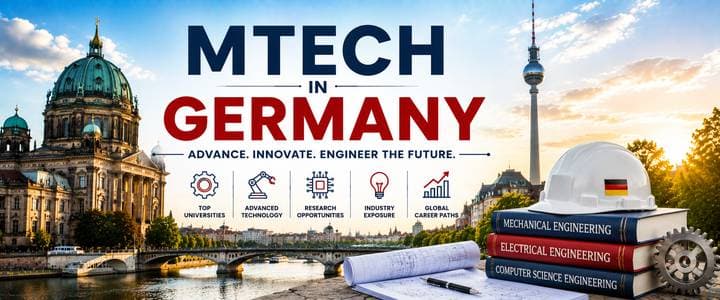
Germany is a leading destination for postgraduate engineering education, offering approximately 1,600 master’s-level engineering programs across research universities, technical universities, and universities of applied sciences.
The qualification commonly called MTech in India is not normally awarded under the same title in Germany. German universities typically award a Master of Science or Master of Engineering. These qualifications are the closest German equivalents of an Indian Master of Technology.
An engineering master’s degree in Germany generally takes three or four semesters and awards 90 or 120 ECTS credits. Students can specialize in mechanical engineering, automotive technology, electrical engineering, robotics, mechatronics, civil engineering, aerospace, renewable energy, chemical engineering, materials, industrial engineering, biomedical technology, and several emerging fields.
Many consecutive engineering master’s programs at public universities charge no regular tuition. Important exceptions include tuition for numerous non-EU students in Baden-Württemberg, program-specific tuition at the Technical University of Munich, private-university fees, and charges for professional or non-consecutive programs.
Indian engineering graduates generally need an APS certificate. Under the current rules, many MTech applicants are also affected by the dMAT requirement because their previous degree falls within engineering. dMAT applies to selected master’s applicants for the summer semester 2027 intake and subsequent intakes, subject to the official transitional exemptions.
This guide explains MTech-equivalent programs in Germany, M.Sc. and M.Eng. degrees, universities, specializations, admission requirements, APS, dMAT, tuition fees, application procedures, scholarships, work rights, and career opportunities.
MTech in Germany: Quick Overview
| Category | Details |
|---|---|
| German Equivalent of MTech | Master of Science or Master of Engineering |
| Typical Duration | 3–4 semesters |
| Academic Credits | Usually 90 or 120 ECTS |
| Main Intake | Winter semester |
| Additional Intake | Summer semester for selected programs |
| Teaching Language | English, German, or bilingual |
| Main Admission Requirement | Related bachelor’s degree in engineering or an eligible technical field |
| Public-University Tuition | Often no regular tuition for consecutive programs |
| Semester Contribution | Commonly approximately €150–€450 |
| Baden-Württemberg Tuition | Generally €1,500 per semester for many non-EU students |
| TUM Non-EU Tuition | Commonly €4,000 or €6,000 per semester for master’s programs |
| Current Visa Financial Benchmark | €11,904 for one year, equivalent to €992 per month |
| Student Work Rights | Generally 140 full days or 280 half-days annually, or the applicable 20-hour weekly alternative |
| Post-Study Job Search | Up to 18 months for eligible graduates |
| APS for Indian Students | Generally required |
| dMAT for Indian Engineering Graduates | Required for applicable master’s applicants under current rules |
Is MTech Available in Germany?
The exact Master of Technology title is uncommon in Germany. Students should search for:
Master of Science
Master of Engineering
Engineering Sciences
Applied Engineering
Advanced Engineering
Computational Engineering
International Engineering
Technology Management
Specialized engineering master’s programs
A German M.Sc. or M.Eng. can be used for engineering employment, doctoral applications, research, technical management, and international career opportunities.
The degree title alone does not determine quality or professional value. Students should compare:
Curriculum
Research orientation
Laboratory facilities
Academic-credit requirements
Industry projects
Internship opportunities
Faculty expertise
Master’s thesis structure
Teaching language
Tuition and living costs
Master of Science Versus Master of Engineering
| Factor | Master of Science | Master of Engineering |
|---|---|---|
| Common Abbreviation | M.Sc. | M.Eng. |
| Main Orientation | Scientific, theoretical and research-oriented | Applied, practical and industry-oriented |
| Mathematics and Theory | Often extensive | Strong but commonly application-focused |
| Research | Frequently central to the program | Applied research and industrial development |
| Practical Projects | Program-dependent | Commonly emphasized |
| Typical Institution | Research or technical university | University of applied sciences or technical institution |
| Doctoral Eligibility | Yes, subject to university rules | Yes, subject to university rules |
| Employment Areas | Research, development, engineering, analysis | Engineering practice, development, production, management |
The division is not absolute. Some M.Sc. programs are highly practical, and some M.Eng. programs include substantial research and can prepare students for doctoral study.
Applicants should not assume that an M.Sc. is automatically superior to an M.Eng. The better qualification is the one that matches the applicant’s academic background and career objective.
Why Study MTech in Germany?
Germany has a major industrial economy supported by engineering, manufacturing, automotive technology, chemicals, electronics, energy, construction, transportation, aerospace, medical technology, and industrial automation.
Advantages include:
A large selection of engineering master’s programs
English-taught courses in major technical fields
Low or no regular tuition at many public universities
Access to research laboratories and technical infrastructure
Industry-linked projects and thesis opportunities
Strong universities of applied sciences
Specializations in future-focused technologies
Working-student and research-assistant opportunities
Post-study job-search residence options
Access to German and European professional networks
A pathway to doctoral research
Internationally recognized M.Sc. and M.Eng. qualifications
Germany is particularly attractive to students who want to combine technical education with industrial experience.
Types of Engineering Master’s Programs
Consecutive Engineering Master’s
A consecutive program builds directly on a related bachelor’s degree.
Examples include:
BTech Mechanical Engineering to M.Sc. Mechanical Engineering
BE Electrical Engineering to M.Sc. Electrical Engineering
BTech Civil Engineering to M.Eng. Civil Engineering
BTech Mechatronics to M.Sc. Robotics or Mechatronics
BTech Chemical Engineering to M.Sc. Process Engineering
These programs generally emphasize academic continuity and frequently have no regular tuition at public universities.
Non-Consecutive Master’s
A non-consecutive program may accept broader academic backgrounds or provide professional specialization.
Such programs may include:
Engineering management
Technology management
Sustainability management
International project management
Innovation and entrepreneurship
Professional energy management
Specialized continuing engineering education
Non-consecutive programs can require work experience and may charge tuition.
Research-Oriented Master’s
Research-oriented courses prepare students for:
Research and development
Scientific institutes
Advanced product development
Doctoral study
Academic careers
Computational or laboratory research
They commonly include research seminars, experimental methods, advanced mathematics, independent projects, and a substantial thesis.
Application-Oriented Master’s
Application-oriented programs emphasize:
Engineering design
Industrial projects
Practical laboratories
Product development
Simulation
Internships
Company collaboration
Applied master’s theses
Universities of applied sciences are especially known for this structure.
Dual and Work-Integrated Master’s
Some programs combine postgraduate study with structured company employment.
They may require:
An employer contract
Relevant professional experience
Strong German
Coordination between the university and employer
Continued employment during study
These courses can provide income and direct industry experience but are less accessible to applicants applying from abroad without a German employer.
Popular MTech-Equivalent Courses
MTech in Mechanical Engineering
The German equivalent is usually an M.Sc. or M.Eng. in Mechanical Engineering.
Common specializations include:
Computational mechanics
Design engineering
Manufacturing
Production systems
Thermodynamics
Fluid mechanics
Lightweight construction
Materials
Simulation
Industrial automation
Applicants normally need significant bachelor’s coursework in mathematics, mechanics, thermodynamics, fluid mechanics, design, and manufacturing.
MTech in Automotive Engineering
Automotive Engineering programs may cover:
Vehicle dynamics
Electric mobility
Battery systems
Automotive electronics
Powertrain engineering
Autonomous vehicles
Vehicle safety
Lightweight design
Automotive software
Testing and validation
Students should prioritize programs that address electric, connected, autonomous, and software-defined mobility.
MTech in Electrical Engineering
Common areas include:
Electrical machines
Power electronics
Renewable-energy systems
Communications
Signal processing
Control engineering
Microelectronics
Semiconductor technology
Embedded systems
Smart grids
A closely related bachelor’s degree with strong mathematics and electrical-engineering credits is usually required.
MTech in Electronics and Communication Engineering
German program titles may include:
Communications Engineering
Information Technology
Electrical and Computer Engineering
Information and Communication Systems
Microelectronics
Embedded Systems
Signal Processing
Communications and Multimedia Engineering
Applicants should compare module requirements instead of searching only for the abbreviation ECE.
MTech in Computer Science and Engineering
Depending on the university, a BTech CSE graduate can apply for:
M.Sc. Computer Science
Software Engineering
Distributed Systems
Information Systems
Cybersecurity
Embedded Systems
High-Performance Computing
Cloud Computing
Human-Computer Interaction
Computational Engineering
Computer-science programs may expect undergraduate credits in algorithms, data structures, theoretical computer science, mathematics, databases, operating systems, and programming.
MTech in Artificial Intelligence
AI programs may include:
Machine learning
Deep learning
Computer vision
Natural-language processing
Reinforcement learning
Intelligent systems
Statistical learning
AI ethics
Autonomous systems
Knowledge representation
Strong foundations in linear algebra, probability, statistics, calculus, algorithms, and programming are often essential.
MTech in Data Science
Data Science combines:
Statistics
Mathematics
Machine learning
Data engineering
Scientific computing
Databases
Optimization
Data visualization
Big-data systems
Responsible data analysis
Applicants with engineering degrees can be rejected if their transcripts do not contain sufficient mathematics, statistics, or computer-science credits.
MTech in Robotics
Robotics programs can cover:
Robot kinematics
Control systems
Computer vision
Sensor technology
Machine learning
Embedded systems
Automation
Autonomous navigation
Human-robot interaction
Intelligent manufacturing
Eligible backgrounds may include mechanical engineering, mechatronics, electrical engineering, computer science, control engineering, or related fields.
MTech in Mechatronics
Mechatronics integrates:
Mechanical systems
Electronics
Control
Sensors
Embedded programming
Automation
Robotics
System modeling
Manufacturing
Product development
Admission committees commonly examine whether the bachelor’s curriculum includes all three major components: mechanics, electronics, and computing or control.
MTech in Civil Engineering
Specializations include:
Structural engineering
Construction management
Geotechnical engineering
Transportation
Water resources
Infrastructure planning
Computational mechanics
Sustainable construction
Environmental engineering
Urban systems
German proficiency can be important for employment because construction standards, regulations, project documents, and site communication often use German.
MTech in Aerospace Engineering
Aerospace programs may include:
Aerodynamics
Flight mechanics
Propulsion
Aircraft structures
Space systems
Guidance and control
Computational fluid dynamics
Lightweight materials
Satellite systems
Systems engineering
Programs are competitive and normally require strong mathematics, mechanics, thermodynamics, and fluid-dynamics preparation.
MTech in Chemical and Process Engineering
Program titles may include Chemical Engineering, Process Engineering, Biochemical Engineering, or Chemical and Energy Engineering.
Common subjects include:
Reaction engineering
Thermodynamics
Process control
Plant design
Heat and mass transfer
Fluid mechanics
Separation processes
Process safety
Sustainable production
Bioprocess engineering
MTech in Renewable Energy
Students may specialize in:
Solar energy
Wind energy
Energy storage
Hydrogen technology
Smart grids
Power systems
Energy efficiency
Sustainable energy conversion
Energy economics
Environmental assessment
Programs differ in orientation. Some are primarily electrical, while others focus on mechanical systems, thermal energy, chemical processes, or interdisciplinary sustainability.
MTech in Materials Science
Materials programs may cover:
Metals
Polymers
Ceramics
Composite materials
Semiconductors
Nanomaterials
Material characterization
Computational materials
Manufacturing
Sustainable materials
Possible applicants include graduates in mechanical, materials, metallurgical, chemical, production, or related engineering.
MTech in Industrial Engineering
Industrial Engineering combines technical and managerial subjects.
Students may study:
Production planning
Operations research
Logistics
Supply-chain systems
Quality management
Project management
Engineering economics
Digital manufacturing
Data analytics
Process optimization
German programs may use the title Wirtschaftsingenieurwesen, Engineering Management, Production Engineering, or Business Engineering.
MTech in Biomedical Engineering
Biomedical or medical-engineering programs include:
Medical devices
Biomedical imaging
Signal processing
Sensors
Biomechanics
Medical electronics
Regulatory engineering
Healthcare technology
Product development
Validation
Admission backgrounds may include biomedical, electrical, electronics, mechanical, mechatronics, or related engineering.
MTech in Environmental Engineering
Environmental-engineering programs may cover:
Water treatment
Waste management
Air-pollution control
Circular economy
Environmental modeling
Resource efficiency
Climate adaptation
Sustainable infrastructure
Environmental assessment
Industrial ecology
Representative Universities for MTech-Equivalent Programs
| University | Representative Strengths |
|---|---|
| Technical University of Munich | Mechanical, electrical, aerospace, robotics, energy and interdisciplinary engineering |
| RWTH Aachen University | Mechanical, automotive, production, electrical, civil and materials engineering |
| Karlsruhe Institute of Technology | Mechanical, electrical, energy, process, civil and computational engineering |
| Technical University of Berlin | Mechanical, electrical, energy, transport and environmental engineering |
| Technical University of Dresden | Mechanical, electrical, civil, materials and microelectronics |
| Technical University of Darmstadt | Mechanical, electrical, civil, computer and systems engineering |
| University of Stuttgart | Mechanical, automotive, aerospace, civil and computational engineering |
| Leibniz University Hannover | Mechanical, electrical, production, civil and environmental engineering |
| Technical University of Braunschweig | Automotive, aerospace, mechanical and mobility engineering |
| Hamburg University of Technology | Mechanical, process, logistics, civil and electrical engineering |
| Friedrich-Alexander University Erlangen-Nuremberg | Electrical, chemical, materials, AI and medical engineering |
| Ruhr University Bochum | Mechanical, electrical, civil, materials and environmental engineering |
| University of Duisburg-Essen | Mechanical, electrical, civil, energy and computer engineering |
| Otto von Guericke University Magdeburg | Mechanical, process, systems and electrical engineering |
| Chemnitz University of Technology | Automotive, mechanical, electrical, materials and production engineering |
| Technical University of Ilmenau | Electrical, mechanical, mechatronics and communication engineering |
| Brandenburg University of Technology Cottbus-Senftenberg | Energy, environmental, civil and mechanical engineering |
| Ingolstadt Technical University of Applied Sciences | Automotive, mobility, electrical and applied engineering |
| Rosenheim Technical University of Applied Sciences | Engineering sciences, technology and applied research |
| OTH Amberg-Weiden | Energy, automation, environmental and international engineering |
| Würzburg-Schweinfurt University of Applied Sciences | Business engineering, mechanical and applied technical programs |
| Munich University of Applied Sciences | Applied engineering, research and technology programs |
| HAW Hamburg | Process, mechanical, electrical and applied engineering |
The best choice depends on specialization, curriculum, research group, industry access, cost, and academic eligibility.
Research University Versus University of Applied Sciences
| Factor | Research or Technical University | University of Applied Sciences |
|---|---|---|
| Main Focus | Theory, research and scientific depth | Practical application and industry |
| Teaching Style | Independent and research-oriented | Structured and project-oriented |
| Research | Fundamental and advanced research | Applied and industry-linked research |
| Internships | Program-dependent | Frequently encouraged or required |
| Class Size | Can be larger | Often smaller |
| Master’s Thesis | University laboratory or external research | Commonly company or applied project |
| Best For | PhD preparation and research-intensive careers | Applied engineering and industry careers |
Both institution types award recognized master’s qualifications. Graduates of universities of applied sciences can pursue doctoral study, although the route may involve cooperation with a doctoral-awarding institution or state-specific doctoral structures.
MTech Eligibility Requirements
Relevant Bachelor’s Degree
Applicants generally need a recognized bachelor’s degree in a related engineering or technical field.
Common qualifying degrees include:
Bachelor of Technology
Bachelor of Engineering
Bachelor of Science in Engineering
Relevant four-year technical degree
Related scientific degree for selected interdisciplinary programs
The university evaluates whether the previous degree provides sufficient preparation for the master’s curriculum.
Subject and Module Matching
German universities often assess individual bachelor’s modules.
An admission committee may examine credits in:
Engineering mathematics
Physics
Mechanics
Thermodynamics
Programming
Control systems
Electronics
Design
Manufacturing
Materials
Statistics
Laboratory courses
Final-year project
A high CGPA does not compensate when mandatory subject credits are missing.
Academic Credit Requirements
Engineering master’s programs commonly require the equivalent of:
180 ECTS
210 ECTS
A specified bachelor’s duration
A defined amount of engineering coursework
A four-semester master’s normally awards 120 ECTS. A three-semester course commonly awards 90 ECTS.
Applicants with an educational background evaluated as 180 ECTS may need additional credits for certain 90-ECTS master’s programs. Some institutions provide a four-semester route or require bridging modules.
GPA Requirements
There is no universal CGPA requirement for MTech-equivalent programs.
A university may use:
A minimum German grade
A converted foreign grade
Subject-specific grade requirements
Competitive ranking
An aptitude-assessment score
Interviews
Technical tests
Departmental selection
Popular programs can reject applicants who satisfy the published minimum because available places are limited.
English-Language Proficiency
English-taught engineering programs may accept:
IELTS Academic
TOEFL iBT
Cambridge English
Previous English-medium education where explicitly accepted
Another recognized qualification
IELTS 6.5 or an equivalent result is common, but it is not a national rule. Some programs accept B2-level evidence, while others require C1.
A Medium of Instruction certificate should be used only when the university explicitly accepts it.
German-Language Proficiency
German-taught programs commonly require:
TestDaF
DSH
telc Deutsch C1 Hochschule
Goethe certificates where accepted
Another university-approved qualification
Some English-taught programs require students to complete A1 or A2 German during the degree. Others have no formal German requirement.
German is still valuable for internships, working-student jobs, company projects, and graduate employment.
GRE, GATE and Other Tests
GRE and GATE are not universal requirements.
Depending on the program, an applicant may need:
GRE General Test
GRE Quantitative score
GATE
University aptitude test
Technical assessment
Online interview
Written entrance examination
Students should take these tests only when the official course requirements ask for them or clearly indicate that they strengthen the application.
Work Experience
Most consecutive engineering master’s programs do not require full-time professional experience.
Work experience may be required for:
Non-consecutive programs
Continuing-education master’s degrees
Engineering management
Executive programs
DAAD EPOS scholarships
Certain specialized professional courses
Relevant internships, projects, publications, patents, and employment can still strengthen an application.
Can Students Change Their Engineering Branch?
German consecutive master’s programs generally expect close academic continuity.
| Previous Degree | Potentially Related Master’s Areas |
|---|---|
| Mechanical Engineering | Mechanical, automotive, production, aerospace, energy, mechatronics |
| Electrical Engineering | Electrical, power, communications, control, embedded systems |
| Electronics and Communication | Communications, embedded systems, microelectronics, information engineering |
| Computer Science Engineering | Computer science, AI, data, cybersecurity, software, embedded systems |
| Civil Engineering | Structural, transport, water, geotechnical, environmental, construction |
| Chemical Engineering | Chemical, process, energy, environmental, biochemical engineering |
| Mechatronics | Mechatronics, robotics, automation, control, embedded systems |
| Biotechnology Engineering | Biotechnology, bioprocess, biochemical or selected life-science engineering |
| Production Engineering | Production, manufacturing, industrial, materials, logistics |
| Aerospace Engineering | Aerospace, computational mechanics, propulsion, systems engineering |
| Biomedical Engineering | Medical engineering, imaging, biomedical systems, devices |
These are possible academic relationships, not guaranteed admission routes. The university evaluates the actual transcript, not only the degree title.
A major change such as Civil Engineering to Artificial Intelligence or Biotechnology to Automotive Engineering is normally difficult unless the applicant has substantial relevant coursework.
Documents Required
Applicants may need:
Passport
Bachelor’s degree certificate
Complete semester-wise transcripts
Provisional certificate
Current transcript for an unfinished degree
Class 10 and Class 12 certificates
APS certificate
dMAT certificate where required
English or German language certificate
Curriculum vitae
Motivation letter
Letters of recommendation
Module descriptions
Official grading system
Final-year project summary
Internship certificates
Employment certificates
GRE or GATE score where required
Portfolio of technical projects
Research papers or publications
Application form
Preliminary Review Documentation where required
Certified translations
Students should maintain detailed course descriptions because the university may use them to compare the Indian curriculum with German subject requirements.
APS Certificate for Indian Students
APS India verifies academic documents issued by Indian educational institutions.
The APS certificate is generally required for:
German student-visa documentation
Applications at universities that request it
Uni-assist or VPD procedures where applicable
APS verification does not guarantee:
University admission
Visa approval
Academic equivalence for every program
Acceptance of a branch change
Satisfaction of language requirements
Graduates should use the APS procedure corresponding to completed bachelor’s or master’s qualifications.
APS certificates are issued as digitally signed PDF files. The original file should remain unchanged. Applicants should not edit, rename, combine, or modify the certificate.
dMAT for Indian Engineering Graduates
The Digital Master Test is an additional component of APS documentation for selected master’s applicants.
The published affected fields include:
Engineering
Commerce
Accounting
Finance
Economics
Business
Management
Since most MTech applicants hold BTech or BE degrees, they generally fall within the engineering field group when the current dMAT conditions apply.
The requirement applies to relevant applicants for the summer semester 2027 master’s intake and subsequent intakes, unless an official transitional exemption applies.
Important points include:
dMAT is administered by g.a.s.t.
APS India continues to verify academic documents.
dMAT does not replace APS.
dMAT does not guarantee university admission.
dMAT does not replace a university aptitude test.
Applicants can submit APS documents before the dMAT certificate becomes available in applicable cases.
APS can issue the final certificate only after the required dMAT result has been submitted and checked.
The requirement is determined by the previous degree field and application conditions.
Students should verify the latest affected-field list, test schedule, registration period, transitional rules, and certificate-submission process before applying.
Application Routes
Direct Application
The student applies through the university’s own application portal.
Uni-Assist Application
Uni-assist evaluates foreign academic documents for participating universities. It may process the full application or conduct an initial academic review.
VPD Procedure
Some universities require a Preliminary Review Documentation from uni-assist. The applicant obtains the VPD and then applies directly to the university.
VPD processing generally takes approximately four to six weeks after a complete application is submitted. Applicants should request it well before the university deadline.
Step-by-Step Application Process
Select an engineering specialization related to the bachelor’s degree.
Search for M.Sc., M.Eng., and specialized German degree titles.
Compare required modules with the bachelor’s transcript.
Check whether the program requires 180 or 210 ECTS.
Confirm the minimum grade and selection procedure.
Verify English and German requirements.
Check GRE, GATE, aptitude-test, and experience requirements.
Start APS verification.
Register for dMAT if the requirement applies.
Prepare module descriptions, project evidence, and the grading system.
Write a program-specific motivation letter.
Obtain recommendation letters where required.
Identify the direct, uni-assist, or VPD application route.
Submit the application before the international deadline.
Complete interviews or technical assessments.
Compare offers based on curriculum, research, cost, and location.
Accept admission and satisfy enrollment conditions.
Arrange financial evidence and health insurance.
Apply for the student visa.
Secure accommodation and prepare for arrival.
Winter and Summer Intakes
Winter Semester
The winter semester generally begins in September or October. It offers the largest number of M.Sc. and M.Eng. engineering programs.
Application periods commonly fall between March and July, but competitive international programs may close earlier.
Summer Semester
The summer semester generally begins in March or April. It has fewer program choices, although many universities offer engineering entry in both semesters.
Application periods often fall between October and January.
| Intake | Typical Beginning | General Application Period |
|---|---|---|
| Winter | September or October | Commonly March–July |
| Summer | March or April | Commonly October–January |
Every university sets its own deadline. Non-EU applicants may have earlier deadlines than German or EU applicants.
Tuition Fees
Public Universities
Many consecutive engineering master’s programs at public universities have no regular tuition. Students pay a semester contribution, commonly around €150–€450.
Baden-Württemberg
Many non-EU students at public universities in Baden-Württemberg generally pay €1,500 per semester, subject to exemptions.
Engineering institutions affected can include:
Karlsruhe Institute of Technology
University of Stuttgart
Esslingen University of Applied Sciences
Mannheim University of Applied Sciences
Aalen University
Other public institutions in the state
Technical University of Munich
TUM charges tuition to many newly enrolled students from outside the European Union. Master’s fees are commonly €4,000 or €6,000 per semester, depending on the program.
Students also pay the applicable semester fee. Waivers, exemptions, and scholarships may be available in qualifying cases but are not automatic.
Private Universities
Private engineering programs can charge substantial fees. Students should examine:
Total tuition
Enrollment charges
Examination fees
Laboratory access
Accreditation
Industry partnerships
Internship support
Refund conditions
Graduate outcomes
Non-Consecutive and Continuing Programs
Professional master’s programs can charge tuition even when offered by a public institution. Applicants must check the individual course page.
Estimated Monthly Living Costs
| Expense | Approximate Monthly Range |
|---|---|
| Accommodation | €350–€850 |
| Food | €180–€300 |
| Student Health Insurance | Approximately €130–€160 |
| Transport Beyond Included Benefits | €0–€80 |
| Study Materials | €20–€70 |
| Phone and Internet | €20–€45 |
| Personal Expenses | €80–€200 |
| Estimated Total | Approximately €850–€1,550 |
Munich, Frankfurt, Stuttgart, Hamburg, Heidelberg, and central Berlin are generally more expensive. Smaller engineering cities can offer lower rent and shorter commuting distances.
Proof of Funds
For applicable student-visa applications through German Missions in India, the current blocked-account benchmark is €11,904 for one year, with a monthly withdrawal limit of €992.
Accepted alternatives may include:
Formal obligation from an eligible sponsor in Germany
Recognized German or European scholarship
Another financial method accepted by the responsible mission
The visa benchmark is not an estimate of total study cost. Students attending tuition-charging universities must demonstrate how tuition will also be paid.
Scholarships
Possible funding sources include:
DAAD Study Scholarships for STEM disciplines
DAAD EPOS scholarships
Deutschlandstipendium
Erasmus funding
University merit scholarships
Research-project funding
Foundation scholarships
Company sponsorship
State or regional grants
Departmental assistantships
DAAD STEM Scholarships
DAAD offers scholarships aimed at high-achieving applicants from developing and emerging countries pursuing master’s study in innovation-driving STEM fields.
Applicants should check:
Eligible programs
Nationality requirements
Academic conditions
Application deadlines
Required nomination or admission documents
Scholarship duration
Funding components
DAAD EPOS
EPOS supports selected development-related postgraduate courses and generally expects at least two years of relevant professional experience.
Not every engineering program participates in EPOS.
Research Assistantships
Students may obtain paid roles as:
Research assistants
Teaching assistants
Laboratory assistants
Project assistants
These positions are competitive and should not be treated as guaranteed funding.
Working While Studying
Eligible students from outside the European Union can generally work:
Up to 140 full days per year
Up to 280 half-days per year
Or under the applicable alternative of up to 20 hours per week during the lecture period
Common engineering student jobs include:
Working student
Research assistant
Laboratory assistant
CAD engineer
Simulation assistant
Software developer
Test engineer
Data analyst
Production assistant
Quality-assurance assistant
Technical support employee
Energy or sustainability assistant
Compulsory internships are generally treated differently from voluntary internships. Voluntary internships commonly count toward the annual work allowance.
Students should not depend entirely on part-time employment to finance their degree.
Master’s Thesis and Industry Experience
The master’s thesis is a central part of German engineering education.
Students may complete it:
At a university institute
In a research laboratory
With a company
At an independent research organization
Through an international partner university
A company thesis can provide:
Industry experience
Professional contacts
Access to equipment and data
Exposure to German engineering processes
Potential employment opportunities
However, company theses may involve confidentiality restrictions. Students planning doctoral research should consider whether the project can produce publishable academic work.
German Language and Employment
An English-taught M.Sc. or M.Eng. may not require German for admission, but German considerably improves employment opportunities.
German is useful for:
Working-student roles
Company internships
Production environments
Safety communication
Technical documentation
Meetings with local teams
Supplier and customer communication
Small and medium-sized employers
Construction and infrastructure work
Long-term career integration
Students should aim for at least B1 or B2 by graduation. Client-facing, construction, public-sector, regulatory, and operational roles may require stronger proficiency.
Career Opportunities
| Specialization | Representative Roles |
|---|---|
| Mechanical Engineering | Design engineer, simulation engineer, production engineer |
| Automotive Engineering | Vehicle engineer, mobility specialist, test engineer |
| Electrical Engineering | Power engineer, controls engineer, electronics engineer |
| Communications Engineering | Network engineer, RF engineer, communications specialist |
| Computer Engineering | Systems engineer, embedded engineer, software engineer |
| Artificial Intelligence | Machine-learning engineer, AI specialist, vision engineer |
| Data Science | Data scientist, data engineer, analytics specialist |
| Robotics | Robotics engineer, automation engineer, controls specialist |
| Mechatronics | Mechatronics engineer, systems engineer, automation specialist |
| Civil Engineering | Structural engineer, infrastructure planner, project engineer |
| Aerospace Engineering | Aerospace engineer, simulation specialist, systems engineer |
| Chemical Engineering | Process engineer, plant engineer, safety specialist |
| Renewable Energy | Energy engineer, grid specialist, sustainability analyst |
| Materials Science | Materials engineer, process specialist, research engineer |
| Industrial Engineering | Production planner, operations analyst, supply-chain specialist |
| Biomedical Engineering | Medical-device engineer, validation engineer, product specialist |
| Environmental Engineering | Environmental engineer, water specialist, sustainability consultant |
Employment depends on technical skills, language ability, internship experience, market conditions, and whether a role is regulated.
Post-Study Opportunities
Eligible graduates of German higher-education institutions can apply for a residence permit lasting up to 18 months to search for qualified employment.
During this period, graduates can generally work in any occupation while searching for a suitable skilled position.
After securing qualified employment, graduates may apply for:
Residence permit for qualified employment
EU Blue Card if the applicable conditions are met
Another relevant employment residence category
A German engineering master’s degree does not automatically issue a work permit. The graduate must complete the applicable residence procedure.
Common Application Mistakes
Searching Only for MTech
German universities normally use M.Sc. or M.Eng. Applicants searching only for MTech will miss relevant programs.
Choosing a Course Based Only on Its Title
The module requirements can be more important than the program name.
Ignoring Academic-Credit Requirements
A university can reject a strong applicant who lacks mandatory subject credits.
Attempting a Major Branch Change
Consecutive master’s programs generally expect the bachelor’s degree to be closely related.
Using a Generic Motivation Letter
The motivation letter should explain academic preparation, program fit, specialization, and future goals.
Missing dMAT Requirements
Many Indian engineering graduates are within the affected dMAT field group for applicable master’s intakes.
Starting APS Too Late
Delayed APS or institutional verification can cause missed application and visa deadlines.
Assuming Every Public Program Is Tuition-Free
Non-EU tuition applies in Baden-Württemberg and at TUM for many students. Professional programs can also charge fees.
Assuming English Is Enough for Employment
English can be sufficient for study, but German can determine access to internships and full-time roles.
Applying Only to Famous Universities
Strong universities of applied sciences and smaller technical institutions may offer better specialization and industry access.
Depending Entirely on Rankings
Program content, academic eligibility, thesis options, and location should guide the shortlist.
Application Checklist
Before applying, confirm:
The program awards an M.Sc. or M.Eng.
The bachelor’s degree is academically related.
Mandatory subject credits are satisfied.
The 180- or 210-ECTS requirement has been checked.
The GPA meets the published condition.
The language certificate is accepted.
GRE or GATE requirements are understood.
Work-experience requirements are satisfied.
APS verification has been started.
dMAT applicability has been confirmed.
Module descriptions are available.
The correct application route is known.
VPD processing time has been included.
International deadlines are verified.
Tuition and semester contributions are calculated.
Living costs are affordable.
Scholarship deadlines are checked.
The visa and financial plan is realistic.
Frequently Asked Questions
Is MTech available in Germany?
The MTech title is uncommon. German universities usually award a Master of Science or Master of Engineering in technical fields.
Is a German M.Sc. or M.Eng. equivalent to MTech?
Both are postgraduate engineering qualifications comparable in academic level to an MTech. The curriculum and orientation determine the closest match.
What is the difference between M.Sc. and M.Eng.?
M.Sc. programs are often more scientific and research-focused, while M.Eng. programs commonly emphasize practical and industrial application. The distinction varies by institution.
How long is MTech in Germany?
Most M.Sc. and M.Eng. engineering programs take three or four semesters.
Can I study MTech in Germany in English?
Yes. Many engineering master’s courses are taught completely in English, particularly in mechanical, electrical, automotive, robotics, energy, aerospace, computer, and process engineering.
What CGPA is required?
There is no national CGPA requirement. Each university sets its own minimum grade, subject-credit conditions, and selection procedure.
Can I apply with a three-year bachelor’s degree?
It may be possible if the degree is recognized and satisfies the program’s academic and credit requirements. Many engineering courses expect a closely related technical degree.
Is GATE required?
GATE is not required by every German university. Some technical programs may accept or request it.
Is GRE compulsory?
GRE is not universally compulsory. Certain universities or programs may require or recommend it.
Is work experience required?
Most consecutive engineering master’s programs do not require professional experience. Non-consecutive, management, continuing-education, and EPOS programs may require it.
Can I change from mechanical engineering to data science?
It may be difficult unless the bachelor’s transcript contains substantial mathematics, statistics, programming, and computer-science coursework.
Is APS required for Indian students?
APS is generally required for Indian applicants pursuing academic study in Germany and for the student-visa procedure, subject to applicable exemptions.
Is dMAT required for MTech applicants?
Many applicants with previous engineering degrees fall within the affected dMAT group for applicable master’s intakes under current APS India rules.
Does dMAT replace APS?
No. dMAT is an additional component for affected applicants. APS continues to verify academic documents.
Can I submit APS documents before receiving dMAT?
Current APS guidance allows affected applicants to submit their APS documents before the dMAT certificate is available in applicable cases. The APS certificate can only be issued after the required dMAT result is submitted and checked.
Is MTech free in Germany?
Many consecutive engineering programs at public universities have no regular tuition. Semester contributions and living costs remain payable. Tuition applies in Baden-Württemberg, at TUM for many non-EU students, and in private or professional programs.
How much does TUM charge for engineering master’s programs?
TUM master’s tuition for eligible non-EU students is commonly €4,000 or €6,000 per semester, depending on the program.
Can I work while studying?
Eligible non-EU students can generally work up to 140 full days or 280 half-days per year, or use the applicable 20-hour-per-week alternative.
Can I stay in Germany after completing the degree?
Eligible graduates can apply for up to 18 months to search for qualified employment.
Is German required for engineering jobs?
Not for every position, but German significantly increases access to internships, production roles, regional employers, and client-facing work.
Final Thoughts
An MTech-equivalent degree in Germany can offer advanced engineering education, research exposure, industry experience, and access to European employment opportunities. Students should search for Master of Science and Master of Engineering programs rather than expecting the Indian MTech title.
The most important admission factor is academic compatibility. German universities frequently examine the exact mathematics, engineering, programming, design, laboratory, and specialization credits completed during the bachelor’s degree.
Indian applicants should begin APS early and verify the latest dMAT rules. Most BTech and BE graduates fall within the engineering field group affected by dMAT for applicable master’s intakes, unless an official exemption applies.
Germany can be affordable, but it is not universally tuition-free. Students must check Baden-Württemberg tuition, TUM fees, private-program costs, semester contributions, health insurance, accommodation, and the complete visa-funding requirement.
Learning German alongside an English-taught program can substantially improve working-student, internship, thesis, and full-time career opportunities. With a carefully matched program, balanced university shortlist, complete documentation, and realistic financial plan, Germany can be an excellent destination for advanced engineering study.









