


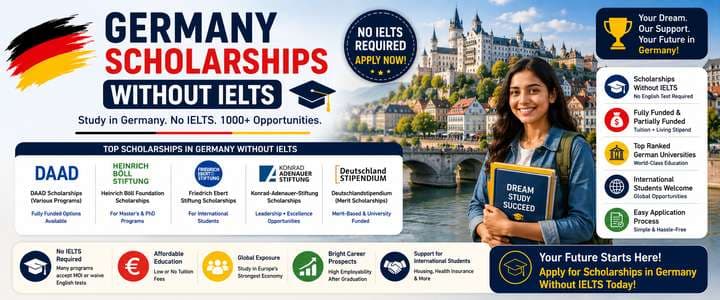
Germany scholarships without IELTS are available, but “without IELTS” rarely means “without language proof.” Depending on the scholarship and degree programme, applicants may qualify through another English-language test, proof of previous education in English, a university-issued language waiver, an internal assessment, or a German-language certificate.
The scholarship provider, university and German visa authority can apply different rules. Receiving admission or a scholarship without IELTS does not automatically guarantee that the same language evidence will be accepted for a student visa.
Can You Get a Scholarship in Germany Without IELTS?
Yes. Applicants may receive a scholarship without submitting IELTS when:
The scholarship accepts another recognized English test.
The scholarship has no separate English-language requirement.
The university has already confirmed the applicant’s language eligibility.
The applicant completed previous education in English and the institution accepts a Medium of Instruction certificate.
The course is taught in German and the applicant provides German-language proof.
The scholarship selection process uses an interview or internal language assessment.
The funding is awarded after university enrolment and depends primarily on academic performance, social commitment or financial circumstances.
Each condition must be confirmed separately with the scholarship provider, degree programme and responsible visa authority.
Germany Scholarships Without IELTS: Quick Comparison
| Scholarship or Funding Route | IELTS Position | Funding Type | Main Language Condition |
|---|---|---|---|
| DAAD scholarships | IELTS is not universally mandatory | Varies by programme | The individual call determines accepted English or German certificates |
| Deutschlandstipendium | No central IELTS requirement | €300 per month | Admission or enrolment at a participating university is normally required |
| Erasmus Mundus Joint Masters | No universal IELTS rule | Comprehensive funding may be available | Each programme consortium sets its own accepted language evidence |
| Erasmus+ mobility funding | IELTS is not always required | Mobility support | Sending and receiving institutions determine language requirements |
| Heinrich Böll Foundation scholarship | IELTS is not the main requirement | Scholarship funding | Strong German proficiency is normally required |
| Friedrich Ebert Foundation scholarship | No general IELTS-centred rule | Scholarship funding | Sufficient German and a strong social profile are expected |
| Konrad Adenauer Foundation scholarship | IELTS is not generally central | Scholarship funding | German proficiency at approximately B2 level is normally required |
| Friedrich Naumann Foundation scholarship | IELTS is not generally required for selection | Scholarship funding | German proficiency at approximately B2 level is essential |
| University merit scholarships | Often no separate IELTS rule | Partial or comprehensive | Admission and programme-language rules usually apply |
| Research and doctoral funding | Project-specific | Salary, stipend or grant | Supervisor, project and university determine acceptable proof |
What Does “Without IELTS” Actually Mean?
The phrase can describe several different situations.
IELTS Is Replaced by Another English Test
A scholarship or university may accept TOEFL, Cambridge English, PTE Academic, TOEIC, onSET English or another listed examination.
This is the most reliable IELTS-free route because the applicant still has standardized evidence of English proficiency.
A Medium of Instruction Certificate Is Accepted
Some institutions accept an official letter confirming that the applicant’s previous qualification was taught and examined entirely in English.
This document is usually called a Medium of Instruction certificate or MOI. Acceptance is never automatic. Some universities accept it, some evaluate it individually and others insist on a standardized test.
The Scholarship Has No Separate Language Test
Certain scholarships are awarded only after the applicant has received admission or enrolled at a university. The scholarship committee may rely on the university’s admission decision instead of asking for IELTS again.
The applicant must still meet the language conditions of the degree programme.
German Replaces English
Scholarships connected to German political foundations frequently expect German proficiency. An applicant may not need IELTS, but may need TestDaF, DSH, Goethe, telc, ÖSD or another accepted German certificate.
This is an IELTS-free route, not a language-free route.
The Programme Conducts Its Own Assessment
A university or scholarship consortium may assess language ability through:
An interview
A written assessment
Previous academic work
Professional experience
An internal university test
A letter from the previous institution
Applicants should obtain written confirmation that the assessment satisfies both admission and scholarship requirements.
DAAD Scholarships Without IELTS
DAAD administers a wide range of funding programmes for international students, graduates, researchers and academic professionals.
There is no single language rule covering every DAAD scholarship. The accepted evidence depends on:
The scholarship programme
The selected degree
The teaching language
The host university
The applicant’s country
The requirements stated in the official call
For English-taught programmes, individual calls may accept IELTS alongside alternatives such as:
TOEFL
Cambridge English qualifications
PTE Academic
TOEIC
onSET English
Other explicitly listed certificates
Some calls may consider evidence of previous English-medium education, but applicants must not assume that an MOI letter automatically replaces a test.
For German-taught programmes, accepted certificates may include:
TestDaF
DSH
Goethe certificates
telc Deutsch
ÖSD
German Language Diploma
onSET Deutsch
DAAD applicants should check two different language requirements:
The language condition of the scholarship call
The admission condition of the selected university programme
Meeting only one of them is insufficient.
DAAD funding can include a monthly scholarship payment and additional benefits, but the package differs between programmes. Applicants should use the exact funding description in the relevant call rather than assuming every DAAD scholarship is fully funded.
Deutschlandstipendium Without IELTS
Deutschlandstipendium supports high-performing and socially engaged students at participating public and state-recognized universities in Germany.
The scholarship generally provides €300 per month. It is jointly financed through public and private funding.
There is no nationwide IELTS requirement specifically for Deutschlandstipendium. Applicants are usually evaluated by their university after admission or enrolment. Therefore, the language requirement normally comes from the academic programme rather than the scholarship itself.
Selection may consider:
Academic performance
Academic potential
Social or community involvement
Personal achievements
Employment or family responsibilities
Difficult personal circumstances
Voluntary work
Motivation and career direction
International students can apply when they satisfy the participating university’s conditions. Availability, deadlines, required documents and selection procedures differ by institution.
Deutschlandstipendium is valuable financial support, but it should not be presented as a complete replacement for the full cost of studying and living in Germany.
Erasmus Mundus Scholarships Without IELTS
Erasmus Mundus Joint Masters are international programmes delivered by university consortia. A programme may include a German university and study periods in more than one country.
Comprehensive scholarships may support:
Participation costs
Travel
Installation expenses
Monthly living costs
The current scholarship contribution can reach €1,400 per month for a maximum of 24 months, subject to the programme’s rules.
There is no universal IELTS requirement for every Erasmus Mundus programme. Each consortium determines its own:
Accepted English tests
Minimum scores
MOI policy
Academic eligibility
Required degree background
Application documents
Selection method
Depending on the consortium, IELTS alternatives may include TOEFL, Cambridge English, an English-medium degree or another approved form of evidence.
Applicants must read the programme’s eligibility page carefully. A language exemption accepted by one Erasmus Mundus programme may be rejected by another.
Erasmus+ Mobility Funding
Students already enrolled at a university may qualify for Erasmus+ mobility support for an exchange, traineeship or study period at a partner institution.
IELTS is not automatically required for every Erasmus+ mobility opportunity. Language readiness may be evaluated through:
The home university
The receiving university
An internal assessment
An accepted certificate
An online language evaluation
Evidence that the student can study in the agreed teaching language
This route is most relevant to students whose university has an active Erasmus partnership with a German institution.
Heinrich Böll Foundation Scholarship
The Heinrich Böll Foundation supports academically strong and socially engaged students whose values align with democracy, sustainability, human rights and civic responsibility.
International applicants should understand that this is not a no-language scholarship. German proficiency is normally important, and applicants may need evidence around B2 or DSH level depending on their applicant category.
The application process may require documents in German. Candidates should therefore be able to:
Understand scholarship instructions
Prepare application materials
participate in selection activities
Communicate about academic and social topics
Engage with the foundation’s programme
IELTS may not be the central requirement, but sufficient German is essential.
Friedrich Ebert Foundation Scholarship
The Friedrich Ebert Foundation supports students with strong academic ability, social commitment and an interest in social democracy.
International applicants are generally expected to demonstrate:
Good academic performance
Social or political engagement
Commitment to democratic values
Clear motivation
Sufficient German-language ability
Many foreign applicants are expected to be studying in Germany when they apply. Exact eligibility depends on applicant status and scholarship category.
The foundation does not use IELTS as a universal selection requirement. However, the applicant must still meet the university’s language conditions and demonstrate the German ability required by the foundation.
Konrad Adenauer Foundation Scholarship
The Konrad Adenauer Foundation offers scholarships for international postgraduate students, doctoral candidates and researchers.
Common selection factors include:
Strong academic achievement
Clear academic or research objectives
Voluntary or community involvement
Interest in political and social issues
Commitment to democratic principles
Plans for a substantial period of study or research in Germany
German proficiency at approximately B2 level is normally required. Applicants should not treat this scholarship as a way to avoid language preparation.
IELTS may be unnecessary for the foundation application, but an English-taught university programme may still request English proof for admission.
Friedrich Naumann Foundation Scholarship
The Friedrich Naumann Foundation supports candidates with strong academic records, personal initiative, civic engagement and an interest in liberal values.
For international applicants, German ability at approximately B2 level is essential. The application and interview process may take place in German.
The foundation’s selection process may not require IELTS or a separate English test. This does not remove the need to:
Meet the university’s admission requirements
Communicate effectively in German
Complete the scholarship selection process
Demonstrate academic and personal suitability
Applicants should also verify whether their study level and remaining study duration meet the foundation’s eligibility rules.
University Scholarships Without IELTS
Many German universities offer their own:
Merit scholarships
Completion grants
International student grants
Emergency funding
Research awards
Departmental scholarships
Equal-opportunity scholarships
Mobility grants
Alumni-funded awards
These scholarships frequently do not impose an additional IELTS requirement. Instead, the university may require the applicant to be:
Formally admitted
Fully enrolled
Academically successful
Within a specified study stage
Experiencing documented financial need
Active in university or community life
If the student entered the university with an approved IELTS alternative, the scholarship office may rely on the existing admission record.
University funding can be highly competitive and may cover only part of the applicant’s expenses.
Research Assistantships and Doctoral Funding
Research projects, graduate schools and university chairs may fund international candidates through:
Research assistant employment
Doctoral positions
Project contracts
Graduate school scholarships
Research grants
Teaching assistantships
Language requirements depend on the research environment. In an English-speaking laboratory or research group, the supervisor may evaluate the candidate through an interview, publications, previous English-medium study or another English certificate.
Some doctoral programmes still require standardized proof. German may also be necessary when the position includes teaching, administration, patient contact, fieldwork or communication with local partners.
Applicants should distinguish between a scholarship and an employment contract. Salaried research positions can involve taxes, social insurance and formal employment responsibilities.
Fully Funded and Partially Funded Options
| Funding Route | Typical Coverage | Important Limitation |
|---|---|---|
| DAAD programme scholarship | May include monthly support and additional allowances | Benefits vary by scholarship call |
| Erasmus Mundus scholarship | Can provide comprehensive study and living support | Extremely competitive and programme-specific |
| Political foundation scholarship | May provide substantial support and development activities | Values, engagement and German ability are important |
| Deutschlandstipendium | €300 per month | Partial funding only |
| University merit scholarship | Amount varies | Often limited in duration |
| Completion grant | Short-term financial support | Usually available only near graduation |
| Research assistantship | Salary or project-based payment | Includes employment duties |
| Emergency grant | Limited short-term assistance | Not intended as a complete funding plan |
“Fully funded” should never be assumed from a scholarship’s name. Applicants must check which expenses are actually covered, including:
Tuition or semester contributions
Monthly living costs
Health insurance
Travel
Visa expenses
Language-test fees
Study materials
Rent deposit
Family expenses
A partial scholarship may not be sufficient for visa-related financial proof.
IELTS Alternatives Accepted in Germany
| Alternative | Possible Use | Main Caution |
|---|---|---|
| TOEFL | English-taught degree admission and some scholarships | Accepted formats and minimum scores differ |
| Cambridge English | University admission and scholarship applications | Required certificate level varies |
| PTE Academic | Accepted by selected institutions and scholarship programmes | Not accepted universally |
| TOEIC | Accepted by some scholarship calls or programmes | Less common for degree admission |
| onSET English | Used by selected DAAD-related programmes | Not a universal university test |
| Duolingo English Test | Accepted by selected international programmes | Visa acceptance can be more restrictive |
| Medium of Instruction certificate | May support an English-test waiver | University, scholarship and visa acceptance can differ |
| University interview | Used for internal language evaluation | May not satisfy the visa authority |
| Previous degree in English | Can support an exemption | Must usually be formally documented |
| TestDaF or DSH | German-taught study | Not evidence of English proficiency |
| Goethe, telc or ÖSD | German-language proof | Required level depends on programme and scholarship |
Applicants should submit only the evidence explicitly accepted by the relevant authority.
Can a Medium of Instruction Certificate Replace IELTS?
It can replace IELTS in selected university or scholarship applications, but not in every case.
A strong MOI certificate should:
Be printed on official institutional letterhead
State the applicant’s full name
Identify the qualification and department
Confirm that the complete programme was taught in English
Confirm that examinations were conducted in English
Include the study period
Carry an authorized signature
Include the institution’s stamp or verification details
Suggested wording:
This is to certify that the named student completed the stated academic programme at this institution. The language of instruction and examination throughout the programme was English.
Applicants should ask the university and scholarship provider for written confirmation before relying on an MOI letter.
Scholarship Acceptance and Visa Acceptance Are Different
This is the most important issue for applicants planning to study without IELTS.
A university may accept an MOI certificate, while the responsible German mission may request a recognized language certificate. Similarly, a scholarship provider may not ask for IELTS because it relies on the admission decision, but the visa officer may still examine whether the applicant can study in the programme’s teaching language.
Applicants should verify language evidence at three levels:
| Decision Maker | What Must Be Confirmed |
|---|---|
| University | Whether the applicant satisfies the degree’s language requirement |
| Scholarship provider | Whether the application requires separate language evidence |
| German visa authority | Whether the submitted certificate is accepted for the visa category and location |
An exemption at one level does not automatically bind the other two.
Important Guidance for Applicants from India
Applicants using the German student-visa process in India should be particularly cautious about the phrase “without IELTS.”
Current mission guidance requires applicants to demonstrate knowledge of the language of instruction using acceptable evidence. An MOI letter or university waiver may not always replace a recognized certificate for visa purposes.
Applicants should verify:
The required language level
Accepted English or German certificates
Whether the test format is accepted
Whether an online or home-edition test is recognized
Whether the admission letter clearly records the language condition
Whether preparatory language study changes the requirement
PTE, the Duolingo English Test and the TOEFL Home Edition should not be assumed acceptable for a German student-visa application in India merely because a university accepts them.
Visa rules can differ by mission and applicant circumstances. Written guidance from the responsible German mission should take priority over information from agents, social-media posts or unofficial websites.
APS and Language Proof Are Separate
Applicants who require an APS certificate should understand that APS verifies academic documents and educational eligibility. It does not replace:
IELTS
TOEFL
German-language certificates
University admission
Scholarship approval
Visa financial proof
An applicant may need APS, admission, language evidence and financial documents as separate components of the application.
General Eligibility Requirements
Scholarship criteria differ, but commonly include:
Academic Performance
Strong grades improve competitiveness, especially for merit-based funding. Some programmes publish a minimum academic standard, while others compare applicants within the complete pool.
Relevant Academic Background
The previous degree should normally align with the intended programme. Competitive scholarships expect a convincing academic progression rather than an unexplained change of field.
Motivation
Applicants should explain:
Why they selected the programme
Why Germany is appropriate for their goals
How the scholarship supports their development
What they intend to do after graduation
How their work may benefit society, research or their professional field
Social or Political Engagement
Political foundations place significant weight on community service, civic participation, leadership and alignment with the foundation’s values.
Professional Experience
Some development-focused and postgraduate scholarships require relevant work experience. Internships may not always count as full professional experience.
Language Ability
Even when IELTS is not mandatory, applicants must demonstrate that they can successfully complete the programme and participate in the scholarship community.
Admission or Enrolment
Some scholarships require a university admission letter. Others accept applications before admission, while several university scholarships are available only after enrolment.
Documents Commonly Required
A Germany scholarship application may require:
Completed application form
Passport copy
Curriculum vitae
Motivation letter
Academic transcripts
Degree certificates
Grading-system explanation
University admission letter
Proof of application to a university
English or German language evidence
Medium of Instruction certificate
Academic references
Employer recommendation
Employment certificates
Research proposal
Writing sample
Portfolio
Proof of social engagement
Financial documents
Enrolment certificate
Every document should match the instructions for format, language, certification and file size.
How to Apply for Scholarships Without IELTS
Step 1: Select the Degree Programme
Identify programmes that match your academic background and career plans. Confirm the teaching language and all admission requirements.
Step 2: Check Accepted Language Evidence
Look for an official list of accepted tests and exemptions. Do not rely on general statements such as “IELTS optional” without checking the conditions.
Step 3: Separate the Three Requirements
Create three columns in your application notes:
University requirement
Scholarship requirement
Visa requirement
Record the accepted evidence for each one.
Step 4: Select Appropriate Scholarships
Choose scholarships based on your:
Nationality
Academic level
Subject
University
Professional experience
Social engagement
Language ability
Financial situation
Step 5: Obtain Written Confirmation
If you intend to use MOI, previous English-medium education or an internal interview, ask the relevant institution to confirm acceptance in writing.
Step 6: Prepare a Scholarship-Specific Application
A generic motivation letter is rarely competitive. Connect your experience and goals to the scholarship’s actual purpose.
Step 7: Apply Before the Deadline
Scholarship and university deadlines may be different. Some funding applications must be submitted before admission, while others open only after enrolment.
Step 8: Prepare for Interviews
Be ready to discuss:
Your academic choices
Career objectives
Leadership experience
Social engagement
Knowledge of Germany
Reasons for selecting the scholarship
How you will manage the programme’s teaching language
Step 9: Recheck Visa Evidence
Once admitted and funded, confirm the current visa checklist. Do not assume the scholarship decision removes every financial or language requirement.
How to Build a Strong Scholarship Profile
Demonstrate Academic Direction
Show a clear connection between your previous education, intended programme and future work.
Quantify Your Achievements
Instead of writing “I participated in community service,” explain the scale, responsibility and result.
For example:
Coordinated a team of volunteers
Organized workshops for a defined group
Improved participation or completion rates
Built a project used by a community or institution
Published or presented academic research
Explain Your IELTS Alternative
If using MOI or another certificate, state the situation clearly. Avoid making unsupported claims about being “exempt.”
Show Scholarship Fit
A technical scholarship may prioritize academic ability and research potential. A political foundation may place greater weight on civic engagement and values.
Secure Strong Recommendations
A useful recommendation should describe the applicant’s:
Academic ability
Reliability
Initiative
Research potential
Communication skills
Leadership qualities
Suitability for the proposed programme
Start German Early
Even students entering English-taught programmes benefit from German. It supports daily life, internships, networking, part-time employment and long-term career opportunities.
Common Reasons for Rejection
Applications may be rejected because:
The applicant assumes “without IELTS” means no language evidence.
The submitted test is not accepted by the programme.
The MOI letter lacks specific wording.
The applicant meets university requirements but not scholarship conditions.
The programme does not match the previous degree.
The motivation letter is generic.
Academic or employment documents are incomplete.
Work experience does not meet the scholarship definition.
References are weak or submitted incorrectly.
The applicant ignores German-language expectations.
The application is submitted after the deadline.
The scholarship is incorrectly described as fully funded.
The applicant relies on an education agent instead of official instructions.
Visa requirements are checked only after admission.
Scholarship Scams to Avoid
A legitimate scholarship normally does not guarantee selection in exchange for payment.
Warning signs include:
Guaranteed scholarship claims
Guaranteed admission without eligibility checks
Requests for payment to release scholarship funds
Unofficial email addresses
Fake appointment or visa services
Requests to transfer money into a personal account
Fabricated admission letters
Pressure to submit immediately
Claims that no academic or language evidence will ever be required
Promises to influence a university or embassy decision
Always verify the scholarship through the official provider or university.
Frequently Asked Questions
Can I study in Germany with a scholarship without IELTS?
Yes, when the university and scholarship accept another form of language evidence. Visa acceptance must be checked independently.
Does Germany offer fully funded scholarships without IELTS?
Some DAAD and Erasmus Mundus opportunities can provide comprehensive funding without making IELTS the only accepted English test. Each programme has separate eligibility and language rules.
Is IELTS compulsory for DAAD scholarships?
No single IELTS rule applies to every DAAD scholarship. The relevant call specifies the accepted language evidence.
Does DAAD accept a Medium of Instruction certificate?
Some programmes or universities may consider previous English-medium education, but MOI acceptance is not universal. The individual scholarship call and programme rules control the decision.
Can I receive Deutschlandstipendium without IELTS?
Deutschlandstipendium does not have a central nationwide IELTS requirement. Applicants must still satisfy their university’s admission and language rules.
How much does Deutschlandstipendium provide?
It provides €300 per month to selected students at participating institutions.
Can I apply for Erasmus Mundus without IELTS?
Yes, if the selected consortium accepts another language test, an English-medium qualification or another approved exemption.
Do German political foundations require IELTS?
IELTS is generally not their central requirement. Several foundations place greater emphasis on German proficiency, academic achievement, social engagement and alignment with their values.
Can I use TOEFL instead of IELTS?
Many programmes accept TOEFL, but required scores and accepted test formats differ. Visa acceptance should also be checked.
Is PTE accepted in Germany?
Selected universities and scholarship programmes accept PTE Academic. It is not universally accepted, and visa authorities may apply narrower rules.
Is the Duolingo English Test accepted?
Some programmes accept it, but many do not. Applicants should not assume that university acceptance guarantees visa acceptance.
Is an MOI certificate enough for a German student visa?
Not always. The responsible German mission may request a recognized language certificate even when the university accepts MOI.
Can I apply without any English test?
It may be possible if the university grants an exemption or the programme is taught in German. However, applicants must still provide whatever language evidence the university, scholarship and visa authority require.
Can I apply with German-language proof instead of IELTS?
Yes, for a German-taught programme or a scholarship that primarily requires German. German proof does not normally replace English proof for an English-taught course unless the programme confirms otherwise.
Which German certificates may be accepted?
Common certificates include TestDaF, DSH, Goethe, telc, ÖSD and the German Language Diploma. The required certificate and level depend on the institution.
Does a scholarship replace a blocked account?
A recognized scholarship may satisfy all or part of the financial-proof requirement when its documented amount and conditions meet visa rules. A partial scholarship may require additional financial evidence.
Does a scholarship guarantee a visa?
No. Scholarship selection and visa approval are separate decisions.
Does APS replace IELTS?
No. APS verifies academic documents and does not replace language proof.
Are German university scholarships open to international students?
Many are, but eligibility depends on the university, scholarship type, study level and enrolment status.
Can Bachelor’s applicants get scholarships without IELTS?
Possible options exist, but comprehensive scholarships are less common at Bachelor’s level. University-based awards and Deutschlandstipendium may be relevant after admission or enrolment.
Are Master’s students more likely to find funding?
Master’s applicants generally have access to a wider range of DAAD, Erasmus Mundus, university and foundation opportunities.
Can doctoral applicants avoid IELTS?
Some research groups assess English through interviews, publications or previous study. Structured doctoral programmes may still require an approved certificate.
Is German necessary for an English-taught programme?
It may not be required for admission, but it is highly useful for daily life, employment and integration. Some scholarships also require German independently of the programme’s teaching language.
Can I work while receiving a scholarship?
This depends on residence rules and the scholarship contract. Some providers limit outside employment or require prior approval.
Should I apply for admission or the scholarship first?
The order depends on the scholarship. Some require admission before application, while others run their selection process before university admission is complete.
Can an agent guarantee an IELTS-free scholarship?
No. Only the university, scholarship provider and responsible authorities can confirm eligibility and acceptance.
Final Thoughts
Germany scholarships without IELTS are real, but the strongest application strategy is not to search for “no-language” opportunities. It is to identify scholarships that accept a suitable alternative.
Applicants should confirm:
What the university accepts
What the scholarship accepts
What the visa authority accepts
Whether the funding is full or partial
Whether German proficiency is required
Whether an MOI certificate is sufficient
Whether admission or enrolment is needed before applying
The safest IELTS-free applicant has written confirmation from the university, a valid scholarship application and language evidence that is also suitable for the visa process.









