


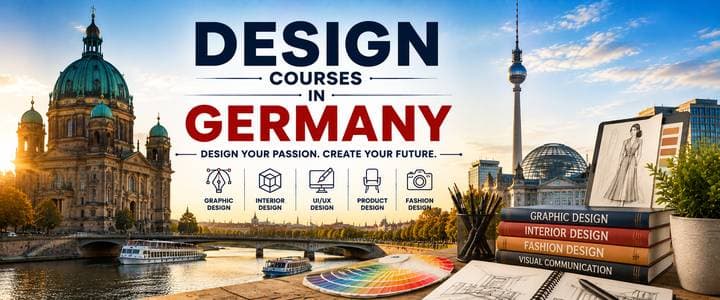
Germany is an attractive study destination for students interested in graphic design, communication design, product design, interaction design, fashion, transportation design, visual communication, and other creative fields. The country combines a strong artistic heritage with advanced manufacturing, digital technology, sustainability, and practical university education.
Unlike programs based primarily on examination scores, admission to many design courses in Germany depends heavily on artistic ability. A portfolio, design assignment, aptitude examination, or interview can be as important as the applicant’s academic grades. Some universities expect traditional drawing and visual experimentation, while others focus on digital products, user research, systems thinking, prototypes, or problem-solving.
International students can study at public art universities, universities of applied sciences, comprehensive universities, and private design schools. Public institutions are generally affordable, but many bachelor’s courses are taught in German. English-taught options are more common at the master’s level and at private universities.
Indian students must also evaluate their university entrance eligibility, obtain an APS certificate in most cases, and determine whether they need Studienkolleg before applying. This guide covers the major design specializations, universities, eligibility criteria, portfolio requirements, application process, tuition fees, living expenses, scholarships, and career opportunities in Germany.
Design Courses in Germany: Quick Overview
| Category | Details |
|---|---|
| Popular qualifications | Bachelor of Arts, Bachelor of Design, Master of Arts, Master of Design, Master of Fine Arts |
| Bachelor’s duration | Usually 6–8 semesters |
| Master’s duration | Usually 2–4 semesters |
| Main intake | Winter semester |
| Additional intake | Summer semester at selected institutions |
| Main teaching language | German at the bachelor’s level; German or English at the master’s level |
| Typical German requirement | B2 or C1, depending on the program |
| Typical English requirement | IELTS, TOEFL, Cambridge, or another accepted qualification |
| Portfolio | Required for many design programs |
| Aptitude examination | Common at public art and design universities |
| Regular tuition at public institutions | Usually no general tuition fee |
| Semester contribution | Commonly approximately €150–€400 |
| Non-EU tuition in Baden-Württemberg | Generally €1,500 per semester, subject to exemptions |
| Private university tuition | Commonly €7,000–€20,000 or more per year |
| Estimated living expenses | Approximately €900–€1,550 per month |
| APS for Indian students | Generally required |
| Current visa proof of funds | €11,904 for one year |
| Post-study job-search period | Up to 18 months for eligible non-EU graduates |
Why Study Design in Germany?
Germany’s design environment extends beyond advertising and visual art. German companies use designers in manufacturing, mobility, software, publishing, architecture, consumer products, healthcare, sustainability, public services, and cultural institutions.
Strong Connection Between Design and Industry
Germany is home to automotive companies, industrial manufacturers, technology businesses, publishers, fashion brands, cultural organizations, and digital agencies. This creates opportunities for projects involving real products, users, technical limitations, production processes, and commercial requirements.
Product and transportation design students may collaborate with engineers. Interaction designers may work with software developers and psychologists. Communication designers can explore typography, editorial systems, branding, photography, and moving images.
Project-Based Education
Many German design programs are organized around studios, workshops, group projects, critiques, exhibitions, and practical assignments. Students are expected to develop ideas, test alternatives, accept feedback, and explain the reasoning behind their decisions.
A strong program teaches more than software operation. It develops research, observation, experimentation, visual judgment, technical understanding, and the ability to solve problems for specific users.
Affordable Public Institutions
Many public universities do not charge a general tuition fee. Students ordinarily pay a semester contribution covering administration, student services, and other institutional benefits.
The principal exceptions include tuition for non-EU students in Baden-Württemberg and fees charged by private universities or certain continuing-education programs.
Diverse Design Specializations
Students are not limited to graphic design. German institutions offer programs covering digital interfaces, physical products, mobility, fashion, jewelry, interiors, service systems, games, animation, photography, and interdisciplinary design.
International Career Potential
A German design degree can support careers in Germany, India, and other international markets. However, employment depends heavily on the quality of the graduate’s portfolio, practical experience, specialization, communication skills, and professional network.
Types of Design Courses in Germany
Design programs use different titles, and similarly named degrees can have very different curricula. Applicants should examine the module handbook and student projects rather than choosing a course based only on its title.
| Design Specialization | Main Areas of Study | Possible Careers |
|---|---|---|
| Communication Design | Typography, branding, editorial design, visual systems, photography | Communication designer, brand designer, art director |
| Graphic Design | Layout, illustration, typography, advertising, digital graphics | Graphic designer, visual designer, illustrator |
| Visual Communication | Image-making, typography, photography, film, digital and spatial communication | Visual communicator, creative designer, editorial designer |
| Product Design | Research, sketching, form development, materials, prototyping | Product designer, industrial designer, design consultant |
| Industrial Design | Manufacturing, ergonomics, technical design, usability, systems | Industrial designer, product-development designer |
| Interaction Design | User experience, interface design, digital products, prototyping | UX designer, UI designer, interaction designer |
| Digital Product Design | Apps, websites, software interfaces, design systems, user research | Product designer, UX/UI designer |
| Transportation Design | Vehicle concepts, mobility systems, visualization, modeling | Automotive designer, mobility designer, transportation designer |
| Fashion Design | Garment construction, textiles, illustration, collections, fashion concepts | Fashion designer, collection designer, fashion consultant |
| Textile Design | Materials, surfaces, weaving, printing, sustainable textiles | Textile designer, material designer, surface designer |
| Interior Design | Spatial planning, furniture, lighting, materials, construction | Interior designer, spatial designer, exhibition designer |
| Jewelry and Accessory Design | Metals, materials, wearable objects, craftsmanship | Jewelry designer, accessory designer, independent artist |
| Game Design | Game systems, storytelling, interactive media, prototyping | Game designer, level designer, narrative designer |
| Animation and Motion Design | 2D and 3D animation, film, compositing, visual storytelling | Animator, motion designer, 3D artist |
| Service Design | User journeys, service systems, research, organizational design | Service designer, experience strategist |
| Strategic Design | Design research, management, innovation, systems thinking | Design strategist, innovation consultant |
| Sustainable Design | Circular design, materials, social impact, responsible production | Sustainability designer, circular-design consultant |
| Stage and Costume Design | Theater spaces, performance, costume, visual storytelling | Stage designer, costume designer, production designer |
| Photography | Artistic photography, documentary practice, image theory | Photographer, visual artist, image editor |
Bachelor’s Design Courses in Germany
A bachelor’s degree introduces students to design principles, visual methods, materials, production processes, research, and professional practice. The standard duration is normally six to eight semesters.
Common bachelor’s degree titles include:
Bachelor of Arts in Communication Design
Bachelor of Arts in Product Design
Bachelor of Arts in Interaction Design
Bachelor of Arts in Fashion Design
Bachelor of Arts in Visual Communication
Bachelor of Arts in Integrated Design
Bachelor of Design
Bachelor of Fine Arts
Bachelor of Engineering in design-related technical programs
Bachelor of Science in digital or technology-centered design programs
A bachelor’s curriculum may include foundation studios during the first year, followed by specialization, electives, practical projects, an internship, and a final thesis or design project.
Master’s Design Courses in Germany
Master’s programs allow students to specialize, develop a more advanced creative practice, or combine design with research, management, technology, sustainability, or social innovation.
Popular master’s areas include:
Strategic Design
Integrated Design Research
Visual Communication
Product Design
Interaction Design
User Experience Design
Transportation Design
Design and Future Making
Creative Direction
Fashion Design
Design Management
Service Design
Sustainable Design
Digital Media Design
Media Arts
Exhibition Design
Urban and Spatial Design
Most programs require a relevant undergraduate degree and a portfolio. Some interdisciplinary courses accept applicants from architecture, engineering, media, computer science, social science, or business, provided they demonstrate a convincing connection to design.
A master’s portfolio should usually show independent thinking, a coherent design process, advanced projects, and evidence that the applicant can work at the expected academic level.
Public Art Universities, Universities of Applied Sciences, and Private Schools
Germany has several types of institutions offering design education.
Art and Design Universities
Art universities emphasize artistic development, experimentation, critique, conceptual work, and individual creative practice. Admission is often based on special artistic aptitude.
These institutions may have small classes and highly selective entrance procedures. They can be suitable for students interested in visual communication, fine art, fashion, stage design, product design, or experimental media.
Universities of Applied Sciences
Universities of applied sciences generally provide practice-oriented education. Design programs may include industry projects, internships, workshops, technical modules, and applied research.
They are particularly relevant for communication design, interaction design, product design, industrial design, interior design, media design, and digital design.
Comprehensive and Technical Universities
Some comprehensive or technical universities combine design with architecture, media, engineering, technology, urban studies, or the humanities.
Private Design Universities
Private institutions may offer more English-taught programs, flexible intakes, smaller classes, and specialized facilities. However, tuition can be considerably higher.
Before selecting a private institution, students should verify:
State recognition
Accreditation
Awarding institution
Total tuition
Program language
Facilities
Internship support
Graduate outcomes
Cancellation and refund terms
Whether the degree qualifies for the intended visa and career pathway
Design Universities in Germany
The following institutions are representative options, not a universal ranking.
| Institution | Location | Selected Design Areas |
|---|---|---|
| Berlin University of the Arts | Berlin | Visual communication, product design, fashion, stage design, costume design |
| Weißensee Academy of Art Berlin | Berlin | Visual communication, product design, fashion, textile and surface design |
| Bauhaus University Weimar | Weimar | Product design, visual communication, media art and design |
| Burg Giebichenstein University of Art and Design | Halle | Industrial design, communication design, fashion, interior architecture, multimedia |
| Pforzheim University School of Design | Pforzheim | Fashion, industrial design, transportation design, visual communication, jewelry |
| HfG Schwäbisch Gmünd | Schwäbisch Gmünd | Communication, interaction, product and digital product design |
| Köln International School of Design, TH Köln | Cologne | Integrated design and design research |
| Folkwang University of the Arts | Essen | Communication design, industrial design, photography |
| Offenbach University of Art and Design | Offenbach | Design, visual communication, art and media |
| Muthesius University of Fine Arts and Design | Kiel | Communication design, industrial design, spatial strategies |
| Hamburg University of Applied Sciences | Hamburg | Communication, illustration, fashion and media-related design |
| Potsdam University of Applied Sciences | Potsdam | Communication design, interface design, product design |
| TH Rosenheim | Rosenheim | Interior design and applied design-related disciplines |
| Trier University of Applied Sciences | Trier | Fashion, communication, interior and interdisciplinary design |
| Mainz University of Applied Sciences | Mainz | Communication design and media-oriented design |
| Darmstadt University of Applied Sciences | Darmstadt | Media, animation, interaction, augmented and virtual reality design |
| Osnabrück University of Applied Sciences | Osnabrück | Industrial product design and media-related programs |
| TH Würzburg-Schweinfurt | Würzburg | Communication design |
| University of Applied Sciences Berlin | Berlin | Communication design, fashion design, media and product-related programs |
| University of Europe for Applied Sciences | Multiple locations | Communication, illustration, UX/UI, game and digital design |
Course availability, teaching language, admission criteria, and deadlines can change. Students should verify the current program page before applying.
Eligibility for Design Courses in Germany
General admission requirements can include:
A recognized school-leaving or university entrance qualification
A qualifying bachelor’s degree for master’s admission
A portfolio
Artistic or design aptitude examination
Program-specific assignment
Interview
German or English language proficiency
Relevant internship or work experience
APS certificate for applicants with Indian qualifications
Preliminary Review Documentation from uni-assist, where required
Design admission is unusual because academic eligibility and artistic eligibility may be assessed separately. A university may first determine whether the applicant’s educational qualification permits enrollment and then evaluate the portfolio or aptitude test.
Eligibility for Indian Students After Class 12
For admissions beginning with the winter semester 2026/27, APS India requires a minimum overall score of 70% in the Indian Class XII certificate for the established undergraduate pathways.
The principal possibilities are:
| Indian Academic Background | Possible Admission Route |
|---|---|
| Class XII with at least 70% | Possible subject-restricted Studienkolleg pathway |
| Class XII plus one successful academic year in a recognized bachelor’s program | Possible direct subject-restricted admission in the previous or a closely related field |
| Recognized International Baccalaureate | Direct or subject-specific admission may be possible |
| Recognized GCE qualification | Direct subject-specific admission may be possible |
| Exceptional artistic aptitude | Certain art universities may offer special admission provisions, subject to state and institutional rules |
| Completed relevant bachelor’s degree | Possible admission to a related master’s program |
The 70% requirement establishes academic eligibility for the applicable route. It does not replace a portfolio, aptitude examination, or other program requirements.
An Indian student with 70% in Class XII is not automatically eligible for direct bachelor’s admission. In many cases, the student must complete Studienkolleg or one successful academic year at a recognized Indian university.
Is Studienkolleg Required for Design?
Studienkolleg may be required when the applicant’s school qualification does not provide direct university entrance eligibility.
The appropriate preparatory course depends on the institution and design program. Possibilities may include:
G-course for humanities, arts, and language-related studies
GD-course for arts and design at certain universities of applied sciences
T-course for technically oriented design programs
Another course specified by the institution
No Studienkolleg in limited cases where admission based on exceptional artistic talent is legally permitted
Students should not independently select a Studienkolleg course based only on the word “design.” Product design, communication design, interior design, and digital product design may be assigned differently.
The university should confirm in writing:
Whether Studienkolleg is required
Which course is appropriate
Whether the institution accepts the chosen Feststellungsprüfung
Whether the qualification creates eligibility for that exact design program
Passing the Feststellungsprüfung establishes academic eligibility but does not replace the portfolio or aptitude assessment.
Can JEE Advanced Provide Direct Entry to Design?
The JEE Advanced pathway described by DAAD India is intended for technology and natural-science programs. Students should not assume that a JEE Advanced result provides direct admission eligibility for a conventional communication, fashion, visual, or artistic design course.
A technical design or design-engineering program may be evaluated differently, but eligibility must be confirmed by APS and the university.
Admission Requirements for Bachelor’s Design Programs
A bachelor’s application commonly requires:
Recognized university entrance qualification
Class X and Class XII records
Portfolio or work samples
Design assignment
Artistic aptitude test
Interview
German language certificate
APS certificate for Indian applicants
Curriculum vitae
Motivation letter
Pre-study internship, where required
Uni-assist VPD, where required
Some institutions can admit applicants without the usual school qualification if they demonstrate exceptional artistic talent. This is an institution-specific exception, not a general route for all international students.
Admission Requirements for Master’s Design Programs
Master’s applicants may need:
Recognized bachelor’s degree
Relevant design or related academic background
Minimum required ECTS credits
Portfolio
Bachelor’s thesis or final project
Statement of purpose
Curriculum vitae
Letters of recommendation
English or German language certificate
APS certificate
Work experience, where required
Proposed research topic
Interview or presentation
A student with a 180-ECTS bachelor’s degree may face additional requirements if the German master’s program expects 210 or 240 ECTS. Certain universities offer adaptation modules, while others reject applicants who do not meet the credit requirement.
Portfolio Requirements
The portfolio is often the most important part of a design application. It should demonstrate how the applicant observes, explores, develops, and communicates ideas.
Universities may request approximately 10–25 projects or work samples, but there is no universal number. Some ask for a single PDF, while others require physical work, videos, digital uploads, or a university-specific task.
A portfolio can contain:
Drawings
Sketchbooks
Paintings
Typography
Photography
Editorial layouts
Brand systems
Posters
Illustrations
Product sketches
Physical models
Prototypes
Interface designs
User research
Animation
Film
Fashion garments
Textile experiments
Spatial installations
Process documentation
What Makes a Strong Portfolio?
A strong portfolio shows:
Original work
Clear observation
Independent thinking
Experimentation
Development from initial idea to final result
Ability to work with different media
Understanding of the selected specialization
Reflection on successes and failures
Clear project descriptions
Good visual organization
Admissions committees generally want to understand how an applicant thinks. A polished final image without sketches, research, alternatives, or explanation may reveal less than a well-documented project.
Portfolio Structure
A useful structure is:
Short introduction
Selected strongest project
Research and observation
Initial sketches
Experiments and rejected alternatives
Development process
Prototype or final output
Evaluation and learning
Additional work
Contact and authorship information
The portfolio should follow the university’s format exactly. A candidate should not submit 40 projects when the limit is 20.
Use of Artificial Intelligence
If generative AI is used, applicants should disclose it and explain how it contributed to the process. Some design schools now explicitly request disclosure.
AI-generated visuals should not replace the applicant’s own thinking, observation, drawing, experimentation, and authorship. Submitting generated work as independently created artwork can lead to rejection or questions about academic integrity.
Design Assignment and Aptitude Examination
Portfolio assessment is frequently followed by a creative assignment, aptitude test, or interview.
Possible tasks include:
Responding visually to a theme
Creating a poster or sequence
Drawing an observed object
Developing a product concept
Solving a user-experience problem
Building a paper model
Producing a storyboard
Explaining a portfolio project
Discussing design interests and influences
The evaluators may assess creativity, visual judgment, conceptual thinking, communication, curiosity, originality, technical potential, and the applicant’s openness to feedback.
Students should not memorize fashionable design terminology. They should be able to explain why they made particular decisions and what they learned from each project.
Language Requirements
German-Taught Programs
Most public bachelor’s design courses are taught in German. Common requirements range from B2 to C1.
Accepted qualifications may include:
TestDaF
DSH
Goethe certificates
telc Deutsch C1 Hochschule
German Language Diploma
Other university-approved certificates
Some art universities permit an application with B1 but require B2 or a higher level before enrollment. The exact rule must be checked for the selected course.
English-Taught Programs
English-taught master’s programs and private bachelor’s courses may accept:
IELTS
TOEFL
Cambridge English
Other recognized B2 or C1 certificates
Proof of previous education in English, if expressly accepted
A Medium of Instruction letter is not universally accepted.
Is German Necessary for an English-Taught Design Course?
German may not be required for formal admission to an English-taught program, but it is valuable for:
Internships
Student jobs
Client communication
Networking
Housing
Administrative tasks
Graduate employment
Freelance projects
A student planning a design career in Germany should aim for at least B1 or B2 German even when the degree is taught in English.
APS Certificate for Indian Students
APS India verifies Indian academic qualifications for German university and visa applications.
Important points include:
APS is generally required for students with Indian qualifications.
The correct procedure depends on the applicant’s completed academic stage.
From winter semester 2026/27, the undergraduate pathways require at least 70% overall in Class XII.
APS verification does not guarantee university admission.
TestAS is not currently mandatory for the APS process, although a university or visa authority may request it.
The Digital Master Test applies to selected master’s applicant groups and is not a general undergraduate design requirement.
The original digital APS document should not be renamed, merged, edited, or compressed.
Processing times are not fixed, so students should apply early.
Students using the one-year bachelor’s route should normally obtain APS after successfully completing the academic year that establishes their intended eligibility category.
How to Apply for Design Courses in Germany
The application channel may be:
Direct university application
Uni-assist
A university application portal
A separate portfolio portal
A combination of uni-assist and direct artistic assessment
Step 1: Select a Specialization
Decide whether the intended field is visual, digital, physical, spatial, fashion-related, technical, or interdisciplinary.
Step 2: Check Academic Eligibility
Determine whether the qualification allows direct admission or requires Studienkolleg. Indian students should review APS requirements.
Step 3: Check the Teaching Language
Confirm the required German or English level and accepted certificates.
Step 4: Read the Portfolio Instructions
Record the number of projects, file size, accepted media, submission method, labeling rules, and deadline.
Step 5: Complete the Design Assignment
Some universities publish a specific topic or homework task. Follow the brief without copying existing solutions.
Step 6: Obtain APS or VPD
Complete document verification early. Some universities require a uni-assist VPD in addition to their own application.
Step 7: Submit the Formal Application
Upload academic records, language certificates, portfolio documents, and the application fee before the deadline.
Step 8: Attend the Aptitude Test or Interview
Be prepared to discuss projects, influences, design process, and reasons for choosing the program.
Step 9: Accept the Offer and Arrange Finances
Pay the semester contribution or tuition, obtain health insurance, and prepare proof of funds.
Step 10: Apply for the Student Visa
Submit the admission letter, APS certificate, financial documents, insurance, language proof, and other required records.
Documents Required
The final checklist depends on the institution, but students may need:
Passport
Passport photographs
Class X certificate and mark sheet
Class XII certificate and mark sheet
Bachelor’s degree and transcripts
APS certificate
Uni-assist VPD
Studienkolleg and Feststellungsprüfung records
Portfolio
Design assignment
Curriculum vitae
Motivation letter
Language certificate
Letters of recommendation
Internship or employment certificate
Bachelor’s thesis summary
Application fee receipt
Certified translations
Proof of health insurance at enrollment
Documents already issued in German or English may not require translation, but institutional rules must be followed.
Application Deadlines and Intakes
Many design courses begin only in the winter semester. Their portfolio deadlines can be much earlier than ordinary university application deadlines.
A typical schedule may look like this:
| Period | Recommended Action |
|---|---|
| 18–24 months before enrollment | Select specialization and begin language preparation |
| 12–18 months before enrollment | Develop portfolio projects and evaluate academic eligibility |
| 9–12 months before enrollment | Obtain APS and take language tests |
| November–March | Submit early portfolio or aptitude-test applications where applicable |
| March–May | Submit additional university and portfolio applications |
| May–July | Attend aptitude tests and interviews |
| July–August | Complete enrollment and visa preparation |
| September–October | Arrive and begin the winter semester |
This is a planning example, not a universal calendar. Some universities open applications only once per year, and missing the artistic-assessment deadline may delay admission by an entire year.
Tuition Fees
Public Universities
Many public institutions charge no regular tuition fee for standard bachelor’s and consecutive master’s programs. Students commonly pay a semester contribution of approximately €150–€400.
The contribution may cover:
Student administration
Student services
Student representation
Campus facilities
Public transportation benefits
Baden-Württemberg
Public institutions in Baden-Württemberg generally charge non-EU students €1,500 per semester unless an exemption applies.
Design institutions in this state include Pforzheim University and HfG Schwäbisch Gmünd. Applicants should verify the current fee for their program and personal category.
Private Universities
Private design tuition can range from approximately €7,000 to more than €20,000 per year. Some institutions publish monthly rather than annual prices.
Students should calculate:
Enrollment fee
Monthly or semester tuition
Examination fees
Software licenses
Equipment
Studio charges
Graduation fees
Tuition increases
Total cost for the complete degree
Additional Design-Study Expenses
Design students may spend more on materials than students in lecture-based programs.
| Expense | Possible Cost |
|---|---|
| Laptop or workstation | €700–€2,500 |
| Drawing tablet | €50–€800 |
| Camera equipment | €300–€2,000 or rental costs |
| Printing and portfolio production | €100–€600 per year |
| Models and prototyping materials | €150–€1,000 per year |
| Art supplies | €100–€600 per year |
| Software | Free through university or several hundred euros annually |
| Sewing or fashion materials | Highly dependent on the project |
| Workshop and exhibition expenses | Program-specific |
| External hard drives and storage | €60–€250 |
Students should first check what the university provides. Workshops, computer laboratories, cameras, fabrication equipment, software licenses, and printing facilities may be available at subsidized rates.
Cost of Living
| Expense | Estimated Monthly Cost |
|---|---|
| Accommodation and utilities | €350–€850 |
| Food | €180–€320 |
| Health insurance | €130–€160 |
| Transportation | €0–€100 |
| Phone and internet | €25–€60 |
| Study materials | €30–€150 |
| Personal expenses | €100–€250 |
| Estimated total | €900–€1,550 |
Housing is usually the largest expense. Berlin, Munich, Hamburg, Frankfurt, and other competitive cities can be significantly more expensive than smaller university towns.
The current proof-of-funds amount stated for Indian student visa applicants is €11,904 for one year, with a monthly withdrawal limit of €992. This is a visa threshold and may not cover the full cost of living in expensive cities.
Scholarships for Design Students
Funding possibilities include:
DAAD scholarship programs
Deutschlandstipendium
University scholarships
Foundation scholarships
Erasmus funding
Exchange grants
Project grants
Competition prizes
Emergency assistance
Final-semester grants
Fully funded scholarships for international bachelor’s students are limited. Many DAAD programs focus on postgraduate study, research, or applicants with professional experience.
Design students may also benefit from competitions, commissioned work, assistant positions, and paid internships, but these sources should not replace a secure financial plan.
Working While Studying
Eligible students from non-EU countries may generally work up to 140 full days or 280 half days per year. Alternatively, students may work up to 20 hours per week during the lecture period under the applicable arrangement.
Possible student jobs include:
Design assistant
Social media designer
Junior graphic designer
Photography assistant
Workshop assistant
University student assistant
Web design assistant
Content creator
Retail employee
Hospitality worker
International students should verify how freelance work or self-employment affects their residence permit. Freelancing may require permission from the foreigners authority.
Compulsory and voluntary internships can be treated differently under employment rules. Students should consult the university’s international office before accepting an internship.
Internships and Practical Experience
Internships can help students:
Build professional projects
Learn workplace processes
Understand client feedback
Develop German communication skills
Test a specialization
Build industry contacts
Improve the graduate portfolio
Potential employers include:
Design agencies
Technology companies
Automotive companies
Fashion businesses
Manufacturers
Publishers
Architecture studios
Museums
Media companies
Startups
Public institutions
A strong combination of university projects, internships, freelance assignments, and self-initiated work can make a graduate portfolio more competitive.
Career Opportunities
| Degree Area | Potential Roles |
|---|---|
| Communication Design | Communication designer, art director, brand designer |
| Graphic Design | Graphic designer, editorial designer, illustrator |
| Interaction Design | UX designer, UI designer, interaction designer |
| Digital Product Design | Product designer, UX researcher, design systems designer |
| Product Design | Product designer, industrial designer, design consultant |
| Transportation Design | Automotive designer, mobility designer, visualization specialist |
| Fashion Design | Fashion designer, collection assistant, fashion illustrator |
| Interior Design | Interior designer, spatial designer, exhibition designer |
| Animation | Animator, motion designer, storyboard artist |
| Game Design | Game designer, level designer, interactive storyteller |
| Service Design | Service designer, customer-experience designer |
| Strategic Design | Design strategist, innovation consultant, design researcher |
| Photography | Photographer, image editor, visual artist |
| Stage and Costume Design | Stage designer, costume designer, production designer |
Expected Salaries
Design salaries vary according to specialization, city, experience, employer, portfolio, and technical skills.
Indicative annual gross salary ranges may include:
| Role | Approximate Annual Gross Range |
|---|---|
| Junior graphic or communication designer | €30,000–€45,000 |
| UX or UI designer | €40,000–€60,000 |
| Product or industrial designer | €38,000–€58,000 |
| Motion or 3D designer | €35,000–€55,000 |
| Interior or spatial designer | €34,000–€52,000 |
| Service or strategic designer | €42,000–€65,000 |
| Experienced art or creative director | €50,000–€80,000 or more |
These figures are broad market estimates, not guaranteed salaries. Entry-level fashion, cultural, and independent creative work may pay less, while experienced digital-product designers can earn more.
Skills That Improve Employability
Employers may look for:
Strong portfolio
Concept development
User research
Visual communication
Prototyping
Typography
Design systems
Figma and interface tools
Adobe Creative Cloud
3D modeling
Motion design
CAD software
Materials and manufacturing knowledge
German communication
Presentation skills
Teamwork
Project management
Responsible use of AI tools
Software alone does not make someone a designer. Employers also evaluate research, judgment, problem-solving, communication, and the ability to improve work after feedback.
Post-Study Work Opportunities
Eligible non-EU graduates of German universities can apply for a residence permit of up to 18 months to search for qualified employment.
During the job-search period, graduates can generally take different forms of employment while seeking an appropriate professional role. After securing qualified employment, they can apply for the relevant work residence permit.
Design graduates should begin preparing before the final semester by:
Translating the portfolio into English and German where useful
Creating a focused professional website
Applying for internships and student jobs
Attending exhibitions and industry events
Building German proficiency
Requesting references
Preparing case studies
Learning German application conventions
Common Application Mistakes
Submitting the Same Portfolio Everywhere
Each program has different expectations. A transportation design portfolio should not be identical to an interaction design application.
Showing Only Final Images
Admissions committees want to see research, sketches, alternatives, prototypes, and development.
Ignoring the Portfolio Format
Incorrect file size, excessive work samples, missing labels, or prohibited external links can invalidate an application.
Using Templates Excessively
A portfolio should express the applicant’s thinking and visual identity. Generic layouts and copied online projects weaken credibility.
Hiding AI Use
If AI tools contributed to a project, disclose their role. Applicants must be able to demonstrate authorship and independent creative judgment.
Applying Too Late
Portfolio deadlines at art universities may occur months before general university deadlines.
Assuming English Is Sufficient
Many public bachelor’s courses require B2 or C1 German.
Confusing Artistic Admission With Academic Eligibility
Passing the portfolio round does not always resolve school-qualification, APS, or Studienkolleg requirements.
Selecting a Private Institution Without Verification
Students should confirm recognition, accreditation, complete tuition, and degree-awarding authority.
Application Checklist
Before applying, confirm that:
Your chosen design specialization matches your interests.
The qualification is recognized.
You know whether Studienkolleg is required.
The selected Studienkolleg course is accepted.
You satisfy the Class XII eligibility rules.
You have obtained or applied for APS.
You meet the language requirement.
Your portfolio follows the exact instructions.
Your projects demonstrate process and authorship.
You have completed the required assignment.
You are prepared for the aptitude test.
You know the correct application portal.
You have checked the portfolio and academic deadlines separately.
You understand all tuition and material expenses.
You can finance your living costs.
You have researched internships and graduate opportunities.
Frequently Asked Questions
Is Germany good for design students?
Germany offers respected public design institutions, project-based education, strong connections with technology and manufacturing, and relatively affordable tuition. The best choice depends on the student’s specialization and portfolio.
Which design course is best in Germany?
There is no single best design course. Interaction design can suit students interested in digital products, while industrial design is appropriate for physical products and manufacturing. Communication design focuses on visual systems, and fashion design centers on garments, materials, and collections.
Can I study design in Germany after Class 12?
Yes, but Indian Class XII qualifications do not normally provide automatic direct admission. Students may need Studienkolleg or one successful academic year in a recognized bachelor’s program.
What is the minimum Class XII percentage?
For admission beginning with winter semester 2026/27, APS India specifies at least 70% overall in Class XII for the established undergraduate admission pathways. Universities may impose additional requirements.
Is a portfolio compulsory?
A portfolio or collection of work samples is required for many design programs. Some programs use a university assignment or aptitude test instead of a traditional portfolio.
How many projects should a design portfolio contain?
Requirements commonly range from 10 to 25 works, but every university sets its own limit. Students must follow the specified number and format.
Can I include digital work in my portfolio?
Yes, if the program permits it. Digital interfaces, animation, photography, film, prototypes, and 3D projects may be included alongside drawings and process work.
Can I use AI-generated images?
AI use should be disclosed. The portfolio must still demonstrate the applicant’s own observation, process, decisions, skills, and authorship.
Is German required?
Most public bachelor’s programs require German, commonly at B2 or C1. English-taught options are more common at private universities and in master’s programs.
Are public design universities free?
Many public institutions do not charge regular tuition, but students pay a semester contribution. Non-EU students in Baden-Württemberg generally pay €1,500 per semester unless exempt.
Is APS required for Indian design students?
APS is generally required for applicants whose academic qualifications were earned in India.
Is TestAS required?
TestAS is not currently mandatory for APS verification. A university or visa authority may request it separately.
Which Studienkolleg course is required for design?
The correct course may be G, GD, T, or another option, depending on the institution and type of design degree. The university must confirm the appropriate route.
Can I pursue a master’s in design after a non-design bachelor’s degree?
Some interdisciplinary programs accept graduates from related subjects, but the applicant must demonstrate relevant experience and a convincing portfolio. Other programs require a formal design degree.
How much does it cost to study design in Germany?
At a public institution, students may mainly pay the semester contribution and living expenses. A realistic annual budget can exceed €12,000–€18,000 after housing, insurance, food, materials, and personal costs are included.
Can international students work during their studies?
Eligible third-country students may generally work 140 full or 280 half days annually, or use the applicable 20-hour-per-week alternative.
Can I freelance while studying?
Freelancing or self-employment may require permission from the responsible foreigners authority. Students should obtain guidance before accepting independent projects.
Can I remain in Germany after completing a design degree?
Eligible graduates can apply for up to 18 months to search for qualified employment in Germany.
Final Thoughts
Germany offers design education across artistic, digital, technical, and commercial disciplines. Students can study visual communication in an art university, develop digital products in an interaction design program, explore mobility through transportation design, or combine research and management through strategic design.
Successful admission requires more than good grades. Applicants must demonstrate curiosity, independent thinking, visual judgment, problem-solving, and a genuine design process. A focused portfolio, correct academic pathway, appropriate language proficiency, and careful deadline management are essential.
Indian students should begin by confirming APS and university entrance eligibility. From the winter semester 2026/27, the applicable undergraduate routes require at least 70% overall in Class XII. Students must then determine whether they need Studienkolleg and which preparatory course their intended university accepts.
Germany can be affordable at public institutions, but students must budget for housing, health insurance, materials, equipment, and semester fees. Learning German substantially improves access to public programs, internships, professional networks, and graduate employment.
The strongest strategy is to choose a clear specialization, study the work produced at each university, create original portfolio projects, document the complete process, and apply only after understanding both the academic and artistic requirements.









