


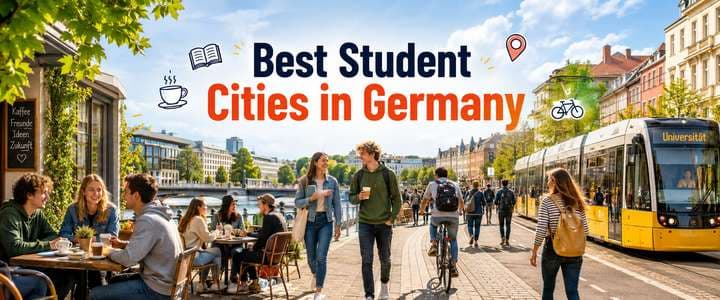
Germany offers international students a choice between globally recognized metropolitan centers, specialized university towns, affordable eastern cities, and industrial hubs with strong employment opportunities. The best student city in Germany depends on more than university rankings. Accommodation costs, course availability, part-time jobs, transportation, language requirements, lifestyle, and career prospects can significantly affect the overall experience.
Munich and Berlin are Germany’s highest-ranked international student cities. In the QS Best Student Cities 2026 ranking, Munich placed fourth globally, while Berlin shared seventh place. However, both cities have competitive housing markets, and Munich is one of Germany’s most expensive places to live.
Students seeking affordable alternatives can consider Leipzig, Dresden, Saarbrücken, Göttingen, or Aachen. Those prioritizing engineering and technology may prefer Munich, Aachen, Karlsruhe, Stuttgart, or Dresden. Frankfurt is strong for finance, Hamburg for logistics and media, Cologne for business and communication, and Heidelberg for medicine and research.
This guide compares the best student cities in Germany based on universities, approximate living costs, accommodation, part-time employment, transportation, student life, and opportunities for Indian and international students.
Best Student Cities in Germany: Quick Comparison
| City | Best known for | Approximate monthly budget | Cost level |
|---|---|---|---|
| Munich | Engineering, technology, business, research | €1,300–€1,800 | Very high |
| Berlin | Startups, technology, arts, social sciences | €1,150–€1,600 | High |
| Aachen | Engineering, technology, research | €900–€1,250 | Moderate |
| Heidelberg | Medicine, life sciences, research | €1,050–€1,400 | High |
| Hamburg | Logistics, aviation, media, business | €1,100–€1,500 | High |
| Frankfurt | Finance, economics, business, data | €1,150–€1,550 | High |
| Cologne | Business, media, humanities, sports | €1,050–€1,450 | High |
| Stuttgart | Automotive, engineering, manufacturing | €1,100–€1,500 | High |
| Karlsruhe | Computer science, engineering, energy | €950–€1,300 | Moderate |
| Dresden | Semiconductors, engineering, research | €850–€1,150 | Affordable |
| Leipzig | Business, media, logistics, humanities | €850–€1,150 | Affordable |
| Freiburg | Environment, medicine, sustainability | €1,050–€1,400 | High |
| Göttingen | Research, natural sciences, humanities | €850–€1,150 | Affordable |
| Münster | Business, law, humanities, student life | €900–€1,250 | Moderate |
| Erlangen–Nuremberg | Engineering, healthcare, business | €950–€1,300 | Moderate |
| Saarbrücken | Computer science, AI, linguistics | €800–€1,100 | Affordable |
The budget estimates include shared accommodation, food, health insurance, transportation, communication, study materials, and basic personal expenses. Actual spending depends on housing, insurance status, and lifestyle.
How to Choose the Best Student City
Students should compare the following factors before accepting a university offer.
University and Course Quality
A highly ranked city is not automatically the best choice for every subject. A specialized university in a smaller city may provide stronger laboratories, faculty access, and industry connections in a particular field.
Students should evaluate:
Course curriculum
Faculty and research groups
Laboratory facilities
Industry partnerships
Internship opportunities
Graduate employment
Language of instruction
Accreditation
Thesis opportunities
Class size
Cost of Living
Rent is normally the largest monthly expense. A difference of €300 in monthly accommodation creates an additional cost of €7,200 over a two-year master’s degree.
Students should compare:
Student residence rent
Shared-apartment rent
Private studio rent
Health insurance
Food
Transportation
Semester contribution
Tuition fees
Residence-permit costs
Broadcasting contribution
Personal expenses
Availability of Accommodation
Housing demand is particularly high in Munich, Berlin, Hamburg, Frankfurt, Cologne, Heidelberg, Freiburg, and Stuttgart.
A city may have excellent universities but still create financial pressure if the student cannot obtain affordable housing.
Part-Time Jobs
Large cities offer more businesses, restaurants, logistics companies, technology firms, and multinational employers. Smaller university cities may have fewer jobs but also less competition and shorter commuting times.
Career Opportunities
Students planning to remain in Germany should consider the industries located in the surrounding region.
Examples include:
Automotive engineering in Munich and Stuttgart
Finance in Frankfurt
Technology and startups in Berlin
Logistics and aviation in Hamburg
Engineering in Aachen and Karlsruhe
Semiconductors in Dresden
Pharmaceuticals and chemicals around the Rhine-Neckar region
Computer science and AI in Saarbrücken
Language
English-speaking courses and workplaces are more common in international cities and research environments. German remains valuable everywhere and becomes particularly important for customer-facing jobs, smaller companies, healthcare, law, architecture, and public administration.
Munich: Best for Academic Reputation and Career Opportunities
Munich is one of Europe’s strongest centers for education, research, engineering, technology, business, and corporate employment. It ranked fourth globally in the QS Best Student Cities 2026 ranking, making it Germany’s highest-ranked student city.
Major Universities in Munich
Technical University of Munich
Ludwig Maximilian University of Munich
Munich University of Applied Sciences
University of Television and Film Munich
Academy of Fine Arts Munich
Best Subjects in Munich
Munich is particularly suitable for:
Engineering
Computer science
Artificial intelligence
Data science
Robotics
Physics
Mathematics
Medicine
Life sciences
Business
Finance
Management
Career Opportunities
The Munich region includes employers in:
Automotive manufacturing
Aerospace
Software
Electronics
Insurance
Finance
Management consulting
Biotechnology
Media
Advanced research
Students can explore internships, working-student roles, research positions, and graduate programs with major corporations, startups, universities, and research institutes.
Cost of Living in Munich
A realistic monthly student budget is approximately:
€1,300–€1,800
Shared rooms can be expensive, while private studios may exceed the upper end of a typical student budget.
Students should apply for student housing immediately after receiving admission. Living in surrounding areas and commuting can sometimes reduce rent.
Important Tuition Consideration
International students from non-EU countries should not assume that every Munich university is tuition-free. The Technical University of Munich charges tuition fees for many newly enrolled non-EU students.
Typical TUM tuition can be:
€2,000 or €3,000 per semester for many bachelor’s programs
€4,000 or €6,000 per semester for many master’s programs
Program-specific amounts and exemptions must be checked before enrollment.
Who Should Choose Munich?
Munich is best for students who:
Have a sufficient budget
Prioritize academic reputation
Want strong engineering or technology careers
Value access to multinational employers
Can begin the housing search early
Are willing to commute from surrounding areas
Berlin: Best for International Culture, Startups, and Student Life
Berlin combines major universities, research institutions, startup companies, cultural diversity, political organizations, and a large international community.
It shared seventh place globally in the QS Best Student Cities 2026 ranking.
Major Universities in Berlin
Free University of Berlin
Humboldt University of Berlin
Technical University of Berlin
Berlin University of Applied Sciences and Technology
University of Applied Sciences Berlin
Berlin University of the Arts
Charité University Medicine Berlin
Best Subjects in Berlin
Berlin is strong in:
Computer science
Artificial intelligence
Data science
Engineering
Political science
International relations
Business
Economics
Arts and design
Media
Medicine
Social sciences
Career Opportunities
Berlin is a major location for:
Startups
Software development
Fintech
E-commerce
Artificial intelligence
Digital marketing
Media
Creative industries
Public policy
International organizations
Research
English-speaking jobs are more common in Berlin than in many smaller German cities. However, competition for these positions is strong.
Cost of Living in Berlin
A realistic monthly budget is:
€1,150–€1,600
Berlin is no longer a low-cost student city. Rent has increased, and finding a suitable room can take considerable time.
Students should consider districts outside the center and areas with good public-transport connections.
Advantages of Berlin
Large international population
Extensive public transportation
Strong arts and cultural scene
Many English-speaking workplaces
Large startup ecosystem
Numerous universities and research centers
Diverse food and social communities
Challenges
Difficult housing market
Long commuting distances
Competitive job applications
Administrative appointment delays
Higher rent than many students expect
Who Should Choose Berlin?
Berlin is best for students interested in technology, startups, politics, international relations, media, design, arts, and multicultural student life.
Aachen: Best for Engineering Students
Aachen is one of Germany’s most important engineering and technology education centers. It provides a university-town atmosphere with close connections to industry and neighboring Belgium and the Netherlands.
Major Universities
RWTH Aachen University
FH Aachen University of Applied Sciences
Best Subjects
Mechanical engineering
Automotive engineering
Electrical engineering
Computer science
Industrial engineering
Materials science
Energy engineering
Robotics
Production engineering
Career Opportunities
RWTH Aachen has extensive research and industry connections. Students may access:
University research-assistant positions
Engineering internships
Automotive projects
Manufacturing research
Energy technology
Startup programs
Thesis opportunities with companies
Cost of Living
A reasonable monthly budget is:
€900–€1,250
Aachen is generally more affordable than Munich, Frankfurt, Hamburg, or Stuttgart. Housing demand can still be high at the start of the semester.
Student Life
Aachen has a large student population relative to its size. Distances are manageable, cycling is common, and students can travel easily to Belgium and the Netherlands.
Who Should Choose Aachen?
Aachen is one of the best choices for students prioritizing engineering reputation, applied research, industry connections, and moderate living costs.
Heidelberg: Best for Medicine and Research
Heidelberg is an internationally recognized university city with a strong academic and research environment.
Major Institution
Heidelberg University
The region also contains hospitals, laboratories, research institutes, biotechnology companies, and organizations connected to the life sciences.
Best Subjects
Medicine
Biology
Biotechnology
Molecular sciences
Physics
Psychology
Public health
Humanities
Law
Data-intensive scientific research
Career and Research Opportunities
Students may find opportunities through:
University hospitals
Medical research
Life-science laboratories
Biotechnology companies
Research institutes
Pharmaceutical employers in the surrounding region
Cost of Living
A realistic monthly budget is:
€1,050–€1,400
Heidelberg is smaller than Berlin or Munich, but accommodation is expensive because demand is high.
Tuition Consideration
Heidelberg is located in Baden-Württemberg. Many non-EU international students at state universities in this federal state are required to pay €1,500 per semester, subject to exemptions.
Students must include both tuition and living costs in their budget.
Who Should Choose Heidelberg?
Heidelberg is particularly attractive for students focused on medicine, life sciences, research, psychology, and academic careers.
Hamburg: Best for Logistics, Aviation, and Media
Hamburg is Germany’s second-largest city and a major European port, logistics center, aviation location, and media market.
Major Universities
University of Hamburg
Hamburg University of Technology
Hamburg University of Applied Sciences
HafenCity University Hamburg
Best Subjects
Logistics
Supply-chain management
Engineering
Aviation
Maritime studies
Business
Economics
Media
Environmental science
Data science
Career Opportunities
Hamburg provides access to:
Shipping companies
Logistics businesses
Aviation employers
Media companies
Renewable-energy firms
Consulting organizations
Technology companies
International trade
Cost of Living
A typical monthly student budget is:
€1,100–€1,500
Housing is competitive, particularly in central and popular neighborhoods. Students can consider suburban areas connected by rapid transit.
Student Lifestyle
Hamburg provides:
Extensive public transportation
Cultural activities
Nightlife
Waterfront areas
International communities
Strong employment options
Who Should Choose Hamburg?
Hamburg is well suited to students interested in logistics, aviation, maritime business, media, renewable energy, and international trade.
Frankfurt: Best for Finance and Business
Frankfurt is Germany’s leading financial center and an important location for banking, consulting, insurance, technology, transportation, and international business.
Major Universities
Goethe University Frankfurt
Frankfurt University of Applied Sciences
Frankfurt School of Finance and Management
Best Subjects
Finance
Economics
Business
Management
Data analytics
Law
Banking
Risk management
Computer science
Career Opportunities
Frankfurt hosts:
Banks
Financial regulators
Insurance companies
Consulting firms
Accounting firms
Fintech companies
Data centers
Logistics companies
International corporations
Students interested in finance can access internships and working-student positions, although recruitment can be highly competitive.
Cost of Living
A realistic monthly budget is:
€1,150–€1,550
Rent is high in central Frankfurt. Students may consider Offenbach, Darmstadt, Mainz, Wiesbaden, or other connected locations, depending on the university and commute.
Who Should Choose Frankfurt?
Frankfurt is one of Germany’s best cities for finance, economics, corporate business, risk, consulting, and international employment.
Cologne: Best for Media, Business, and Social Life
Cologne is a large, culturally active student city with universities, media organizations, insurance companies, retailers, and technology businesses.
Major Universities
University of Cologne
TH Köln University of Applied Sciences
German Sport University Cologne
Best Subjects
Business
Economics
Media
Communications
Social sciences
Law
Sports science
Engineering
Information technology
Career Opportunities
Cologne and the nearby Düsseldorf region offer opportunities in:
Media
Television
Marketing
Insurance
Retail
Telecommunications
Consulting
Automotive businesses
Events
Technology
Cost of Living
A reasonable monthly budget is:
€1,050–€1,450
Finding accommodation can be difficult. Students may search in neighboring areas connected by regional and local trains.
Student Lifestyle
Cologne is known for:
Friendly social culture
Festivals and events
Nightlife
International communities
Cultural institutions
Good regional transport
Who Should Choose Cologne?
Cologne is attractive for students seeking a large-city experience in business, media, communication, sports science, humanities, or social sciences.
Stuttgart: Best for Automotive and Manufacturing Careers
Stuttgart is one of Germany’s strongest industrial and engineering regions.
Major Universities
University of Stuttgart
University of Hohenheim
Stuttgart Media University
Stuttgart University of Applied Sciences
Best Subjects
Automotive engineering
Mechanical engineering
Electrical engineering
Aerospace engineering
Manufacturing
Computer science
Architecture
Business
Agriculture and food science
Career Opportunities
The Stuttgart region has employers in:
Automotive manufacturing
Industrial engineering
Software
Electronics
Machinery
Aerospace
Consulting
Research and development
Cost of Living
A realistic student budget is:
€1,100–€1,500 per month
Housing costs are high, although students may find alternatives outside the city center.
Tuition Consideration
Stuttgart is located in Baden-Württemberg. Many non-EU students at state universities must pay €1,500 per semester, unless they qualify for an exemption.
Who Should Choose Stuttgart?
Stuttgart is best for students targeting automotive engineering, advanced manufacturing, industrial technology, and corporate research careers.
Karlsruhe: Best for Computer Science and Technology
Karlsruhe is a major center for technology, engineering, energy, and computer science.
Major Universities
Karlsruhe Institute of Technology
Karlsruhe University of Applied Sciences
Best Subjects
Computer science
Electrical engineering
Mechanical engineering
Energy engineering
Physics
Mathematics
Information systems
Civil engineering
Career Opportunities
Karlsruhe has:
Technology companies
Research institutes
Engineering businesses
Energy organizations
Software startups
Cybersecurity activity
University research positions
Cost of Living
A typical student budget is:
€950–€1,300 per month
The city is generally less expensive than Munich or Stuttgart, although student accommodation remains competitive.
Tuition Consideration
As Karlsruhe is in Baden-Württemberg, the €1,500 non-EU tuition rule may apply at state universities.
Who Should Choose Karlsruhe?
Karlsruhe is an excellent alternative for students seeking strong computer science and engineering programs without Munich’s cost level.
Dresden: Best Affordable City for Engineering and Semiconductors
Dresden combines lower living costs with strong engineering, semiconductor, research, and technology opportunities.
Major Universities
Dresden University of Technology
Dresden University of Applied Sciences
Best Subjects
Electrical engineering
Microelectronics
Semiconductor technology
Mechanical engineering
Computer science
Materials science
Physics
Biotechnology
Career Opportunities
Dresden is an important location for:
Semiconductor manufacturing
Microelectronics
Engineering
Research
Software
Materials science
Advanced manufacturing
Cost of Living
A realistic monthly budget is:
€850–€1,150
Compared with Munich, Frankfurt, or Hamburg, students may find more affordable shared accommodation.
Student Life
Dresden offers:
Historical architecture
Cultural attractions
Cycling
Outdoor recreation
A substantial student population
Good regional transportation
Who Should Choose Dresden?
Dresden is one of the best-value German cities for engineering, electronics, semiconductor, and research students.
Leipzig: Best for Affordable Big-City Life
Leipzig offers the culture and employment possibilities of a growing city while remaining more affordable than Germany’s largest western metropolitan areas.
Major Universities
Leipzig University
Leipzig University of Applied Sciences
Best Subjects
Business
Economics
Logistics
Media
Humanities
Social sciences
Computer science
Medicine
Environmental studies
Career Opportunities
Important sectors include:
Logistics
Automotive production
E-commerce
Media
Business services
Technology
Healthcare
Research
Cost of Living
A reasonable monthly budget is:
€850–€1,150
Housing has become more expensive as the city has grown, but Leipzig can still offer better value than Berlin or Munich.
Who Should Choose Leipzig?
Leipzig is suitable for students seeking an active city, affordable accommodation, cultural life, and growing employment opportunities.
Freiburg: Best for Sustainability and Quality of Life
Freiburg is known for environmental awareness, cycling, solar energy, research, medicine, and access to the Black Forest.
Major University
University of Freiburg
Best Subjects
Environmental science
Sustainability
Renewable energy
Forestry
Medicine
Biology
Humanities
European studies
Career Opportunities
The region supports opportunities in:
Environmental consulting
Solar technology
Sustainability
Research
Healthcare
Biotechnology
Tourism
Cost of Living
A typical monthly budget is:
€1,050–€1,400
Freiburg has a difficult housing market for its size. Students should apply for accommodation early.
Tuition Consideration
The Baden-Württemberg non-EU tuition fee may apply.
Who Should Choose Freiburg?
Freiburg is ideal for students who value sustainability, cycling, nature, environmental research, and a smaller-city atmosphere.
Göttingen: Best Traditional University Town
Göttingen is a compact university city with a strong academic identity and a substantial student population.
Major University
University of Göttingen
Best Subjects
Natural sciences
Agriculture
Forestry
Mathematics
Humanities
Social sciences
Economics
Research
Cost of Living
A realistic student budget is:
€850–€1,150 per month
Daily travel distances are short, and cycling is widely used.
Student Life
Because students form a large part of the population, the city offers:
Student societies
Academic events
Affordable social activities
University sports
International communities
Easy access to university facilities
Who Should Choose Göttingen?
Göttingen is a strong option for students who prefer an academically focused, affordable, and manageable university town.
Münster: Best for Cycling and a Classic Student Experience
Münster is known for its cycling culture, historic center, active student population, and strong university environment.
Major Universities
University of Münster
Münster University of Applied Sciences
Best Subjects
Business
Economics
Law
Humanities
Social sciences
Natural sciences
Information systems
Cost of Living
A reasonable monthly budget is:
€900–€1,250
Housing can be competitive because of the city’s popularity among students.
Student Life
Münster offers:
Extensive cycling infrastructure
Student clubs and societies
Cafés and cultural activities
Short commuting distances
A lively but manageable urban environment
Who Should Choose Münster?
Münster is best for students seeking a traditional German university-city experience with an active social environment.
Erlangen–Nuremberg: Best for Engineering, Healthcare, and Business
Erlangen and Nuremberg form a connected academic and employment region.
Major Universities
Friedrich-Alexander University Erlangen-Nuremberg
Nuremberg Institute of Technology
Best Subjects
Engineering
Medical technology
Computer science
Artificial intelligence
Medicine
Business
Economics
Energy technology
Career Opportunities
The region includes:
Engineering firms
Medical-technology employers
Energy companies
Software businesses
Manufacturing
Research institutes
Business-service companies
Cost of Living
A realistic monthly budget is:
€950–€1,300
Erlangen can be surprisingly expensive because of student and corporate demand. Nuremberg and surrounding towns may provide additional housing options.
Who Should Choose the Region?
It is well suited to students who want industrial career opportunities without living in Munich or Stuttgart.
Saarbrücken: Best Affordable City for Computer Science and AI
Saarbrücken is smaller and less internationally famous than Munich or Berlin, but it has an exceptional research environment in computer science, artificial intelligence, language technology, and cybersecurity.
Major Universities and Research Environment
Saarland University
Saarland University of Applied Sciences
Major computer-science and informatics research institutes
Best Subjects
Computer science
Artificial intelligence
Cybersecurity
Computational linguistics
Software engineering
Data science
Language technology
Cost of Living
A reasonable student budget is:
€800–€1,100 per month
Saarbrücken is among the more affordable options in this guide.
Advantages
Strong computer-science research
Lower accommodation costs
Access to France and Luxembourg
Compact city
International research community
Who Should Choose Saarbrücken?
Saarbrücken is an excellent choice for computer science and AI students who prioritize research quality and affordability over big-city life.
Best German Cities by Subject
| Subject | Recommended cities |
|---|---|
| Computer Science | Munich, Berlin, Karlsruhe, Saarbrücken, Aachen |
| Artificial Intelligence | Munich, Berlin, Saarbrücken, Tübingen, Erlangen |
| Mechanical Engineering | Aachen, Munich, Stuttgart, Karlsruhe, Dresden |
| Automotive Engineering | Stuttgart, Munich, Aachen, Wolfsburg, Ingolstadt |
| Electrical Engineering | Aachen, Munich, Karlsruhe, Dresden, Erlangen |
| Data Science | Berlin, Munich, Frankfurt, Saarbrücken, Mannheim |
| Business and Management | Frankfurt, Munich, Cologne, Berlin, Mannheim |
| Finance | Frankfurt, Munich, Cologne |
| Medicine | Heidelberg, Munich, Berlin, Freiburg, Göttingen |
| Biotechnology | Heidelberg, Munich, Berlin, Freiburg, Dresden |
| Renewable Energy | Freiburg, Hamburg, Oldenburg, Berlin, Aachen |
| Logistics | Hamburg, Leipzig, Frankfurt, Dortmund |
| Media and Communication | Berlin, Hamburg, Cologne, Munich |
| Arts and Design | Berlin, Weimar, Hamburg, Cologne |
| Law | Heidelberg, Munich, Münster, Cologne, Frankfurt |
| Architecture | Berlin, Munich, Stuttgart, Karlsruhe, Weimar |
Best Affordable Student Cities in Germany
Students prioritizing low living costs can consider:
Saarbrücken
Dresden
Leipzig
Göttingen
Magdeburg
Chemnitz
Halle
Kaiserslautern
Ilmenau
Jena
Smaller cities may offer:
Lower rent
Shorter commutes
Easier access to professors
More concentrated student communities
Lower daily expenses
Potential disadvantages include:
Fewer English-speaking part-time jobs
Smaller international communities
Reduced nightlife
Fewer large corporate employers
More dependence on German
Best Cities for Part-Time Jobs
The strongest cities for part-time employment generally include:
Berlin
Munich
Hamburg
Frankfurt
Cologne
Düsseldorf
Stuttgart
Leipzig
Nuremberg
Students may find work in:
University departments
Research laboratories
Restaurants and cafés
Retail
Warehouses and logistics
Customer service
Software development
Tutoring
Administrative support
Working-student corporate positions
International students from third countries can generally work up to 140 full or 280 half working days per year or use the permitted 20-hour-per-week arrangement during the lecture period.
Students should not rely on part-time employment as their only financial plan. Finding a job may take time, and German-language ability influences the number of available opportunities.
Student Accommodation in German Cities
The main accommodation options are:
Student residences
Shared apartments
Private rooms
Studio apartments
Sublets
Temporary housing
Student residences operated by Studierendenwerke are generally the most affordable option. Recent national statistics placed the average monthly rent in these residences at approximately €318, including running costs, although actual prices vary by city and room type.
Demand greatly exceeds supply in many cities. Students should apply as soon as possible.
Private shared-apartment rent can be substantially higher:
| City type | Approximate shared-room rent |
|---|---|
| Most expensive cities | €650–€1,000 or more |
| Large western cities | €550–€850 |
| Moderate-cost university cities | €400–€650 |
| Affordable smaller cities | €300–€550 |
Tuition Fees and City Selection
Most public universities in Germany do not charge general tuition fees for standard degree programs. Students normally pay a semester contribution, often between €100 and €350.
However, important exceptions apply.
Baden-Württemberg
Many non-EU students at state universities in Baden-Württemberg must pay:
€1,500 per semester
This affects cities such as:
Heidelberg
Stuttgart
Karlsruhe
Freiburg
Mannheim
Tübingen
Legal exemptions apply to some students.
Technical University of Munich
TUM charges tuition to many newly enrolled non-EU students. Program-specific fees can be several thousand euros per semester.
Private Universities
Private universities can charge substantially higher tuition regardless of city.
Students must compare the exact program fee rather than relying on the general statement that Germany has free education.
Best Cities for Indian Students
Indian students commonly prefer cities with technical universities, international communities, English-taught programs, and strong employment markets.
Popular options include:
Munich
Berlin
Aachen
Stuttgart
Hamburg
Frankfurt
Karlsruhe
Dresden
Erlangen
Saarbrücken
A large Indian community can provide social support, but it should not be the only selection criterion.
Indian applicants should compare:
Course quality
Total tuition
Monthly rent
English-taught modules
German-language requirements
Internship opportunities
Nearby employers
Housing availability
Post-study career options
Flight and rail connectivity
Sample Monthly Student Budget
The following sample illustrates expenses in a moderate-cost city.
| Expense | Approximate monthly amount |
|---|---|
| Shared room | €500 |
| Health insurance | €130–€150 |
| Food | €250–€350 |
| Transportation | €30–€60 |
| Phone and internet | €30–€50 |
| Study materials | €20–€50 |
| Personal expenses | €150–€250 |
| Total | Approximately €1,110–€1,410 |
A student in an affordable residence may spend less. A private studio in Munich, Berlin, Frankfurt, or Hamburg can increase the total substantially.
Common Mistakes When Selecting a German City
Choosing only by global university ranking
Ignoring housing availability
Assuming every public university is tuition-free
Comparing cities without checking the specific course
Relying entirely on part-time work
Underestimating health insurance and deposits
Applying only to Munich and Berlin
Ignoring German-language requirements
Assuming a lower-cost city has no career opportunities
Selecting a city based only on social media
Forgetting to check nearby towns and commuting options
Paying accommodation deposits without verification
Frequently Asked Questions
Which is the best student city in Germany?
Munich is Germany’s highest-ranked global student city, while Berlin offers the largest international and cultural environment. The best city depends on the student’s course, budget, and career goals.
Which German city is best for international students?
Berlin, Munich, Aachen, Hamburg, Frankfurt, Heidelberg, and Cologne are popular. Aachen, Dresden, Leipzig, Göttingen, and Saarbrücken can provide better affordability.
Which is the cheapest student city in Germany?
Saarbrücken, Dresden, Leipzig, Magdeburg, Chemnitz, Halle, and Göttingen are generally among the more affordable options.
Is Munich expensive for students?
Yes. Munich is one of Germany’s most expensive student cities, particularly for accommodation.
Is Berlin affordable for students?
Berlin is less expensive than Munich in some respects, but it is no longer a cheap city. Housing demand and rent are major challenges.
Which city is best for engineering?
Aachen is an outstanding choice for engineering. Munich, Stuttgart, Karlsruhe, Dresden, and Erlangen also offer strong programs and employers.
Which city is best for computer science?
Munich, Berlin, Karlsruhe, Saarbrücken, and Aachen are among the strongest choices.
Which city is best for finance?
Frankfurt is Germany’s leading city for banking, finance, risk, and related corporate employment.
Which city is best for automotive engineering?
Stuttgart and Munich are leading automotive centers. Aachen, Wolfsburg, and Ingolstadt also provide relevant opportunities.
Which German city is best for medicine?
Heidelberg, Munich, Berlin, Freiburg, and Göttingen have strong medical and research environments.
Where can students find affordable accommodation?
Student residences and shared apartments in smaller cities generally provide the lowest rents. Applications for student housing should be submitted early.
Is student housing guaranteed?
No. Students normally arrange their own accommodation, and university admission does not guarantee a residence room.
How much money does a student need each month?
Many students need approximately €900–€1,400 per month. Munich, Frankfurt, Hamburg, and Berlin may require a higher budget.
Can international students work in Germany?
Yes. Third-country students can generally work 140 full or 280 half days annually or follow the permitted 20-hour-per-week arrangement during the lecture period.
Do students receive free public transportation?
Some university semester contributions include regional transportation benefits. Other students may need to purchase a discounted student or national transport ticket.
Are German cities safe for international students?
German university cities are generally considered safe. Students should still take normal precautions, particularly at night, in crowded transport areas, and when searching for housing.
Is German necessary in Berlin or Munich?
Students may complete an English-taught degree without advanced German, but German improves access to accommodation, part-time jobs, internships, healthcare, administration, and social integration.
Is it better to study in a large or small German city?
Large cities provide more employment, entertainment, and international communities. Smaller cities often offer lower costs, shorter commutes, and closer university communities.
Is Heidelberg expensive?
Yes. Heidelberg has a strong academic environment but a competitive housing market. Non-EU students may also need to pay Baden-Württemberg tuition fees.
Is Aachen affordable?
Aachen is generally more affordable than Munich, Frankfurt, Hamburg, or Stuttgart, although accommodation demand remains high.
Which city offers the best balance of cost and career opportunities?
Aachen, Dresden, Leipzig, Karlsruhe, Erlangen–Nuremberg, and Saarbrücken offer strong combinations of academic quality, employment potential, and moderate costs.
Final Thoughts
Munich and Berlin lead Germany’s international student-city rankings, but they are not automatically the best choices for every student. Munich offers exceptional universities and employers but has very high accommodation costs. Berlin provides international culture, startups, and English-speaking opportunities, while its housing market remains challenging.
Aachen is an excellent engineering destination with moderate costs. Frankfurt is best for finance, Hamburg for logistics and aviation, Stuttgart for automotive careers, Heidelberg for medicine and research, and Karlsruhe for computer science and engineering.
Dresden, Leipzig, Göttingen, and Saarbrücken can provide better affordability without sacrificing academic quality. Saarbrücken is particularly attractive for computer science and AI, while Dresden provides strong semiconductor and engineering opportunities.
International students should select a city only after comparing the specific university, course curriculum, tuition fees, rent, accommodation supply, part-time jobs, language requirements, and nearby industries. The best student city is ultimately the one that supports the student’s academic goals, financial capacity, and long-term career plan.









