GATE 2026 Electrical Engineering Cutoff: Check IIT, NIT and Branch-Wise Trends
The GATE 2026 Electrical Engineering (EE) cutoff is an important reference for engineering graduates seeking admission to M.Tech programmes at Indian Institutes of Technology (IITs), National Institutes of Technology (NITs) and other participating institutions. Candidates should understand the difference between the qualifying cutoff and the institute-level admission cutoff before shortlisting postgraduate programmes.
The Graduate Aptitude Test in Engineering (GATE) assesses candidates' understanding of undergraduate engineering subjects. For Electrical Engineering graduates, the score can be used to apply to programmes in power systems, power electronics, electrical machines, control systems, renewable energy and related specialisations, depending on each institution's eligibility requirements.
GATE 2026 EE Cutoff: Qualifying Marks
GATE qualifying cutoffs are published separately for each examination paper and category. They determine whether a candidate has qualified in the examination, but qualifying does not guarantee admission to a particular M.Tech programme.
For GATE 2026, the published qualifying marks for Electrical Engineering were:
| Category | Qualifying marks out of 100 |
|---|---|
| General | 25.0 |
| OBC-NCL / EWS | 22.5 |
| SC / ST / PwD | 16.6 |
These are examination qualifying marks, not the GATE scores required for admission to individual IITs or NITs. Candidates should verify the figures against the official GATE 2026 cutoff information published by the organising institute.
GATE EE Admission Cutoff for IITs
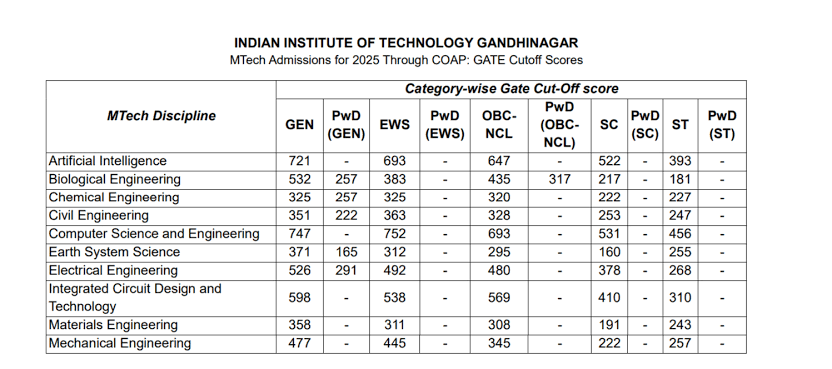
IITs use their own admission criteria, and requirements can vary by department, programme, category and selection process. Some departments shortlist candidates using a minimum GATE score, while others may also consider written tests, interviews or additional eligibility conditions.
For example, IIT Bombay's published minimum qualifying GATE score for certain postgraduate Electrical Engineering admission groups is a screening requirement rather than the final closing score for admission. IIT Madras publishes programme-specific offer or cutoff information for specialisations such as Power Systems and Power Electronics, Control and Optimization, and Electric Vehicles.
| Institute / programme | Reported 2026 General-category reference | How to interpret it |
|---|---|---|
| IIT Madras — Electric Vehicles | 751 | Reported programme offer cutoff |
| IIT Madras — Power Systems and Power Electronics | 730 | Reported programme offer cutoff |
| IIT Madras — Control and Optimization | 718 | Reported programme offer cutoff |
| IIT Bombay — certain EE admission groups | 510 | Minimum score to be considered, not a final closing score |
These figures are programme-specific references, not a universal IIT Electrical Engineering cutoff. Candidates should consult each department's official admission notice before using them to assess their chances.
GATE EE Cutoff for NITs Through CCMT
Most participating NITs use the Centralized Counselling for M.Tech./M.Arch./M.Plan. Admissions (CCMT) process. The CCMT opening and closing scores show the range of scores at which seats were allotted in a particular programme, category and counselling round.
Published 2026 counselling data includes examples such as an opening-round General-category closing score of 584 for NIT Tiruchirappalli's Power Electronics programme and 499 for its Power Systems programme. These values are specific to the programme and round; they should not be treated as universal cutoffs for the institute.
Applicants should use the official CCMT opening-and-closing-score portal to compare programmes, categories and rounds. A candidate's chances can differ substantially between specialisations even within the same institution.
Factors Affecting GATE EE Admission Cutoffs
- GATE score: Higher scores can improve competitiveness for popular programmes.
- Category: Cutoffs vary according to the applicable reservation category and admission rules.
- Programme demand: Specialisations such as power electronics, control systems and electric vehicles may attract different levels of competition.
- Seat availability: The number of seats and the applicant pool influence closing scores.
- Counselling round: Opening and closing scores can change as seats are allotted and vacancies arise.
- Department rules: Some IITs may use additional screening stages or programme-specific eligibility conditions.
How to Use GATE 2026 EE Cutoff Data
Candidates should first check whether they have qualified in GATE EE, then shortlist eligible M.Tech programmes based on their score, category, academic background and preferred specialisation. IIT applicants should monitor the Common Offer Acceptance Portal (COAP) and individual institute notices, while NIT applicants should check CCMT counselling information.
Previous closing scores are useful for estimating competition, but they cannot guarantee admission in a future round or year. Always verify the latest official cutoff documents and counselling instructions before making an admission decision.