
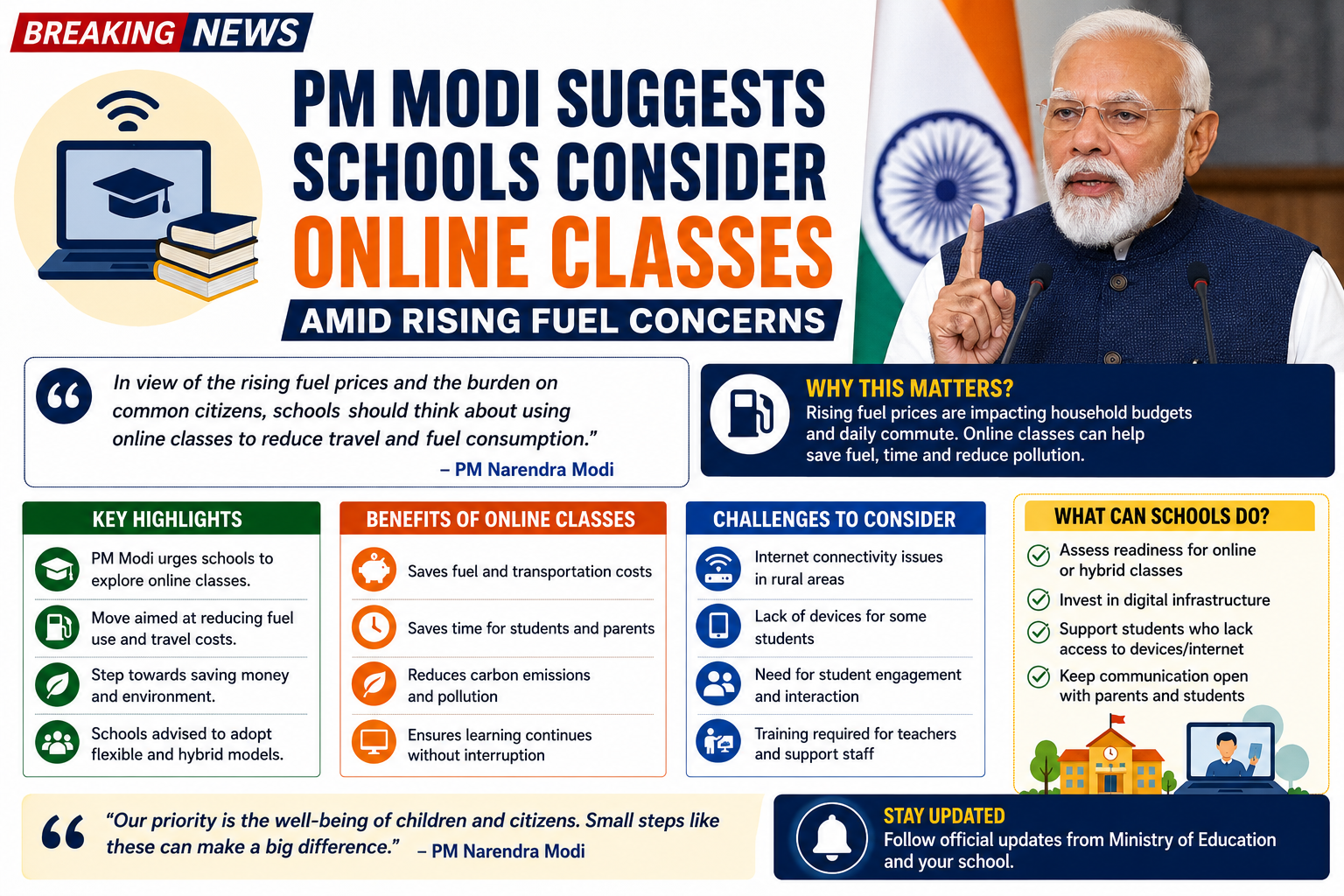
PM Modi Suggests Schools Consider Online Classes Amid Rising Fuel Concerns
Prime Minister Narendra Modi has urged citizens to reduce petrol and diesel consumption amid rising global fuel concerns linked to ongoing Middle East tensions. Addressing a rally in Hyderabad, he suggested that schools could temporarily consider online classes to help reduce fuel usage.
PM Modi’s Appeal On Fuel Conservation
Prime Minister Narendra Modi appealed to citizens to reduce petrol and diesel consumption during the current global energy uncertainty. He said that digital technology, remote work and virtual communication have become more accessible in recent years and can help reduce unnecessary travel.
During the address, PM Modi also appealed to schools to consider temporary arrangements for online classes. The suggestion comes as part of a larger appeal to reduce daily travel, lower fuel usage and manage the possible economic impact of rising global fuel prices.
Key Suggestions Made By PM Modi
PM Modi encouraged citizens, schools, offices and organisations to adopt practical measures that may help reduce fuel consumption.
Online Classes
Schools could temporarily consider online classes where possible to reduce student and staff travel.
Work From Home
Government and private organisations may encourage remote work wherever practical.
Virtual Communication
Offices and institutions can use video meetings instead of unnecessary physical meetings.
Public Transport
People living in cities with metro services can use metro and other public transport options.
Carpooling
Daily commuters can carpool to reduce individual fuel consumption and travel costs.
Electric Vehicles
Citizens may choose electric vehicles where possible to reduce petrol and diesel dependence.
Fuel-Saving Measures Suggested For Citizens
| Suggested Measure | How It Helps | Who Can Use It |
|---|---|---|
| Online Classes | Reduces school commute and transport fuel usage | Schools, students and parents |
| Work From Home | Reduces office travel and daily commuting fuel demand | Government and private organisations |
| Virtual Meetings | Avoids unnecessary official or business travel | Offices, institutions and businesses |
| Metro And Public Transport | Reduces private vehicle use in cities | Daily commuters and urban residents |
| Carpooling | Allows multiple people to travel using one vehicle | Office goers, students and families |
| Electric Vehicles | Reduces petrol and diesel dependence | Consumers with EV access |
| Limit Non-Essential Foreign Travel | Helps reduce avoidable travel-related energy use and spending | Travellers and organisations |
| Reduce Non-Essential Gold Purchases | Helps manage spending during economic uncertainty | Households and buyers |
Why Fuel Concerns Are Rising
Fuel concerns have increased due to global energy market uncertainty linked to tensions in the Middle East. India imports nearly 85 per cent of its crude oil requirement, which makes the country sensitive to international supply disruptions and price fluctuations.
The Strait of Hormuz is a critical global oil transportation route. Any disruption in this route can affect crude oil, liquefied natural gas and liquefied petroleum gas shipments passing through the region.
| Energy Factor | Why It Matters For India |
|---|---|
| Crude Oil Import Dependence | India imports nearly 85 per cent of its crude oil needs. |
| Strait of Hormuz | It is a key route for global oil and gas shipments. |
| Crude Oil Flow | A major portion of India’s crude oil imports passes through the region. |
| LNG Supplies | Liquefied natural gas imports may also be affected by shipping disruptions. |
| LPG Shipments | Cooking fuel supplies are also linked to international shipment routes. |
| Global Oil Supply | The Strait of Hormuz handles close to one-fifth of the world’s oil supply during normal conditions. |
Global Oil Prices Surge Amid Tensions
Global crude oil prices recorded sharp gains amid geopolitical tensions. A rise in international oil prices can increase pressure on fuel-importing countries and may affect transport, logistics and essential services if the situation continues.
| Crude Oil Benchmark | Reported Increase | Price Level |
|---|---|---|
| Brent Crude Futures | Up by 4.04 US dollars, or 3.99 per cent | 105.33 US dollars per barrel |
| US West Texas Intermediate | Up by 4.43 US dollars, or 4.64 per cent | 99.85 US dollars per barrel |
Possible Impact On Schools And Students
If schools temporarily adopt online classes, students may attend lessons from home for a limited period. This can reduce the use of school buses, private vehicles and daily commute fuel. However, schools may need to ensure that students have access to devices, internet connectivity and proper digital learning support.
- Reduced student commute
- Lower school transport fuel usage
- More use of digital classrooms
- Need for internet access
- Possible hybrid learning models
- Temporary academic adjustments
Fuel Conservation Timeline: What May Happen Next
What Parents And Students Should Know
Parents and students should wait for official instructions from their schools before making any schedule changes. The Prime Minister’s suggestion does not automatically mean all schools will shift to online classes immediately. Schools may decide based on local conditions, government instructions and practical feasibility.
FAQs On PM Modi’s Online Classes Suggestion
Did PM Modi suggest online classes for schools?
Yes, PM Modi suggested that schools could temporarily consider arrangements for online classes to help reduce fuel usage amid global fuel concerns.
Why did PM Modi suggest online classes?
The suggestion was made as part of a broader appeal to reduce petrol and diesel consumption during rising global fuel concerns linked to Middle East tensions.
Will all schools shift to online classes immediately?
No automatic shift has been announced for all schools. Students and parents should wait for official instructions from their school or education department.
What other measures were suggested to reduce fuel consumption?
Suggested measures include using metro and public transport, choosing electric vehicles where possible, carpooling, avoiding unnecessary fuel use and encouraging work-from-home arrangements.
Why is India concerned about fuel imports?
India imports nearly 85 per cent of its crude oil requirement, making the country dependent on international energy markets and sensitive to global price changes.
What should students do now?
Students should continue attending classes as instructed by their school and follow only official updates regarding any online or hybrid class arrangements.

