India’s Green Economy Could Support 1.3 Crore Jobs by 2035: Skills Gap in Focus
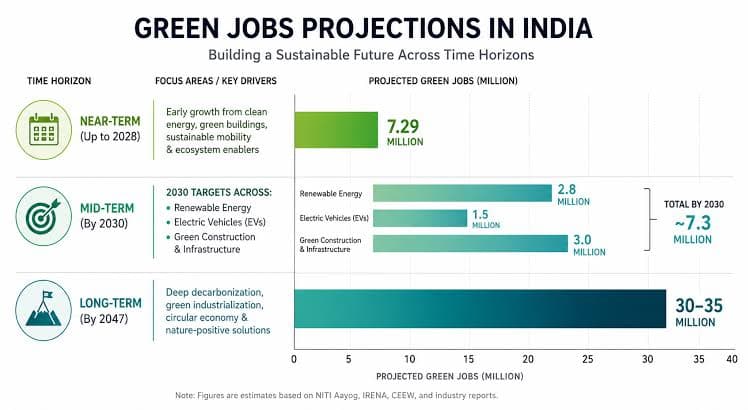
India’s green economy could support nearly 1.3 crore jobs by 2035, according to a newly released workforce report. The projection highlights opportunities across clean energy, electric mobility, recycling and environmental restoration, while warning that inadequate training could limit the employment benefits.
For students and job seekers, the findings point toward emerging career pathways. However, the headline figure represents potential employment supported by green sectors, not 1.3 crore currently advertised vacancies or guaranteed new appointments.
Green Employment Projections at a Glance
| Employment Measure | Time Frame | Reported Estimate |
|---|---|---|
| Employment supported across green sectors | 2030 | 98.5 lakh jobs |
| Employment supported across green sectors | 2035 | Nearly 1.3 crore jobs |
| Direct employment in selected green industries | 2026 | Approximately 14.5 lakh jobs |
| Direct employment in selected green industries | 2035 | More than 54 lakh jobs |
The direct-employment estimates cover selected industries, including renewable energy, green hydrogen, electric vehicle manufacturing, charging infrastructure and formal recycling. They have a narrower scope than the overall green-economy projection and should not be added to it.
Why Training Is Central to the Opportunity
The report identifies limited technical education, insufficient specialized training and unequal access for women as barriers. It estimates that only 4.5% of the working-age population had technical education in 2025, compared with 3.1% of working-age women.
It recommends making green employment a central component of national skills policy and establishing a dedicated Green Jobs and Skilling Mission. These are recommendations, rather than confirmation that a new recruitment scheme has opened.
Green Careers Extend Beyond Energy
The employment outlook also covers the circular economy and nature-based activities. This broadens the discussion beyond solar panels and electric vehicles to include resource recovery, waste management and ecosystem restoration.
For career planning, students should identify a specific occupation before choosing a course. “Green jobs” describes a broad area of economic activity; it does not specify one qualification, salary range or recruitment process.
How Students Can Assess Training Options
- Compare course content with the duties listed in actual job advertisements.
- Ask how much supervised practical training the program includes.
- Check the awarding body and the qualification’s recognition.
- Request evidence of apprenticeships and employer participation.
- Examine placement outcomes separately from promotional promises.
- Consider local opportunities and the cost of relocating for work.
A useful preparation exercise is to collect several advertisements for one target role and identify recurring requirements. This helps distinguish essential technical abilities from optional credentials and provides a clearer basis for comparing courses.
What the Projection Means for Education
The practical implication is that institutions should connect teaching with identifiable workplace tasks. Students can ask whether laboratory exercises, field assignments and internships produce work they can demonstrate to an employer. A documented project can also help them explain what they learned and contributed.
Frequently Asked Questions
Are these government vacancies?
No. The figures describe projected sectoral employment, not an announced government recruitment drive.
Does a green-skills certificate guarantee employment?
No. Applicants should assess the relevance of training, practical competence and available opportunities rather than relying on a certificate title alone.




q.jpg)