The United States education system is classified into three major levels: elementary education, secondary education and higher education. Students typically complete 12 grades of school before they enter college or university, which awards qualifications according to the academic credits and other degree requirements a student has completed.
The most important feature of the American education is its decentralized structure . There is no national school board or university authority that sets the curriculum, admission criteria and academic regulations for each institution.
State governments, local school districts, universities and recognized educational organizations all have different duties.
This results in a great deal of variation in school structures, undergraduate programs, grading rules and graduation requirements.
Arizona State University requires a minimum of 120 semester credit hours to earn a bachelor’s degree. The University of California, Davis is a quarter system school and requires at least 180 quarter units to graduate with an undergraduate degree.
Both are typical bachelor’s degree tracks, but the credit systems are different.
Similarly, an undergraduate at a liberal arts college may complete a significant amount of coursework outside of their major, whereas an Engineering student at a research university may have a more rigid curriculum.
International students need to be aware of these differences before choosing a university.
A student graduating from Class 12 in India should be aware of what undergrad admission, credits, general education and major requirements mean. A BTech graduate looking for an MS should know about graduate coursework, academic prerequisites, research options and GPA.
The US education system is flexible, but completing a degree requires careful academic planning. Students must satisfy the exact requirements established by their institution and program.
The United States education system is classified into three major levels: elementary education, secondary education and higher education. Students typically complete 12 grades of school before they enter college or university, which awards qualifications according to the academic credits and other degree requirements a student has completed.
The most important feature of the American education is its decentralized structure . There is no national school board or university authority that sets the curriculum, admission criteria and academic regulations for each institution.
State governments, local school districts, universities and recognized educational organizations all have different duties.
This results in a great deal of variation in school structures, undergraduate programs, grading rules and graduation requirements.
Arizona State University requires a minimum of 120 semester credit hours to earn a bachelor’s degree. The University of California, Davis is a quarter system school and requires at least 180 quarter units to graduate with an undergraduate degree.
Both are typical bachelor’s degree tracks, but the credit systems are different.
Similarly, an undergraduate at a liberal arts college may complete a significant amount of coursework outside of their major, whereas an Engineering student at a research university may have a more rigid curriculum.
International students need to be aware of these differences before choosing a university.
A student graduating from Class 12 in India should be aware of what undergrad admission, credits, general education and major requirements mean. A BTech graduate looking for an MS should know about graduate coursework, academic prerequisites, research options and GPA.
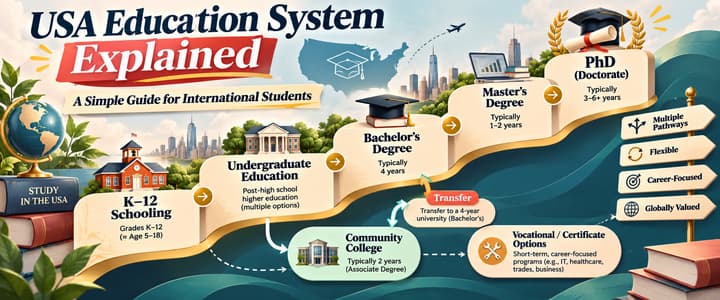
1. Structure of the USA Education System
American education is broadly organized into school education and postsecondary education.
The school system commonly begins with kindergarten and continues through Grade 12. Students who complete high school may enter community colleges, four-year colleges, universities or career-focused institutions.
USA Education System: Complete Structure
| Education Level | Common Grades or Qualification | Typical Age or Duration |
|---|---|---|
| Preschool | Pre-Kindergarten | Approximately 3–5 Years |
| Kindergarten | Kindergarten | Approximately 5–6 Years |
| Elementary School | Grades 1–5 | Approximately 6–11 Years |
| Middle School | Grades 6–8 | Approximately 11–14 Years |
| High School | Grades 9–12 | Approximately 14–18 Years |
| Community College | Associate Degree | Usually 2 Years |
| Four-Year College or University | Bachelor's Degree | Commonly 4 Years |
| Graduate School | Master's Degree | Often 1–2 Years |
| Doctoral Education | PhD or Other Doctorate | Varies by Program |
| Professional Education | JD, MD and Other Degrees | Profession-Specific |
Important: Grade divisions vary by state and school district. Some elementary schools include Grade 6, while some middle schools serve Grades 7–8 or other combinations.
The age ranges are approximate rather than mandatory nationwide rules.
The American system is also known as K–12 education for the school years from kindergarten through Grade 12.
Education after high school is commonly called postsecondary education or higher education.
2. Who Controls Education in the United States?
The United States does not operate one centrally administered national curriculum covering all schools and universities.
Education is primarily a state and local responsibility.
Responsibilities Within the Education System
| Authority | Main Responsibilities |
|---|---|
| Federal Government | Federal Education Laws, Civil Rights Enforcement and Certain Funding Programs |
| State Governments | State Education Standards, School Requirements and Public Higher Education Oversight |
| Local School Districts | Public School Administration and Local Educational Operations |
| Colleges and Universities | Institutional Admission, Curriculum, Assessment and Degree Requirements |
| Accrediting Organizations | External Institutional or Program Quality Evaluation |
Federal government: The US Department of Education administers federal education responsibilities and programs. However, it does not establish one compulsory national curriculum for every school.
State governments: States create education requirements and oversee various aspects of public education.
School districts: Local school districts commonly administer public elementary, middle and high schools.
Universities: Higher education institutions have substantial independence in developing academic programs and establishing admission requirements.
This explains why two universities offering Computer Science degrees may require different courses, examinations and total credits.
It also explains why applicants cannot use one university's eligibility requirements as a nationwide standard.
3. Preschool and Kindergarten in the USA
Early childhood education generally includes preschool and kindergarten.
Preschool programs may provide activities focused on early language development, social interaction, numbers, communication and basic learning skills.
Children may attend public, private or community-based early childhood programs.
Preschool availability and funding arrangements differ between states and local communities.
Kindergarten: Kindergarten is commonly the year before Grade 1 and generally serves children around five years old. Entry-age requirements and whether attendance is compulsory vary by state.
Kindergarten introduces children to structured classroom learning.
Activities may include early reading, writing, counting, problem-solving and social development.
The emphasis is generally on foundational academic and developmental skills.
Is Preschool Mandatory?
There is no universal nationwide preschool attendance requirement.
State and local rules determine compulsory education ages.
Some states provide publicly funded prekindergarten opportunities, while others have different eligibility or program arrangements.
For families moving to the United States, school availability should be checked according to their intended residential location.
Private preschool costs should not be confused with public K–12 school arrangements.
4. Elementary School Education
Elementary education introduces students to foundational academic subjects.
A common structure covers Grades 1–5, although some districts include kindergarten or Grade 6.
Students usually study several subjects as part of the regular school curriculum.
Common Elementary School Subjects
| Subject | Main Learning Areas |
|---|---|
| English Language Arts | Reading, Writing and Communication |
| Mathematics | Arithmetic, Numbers and Problem-Solving |
| Science | Basic Scientific Concepts |
| Social Studies | History, Geography and Society |
| Physical Education | Exercise and Physical Development |
| Art and Music | Creative Expression |
| Technology | Age-Appropriate Digital Skills |
Elementary teachers often teach several subjects to the same group of students.
However, school organization varies.
Students may also receive instruction from specialist teachers for subjects such as music, physical education or art.
How Are Elementary Students Assessed?
Schools may use classroom assignments, tests, projects, teacher observations and school-specific assessments.
Some districts use letter grades, while others report performance against learning standards.
There is no single nationwide elementary grading format.
Main objective: Elementary education develops reading, writing, mathematics, communication and foundational learning abilities needed for later education.
5. Middle School Education
Middle school commonly covers Grades 6–8, although grade arrangements differ between districts.
Students begin moving toward more specialized subject instruction.
Instead of learning every subject from one classroom teacher, students may attend different classes taught by subject specialists.
Typical Middle School Subjects
Students generally continue English, Mathematics, Science and Social Studies. Additional subjects may include foreign languages, technology, health education, physical education, music and visual arts.
Some schools offer advanced mathematics or other accelerated courses.
A student demonstrating strong mathematical preparation may be eligible for a more advanced class, depending on school placement rules.
How Middle School Differs From Elementary School
Subject specialization: Students may have different teachers for Mathematics, English and Science.
Academic responsibility: Homework, assignments and course schedules can become more demanding.
Elective options: Some schools permit students to select subjects such as music, art or technology.
Preparation for high school: Schools may begin advising students about appropriate academic pathways.
Middle school does not normally award a university-entry qualification.
It prepares students for secondary education.
6. High School Education: Grades 9–12
High school generally includes Grades 9–12.
Students normally complete Grade 12 around age 17 or 18, although individual circumstances vary.
Successful students receive a high school diploma after satisfying the relevant graduation requirements.
A US high school diploma is the standard secondary school completion qualification used for entry into American undergraduate education.
International applicants who completed recognized qualifications such as CBSE Class 12, ISC, state boards, IB or Cambridge A-Levels may be evaluated for equivalent undergraduate admission eligibility.
High School Grade Names
| Grade | Common Name |
|---|---|
| Grade 9 | Freshman |
| Grade 10 | Sophomore |
| Grade 11 | Junior |
| Grade 12 | Senior |
These terms are also commonly used for the first four years of undergraduate college education.
Common High School Subjects
High schools generally offer English, Mathematics, Science, History, Social Studies and other subjects. Graduation requirements may also include physical education, arts, languages or approved electives.
Students may choose courses based on their interests and future academic plans.
For example, a student interested in Engineering may pursue advanced mathematics and physics where available.
A student interested in Business might select additional mathematics, economics or related electives.
High School Graduation Requirements
Requirements depend on the state, district and school.
Students may need to complete specified credits in required subject areas.
Some states also impose additional graduation conditions.
Completing Grade 12 coursework is not always sufficient if mandatory credits or other graduation requirements remain outstanding.
7. Public, Private and Charter Schools
The American school system includes different institutional models.
Types of Schools
| School Type | Main Feature | Funding or Administration |
|---|---|---|
| Traditional Public School | Government-Operated School | Public Funding |
| Charter School | Public School Operating Under a Charter | Public Funding and Applicable Charter Rules |
| Private School | Independently Operated | Tuition and Private Resources |
| Magnet School | Specialized Academic Focus | Commonly Part of Public Education |
| Homeschooling | Education Outside a Conventional School | Subject to State Requirements |
Public schools: Public elementary and secondary schools are generally available without tuition to eligible resident students under applicable state and local rules.
Private schools: Private institutions may have independent educational approaches, religious affiliations or specialized curricula. They commonly charge tuition.
Charter schools: Charter schools are public schools operating under charter arrangements and applicable state oversight.
Magnet schools: Magnet programs may focus on areas such as Science, Technology, Performing Arts or International Studies.
Homeschooling: Families may educate children outside conventional schools under their state's legal requirements.
Important Immigration Distinction
International students seeking to attend US schools directly in F-1 status face specific restrictions.
F-1 students cannot enroll in public elementary or public middle schools. F-1 attendance at a public high school is generally limited to 12 months and requires payment of the full unsubsidized cost of education.
Different rules can apply to children holding dependent immigration status.
Families should not assume that public-school access for a resident child and F-1 international school enrollment follow identical rules.
8. Advanced Placement, Honors and IB Programs
American high schools may provide advanced academic options.
These can include Advanced Placement courses, honors classes and International Baccalaureate programs.
Advanced Placement
Advanced Placement, commonly called AP, allows eligible high school students to study college-level material in selected subjects.
AP examinations use a scale from 1 to 5.
Universities may award college credit, advanced course placement or both for qualifying examination results.
However, the receiving institution determines its own policy.
A student earning an AP score of 4 in Biology might receive credit at one university but a different amount of credit or placement at another.
Honors Courses
Honors courses are school-specific advanced courses.
They may involve additional academic work or a faster pace than standard classes.
The term honors does not establish one nationally standardized curriculum.
International Baccalaureate
The IB Diploma Programme provides a structured secondary school curriculum and external assessments.
American universities may consider the IB Diploma for undergraduate admission and may award credit for qualifying results.
Are AP or IB Credits Guaranteed?
No.
Students should review the university's actual credit recognition policy.
A qualifying examination result may reduce the number of introductory courses required, but the credit must satisfy the intended degree's graduation rules.
9. What Happens After High School?
Students completing high school may enter higher education, employment or career-focused training.
For those pursuing further education, the main pathways include community colleges, four-year colleges and universities.
Postsecondary Education Pathways
| Pathway | Typical Qualification | Main Purpose |
|---|---|---|
| Community College | Associate Degree | Career Preparation or University Transfer |
| Four-Year College | Bachelor's Degree | Undergraduate Education |
| University | Bachelor's, Master's and Doctoral Degrees | Undergraduate and Graduate Education |
| Technical Institution | Certificate or Applied Degree | Occupational Preparation |
| Professional School | Professional Qualification | Preparation for Specific Professions |
Students do not necessarily need to complete an associate degree before entering a bachelor's program.
A student may apply directly from high school to a four-year college or university.
Alternatively, the student may begin at a community college and later transfer.
The best pathway depends on academic eligibility, cost, degree availability and intended career.
10. Types of Colleges and Universities in USA
American higher education includes several institution types.
Understanding their differences helps students choose an appropriate academic environment.
Public Universities
Public universities receive support through state government funding arrangements and other sources.
They often charge different tuition rates for residents and nonresidents.
International students commonly pay nonresident tuition.
Examples include Arizona State University, University of California campuses and San José State University.
Public universities may offer extensive undergraduate programs, graduate education and research opportunities.
Private Universities
Private universities are funded through tuition, endowments, donations, research support and other resources.
Examples include Princeton University, Stanford University and the University of Chicago.
Private universities establish their own tuition and financial aid policies.
A higher published tuition does not automatically mean a higher final cost after financial aid.
Liberal Arts Colleges
Liberal arts colleges commonly emphasize undergraduate education across humanities, social sciences, natural sciences and other disciplines.
Bowdoin College is an example.
Students may complete a major while also taking courses outside their primary field.
Community Colleges
Community colleges typically provide associate degrees, career programs and university transfer pathways.
Some also offer selected bachelor's degrees where authorized.
Specialized Institutions
Some institutions focus on fields such as technology, art, design, music or business.
Students should evaluate their degree recognition, accreditation and curriculum rather than assume that all institutions use the same academic structure.
11. College vs University in USA
In everyday American English, people often use college and university interchangeably.
However, there are common institutional distinctions.
College: The word may describe an independent undergraduate institution or an academic division within a university.
University: A university often includes multiple colleges or schools and offers both undergraduate and graduate programs.
For example, a university may contain a College of Engineering, College of Business and College of Arts and Sciences.
A student enrolled in the College of Engineering is still attending the university.
Does College Mean a Lower Qualification?
No.
A bachelor's degree from an accredited college is not inherently inferior to a bachelor's degree from a university.
The academic program, degree level, accreditation and institution-specific quality matter.
Similarly, a college offering undergraduate education may provide strong academic preparation without offering doctoral programs.
Students should compare the actual qualification rather than judge an institution solely by whether its name contains "College" or "University."
12. Higher Education Degrees in USA
American higher education includes multiple degree levels.
The pathway depends on the student's previous education and intended specialization.
USA Degree Structure
| Degree | Common Duration | Typical Entry Qualification |
|---|---|---|
| Associate Degree | Around 2 Years | High School Completion |
| Bachelor's Degree | Around 4 Years | High School Completion |
| Master's Degree | Often 1–2 Years | Accepted Bachelor's Degree |
| PhD | Often 4–7+ Years | Relevant Bachelor's or Master's |
| Juris Doctor | Commonly 3 Years | Bachelor's Degree |
| Doctor of Medicine | Commonly 4 Years | Bachelor's Degree and Premedical Preparation |
These are typical durations rather than guaranteed completion periods.
Students graduate after satisfying the relevant credit, coursework, assessment and other degree requirements.
Some accelerated or combined programs have different structures.
Undergraduate Education
Undergraduate education includes associate and bachelor's degrees.
Students typically enter after high school.
Graduate Education
Graduate education follows an accepted undergraduate qualification and includes master's and doctoral degrees.
Professional Education
Certain professions require specialized degrees, examinations, supervised training or licensing.
A professional degree should not automatically be equated with a research doctorate.
13. Associate Degree: How Community College Works
An associate degree commonly requires approximately two years of full-time study.
Many associate programs require around 60 semester credit hours.
Austin Community College Example
Austin Community College's 2026–27 catalog requires at least 60 semester credit hours for most associate degrees.
Its bachelor's programs require at least 120 semester credits.
The college also offers certificates and career-focused awards with different credit requirements.
Common Associate Degrees
| Degree | Main Orientation |
|---|---|
| Associate of Arts (AA) | General Education and Transfer |
| Associate of Science (AS) | Science, Mathematics or Transfer |
| Associate of Applied Science (AAS) | Career-Focused Technical Education |
| Associate of Arts in Teaching (AAT) | Teacher Education Transfer Pathways |
Is an Associate Degree Equal to a Bachelor's Degree?
No.
An associate degree is a separate qualification, generally requiring fewer credits than a bachelor's degree.
It may support employment or transfer into further undergraduate education.
Can International Students Attend Community College?
Yes, where the institution accepts international students and can support the appropriate immigration status.
Applicants must satisfy admission, financial and language requirements.
Community college can be a useful option, but students should confirm whether their intended credits will transfer to a future university.
14. Bachelor's Degree: Four-Year Undergraduate Education
A bachelor's degree is the standard qualification awarded after completing an undergraduate program at a four-year institution.
Students may earn degrees such as Bachelor of Arts, Bachelor of Science, Bachelor of Business Administration or Bachelor of Engineering, depending on the institution.
Arizona State University Example
ASU requires students pursuing a bachelor's degree to complete at least 120 credit hours.
At least 45 credits must be in upper-division coursework under its general graduation requirements.
Individual programs may require additional coursework or a higher total.
How 120 Credits Translate Into Four Years
| Academic Year | Illustrative Credits Earned |
|---|---|
| First Year | 30 |
| Second Year | 30 |
| Third Year | 30 |
| Fourth Year | 30 |
| Total | 120 |
This example assumes 15 semester credits in each fall and spring term.
Actual schedules vary.
A student may take additional credits in summer, transfer accepted credits or need more than four years to finish.
BA vs BS
A Bachelor of Arts may emphasize broad academic study or a field's humanities and social science dimensions.
A Bachelor of Science may involve more technical, mathematical or scientific coursework.
However, there is no nationwide rule establishing one degree as superior.
A BA in Computer Science at one university may have different requirements from a BS in Computer Science at another.
Students should compare the curriculum.
15. Master's Degree: Graduate Education
A master's degree provides education beyond the bachelor's level.
Common qualifications include Master of Science, Master of Arts, Master of Engineering, Master of Business Administration and Master of Public Health.
Master's programs may emphasize academic research, advanced coursework or professional preparation.
Master's Program Types
| Program Type | Academic Focus |
|---|---|
| Coursework Master's | Advanced Classes and Assessments |
| Thesis Master's | Coursework and Supervised Research |
| Professional Master's | Applied or Career-Oriented Education |
| Research Master's | Research Methods and Independent Investigation |
| MBA | Management and Business Education |
How Long Does a Master's Take?
Many programs are designed for approximately one to two years of full-time study.
However, duration depends on required credits, course availability, research requirements and the academic calendar.
Some specialized programs have shorter or longer structures.
Example: Two Different Students
A BTech graduate interested in Machine Learning may pursue an MS with advanced mathematics, algorithms and computing courses.
A Business graduate with professional experience may pursue an MBA focused on leadership, management and business decision-making.
Both qualifications are master's-level degrees, but their academic purposes are different.
Is Every Master's Program Research-Based?
No.
Some require a thesis, while others emphasize coursework, applied projects or capstone experiences.
Applicants planning a future PhD should determine whether the degree offers suitable research preparation.
16. PhD and Doctoral Education in USA
A Doctor of Philosophy, or PhD, is an advanced research degree.
Students develop expertise in a discipline and undertake original research.
American doctoral programs may admit applicants after a bachelor's degree or a master's degree, depending on institutional and departmental rules.
Common PhD Components
Advanced coursework: Students may complete graduate classes to develop theoretical and methodological knowledge.
Research preparation: Departments may require research-methods training or preliminary projects.
Qualifying examinations: Some programs evaluate whether students are prepared to advance toward independent doctoral research.
Dissertation: Students conduct substantial original research and prepare a doctoral dissertation.
Defense: Some disciplines require an oral examination or defense of the dissertation.
Is Every PhD the Same Length?
No.
The required time depends on the discipline, research progress, previous preparation and program rules.
Some doctoral programs may take four to seven years or longer.
PhD Funding
Certain research-based doctoral programs provide tuition assistance and stipends through fellowships or assistantships.
However, funding arrangements differ.
Students should evaluate the written offer rather than assume every PhD is fully funded.
A PhD is primarily a research qualification, not simply a longer master's degree.
17. Professional Degrees: Medicine, Law and Other Fields
Professional education has distinct structures and eligibility requirements.
Medicine
The conventional US Doctor of Medicine pathway generally follows undergraduate education and premedical preparation.
Most medical schools require the MCAT.
A medical student typically completes a four-year MD curriculum, followed by required postgraduate clinical training for professional practice.
This differs from India's conventional direct-entry MBBS pathway after Class 12.
Law
The Juris Doctor, commonly called JD, is the principal professional law degree in the United States.
JD programs generally require an accepted bachelor's degree.
Students seeking professional legal practice must also consider licensing and bar examination requirements.
Other Professional Fields
Pharmacy, Dentistry, Nursing, Veterinary Medicine, Architecture and other fields have different professional qualification arrangements.
Some qualifications begin at the undergraduate level, while others require previous college study.
Why International Students Must Check Licensing
A US qualification does not automatically authorize professional practice in India or another country.
Recognition and licensing requirements depend on the profession and jurisdiction.
Students should check the complete professional pathway before enrolling.
18. Semester System in USA Universities
Many American universities organize the academic year into two main semesters.
These are usually the fall semester and spring semester.
Typical Semester Calendar
| Semester | Common Period | Main Feature |
|---|---|---|
| Fall | August/September–December | Main Academic Intake |
| Spring | January–May | Second Main Semester |
| Summer | May/June–August | Optional or Program-Specific Courses |
Actual dates vary.
Some institutions begin fall classes in late August, while others begin in September.
A semester commonly lasts around 15–16 instructional weeks, although institutional calendars differ.
Fall Semester
Fall is a major entry period for international students.
Many undergraduate and graduate programs begin their academic year during this term.
Spring Semester
Some universities also admit students in January.
However, not every academic program offers spring admission.
Summer Term
Summer courses may help students complete additional credits, satisfy prerequisites or progress toward graduation.
Summer study can involve additional tuition and different course scheduling.
Students should check the academic calendar for their exact university and degree.
19. Quarter System vs Semester System
Some American universities use quarters rather than semesters.
The academic year is divided into shorter terms.
A common quarter calendar includes fall, winter, spring and summer, with students normally taking courses during the first three terms.
Semester vs Quarter Comparison
| Feature | Semester System | Quarter System |
|---|---|---|
| Main Academic Terms | Usually 2 | Usually 3 |
| Typical Term Length | Approximately 15–16 Weeks | Approximately 10 Weeks |
| Summer Term | Often Available | Often Available |
| Common Bachelor's Requirement | Around 120 Semester Credits | Around 180 Quarter Units |
| Course Pace | Longer Terms | Shorter Terms |
UC Davis Example
UC Davis uses the quarter system and requires at least 180 quarter units for a bachelor's degree.
Its expected pace for completing a 180-unit degree in four years is approximately 15 units per quarter.
The standard four-year calculation is:
15 quarter units × 3 quarters × 4 years = 180 quarter units.
Credit Conversion
One semester credit generally corresponds to approximately 1.5 quarter units for conversion purposes.
For example:
3 semester credits × 1.5 = 4.5 quarter units.
The receiving university determines how transferred coursework is evaluated.
A quarter unit and a semester credit are not numerically identical. Students must understand the calendar system before calculating graduation progress.
20. Credit System in USA Universities
Credits measure academic coursework completed toward a qualification.
A degree requires a specified number of credits in different subject categories.
Students normally earn credits by successfully completing courses.
What Is a Three-Credit Course?
In a conventional semester arrangement, a three-credit lecture course may involve approximately three hours of scheduled instruction per week, plus independent study and assignments.
Laboratory, studio, clinical and other course formats may calculate instructional time differently.
Example: One Undergraduate Semester
| Course | Semester Credits |
|---|---|
| Calculus | 4 |
| Academic Writing | 3 |
| Economics | 3 |
| Introduction to Programming | 3 |
| General Education Elective | 2 |
| Total | 15 |
This is an illustrative schedule, not an actual university timetable.
Why Credit Planning Matters
A bachelor's student completing 15 credits in each of eight semesters would earn 120 credits.
A student completing only 12 credits per semester would earn 96 credits after eight semesters unless additional credits were earned elsewhere.
The student might therefore need summer courses, transfer credit or extra semesters.
Full-Time Does Not Always Mean On-Time
A student may satisfy the minimum full-time enrollment requirement without taking enough credits to complete a degree in four years.
For example, an F-1 undergraduate commonly needs at least 12 qualifying credits per term under standard semester or quarter arrangements.
However, the degree may require a faster credit accumulation pace.
Immigration enrollment requirements and academic graduation planning are related but distinct.
21. Major, Minor and Electives Explained
American undergraduate degrees may include a major, general education requirements, electives and sometimes a minor.
Major
A major is the student's primary academic specialization.
Examples include Computer Science, Economics, Biology, Mechanical Engineering and Psychology.
The major normally requires a defined set of introductory and advanced courses.
Minor
A minor is a secondary academic concentration.
For example, a Computer Science major may pursue a Mathematics minor.
A Business major might complete a Psychology minor where permitted.
Minors generally involve fewer required courses than majors.
Electives
Electives are courses students may choose within the degree's permitted options.
Some electives relate directly to the major, while others allow exploration outside the primary discipline.
General Education
General education requirements provide academic breadth outside the major.
They may include writing, mathematics, natural sciences, humanities or social sciences.
Degree Components
| Component | Purpose |
|---|---|
| Major | Primary Academic Specialization |
| Minor | Secondary Field of Study |
| General Education | Broad Academic Foundation |
| Free Electives | Additional Course Choices |
| Prerequisites | Preparation for Advanced Courses |
| Capstone | Integrative Advanced Project Where Required |
Not every university requires a minor, and some majors have limited elective space.
22. Double Majors and Dual Degrees
Some American universities allow students to complete two majors or pursue two degrees.
However, these arrangements have different academic requirements.
Double Major
A double major generally involves completing the requirements for two academic specializations within one degree structure.
For example, a student might pursue Economics and Mathematics.
The student must satisfy both departments' requirements and any university restrictions.
Dual Degree
A dual-degree arrangement involves earning two distinct qualifications.
The program may require additional credits and time.
Some universities offer formal combined-degree pathways.
Is a Double Major Automatically Better?
No.
Completing two majors can provide useful interdisciplinary preparation, but it also increases academic demands.
A student interested in Data Science may benefit from combining Statistics and Computer Science.
However, choosing several subjects without a coherent academic purpose can create scheduling difficulties.
Can Students Change Their Major?
Some universities allow major changes relatively easily.
Others restrict entry into competitive programs such as Engineering, Nursing or Computer Science.
Students should verify whether a major can be changed and whether admission is guaranteed.
23. General Education and Liberal Arts Education
General education is an important feature of many American bachelor's degrees.
It provides academic exposure beyond the student's primary specialization.
A Computer Science student may study writing, history or economics.
A Political Science student may complete mathematics or natural science requirements.
The purpose is to develop broad knowledge and transferable academic skills.
Austin Community College Example
Austin Community College's 2026–27 catalog identifies a 42-credit core curriculum for its traditional transfer degrees.
The core supports general education and transfer arrangements under the applicable Texas framework.
Different universities establish different general education structures.
Liberal Arts Colleges
Liberal arts colleges often emphasize learning across humanities, sciences, mathematics and social sciences.
Students usually complete a major alongside additional coursework.
A liberal arts college does not necessarily mean an institution that offers only arts or humanities degrees.
Some offer substantial mathematics and natural science programs.
Is General Education a Waste of Time?
Its value depends on the student's goals and the curriculum.
Courses outside a major may strengthen writing, quantitative reasoning or interdisciplinary understanding.
However, students pursuing highly structured professional degrees may have fewer choices.
General education is part of the degree design, not automatically an unrelated extra qualification.
24. GPA and Grading System in USA
Most American colleges and universities use letter grades and a numerical Grade Point Average.
A common GPA scale ranges from 0.0 to 4.0.
However, universities differ in how they apply plus and minus grades, pass/fail options and other grading categories.
Common GPA Values
| Letter Grade | Typical Grade Points |
|---|---|
| A | 4.0 |
| B | 3.0 |
| C | 2.0 |
| D | 1.0 |
| F | 0.0 |
This simplified table illustrates the basic grading scale.
A university may also assign grades such as A−, B+ or C−, with different numerical values.
UC Davis Example
UC Davis generally assigns A = 4, B = 3, C = 2, D = 1 and F = 0 for GPA calculation.
Its plus and minus grades normally adjust the value by approximately 0.3, with A+ treated as 4.0.
What Is GPA?
GPA is the credit-weighted average of a student's grade points.
A course worth four credits contributes more to the GPA calculation than a one-credit course.
This is why students should understand both the letter grade and the credit value of each course.
25. How to Calculate GPA: Worked Example
Suppose a student completes three courses during a semester.
| Course | Credits | Grade | Grade Points | Weighted Points |
|---|---|---|---|---|
| Mathematics | 3 | A | 4.0 | 12 |
| Computer Science | 4 | B | 3.0 | 12 |
| Economics | 3 | C | 2.0 | 6 |
| Total | 10 | 30 |
GPA = Total weighted grade points ÷ Total graded credits
Therefore:
GPA = 30 ÷ 10 = 3.00
The student's semester GPA is 3.00.
Semester GPA vs Cumulative GPA
Semester GPA: Measures performance in the courses completed during a specific semester.
Cumulative GPA: Includes the qualifying graded coursework completed over a longer period, generally across the student's enrollment.
Why GPA Matters
GPA may affect academic standing, admission to certain majors, graduate study eligibility and scholarship renewal.
Some programs require minimum grades in specific subjects even when the cumulative GPA is satisfactory.
Can Indian Percentages Be Converted Directly?
There is no universal formula accepted by every US university for converting Indian percentages into GPA.
Institutions may evaluate different grading systems according to their own procedures.
Students should report original results accurately and follow the university's instructions.
26. How Students Are Assessed in American Universities
American university assessment often involves multiple components throughout the academic term.
A student's final grade may not depend entirely on one examination.
Common assessment methods include homework, quizzes, laboratory work, written assignments, projects, presentations, midterm examinations and final examinations.
Illustrative Course Grading Structure
| Assessment Component | Weight |
|---|---|
| Homework and Assignments | 20% |
| Quizzes | 10% |
| Midterm Examination | 25% |
| Project | 20% |
| Final Examination | 25% |
| Total | 100% |
This is a hypothetical example.
Each instructor or academic department establishes the actual course grading rules.
What Is a Syllabus?
A course syllabus explains the subject content, learning objectives, assignments, grading system and important academic policies.
Students should read the syllabus carefully at the beginning of a course.
Midterm vs Final Examination
Midterm: An examination or assessment conducted during the academic term.
Final: An examination or other major assessment often conducted near the end of the term.
Some courses have no traditional final examination and use projects or other assessments instead.
Why Continuous Assessment Matters
Missing assignments can reduce a student's course grade even if they perform well on the final examination.
Students must manage work throughout the semester rather than prepare only during the final weeks.
27. Academic Standing, Probation and Graduation
Universities establish requirements for satisfactory academic progress.
Students may need to maintain a minimum GPA, complete specified credits and meet major-specific standards.
Good Academic Standing
A student is generally in good standing when they satisfy the institution's applicable academic progress requirements.
The exact minimum depends on the university and degree.
Academic Warning or Probation
Students who fail to meet academic standards may be placed on warning or probation under institutional procedures.
They may be required to improve their GPA or satisfy other conditions.
Continued poor performance can lead to further consequences, including suspension or dismissal.
Graduation Requirements
Earning the minimum number of credits is not always sufficient.
Students may also need to complete:
General education requirements
Major-specific coursework
Minimum GPA requirements
Advanced or upper-division credits
Capstone or thesis requirements
Residency requirements
Other institutional conditions
Degree Audit
Many universities provide degree-audit tools showing completed requirements and remaining coursework.
Students should review these records with academic advisers.
Graduation requires satisfying the full degree curriculum, not simply remaining enrolled for four years.
28. Transfer System: Changing Colleges or Universities
Students may transfer between American higher education institutions.
The receiving university evaluates previous academic coursework and determines which credits can be accepted.
Community College to University
A common pathway involves beginning at a community college, completing qualifying coursework and applying to a four-year university.
A successful transfer student may enter with junior-level academic standing, depending on credits and degree requirements.
However, admission and credit recognition are separate decisions.
Austin Community College Example
Austin Community College offers transfer-oriented Associate of Arts and Associate of Science degrees.
Its 2026–27 catalog explains that transfer coursework should be selected using the receiving university's course equivalency and transfer guides.
It also notes that transferred credits may not always satisfy the intended degree's specific requirements.
Transfer Credit vs Degree Credit
A university may accept a course as general elective credit but not allow it to replace a required course in the major.
For example, a mathematics course completed elsewhere may receive academic credit without satisfying the exact prerequisite for a particular Engineering sequence.
Does an Associate Degree Guarantee Transfer?
No.
Some states and universities provide structured articulation or admission arrangements.
However, eligibility conditions apply, and not every institution participates.
Students should plan transfer coursework around the destination university and intended major from the beginning.
29. Academic Calendar and Course Registration
American universities usually publish academic calendars showing term dates, registration periods, examination schedules and holidays.
Students choose or register for courses according to their academic program.
Important Academic Terms
| Term | Meaning |
|---|---|
| Registration | Enrolling in Courses |
| Add/Drop Period | Period for Changing Courses |
| Prerequisite | Required Prior Coursework |
| Corequisite | Course Taken Alongside Another |
| Waitlist | Queue for a Course Without Available Seats |
| Withdrawal | Leaving a Course Under Applicable Rules |
| Academic Hold | Restriction Affecting Registration or Other Services |
| Transcript | Official Academic Record |
What Happens During Course Registration?
Students select courses that satisfy their degree requirements.
Registration may depend on available seats, completed prerequisites and academic standing.
A student may need adviser approval for certain courses.
What Is a Waitlist?
If a course is full, students may be able to join a waitlist.
However, a waitlist position does not guarantee enrollment.
Dropping vs Withdrawing
Dropping a course during the permitted period may have different academic and financial consequences from withdrawing later.
A withdrawal may appear on the transcript, depending on university rules.
International students must also consider whether reducing course enrollment affects immigration status.
30. Teaching Methods and Classroom Culture
American universities use different teaching methods depending on the discipline.
Common formats include lectures, seminars, laboratories, tutorials, studios and project-based classes.
Lectures
Lectures commonly involve an instructor presenting concepts to a larger group of students.
Students may complete readings and assignments independently.
Seminars
Seminars often involve smaller groups and more discussion.
Students may analyze readings, present arguments or lead discussions.
Laboratories
Science and Engineering programs may require practical laboratory sessions.
These provide opportunities to apply methods and complete experiments.
Tutorials and Discussion Sections
Some courses include smaller sessions led by instructors or teaching assistants.
These may focus on problem-solving, discussion or review.
Projects and Capstones
Students may complete group projects, research papers, designs or other substantial assignments.
A capstone often integrates knowledge gained across the degree.
Student Participation
Some courses assign part of the grade to participation.
Others evaluate students primarily through written assessments or projects.
Students should follow the course syllabus rather than assume participation is graded identically everywhere.
31. Academic Integrity and Plagiarism Rules
American universities generally establish formal academic integrity policies.
These policies may cover plagiarism, cheating, unauthorized collaboration, fabrication of research data and misuse of academic resources.
Plagiarism
Plagiarism can include presenting another person's words or ideas as one's own without appropriate acknowledgment.
Students must follow the citation standards required by their instructors.
Unauthorized Collaboration
Some assignments allow group work.
Others require independent completion.
Students should not assume that collaboration is allowed simply because classmates are working on the same task.
Artificial Intelligence Tools
Universities and individual instructors may establish rules governing the use of generative AI tools for academic work.
A tool permitted for brainstorming may be prohibited for completing an assessment.
Students should review the actual course policy.
Research Integrity
Research students must follow applicable standards for data collection, analysis, authorship and ethical approval.
Violations can have serious academic consequences.
The safest approach is to understand the institution's rules and obtain permission when an academic practice is unclear.
32. Admissions in USA: How Universities Select Students
Undergraduate and graduate admissions use different criteria.
American universities do not apply a single nationwide examination or centralized admission system.
Undergraduate Admission
Universities may consider secondary school records, academic preparation, recommendations, essays, activities, standardized scores and other relevant factors.
Some universities require SAT or ACT, others make testing optional, and some do not use the scores for admission.
Graduate Admission
Graduate schools generally evaluate previous degrees, transcripts, relevant subject preparation, recommendations and statements of purpose.
GRE or GMAT requirements depend on the specific program.
Research degrees may also consider research experience and compatibility with departmental interests.
Undergraduate vs Graduate Admission
| Requirement | Undergraduate | Graduate |
|---|---|---|
| Previous Education | High School Qualification | Bachelor's Degree |
| Academic Records | School Transcripts | University Transcripts |
| Entrance Tests | SAT/ACT Where Applicable | GRE/GMAT Where Applicable |
| Essays | Personal or University-Specific | Statement of Purpose |
| Recommendations | Institution-Specific | Commonly Required |
| Subject Prerequisites | Depend on Major | Depend on Specialization |
| Research Preparation | Sometimes Relevant | Important for Research Programs |
Holistic Admission
Some universities evaluate multiple components of an application rather than using one cutoff.
However, holistic evaluation does not mean academic qualifications are unimportant.
Applicants must satisfy the institution's eligibility requirements.
33. How Indian Students Enter the USA Education System
Indian students can enter American higher education after completing a recognized secondary school qualification or accepted undergraduate degree.
The appropriate entry point depends on previous education.
USA Education Pathways for Indian Students
| Indian Qualification | Potential US Pathway |
|---|---|
| Class 12 CBSE/ISC/State Board | Associate or Bachelor's Degree |
| International Baccalaureate | Undergraduate Admission |
| Cambridge A-Levels | Undergraduate Admission |
| Three-Year BA/BSc/BCom | Selected Master's Programs |
| Four-Year BTech/BE | Relevant Master's or PhD |
| Master's Degree | Further Graduate or Doctoral Study |
These are potential pathways, not universal admission guarantees.
After Class 12
Students normally apply for first-year undergraduate admission.
Universities evaluate school qualifications, academic subjects and other application requirements.
After a Three-Year Bachelor's Degree
Some universities recognize qualifying three-year Indian degrees for graduate admission.
Others impose different equivalency requirements.
Applicants must verify eligibility for the exact program.
After BTech or BE
Students may pursue an MS, MEng, MBA or qualifying research degree.
The chosen field determines relevant academic prerequisites.
Does Every Student Need SAT or GRE?
No.
Testing requirements differ by institution and program.
Applicants should not register for an examination before checking whether the selected universities require or consider it.
34. USA Education System vs Indian Education System
India and the United States have different approaches to educational structure, academic specialization and degree planning.
However, both countries contain considerable institutional diversity.
USA vs India: Education Comparison
| Feature | United States | India |
|---|---|---|
| School Structure | Commonly K–12 | Commonly Schooling Through Class 12 |
| School Governance | State and Local Systems | National, State and Other Recognized Systems |
| Undergraduate Structure | Credit-Based Degrees | Credit-Based and Program-Specific Structures |
| Common Bachelor's Duration | Around 4 Years | Often 3–4 Years, Depending on Degree |
| General Education | Common in Many Bachelor's Programs | Varies by Institution and Framework |
| Academic Specialization | Major-Based | Degree and Discipline-Based |
| Academic Calendar | Semester or Quarter | Commonly Semester-Based |
| Grading | GPA and Letter Grades | Percentage, CGPA or Other Scales |
| Transfer Opportunities | Established but Institution-Specific | Depends on Applicable Regulations |
| Graduate Admission | University and Department-Specific | Institution and Program-Specific |
Flexibility
Some American universities allow students to explore subjects before declaring a final major.
However, highly structured professional programs may allow less flexibility.
Indian institutions also offer multidisciplinary and credit-based education, so the difference should not be overstated.
Assessment
American courses commonly use multiple assessments during the term.
Many Indian universities also use continuous assessment, practical examinations and semester-based grading.
The actual differences depend on the institutions being compared.
Degree Length
A conventional US bachelor's degree commonly requires approximately four years of full-time study.
Indian bachelor's degrees may take three or four years, depending on the academic discipline and degree structure.
Which System Is Better?
Neither education system is universally better.
Students should compare program quality, curriculum, cost, research opportunities and professional recognition.
35. Tuition Fees and Financial Aid in American Education
American universities establish different tuition policies.
Public universities may charge different rates for residents and nonresidents.
Private institutions generally publish their own tuition structures.
International students must use the rate applicable to their enrollment category.
San José State University Example
For 2026–27, San José State University publishes the following estimated annual financial requirements for international students:
| Expense | Undergraduate | Graduate |
|---|---|---|
| Tuition and Fees | $20,538 | $19,422 |
| Living Expenses | $26,490 | $26,490 |
| Medical Insurance | $2,250 | $2,250 |
| Estimated Annual Total | $49,278 | $48,162 |
The undergraduate estimate assumes 12 units per semester; the graduate estimate generally uses nine units per semester, with different arrangements for certain programs.
These figures are published financial estimates, not guaranteed final costs.
Important distinction: Twelve credits may satisfy an undergraduate full-time enrollment requirement, but 15 credits per semester is a common planning pace for a 120-credit degree completed in four years.
Financial Aid Types
Merit scholarships: Awards based on academic or other qualifying achievements.
Need-based grants: Assistance determined through financial circumstances under institutional rules.
Graduate assistantships: Funding arrangements involving teaching or research responsibilities.
Fellowships: Awards associated with academic or research qualifications.
Federal Student Aid
Most students in F-1 status are not eligible for US federal student financial aid.
Certain eligible noncitizens may qualify under specific rules, but ordinary F-1 status does not establish eligibility.
International applicants should investigate university-specific and external funding arrangements.
36. Accreditation and Degree Recognition
Accreditation is an important quality-assurance feature of American higher education.
It involves evaluating institutions or academic programs against established standards.
The US Department of Education does not directly accredit individual universities.
Instead, it recognizes accrediting organizations that meet applicable federal criteria.
Types of Accreditation
| Accreditation Type | What It Evaluates |
|---|---|
| Institutional Accreditation | Institution as a Whole |
| Programmatic Accreditation | Specific Academic or Professional Programs |
Why Accreditation Matters
Accreditation may affect academic recognition, transfer-credit evaluation, employer expectations and professional licensing.
However, accreditation does not guarantee that another university will accept transferred credits.
It also does not guarantee employment after graduation.
Accreditation vs SEVP Certification
An institution's academic accreditation and its ability to enroll students in particular immigration categories are separate issues.
A school seeking to issue Form I-20 must have the appropriate authorization through the Student and Exchange Visitor Program.
Students should check both when considering an unfamiliar institution.
What Should Applicants Verify?
Confirm the institution's identity, academic recognition, relevant program accreditation, degree-awarding authority and ability to support the intended immigration arrangement.
A university's impressive advertising should not replace these checks.
37. F-1 Student Status and Course Enrollment
International students pursuing eligible full-time academic study in the United States commonly use F-1 status.
However, enrollment rules are separate from academic credit requirements for graduation.
Full Course of Study
For many undergraduate students enrolled in standard semester or quarter systems, a full course of study generally means at least 12 qualifying credits per academic term.
Graduate full-time enrollment is determined according to the applicable institutional certification and immigration rules.
Students should not assume that every graduate program requires exactly nine credits.
Online Course Restrictions
Under standard F-1 rules, only the equivalent of one online class or three online credits per term may generally count toward the full-course-of-study requirement when the course does not require relevant physical attendance.
Students should confirm their course arrangements with the designated school official.
Reduced Course Load
Certain students may qualify for an authorized reduced course load under specific circumstances.
However, students should not reduce enrollment without following the required approval procedures.
What Is a DSO?
A Designated School Official, or DSO, is an authorized school representative responsible for applicable international student immigration records and procedures.
The DSO can help students understand enrollment, program changes and other status-related requirements.
38. Internships, CPT and OPT
Some American degree programs include practical training opportunities.
International students must distinguish academic eligibility from employment authorization.
Curricular Practical Training
Curricular Practical Training, or CPT, may allow eligible F-1 students to participate in practical training that is integral to an established curriculum.
A student must satisfy the applicable eligibility and authorization conditions.
Optional Practical Training
Optional Practical Training, or OPT, may permit eligible F-1 students to gain temporary practical experience related to their major.
Regular OPT generally provides up to 12 months of authorized training at an eligible educational level.
STEM OPT Extension
Some graduates holding qualifying STEM degrees may apply for an additional 24-month extension.
Eligibility depends on the degree classification, employer and other immigration rules.
Training Comparison
| Training Route | Main Purpose |
|---|---|
| CPT | Qualifying Practical Training During Study |
| Regular OPT | Temporary Training Related to the Major |
| STEM OPT Extension | Additional Training for Certain Eligible Graduates |
Important: Internships, OPT and future employment are not guaranteed by university admission.
A degree's name alone does not establish eligibility for STEM OPT.
Students should confirm applicable rules before planning employment.
39. Advantages and Challenges of the USA Education System
The American system provides several potential advantages, but students should also understand its limitations.
Advantages
Academic choice: Students can select from different institutional models and degree structures.
Credit-based learning: Progress is measured through completed coursework and graduation requirements.
Interdisciplinary study: Some programs permit majors, minors and electives across disciplines.
Research opportunities: Selected institutions provide access to faculty research and laboratories.
Practical education: Certain degrees incorporate projects, internships and applied learning.
Transfer pathways: Students may complete qualifying coursework at one institution and transfer to another.
Challenges
High expenses: International tuition and living costs can be substantial.
Complex academic planning: Students must manage prerequisites, registration and credit requirements.
Different institutional policies: Admission, grading and graduation rules vary.
Transfer limitations: Accepted credits may not satisfy every requirement at the receiving institution.
Immigration responsibilities: International students must comply with enrollment and work rules.
Unequal opportunities: Research access, scholarships and practical training differ by institution.
The system's flexibility can be valuable, but it also requires students to take responsibility for understanding their degree requirements.
40. How to Choose the Right American University
Students should evaluate academic, financial and practical considerations before choosing an institution.
University Selection Checklist
| Factor | What to Verify |
|---|---|
| Accreditation | Institutional and Relevant Program Recognition |
| Degree | Correct Qualification and Specialization |
| Curriculum | Required Courses and Academic Depth |
| Credit System | Semester or Quarter Requirements |
| Admission | Qualification and Subject Eligibility |
| English Proficiency | Accepted Examination or Exemption |
| Tuition | International Student Rate |
| Living Expenses | Housing, Meals, Insurance and Transport |
| Financial Aid | Confirmed and Available Funding |
| Research | Relevant Faculty and Facilities |
| Practical Training | Program and Immigration Eligibility |
| Transfer | Accepted Credits and Degree Applicability |
| Graduation | Total Credits and Other Requirements |
Undergraduate Applicants
Students applying after Class 12 should focus on academic eligibility, major selection, curriculum flexibility and the total cost of completing the bachelor's degree.
Master's Applicants
Students should investigate advanced coursework, previous degree recognition, research or professional focus and financial requirements.
PhD Applicants
Research compatibility, supervision and funding conditions are especially important.
A university should be selected because its academic structure supports the student's goals, not simply because it appears in a general ranking.
41. Frequently Asked Questions About the USA Education System
Q1. How does the USA education system work? The system generally includes elementary school, secondary school and higher education. Students complete high school before entering eligible postsecondary programs.
Q2. What is K–12 education in USA? K–12 describes kindergarten through Grade 12, representing the principal school years before higher education.
Q3. How many years is school education in USA? Students commonly complete kindergarten and 12 numbered grades. The exact age and school structure vary.
Q4. What is elementary school in USA? Elementary school provides foundational education, commonly covering Grades 1–5, although grade arrangements differ.
Q5. What is middle school? Middle school commonly covers Grades 6–8 and prepares students for secondary education.
Q6. What is high school in USA? High school generally includes Grades 9–12 and leads to a high school diploma after graduation requirements are satisfied.
Q7. What is the difference between college and university? Colleges often emphasize undergraduate education, while universities commonly offer graduate programs. The terms are also used interchangeably.
Q8. What is a community college? A community college offers associate degrees, career programs and transfer pathways. Some also award selected bachelor's degrees.
Q9. What is an associate degree? An associate degree is a postsecondary qualification commonly requiring approximately 60 semester credits and around two years of full-time study.
Q10. How long is a bachelor's degree in USA? A bachelor's degree commonly takes approximately four years, but completion depends on credits and program requirements.
Q11. How many credits are required for a bachelor's degree? Many semester-based programs require around 120 credits. Quarter-based programs may use approximately 180 units.
Q12. What is a major in USA? A major is the student's primary undergraduate academic specialization.
Q13. What is a minor? A minor is a secondary field of study requiring fewer courses than a major.
Q14. What are electives? Electives are courses students can select within their degree's permitted options.
Q15. What is general education? General education includes academic coursework outside the major, often involving writing, mathematics, sciences, humanities or social sciences.
Q16. What is a semester? A semester is an academic term, commonly lasting around 15–16 instructional weeks.
Q17. What is a quarter system? A quarter system divides the academic year into shorter terms, commonly including fall, winter and spring instruction.
Q18. What is GPA? Grade Point Average is a numerical measure of academic performance based on grades and course credits.
Q19. What is a 4.0 GPA? On a conventional 4.0 scale, 4.0 represents the highest standard grade-point average for ordinary graded coursework.
Q20. How is GPA calculated? Multiply each course's grade points by its credits, add the results and divide by total graded credits.
Q21. Is the US education system exam-based? Universities commonly use several assessments, including assignments, quizzes, projects, midterms and final examinations. The grading method depends on the course.
Q22. Can students change majors? Many universities allow major changes, but competitive departments may have separate eligibility requirements.
Q23. Can students transfer between universities? Yes, subject to admission and transfer-credit evaluation by the receiving institution.
Q24. Is a three-year Indian bachelor's degree accepted for master's admission? Some universities accept qualifying three-year degrees, while others apply different equivalency rules.
Q25. Is SAT compulsory for every American university? No. Undergraduate testing requirements vary between universities.
Q26. Is GRE mandatory for all master's programs? No. Some programs require GRE, others make it optional and some do not consider it.
Q27. Is education free in USA? Public K–12 education is generally tuition-free for eligible resident students. Higher education commonly charges tuition, although scholarships and grants may reduce costs.
Q28. Are international students eligible for scholarships? Some universities and organizations provide scholarships or graduate funding. Eligibility and award amounts vary.
Q29. Do international students pay higher tuition? Many public universities charge international students nonresident tuition. Private universities establish their own fee and financial aid structures.
Q30. Can F-1 students study online? Standard F-1 rules limit the number of fully online credits that may count toward a full course of study.
Q31. Can students work while studying? Eligible students may work under applicable immigration authorization rules. Employment is not automatically permitted without restrictions.
Q32. Is a US bachelor's degree equivalent to an Indian degree? Equivalency depends on the qualification, receiving institution, employer or professional regulator. There is no universal automatic recognition rule.
Q33. Can students join an American university after Class 12? Yes. Eligible students may apply for undergraduate admission using recognized secondary school qualifications.
Q34. Can Indian students pursue PhD directly after BTech? Some doctoral programs admit applicants with suitable bachelor's degrees, subject to departmental requirements.
Q35. Which education system is better, USA or India? Neither is universally better. Students should compare the specific degrees, academic quality, research opportunities, affordability and intended career.
Conclusion
The USA education system is a decentralized, credit-based system that offers multiple routes from school education to undergraduate, graduate, professional and doctoral qualifications. Students typically complete kindergarten through Grade 12 before entering higher education, where degree requirements depend on credits, academic performance and the institution's curriculum.
American colleges and universities use different academic structures. Some operate on semesters, while others follow quarters. Many bachelor's programs allow students to combine majors, electives and general education, while professional degrees may have more structured requirements.
The GPA system measures performance across graded coursework, and students commonly complete assignments, projects, examinations and other assessments throughout an academic term.
For international students, understanding the system is essential before applying. Credit requirements, academic eligibility, tuition, accreditation, transfer policies and immigration rules can differ substantially between institutions.
Before selecting a US university, students should understand six essential elements: the type of institution, degree structure, credit system, grading requirements, total cost and international enrollment conditions. These factors determine not only whether a student can enter a program but also how they progress successfully toward graduation.