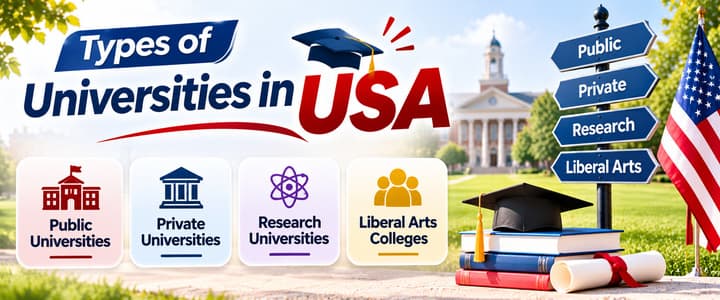
Types of Universities in USA: Complete Guide for International Students
The main types of universities in the USA are public universities, private nonprofit institutions, private for-profit organizations, research universities, liberal arts colleges, community colleges and specialized universities. Institutions can also be sorted by academic mission, highest degree awarded, research activity and student population.
But these categories are not mutually exclusive.
For example, Arizona State University is a public research university. Princeton University is an independent, not-for-profit research university. Bowdoin College is a private, non-profit liberal arts institution. Howard University is a private research university and a historically black college and university (HBCU).
These descriptions are of different aspects of an institution rather than different academic systems.
An international student looking at universities needs to know what each classification really means.
A public university isn't necessarily cheaper than a private institution after scholarships. Attending a research university is no guaranty of better undergraduate instruction. A liberal arts college is more than a humanistic program, and a community college is not necessarily an inferior academic choice.
The degree, the curriculum, the recognition of the institution and the overall cost are more important than the category itself.
For example, a student pursuing a PhD in Computer Science may seek research facilities and faculty expertise. If you get offered a big financial aid package for your bachelor’s degree, a private nonprofit college might actually be cheaper than a public university that charges nonresident tuition.
A student wanting to transfer into a bachelor’s program can start their studies at a community college, as long as the courses meet the requirements of the receiving school.
The best type of American university depends on the student's academic goals, financial resources, intended degree and preferred learning environment.
1. Types of Universities in USA: Quick Comparison
American higher education institutions can be compared according to ownership, educational mission and degree offerings.
| Institution Type | Main Characteristic | Examples |
|---|---|---|
| Public University | Government-Supported Institution | Arizona State, UC Berkeley |
| Private Nonprofit University | Privately Governed, Nonprofit Institution | Princeton, Stanford |
| Private For-Profit Institution | Commercially Operated Education Provider | Varies by Institution |
| Research University | Substantial Academic Research Activity | MIT, UC Berkeley |
| Liberal Arts College | Broad Undergraduate Education | Bowdoin, Wellesley |
| Community College | Associate Degrees and Transfer Pathways | Austin Community College |
| Land-Grant University | Education, Research and Public-Service Mission | Iowa State University |
| Specialized Institution | Concentration in Particular Disciplines | RISD, Juilliard |
| HBCU | Historically Black Educational Mission | Howard, Florida A&M |
| Women's College | Undergraduate Education With a Women's College Mission | Wellesley |
| Online University or Program | Primarily Distance-Based Education | Georgia Tech OMSCS |
Important: An institution can belong to several categories. For example, Florida A&M University is public, historically Black and land-grant. These descriptions are compatible.
Other classifications identify whether universities primarily award bachelor's, master's or doctoral degrees.
Students should therefore evaluate institutions across several dimensions rather than assign each university one label.
2. Public Universities in USA
Public universities are institutions established and supported through state government arrangements.
They commonly receive funding from state appropriations, tuition, research grants and other sources.
Many public universities provide undergraduate, graduate and doctoral programs.
However, public universities differ in academic focus, size, research activity and tuition.
Examples of Public Universities
| University | State | Institutional Characteristic |
|---|---|---|
| University of California, Berkeley | California | Public Research University |
| University of California, Los Angeles | California | Public Research University |
| Arizona State University | Arizona | Public Research University |
| University of Illinois Urbana-Champaign | Illinois | Public Research University |
| San José State University | California | Public University |
| Iowa State University | Iowa | Public Land-Grant University |
| Florida A&M University | Florida | Public HBCU |
How Public University Tuition Works
Public universities frequently distinguish between resident and nonresident tuition.
Students meeting the applicable state residency requirements may qualify for lower tuition.
International students studying in F-1 status generally should plan using nonresident rates unless the institution establishes a specific exception.
For example, a university may advertise an undergraduate tuition amount intended for state residents. An international applicant cannot assume that this figure applies to them.
Main advantage: Public universities offer a broad range of academic options, and some have extensive research facilities and graduate programs.
Main limitation: International tuition and living expenses can still be substantial. Public ownership does not guarantee affordability.
Students should compare the complete international cost rather than the university's resident tuition.
3. Private Nonprofit Universities in USA
Private nonprofit universities are governed independently of state university systems.
They generally obtain funding through tuition, endowments, donations, grants, research activities and other institutional resources.
The nonprofit designation describes the institution's legal and financial organization. It does not mean education is provided without charge.
Private nonprofit universities can be large research institutions, small liberal arts colleges or specialized professional institutions.
Examples
| University | Type | Academic Characteristic |
|---|---|---|
| Princeton University | Private Nonprofit | Undergraduate and Research Education |
| Stanford University | Private Nonprofit | Research-Intensive University |
| Massachusetts Institute of Technology | Private Nonprofit | Science, Engineering and Research |
| University of Chicago | Private Nonprofit | Undergraduate and Graduate Education |
| Bowdoin College | Private Nonprofit | Liberal Arts College |
| Wellesley College | Private Nonprofit | Women's Liberal Arts College |
Are Private Universities More Expensive?
Their published tuition is often substantial, but the amount students actually pay depends on financial assistance.
For example, Princeton's published first-year undergraduate budget for 2026–27 is $94,624, excluding variable transportation costs.
However, Princeton offers need-based financial assistance to qualifying admitted students, including international applicants.
Its undergraduate aid is grant-based rather than a standard loan package.
Bowdoin also follows need-blind admission for first-year international applicants and meets the full calculated financial need of admitted students.
These arrangements differ from universities that primarily offer limited merit scholarships.
Main advantage: Certain private nonprofit universities offer substantial financial aid, specialized academic environments and research opportunities.
Main limitation: Financial assistance varies significantly. Students cannot assume every private university meets international students' full financial need.
The relevant figure is the cost after confirmed financial aid.
4. Public vs Private Universities: Which Is Better?
Public and private universities differ primarily in governance and funding.
Neither category is automatically academically superior.
| Feature | Public University | Private Nonprofit University |
|---|---|---|
| Governance | State-Related Public System | Independent Nonprofit Governance |
| Funding | State Support, Tuition and Other Sources | Tuition, Endowments, Donations and Other Sources |
| Tuition Structure | Often Resident and Nonresident Rates | Institution-Specific Tuition |
| Scholarships | Institutional and Other Awards | Institutional and Other Awards |
| Undergraduate Programs | Often Broad | Varies by Institution |
| Research Opportunities | Varies | Varies |
| Graduate Programs | Common at Universities | Common at Universities |
| Class Size | Depends on Program | Depends on Program |
Academic Quality
A public research university may provide excellent technical education.
A private liberal arts college may offer an undergraduate experience with extensive faculty interaction.
Neither environment is necessarily preferable for every student.
Cost
A public university may have lower published tuition but limited financial aid for international undergraduates.
A private institution may publish higher tuition but provide a substantial need-based grant.
Admission
Some public universities use published minimum academic eligibility requirements and major-specific selection criteria.
Certain private universities evaluate applications through a broader review process.
However, admission methods cannot be determined solely from ownership.
Best choice: Compare the actual degree, net cost, academic requirements and opportunities rather than choosing public or private by default.
5. Private For-Profit Colleges and Universities
Private for-profit institutions operate through commercial ownership structures.
They may offer certificates, associate degrees, bachelor's degrees, graduate programs or career-focused qualifications.
Some operate mainly online, while others provide campus-based instruction.
The for-profit label identifies the institution's business structure. It does not, by itself, establish whether a particular program is accredited or appropriate.
However, prospective students should investigate these institutions carefully before enrolling.
Important Checks
| Factor | What Students Should Verify |
|---|---|
| Accreditation | Current Recognized Institutional Accreditation |
| Degree Authorization | Authority to Award the Intended Qualification |
| Program Quality | Curriculum and Relevant Professional Standards |
| Total Tuition | Complete Cost Until Graduation |
| Transfer Credits | Acceptance by Potential Receiving Institutions |
| Graduation Outcomes | Published Completion Data |
| Employment Claims | Evidence Behind Advertised Results |
| F-1 Eligibility | Appropriate SEVP Certification and Program Format |
Transfer Credit Risk
A student may complete coursework at one institution and later discover that another university will not accept the credits toward the intended degree.
This risk is not exclusive to for-profit colleges, but it is particularly important when considering specialized or career-focused institutions.
Employment Claims
Applicants should be cautious about advertisements promising guaranteed employment, high salaries or automatic professional certification.
A degree does not guarantee an employer will hire the graduate.
Practical recommendation: Evaluate a for-profit institution using the same accreditation, financial and academic standards applied to other universities. Do not enroll based solely on promotional claims.
6. Research Universities in USA
Research universities combine academic teaching with substantial research activity.
They may offer undergraduate, master's, doctoral and professional degrees.
Their faculties conduct research in fields such as Engineering, Medicine, Computer Science, Economics, Physics, Biology, Humanities and Social Sciences.
Research universities can be public or private.
Examples of Research Universities
| University | Ownership |
|---|---|
| University of California, Berkeley | Public |
| University of California, Los Angeles | Public |
| Arizona State University | Public |
| Massachusetts Institute of Technology | Private Nonprofit |
| Stanford University | Private Nonprofit |
| Princeton University | Private Nonprofit |
| Howard University | Private Nonprofit |
What Makes Research Universities Different?
Research activity may involve laboratories, specialized equipment, doctoral supervision, research grants and collaborations.
Graduate students may participate in research through theses, dissertations or assistantships.
Eligible undergraduates may also join faculty projects.
However, research opportunities are not distributed equally across departments.
A large university may conduct extensive research while offering comparatively limited participation to students in a particular coursework master's program.
Who Should Consider a Research University?
Students planning research-focused master's or doctoral education may benefit from relevant facilities and faculty expertise.
Undergraduates interested in scientific projects may also find suitable opportunities.
Important distinction: A university's research activity does not automatically measure undergraduate teaching quality, student satisfaction or graduate employment outcomes.
7. R1, R2 and RCU Universities: Carnegie Research Classification
The Carnegie Classification system provides research activity designations for qualifying American higher education institutions.
The 2025 methodology uses research spending and doctoral degree production.
2025 Carnegie Research Categories
| Classification | Research Spending | Research Doctorates |
|---|---|---|
| R1 | At Least $50 Million | At Least 70 |
| R2 | At Least $5 Million | At Least 20 |
| Research Colleges and Universities (RCU) | At Least $2.5 Million | No R1/R2 Doctorate Threshold |
For R1 and R2, institutions must satisfy the applicable spending and doctorate requirements.
The RCU category recognizes research activity at institutions that do not meet the R1 or R2 criteria.
What Does R1 Mean?
R1 identifies institutions with very high research spending and doctoral degree production.
Under the 2025 classification, 187 institutions received R1 designation.
Examples include major public and private research universities.
What Does R2 Mean?
R2 identifies institutions meeting the stated high-research-activity threshold.
The 2025 classification included 139 R2 institutions.
What Is RCU?
The Research Colleges and Universities designation recognizes institutions with meaningful research expenditures even when they award relatively few or no research doctorates.
The 2025 classification included 216 RCU institutions.
Does R1 Mean the University Is Better?
Not necessarily.
R1 measures research activity against specified thresholds.
It does not directly establish undergraduate teaching quality, affordability, admission difficulty or employment performance.
A student seeking extensive undergraduate mentoring may prefer a smaller institution.
Someone pursuing a research-intensive PhD may prioritize relevant doctoral departments at an R1 university.
The appropriate research classification depends on what the student wants from the degree.
8. Understanding the 2025 Carnegie Institutional Classification
Research status is not the only Carnegie classification.
The redesigned 2025 system separates research activity from the broader institutional classification.
The institutional classification considers degree-awarding patterns, academic program mix and institutional size.
Main Degree-Level Categories
| Institutional Focus | General Meaning |
|---|---|
| Associate | Primarily Associate Degrees |
| Associate/Baccalaureate | Associate Degrees With Significant Bachelor's Activity |
| Baccalaureate | Primarily Bachelor's Degrees |
| Undergraduate/Graduate-Master's | Undergraduate and Master's Education |
| Undergraduate/Graduate-Doctorate | Undergraduate and Doctoral Education |
| Special Focus | Concentration in Particular Academic Fields |
The classification includes more detailed groups based on academic programs and size.
For example, a specialized arts institution may differ substantially from a university offering degrees across Engineering, Business, Medicine and Humanities.
Why This Classification Matters
A student searching for a bachelor's degree may find suitable institutions that do not offer doctorates.
An MS applicant needs an institution authorized to award the intended graduate qualification.
A PhD applicant must verify that the relevant doctoral program exists and admits students.
A university's highest degree offering and program mix can be more relevant than its general reputation.
9. Liberal Arts Colleges in USA
Liberal arts colleges generally emphasize undergraduate education across several disciplines.
They commonly offer bachelor's degrees in humanities, social sciences, natural sciences, mathematics and related fields.
The term liberal arts does not mean these colleges teach only painting, music or literature.
Many provide rigorous Science, Mathematics, Economics and Computer Science education.
Examples of Liberal Arts Colleges
| College | Institutional Characteristic |
|---|---|
| Bowdoin College | Private Nonprofit Liberal Arts College |
| Amherst College | Private Nonprofit Liberal Arts College |
| Williams College | Private Nonprofit Liberal Arts College |
| Wellesley College | Private Women's Liberal Arts College |
| Swarthmore College | Private Nonprofit Liberal Arts College |
Academic Structure
Students generally complete a major alongside coursework in other disciplines.
The institution may emphasize seminars, writing, faculty interaction and undergraduate research.
However, curriculum flexibility differs between colleges.
Bowdoin College Example
Bowdoin is a private nonprofit liberal arts college in Maine.
It offers need-blind admission for first-year international applicants and meets the full calculated financial need of admitted students.
This makes it relevant to students seeking a liberal arts education who require substantial financial assistance.
However, admission remains selective.
Who Should Choose a Liberal Arts College?
Students interested in broad undergraduate education, interdisciplinary study or close engagement with academic subjects may benefit.
Students seeking a specialized professional qualification should first confirm that the intended program is offered.
A liberal arts college can prepare students for graduate education or professional careers, but its degree offerings differ from those of a large comprehensive university.
10. Liberal Arts Colleges vs Research Universities
These institutions differ primarily in educational mission rather than the basic legitimacy of their degrees.
| Factor | Liberal Arts College | Research University |
|---|---|---|
| Primary Emphasis | Often Undergraduate Education | Teaching and Research |
| Graduate Programs | Limited or Absent at Many | Common |
| Academic Breadth | Broad Within Offered Fields | Often Extensive |
| Faculty Research | May Be Available | Major Institutional Activity |
| Undergraduate Research | Depends on College | Depends on Department |
| Class Size | Often Smaller | Highly Variable |
| Doctoral Education | Generally Limited | Common at Doctoral Universities |
Undergraduate Experience
A liberal arts college may provide an undergraduate-focused environment.
A research university may offer a wider range of advanced laboratories and graduate departments.
However, students should not assume every liberal arts college has small classes or every research university has large classes.
Career Preparation
Both types can prepare students for employment and further study.
The appropriate choice depends on the actual curriculum and relevant opportunities.
Financial Considerations
Some selective liberal arts colleges provide substantial need-based financial aid.
Public research universities may use nonresident tuition and different scholarship arrangements.
Students should compare undergraduate teaching, degree offerings and net cost—not simply institution size.
11. Community Colleges in USA
Community colleges are postsecondary institutions commonly associated with associate degrees, certificates and transfer pathways.
Many are publicly supported and serve students seeking professional preparation or entry into a four-year university.
Community colleges often have different admission procedures from selective universities.
However, international students must still satisfy relevant academic, English proficiency and financial requirements.
Common Community College Qualifications
| Qualification | Academic Purpose |
|---|---|
| Associate of Arts (AA) | General Education and Transfer |
| Associate of Science (AS) | Science or Transfer Preparation |
| Associate of Applied Science (AAS) | Career-Oriented Education |
| Certificate | Specialized Training |
| Selected Bachelor's Degrees | Available at Certain Authorized Colleges |
Austin Community College Example
Austin Community College offers associate degrees, certificates and selected bachelor's programs.
Its traditional associate degrees generally require at least 60 semester credits.
Some programs are designed to prepare students for transfer.
Main Benefits
Potentially lower tuition: Community college coursework may cost less than comparable study at a four-year university.
Transfer preparation: Students can complete qualifying lower-division courses.
Academic support: Institutions may provide tutoring, advising and introductory academic preparation.
Career programs: Some qualifications focus on technical or occupational skills.
Main Limitations
Transfer admission is not automatic, and not every course will satisfy the receiving university's degree requirements.
International students must also consider housing, insurance and immigration arrangements.
12. The 2+2 Community College Transfer Pathway
The 2+2 model involves approximately two years of community college education followed by two years at a four-year institution.
The objective is to earn a bachelor's degree from the receiving university.
However, successful completion depends on credit transferability, admission eligibility and required coursework.
Illustrative Transfer Plan
| Academic Stage | Institution | Intended Progress |
|---|---|---|
| Year 1 | Community College | General Education and Prerequisites |
| Year 2 | Community College | Additional Transferable Coursework |
| Year 3 | Four-Year University | Upper-Division Major Courses |
| Year 4 | Four-Year University | Remaining Degree Requirements |
This is a planned pathway, not a guarantee that every student graduates in exactly four years.
University of California Transfer Arrangements
Certain University of California campuses participate in Transfer Admission Guarantee arrangements for eligible California community college students.
The guarantees have campus, major, GPA and coursework conditions.
UC Berkeley and UCLA do not participate in the six-campus guarantee arrangement.
Does Transfer Save Money?
Potentially.
Students must calculate community college tuition, living expenses, transfer-related costs and the remaining university tuition.
A student completing unnecessary or nontransferable courses may need additional semesters.
The correct approach is to identify the receiving university and intended major before selecting community college courses.
13. State Universities and State University Systems
A state university is a public higher education institution associated with a state government.
Some states have multiple public university systems.
A system may include several separately administered campuses with different academic programs and admission requirements.
California Example
California has distinct public higher education systems, including the University of California, California State University and California Community Colleges.
The University of California system includes 10 campuses, with nine offering the regular first-year undergraduate programs commonly associated with UC admission.
UC San Francisco focuses primarily on graduate and professional education.
The California State University system includes universities with different academic specializations and campus environments.
Why System Names Can Be Confusing
Students should not assume that admission to one campus guarantees admission to another.
For example, admission to UC Riverside does not automatically provide admission to UC Berkeley.
Similarly, different CSU campuses may have distinct major requirements.
Graduate Programs Within a System
Not every campus offers every master's or doctoral degree.
A student interested in Biomedical Engineering, for instance, must identify which campuses offer the intended specialization.
University systems provide multiple options, but each campus and program must be evaluated separately.
14. Flagship Universities in USA
A flagship university is commonly understood as a state's prominent public university, often associated with extensive academic programs and research activity.
However, flagship is not a uniform federal accreditation category.
Its use can vary between states and institutions.
Examples
The University of Texas at Austin and the University of Wisconsin–Madison are commonly described as flagship public universities.
Students may also encounter the term in state university systems with several major campuses.
What Does Flagship Status Indicate?
It may describe an institution's historical role, academic breadth, research responsibilities or prominence within a public system.
However, it does not guarantee:
Lower international tuition
Easier admission
Better undergraduate teaching
Guaranteed scholarships
Guaranteed employment
Who Should Consider Flagship Universities?
Students looking for broad degree offerings, established academic departments and substantial research activity may include flagship institutions in their comparisons.
However, the specific department and financial package matter more than the title.
Flagship is a descriptive institutional label, not an independent academic qualification.
15. Land-Grant Universities in USA
Land-grant universities developed through federal legislation supporting practical higher education and public service.
Historically, the land-grant mission emphasized Agriculture, Mechanical Arts and other subjects connected to public needs.
Modern land-grant institutions often provide extensive education and research across many disciplines.
Iowa State University Example
Iowa State University traces its origins to the Iowa Agricultural College and Model Farm, established in 1858.
Iowa accepted provisions of the Morrill Act in 1862, and the land-grant award was applied to the institution in 1864.
The university developed a mission connecting education, research and public engagement.
What Makes Land-Grant Institutions Distinct?
Many operate extension and outreach activities designed to share knowledge beyond the university campus.
Areas may include Agriculture, Engineering, Natural Resources and community development.
Are Land-Grant Universities Only for Agriculture?
No.
Modern land-grant universities may offer Computer Science, Business, Humanities, Medicine-related programs and other fields.
Their historical designation should not be confused with a restriction on academic subjects.
Public vs Private Land-Grant Institutions
Most land-grant universities are public, but the institutional designation is not identical to public ownership.
Students should check each university's actual structure.
The land-grant label describes historical and public-service responsibilities; it does not automatically determine tuition or academic quality.
16. Regional and Teaching-Focused Universities
Not every American university emphasizes large-scale doctoral research.
Some institutions focus heavily on undergraduate education, professional preparation and selected master's programs.
These may be described as regional universities, teaching-focused universities or comprehensive institutions.
However, these terms are not interchangeable official classifications.
Academic Characteristics
Students may encounter institutions offering bachelor's degrees across several disciplines and a smaller portfolio of graduate programs.
Some provide applied Engineering, Education, Nursing, Business or Computer Science degrees.
The level of research activity can vary substantially.
Potential Advantages
Program focus: Certain institutions organize programs around professional and regional workforce needs.
Academic support: Students may find advising, tutoring and practical learning opportunities relevant to their degree.
Degree availability: A university may offer the exact specialization needed without operating a large doctoral research enterprise.
Potential Limitations
An institution without a substantial doctoral program may provide fewer opportunities for advanced research.
However, this does not necessarily affect the quality of its undergraduate or professional education.
What Should International Students Check?
Evaluate the actual degree curriculum, accreditation, faculty expertise, graduation requirements and cost.
A student seeking a coursework master's may find a suitable program at a teaching-focused institution.
A student pursuing original doctoral research must verify that the required research infrastructure exists.
17. Technical and Technology-Focused Universities
Some institutions have a strong academic emphasis on Science, Technology, Engineering, Mathematics or applied technical education.
However, the word technology in an institution's name does not establish one uniform category.
Massachusetts Institute of Technology
MIT is a private nonprofit institution with substantial science, engineering and research activity.
Despite its name, MIT offers academic programs beyond Engineering and Computing.
California Institute of Technology
Caltech is a private research institution with a strong focus on Science and Engineering.
Its academic environment differs from that of a large comprehensive public university.
Rochester Institute of Technology
RIT is a private nonprofit university offering programs across technology, engineering, computing, design, business and other fields.
Choosing a Technology-Focused Institution
Students should investigate the exact major.
For example, a degree in Software Engineering may have a different curriculum from Computer Science.
An Engineering Technology degree can also differ from an Engineering degree in mathematical preparation and professional recognition.
Program accreditation and curriculum matter more than the institution's name.
Students planning a regulated Engineering profession should investigate relevant professional requirements.
18. Specialized Art, Design and Performing Arts Institutions
Some American colleges focus on creative disciplines.
These institutions may use studio instruction, critiques, portfolios, performances and professional projects as central parts of education.
Rhode Island School of Design
Rhode Island School of Design (RISD) is a private nonprofit college specializing in Art and Design.
It offers bachelor's and master's programs in fields such as Graphic Design, Industrial Design, Illustration, Architecture, Painting and related subjects.
Its educational approach emphasizes studio work and creative development.
The Juilliard School
Juilliard specializes in performing arts education, including Music, Dance and Drama.
The school offers undergraduate and graduate qualifications in relevant disciplines.
Admission to certain programs involves auditions or other artistic assessments.
Admission Requirements
Creative programs may evaluate portfolios, auditions, artistic experience and academic records.
A strong Class 12 percentage does not automatically replace a required portfolio or audition.
Degree Recognition
Students should distinguish degree programs from professional diplomas, certificates and nondegree training.
For example, a conservatory may award different qualifications depending on the program.
Specialized institutions are most suitable when their curriculum and training environment match the student's intended artistic or professional direction.
19. Business-Focused Colleges and Universities
Business education is available through different institutional structures.
A comprehensive university may contain a business school offering undergraduate and graduate qualifications.
Other institutions place business education at the center of their academic mission.
Academic Qualifications
Business programs may include:
| Degree | Typical Academic Focus |
|---|---|
| BBA | Undergraduate Business Education |
| BS in Business | Business With Program-Specific Requirements |
| Master in Management | Graduate Management Education |
| Master in Finance | Specialized Finance Education |
| MS in Business Analytics | Quantitative and Analytical Business Skills |
| MBA | Graduate Management and Professional Development |
Undergraduate vs Graduate Business Education
A BBA applicant normally applies after secondary school.
An MBA applicant generally needs an accepted bachelor's degree and may be evaluated for professional experience.
Specialized master's programs can have different requirements.
Accreditation
Students should check institutional accreditation and any relevant business program accreditation.
Some business schools hold accreditation from organizations such as AACSB.
However, the absence or presence of a particular programmatic accreditation should be considered alongside the institution's broader academic recognition and the student's career requirements.
Financial Planning
Business programs can vary substantially in tuition and duration.
An expensive MBA may involve significant income forgone if the student leaves employment.
A specialized master's may provide a more suitable academic route for some recent graduates.
The appropriate institution depends on the intended business qualification and professional objective.
20. Historically Black Colleges and Universities (HBCUs)
Historically Black Colleges and Universities are institutions established before 1964 with a historical mission of educating Black Americans, subject to the applicable federal definition.
HBCUs developed in the context of restricted educational opportunities and have played an important role in American higher education.
They can be public or private institutions.
They may offer undergraduate, graduate and professional degrees.
Examples of HBCUs
| University | Ownership | Academic Characteristic |
|---|---|---|
| Howard University | Private Nonprofit | Research University |
| Florida A&M University | Public | Comprehensive University |
| Spelman College | Private Nonprofit | Women's Liberal Arts College |
| North Carolina A&T State University | Public | Research-Oriented University |
Howard University
Howard is a private research university in Washington, DC.
It offers undergraduate, graduate and professional education across several schools and colleges.
Howard also holds R1 research status under the 2025 Carnegie classifications.
Florida A&M University
Florida A&M is a public HBCU in Tallahassee, Florida.
It provides undergraduate and graduate education and is part of Florida's public university system.
Can International Students Apply?
HBCU status does not mean admission is restricted to one racial or national group.
Institutions establish their own admission requirements and enroll students from different backgrounds.
International students should evaluate academic eligibility, available programs and financial assistance.
HBCU describes an institution's historical mission, not a separate degree level or ownership category.
21. Hispanic-Serving Institutions and Other Minority-Serving Institutions
Some American higher education institutions are identified as Minority-Serving Institutions (MSIs).
These designations relate to their educational mission, student enrollment characteristics or applicable federal criteria.
They are not separate types of degrees.
Hispanic-Serving Institutions
A qualifying Hispanic-Serving Institution generally must meet eligibility conditions that include at least 25% Hispanic undergraduate full-time-equivalent enrollment.
Additional requirements apply to relevant federal program eligibility.
Other MSI Categories
Institutional designations may include:
Historically Black Colleges and Universities
Hispanic-Serving Institutions
Tribal Colleges and Universities
Alaska Native-Serving Institutions
Native Hawaiian-Serving Institutions
Asian American and Native American Pacific Islander-Serving Institutions
Other qualifying institutions under applicable federal programs
Why These Categories Matter
Some federal programs support educational capacity, academic services or institutional development at qualifying institutions.
However, these programs are not automatically scholarships available to every international applicant.
Students should distinguish institutional funding from individual student aid.
Academic Selection
An MSI may be public, private nonprofit, research-intensive or primarily undergraduate.
Its mission-related designation does not determine the complete curriculum or admission standards.
International applicants should evaluate the institution's degree offerings and financial aid policies independently of its MSI status.
22. Tribal Colleges and Universities
Tribal Colleges and Universities serve important educational and community missions connected to Native American and tribal communities.
Many provide associate degrees, bachelor's programs, certificates and other educational opportunities.
Their governance, authorization and academic structures differ.
Some institutions are established or controlled through tribal arrangements.
Academic Characteristics
Programs may include general education, teacher preparation, business, environmental studies, tribal languages, cultural studies and other disciplines.
Degree availability varies by institution.
Are Tribal Colleges Only for Tribal Students?
Admission eligibility depends on the institution and program.
Students should not assume that every program is either universally open or universally restricted.
International Student Considerations
Applicants should verify whether the institution accepts international students and is appropriately certified for the intended immigration classification.
They should also check academic accreditation, degree recognition, tuition and financial assistance.
Why Classification Matters
Tribal colleges may appear in institutional categories based on degree levels and can also receive research designations if they satisfy the applicable criteria.
Their educational mission and governance structure should not be confused with assumptions about academic quality or degree validity.
23. Women's Colleges in USA
Women's colleges are institutions with a historical or continuing mission centered on women's education.
Many are private nonprofit liberal arts colleges.
Their admission policies must be checked individually.
Wellesley College
Wellesley College is a private nonprofit undergraduate liberal arts institution in Massachusetts.
It offers bachelor's-level education across humanities, social sciences, mathematics and natural sciences.
The college identifies women's education as central to its mission.
Other Examples
Smith College, Mount Holyoke College and Spelman College are additional institutions associated with women's undergraduate education.
Their curricula and admission policies differ.
Academic Benefits
A women's college may offer an undergraduate-focused environment with academic advising, faculty interaction and leadership opportunities.
However, these characteristics should be evaluated using institutional evidence rather than assumed to apply equally everywhere.
Admission Eligibility
Students should review each institution's current admissions policy.
Policies concerning eligible applicants may differ between women's colleges.
A women's college is not automatically limited to arts or humanities education. Many offer substantial Science, Mathematics and Social Science programs.
24. Religious and Faith-Affiliated Universities
Some American universities have historical or active religious affiliations.
They may be private nonprofit institutions with a particular educational mission.
However, religious affiliation does not necessarily mean that every academic program is theological.
Academic Programs
Faith-affiliated institutions may offer Engineering, Computer Science, Business, Nursing, Humanities and other disciplines.
Some also operate theology or religious studies departments.
Examples
The University of Notre Dame is a private Catholic research university.
Brigham Young University is a private university associated with The Church of Jesus Christ of Latter-day Saints.
These institutions have different academic programs, student expectations and institutional policies.
What Applicants Should Check
Curriculum: Determine whether the degree requires religious studies or other institution-specific coursework.
Conduct policies: Some institutions maintain student conduct codes reflecting their mission.
Admissions: Requirements may include academic qualifications and additional institutional criteria.
Funding: Scholarships and tuition arrangements vary.
Campus expectations: Housing, student activities and institutional policies may differ from those at secular universities.
International students should evaluate whether the environment is suitable for their academic and personal preferences.
25. Professional Schools and Graduate-Only Institutions
Some institutions or academic divisions focus primarily on graduate and professional education.
These may offer Medicine, Law, Public Health, Dentistry, Business or other advanced qualifications.
A university may have undergraduate programs while also operating specialized professional schools.
Other institutions have little or no traditional undergraduate enrollment.
University of California, San Francisco
UC San Francisco primarily focuses on graduate and professional health sciences education.
It differs from UC Berkeley or UCLA, which offer extensive first-year undergraduate programs.
Professional Schools
Examples of professional education include:
| Professional Field | Common Qualification |
|---|---|
| Medicine | MD |
| Law | JD |
| Dentistry | DDS or DMD |
| Public Health | MPH |
| Pharmacy | PharmD |
| Business | MBA |
Admission often requires previous education and may involve professional entrance examinations or additional prerequisites.
Why This Matters After Class 12
A student completing secondary school cannot assume every university offers direct entry to the intended professional degree.
For example, the conventional US MD pathway generally requires undergraduate education and premedical preparation first.
Graduate-Only vs Comprehensive Universities
A graduate-focused institution may offer specialized education without the broad undergraduate experience of a comprehensive university.
Students must verify the level at which admission is available before applying.
26. Online Universities and Distance Education Programs
Online education allows students to complete coursework remotely.
Some institutions operate mainly through online delivery, while established campus universities may offer individual online degrees.
The academic qualification and immigration implications depend on the institution and program.
Georgia Tech Online MS Computer Science
Georgia Institute of Technology offers an Online Master of Science in Computer Science, commonly called OMSCS.
The program awards a Master of Science in Computer Science.
It is designed to accommodate students studying remotely, including working professionals.
Does an Online US Degree Provide an F-1 Visa?
Not automatically.
Georgia Tech states that international students enrolling in OMSCS are not offered student visas through that program and do not qualify for OPT on the basis of completing it.
Online vs On-Campus Education
| Factor | Online Degree | On-Campus Degree |
|---|---|---|
| Location | Usually Remote | Campus Attendance |
| Relocation | Often Unnecessary | Commonly Required |
| Course Delivery | Online | In Person or Approved Hybrid |
| Living Expenses in USA | May Be Avoided | Usually Required |
| Campus Experience | Limited or Different | In-Person Opportunities |
| F-1 Eligibility | Not Automatic | Depends on Eligible Institution and Program |
| OPT | Not Automatically Available | Possible for Eligible F-1 Students |
Is an Online Degree Less Valuable?
Not necessarily.
Students should evaluate accreditation, curriculum, degree recognition and learning format.
An online program may be suitable for professionals seeking advanced knowledge without leaving employment.
However, students seeking physical study in the United States and eligible F-1 practical training must verify that the chosen program supports those arrangements.
27. Hybrid Universities, Branch Campuses and Satellite Locations
Some universities operate multiple campuses or offer hybrid education combining online and in-person instruction.
However, branch campuses and hybrid programs can differ in academic recognition, tuition and immigration eligibility.
Branch Campuses
A university may operate teaching facilities outside its main campus.
The branch may offer selected degrees rather than the complete academic portfolio.
Students should verify whether the degree is awarded by the parent university and whether the campus is covered by the relevant institutional accreditation.
Satellite Locations
Some satellite locations provide particular graduate programs, professional education or continuing education.
They may not provide the same academic resources as the main campus.
Hybrid Programs
A hybrid program combines online instruction with required physical attendance.
The proportion of online coursework and in-person participation varies.
International Student Requirements
F-1 students must satisfy the full-course-of-study requirements applicable to their status.
Under standard rules, only one online course or three online credits per term may generally count toward the required full course of study when the class does not require relevant physical attendance.
Specific situations and exceptions must be evaluated under current regulations.
Students should not assume that a hybrid or branch-campus program qualifies for the same immigration arrangements as the main residential degree.
28. University Accreditation: How to Verify an Institution
Accreditation helps students evaluate institutional and program recognition.
In the United States, accreditation is conducted by recognized accrediting organizations rather than directly by the federal Department of Education.
Main Accreditation Categories
| Accreditation | What It Evaluates |
|---|---|
| Institutional Accreditation | The Institution as a Whole |
| Programmatic Accreditation | A Particular Degree, Department or Professional Program |
Institutional Accreditation
Institutional accreditation assesses whether an institution meets the accreditor's applicable standards.
Students should verify that the accrediting organization is appropriately recognized.
Programmatic Accreditation
Certain academic fields use additional specialized accreditation.
For example, Engineering programs may hold ABET accreditation, while business schools may hold recognized business accreditation.
Professional licensing requirements can make programmatic accreditation particularly important.
Regional vs National Accreditation
Older college guides often distinguish between regional and national accreditation.
However, the federal government no longer recognizes regional accreditation as a separate superior category of institutional accreditation.
Students should verify the actual recognized accrediting agency, its scope and the institution's current status.
Does Accreditation Guarantee Credit Transfer?
No.
The receiving university decides whether previous coursework satisfies its transfer and degree requirements.
Accreditation is important, but it does not automatically establish admission eligibility or professional licensing.
29. Accreditation vs SEVP Certification
International applicants must distinguish academic recognition from authorization to enroll students under particular immigration rules.
Institutional Accreditation
Accreditation concerns academic quality assurance and recognition.
SEVP Certification
Student and Exchange Visitor Program certification concerns an institution's eligibility to enroll qualifying nonimmigrant students under the applicable rules.
An institution seeking to issue Form I-20 for F-1 students must satisfy the relevant certification requirements.
Why Both Checks Matter
A school may advertise academic programs online without offering the appropriate immigration documentation for a student intending to live and study in the United States.
Conversely, immigration certification should not be treated as a substitute for checking academic accreditation and degree quality.
Verification Checklist
| Question | Why It Matters |
|---|---|
| Is the institution accredited? | Academic Recognition |
| Is the accrediting agency recognized? | Accreditation Validity |
| Is the intended program covered? | Degree-Specific Recognition |
| Is the school SEVP-certified? | Relevant International Enrollment |
| Can the program issue Form I-20? | Applicable F-1 Process |
| Is the study format F-1 eligible? | Enrollment Compliance |
The safest approach is to verify both academic recognition and immigration eligibility before accepting admission.
30. Tuition Comparison: Different Types of Universities
International students should compare total educational expenses rather than assume a category determines affordability.
Published cost examples illustrate the differences.
2026–27 University Cost Examples
| Institution | Published Amount | Cost Category |
|---|---|---|
| San José State University | $49,278 | Annual International Undergraduate Estimate |
| Arizona State University | $69,906 | Annual International Undergraduate Estimate |
| Princeton University | $94,624 | First-Year Undergraduate Budget Before Aid |
| Bowdoin College | $95,400 | Annual Direct Costs Before Aid |
These figures do not include identical cost categories.
San José State's estimate includes tuition and fees, living expenses and medical insurance.
ASU's estimate includes a broader set of educational and personal expense categories.
Princeton's budget includes tuition, housing, food, academic supplies, personal expenses and fees, while transportation varies.
Bowdoin's $95,400 figure covers direct costs. Additional estimated expenses include books, personal costs and transportation.
Why Private Colleges May Cost Less After Aid
Consider two hypothetical admission offers.
| Financial Item | Public University A | Private College B |
|---|---|---|
| Annual Published Cost | $50,000 | $90,000 |
| Confirmed Annual Grant | $5,000 | $55,000 |
| Annual Net Cost | $45,000 | $35,000 |
These are illustrative figures, not actual scholarship offers.
The private college has the higher published price but lower cost after confirmed assistance.
Scholarships and Degree Level
Graduate funding may differ substantially from undergraduate funding.
A research PhD may provide tuition support and a stipend.
A professional master's program may offer limited scholarships.
University type affects how institutions operate, but affordability must be calculated from the student's actual offer.
31. Admission Requirements by University Type
American universities establish their own admission requirements.
No single percentage or test score applies to all public, private or research universities.
Typical Admission Considerations
| Institution Type | Main Admission Considerations |
|---|---|
| Public University | Academic Records, Program Eligibility, English Requirements |
| Private University | Academic Records and Institution-Specific Materials |
| Liberal Arts College | Undergraduate Preparation, Essays and Other Required Materials |
| Community College | Secondary Qualification and Applicable Language Requirements |
| Research Master's | Bachelor's Degree and Technical or Academic Prerequisites |
| PhD Program | Academic Preparation, Research Ability and Recommendations |
| Art or Design School | Academic Records and Required Portfolio |
| Performing Arts School | Academic Eligibility and Audition Requirements |
Public University Admission
Certain public universities publish minimum GPA or school subject requirements.
However, competitive majors may establish additional criteria.
Private University Admission
Some private institutions use broader application evaluations involving essays, recommendations and academic preparation.
Others have more structured academic admission procedures.
Community College Admission
Many community colleges provide more accessible entry routes.
However, open-admission policies do not eliminate international documentation, language or immigration requirements.
Graduate Admission
Graduate requirements depend heavily on the department.
A university that accepts an applicant for one master's degree may reject the same applicant for another because the academic prerequisites differ.
Students must check the intended course, not merely the institution's general admission page.
32. Which University Type Is Best for a Bachelor's Degree?
Undergraduate students should evaluate academic flexibility, major availability, total cost and student support.
Public Universities
A public university may offer numerous majors, research opportunities and campus activities.
However, international nonresident tuition can be substantial.
Private Universities
A private university may provide a suitable undergraduate curriculum and potentially substantial need-based assistance.
However, financial aid policies vary.
Liberal Arts Colleges
These institutions may be attractive to students who want broad academic education or flexibility to explore subjects.
Students must verify that the intended major is offered.
Community Colleges
Community colleges may provide a lower-cost initial pathway toward a bachelor's degree.
However, the transfer plan must be academically sound.
Example: Computer Science After Class 12
A student interested in Computer Science might compare a public research university with a private liberal arts college and a community college transfer route.
The correct choice depends on mathematics preparation, admission competitiveness, degree requirements, scholarships and the complete cost.
A cheaper initial tuition figure is not automatically the best overall option.
33. Which University Type Is Best for MS Students?
Master's applicants should prioritize the actual graduate program rather than the institution's broad category.
Research Universities
Research universities may provide advanced academic courses, specialized facilities and relevant faculty research.
They can be useful for students considering research-oriented master's degrees or future doctoral study.
Teaching-Focused Universities
A university with less extensive research activity may still offer a suitable professional master's degree.
Students should review the curriculum and available applied projects.
Specialized Technical Institutions
Institutions focusing on Engineering, Computing or related fields may offer advanced degrees with technical depth.
However, program quality and admission requirements must be assessed individually.
Professional Master's Programs
Some universities offer coursework-focused programs designed for professional preparation.
These may have limited research opportunities or financial assistance.
Indian Degree Recognition
Students holding three-year BCom, BBA, BCA, BA or BSc degrees must verify degree equivalency.
A university's research classification does not determine whether it accepts a particular Indian qualification.
For MS applicants, program-level academic suitability and affordability are usually more useful than choosing an institution solely because it is R1.
34. Which University Type Is Best for MBA Students?
MBA students should compare business schools according to career goals, professional background, curriculum and financial requirements.
Business schools may operate within public or private universities.
Some institutions specialize in business education.
Main Considerations
Academic curriculum: Determine whether the program emphasizes General Management, Finance, Marketing, Entrepreneurship or another concentration.
Professional experience: Many established full-time MBA programs recruit students with relevant work experience.
Career services: Evaluate the actual assistance offered and available employment information.
Duration: Program length affects tuition and income forgone.
Scholarships: Business school funding varies.
International employment: Applicants must consider immigration eligibility and realistic career alternatives.
MBA vs Specialized Master's
An MBA may be appropriate for applicants seeking broader management responsibilities.
A specialized Master in Finance or Business Analytics may be more suitable for someone pursuing a particular technical or analytical function.
The best business school is the one whose program, student profile and cost match the applicant's intended professional transition.
35. Which University Type Is Best for PhD Students?
Doctoral applicants should prioritize research supervision and program funding.
A relevant PhD program must provide suitable academic preparation and opportunities to conduct original research.
Research Universities
R1 and R2 universities may be relevant because their classifications reflect substantial research activity.
However, the research intensity of a university does not guarantee strength in every discipline.
Faculty Compatibility
Students should investigate faculty research areas.
For example, an applicant interested in Computer Vision should examine faculty working on relevant problems rather than select a department based solely on its overall ranking.
Funding
Some doctoral programs provide financial support through fellowships or assistantships.
Students should review the written funding offer for tuition coverage, stipend, duration and conditions.
Research Environment
Facilities, equipment and access to research resources may matter for experimental disciplines.
Other subjects may place greater emphasis on scholarly collections, fieldwork support or research communities.
Career Objectives
A PhD is primarily preparation for sustained research.
Students seeking a short professional qualification should not assume that doctoral study is automatically the better route.
Research fit, supervision and funding matter more than the broad label public or private.
36. Which University Type Is Most Affordable for International Students?
There is no universally cheapest category.
A community college may offer lower tuition for initial undergraduate coursework.
A public university may provide comparatively affordable degree options.
A private college may offer substantial financial aid.
A funded PhD may involve a different financial arrangement from a self-funded master's degree.
Affordability Comparison
| Student Situation | Potentially Suitable Route | Main Financial Check |
|---|---|---|
| Undergraduate With Limited Funds | Community College Transfer | Total Four-Year Cost |
| Strong Student Requiring Aid | Need-Based Private College | Calculated Family Contribution |
| Student Seeking Public University | Suitable State University | Nonresident Tuition |
| Research-Focused Graduate | Funded PhD | Stipend and Funding Conditions |
| Working Professional | Recognized Online Program | Tuition and Degree Suitability |
Community College Savings
Students may save on tuition by completing transferable coursework before entering a four-year university.
However, housing costs and additional semesters can reduce expected savings.
Private College Financial Aid
Princeton and Bowdoin provide examples of institutions where need-based assistance can substantially change affordability.
However, admission is competitive and the university calculates the actual award.
Graduate Financial Aid
Master's students should investigate whether assistantships or scholarships are actually available to their degree category.
The most affordable university is the one offering an academically suitable degree at the lowest realistic net cost—not necessarily the lowest advertised tuition.
37. University Size: Small vs Large Institutions
American institutions differ substantially in student enrollment.
Size can influence course availability, campus activities, advising structures and the learning environment.
However, institution size does not automatically establish educational quality.
Large Universities
Large universities may offer extensive academic programs, research facilities and student organizations.
Some introductory lectures may enroll substantial numbers of students.
However, laboratory or advanced seminars may still be small.
Small Colleges
Small colleges may emphasize undergraduate education and faculty interaction.
However, students should verify actual class sizes and advising arrangements rather than assume every course is small.
Medium-Sized Institutions
These may combine broad academic offerings with a campus environment different from very large universities.
Practical Comparison
| Student Preference | What to Investigate |
|---|---|
| Wide Major Selection | Available Degrees and Departments |
| Faculty Interaction | Class Structure and Advising |
| Research Access | Undergraduate or Graduate Participation |
| Extensive Campus Activities | Student Organizations and Facilities |
| Small Learning Environment | Actual Class Sizes |
| Academic Flexibility | Electives and Major Change Policies |
Students should evaluate their intended department, not only the total university enrollment.
38. Urban, Suburban and Rural Universities
Location affects living expenses, transport, housing and the campus environment.
However, a university's location is not a direct measure of academic quality.
Urban Universities
Urban campuses are located within major cities or metropolitan areas.
Students may have access to public transport and professional events, but living expenses can be high.
Suburban Universities
Suburban campuses may offer a different residential environment while remaining connected to a metropolitan region.
Transport arrangements vary.
Rural and College-Town Universities
Some institutions are located in smaller communities or dedicated college towns.
Students may find a different pace of life and housing market.
However, the availability of transport, internships and services depends on the particular location.
Financial Planning
A university's total attendance cost is more informative than a general assumption that large cities are always more expensive.
Housing arrangements can significantly change annual expenses.
Academic Considerations
A research laboratory in a smaller city may be more suitable for a specialized academic objective than a university located near corporate headquarters.
Students should evaluate cost, safety, transport and academic opportunities for the actual campus location.
39. Common Mistakes When Choosing a US University
International applicants often misunderstand institutional categories.
Assuming Public Means Cheap
Public universities commonly charge international students nonresident tuition.
The full amount may be substantially higher than resident tuition.
Assuming Private Means Better
Private ownership does not guarantee superior teaching, research or employment outcomes.
Treating R1 as a General Quality Ranking
R1 measures research activity, not every dimension of educational quality.
Confusing Liberal Arts With Fine Arts
Liberal arts colleges commonly teach Mathematics, Sciences and Social Sciences alongside Humanities.
Assuming Community College Guarantees Transfer
Transfer admission and credit recognition depend on the receiving institution.
Ignoring Degree Level
A specialized graduate institution may not offer first-year undergraduate admission.
Confusing Accreditation With Immigration Authorization
Academic recognition and SEVP certification are separate considerations.
Assuming Online Degrees Provide OPT
Remote programs do not automatically establish F-1 or practical-training eligibility.
Ignoring Programmatic Recognition
Certain professions require specific accreditation or licensing.
Comparing Only Tuition
Students should include housing, insurance, food, transportation and mandatory fees.
Relying on General University Rankings
An institution's overall reputation may not reflect the suitability of a particular specialization.
The strongest university shortlist is built around actual degree requirements, academic opportunities and affordability.
40. How to Choose the Right University Type: Step-by-Step
Students can use the following process to create a suitable shortlist.
Step 1: Identify the qualification. Determine whether the goal is an associate, bachelor's, master's, MBA, professional or doctoral degree.
Step 2: Check academic eligibility. Confirm recognition of previous school or university qualifications.
Step 3: Identify the intended specialization. Compare actual curricula and subject prerequisites.
Step 4: Choose suitable institution types. Consider public, private, research, liberal arts, specialized or community college options according to the degree.
Step 5: Verify accreditation. Confirm institutional recognition and any important program-specific requirements.
Step 6: Evaluate international tuition. Use the correct nonresident or international rate.
Step 7: Investigate scholarships. Distinguish confirmed awards from potential future assistance.
Step 8: Review academic opportunities. Examine relevant laboratories, projects, faculty or professional preparation.
Step 9: Confirm immigration eligibility. Verify whether the school and program support the intended student status.
Step 10: Compare complete costs and outcomes. Evaluate the degree's educational value, financing and realistic alternatives.
University Comparison Tracker
| Comparison Factor | Information to Record |
|---|---|
| Institution | Official University Name |
| Ownership | Public, Private Nonprofit or For-Profit |
| Academic Type | Research, Liberal Arts or Specialized |
| Degree | Exact Qualification |
| Research Classification | R1, R2, RCU or Other |
| Accreditation | Recognized Institutional Status |
| Program Accreditation | Where Relevant |
| Admission | Academic and Examination Requirements |
| Annual Cost | International Cost of Attendance |
| Financial Aid | Confirmed and Available Awards |
| Practical Experience | Actual Program Opportunities |
| F-1 Eligibility | Appropriate School and Program Authorization |
| Final Assessment | Academic Fit and Net Affordability |
A spreadsheet using these fields can help students compare universities consistently.
41. Frequently Asked Questions About Types of Universities in USA
Q1. What are the main types of universities in USA? The main categories include public universities, private nonprofit universities, private for-profit institutions, research universities, liberal arts colleges, community colleges and specialized institutions.
Q2. What is a public university in USA? A public university is an institution established and supported through state government arrangements. International students commonly pay nonresident tuition.
Q3. What is a private university? A private university is independently governed. It may operate as a nonprofit or for-profit institution, depending on its legal structure.
Q4. Are private universities better than public universities? Not necessarily. Academic quality, research opportunities, financial aid and degree suitability vary between institutions.
Q5. Are public universities cheaper for international students? Some are, but international nonresident tuition can be substantial. A private college with significant financial aid may cost less.
Q6. What is a research university? A research university conducts substantial scholarly or scientific research alongside academic teaching.
Q7. What does R1 university mean? R1 identifies institutions meeting the Carnegie threshold for very high research spending and research doctorate production.
Q8. What is an R2 university? R2 identifies institutions meeting the Carnegie threshold for high research spending and doctorate production.
Q9. What does RCU mean? RCU stands for Research Colleges and Universities, a designation for qualifying institutions with substantial research activity outside the R1 and R2 categories.
Q10. Is an R1 university always better? No. Research classification does not directly measure every aspect of teaching quality, student support or employment outcomes.
Q11. What is a liberal arts college? A liberal arts college commonly emphasizes undergraduate education across Humanities, Social Sciences, Natural Sciences, Mathematics and related fields.
Q12. Can students study Computer Science at a liberal arts college? Yes, if the college offers the major and the student meets the academic requirements.
Q13. What is a community college? A community college commonly offers associate degrees, certificates and transfer-oriented undergraduate coursework.
Q14. Can international students attend community college? Yes, at eligible institutions accepting international applicants and supporting the appropriate immigration status.
Q15. Does community college guarantee university admission? No. Transfer eligibility depends on the receiving university and any applicable agreement.
Q16. What is a flagship university? It is a term commonly used for a prominent public university within a state. It is not a uniform federal academic classification.
Q17. What is a land-grant university? A land-grant university is associated with the historical public-service and practical education mission established through federal legislation.
Q18. What is a technical university? A technical university or institute commonly emphasizes fields such as Science, Engineering, Computing or applied technology, although degree offerings differ.
Q19. What is an HBCU? A Historically Black College or University is an institution meeting the relevant historical and educational mission criteria under federal law.
Q20. Can international students apply to HBCUs? Yes, where the university accepts international applicants who meet its academic and other admission requirements.
Q21. What is a Hispanic-Serving Institution? It is an institution meeting applicable eligibility requirements, including a qualifying Hispanic undergraduate enrollment threshold.
Q22. What is a women's college? A women's college has an educational mission centered on women's education. Admission eligibility must be checked individually.
Q23. What is a specialized university? It is an institution concentrating on particular disciplines such as Art, Design, Music, Technology or professional education.
Q24. Do online US universities provide student visas? Not automatically. The institution and specific program must support the applicable immigration classification.
Q25. Is accreditation important? Yes. Students should verify recognized institutional accreditation and relevant program-specific accreditation where necessary.
Q26. Is regional accreditation better than national accreditation? The federal government does not recognize regional accreditation as a separate superior category. Students should verify the actual recognized agency and accreditation scope.
Q27. What is SEVP certification? SEVP certification concerns a school's authorization to enroll qualifying international students under applicable immigration rules.
Q28. Which university type is best for a bachelor's degree? The best option depends on the major, academic preparation, financial aid, curriculum and student preferences.
Q29. Which university type is best for MS? Research universities, specialized institutions and comprehensive universities may all offer suitable MS programs. Program-specific academic fit matters most.
Q30. Which university type is best for PhD? Students should prioritize research supervision, departmental expertise, facilities and funding rather than ownership alone.
Q31. Are community colleges always cheaper? Tuition may be lower, but students must calculate living costs, transfer expenses and the full bachelor's degree cost.
Q32. Can a private university offer full financial aid? Certain private nonprofit institutions meet the full calculated financial need of admitted students, including eligible international applicants.
Q33. Is university ranking more important than type? Neither should dominate the decision. The actual degree, recognition, opportunities and affordability are more important.
Q34. Can one university belong to multiple categories? Yes. A university may simultaneously be public, land-grant, research-intensive and historically Black.
Q35. How should international students choose a US university? Compare the intended degree, academic eligibility, accreditation, international tuition, financial assistance and relevant study opportunities.
Conclusion
The United States has a diverse higher education system with public, private nonprofit, for-profit, research, liberal arts, community college and specialized institutions. These categories describe different aspects of ownership, academic mission, degree offerings and educational structure.
Public universities may provide extensive degree choices and research opportunities, but international students commonly pay nonresident tuition. Private nonprofit universities can offer substantial financial assistance, although funding policies differ. Liberal arts colleges often emphasize undergraduate education, while research universities may offer broader doctoral and research opportunities.
Community colleges provide associate degrees and possible transfer routes. Specialized institutions focus on areas such as Engineering, Design, Music or professional education. HBCUs, land-grant universities and other mission-related institutions have distinct historical or educational responsibilities that can overlap with public, private and research classifications.
Research designations such as R1, R2 and RCU identify institutional research activity but should not be treated as universal academic quality rankings.
For international students, accreditation, degree recognition and immigration eligibility are especially important. An institution's ability to award a recognized qualification is separate from its authorization to enroll qualifying F-1 students.
Before choosing a university, compare six essentials: the institution's ownership and academic type, exact degree, accreditation, admission eligibility, total cost after financial aid and available academic opportunities.
The best American university is not necessarily the largest, most famous or highest-ranked institution. It is the one that offers an academically appropriate degree, credible educational opportunities and a financially realistic pathway toward the student's long-term goals.