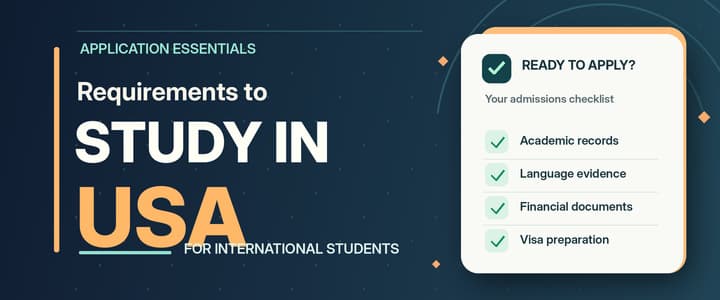
International students can study in the USA after Class 12, graduation or postgraduate education provided they fulfilll the admission criteria of the university of their choice and the applicable immigration regulations. But there is no single national standard for admission in American universities. For example, a bachelor’s applicant may be required to have taken certain subjects in school, an MS applicant may be required to show adequate preparation at the undergraduate level, and an MBA or PhD applicant may be required to meet other professional or research-related requirements.
The recognition of international qualifications also differs between university policies. Take Arizona State University, which sets a general 3.00 GPA benchmark for international first-year applicants. The University of Illinois Urbana-Champaign will accept three and four year Indian bachelor’s degrees for graduate consideration, although departments may have additional requirements.
There is no minimum percentage, IELTS score, GRE score or bank balance that will get you admission to any American university. Students should consider the exact degree, academic entry requirements, examinations, application documents, funding and immigration requirements before applying.
1. Requirements to Study in USA: Quick Overview
The main requirements depend on the student's intended academic level.
| Study Level | Previous Qualification | Additional Requirements |
|---|---|---|
| Bachelor's | Recognized Class 12 or equivalent | School grades, subjects, English proficiency, possible SAT/ACT |
| Master's | Accepted bachelor's degree | Relevant coursework, English proficiency, possible GRE |
| MBA | Accepted bachelor's degree | Essays, resume, possible work experience and GMAT/GRE |
| PhD | Relevant bachelor's or master's | Research preparation, recommendations, department requirements |
Key distinction: Academic eligibility, English proficiency and entrance examinations are separate requirements. A university may waive GRE but still require TOEFL, while a student may satisfy general admission requirements without meeting the prerequisites for a particular major.
2. Academic Requirements After Class 12
Students completing recognized secondary school qualifications can apply for American undergraduate programs. Indian qualifications commonly evaluated include CBSE, ISC, recognized state boards, International Baccalaureate and Cambridge International examinations. Universities assess grades, subject preparation and recognition of the qualification.
Arizona State University: ASU's general international first-year benchmark is a 3.00 GPA on a 4.00 scale or an evaluated equivalent. Its academic competency requirements include four years of qualifying mathematics and three years of laboratory science. Some majors impose higher standards.
University of California: UC generally requires a minimum 3.4 UC GPA for nonresident applicants, including international students. It evaluates college-preparatory coursework under its A-G subject framework. The GPA is calculated using UC rules rather than a direct conversion from an Indian percentage.
| University | Academic Requirement | Important Condition |
|---|---|---|
| Arizona State | 3.00 GPA or equivalent | Major-specific standards may be higher |
| University of California | 3.4 UC GPA | Applies to nonresident applicants |
| UC applicants from India | Class 10 and 12 averages above 60 | Baseline for consideration, not admission guarantee |
Is 60% enough? It may satisfy a stated baseline at some institutions, but it does not guarantee admission. UC's India-specific marks criterion should not be interpreted as a likely admission outcome for Berkeley or UCLA.
Applying before Class 12 results: Students completing school may apply using current academic records where permitted. Universities can request final official results after admission and make offers conditional upon completing the qualification.
Subject Requirements for Popular Degrees
| Intended Degree | Relevant Academic Preparation |
|---|---|
| Computer Science | Mathematics and computing foundations |
| Mechanical or Electrical Engineering | Mathematics and physics |
| Biology or Biochemistry | Biology, chemistry and laboratory science |
| Mathematics or Statistics | Advanced mathematics |
| Economics or Finance | Mathematics and quantitative reasoning |
| Business Administration | General academic preparation and mathematics |
| Fine Arts or Design | Portfolio where required |
| Music | Audition where required |
University of Illinois example: Certain Engineering, Business and Computer Science-related undergraduate programs expect advanced mathematics preparation. Strong overall grades do not automatically compensate for missing required subjects. Students from Science, Commerce or Humanities backgrounds should check the intended major rather than assume their school stream determines every available degree.
3. Requirements After Graduation and Three-Year Degree Eligibility
Graduate applicants generally need an accepted bachelor's degree or international equivalent, suitable academic performance and preparation for the intended specialization.
University of Illinois: Its Graduate College generally requires a 3.00 GPA on a 4.00 scale or comparable international performance. India-specific guidance describes alternative benchmarks using different grading systems, including a B average, 55%, 8/10 or upper second-class performance. These are alternative grading-system benchmarks, not simultaneous requirements. Individual departments can impose higher standards.
Are three-year Indian degrees accepted? Yes, at some universities—but not automatically everywhere. Illinois recognizes qualifying three- and four-year Indian bachelor's degrees for graduate consideration. Other institutions may require different credentials or additional qualifications.
| Previous Degree | Main Eligibility Check |
|---|---|
| Three-year BCom | Degree recognition and business prerequisites |
| Three-year BBA | Graduate school equivalency |
| Three-year BCA | Computing and mathematics preparation |
| Three-year BSc | Relevant subject coursework |
| Three-year BA | Degree recognition and discipline fit |
| Four-year BTech/BE | Technical prerequisites and degree recognition |
Credential evaluation: An external evaluation does not guarantee admission. The university decides whether a qualification meets its requirements.
Final-year applicants: Some institutions, including Illinois, consider students completing their bachelor's degree. Admission may be conditional until final transcripts and proof of graduation are submitted.
4. MS, MBA and PhD Requirements
MS in USA: Applicants generally need an accepted bachelor's degree, relevant coursework, transcripts, recommendations, a statement of purpose and English proficiency evidence. GRE may be required, optional or not considered. Stanford MS Computer Science does not require or consider GRE, but applicants still need strong computing preparation. Harvard Computational Science and Engineering makes GRE optional and expects preparation in calculus, linear algebra, differential equations, probability, statistics, programming and basic computer science. A student changing disciplines must demonstrate the required technical foundation.
MBA in USA: Applications commonly include academic transcripts, a resume, career-focused essays, recommendations and sometimes an interview. GMAT or GRE policies vary. Many full-time MBA programs recruit applicants with professional experience, although work experience is not compulsory everywhere. Fresh graduates may also consider specialized master's degrees in Management, Finance or Business Analytics.
PhD in USA: Research preparation is central. Departments may request research statements, writing samples, academic recommendations and evidence of previous scholarly work. Some doctoral programs admit students directly after a bachelor's degree, while others expect further qualifications. Funding also varies: a research-based PhD may provide tuition support and a stipend, while a professional master's program may require self-financing.
5. English Language Requirements: IELTS, TOEFL and Duolingo
International applicants generally need accepted English proficiency evidence unless they qualify for an exemption. Universities set their own minimums, and requirements may differ between departments.
Arizona State University: Undergraduate Minimums
| Program Category | IELTS | Duolingo | PTE |
|---|---|---|---|
| General undergraduate | 6.0 | 95 | 53 |
| Selected engineering | 6.5 | 105 | 58 |
| Bachelor of Science in Nursing | 6.5 | 100 | Not accepted |
| Selected journalism programs | 7.0 | 120 | 73 |
A Duolingo score of 100 may satisfy ASU's general undergraduate requirement but not an Engineering program requiring 105.
University of Illinois: Graduate English Minimums
| Examination | Limited Status | Full Status |
|---|---|---|
| IELTS Academic | 6.5 | 7.5 |
| Duolingo | 115 | 135 |
| TOEFL iBT, previous scale | 79 | 103 |
| TOEFL iBT, new scale | 4.0 | 5.0 |
Limited-status admission may involve additional English placement assessments or coursework. Departments may require higher results.
TOEFL Scoring Change
TOEFL iBT introduced a 1–6 score reporting scale on January 21, 2026, replacing the previous 0–120 overall scale for new tests. Universities may publish requirements in both formats.
| Previous TOEFL Benchmark | New Overall Benchmark |
|---|---|
| 70 | 3.5 |
| 80 | 4.0 |
| 90 | 4.5 |
| 100 | 5.0 |
These are general alignment benchmarks, not universal admission cutoffs. Applicants must check score validity and sectional requirements.
6. Can You Study in USA Without IELTS, TOEFL, SAT or GRE?
Yes, where the selected university permits an alternative or exemption. These examinations serve different purposes.
| Examination | Main Purpose | Universally Required? |
|---|---|---|
| SAT/ACT | Undergraduate admission | No |
| GRE | Selected graduate programs | No |
| GMAT | MBA and selected business programs | No |
| IELTS/TOEFL | English proficiency | No; alternatives may apply |
| Duolingo/PTE | English proficiency alternatives | Accepted by participating universities |
English-medium education: Some universities waive testing for applicants with qualifying previous education in English. A Medium of Instruction certificate may support the request but is not universally accepted.
Harvard example: Its Computational Science and Engineering master's programs accept TOEFL or IELTS where English testing is required, but not Duolingo.
Illinois example: Graduate English exemptions depend on specified previous-education or approved-country criteria. An English-medium bachelor's degree from India does not automatically establish eligibility.
For entrance examinations, the department controls the requirement. UC does not consider SAT/ACT for undergraduate admission, Stanford MS Computer Science does not consider GRE, and other universities may require testing.
7. Documents Required for USA University Admission
| Undergraduate Applicants | Graduate Applicants |
|---|---|
| School transcripts | Bachelor's transcripts |
| Class 10 and 12 results | Degree certificate |
| Passport information | Passport information |
| School report, where required | Resume or CV |
| Teacher/counselor recommendations | Academic or professional recommendations |
| Essays or personal statements | Statement of purpose |
| English proficiency evidence | English proficiency evidence |
| SAT/ACT, where required | GRE/GMAT, where required |
| Portfolio or audition, if applicable | Research statement or writing sample |
Official transcripts: Some universities accept uploaded academic records initially and request official documents after admission; others require authenticated records earlier. Follow the receiving institution's instructions before paying for translations, courier services or credential evaluations.
Statements and essays: Undergraduate essays should answer the actual university prompts and describe meaningful experiences. Graduate statements should connect coursework, projects, research or professional experience with the intended program.
Recommendations: Choose teachers, research supervisors or professional referees who know your work. Specific evidence of academic or professional ability is more useful than generic praise.
8. Financial Requirements and Proof of Funds
International students must demonstrate sufficient funding for the applicable university and immigration procedures. Requirements depend on tuition, housing, meals, insurance, transportation and other estimated expenses. There is no universal fixed bank balance required for every F-1 applicant.
University of Illinois example: Illinois requires international undergraduates seeking immigration documentation to provide evidence of at least $73,000 for one year of study under its financial verification arrangements. This figure does not apply to every university.
Acceptable financial evidence: Depending on the institution, students may use bank statements, sponsor documents, approved education loans and confirmed scholarships. Pending scholarships and unapproved loans should not be counted as secured funding.
| Funding Source | Illustrative Amount |
|---|---|
| Available family savings | $20,000 |
| Approved education loan | $25,000 |
| Confirmed scholarship | $10,000 |
| Total | $55,000 |
If the university estimates first-year expenses of $55,000, this documented funding matches the estimate. The school must still approve the documents, and the student needs a credible plan for remaining years. Property ownership and other illiquid assets are not automatically equivalent to accessible tuition funds.
9. Cost of Studying in USA: Tuition and Living Expenses
Tuition does not represent the complete cost of attendance. Students must include university fees, accommodation, meals, health insurance, books, travel and personal expenses.
Arizona State University: 2026–27 Estimated Costs
| Expense | Undergraduate | Graduate |
|---|---|---|
| Base tuition | $39,062 | $30,348 |
| Tuition surcharge | $350 | $350 |
| Advanced technology fee | $200 | $200 |
| College or graduate support fees | $2,190 | $300 |
| Student-initiated fees | $807 | $807 |
| Housing and meals | $18,819 | $21,087 |
| Books and supplies | $1,320 | $1,908 |
| Travel | $1,650 | $3,696 |
| Personal expenses | $2,343 | $4,785 |
| Health insurance | $2,765 | $2,765 |
| International student fee | $400 | $400 |
| Estimated annual total | $69,906 | $66,646 |
These are university estimates. The undergraduate calculation uses the highest listed college fee; insurance estimates were based on rates available when the budget was prepared. Actual costs vary by program and living arrangements.
University of California: UC's estimated average annual cost for a new nonresident undergraduate living on campus in 2027–28 is approximately $90,100. Individual campus costs differ.
Four-year budget example: A degree costing $48,000 annually totals $192,000 over four years if expenses remain unchanged. A confirmed renewable scholarship of $12,000 annually reduces the illustrative four-year total to $144,000, assuming the award renews every year. Students should account for possible tuition increases, exchange-rate changes and other expenses.
10. Scholarships and Graduate Funding
International students may qualify for merit scholarships, need-based grants, departmental funding, fellowships or assistantships. Eligibility varies by program.
| Funding Type | Main Basis |
|---|---|
| Merit scholarship | Academic or other achievements |
| Need-based grant | University-calculated financial need |
| Research assistantship | Research preparation and available funding |
| Teaching assistantship | Academic and teaching qualifications |
| Graduate fellowship | Academic or research achievement |
| Departmental award | Program-specific criteria |
Undergraduate funding: Some institutions offer merit scholarships, while others provide need-based financial aid. Students should verify whether an award covers tuition only or additional expenses.
Master's funding: Professional degrees may offer limited financial assistance. Harvard's Computational Science and Engineering terminal master's programs, for example, do not provide internal financial aid through the engineering school.
PhD funding: Some research doctoral programs provide tuition support and stipends under the conditions of the written offer. Calculate affordability using confirmed awards rather than hoped-for assistantships or scholarships.
11. University Application Deadlines
American universities establish their own deadlines. Undergraduate and graduate programs at the same institution may close on different dates.
| University or Program | Fall 2027 Deadline |
|---|---|
| University of California, first-year admission | November 30, 2026 |
| Harvard Computational Science and Engineering master's | December 1, 2026 |
| Stanford MS Computer Science | December 8, 2026 |
| Harvard Engineering and Applied Sciences PhD programs | December 15, 2026 |
These dates apply only to the stated programs. Scholarship and supporting-document deadlines may differ. Students targeting Fall 2027 should prioritize the actual application deadlines and arrange transcripts, recommendations, examination results and financial documents accordingly.
12. F-1 Student Visa Requirements
International students entering the United States for full-time academic study commonly require an F-1 visa. M-1 applies to qualifying vocational study, while J-1 applies to approved exchange programs. The institution and program must support the appropriate immigration status.
Form I-20: An eligible school issues this document after the applicable admission and financial procedures. It contains student, program, funding and SEVIS information. Form I-20 is not the visa; it is used during the visa application process.
F-1 Visa Application Process
Accept admission and complete university requirements.
Submit acceptable financial evidence.
Receive and review Form I-20.
Pay the SEVIS I-901 fee.
Complete Form DS-160.
Pay the visa application fee.
Schedule the consular appointment.
Prepare academic, immigration and financial documents.
Attend the interview where required.
Receive the visa decision or additional processing instructions.
| Fee | Amount |
|---|---|
| F-1 visa application processing | $185 |
| Standard SEVIS I-901 | $350 |
| Combined standard fees | $535 |
Additional charges may apply. Core documents include a valid passport, Form I-20, DS-160 confirmation, fee receipts, photograph where required, academic records and financial evidence. The Department of State generally requires passports valid for at least six months beyond the intended stay, subject to exceptions.
13. Visa Timing, Interview and Arrival
A new F-1 student visa may be issued up to 365 days before the program start date, but a newly arriving student generally cannot enter the United States more than 30 days before the program begins. Receiving a visa early does not remove the entry restriction.
Visa interview: A consular officer may ask about the university, intended degree, previous education, funding and future plans. Applicants should explain their actual circumstances accurately and provide supporting evidence when requested. Current screening procedures also include online presence review for F, M and J applicants; students should follow the applicable official instructions.
Visa approval and entry: Admission does not guarantee visa issuance, and a visa does not itself guarantee entry at a US port of entry. Students should carry relevant immigration and university documents when traveling.
14. Health Insurance, Enrollment and Working Rules
Admission and visa approval may be followed by university-specific requirements covering health insurance, immunizations, orientation and academic placement.
Health insurance: Many universities require qualifying coverage and may automatically enroll international students unless an approved waiver applies.
Vaccinations: Requirements differ; ASU has measles, mumps and rubella documentation requirements for qualifying on-campus students.
Academic placement: Mathematics or language assessments may be required before course registration, even when admission did not require SAT.
Employment Rules for F-1 Students
| Employment Category | General Rule |
|---|---|
| On-campus employment | Generally up to 20 hours weekly during school sessions |
| Curricular Practical Training | Integral to an eligible curriculum; authorization required |
| Optional Practical Training | Generally up to 12 months at an eligible degree level |
| STEM OPT extension | Additional 24 months for certain qualifying graduates |
Eligibility depends on immigration status, degree classification and authorization rules. Jobs and internships are not guaranteed; expected earnings should not replace documented education funding.
15. Requirements for Medicine in USA After Class 12
The conventional American MD pathway differs from India's direct-entry MBBS structure. Students generally complete undergraduate education and premedical preparation before entering medical school. Most US medical schools require the MCAT, although academic prerequisites differ. Not every medical school accepts international applicants, and some impose additional coursework or financial requirements. Students considering Medicine should evaluate the complete undergraduate-to-medical-school route, including eligibility, duration and total cost.
16. Practical Admission Scenarios
The following examples show how admission requirements differ according to academic background.
| Student Profile | Main Eligibility Issue |
|---|---|
| CBSE Science student seeking Computer Science | Mathematics, GPA, English proficiency |
| Three-year BCom graduate | Degree equivalency and program prerequisites |
| BTech CS graduate applying to Stanford | Computing preparation and funding |
| Mathematics graduate applying to Harvard | Advanced mathematics and programming |
| Admitted student with insufficient funds | Financial documentation for Form I-20 |
BTech applicant to Stanford: GRE is not required for MS Computer Science, but strong academic preparation and adequate funding are essential. The department does not normally provide financial support to MS students.
Mathematics graduate applying to Harvard: Relevant preparation includes calculus, linear algebra, differential equations, statistics and programming. GRE is optional, but academic preparation and affordability remain important.
Student with insufficient funding: Admission may not be enough to complete the I-20 process until acceptable financial evidence is provided. Approved loans or confirmed scholarships may help under the school's rules; expected part-time earnings should not be treated as secured funding.
17. Frequently Asked Questions
Q1. What are the basic requirements to study in USA? An accepted academic qualification, suitable subject preparation, English proficiency evidence or an exemption, required documents, funding and appropriate immigration status.
Q2. What minimum percentage is required? There is no nationwide cutoff; universities establish their own academic standards.
Q3. Can I study in USA after Class 12? Yes, with a recognized secondary school qualification and the university's required academic preparation.
Q4. Is 60% enough for admission? It may meet a baseline at some institutions, but it does not guarantee admission.
Q5. What GPA is required? Requirements vary. ASU has a general 3.00 undergraduate benchmark; Illinois generally requires a 3.00 graduate GPA or accepted equivalent.
Q6. Are three-year Indian degrees accepted? Some universities accept qualifying three-year bachelor's degrees; others apply different requirements.
Q7. Can I pursue MS after BTech? Yes, if the university accepts the qualification and the applicant meets the program's prerequisites.
Q8. Is IELTS compulsory? No. Accepted alternatives or exemptions may be available.
Q9. What IELTS score is required? It varies. ASU's general undergraduate minimum is 6.0, with higher requirements for selected programs.
Q10. Is GRE mandatory for MS? No. Some programs require it, others make it optional or do not consider it.
Q11. Is GMAT mandatory for MBA? Not everywhere. Business schools establish their own testing rules.
Q12. Can I pursue a PhD without a master's degree? Some doctoral programs admit qualifying bachelor's degree holders directly.
Q13. How much bank balance is required for an F-1 visa? There is no universal amount. Funding must satisfy the applicable educational and immigration requirements.
Q14. Is an education loan accepted? An approved loan may be accepted under the university's financial documentation rules.
Q15. What is Form I-20? A school-issued immigration document containing relevant student, program, funding and SEVIS information.
Q16. Does university admission guarantee a visa? No. Visa eligibility is assessed separately.
Q17. Can students work while studying? Eligible F-1 students may work under applicable authorization rules, including limits on on-campus employment.
Q18. Are scholarships available? Yes, depending on the university, program and applicant's eligibility.
Q19. How much does studying in USA cost? Total expenses depend on tuition, fees, housing, insurance, travel and personal costs.
Q20. When should I apply for Fall 2027? Follow the exact program deadline; UC first-year admission closes November 30, 2026, and Harvard Computational Science and Engineering master's closes December 1, 2026.
Q21. Can I study Medicine directly after Class 12? The conventional US MD route generally requires previous undergraduate education and premedical preparation.
Q22. What should I verify before applying? Academic eligibility, examinations, documents, total affordability and immigration requirements.
Conclusion
Studying in the United States requires more than meeting a minimum percentage or passing an entrance examination. Undergraduate students need recognized school qualifications and appropriate subject preparation, while graduate applicants need accepted degrees and readiness for advanced study. English proficiency, SAT, GRE and GMAT requirements vary by program.
Financial planning is equally important: applicants must distinguish tuition from total attendance costs, verify scholarship eligibility and provide acceptable financial documentation. Before applying, confirm five essentials: academic eligibility, examination requirements, application documents, total affordability and student visa eligibility. Evaluating these factors for the specific university and degree provides a clearer route from application to enrollment.