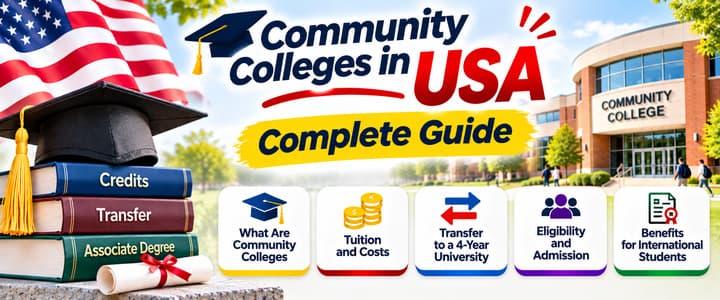
Community Colleges in USA: Complete Guide for International Students
Community college is not necessarily the cheaper route in every situation. International students pay nonresident tuition, incur living expenses and may receive less institutional financial aid than students entering certain four-year universities directly.
The correct decision requires comparing the complete four-year cost, transfer eligibility, degree recognition and immigration conditions.
U.S. community colleges are postsecondary institutions that primarily award associate degrees, certificates, workforce education, and transferable undergraduate courses. Many provide a more affordable route to a bachelor’s degree at a four-year university.
International students like the option of beginning American higher education at a community college and then transferring to a university.
In the traditional 2+2 path, students take about two years of transferable coursework at a community college, then two years at a university. If all academic requirements are met, they will receive a bachelor’s degree from the receiving university.
But the transfer is not a given. Universities take into account transferable credits, grades, major requirements and availability of places.
Imagine a student who finishes Class 12 in India and wants to pursue Computer Science in California. Rather than applying to a four-year university, the student can begin at De Anza College and complete the necessary lower-division coursework before applying to transfer.
Another option for a student interested in Business is Santa Monica College with an approved transfer pathway.
Both can be useful, but the results depend on how the student plans to use their education.
1. Community Colleges in USA: Quick Overview
| Feature | Community College |
|---|---|
| Education Level | Postsecondary / Undergraduate |
| Common Qualifications | Associate Degrees and Certificates |
| Typical Associate Degree | Approximately 2 Years |
| Common Credit Requirement | Around 60 Semester Credits |
| Academic Focus | Transfer Education and Career Preparation |
| Admission | College-Specific Requirements |
| SAT/ACT | Usually Not Required |
| English Proficiency | Test or Approved Alternative |
| International Students | Accepted by Eligible Colleges |
| Tuition | Often Lower Than Four-Year Universities |
| Scholarships | Available at Selected Institutions |
| University Transfer | Possible, Subject to Requirements |
| F-1 Visa | Available Through Eligible Programs |
| OPT | Possible for Eligible Students |
| Bachelor's Degree | Generally Awarded After Transfer to a Four-Year University |
Important distinction: Most community colleges focus on associate-level and lower-division education, but some are authorized to award selected bachelor's degrees. Students should check the qualifications available at the exact institution.
2. What Is a Community College in USA?
A community college is a postsecondary institution offering educational programs that may lead to an associate degree, certificate or further study at a four-year university.
Many are publicly supported institutions serving local communities.
They commonly provide general education, introductory university-level courses and occupational training.
For example, a student may study Calculus, English Composition, Economics and Programming at a community college. If those courses are accepted by the intended university, they may contribute toward a bachelor's degree.
Community colleges also offer career-oriented programs in areas such as Information Technology, Accounting, Healthcare Support, Business Administration and Technical Education.
Main Purposes
University transfer: Preparing students to enter a bachelor's degree at another institution.
Associate degrees: Providing recognized postsecondary qualifications.
Career education: Teaching skills associated with particular occupations.
Academic preparation: Helping students complete prerequisite or foundational courses.
Continuing education: Offering additional learning opportunities to adults and working professionals.
The programs available depend on the institution.
A community college is a legitimate higher education institution, but its degrees and transfer arrangements must be evaluated individually.
3. Community College vs University in USA
Community colleges and four-year universities differ primarily in their degree offerings, academic structure and typical student pathways.
| Factor | Community College | Four-Year University |
|---|---|---|
| Main Undergraduate Degree | Associate | Bachelor's |
| Typical Study Duration | 2 Years | 4 Years |
| Graduate Degrees | Uncommon | Often Available |
| Transfer Courses | Major Focus at Many Colleges | Accepted Under University Rules |
| Career Programs | Common | Common in Different Forms |
| Research Facilities | Varies | Extensive at Some Universities |
| Admission Selectivity | Often More Flexible | Varies Widely |
| International Tuition | Often Lower | Can Be Substantial |
| Class Size | Institution-Specific | Institution-Specific |
| F-1 Eligibility | Possible | Possible |
Academic Differences
Community colleges often concentrate on lower-division coursework equivalent to the early stages of a bachelor's degree.
Universities commonly offer both introductory and advanced major courses.
For example, a community college may teach introductory programming and calculus, while a four-year Computer Science program offers advanced courses in Operating Systems, Machine Learning and Computer Architecture.
Degree Recognition
An associate degree and a bachelor's degree are different qualifications.
Completing an associate degree does not automatically mean the student holds a bachelor's degree.
Is a Community College Less Reputable?
Its value depends on accreditation, curriculum and the student's objective.
A community college can be a suitable starting point for university transfer, but students should not assume every certificate or applied degree is designed for further academic study.
4. Types of Community College Programs
Community colleges offer transfer-oriented, career-oriented and certificate programs.
These qualifications are not interchangeable.
Common Qualifications
| Qualification | Main Purpose | Transfer Consideration |
|---|---|---|
| Associate of Arts (AA) | General Education and Liberal Arts | Often Transfer-Oriented |
| Associate of Science (AS) | Science or Related Education | Often Transfer-Oriented |
| Associate of Applied Science (AAS) | Career and Technical Education | Transfer May Be Limited |
| Associate in Arts for Transfer (AA-T) | California CSU Transfer | Subject to ADT Rules |
| Associate in Science for Transfer (AS-T) | California CSU Transfer | Subject to ADT Rules |
| Certificate | Specialized Education | Credit Recognition Varies |
Associate of Arts: Often includes general education and coursework in Humanities, Social Sciences or related disciplines.
Associate of Science: May emphasize Mathematics, Science or other academic fields.
Associate of Applied Science: Commonly prepares students for particular occupations. Some credits may transfer, but students should not assume the entire qualification satisfies a bachelor's pathway.
AA-T and AS-T: Specific California Associate Degrees for Transfer designed for qualifying pathways into California State University.
Certificates: May provide occupational or academic preparation without awarding a full associate degree.
Best choice for transfer: Select a program whose courses satisfy the intended receiving university's requirements rather than choosing a degree based only on its title.
5. How Long Does Community College Take?
A transfer-oriented associate degree commonly requires approximately 60 semester credits or an equivalent number of quarter units.
Students often complete the requirements over two academic years.
However, actual duration depends on course availability, credit load, prerequisites and academic progress.
Semester-Based Example
| Semester | Illustrative Credits |
|---|---|
| First-Year Fall | 15 |
| First-Year Spring | 15 |
| Second-Year Fall | 15 |
| Second-Year Spring | 15 |
| Total | 60 |
A student completing 15 credits in each semester may reach 60 credits after two years.
However, the credits must also satisfy the chosen degree or transfer pathway.
Quarter-Based Example
Some colleges use the quarter system.
A student planning to earn 90 quarter units over two years might complete 15 units during each of six regular quarters.
Important: Maintaining minimum full-time enrollment is not necessarily enough to finish the intended qualification within two years. Students must calculate the credits needed for graduation and transfer.
6. The 2+2 Program: How Community College Transfer Works
The 2+2 model allows students to begin at a community college and complete their bachelor's degree at a four-year institution.
It is one of the most important routes for international students considering community colleges.
Typical Four-Year Pathway
| Academic Year | Institution | Main Academic Work |
|---|---|---|
| Year 1 | Community College | General Education and Major Prerequisites |
| Year 2 | Community College | Additional Transferable Coursework |
| Year 3 | Four-Year University | Upper-Division Major Courses |
| Year 4 | Four-Year University | Remaining Degree Requirements |
Step 1: Choose the Intended Major
Students should identify their likely bachelor's specialization before selecting community college classes.
For example, Engineering may require a sequence of Mathematics, Physics and introductory technical courses.
Economics may require Calculus and other quantitative preparation.
Step 2: Identify Transfer Universities
A student interested in UC Davis should examine UC Davis transfer requirements.
Someone interested in San José State should investigate the relevant California State University transfer pathway.
The requirements are not identical.
Step 3: Select Transferable Coursework
Courses must be accepted by the receiving institution and, where necessary, satisfy major prerequisites.
Not every course labeled college level is automatically transferable.
Step 4: Maintain the Required GPA
Universities may establish minimum transfer GPAs and higher standards for competitive majors.
Step 5: Apply for Transfer Admission
Students apply according to the university's transfer admission procedures.
Step 6: Complete the Bachelor's Degree
After transferring, students must complete remaining upper-division, residency, GPA and other graduation requirements.
A successful 2+2 route requires coordinated academic planning from the beginning.
7. Can You Transfer Without Completing an Associate Degree?
Yes, at many universities.
Transfer admission may be based on transferable coursework and other academic requirements rather than possession of an associate degree.
For example, the University of California generally evaluates junior-level transfer applicants based on completed transferable credits, required courses and academic performance.
An associate degree may be helpful but is not universally mandatory for transfer.
Why This Matters
A student might complete 60 transferable semester credits while following a carefully planned university pathway.
However, another student could finish an associate degree containing courses that do not satisfy the desired bachelor's major.
The second student may need additional study after transfer.
What Should Students Prioritize?
Transfer goal: Complete the receiving university's required coursework.
Associate degree goal: Satisfy the community college's graduation requirements.
Combined goal: Choose a plan that achieves both without unnecessary credits.
Students should review their course plans with a transfer adviser.
8. Best-Known Community Colleges for International Students
Several established American community colleges operate international student programs and transfer pathways.
The following institutions provide useful examples, but this is not a ranking.
| College | Location | Academic Feature |
|---|---|---|
| Santa Monica College | California | Associate Degrees and University Transfer |
| De Anza College | California | Quarter System and Transfer Programs |
| Foothill College | California | Associate Degrees and Transfer Education |
| Austin Community College | Texas | Transfer and Career Programs |
| Northern Virginia Community College | Virginia | Transfer and Workforce Education |
| Seattle Colleges | Washington | Transfer and Applied Programs |
Santa Monica College: Offers international admission, transfer-oriented coursework and associate degrees.
De Anza College: Operates on a quarter calendar and provides transfer advising and academic programs.
Foothill College: Offers transferable courses, degrees and international student services.
Austin Community College: Provides associate degrees, certificates and selected bachelor's programs.
Northern Virginia Community College: Offers university transfer and career-focused education.
Seattle Colleges: Includes multiple colleges providing transfer and professional pathways.
Selection rule: Choose colleges based on the intended receiving university, course equivalencies, international costs and student services—not general online rankings alone.
9. Community College Tuition Fees in USA: 2026–27 Examples
Community college fees vary by institution, state and enrollment category.
International students normally pay nonresident rates unless they qualify for a specific exception.
Published Annual International Student Estimates
| Community College | Estimated Annual Expenses | Academic Year |
|---|---|---|
| De Anza College | $27,189 | 2026–27 |
| Foothill College | $27,189 | 2026–27 |
| Santa Monica College | $34,000 | Fall 2026–Spring 2027 |
These are published estimates based on each college's stated enrollment and living-expense assumptions.
They are not identical fee schedules.
De Anza and Foothill: Both estimates assume 12 units during each of three regular quarters.
Santa Monica College: Its academic-year tuition estimate assumes 12 semester units in fall and spring.
The minimum enrollment used for financial estimates can be lower than the credit pace needed to complete a two-year transfer plan.
Students should calculate any additional tuition required for a full academic schedule.
10. De Anza College: International Student Cost Breakdown
De Anza College publishes a 2026–27 estimated annual expense of $27,189 for F-1 students.
The estimate includes tuition, health insurance and living expenses.
De Anza College Annual Budget
| Expense | Estimated Amount |
|---|---|
| Tuition and Fees | $10,224 |
| Mandatory Health Insurance | $1,665 |
| Books and Supplies | $1,500 |
| Housing | $10,300 |
| Meals and Spending Money | $3,500 |
| Estimated Annual Total | $27,189 |
The tuition calculation uses $284 per unit for 12 units in each of three regular quarters.
Housing assumes the published shared student-housing arrangement for approximately 10 months.
Accommodation availability is limited, and actual living expenses may differ.
Financial Documentation
De Anza requires international applicants to demonstrate at least the published first-year amount through acceptable financial evidence.
The college states that applicants cannot reduce this minimum by claiming they will live with friends or relatives.
Important Budgeting Detail
The $27,189 estimate assumes 36 quarter units across three regular quarters.
A student aiming to finish 90 quarter units in six quarters would typically plan for an average of 15 units per quarter.
At the published $284 rate, taking three additional units each quarter adds approximately $2,556 in annual tuition.
This produces an illustrative annual budget of $29,745, assuming other estimated costs remain unchanged.
The official minimum funding estimate and the budget for finishing on schedule are not necessarily the same.
11. Foothill College: International Student Costs
Foothill College publishes a 2026–27 annual estimate of $27,189 for international F-1 students.
The college also uses a quarter-based calendar.
Foothill College Annual Expenses
| Expense | Estimated Amount |
|---|---|
| Tuition and Enrollment Fees | $10,224 |
| Health Insurance | $1,665 |
| Books and Supplies | $1,500 |
| Housing | $10,300 |
| Meals and Personal Spending | $3,500 |
| Estimated Annual Total | $27,189 |
Tuition is based on 12 units per quarter across fall, winter and spring.
Students taking additional units pay additional tuition.
Academic Planning
A student intending to transfer after two years must select the correct courses and maintain sufficient academic progress.
A low-cost schedule that leaves major prerequisites unfinished may delay transfer.
Housing Considerations
The published housing estimate uses a particular shared accommodation assumption.
Student housing availability is limited.
Students should investigate alternative accommodation costs before making financial commitments.
Foothill vs De Anza
The colleges share a district, but their academic programs, course schedules and transfer opportunities are not identical.
Students should choose based on the intended major and transfer requirements.
12. Santa Monica College: International Tuition and Expenses
Santa Monica College publishes an estimated $34,000 requirement for international students for fall 2026 through spring 2027.
Its fee structure differs from the quarter-based colleges.
2026–27 International Tuition Components
| Tuition Component | Amount |
|---|---|
| Enrollment Fee | $46 per Unit |
| Nonresident Tuition | $416 per Unit |
| Capital Outlay Fee | $24 per Unit |
| Combined Nonresident Charge | $486 per Unit |
A student taking 12 units during each of two semesters completes 24 units annually.
At $486 per unit, the combined tuition charge for those 24 units is $11,664, before other applicable fees.
Additional Costs
SMC's published international budget includes housing, living expenses, supplies, insurance and other charges.
The overall estimate is $34,000 for the academic year.
Cost of Taking 30 Credits
A student aiming to complete 60 semester credits in four regular semesters would usually need an average of 15 credits per semester.
That means 30 credits annually rather than 24.
At the published rate, six additional credits would increase annual tuition by approximately $2,916.
Adding that amount to the college's rounded $34,000 estimate produces an illustrative budget of approximately $36,916.
Actual expenses and fees may differ.
A student should budget for the academic schedule needed to transfer, not merely the minimum credit load used on the college's financial estimate.
13. Is Community College Really Cheaper Than University?
Community college can reduce tuition expenses during the first part of a bachelor's degree.
However, international students should compare the complete four-year pathway.
A California Transfer Cost Example
Consider a hypothetical student who completes two years at De Anza College and then transfers to UC Davis.
For 2026–27, De Anza's published minimum annual F-1 budget is $27,189.
UC Davis publishes an estimated annual nonresident cost of attendance of $88,279 for a new undergraduate living in a residence hall.
To compare on a consistent 2026–27 price basis, assume the De Anza student takes 15 units per quarter and incurs $29,745 annually.
Illustrative Four-Year Comparison
| Academic Route | Four-Year Estimated Cost |
|---|---|
| Four Years at UC Davis | $353,116 |
| Two Years De Anza + Two Years UC Davis | $236,048 |
| Illustrative Difference | $117,068 |
Calculation: Direct UC Davis = $88,279 × 4. Transfer route = ($29,745 × 2) + ($88,279 × 2).
These figures use the same published 2026–27 cost assumptions for all four hypothetical years.
They are not a forecast of future tuition and do not guarantee admission, transfer, housing availability or degree completion within four years.
The two university years would actually occur later and could cost more.
Why the Savings Could Be Smaller
A student may need additional semesters, higher-cost housing or courses that do not transfer.
The receiving university may also have different costs or scholarship arrangements.
The community college route can be financially attractive, but the savings depend on successful academic planning and actual admission outcomes.
14. Community College Admission Requirements for International Students
Community colleges commonly have more flexible admission procedures than highly selective four-year universities.
However, international applicants still need to satisfy institutional requirements.
Common Admission Documents
| Document | Why It Is Needed |
|---|---|
| Secondary School Transcripts | Academic Eligibility |
| Class 12 Certificate | Proof of School Completion |
| Passport | Identification |
| English Proficiency | Academic Language Readiness |
| Financial Evidence | I-20 Procedures |
| Application Form | Admission Processing |
| Application Fee | Where Required |
| Translations | Where Academic Records Are Not in English |
| Previous College Transcripts | If Applicable |
Is SAT Required?
Most community colleges do not require SAT or ACT for general admission.
However, students should verify the college's own rules and any program-specific conditions.
Is Class 12 Mandatory?
Many community college programs accept applicants with a recognized high school qualification or equivalent.
Some institutions have particular rules for younger applicants or students who have not completed secondary school.
International F-1 admission may have more specific requirements than general community enrollment.
Age Requirements
There is no single nationwide community college age minimum for all student categories.
De Anza generally expects international applicants to be at least 18 but also has conditions for younger applicants who have completed secondary school.
Students should check the institution's international admission policy.
15. English Proficiency Requirements: IELTS, TOEFL and Duolingo
Community colleges set their own English proficiency standards.
Some accept several examinations or qualifying previous English-medium education.
De Anza College Admission Minimums
| Examination | Published Requirement |
|---|---|
| IELTS | 5.5 |
| Duolingo English Test | 95 |
| PTE Academic | 45 |
| TOEFL iBT Before January 21, 2026 | 61 |
| TOEFL iBT From January 21, 2026 | 3.5 |
De Anza also recognizes certain alternative examinations and qualifying previous education.
English-Medium Education
De Anza may consider applicants who completed at least three years at an international secondary school where English was the sole medium of instruction.
Supporting transcripts and school documentation are required, and eligibility is subject to review.
Foothill College Example
Foothill publishes a minimum IELTS requirement of 5.5 for full international admission, along with accepted TOEFL and other alternatives.
Can Students Study Without IELTS?
Yes, if the college accepts another examination or approves an exemption.
However, without IELTS does not necessarily mean without any English proficiency requirement.
Students should confirm whether the policy applies to admission, English course placement or both.
16. How to Apply to a Community College From India
Indian students can apply to eligible community colleges after completing Class 12 or an accepted qualification.
The process is institution-specific.
Step-by-Step Admission Process
Step 1: Select the intended bachelor's major. A student planning to transfer should begin with the eventual university degree.
Step 2: Choose a community college. Compare academic programs, transfer agreements, nonresident tuition and housing.
Step 3: Check academic eligibility. Confirm acceptance of the previous school qualification.
Step 4: Meet English requirements. Prepare the required examination or approved exemption documentation.
Step 5: Submit the application. Provide transcripts, identification and other requested records.
Step 6: Pay the application fee. Follow the college's payment instructions.
Step 7: Complete financial verification. Supply acceptable evidence of available resources.
Step 8: Receive admission and Form I-20. Confirm the program details and dates.
Step 9: Apply for the appropriate student visa. Complete applicable immigration procedures.
Step 10: Register for courses. Follow an approved academic plan aligned with transfer requirements.
De Anza Application Example
De Anza publishes a $75 international application fee.
It requires appropriate academic documents, English proficiency evidence and financial information.
Santa Monica College Application Example
SMC also publishes a $75 international admission application fee.
Students must follow its international application and orientation procedures.
Applying to a community college and qualifying for a future university transfer are separate processes.
17. Community College Application Deadlines
Many community colleges offer several annual entry periods.
However, not every program admits new international students during every term.
De Anza College: General F-1 Deadlines
| Entry Term | Published General Deadline |
|---|---|
| Fall | August 15 |
| Winter | November 15 |
| Spring | February 15 |
| Summer | April 15 |
The college publishes different deadlines for certain transfer-in and online-only applicants.
Students should confirm the year and current availability before applying.
Why International Applicants Should Apply Early
A college admission deadline is not the only date that matters.
Students may also need time to arrange financial documents, receive Form I-20, complete visa procedures and prepare accommodation.
A student applying close to the final deadline may not have sufficient time for international travel arrangements.
Fall 2027 Planning
Students hoping to start community college in Fall 2027 should prepare their admission documents and financial evidence well before the term begins.
The future university transfer application will generally occur later, after sufficient college coursework has been completed.
A Fall 2027 community college applicant is not applying for a Fall 2027 university transfer through the usual two-year pathway.
18. Understanding Transfer Credits and GPA
Transfer applicants are evaluated according to the receiving university's academic rules.
Two separate questions matter: whether the credits are transferable and whether those credits satisfy the intended degree's requirements.
Transferable vs Applicable Credit
Transferable credit: Coursework the receiving institution recognizes for university credit.
Degree-applicable credit: Coursework that also satisfies general education, major or other graduation requirements.
For example, a Programming course may transfer as an elective without replacing a required Computer Science course.
GPA
Universities evaluate academic performance through grade-point averages or equivalent systems.
Competitive majors may expect substantially stronger grades than general university minimums.
Prerequisites
Engineering applicants may need Calculus, Physics and other technical coursework.
Business applicants may need Economics, Mathematics or Accounting courses.
Biological Sciences applicants may require Chemistry, Biology and Mathematics sequences.
Academic Planning
Students should verify courses before registration rather than wait until the final semester.
Earning enough credits is not sufficient if the credits do not meet transfer and major requirements.
19. University of California Transfer Requirements
The University of California provides an established transfer pathway for qualifying students.
Most UC campuses primarily consider junior-level transfer applicants.
General UC Transfer Requirements
| Requirement | UC Standard |
|---|---|
| Transferable Credits | At Least 60 Semester or 90 Quarter Units |
| GPA for California Residents | Minimum 2.4 |
| GPA for Nonresidents | Minimum 2.8 |
| English Composition | Two Transferable Courses |
| Mathematics | One Transferable Course |
| Additional Courses | Four Courses From Specified Subject Areas |
| Major Preparation | Campus and Major-Specific |
| Competitive Selection | May Require Higher Performance |
The 2.8 nonresident GPA is a minimum eligibility threshold, not a guarantee of admission.
Selective majors may require higher grades and specified prerequisite courses.
Seven-Course Pattern
UC requires a qualifying pattern that includes two English composition courses, one mathematical concepts and quantitative reasoning course, and four courses from specified Arts, Humanities, Social Sciences or Natural Sciences subject areas.
Credit Limits
UC generally limits lower-division credit awarded from non-UC institutions to 70 semester units or 105 quarter units.
Students may complete additional coursework, but credits beyond the applicable limit do not necessarily increase the number counted toward graduation.
International Applicants
International students who meet transfer criteria may apply.
However, universities evaluate all relevant academic records, including previous postsecondary enrollment where applicable.
20. UC Transfer Admission Guarantee (TAG)
The University of California operates a Transfer Admission Guarantee program at six campuses.
TAG is designed for qualifying California community college transfer students who satisfy academic and campus-specific conditions.
Participating UC Campuses
| Campus | TAG Participation |
|---|---|
| UC Davis | Yes |
| UC Irvine | Yes |
| UC Merced | Yes |
| UC Riverside | Yes |
| UC Santa Barbara | Yes |
| UC Santa Cruz | Yes |
| UC Berkeley | No |
| UCLA | No |
| UC San Diego | No |
Does TAG Guarantee Admission?
A valid TAG can provide guaranteed admission to the designated participating campus and eligible major if all requirements are satisfied.
However, it is not an unconditional admission promise.
Students must meet the applicable unit, GPA, coursework, enrollment and application requirements.
Certain majors and applicant categories are excluded.
Can International Students Use TAG?
International students attending California community colleges may be eligible when they satisfy the same applicable TAG requirements.
However, previous college history and other eligibility conditions can matter.
Students who already hold a bachelor's degree are not eligible for TAG.
Fall 2027 TAG Deadlines
The Fall 2027 TAG filing period was September 1–30, 2026.
The regular Fall 2027 UC transfer application period is November 1–30, 2026.
Missing the TAG deadline does not automatically prevent an otherwise eligible student from submitting a regular transfer application.
A student beginning community college in Fall 2027 should plan for a later transfer cycle rather than assume these Fall 2027 deadlines apply to their future transfer.
21. UC Davis TAG: A Real Example
UC Davis publishes major-specific TAG requirements for Fall 2027 transfer admission.
UC Davis TAG GPA Requirements
| Academic Area | Minimum TAG GPA |
|---|---|
| Agricultural and Environmental Sciences | 3.20 |
| Biological Sciences | 3.20 |
| Letters and Science | 3.20 |
| Engineering | 3.50 |
Applicants must also meet any additional conditions for their intended major.
Credit Requirements
For Fall 2027 TAG, students needed at least 30 UC-transferable semester units or 45 quarter units by the end of summer 2026.
They must complete at least 60 semester or 90 quarter UC-transferable units by the end of spring 2027.
Additional conditions govern required English, Mathematics and major preparation courses.
Engineering Example
An Engineering applicant needs the required GPA and qualifying technical coursework.
A student who has a high overall GPA but is missing essential Calculus or Physics courses may not meet the intended major requirements.
Why This Example Matters
UC Davis demonstrates that a transfer guarantee is built around detailed academic conditions.
It should not be presented as an automatic reward for completing two years at a California community college.
22. Transferring to California State University
California State University provides several transfer pathways for qualifying students from California community colleges.
One important option is the Associate Degree for Transfer.
Associate Degree for Transfer (ADT)
California community colleges offer Associate in Arts for Transfer and Associate in Science for Transfer degrees.
These are designed to support transfer into compatible CSU bachelor's programs.
What Does ADT Guarantee?
Eligible students completing an approved ADT and satisfying applicable CSU requirements receive a transfer admission guarantee within the CSU system.
However, the guarantee does not necessarily apply to a specific campus or major.
ADT vs UC TAG
| Feature | CSU ADT | UC TAG |
|---|---|---|
| Main University System | California State University | University of California |
| Academic Route | Qualifying Associate Degree for Transfer | Qualifying TAG Application |
| Guarantee | CSU Admission Under Program Rules | Specified Participating UC Campus |
| Specific Campus Guaranteed? | Not Generally | Yes, If TAG Conditions Are Met |
| Major Requirements | Similar Program and Eligibility | Campus and Major-Specific |
Can Students Finish in Two Additional Years?
An eligible student transferring through a compatible ADT pathway may be able to complete the associate and bachelor's degrees within a total of 120 semester credits.
However, continuous academic progress and completion of the required courses are essential.
Students should choose transfer agreements based on the intended receiving university rather than treating all California transfer programs as equivalent.
23. What Are ASSIST, UC TAP and Cal-GETC?
California provides academic planning systems for students preparing to transfer.
These tools help applicants determine which courses satisfy transfer requirements.
Main Transfer Planning Tools
| Tool | Purpose |
|---|---|
| ASSIST | Course Articulation and Transfer Equivalencies |
| UC Transfer Admission Planner (UC TAP) | Tracking UC Transfer Preparation |
| Cal-GETC | California General Education Transfer Curriculum |
| UC Transfer Pathways | Major Preparation Across UC Campuses |
ASSIST
ASSIST allows students to review approved course relationships between California community colleges and participating public universities.
A student planning to transfer into Economics can examine the relevant Mathematics and Economics requirements.
UC TAP
UC TAP helps students organize their transfer history and academic preparation.
It is also used in the TAG application process.
Cal-GETC
For students newly enrolling in California community colleges beginning Fall 2025, Cal-GETC is the applicable common general education transfer curriculum.
Students who began earlier may have eligibility to complete the previous IGETC pattern.
Do STEM Students Need Cal-GETC?
Requirements depend on the major and university.
For certain Engineering and Science programs, completing major prerequisites may be more urgent than finishing every general education course before transfer.
Students should follow the receiving university's advice.
Transfer planning tools reduce avoidable mistakes, but they do not replace checking the latest major requirements.
24. Can You Transfer From Community College to UCLA or UC Berkeley?
Yes. UCLA and UC Berkeley consider eligible community college transfer applicants.
However, neither campus participates in UC's TAG program.
UCLA Transfer
Applicants must satisfy the applicable university transfer requirements and the intended major's academic preparation standards.
Competitive majors may have demanding GPA and course requirements.
UC Berkeley Transfer
Berkeley evaluates transfer applicants according to its admission standards and available programs.
Completing general UC minimums does not guarantee admission.
Community College Transfer Advantage
California community college students can use approved transfer course agreements and academic planning resources.
This can help them prepare coursework appropriately.
However, a community college cannot legitimately guarantee admission to UCLA or UC Berkeley through UC TAG.
Transfer Admission vs Transfer Preparation
An institution may have strong advising and substantial numbers of students who transfer to competitive universities.
That does not mean every applicant receives admission.
Choose a community college for its academic fit and transferable coursework—not a promise of admission to a highly selective campus.
25. Can Community College Students Transfer to Private Universities?
Yes, subject to the receiving private university's transfer requirements.
Some private universities consider applicants with previous college coursework.
However, course recognition and admission conditions vary.
Important Questions
Are transfer applicants accepted? The university must offer the appropriate transfer admission route.
Which courses transfer? General education and major-course evaluation may differ from public university agreements.
How many credits are accepted? Universities may limit the total transferable credits.
Is financial aid available? Transfer applicants may face different funding policies from first-year applicants.
Is housing available? Some universities do not provide identical housing guarantees to transfer students.
Is an Associate Degree Required?
Not necessarily.
The receiving private institution determines whether a completed associate degree is relevant to admission.
Transfer to Highly Selective Institutions
Admission may be competitive, and the number of available transfer places can be limited.
Students should not assume a community college route automatically provides easier access to a particular private university.
26. Scholarships and Financial Aid at Community Colleges
Financial aid can be more limited for international community college students than for eligible domestic students.
Most students in F-1 status do not qualify for US federal student aid.
Some colleges provide institutional or foundation scholarships, but these may be competitive and relatively modest.
De Anza College Example
De Anza explains that F-1 students are not eligible for its regular financial aid programs.
However, certain scholarships may be available after a student begins their first quarter.
The college cautions that these awards are competitive and do not cover the full cost of attendance.
Other Funding Sources
Students may investigate external scholarships, family support, approved education loans or eligible institution-specific awards.
Is Free Community College Available to International Students?
Programs advertising tuition-free community college often have residency, school completion or other eligibility requirements.
For example, California resident tuition arrangements and certain local promise programs should not be assumed to apply to international F-1 students.
Financial Planning
Students should prepare a funding plan covering the college period and the later university years.
A scholarship at the community college may not continue after transfer.
The availability of inexpensive resident tuition should never be confused with the amount an international student must pay.
27. F-1 Student Visa for Community Colleges
International students may attend SEVP-certified community colleges in eligible academic programs using F-1 status.
The institution must have the required authorization to enroll qualifying international students.
Main Immigration Steps
Obtain admission: Meet the college's academic and English requirements.
Provide financial evidence: Complete the institution's funding verification process.
Receive Form I-20: Review student, school and program information.
Pay the applicable SEVIS fee: Follow the required procedures.
Complete the visa application: Submit Form DS-160 and complete applicable payment arrangements.
Attend the interview: Follow consular instructions.
Travel and enroll: Comply with arrival and university reporting requirements.
Required Documents
| Document | Purpose |
|---|---|
| Passport | Identity and Travel |
| Form I-20 | School and Program Eligibility |
| DS-160 Confirmation | Visa Application |
| SEVIS Payment Confirmation | Fee Evidence |
| Academic Records | Previous Education |
| Financial Evidence | Study Funding |
| Admission Documentation | School Acceptance |
Is an F-1 Visa Guaranteed?
No.
College admission and consular visa approval are separate decisions.
A student should not assume that a community college application guarantees visa issuance.
28. F-1 Enrollment and Online Course Rules
Community college students in F-1 status must maintain the required full course of study.
For standard undergraduate programs, the full-time minimum is generally 12 qualifying credits per regular academic term.
However, institution-specific course structures and applicable immigration rules must be followed.
Full-Time Enrollment
A semester-based community college may require at least 12 qualifying semester credits.
A quarter-based college may require at least 12 qualifying units per quarter.
Online Classes
Under standard F-1 rules, only one fully online course or three online credits per term may generally count toward the required full course of study when physical attendance is not necessary for the course.
Reduced Course Load
Certain students may qualify for an authorized reduced course load under specified circumstances.
Students should obtain approval through the appropriate school procedures before reducing enrollment.
Important Graduation Difference
A student completing only 12 semester credits in each of four semesters would earn 48 credits.
That may satisfy regular full-time enrollment rules but fall short of a 60-credit associate or transfer plan.
Maintain immigration status and follow an academic schedule sufficient to complete the intended degree on time.
29. Transferring Your SEVIS Record to a University
An international student transferring from a community college to a four-year university may need a SEVIS record transfer.
This immigration procedure is separate from academic admission and transfer-credit evaluation.
Typical Process
Receive university admission: The student must first qualify for the receiving institution.
Inform the community college DSO: Provide the information required for the school transfer.
Coordinate a SEVIS release date: The schools follow the applicable transfer procedures.
Receive updated documentation: The receiving school issues appropriate immigration documentation.
Begin the new program: Complete required enrollment and international student check-in.
Why Timing Matters
The transfer must comply with applicable program-start and immigration timelines.
Students should not independently choose a transfer date without coordinating with the schools.
Is a New Visa Always Required?
A student lawfully maintaining F-1 status and completing an eligible SEVIS transfer may not need a new visa solely because they changed schools, depending on travel and visa circumstances.
However, a visa's validity and the student's immigration situation must be considered individually.
Academic credits do not transfer a student's immigration record automatically. Both processes must be completed correctly.
30. Can Community College Students Work in USA?
Eligible F-1 students may have access to certain employment opportunities.
However, student employment is regulated.
On-Campus Employment
Eligible students may generally work on campus for up to 20 hours weekly while school is in session, subject to applicable rules.
An on-campus job is not guaranteed.
Curricular Practical Training
CPT may be available when qualifying practical training is integral to an established curriculum and the student meets the applicable eligibility requirements.
A general internship offer does not automatically establish CPT authorization.
Optional Practical Training
Eligible F-1 students may apply for OPT after completing a qualifying associate degree.
Regular post-completion OPT generally provides up to 12 months of authorized practical training at an eligible educational level.
STEM OPT
Certain qualifying STEM graduates may be eligible for the additional 24-month extension under the applicable degree, employer and immigration requirements.
A degree title alone does not establish eligibility.
Important Financial Limitation
Students should not use hypothetical part-time wages or internships as guaranteed funding for tuition.
Employment availability depends on the college, employer and authorization conditions.
31. Career Opportunities After an Associate Degree
An associate degree can support certain career pathways, but the opportunities depend on the qualification and occupation.
Career-Oriented Degrees
An Associate of Applied Science may provide training for technical or occupational roles.
However, some occupations also require state licensing, certification or supervised practical experience.
Transfer-Oriented Degrees
An Associate of Arts or Associate of Science may primarily prepare the student for further undergraduate education.
Such a degree should not automatically be treated as equivalent to professional training in a specific occupation.
International Employment Eligibility
An international graduate's right to work in the United States depends on immigration authorization.
Graduating from community college does not automatically provide unrestricted employment permission.
Career Planning Questions
Does the degree prepare students for the intended occupation? Are additional licenses required? Is the qualification recognized outside the United States? Is the student eligible for authorized employment?
Community college can provide useful academic or career preparation, but the degree's value must be evaluated against the intended profession.
32. Is Community College Good for Indian Students After Class 12?
Community college may be suitable for Indian students seeking a financially manageable introduction to American undergraduate education.
However, the route is strongest when the student has a clear transfer plan.
Science Students
Students planning Computer Science, Mathematics or Engineering should identify prerequisite courses early.
Some degree paths require extended Calculus and Physics sequences.
Commerce Students
Business, Economics and Accounting-related transfer pathways may be available.
Students should check the receiving university's quantitative and general education requirements.
Humanities Students
Students interested in Psychology, Political Science, History, Sociology or Communication may find relevant transferable coursework.
Students Seeking Flexibility
Community college can provide opportunities to explore subjects before selecting a final university major.
However, delaying major selection can make transfer planning more complicated.
Students With Limited Budgets
International tuition may be lower than at some four-year universities, but living expenses remain significant.
A student should compare total four-year spending rather than only community college tuition.
Community college is an option worth evaluating after Class 12, not an automatic substitute for direct university admission.
33. Community College vs Direct University Admission
Students should compare the advantages and limitations of beginning at community college with entering a four-year institution directly.
| Factor | Community College Route | Direct University Route |
|---|---|---|
| Initial Tuition | Often Lower | Depends on University |
| Bachelor's Admission | Requires Later Transfer | Secured at Initial Institution |
| Major Preparation | Must Be Planned for Transfer | Follows University Curriculum |
| Transfer Risk | Yes | Usually Not Applicable |
| Scholarships | Often Limited for F-1 Students | May Be More Substantial |
| Academic Flexibility | Depends on College | Depends on University |
| Degree Completion | Depends on Transfer Success | Depends on University Progress |
| Campus Experience | Split Between Institutions | Continuous at One Institution |
Community College Advantages
Potentially lower initial costs, transferable lower-division education and access to structured transfer pathways.
Community College Risks
Admission to the desired university is not guaranteed, and some coursework may fail to satisfy graduation requirements.
Direct University Advantages
Students begin the bachelor's program at the university and may have access to the institution's academic environment and financial aid from the first year.
Direct University Risks
The full program may involve substantial international tuition.
The better choice depends on the student's actual admission offers, available financial assistance and intended major.
34. Common Mistakes International Students Should Avoid
Assuming Community College Costs Only $5,000 Annually
Some advertised low tuition figures apply to local residents.
International students may face substantially higher nonresident rates.
Choosing an AAS Without Checking Transferability
Career-oriented applied degrees may not align with the intended bachelor's requirements.
Completing Too Few Credits
Taking only the minimum F-1 course load can delay a planned two-year transfer.
Ignoring Major Prerequisites
A student may reach the required credit count without completing the Mathematics or Science courses necessary for admission.
Assuming TAG Includes UCLA and Berkeley
Neither campus participates in UC TAG.
Treating Minimum GPA as Competitive GPA
The UC minimum nonresident transfer GPA is not the same as a competitive admission profile for selective majors.
Ignoring University Costs After Transfer
The final two years may cost substantially more than the community college period.
Assuming Scholarships Are Guaranteed
Community college scholarships may be limited and competitive.
Treating Employment as Guaranteed Funding
F-1 work is restricted, and positions are not guaranteed.
Forgetting SEVIS Transfer Requirements
University admission and immigration record transfer are separate processes.
Assuming All Online Courses Count Toward F-1 Enrollment
Standard limits apply to fully online coursework.
Relying on Outdated General Education Plans
New California community college students generally follow Cal-GETC rather than the older IGETC pattern.
Avoiding these mistakes can prevent unexpected costs, transfer delays and immigration complications.
35. Four Practical Student Scenarios
Scenario 1: CBSE Student Seeking UC Davis
Background: Class 12 Science with Mathematics.
Initial college: De Anza College.
Goal: Transfer into a suitable UC Davis bachelor's program.
Academic priority: Complete UC-transferable coursework, English, Mathematics and required major preparation.
Financial priority: Budget for a 15-unit-per-quarter pace rather than relying only on the published minimum 12-unit estimate.
Main risk: UC Davis transfer or TAG requirements may not be met, especially for selective majors.
Assessment: A potentially useful route if the student follows a documented transfer plan and can finance the later university years.
Scenario 2: Commerce Student Planning CSU Transfer
Background: Class 12 Commerce.
Initial college: California community college offering a suitable AA-T or AS-T pathway.
Goal: Bachelor's degree in a related business discipline at CSU.
Academic priority: Select a transfer degree aligned with the intended CSU program.
Main risk: ADT admission benefits do not necessarily guarantee the student's preferred campus or major.
Assessment: Worth considering when the degree pathway and complete costs are appropriate.
Scenario 3: Student Seeking UCLA Admission
Background: Strong Class 12 record and interest in Economics.
Initial college: Santa Monica College.
Goal: Transfer to UCLA.
Academic priority: Complete relevant UC-transferable Economics and Mathematics prerequisites with strong grades.
Main risk: UCLA does not participate in UC TAG; transfer admission is competitive.
Assessment: A possible transfer strategy, but the student needs alternative university options.
Scenario 4: Student With a Limited Budget
Background: Eligible for community college admission but has restricted funding.
Goal: Obtain a US bachelor's degree.
Main financial issue: Community college tuition may be affordable initially, but the later university costs may exceed available funds.
Appropriate response: Compare confirmed four-year costs, scholarships, less expensive universities and other educational alternatives before enrolling.
Assessment: Community college should not be selected if the student cannot realistically finance the later transfer stage.
36. How to Choose the Right Community College
The best community college is the one that provides academically suitable coursework, reliable transfer planning and manageable costs.
Community College Selection Checklist
| Factor | What Students Should Verify |
|---|---|
| Accreditation | Recognized Institutional Status |
| SEVP Certification | Ability to Enroll Eligible F-1 Students |
| Transfer Agreements | Actual Receiving University Relationships |
| Intended Major | Required Courses Available |
| English Requirements | Accepted Tests or Exemptions |
| Credit System | Semester or Quarter |
| Tuition | International Student Rate |
| Living Expenses | Realistic Local Budget |
| Scholarships | International Eligibility |
| Housing | Availability and Cost |
| Transfer Advising | Access to Academic Planning |
| Student Services | International Support |
| Graduation | Associate Degree Requirements |
| Future University | Admission and Complete Financial Cost |
Decision Process
First: Identify the eventual bachelor's degree.
Second: Select possible receiving universities.
Third: Find community colleges with appropriate transferable coursework.
Fourth: Compare international tuition and living expenses.
Fifth: Confirm English, admission and financial documentation requirements.
Sixth: Build a semester-by-semester or quarter-by-quarter transfer plan.
Seventh: Calculate the entire four-year cost, including the university stage.
Eighth: Prepare alternative transfer options in case the preferred university does not admit the student.
The receiving university and intended major should guide the community college choice—not the other way around.
37. Frequently Asked Questions
Q1. What is a community college in USA? A community college is a postsecondary institution offering associate degrees, certificates, career programs and transferable undergraduate coursework.
Q2. Can international students study at community colleges? Yes, at eligible institutions that accept international applicants and support the appropriate immigration status.
Q3. Can Indian students apply after Class 12? Yes. Recognized secondary qualifications may satisfy the academic entry requirements, subject to the college's admission rules.
Q4. How long does community college take? An associate degree commonly takes around two years of full-time study, depending on credits and course requirements.
Q5. Is community college cheaper than university? Tuition is often lower, but total savings depend on living expenses, transferable credits and the cost of the final bachelor's degree.
Q6. What is the 2+2 pathway? Students typically complete two years of community college coursework and two years at a university to earn a bachelor's degree.
Q7. Is university transfer guaranteed? Not generally. Specific agreements such as qualifying UC TAG or CSU ADT pathways provide defined guarantees under their rules.
Q8. Can students transfer to UCLA? Yes, eligible students can apply, but UCLA does not participate in UC TAG.
Q9. Can students transfer to UC Berkeley? Yes, eligible students may apply, but admission is competitive and Berkeley does not participate in TAG.
Q10. What GPA is required for UC transfer? UC's general minimum is 2.4 for California residents and 2.8 for nonresidents. Selective programs may require higher performance.
Q11. Is an associate degree required for transfer? Not always. Some universities evaluate credits and prerequisites without requiring completion of an associate degree.
Q12. Is SAT required for community colleges? Usually not for general admission, although applicants should check institution-specific requirements.
Q13. Is IELTS compulsory? Not universally. Colleges may accept TOEFL, Duolingo, PTE or approved alternatives.
Q14. What IELTS score is required? It varies. De Anza and Foothill publish 5.5 as a minimum for their stated international admission routes.
Q15. How much does community college cost? Published 2026–27 annual estimates include $27,189 at De Anza and Foothill and $34,000 at Santa Monica College, based on specified enrollment assumptions.
Q16. Are scholarships available? Some colleges offer limited scholarships, but F-1 students are generally ineligible for US federal student aid.
Q17. Can international students work while attending community college? Eligible F-1 students may work under applicable restrictions, including limits on on-campus employment.
Q18. Can associate degree graduates apply for OPT? Eligible students may apply for OPT after completing a qualifying associate-level program.
Q19. Does community college guarantee a student visa? No. Admission and visa approval are separate decisions.
Q20. What is UC TAG? Transfer Admission Guarantee is a qualifying California community college transfer pathway to one of six participating UC campuses.
Q21. Which UC campuses offer TAG? Davis, Irvine, Merced, Riverside, Santa Barbara and Santa Cruz.
Q22. What is CSU ADT? A California Associate Degree for Transfer pathway that provides qualifying admission benefits within the CSU system.
Q23. What is Cal-GETC? It is California's common lower-division general education transfer curriculum for qualifying community college students.
Q24. What is ASSIST? A system for checking approved course articulation and transfer equivalencies between California public higher education institutions.
Q25. How many credits are needed to transfer? UC generally expects at least 60 transferable semester credits or 90 quarter units for junior-level transfer admission.
Q26. Can students transfer from a community college to a private university? Yes, if the receiving institution accepts transfer applicants and the student's academic qualifications.
Q27. Can I study Computer Science at community college? Many colleges offer introductory Computing and Mathematics coursework, but degree and transfer options vary.
Q28. Does an AAS transfer like an AA or AS? Not necessarily. AAS degrees are commonly career-oriented, and their credits may not satisfy a bachelor's transfer pathway.
Q29. Do community colleges offer bachelor's degrees? Some authorized community colleges offer selected bachelor's programs, but most primarily provide associate degrees and related education.
Q30. Is community college suitable for students with low grades? Some institutions have flexible admission policies, but transfer to a competitive university still requires satisfying its academic standards.
Q31. Can I transfer after one year? Some universities consider lower-division transfers, but eligibility varies. UC mainly focuses on junior-level transfers.
Q32. Will my community college credits automatically transfer? No. The receiving university evaluates credits and determines whether they meet degree requirements.
Q33. Can I take all my community college courses online on an F-1 visa? Generally not under standard full-course-of-study rules for residential F-1 enrollment. Specific online credit limits apply.
Q34. What happens to my F-1 status when I transfer? Students must coordinate the appropriate SEVIS record transfer and updated immigration documentation through the schools.
Q35. Is community college worth it for Indian students? It can be worthwhile when the program offers transferable coursework, meaningful cost savings and a realistic pathway to the intended bachelor's degree.
Conclusion
Community colleges in the USA can offer international students an alternative route into American higher education through associate degrees, career education and university transfer programs. Their greatest potential advantage is the opportunity to complete qualifying lower-division coursework before entering a four-year university.
The 2+2 pathway can reduce the cost of a bachelor's degree, but it requires careful planning. Students must confirm transferable credits, major prerequisites, academic performance requirements and the receiving university's admission rules.
For 2026–27, De Anza College and Foothill College publish annual international student estimates of $27,189, while Santa Monica College estimates $34,000. These amounts reflect specified minimum enrollment assumptions and may increase when students take additional courses needed for timely transfer.
California offers structured transfer arrangements through UC TAG, CSU Associate Degrees for Transfer, ASSIST and Cal-GETC. However, these programs have distinct eligibility conditions, and admission to highly selective campuses such as UCLA and UC Berkeley is not guaranteed.
International students must also consider F-1 enrollment rules, financial verification, potential work authorization and the cost of completing the final university years.
Before choosing a community college, evaluate five essentials: the intended bachelor's degree, transfer agreements, required credits and GPA, complete four-year affordability, and immigration eligibility. Community college is most valuable when it serves as a planned academic pathway rather than an uncertain attempt to obtain university admission later.