After Class 12, many students get confused between choosing a diploma course or a degree course. Both options can be useful, but they serve different goals. A diploma is usually shorter and skill-focused, while a degree is more detailed, academic, and widely accepted for long-term higher studies and many professional careers.
Table of Contents
Choosing between a diploma and a degree depends on your career goal, budget, time, academic interest, and whether you want to start working early or build a stronger long-term academic profile. Students looking for quick employment or practical skills may prefer a diploma, while students aiming for higher studies, government exams, professional roles, or broader career options often prefer a degree.
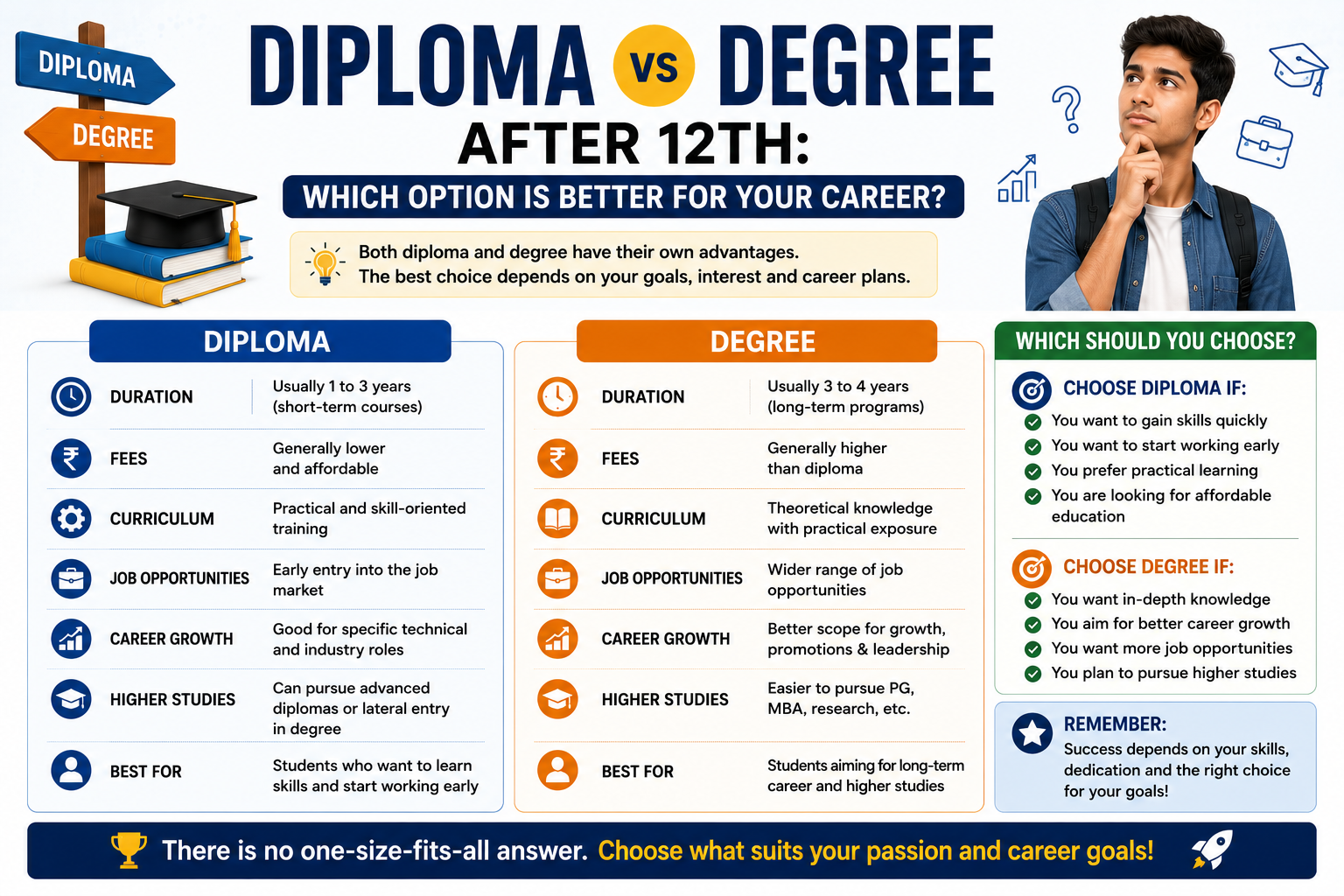
Diploma vs Degree: Key Difference
The main difference between a diploma and a degree is the depth of study and recognition. A diploma usually focuses on practical skills for a specific job area, while a degree gives broader academic knowledge, theoretical base, specialization options, and higher education pathways.
| Factor | Diploma | Degree |
|---|---|---|
| Meaning | Short-term or medium-term skill-based course | Full undergraduate academic qualification |
| Duration | Usually 6 months to 3 years | Usually 3 to 5 years depending on course |
| Focus | Practical skills and job readiness | Academic depth, theory, specialization, and career growth |
| Eligibility | Usually 10th or 12th depending on course | Usually 12th pass with required stream/subjects |
| Higher Studies | Limited but possible through lateral entry or advanced diplomas | Better for PG, MBA, MCA, MA, M.Sc, LLB, professional exams |
| Recognition | Recognized if from approved/reputed institute | Generally more widely recognized for jobs and higher education |
| Best For | Students who want quick skills and early employment | Students who want long-term growth and broader opportunities |
What Is a Diploma Course After 12th?
A diploma course is a shorter, practical, and skill-focused program designed to prepare students for a specific job role or industry. Many diploma courses are available in engineering, design, hotel management, digital marketing, animation, nursing, pharmacy, fashion, travel, event management, and computer applications.
Popular Diploma Courses After 12th
Diploma in Digital Marketing
Useful for SEO, social media, ads, content marketing, email marketing, and online business roles.
3–12 Months DigitalDiploma in Graphic Design
Best for students interested in branding, social media creatives, UI basics, and visual design.
6–18 Months CreativeDiploma in Hotel Management
Good for hospitality, hotels, restaurants, tourism, guest relations, and service industry careers.
1–3 Years HospitalityDiploma in Computer Applications
Suitable for basic IT, office software, web basics, data entry, and computer support roles.
6–12 Months ITDiploma in Animation & VFX
Best for creative students interested in gaming, films, advertising, motion graphics, and media.
1–3 Years MediaDiploma in Pharmacy
Useful for students interested in pharmacy, medicine distribution, and entry-level pharma roles.
2 Years HealthcareAdvantages of Diploma After 12th
- Shorter duration compared to degree courses.
- Usually more skill-oriented and practical.
- Can help students start earning earlier.
- Often more affordable than long professional degrees.
- Useful for portfolio-based careers like design, animation, digital marketing, and hospitality.
- Good option for students who want industry exposure quickly.
Limitations of Diploma After 12th
- May have limited recognition if the institute is not approved or reputed.
- Some government jobs and higher studies may require a degree.
- Salary growth may be slower without further education or strong skills.
- Career options may be narrower compared to degree holders.
- Students may need additional certifications or experience for better jobs.
What Is a Degree Course After 12th?
A degree course is a full undergraduate program offered by a recognized university or college. It gives students deeper knowledge, academic structure, specialization, internships, projects, and eligibility for postgraduate education or professional exams.
Popular Degree Courses After 12th
B.Tech / B.E.
Engineering and technology degree for students interested in technical careers.
4 Years EngineeringB.Com
Best for accounting, finance, taxation, banking, and business careers.
3 Years CommerceBA
Suitable for humanities, civil services, teaching, public policy, and research.
3 Years ArtsBBA
Good for management, startups, marketing, HR, operations, and MBA pathway.
3 Years ManagementBCA
Suitable for IT, software development, web development, apps, and computer careers.
3 Years ITBA LLB / BBA LLB
Integrated law degree for legal, judiciary, compliance, and corporate law careers.
5 Years LawAdvantages of Degree After 12th
- Better long-term recognition for jobs and higher studies.
- Opens postgraduate options like MBA, MCA, MA, M.Sc, M.Com, M.Tech, and LLB.
- Useful for government exams and many professional career paths.
- Provides deeper subject knowledge and broader career base.
- Can improve salary growth with internships, skills, and experience.
- More suitable for students planning long-term career development.
Limitations of Degree After 12th
- Usually takes more time than diploma courses.
- Can be more expensive depending on the college and course.
- Some degrees may be too theoretical without practical skills.
- Students still need internships, projects, and certifications for better employability.
- Choosing the wrong degree without interest can create career confusion.
Diploma vs Degree After 12th: Detailed Comparison
| Comparison Point | Diploma Course | Degree Course | Better Choice For |
|---|---|---|---|
| Duration | Shorter, usually 6 months to 3 years | Longer, usually 3 to 5 years | Diploma for quick start; degree for long-term base |
| Course Focus | Skill-based and practical | Academic, theoretical, and professional | Depends on career goal |
| Fees | Often lower, but varies by institute | Can be higher, especially in private colleges | Diploma if budget is tight; degree if long-term investment is possible |
| Job Readiness | Can be job-ready faster in specific fields | Needs skills, internships, and specialization | Diploma for early job; degree for broader opportunities |
| Higher Studies | Limited or route-specific | Stronger pathway to PG and professional courses | Degree |
| Government Jobs | Eligible for selected diploma-level posts | Eligible for many graduate-level exams and posts | Degree |
| Career Flexibility | More focused on one skill/field | Broader career options | Degree |
| Best Use Case | Quick skill, early earning, industry entry | Long-term growth, higher studies, professional profile | Depends on student plan |
Fees and Duration: Diploma vs Degree
Fees vary by course, college, city, facilities, hostel, and whether the institute is government or private. Below is an indicative comparison for students.
| Option | Common Duration | Indicative Fee Range | Common Admission Mode |
|---|---|---|---|
| Short-Term Diploma / Certificate | 3 months–1 year | ₹10,000 – ₹1,50,000 total/course-wise | Direct admission / Institute process |
| Professional Diploma | 1–3 years | ₹20,000 – ₹3,00,000 per year | Merit / Entrance / Institute process |
| General Degree | 3 years | ₹5,000 – ₹2,50,000 per year | Merit / CUET / University process |
| Professional Degree | 3–5 years | ₹40,000 – ₹6,00,000 per year | Entrance / Merit / University process |
| Integrated Degree | 5 years | ₹50,000 – ₹5,00,000 per year | Entrance / University process |
Career Scope: Diploma vs Degree
Both diploma and degree courses can lead to good careers, but the path is different. A diploma can help students enter the job market faster, while a degree usually gives better long-term flexibility and higher study options.
| Career Goal | Better Option | Why? |
|---|---|---|
| Start earning quickly | Diploma | Shorter duration and practical training can support early entry-level jobs |
| Prepare for government exams | Degree | Many graduate-level exams require a bachelor’s degree |
| Build a professional career | Degree | Professional fields often require recognized degree qualifications |
| Enter creative fields quickly | Diploma + Portfolio | Design, animation, digital marketing, and media value practical work and portfolio |
| Go for higher studies | Degree | Postgraduate courses usually require an undergraduate degree |
| Improve one specific skill | Diploma / Certification | Useful for skill upgrades like coding, digital marketing, graphic design, and tools |
| Keep career options open | Degree | Degrees provide broader academic and career flexibility |
When Should You Choose a Diploma?
A diploma can be a good choice when your goal is practical training, early employment, or a specific skill-based career.
- You want to start working quickly.
- You have a limited budget for higher education.
- You are clear about one specific skill or industry.
- You want a practical course with hands-on training.
- You are interested in fields like digital marketing, animation, design, hospitality, travel, or computer applications.
- You want to test a field before committing to a long degree.
When Should You Choose a Degree?
A degree is usually better when you want long-term growth, higher education options, and broader recognition.
- You want to pursue postgraduate studies later.
- You are planning for government exams or graduate-level jobs.
- You want a strong academic foundation.
- You are interested in professional careers like law, management, engineering, medicine, commerce, teaching, or research.
- You want more career flexibility in the future.
- You can invest more time in education before starting full-time work.
Best Combination: Degree Plus Skill Diploma
For many students, the best option is not diploma or degree alone. A strong combination can be: degree + practical diploma/certification + internships + portfolio.
| Main Degree | Add-On Diploma / Skill | Career Benefit |
|---|---|---|
| B.Com | Accounting software, Excel, finance, taxation, digital marketing | Better employability in finance, accounts, and business roles |
| BA | Content writing, digital marketing, language, public policy, research tools | Useful for media, policy, content, government exam support, and communication roles |
| BCA | Web development, app development, cybersecurity, cloud, data analytics | Improves IT job readiness and project portfolio |
| BBA | Digital marketing, analytics, sales, HR tools, business communication | Supports management, startup, marketing, and operations roles |
| B.Des | UI/UX tools, animation, branding, portfolio development | Improves creative portfolio and freelance/job opportunities |
How to Decide Between Diploma and Degree
Define Your Goal
Decide whether you want early job entry, higher studies, government exams, or professional career growth.
Check Eligibility
Compare subject requirements, minimum marks, entrance exams, and institute recognition.
Compare Fees
Check tuition fees, hostel charges, exam fees, travel cost, and hidden expenses.
Review Career Scope
Look at job options, salary growth, higher studies, internships, and industry demand.
FAQs on Diploma vs Degree After 12th
Which is better after 12th, diploma or degree?
A degree is usually better for long-term career growth, higher studies, and broader opportunities. A diploma is better if you want a shorter, practical, job-oriented course and want to start working early.
Can I get a job after a diploma?
Yes. Many diploma courses are skill-based and can help students get entry-level jobs. However, job quality and salary depend on institute reputation, practical skills, internships, portfolio, and industry demand.
Is a diploma equal to a degree?
No. A diploma and degree are different qualifications. A degree is usually a full undergraduate qualification, while a diploma is generally shorter and more skill-specific. Recognition depends on the institute and course.
Can I do a degree after a diploma?
Yes, in many fields students can pursue a degree after a diploma. Some technical courses may offer lateral entry, while other fields may require students to follow regular admission rules. Eligibility depends on the course and institution.
Which diploma course is best after 12th?
Popular diploma courses after 12th include digital marketing, graphic design, hotel management, animation and VFX, computer applications, fashion design, pharmacy, event management, and travel and tourism.
Should I do a diploma along with a degree?
Yes, this can be a smart strategy. A degree gives academic recognition, while a diploma or certification adds practical skills. This combination can improve internships, job readiness, and portfolio strength.
Conclusion
Diploma and degree courses both have value after Class 12, but they are useful for different goals. A diploma is suitable for students who want quick skills, practical training, and early job entry. A degree is better for students who want long-term career growth, higher studies, government exam eligibility, and wider career options.
The best decision depends on your interest, budget, time, career plan, and learning style. For many students, the strongest option is to pursue a recognized degree and add practical diploma or certification courses to build job skills. Before final admission, always check course recognition, institute reputation, fees, placement support, internship opportunities, and future study options.
Note: Course duration, fees, eligibility, recognition, and admission process may vary by college, institute, university, state, and academic year. Students should verify the latest details from official institute or university websites before applying.