


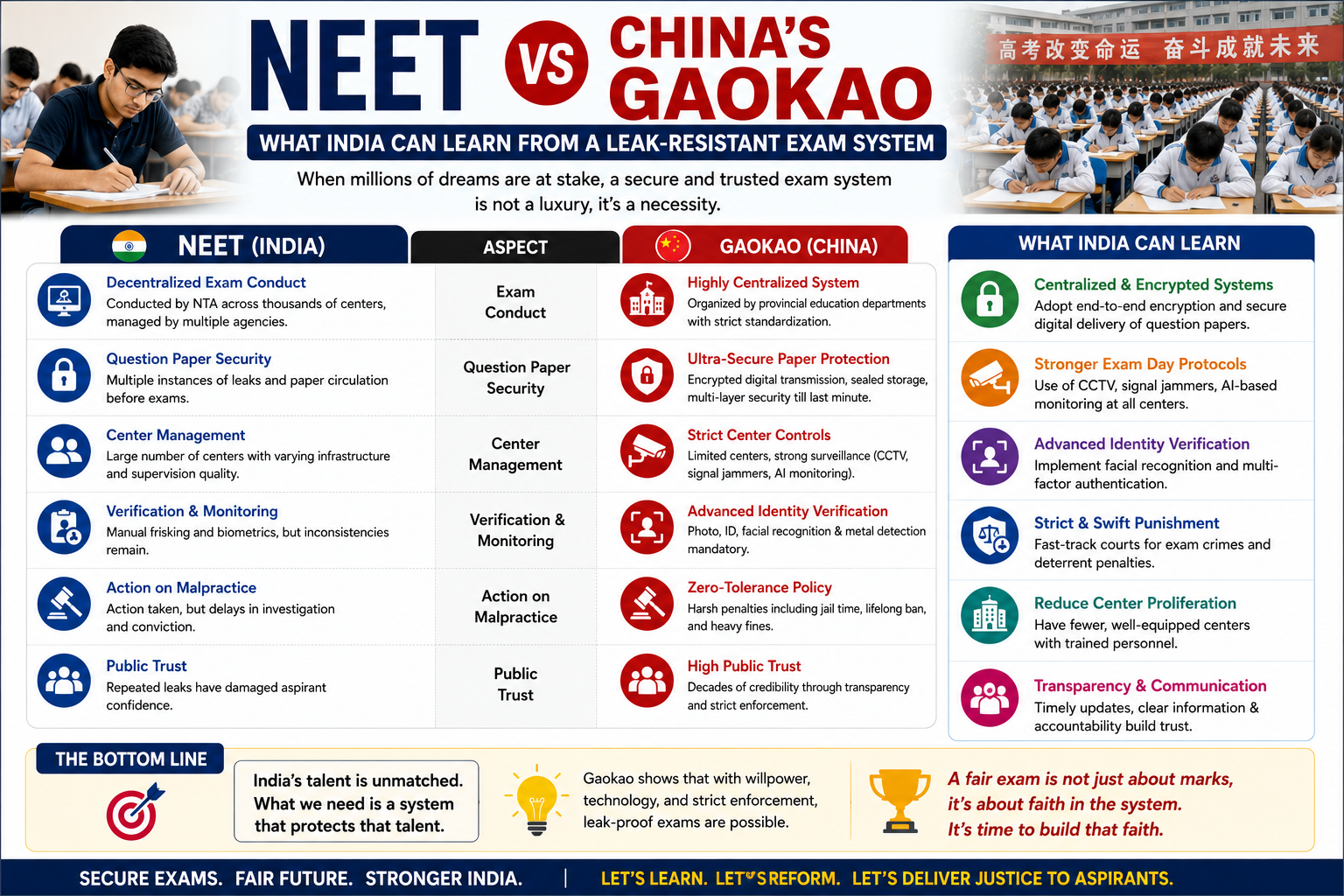
NEET vs China’s Gaokao: What India Can Learn From a Leak-Resistant Exam System
NEET is one of India’s most important medical entrance exams, while China’s Gaokao is among the world’s largest college entrance examinations. The comparison has become important because NEET has faced repeated scrutiny over alleged paper leaks and irregularities, while Gaokao is often described as a tightly controlled and highly monitored exam system.
Table of Contents
Every year, nearly 20 to 25 lakh students appear for NEET in India with the dream of entering medical and dental colleges. In comparison, China’s Gaokao sees nearly 1.3 crore students participating annually. Despite its much larger scale, major exam leak reports are considered rare in China, making Gaokao an important case study in exam security.
NEET in India: Why the Exam Is So Important
NEET UG is conducted for admission to undergraduate medical and dental courses such as MBBS and BDS. For many students, it is the only major gateway to medical education in India. Because the exam affects lakhs of aspirants, even a small irregularity can create a large national debate.
| Factor | NEET UG |
|---|---|
| Country | India |
| Main Purpose | Admission to medical and dental courses such as MBBS and BDS |
| Approx. Candidates | Nearly 20 to 25 lakh students every year |
| Importance | Single major entrance route for medical admissions |
| Current Debate | Paper leak allegations, exam fairness, security, and testing reforms |
What is China’s Gaokao Exam?
The Gaokao is China’s national-level college entrance examination. It is conducted once a year and plays a major role in deciding university admissions. A student’s Gaokao score can determine which university they can enter and which course they may be eligible to pursue.
| Factor | Gaokao |
|---|---|
| Country | China |
| Main Purpose | National college entrance examination for university admissions |
| Approx. Candidates | Nearly 1.3 crore students every year |
| Scope | Gateway to many major undergraduate programmes |
| Public Perception | Highly strict, centralised, and closely monitored exam system |
NEET vs Gaokao: Quick Comparison
| Comparison Point | NEET UG | Gaokao |
|---|---|---|
| Country | India | China |
| Approx. Scale | Nearly 20 to 25 lakh candidates | Nearly 1.3 crore candidates |
| Admission Scope | Mainly medical and dental courses | Broad undergraduate university admissions |
| Frequency | Annual exam | Annual exam |
| Public Debate | Paper leak allegations and testing credibility concerns | Strict exam discipline and leak-resistant perception |
| Security Focus | Needs stronger safeguards and transparency | Highly centralised monitoring and strict control |
Why Is Gaokao Seen as More Leak-Resistant?
One of the most cited reasons is China’s strict and centralised examination framework. Reports often describe Gaokao as a highly monitored exam where technology, administration, and public discipline work together to reduce irregularities.
AI Surveillance
AI-enabled monitoring can help detect suspicious behaviour inside examination centres.
MonitoringBiometric Checks
Biometric authentication can reduce impersonation and identity-related malpractice.
IdentitySignal Jammers
Electronic signal jammers help prevent communication-based cheating during exams.
Anti-CheatingDrone Monitoring
Drone surveillance may be used in sensitive zones to monitor external movement.
SecurityLogistics Control
Strict handling of question papers and exam material reduces leakage risk.
Paper SafetyPublic Coordination
Traffic and public movement may be regulated in some areas to maintain exam discipline.
AdministrationWhat Can India Learn for NEET and Other Entrance Exams?
The comparison between NEET and Gaokao does not mean that one system can be copied exactly into another country. However, India can study the broader principles of exam security, transparency, technology use, logistics control, and accountability.
- Stronger control over question paper printing, storage, movement, and centre-level handling.
- Better biometric verification to reduce impersonation and proxy candidates.
- Use of secure digital tracking for exam material movement.
- Improved CCTV and AI-assisted monitoring at sensitive exam centres.
- Clear accountability for agencies, centres, logistics vendors, and local administrators.
- Quick grievance redressal and transparent communication after any irregularity report.
- Stronger cyber security for online systems, result processing, and candidate data.
- Independent audits of high-stakes exam systems before and after conduct.
Why Exam Security Matters for Students
For students and parents, entrance exams are not only academic events. They represent years of preparation, coaching expenses, emotional pressure, and career hopes. When exam leaks or irregularities are reported, students lose trust in the fairness of the system.
| Issue | Impact on Students |
|---|---|
| Paper Leak Allegations | Creates doubt about fairness and equal opportunity |
| Exam Centre Mismanagement | Can affect performance, confidence, and exam experience |
| Delayed Investigation | Increases stress and uncertainty for students and parents |
| Result Irregularity Claims | Creates confusion over rank, admission, and counselling process |
| Lack of Communication | Students depend on rumours instead of verified updates |
FAQs on NEET vs Gaokao Exam Security
What is NEET UG?
NEET UG is India’s national-level entrance exam for undergraduate medical and dental admissions, including MBBS and BDS courses.
What is China’s Gaokao exam?
Gaokao is China’s national college entrance examination and is used for admission to many major undergraduate programmes across universities in China.
How many students appear for NEET and Gaokao?
NEET generally sees nearly 20 to 25 lakh candidates annually, while Gaokao reportedly sees nearly 1.3 crore students every year.
Why is Gaokao considered more secure?
Gaokao is often described as highly centralised and strictly monitored, with measures such as surveillance, biometric checks, signal control, logistics safeguards, and strict administrative arrangements.
Can India copy the Gaokao model for NEET?
India may not be able to copy the system exactly because both countries have different governance and exam structures. However, India can learn from its strict logistics control, technology use, accountability, and exam-day coordination.
Why do paper leak allegations matter?
Paper leak allegations affect student trust, admission fairness, mental stress, and the credibility of the entire examination system.
Conclusion
The comparison between NEET and China’s Gaokao highlights the importance of exam security in high-stakes education systems. NEET decides medical futures for lakhs of Indian students, while Gaokao plays a central role in university admissions for millions of Chinese students.
India’s challenge is to build a more transparent, secure, and accountable testing system that protects honest candidates and restores public confidence. Stronger logistics, technology-driven monitoring, quick investigation, and clear communication can help improve trust in NEET and other major entrance exams.
Source note: This article is based on the uploaded NDTV education article text provided by the user. Students should follow official exam authorities for verified NEET notices, counselling updates, and admission rules.









