


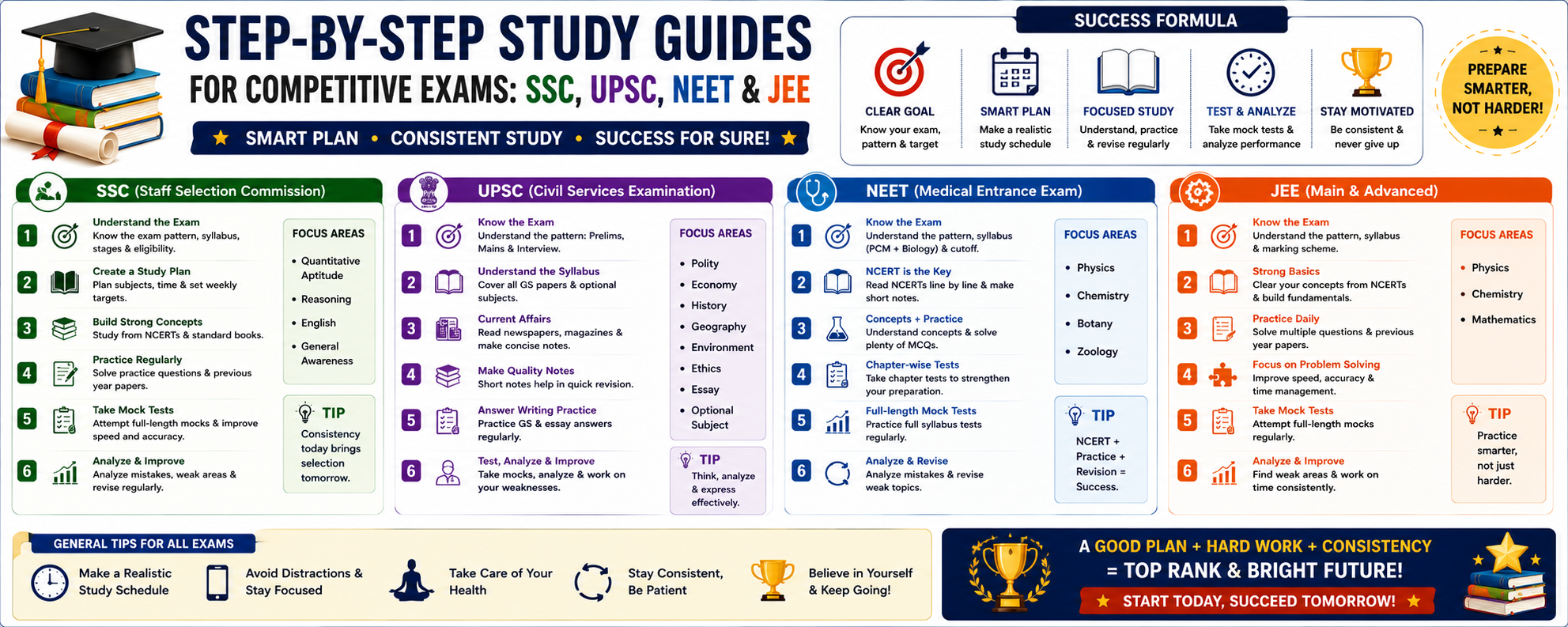
Step-by-Step Study Guides for Competitive Exams: SSC, UPSC, NEET and JEE
Competitive exams require more than hard work. Students need the right syllabus understanding, timetable, revision plan, mock test strategy, previous year paper practice, and consistent performance analysis. This guide explains step-by-step preparation plans for SSC, UPSC, NEET, and JEE aspirants.
Table of Contents
Every competitive exam has a different pattern, syllabus, and selection process. However, successful preparation usually follows the same basic formula: understand the exam, complete the syllabus, revise regularly, practice questions, take mock tests, analyze mistakes, and improve weak areas.
Common Step-by-Step Study Plan for Any Competitive Exam
Before preparing separately for SSC, UPSC, NEET, or JEE, students should understand a common preparation structure. This system works for most competitive exams with small changes according to the syllabus and exam pattern.
Understand the Exam
Read the syllabus, exam pattern, marking scheme, eligibility, stages, and previous year cut-off trends.
Make a Timetable
Create a realistic daily and weekly plan with subject slots, revision time, and test practice.
Complete Basics First
Study core concepts from standard books, NCERTs, class notes, or trusted study material.
Practice Questions
Solve topic-wise questions, previous year questions, and mixed practice sets regularly.
Revise Weekly
Use short notes, formula sheets, current affairs notes, and error notebooks for revision.
Analyze Mock Tests
Check wrong answers, weak topics, time loss, and silly mistakes after every test.
Quick Study Strategy by Exam
| Exam | Main Focus | Best Study Method | Most Important Practice |
|---|---|---|---|
| SSC | Reasoning, Quant, English, General Awareness | Daily practice + speed improvement | Mock tests and previous year papers |
| UPSC | Concepts, current affairs, answer writing, optional subject | NCERT + standard books + revision | Prelims MCQs and mains answer writing |
| NEET | Biology, Chemistry, Physics | NCERT-based study + question practice | Biology revision and full-length mock tests |
| JEE | Physics, Chemistry, Mathematics | Concept clarity + problem solving | Topic-wise practice and timed tests |
Step-by-Step Study Guide for SSC Exams
SSC exams such as SSC CGL, CHSL, MTS, GD, and other recruitment exams usually test reasoning, quantitative aptitude, English, and general awareness. Preparation should focus on speed, accuracy, revision, and repeated practice.
SSC Preparation Steps
- Download the latest SSC syllabus and exam pattern for your target exam.
- Divide subjects into Reasoning, Quantitative Aptitude, English, and General Awareness.
- Start with arithmetic, grammar rules, reasoning patterns, and static GK.
- Practice topic-wise questions daily to build speed and accuracy.
- Revise formulas for percentage, ratio, profit-loss, time-work, speed-distance, and geometry.
- Read current affairs and revise static GK regularly.
- Attempt previous year papers to understand repeated question patterns.
- Take mock tests and analyze wrong answers, slow questions, and guessing mistakes.
Suggested SSC Daily Timetable
| Time Slot | Study Task | Purpose |
|---|---|---|
| 1 hour | Quantitative Aptitude | Concept + practice |
| 45 minutes | Reasoning | Pattern practice and speed |
| 45 minutes | English | Grammar, vocabulary, comprehension |
| 30 minutes | General Awareness | Static GK + current affairs |
| 30 minutes | Revision / Error Notebook | Fix weak areas and repeated mistakes |
| Weekly | Mock Test | Time management and exam simulation |
Step-by-Step Study Guide for UPSC Civil Services
UPSC preparation requires depth, consistency, current affairs understanding, conceptual clarity, and answer writing. Aspirants should prepare for Prelims and Mains together in the initial stage instead of treating them as completely separate exams.
UPSC Preparation Steps
- Understand the complete UPSC syllabus for Prelims, Mains, Essay, Optional, and Interview.
- Start with NCERTs for History, Geography, Polity, Economy, Environment, and Society basics.
- Move to standard books after building the foundation.
- Read a newspaper daily and make short current affairs notes.
- Link current affairs with static topics such as polity, economy, environment, and international relations.
- Practice Prelims MCQs after every topic.
- Start answer writing early for Mains instead of waiting until syllabus completion.
- Revise multiple times because UPSC requires retention, not just reading.
- Attempt full-length Prelims and Mains tests before the exam.
UPSC Study Plan Structure
| Stage | Focus Area | What to Do |
|---|---|---|
| Foundation | NCERT + basic concepts | Build clarity in polity, history, geography, economy, and environment |
| Core Preparation | Standard books + current affairs | Complete GS topics with notes and revision |
| Prelims Practice | MCQs + test series | Solve previous year questions and mock tests |
| Mains Practice | Answer writing | Write structured answers with examples, data, and conclusion |
| Final Revision | Short notes + tests | Revise repeatedly and improve weak areas |
Step-by-Step Study Guide for NEET
NEET preparation requires strong command over Biology, Chemistry, and Physics. Students should focus on NCERT concepts, diagrams, formulas, repeated revision, and full-length mock tests.
NEET Preparation Steps
- Understand the NEET syllabus and weightage of Biology, Chemistry, and Physics.
- Read NCERT Biology line by line and revise diagrams, examples, tables, and key terms.
- Build Chemistry in three parts: Physical Chemistry, Organic Chemistry, and Inorganic Chemistry.
- Practice Physics numericals daily from mechanics, electricity, modern physics, optics, and thermodynamics.
- Make formula sheets for Physics and Physical Chemistry.
- Solve previous year questions after each chapter.
- Revise Biology frequently because it has high scoring potential.
- Take full-length mock tests and analyze accuracy, time management, and weak chapters.
NEET Subject Strategy
| Subject | Study Focus | Practice Method |
|---|---|---|
| Biology | NCERT, diagrams, examples, definitions, repeated revision | Chapter-wise MCQs, NCERT line-based questions, mock tests |
| Chemistry | Concepts, formulas, reactions, periodic trends, mechanisms | Numericals, reaction practice, NCERT-based inorganic revision |
| Physics | Concept clarity, formulas, numericals, time management | Daily problem solving, previous year questions, timed practice |
Step-by-Step Study Guide for JEE
JEE preparation needs strong concepts, problem-solving ability, speed, accuracy, and regular mock test analysis. Students should prepare Physics, Chemistry, and Mathematics with a balance of theory and practice.
JEE Preparation Steps
- Understand the JEE Main and JEE Advanced syllabus separately if preparing for both.
- Start with basic concepts before moving to advanced-level problems.
- Make chapter-wise formula sheets for Physics and Mathematics.
- Study Chemistry in three parts: Physical, Organic, and Inorganic.
- Solve topic-wise questions after completing every concept.
- Practice previous year questions to understand exam level and repeated patterns.
- Take timed tests to improve speed and reduce calculation mistakes.
- Analyze mock tests and create an error notebook for wrong concepts and silly mistakes.
JEE Subject Strategy
| Subject | Study Focus | Practice Method |
|---|---|---|
| Physics | Concepts, formulas, derivations, numerical application | Topic-wise problems, mixed practice, previous year questions |
| Chemistry | Physical concepts, organic mechanisms, inorganic NCERT facts | Formula practice, reaction revision, NCERT reading, MCQs |
| Mathematics | Algebra, calculus, coordinate geometry, trigonometry, vectors | Daily problem solving, timed sets, revision of formulas and methods |
SSC vs UPSC vs NEET vs JEE: Preparation Comparison
| Exam | Type of Exam | Main Subjects | Best Preparation Focus | Common Mistake |
|---|---|---|---|---|
| SSC | Government recruitment | Quant, Reasoning, English, GK | Speed, accuracy, PYQs, mocks | Ignoring mock analysis and calculation speed |
| UPSC | Civil services | GS, CSAT, Essay, Optional | Concepts, current affairs, answer writing | Reading too much without revision or answer writing |
| NEET | Medical entrance | Biology, Chemistry, Physics | NCERT, MCQs, revision, full mocks | Ignoring Physics practice or Biology revision |
| JEE | Engineering entrance | Physics, Chemistry, Mathematics | Concept clarity, problem solving, timed tests | Studying theory without enough problem practice |
Common Mistakes Students Should Avoid
- Starting preparation without reading the official syllabus and exam pattern.
- Studying too many books instead of revising limited good resources.
- Ignoring previous year question papers.
- Attempting mock tests but not analyzing mistakes.
- Not making short notes, formula sheets, or error notebooks.
- Leaving revision for the last month only.
- Comparing preparation with others instead of tracking personal progress.
- Studying long hours without breaks, sleep, or health management.
Best Weekly Revision Plan
| Day | Revision Task | Purpose |
|---|---|---|
| Monday to Friday | Revise one small topic daily | Improve retention |
| Saturday | Practice previous year questions | Understand exam pattern |
| Sunday | Attempt mock test or sectional test | Check speed and accuracy |
| Sunday Evening | Analyze mistakes and update error notebook | Fix weak areas |
FAQs on Competitive Exam Study Guides
How should I start preparing for a competitive exam?
Start by reading the latest syllabus, exam pattern, marking scheme, and previous year papers. Then make a realistic timetable, complete basic concepts, practice topic-wise questions, revise weekly, and analyze mock tests regularly.
How many hours should I study daily for competitive exams?
Study hours depend on the exam, preparation stage, and student level. Instead of only counting hours, focus on daily targets, revision, question practice, and mock test analysis. Consistency matters more than one-day long study sessions.
Are previous year papers important?
Yes. Previous year papers help students understand question type, difficulty level, repeated topics, time pressure, and exam pattern. They are useful for SSC, UPSC, NEET, JEE, and most other competitive exams.
How do I improve mock test scores?
After every mock test, check wrong answers, skipped questions, slow topics, silly mistakes, and weak concepts. Revise those areas and attempt similar questions before taking the next mock.
Which is more important: study material or revision?
Both are important, but revision is often the difference between average and high scores. Limited good study material revised multiple times is usually better than reading too many sources without revision.
Can I prepare for competitive exams without coaching?
Yes, many students prepare without coaching using standard books, NCERTs, online resources, previous year papers, test series, and disciplined self-study. Coaching can help with structure, but consistency and practice are more important.
Conclusion
SSC, UPSC, NEET, and JEE are different exams, but the core preparation method is similar: understand the syllabus, build concepts, practice questions, revise regularly, attempt mock tests, and analyze mistakes. Students should avoid random study and follow a structured plan with weekly targets.
The best study guide is the one that matches your exam, current level, time available, and weak areas. Keep your resources limited, revise repeatedly, solve previous year questions, and track your progress honestly.
Note: Exam pattern, syllabus, eligibility, application dates, and marking schemes may change. Students should always verify the latest details from official exam notifications and official websites before applying or planning.









