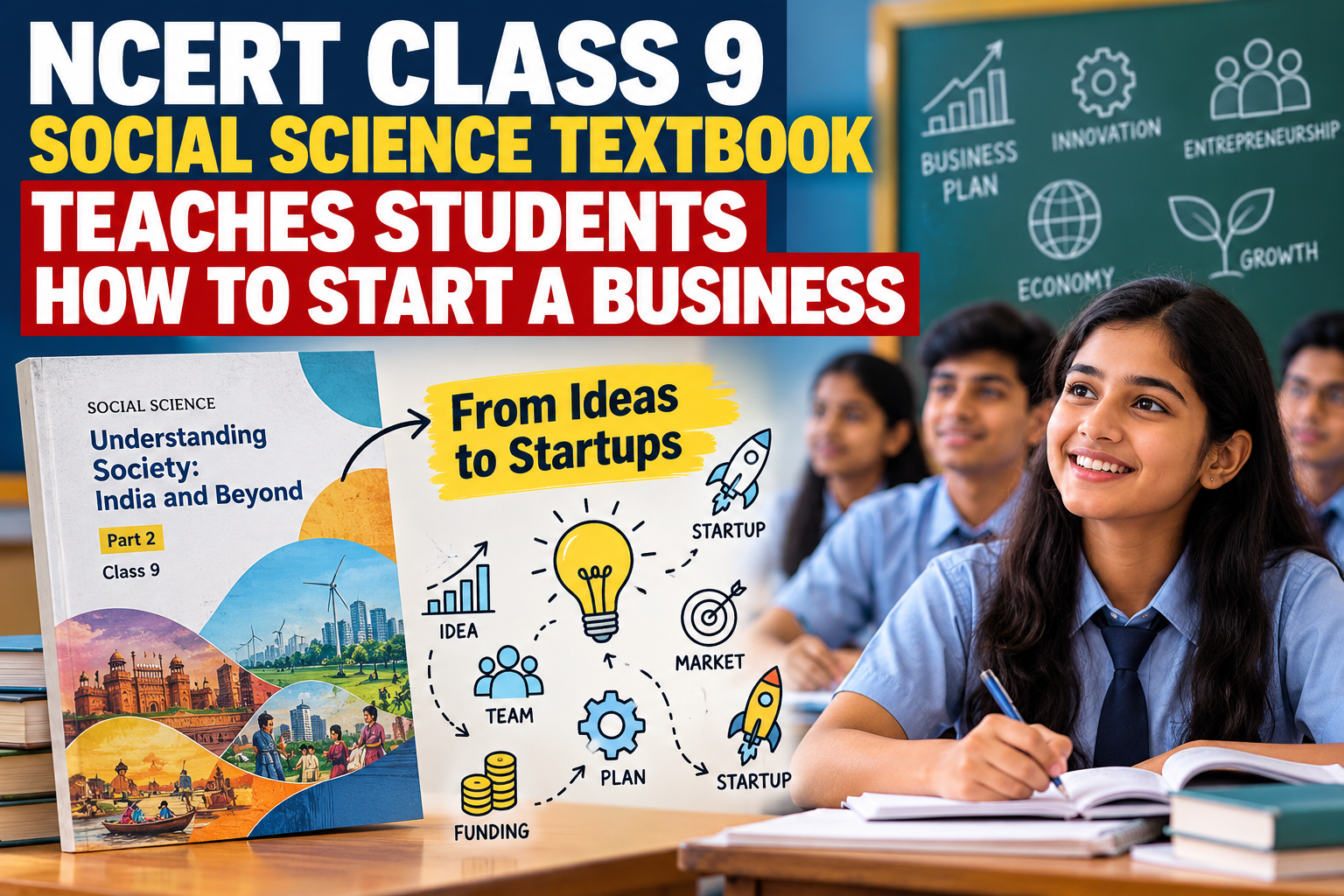
NCERT Class 9 Social Science Textbook Teaches Students How to Start a Business
Class 9 students will now learn how an idea can be developed into a real business as entrepreneurship becomes part of the new Social Science curriculum.
The revised Class 9 Social Science textbook, Understanding Society: India and Beyond – Part 2, includes a dedicated chapter titled “From Ideas to Startups.” The chapter introduces students to entrepreneurship, business planning, startup ecosystems and basic accounting concepts at the school level.
Instead of focusing only on definitions, the chapter takes students through the process of identifying an opportunity, arranging resources, understanding customers, preparing a business plan and eventually turning an idea into an enterprise.
The curriculum also connects entrepreneurship with innovation, employment generation and economic development, giving students an early understanding of how businesses contribute to the economy.
Class 9 Students to Learn Entrepreneurship and Startup Basics
The new entrepreneurship chapter is designed to explain how businesses are created and how entrepreneurs transform ideas into products or services.
Students will learn that starting a business involves much more than simply having an interesting idea.
A successful venture may require:
• Identifying a problem or market opportunity
• Understanding potential customers
• Studying demand
• Developing a business plan
• Arranging finance
• Managing people and resources
• Understanding costs and revenue
• Testing an idea
• Launching the business
• Improving the product or service over time
The chapter introduces these concepts at a level suitable for Class 9 students.
What Will Class 9 Students Learn About Starting a Business?
| Topic | What Students Will Learn |
|---|---|
| Entrepreneurship | How entrepreneurs identify opportunities and create enterprises |
| Business Ideas | How everyday problems can become potential business opportunities |
| Business Planning | How an idea can be developed into a structured plan |
| Resources | Physical, financial, human and intellectual resources needed by businesses |
| Market Understanding | Why businesses need to understand customers and demand |
| Startup Ecosystem | How startups operate within a wider network of investors, institutions and support systems |
| MSMEs | Role of micro, small and medium enterprises in the economy |
| Government Initiatives | How programmes supporting entrepreneurship contribute to business creation |
| Accounting | Basic concepts related to business finances |
| Technology | How digital tools and emerging technologies can support business decisions |
Class 9 Social Science Gets Dedicated ‘From Ideas to Startups’ Chapter
The entrepreneurship content forms a dedicated part of the revised Social Science curriculum rather than being included only as a small reference within another economics chapter.
The syllabus allocates approximately eight instructional hours to “From Ideas to Startups.”
The chapter aims to help students understand entrepreneurship as a process involving innovation, planning, resources, decision-making and execution.
It also introduces students to the relationship between entrepreneurship and wider economic development.
NCERT Class 9 Textbook Explains How to Turn an Idea Into a Startup
Students are introduced to the journey from identifying an idea to executing it as a business.
The process broadly covers:
Identify a need, problem or opportunity.
Think of a possible solution.
Understand the potential market.
Study the resources required.
Prepare a business plan.
Arrange financial and other resources.
Build or prepare the product or service.
Launch the business.
Study customer response.
Improve the venture based on experience.
This gives school students practical exposure to how an entrepreneurial idea progresses beyond the brainstorming stage.
Class 9 Students Will Learn About India's Startup Ecosystem
The textbook also introduces students to India's growing startup ecosystem.
It discusses how entrepreneurs operate within an environment that can include:
• Investors
• Incubators
• Financial institutions
• Technology platforms
• Government initiatives
• Skilled workers
• Educational institutions
• Customers
• Suppliers
• Other businesses
Students are taught that successful businesses generally depend on networks and resources rather than operating completely independently.
From Ideas to Startups: Students to Study MSMEs and Small Businesses
The curriculum also introduces the importance of Micro, Small and Medium Enterprises.
Students learn how smaller businesses contribute to:
• Employment generation
• Local economic activity
• Innovation
• Entrepreneurship
• Manufacturing
• Services
• Rural and regional development
• Inclusive economic growth
The unorganised sector and its role in India's economy are also included in the learning framework.
Class 9 Students to Learn Basic Business Accounting
The chapter does not stop with business ideas and entrepreneurship.
Students are also introduced to basic accounting concepts so that they can understand the financial side of running an enterprise.
At an introductory level, students can learn why businesses need to track:
• Money invested
• Business expenses
• Revenue
• Assets
• Liabilities
• Profit and loss
• Financial resources
The aim is to help students understand that an enterprise must manage its finances along with developing a good product or service.
AI Enters Class 9 Entrepreneurship Lessons
The entrepreneurship chapter also introduces the role that technology, including artificial intelligence, can play in business decision-making.
Students are exposed to the idea that AI tools can assist entrepreneurs in areas such as:
• Market analysis
• Identifying patterns
• Studying customer preferences
• Comparing information
• Supporting business decisions
• Improving efficiency
The emphasis is on understanding technology as a tool that can support entrepreneurial decision-making rather than replace human judgment.
Real Business Stories Used to Explain Entrepreneurship
The textbook uses real-world entrepreneurial examples to make business concepts easier for students to understand.
One example highlights how a small initiative started by a group of women with limited resources eventually developed into a large enterprise.
Such cases are used to demonstrate principles including:
• Opportunity recognition
• Resourcefulness
• Consistency
• Teamwork
• Financial discipline
• Reinvestment
• Quality control
• Social impact
• Long-term growth
The approach allows students to connect theoretical concepts with actual entrepreneurial journeys.
Class 9 Students to Study Government Startup Initiatives
The curriculum also introduces major initiatives associated with India's entrepreneurship and manufacturing ecosystem.
Students learn about programmes such as:
• Startup India
• Make in India
• Digital India
These initiatives are discussed in the broader context of encouraging innovation, entrepreneurship, manufacturing, digital development and employment.
Why Entrepreneurship Has Been Added to Class 9 Social Science
The inclusion of entrepreneurship reflects a broader shift toward practical and skill-oriented learning.
Instead of treating economics only as a collection of theories, students are encouraged to understand how economic activity takes place in everyday life.
Entrepreneurship education can help students develop:
• Problem-solving skills
• Creativity
• Financial awareness
• Decision-making ability
• Communication skills
• Teamwork
• Market awareness
• Planning ability
• Understanding of risk
• Ability to turn ideas into practical solutions
The chapter does not mean every student is expected to become an entrepreneur. It gives students an early understanding of how enterprises operate and how economic opportunities are created.


q.jpg)