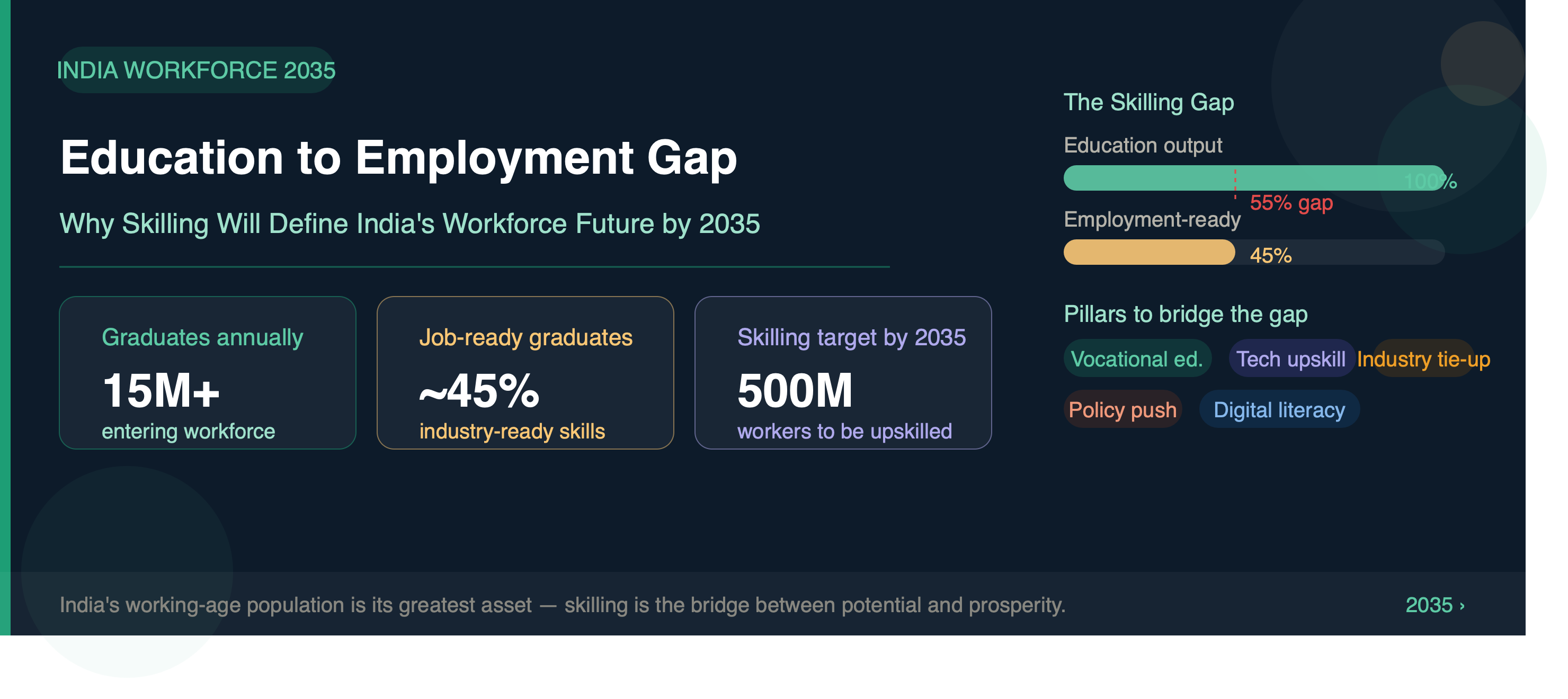
Education to Employment Gap: Why Skilling Will Define India’s Workforce Future by 2035
India’s education system has made remarkable progress over the past two and a half decades, yet a significant challenge remains: the widening gap between education and employment. According to ETEducation’s report titled "India's Education: 25 Years On, The Road to 2035," this gap threatens to impact the country’s workforce potential unless urgent focus is placed on skill development. As India aims to become a global economic powerhouse, skilling initiatives are expected to play a pivotal role in preparing youth for the jobs of the future by 2035.
Key Highlights
- Significant mismatch exists between education outcomes and employability skills.
- Skilling is projected to be the defining factor for India’s workforce by 2035.
- Current education curricula often lack alignment with industry requirements.
- Rapid technological changes demand continuous upskilling and reskilling.
- Government and private sector collaboration is essential to bridge the gap.
- Vocational training and skill certifications can enhance job readiness.
- Digital literacy and soft skills are increasingly critical for employability.
- Investment in skill development infrastructure is necessary for sustainable growth.
What Happened?
ETEducation’s recent report sheds light on the persistent and growing disconnect between the education system and employment opportunities in India. Despite increased enrollment rates and expansion of higher education institutions, many graduates find themselves inadequately prepared for the demands of the modern job market. The report emphasizes that traditional academic knowledge alone is insufficient to secure meaningful employment in a rapidly evolving economy.
Students often graduate without the practical skills, technical know-how, or soft skills such as communication and problem-solving that employers seek. This gap results in high unemployment and underemployment rates among youth, even as industries face shortages of skilled workers. The report forecasts that by 2035, the ability to skill and reskill the workforce will be the key determinant of India’s economic competitiveness and employment landscape.
Moreover, the report highlights the need for a systemic overhaul where education institutions, industries, and policymakers collaborate to design curricula and training programs that are responsive to future job trends, including automation, AI, and green technologies.
Why This Update Matters
For students and job seekers, understanding the education to employment gap is crucial for career planning. Merely completing formal education may no longer guarantee employment without relevant skills. This update signals the importance of actively seeking skill development opportunities alongside academic studies.
Parents and educators should also note the shifting landscape where vocational training, internships, and industry certifications gain prominence. For policymakers and institutions, the update underscores the urgency to revamp education frameworks to include skill-building components that align with market needs, thereby improving employability and reducing youth unemployment.
Official Status
As per media reports, the findings and recommendations are based on ETEducation’s comprehensive analysis and are yet to be officially adopted as government policy. Official confirmation and implementation details regarding national skilling initiatives aligned with these insights are awaited.
Students and stakeholders should watch for announcements from the Ministry of Education, Ministry of Skill Development and Entrepreneurship, and other relevant bodies for formal updates.
Important Details
| Particular | Details |
|---|---|
| Topic | Education to Employment Gap and Skilling in India |
| Category | Education News |
| Status | Expected trends based on ETEducation report, official confirmation awaited |
| Applicable For | Students, job seekers, educators, policymakers |
| Official Website | Official confirmation awaited |
| Next Step | Explore skill development courses, monitor government initiatives, align education with industry needs |
How To Check / Apply / Download
Students and job seekers interested in bridging the education-employment gap can follow these steps to find relevant skill development opportunities and stay updated on government programs.
- Visit official websites of Ministry of Skill Development and Entrepreneurship and National Skill Development Corporation (NSDC).
- Search for recognized skill development courses and certification programs aligned with your career goals.
- Check eligibility criteria and application deadlines for courses or training sessions.
- Register online or contact training providers for enrollment details.
- Download course materials, schedules, and certificates from official portals after completion.
Documents Or Details Students May Need
When applying for skill development programs or certifications, students should keep the following documents ready:
- Educational certificates or mark sheets
- Photo identity proof (Aadhaar card, passport, voter ID)
- Recent passport-sized photographs
- Application or registration number, if applicable
- Contact details including email and phone number
What Students Should Do Next
- Assess your current skills and identify gaps relevant to your career interests.
- Explore vocational and technical training programs that complement your education.
- Engage in internships or apprenticeships to gain practical experience.
- Develop soft skills such as communication, teamwork, and problem-solving.
- Stay updated on emerging industries and job market trends.
- Utilize government and private sector skill development initiatives.
Important Links
| Link Type | Website / Status |
|---|---|
| Official Website | Official confirmation awaited |
| Result / Admit Card / Application Page | Check official government portals related to skill development |
| Source Discovery | ETEducation report used for topic discovery only |
FAQs
What is the education to employment gap?
The education to employment gap refers to the disconnect between the skills and knowledge students gain through education and the actual requirements of the job market, leading to difficulties in securing suitable employment.
Why is skilling important for India’s workforce future?
Skilling equips individuals with practical, job-relevant abilities that improve employability and productivity, which is essential for India’s economic growth and competitiveness by 2035.
How can students bridge the gap between education and employment?
Students can bridge the gap by pursuing vocational training, internships, certification courses, and developing soft skills alongside their formal education.
Are there government initiatives supporting skill development?
Yes, several initiatives like Skill India, Pradhan Mantri Kaushal Vikas Yojana (PMKVY), and NSDC aim to promote skill training across various sectors.
What role do industries play in reducing this gap?
Industries can collaborate with educational institutions to design relevant curricula, offer apprenticeships, and provide feedback on skill requirements.
Is digital literacy part of the skilling focus?
Absolutely. Digital literacy is critical as many jobs increasingly require familiarity with technology and digital tools.
What skills are expected to be in demand by 2035?
Skills related to AI, machine learning, data analytics, green technologies, healthcare, and soft skills like adaptability and critical thinking are expected to be in high demand.
How can parents support their children in this changing landscape?
Parents can encourage skill development, support participation in internships, and guide children to explore diverse career options beyond traditional academic paths.
q.jpg)
-logo.jpg)